
1950S RED SCARE AND MCCARTHYISM By Jahia Morris
1950’S RED SCARE AND MCCARTHYISM By: Jahia Morris Kennedy Mckiernan Valerie Montufar Aaron Garcia Sergio Heredia
SOAPSTONE v Speaker: group 5 v Occasion: Mrs. Hong assigned the power point to learn about the Crucible v Audience: The 11 th grade students v Purpose: To teach students about the 1950’s Red Scare/ Mc. Carthyism v Subject: The Red Scare and Mc. Carthyism v Tone: Assertive, educational

WHAT IS THE RED SCARE v The term Red Scare was the promotion of fear of a potential rise of Communism v The first Red Scare (1919 -1921) was about workers (socialist) revolution and political radicalism v The second Red Scare (1947 -1957) was focused more on national and foreign communists influencing society, infiltrating the federal government, or both
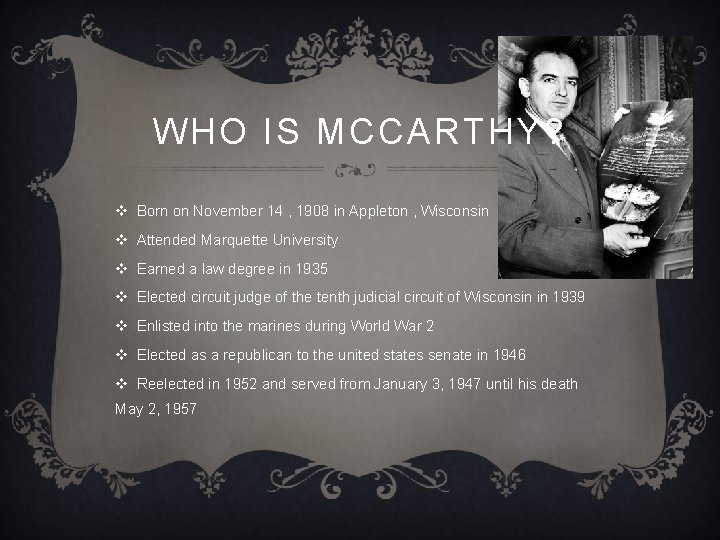
WHO IS MCCARTHY? v Born on November 14 , 1908 in Appleton , Wisconsin v Attended Marquette University v Earned a law degree in 1935 v Elected circuit judge of the tenth judicial circuit of Wisconsin in 1939 v Enlisted into the marines during World War 2 v Elected as a republican to the united states senate in 1946 v Reelected in 1952 and served from January 3, 1947 until his death May 2, 1957

WHAT IS MCCARTHYISM v Mc. Carthyism was a political practice of accusing people of tension of anti government activities. v It was named under the Era of Joe Mc. Carthy v The term had its origins in the period in the U. S. known as the second Red Scare , and lasted 1950 – 1956. v Mc. Carthyism was a widespread social and cultural phenomenon that affected all levels of society.

CONNECTION v The second Red Scare occurred after World War II and was popularly known as “Mc. Carthyism” v Both the Crucible/ Salem and Mc. Carthyism are connected because they allowed both communities to have hysteria be spread without proof of wrong doing v Both communities allowed bad things to happen to good, innocent people. v Mc. Carthyism started because of the Red Scare

ANTICOMMUNIST/ COMMUNIST v By the 1930’s communism had become an attractive economic ideology in the U. S v The communist party in the U. S increased it membership with a peak of 75, 000 members v Postwar anti-communist were rooted even more directly in the political culture of the 1930’s v Joseph Mc. Carthy became the person most closely associated with the anti-communist crusade.

THE EFFECT ON PEOPLE v Lost jobs v Innocent people were being prosecuted by their own country v Kids at school were being out casted v People were violating constitutional rights v Deportations of innocent people v Women’s suffrage associations were weakened
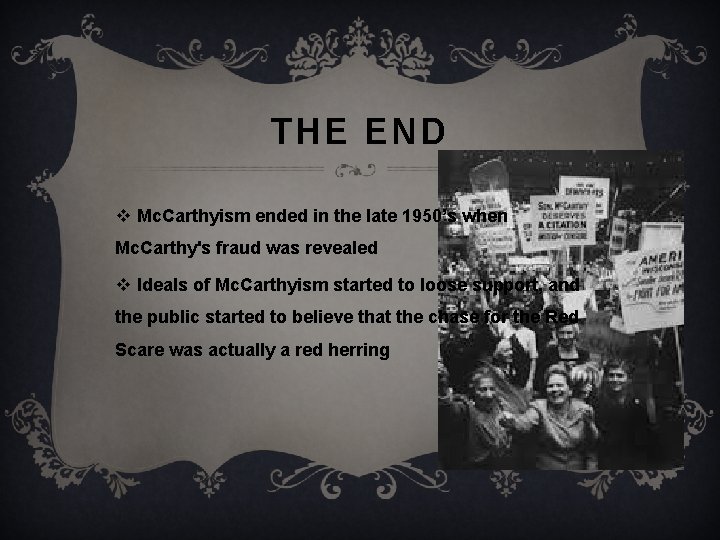
THE END v Mc. Carthyism ended in the late 1950’s when Mc. Carthy's fraud was revealed v Ideals of Mc. Carthyism started to loose support, and the public started to believe that the chase for the Red Scare was actually a red herring
- Slides: 9