
1929 1940 The Great Depression Great Depression I

- Slides: 79
1929 -1940 The Great Depression
Great Depression I Can Statements I can identify & explain the economic factors that contributed to the stock market crash of 1929 & the Great Depression. I can explain the economic, environmental, & social impact of the Great Depression on American society. I can evaluate the impact of the New Deal on various elements of American society.
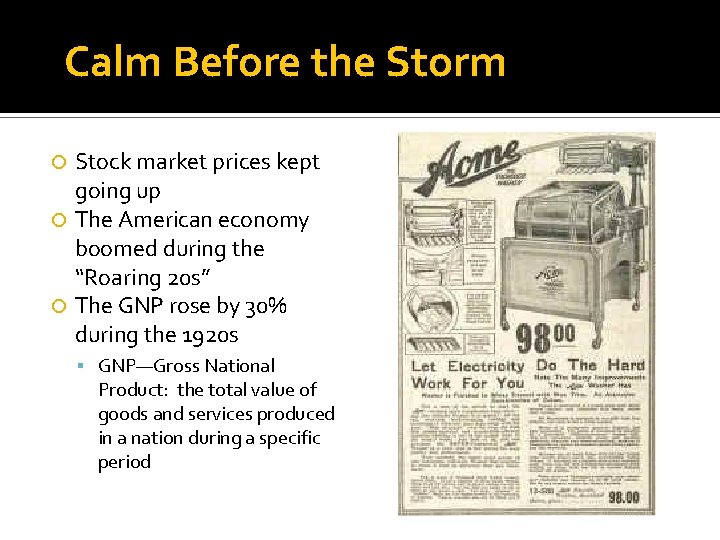
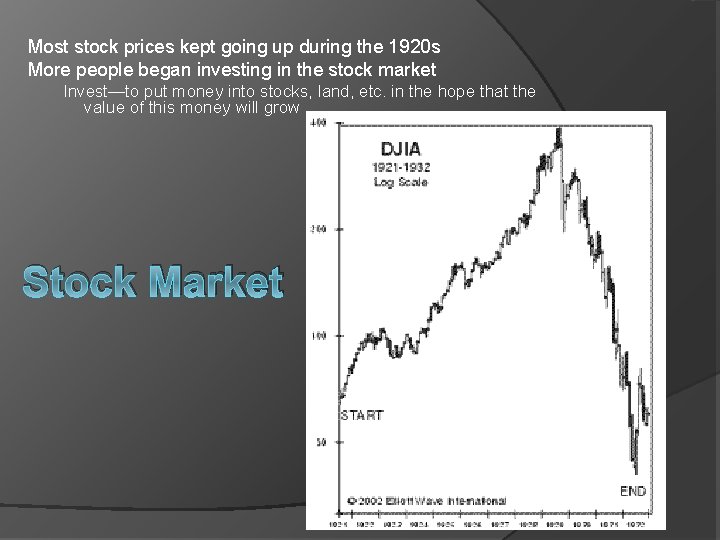
Calm Before the Storm Stock market prices kept going up The American economy boomed during the “Roaring 20 s” The GNP rose by 30% during the 1920 s GNP—Gross National Product: the total value of goods and services produced in a nation during a specific period
Automobile industry Helped drive the economy 1929, 1 in 5 Americans owned a car Related industries (steel, oil, rubber) also thrived Automobile & related industries employed 4 million workers Unemployment very low Averaged around 3% between 1923 & 1929
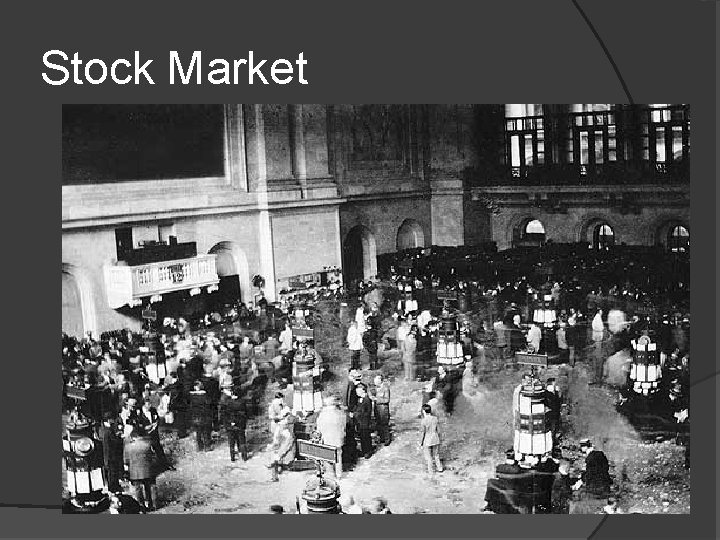
Stock Market Place were stocks are bought & sold Stock—ownership in a company & it is sold in shares A person buys a piece of a corporation by buying shares of stock If a corporation does well, the value of its stock goes up If a corporation does badly, the value of its stock goes down
Stock Market
Most stock prices kept going up during the 1920 s More people began investing in the stock market Invest—to put money into stocks, land, etc. in the hope that the value of this money will grow Stock Market
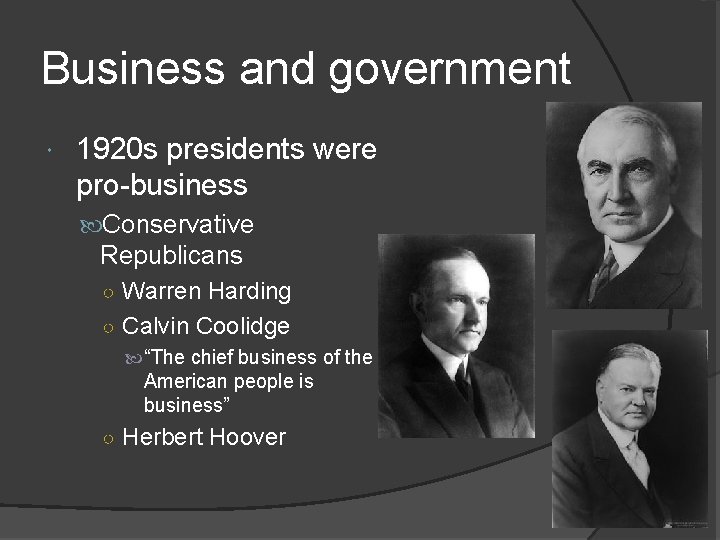
Business and government 1920 s presidents were pro-business Conservative Republicans ○ Warren Harding ○ Calvin Coolidge “The chief business of the American people is business” ○ Herbert Hoover
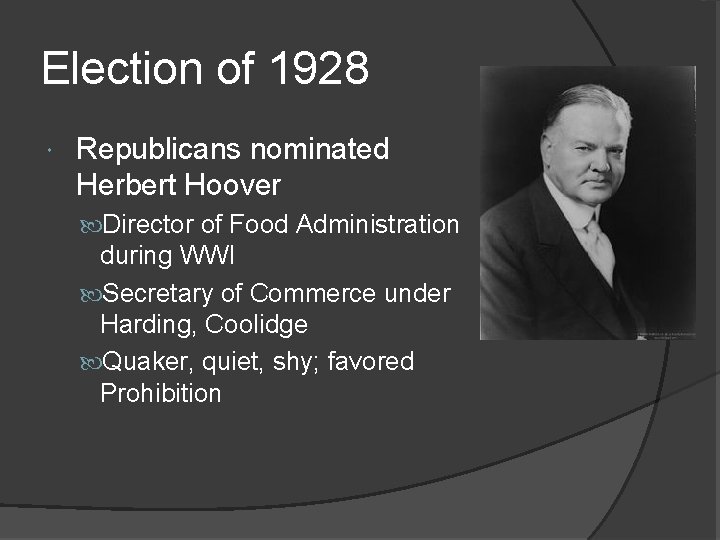
Election of 1928 Republicans nominated Herbert Hoover Director of Food Administration during WWI Secretary of Commerce under Harding, Coolidge Quaker, quiet, shy; favored Prohibition
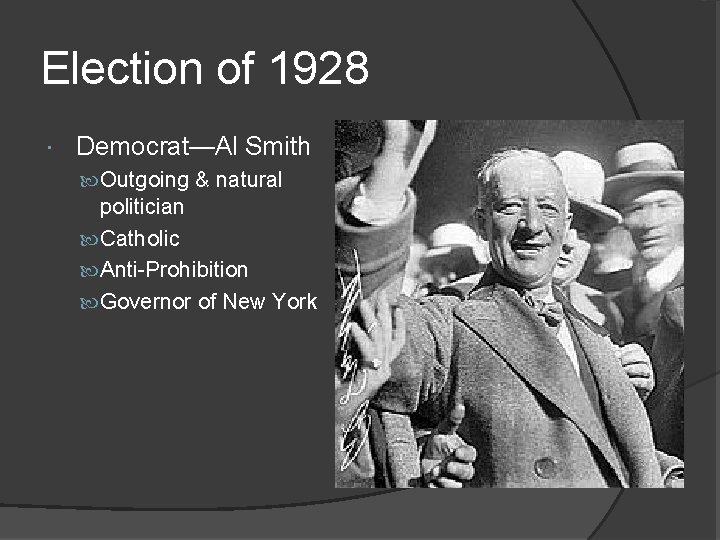
Election of 1928 Democrat—Al Smith Outgoing & natural politician Catholic Anti-Prohibition Governor of New York
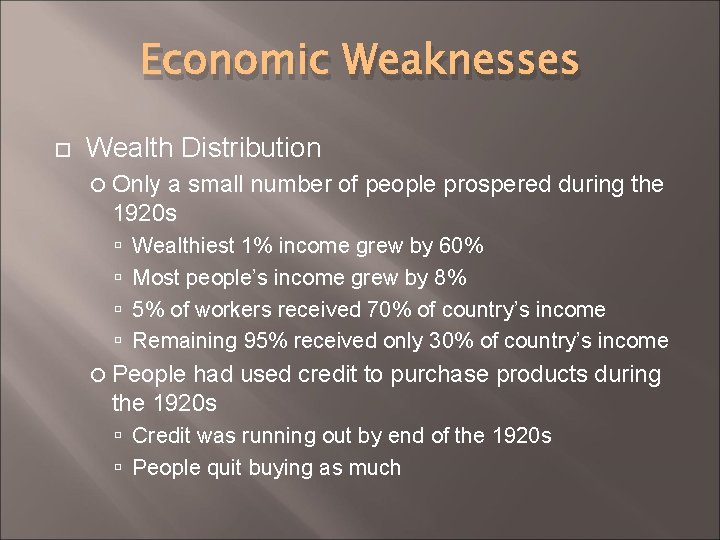
Economic Weaknesses Wealth Distribution Only a small number of people prospered during the 1920 s Wealthiest 1% income grew by 60% Most people’s income grew by 8% 5% of workers received 70% of country’s income Remaining 95% received only 30% of country’s income People had used credit to purchase products during the 1920 s Credit was running out by end of the 1920 s People quit buying as much
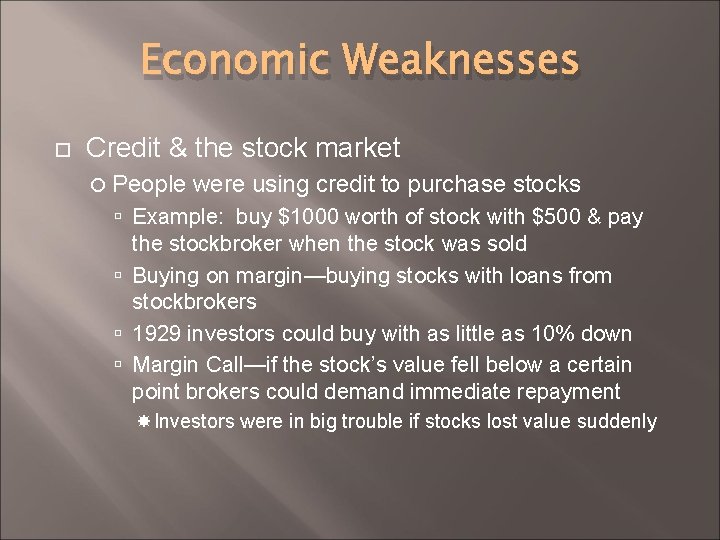
Economic Weaknesses Credit & the stock market People were using credit to purchase stocks Example: buy $1000 worth of stock with $500 & pay the stockbroker when the stock was sold Buying on margin—buying stocks with loans from stockbrokers 1929 investors could buy with as little as 10% down Margin Call—if the stock’s value fell below a certain point brokers could demand immediate repayment Investors were in big trouble if stocks lost value suddenly
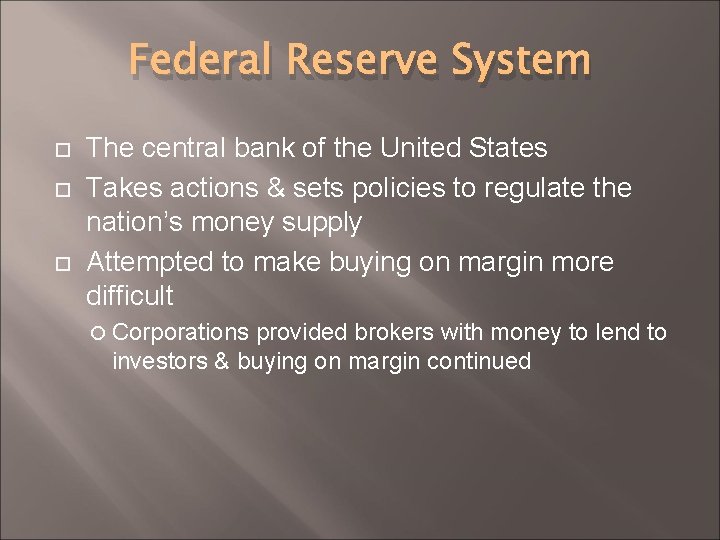
Federal Reserve System The central bank of the United States Takes actions & sets policies to regulate the nation’s money supply Attempted to make buying on margin more difficult Corporations provided brokers with money to lend to investors & buying on margin continued
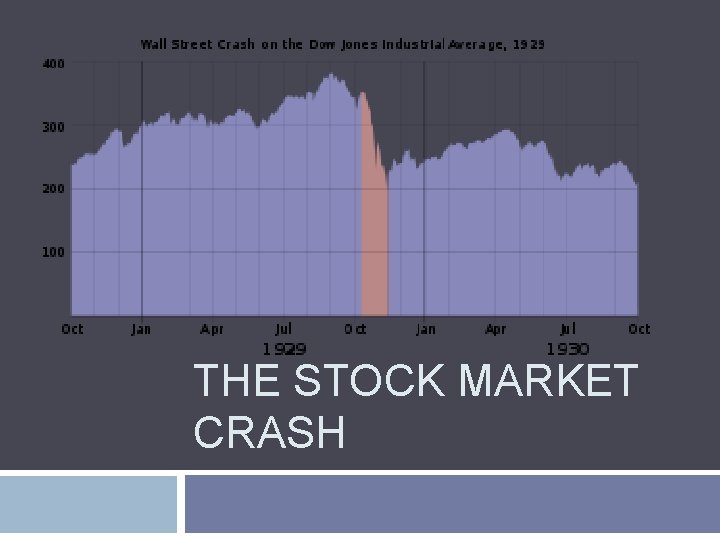
THE STOCK MARKET CRASH
Stock Market Crash Stock market value increased a lot 50% gain in 1928; 27% in 1929 Some saw signs of trouble Sales of manufactured goods were sagging Rumors that big investors were ready to pull out Fears that stock prices could soon collapse Thursday, October 24, 1929 Black Thursday Investors began selling, others joined, a huge selloff began & stock prices plunged
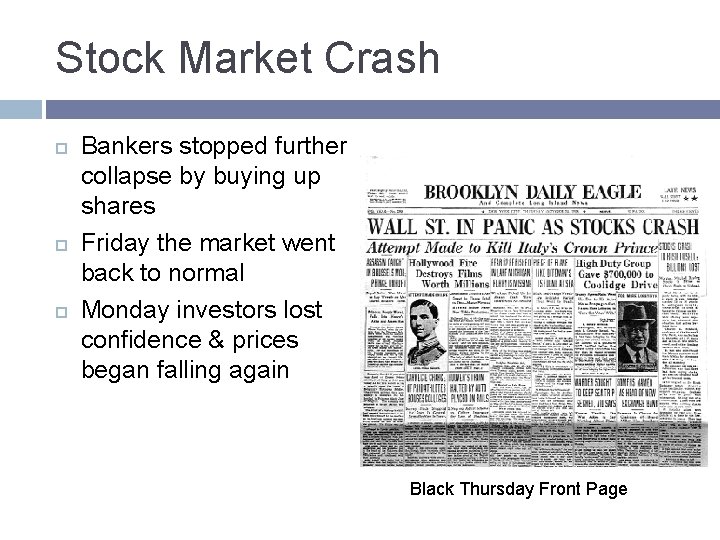
Stock Market Crash Bankers stopped further collapse by buying up shares Friday the market went back to normal Monday investors lost confidence & prices began falling again Black Thursday Front Page
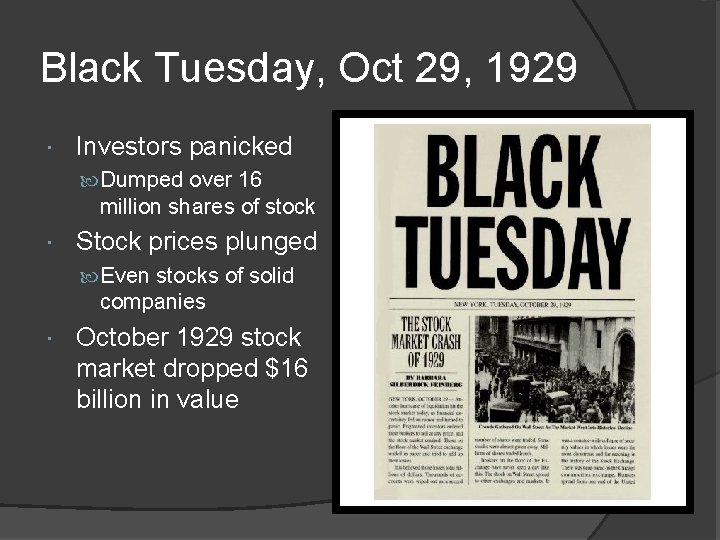
Black Tuesday, Oct 29, 1929 Investors panicked Dumped over 16 million shares of stock Stock prices plunged Even stocks of solid companies October 1929 stock market dropped $16 billion in value
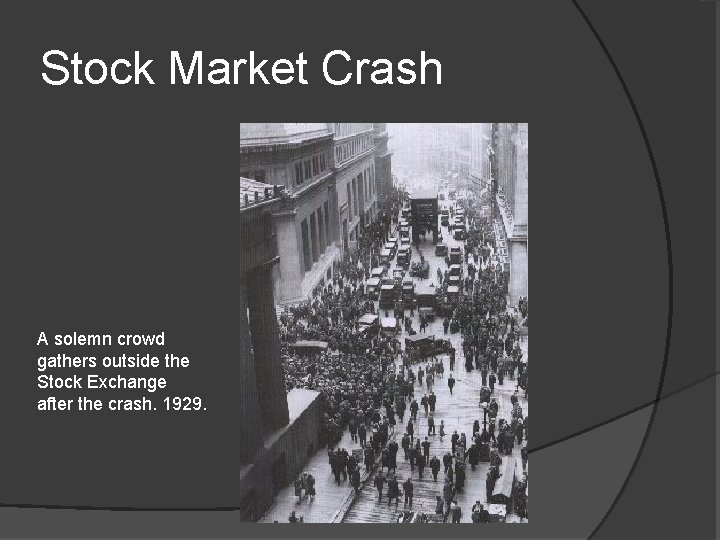
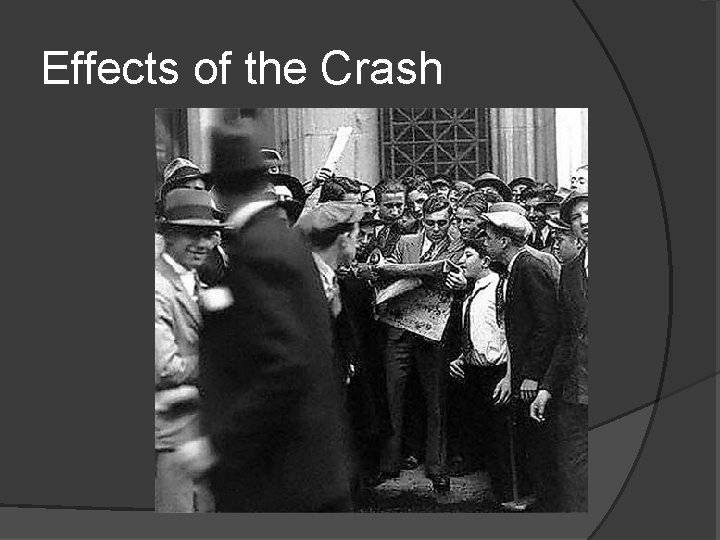
Stock Market Crash A solemn crowd gathers outside the Stock Exchange after the crash. 1929.
Effects of the Crash
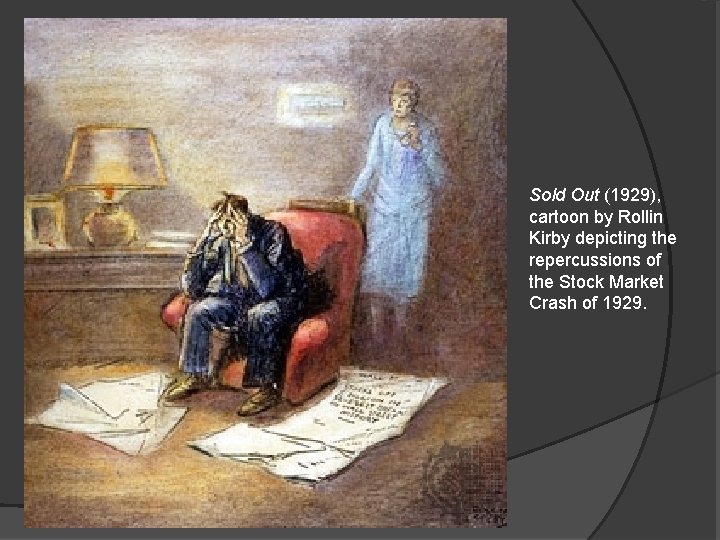
Sold Out (1929), cartoon by Rollin Kirby depicting the repercussions of the Stock Market Crash of 1929.
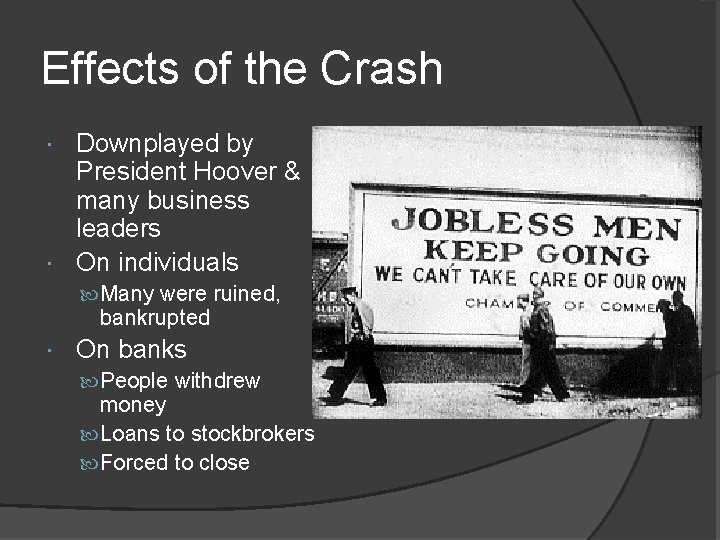
Effects of the Crash Downplayed by President Hoover & many business leaders On individuals Many were ruined, bankrupted On banks People withdrew money Loans to stockbrokers Forced to close
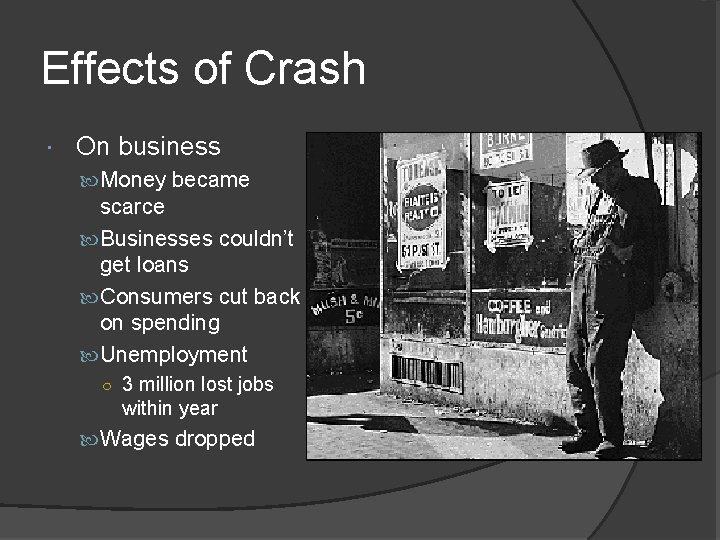
Effects of Crash On business Money became scarce Businesses couldn’t get loans Consumers cut back on spending Unemployment ○ 3 million lost jobs within year Wages dropped
Effects of the crash Overseas Hurt WWI weakened economies American banks called in loans from WWI US & other countries raised tariffs to protect businesses ○ Tariffs actually made things worse World trade declined
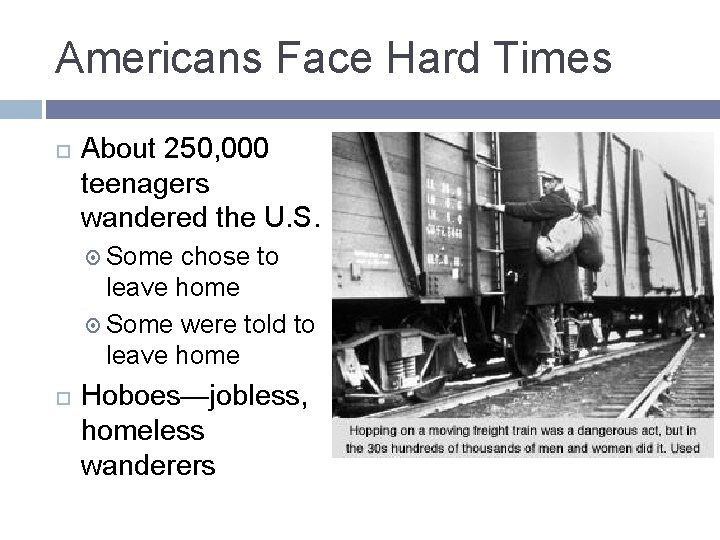
Americans Face Hard Times About 250, 000 teenagers wandered the U. S. Some chose to leave home Some were told to leave home Hoboes—jobless, homeless wanderers
Tramps in the Woods
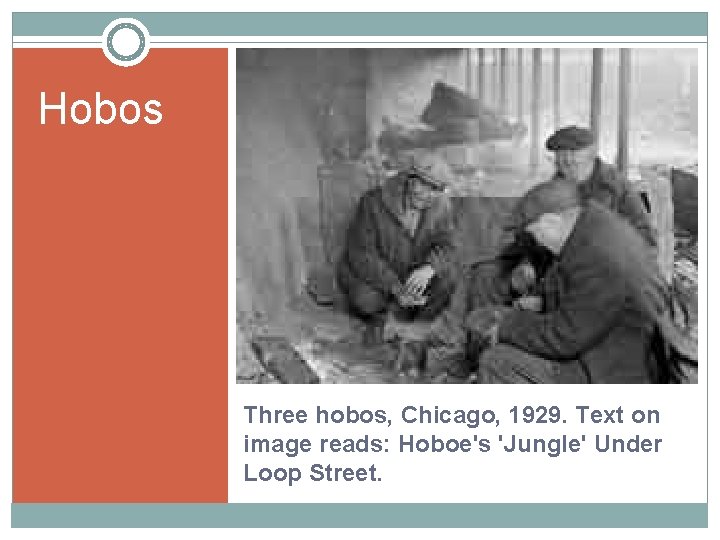
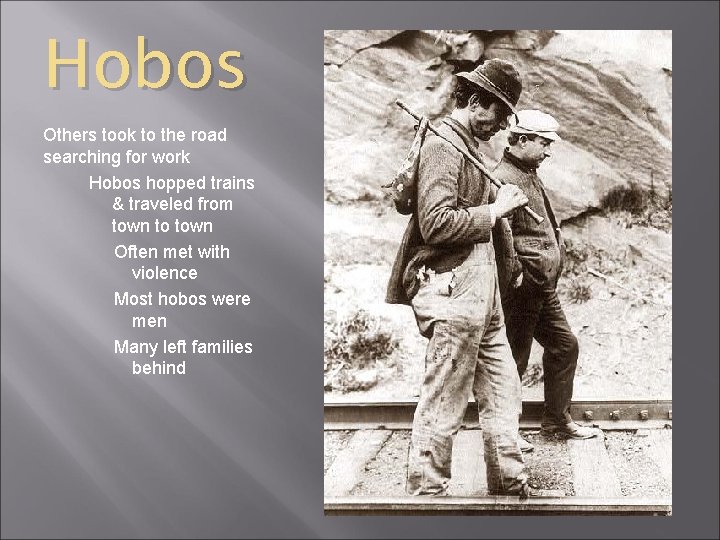
Hobos Three hobos, Chicago, 1929. Text on image reads: Hoboe's 'Jungle' Under Loop Street.
Man in hobo jungle killing turtle to make soup, Minneapolis, Minnesota. Sept. 1939
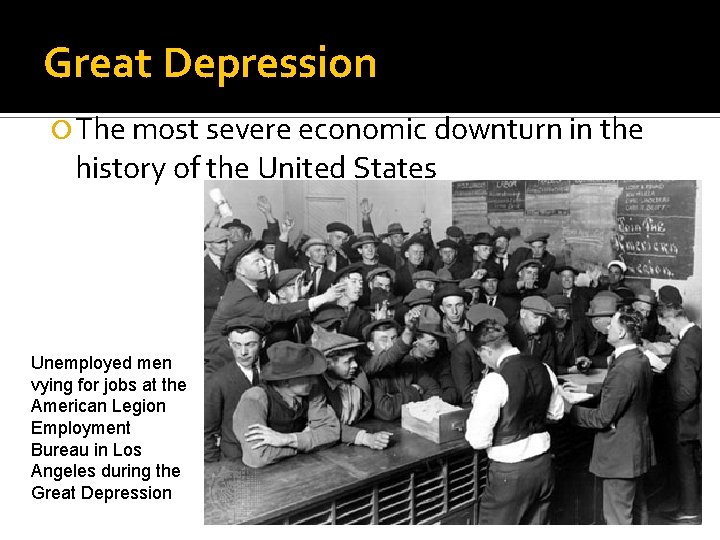
Great Depression The most severe economic downturn in the history of the United States Unemployed men vying for jobs at the American Legion Employment Bureau in Los Angeles during the Great Depression
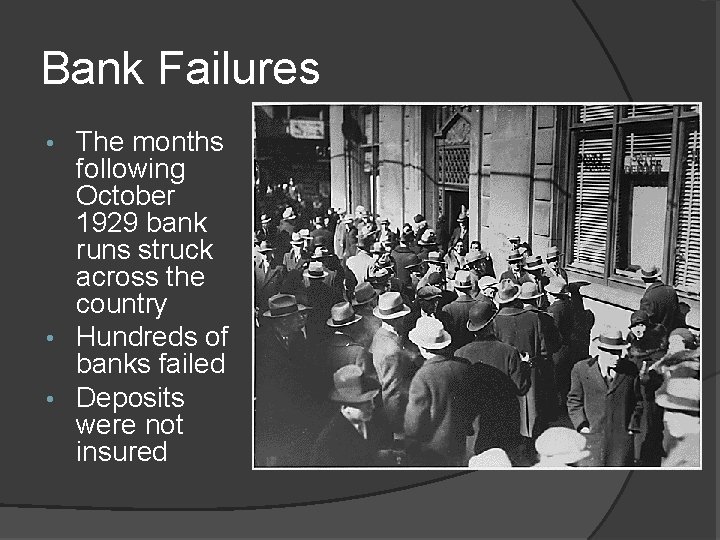
Bank Failures The months following October 1929 bank runs struck across the country • Hundreds of banks failed • Deposits were not insured •
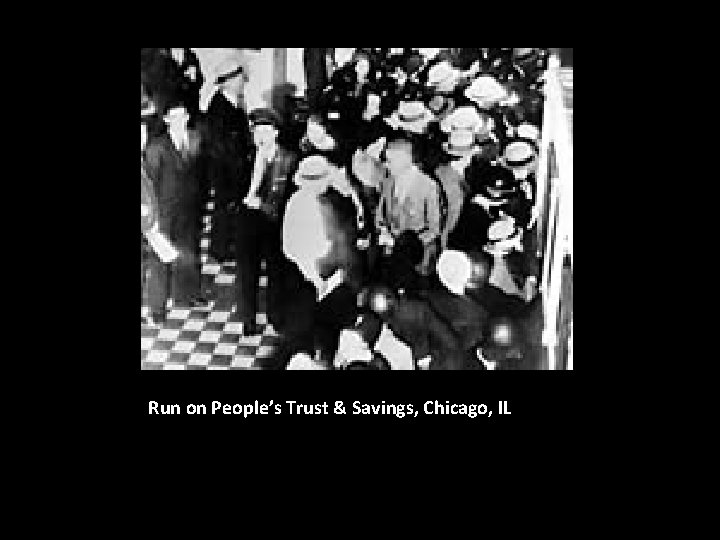
Run on People’s Trust & Savings, Chicago, IL
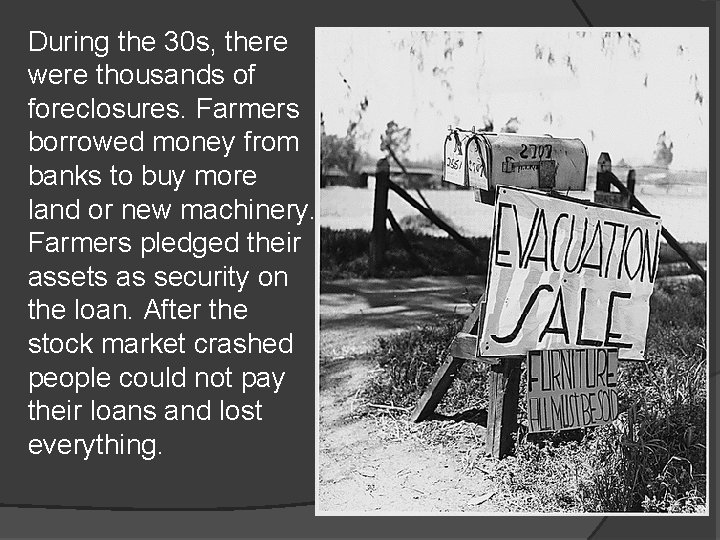
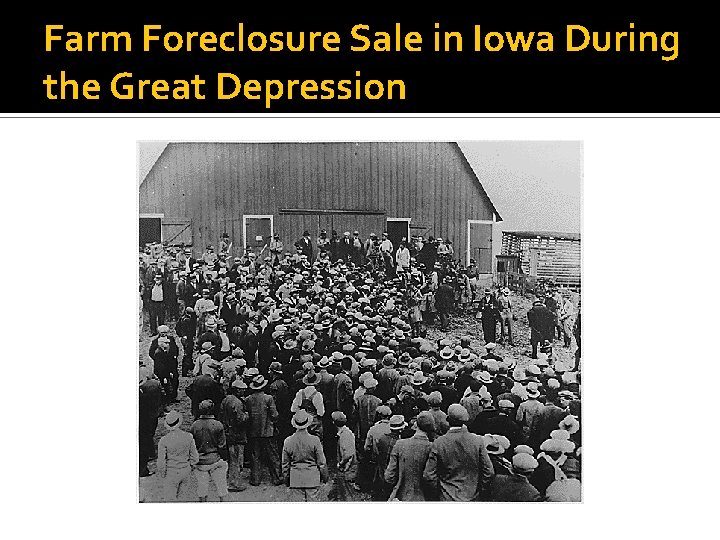
Farm Failures Farm prices dropped Lower income for farmers Farmers unable to repay loans 1933 alone 364, 000 farms bankrupt or foreclosed Foreclosure—when a bank takes over ownership of a property from an owner who has failed to make loan payments
During the 30 s, there were thousands of foreclosures. Farmers borrowed money from banks to buy more land or new machinery. Farmers pledged their assets as security on the loan. After the stock market crashed people could not pay their loans and lost everything.
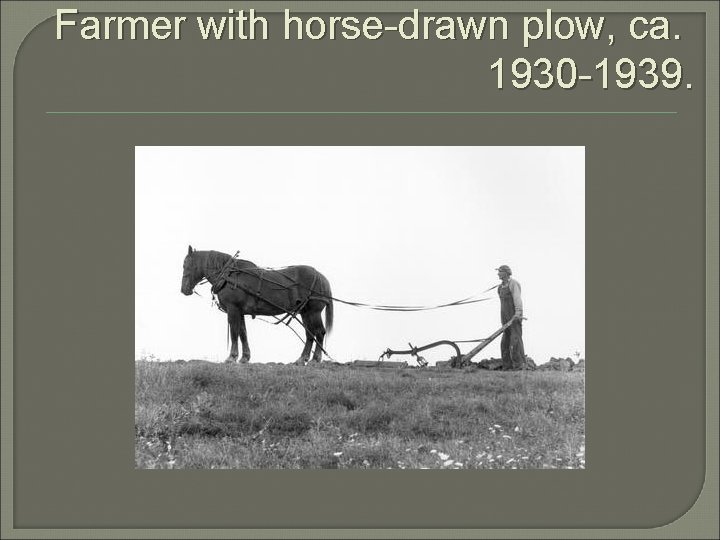
Farmer with horse-drawn plow, ca. 1930 -1939.
Farm Foreclosure Sale in Iowa During the Great Depression
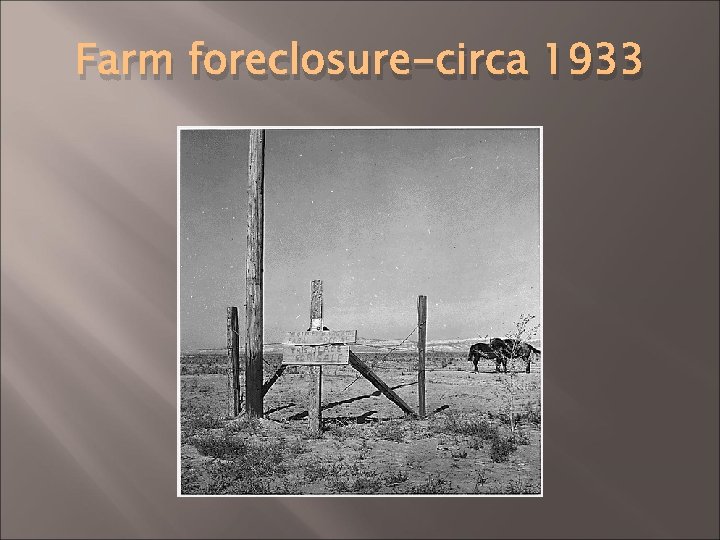
Farm foreclosure-circa 1933
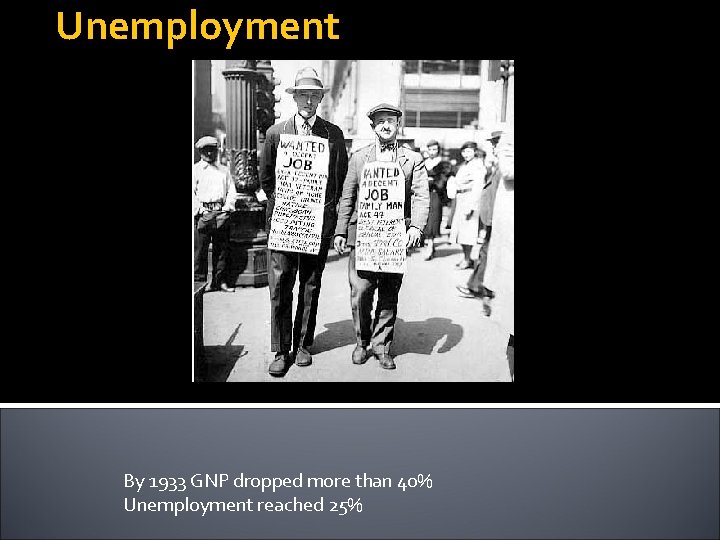
Unemployment By 1933 GNP dropped more than 40% Unemployment reached 25%
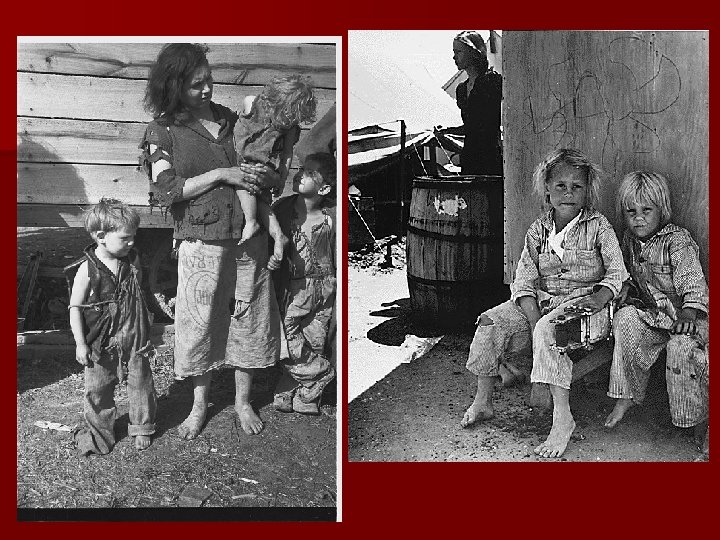
Human Impact of the Great Depression Competition for jobs was fierce Without jobs people slid into poverty People begged People lost their homes
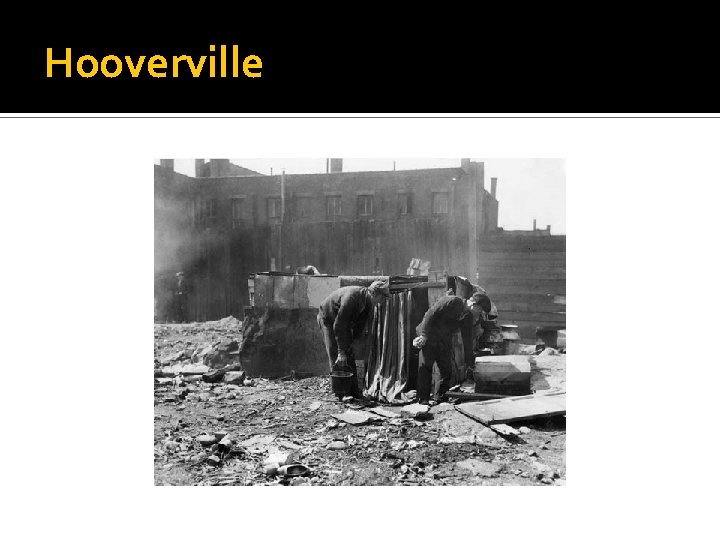
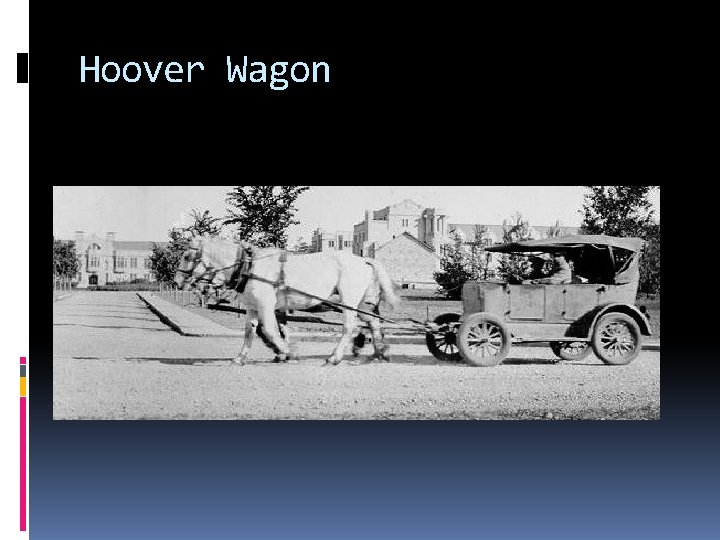
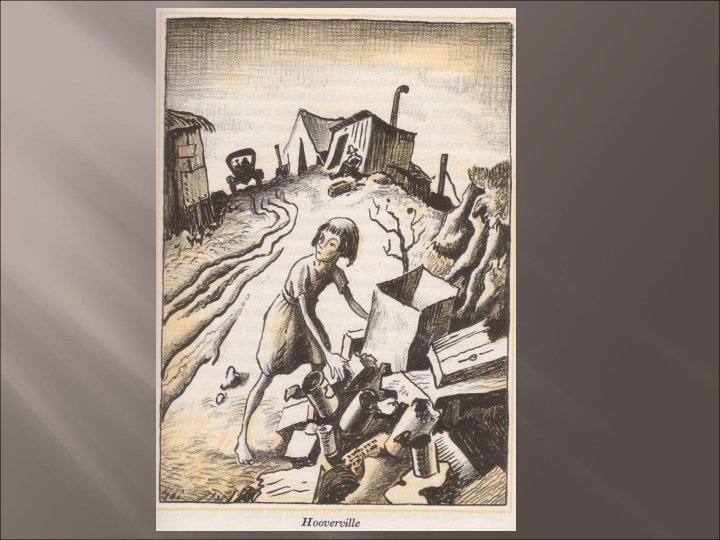
Upset at Hoover, people began to give items that represented the economic crisis negative nicknames. Hoovervilles—shantytowns; neighborhoods of shacks on the outskirts of towns or in public parks "Hoover blankets" were newspapers that homeless people used to protect themselves from the cold. "Hoover flags" were pants pockets that had been turned inside out, symbolizing a lack of money. "Hoover wagons" were old cars pulled by horses since their owners could no longer pay for gas. "Hoover leather" was cardboard used to line a shoe with the sole worn through.
Hooverville
Hoover Wagon
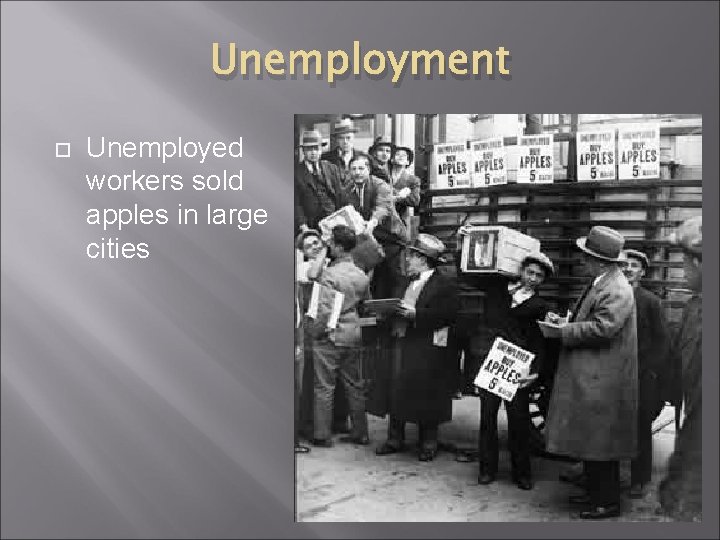
Unemployment Unemployed workers sold apples in large cities
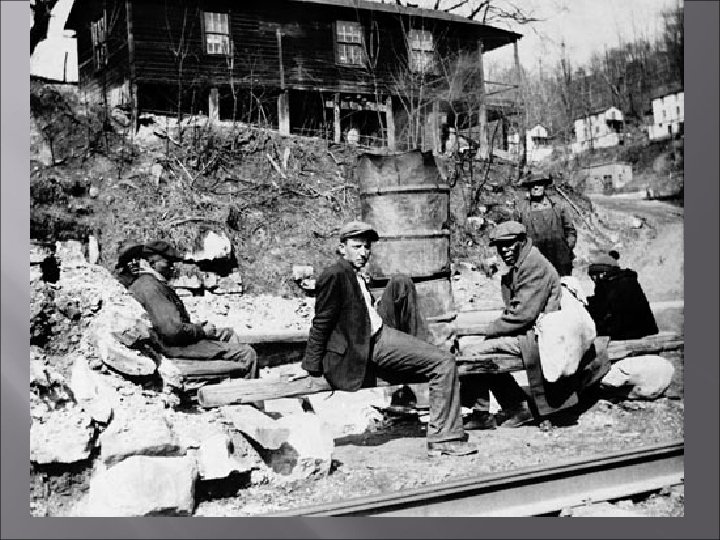
Hobos Others took to the road searching for work Hobos hopped trains & traveled from town to town Often met with violence Most hobos were men Many left families behind
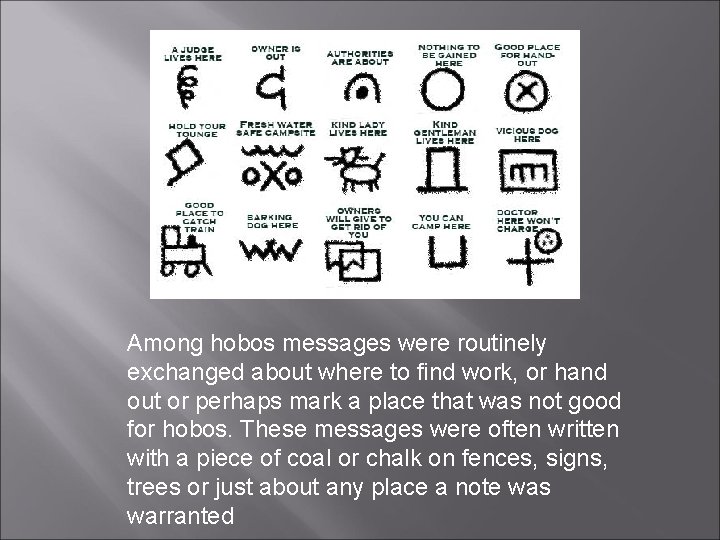
Among hobos messages were routinely exchanged about where to find work, or hand out or perhaps mark a place that was not good for hobos. These messages were often written with a piece of coal or chalk on fences, signs, trees or just about any place a note was warranted
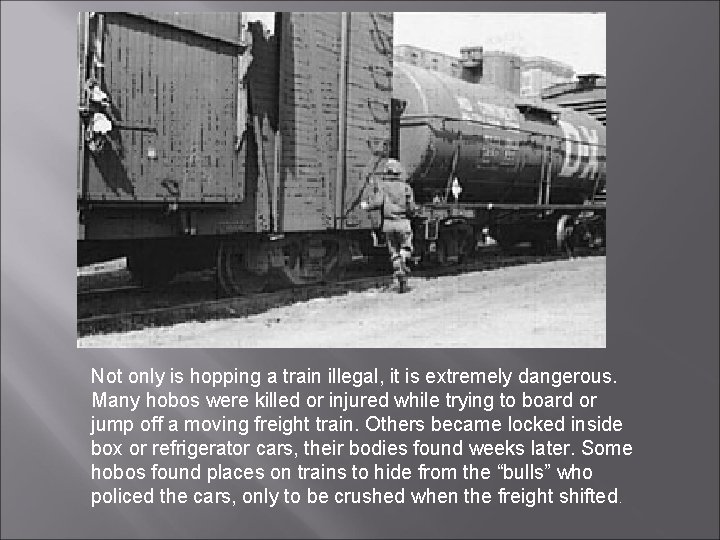
Not only is hopping a train illegal, it is extremely dangerous. Many hobos were killed or injured while trying to board or jump off a moving freight train. Others became locked inside box or refrigerator cars, their bodies found weeks later. Some hobos found places on trains to hide from the “bulls” who policed the cars, only to be crushed when the freight shifted.
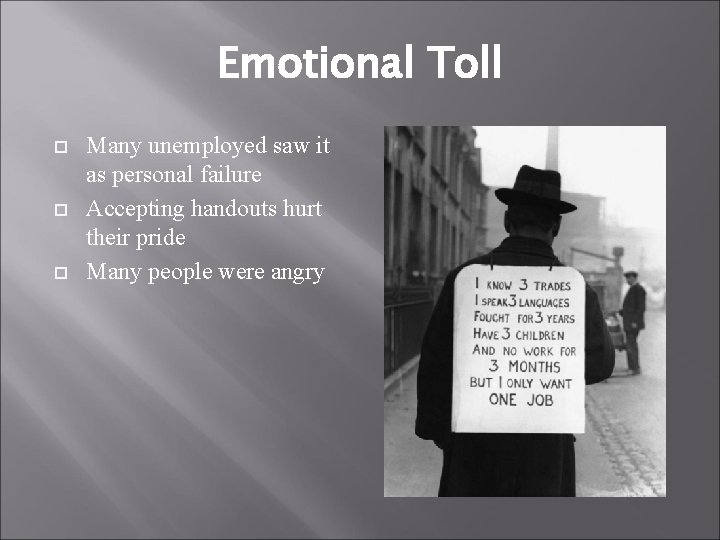
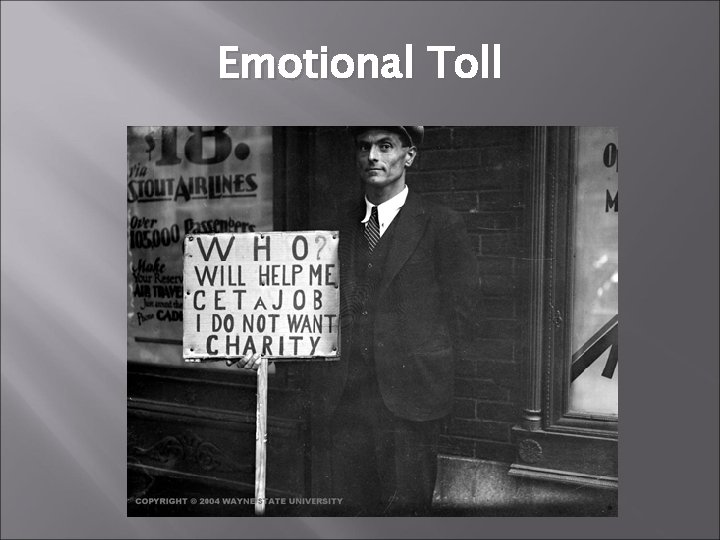
Emotional Toll Many unemployed saw it as personal failure Accepting handouts hurt their pride Many people were angry
Emotional Toll
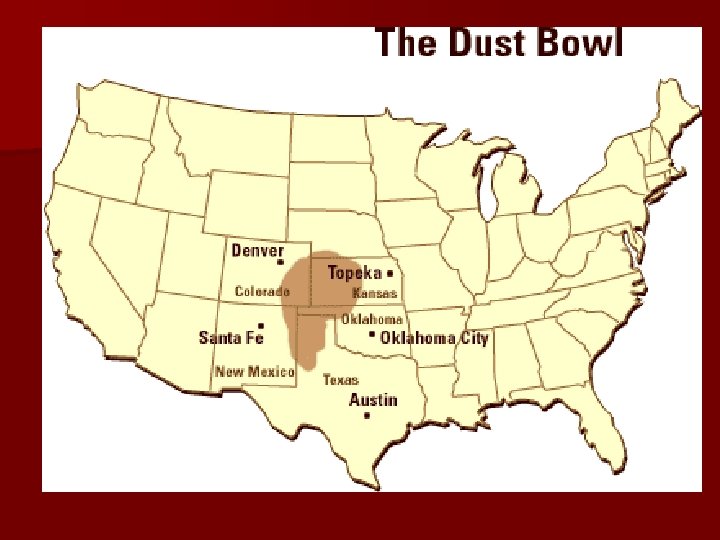
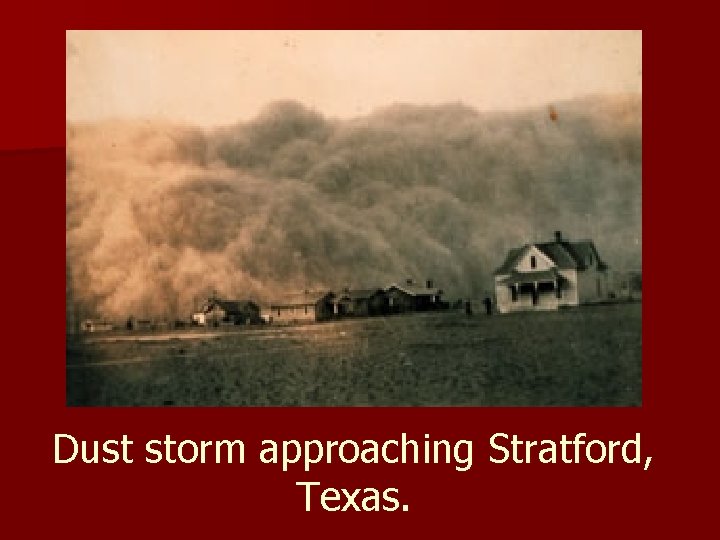
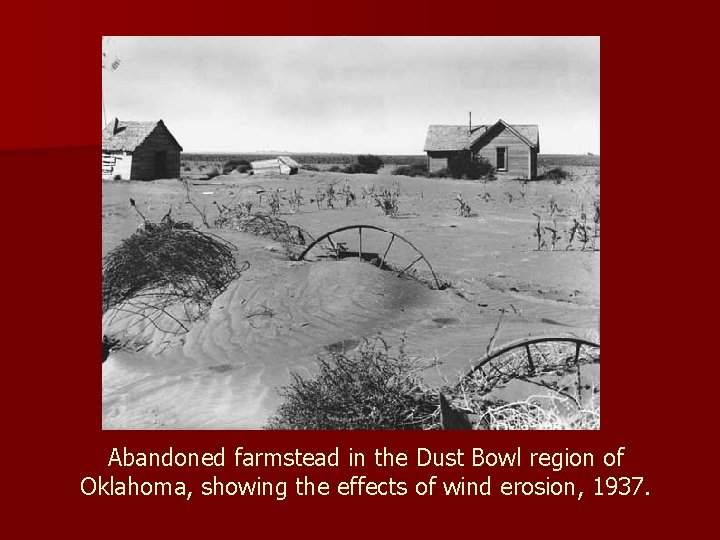
Dust Bowl n 1931 Great Plains region had a drought which lasted several years – Drought—period of below-average rainfall n Careless farming practices made the impact of the drought worse – Topsoil was exposed & the winds blew it away – Created huge dust storms n Dust Bowl—Oklahoma, Kansas, Colorado, New Mexico, & Texas hardest hit areas
Dust storm approaching Stratford, Texas.
Abandoned farmstead in the Dust Bowl region of Oklahoma, showing the effects of wind erosion, 1937.
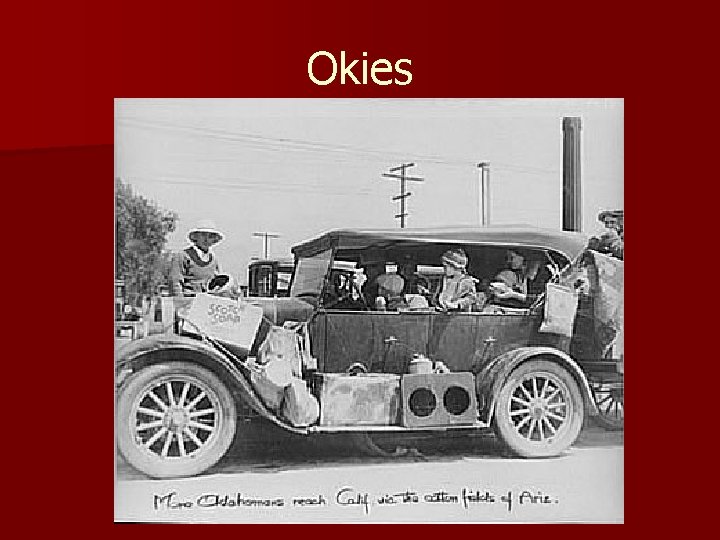
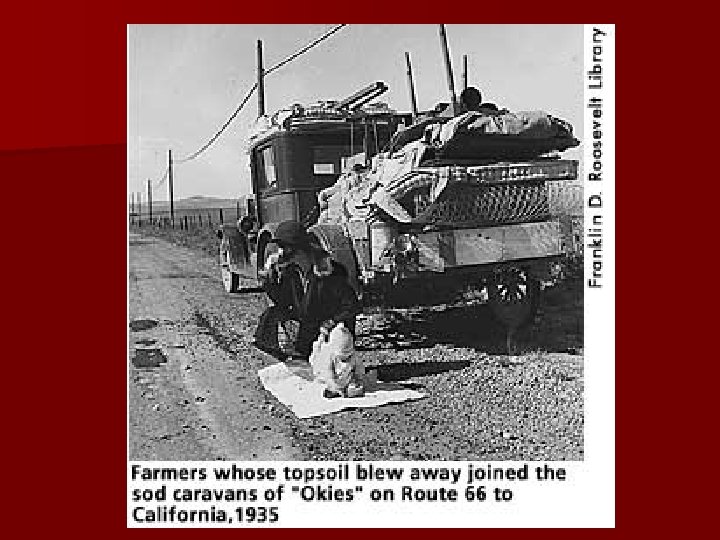
Fleeing the Plains n Drought & dust storms robbed farmers of their livelihood n Many packed up & left – 2. 5 million by end of the 1930 s – Many along Route 66 to California – Okies—nickname given to the migrants Inaccurate, they came from many states Meant to be derogatory & insulting – Okies were not welcome
Okies
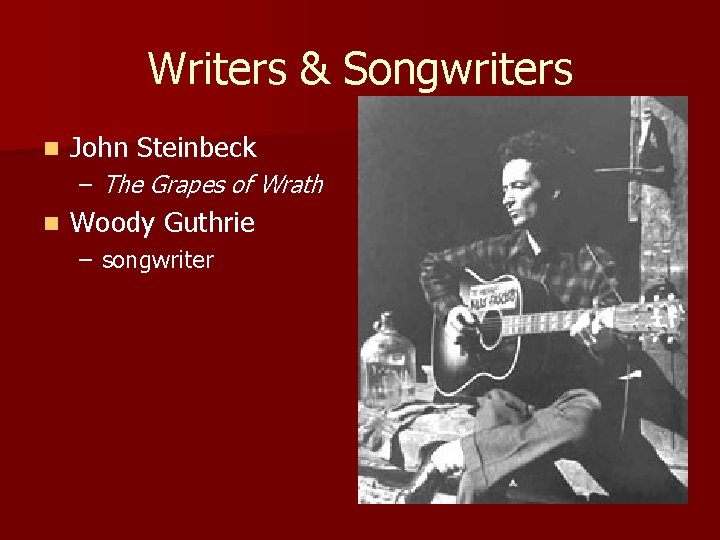
Writers & Songwriters n John Steinbeck – The Grapes of Wrath n Woody Guthrie – songwriter
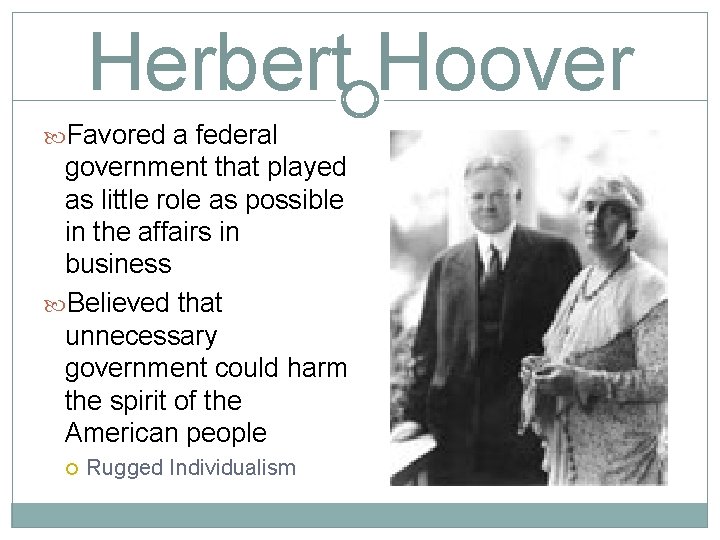
Herbert Hoover Favored a federal government that played as little role as possible in the affairs in business Believed that unnecessary government could harm the spirit of the American people Rugged Individualism
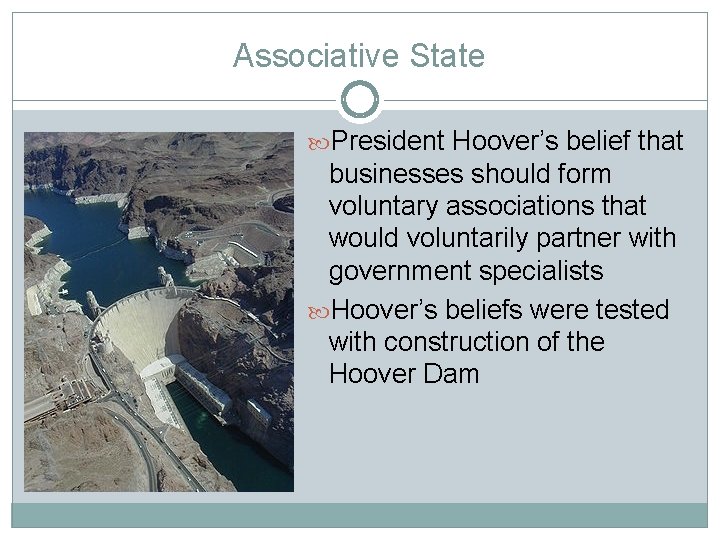
Associative State President Hoover’s belief that businesses should form voluntary associations that would voluntarily partner with government specialists Hoover’s beliefs were tested with construction of the Hoover Dam
Hoover’s Response to the Great Depression Believed government should not provide direct aid, but help people help themselves Before the Crash, he pushed for a loan program to assist farmers in forming cooperatives Cooperative—an organization that is owned & controlled by its members who work together for a common goal After the Crash, he urged business leaders & government leaders not to lay off workers or cut wages
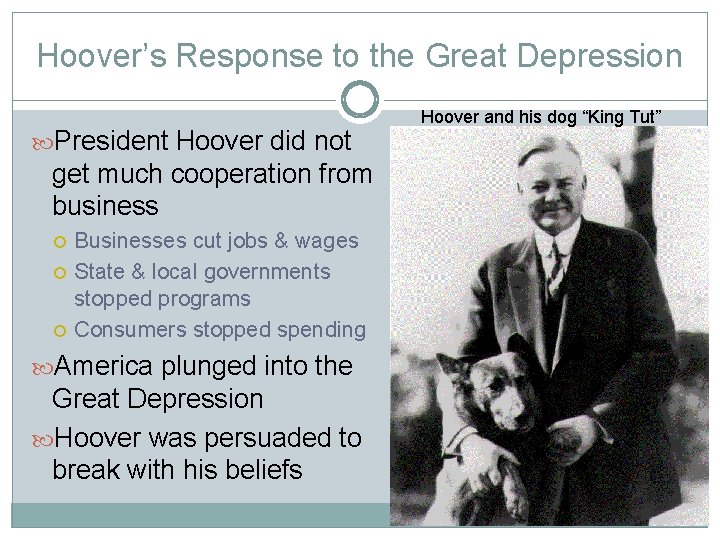
Hoover’s Response to the Great Depression President Hoover did not get much cooperation from business Businesses cut jobs & wages State & local governments stopped programs Consumers stopped spending America plunged into the Great Depression Hoover was persuaded to break with his beliefs Hoover and his dog “King Tut”
Direct Action 1932 Hoover persuades Congress to create: Reconstruction Finance Corporation (RFC) $2 billion in direct government loans to banks, insurance companies, & other institutions Federal Home Loan Bank Encouraged home building & reduced foreclosures Historic expansion of role of federal government Many people thought it too little, too late
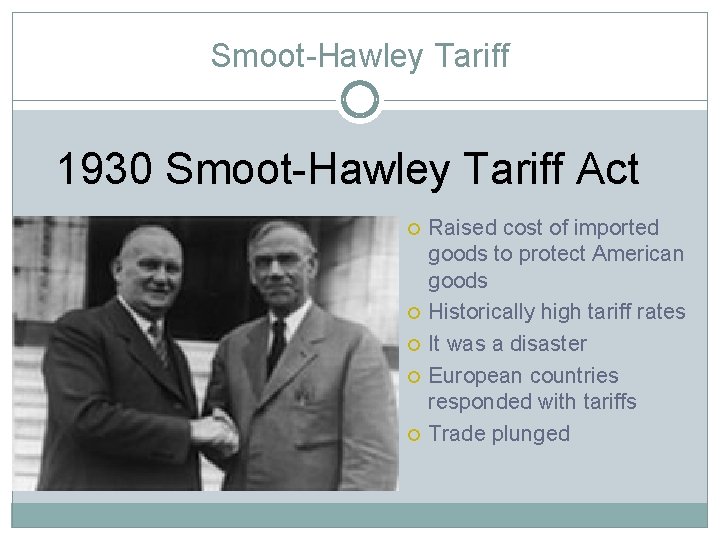
Smoot-Hawley Tariff 1930 Smoot-Hawley Tariff Act Raised cost of imported goods to protect American goods Historically high tariff rates It was a disaster European countries responded with tariffs Trade plunged
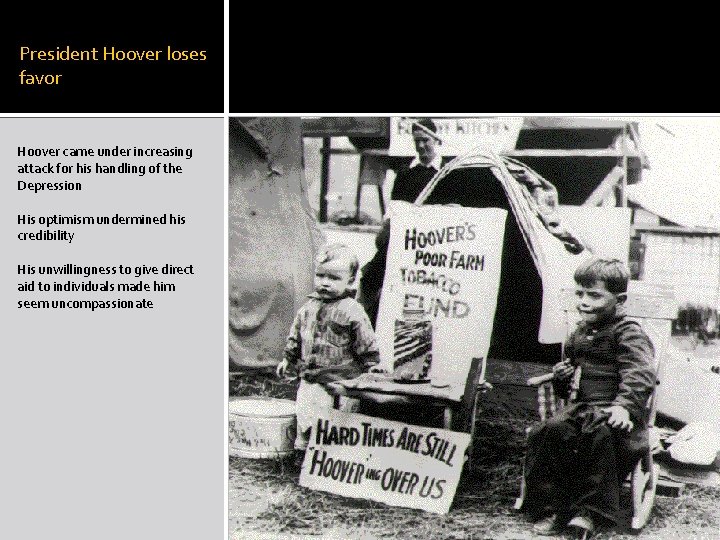
President Hoover loses favor Hoover came under increasing attack for his handling of the Depression His optimism undermined his credibility His unwillingness to give direct aid to individuals made him seem uncompassionate
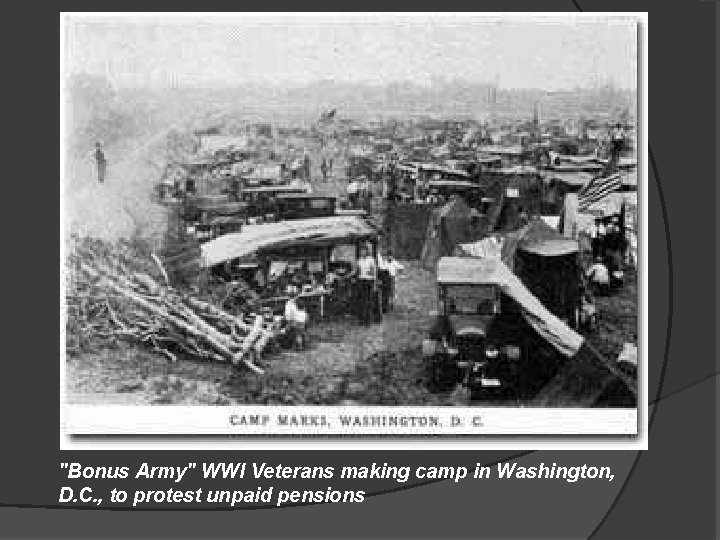
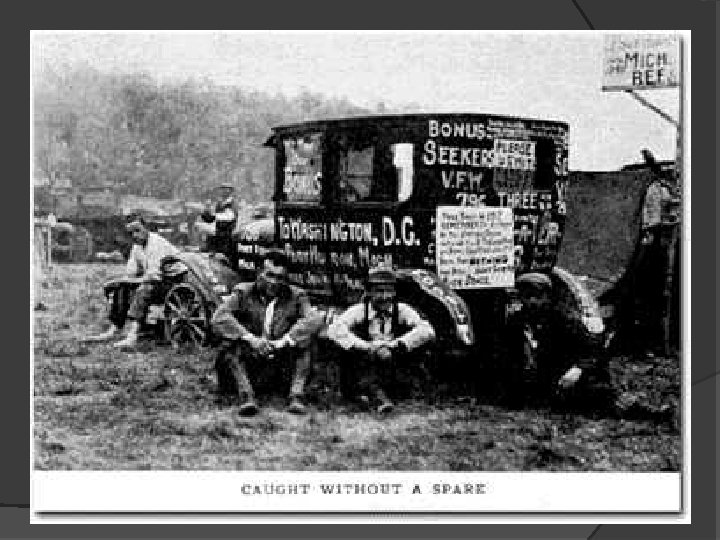
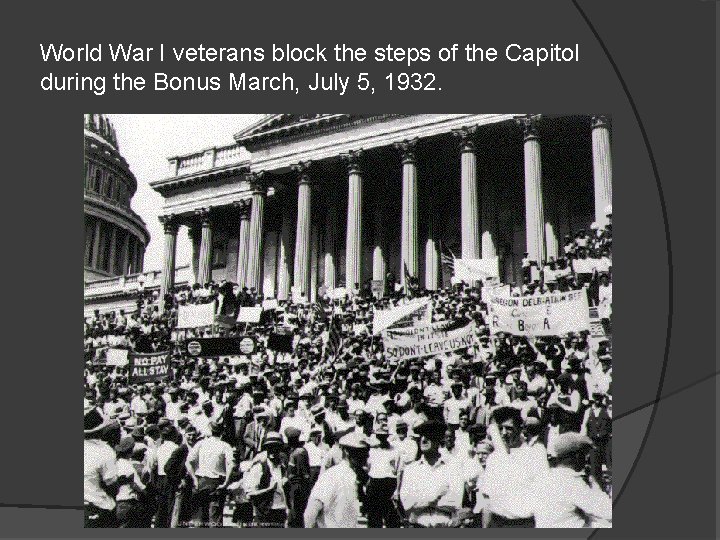
Bonus Army March—May 1932 15, 000 World War I veterans in Washington, D. C. Asking for early payment of WWI bonus ○ $1. 25 for each day overseas ○ Supposed to receive in 1945 Set up a huge camp near the Capital Congress refused their demands Many veterans remained
"Bonus Army" WWI Veterans making camp in Washington, D. C. , to protest unpaid pensions
World War I veterans block the steps of the Capitol during the Bonus March, July 5, 1932.
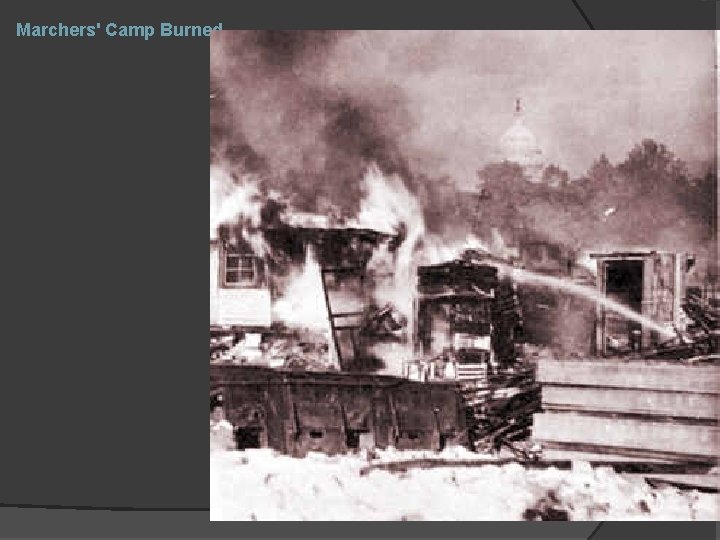
Bonus Army March July 1932, Hoover ordered the army to remove the veterans Violence erupted Camp caught on fire Two veterans were killed Hundreds were wounded Americans were disturbed by the incident
Marchers' Camp Burned
The break-up of the Bonus Army in Washington was conducted by Army Chief of Staff and World War I veteran Douglas Mac. Arthur, assisted by Majors George Patton and Dwight Eisenhower. Mac. Arthur is considered to have exceeded President Hoover's intentions [and possibly his explicit instructions] with his heavy-handedness.
1930 midterm congressional elections Democrats won a majority of the House It was certain Hoover would be defeated in 1932 Hoover didn’t even campaign until October