
1920 s THE REPUBLICAN PRESIDENTS 20 s WARREN
1920 s
THE REPUBLICAN PRESIDENTS (20 s) WARREN G. HARDING -Sought a “return to normalcy” after WWI -Teapot Dome Scandal and others CALVIN COOLIDGE -No right to strike against the public safety -Believed business of America is business HERBERT HOOVER -Engineer who organized food production in World War I; Secretary of Commerce -As President, predicted an end to poverty -Believed in “rugged individualism” -Felt government interference should be minimal in the economy
REASONS FOR PROSPERITY OF 1920 s RISE OF AUTOMOBILE -Cars allowed greater mobility to people -Model T priced at less than $300 OTHER NEW INDUSTRIES -Electricity and electric appliances -Radio, motion pictures, vacuum cleaners MORE EFFICIENT PRODUCTION TECHNIQUES -Assembly line -Standardized parts AGE OF MASS CONSUMPTION -Advertising stimulated demand _Retailers introduced installment buying

CULTURAL VALUES OF THE 1920 s ATTEMPTS TO PRESERVE TRADITIONAL VALUES PROHIBITION -18 TH Amendment banned alcoholic drinks -Social experiment was a failure. (21 st amendment ended Prohibition) Scopes “Monkey Trial” (1925) -Pitted traditional Fundamentalist values against Darwin’s Theory of Evolution -William Jennings Bryan v. Clarence Darrow New Restrictions on Immigration -Growth in nativist sentiment -Immigration Acts of 1921, 1924, 1929
EMERGENCE OF NEW VALUES IN 1920 s WOMEN -19 TH Amendment; flappers, greater independence; new morals and manners YOUTH AND LOST GENERATION -Fads: flagpole sitting, marathon dancing -Rejected desire for material wealth -Sinclair Lewis and F. Scott Fitzgerald HARLEM RENAISSANCE New optimism and growth of African-American culture -Langston Hughes: Poet and novelist -Alain Locke: Black historian -Marcus Garvey: Leader of Back to Africa Movement
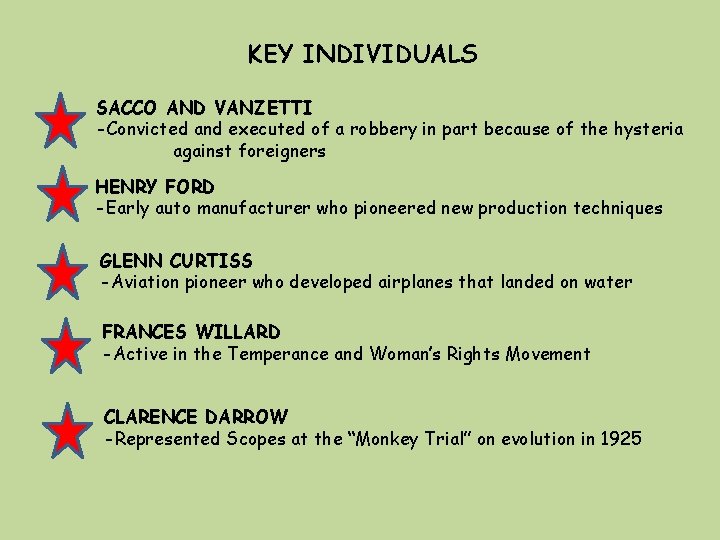
KEY INDIVIDUALS SACCO AND VANZETTI -Convicted and executed of a robbery in part because of the hysteria against foreigners HENRY FORD -Early auto manufacturer who pioneered new production techniques GLENN CURTISS -Aviation pioneer who developed airplanes that landed on water FRANCES WILLARD -Active in the Temperance and Woman’s Rights Movement CLARENCE DARROW -Represented Scopes at the “Monkey Trial” on evolution in 1925
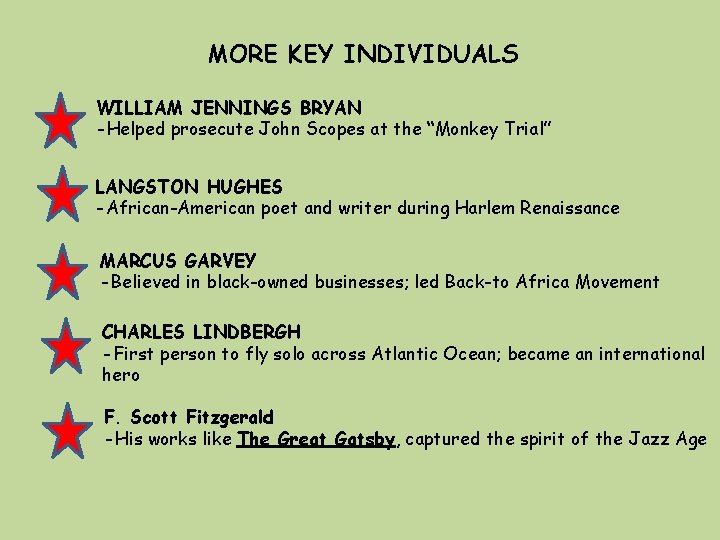
MORE KEY INDIVIDUALS WILLIAM JENNINGS BRYAN -Helped prosecute John Scopes at the “Monkey Trial” LANGSTON HUGHES -African-American poet and writer during Harlem Renaissance MARCUS GARVEY -Believed in black-owned businesses; led Back-to Africa Movement CHARLES LINDBERGH -First person to fly solo across Atlantic Ocean; became an international hero F. Scott Fitzgerald -His works like The Great Gatsby, captured the spirit of the Jazz Age
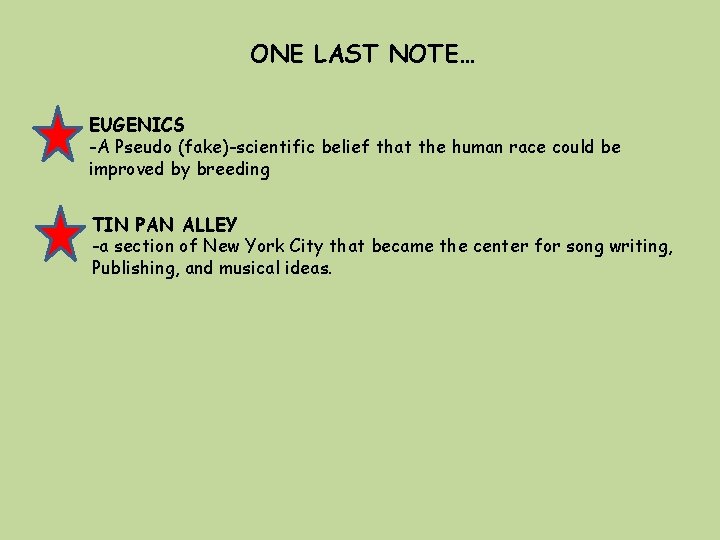
ONE LAST NOTE… EUGENICS -A Pseudo (fake)-scientific belief that the human race could be improved by breeding TIN PAN ALLEY -a section of New York City that became the center for song writing, Publishing, and musical ideas.
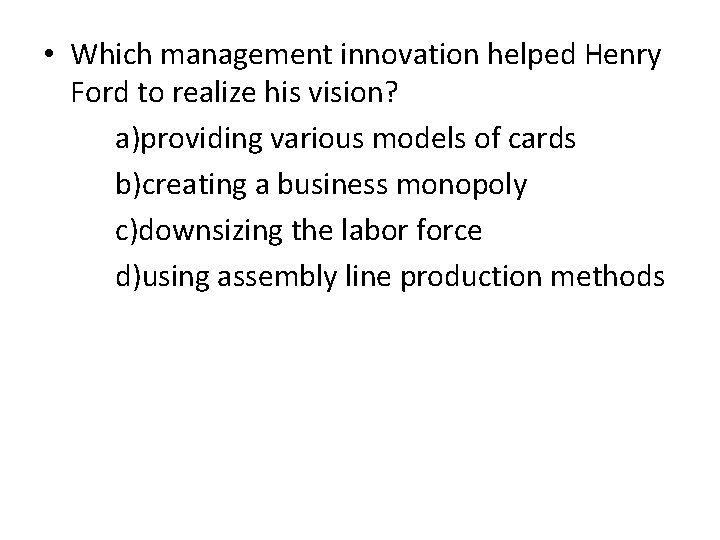
• Which management innovation helped Henry Ford to realize his vision? a)providing various models of cards b)creating a business monopoly c)downsizing the labor force d)using assembly line production methods
• The executions of Sacco and Vanzetti in the 20 s demonstrated the … a)Federal government’s war on crime b)The persistence of lynchings c)Corruption of political machines d)Increase in nativist attitudes
Prohibition, established by the 18 th amendment, stated that a)Only imported alcoholic beverages could be sold b)The manufacture and sale of alcoholic beverages was banned c)Americans must be 21 to purchase alcohol d)Alcohol could be sold in government-run stores only
• The location of music publishing industry in New York City was located here a)Rockefeller Center b)Empire State Building c)Brooklyn Bridge Park d)Tin Pan Alley
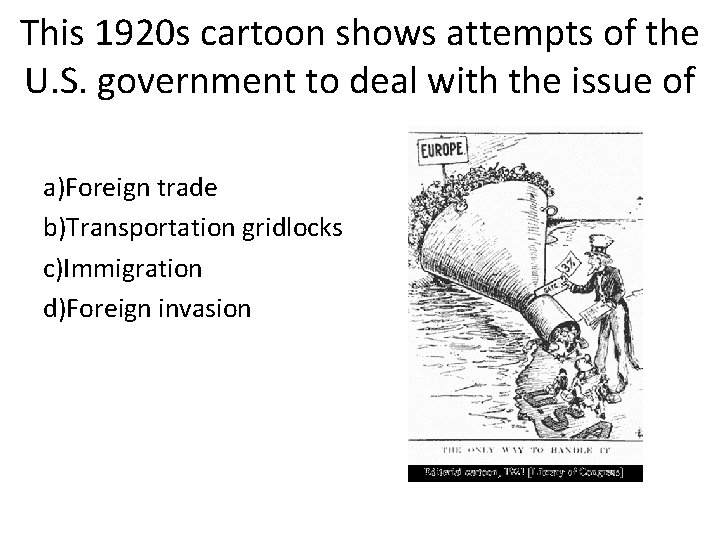
This 1920 s cartoon shows attempts of the U. S. government to deal with the issue of a)Foreign trade b)Transportation gridlocks c)Immigration d)Foreign invasion
- Slides: 13