
1920 s Dance But First The Great Gatsby
1920 s Dance
But First…. . The Great Gatsby!!!
Roaring 20 s Culture • Characteristics of 1920 s Culture – Women Role – Young vs. Old ; Traditional vs. Modern; Conservative vs. Liberal – Prosperity (even false prosperity)
Roaring 20 s Culture • Start of the modern age • Dance was exuberant and energetic • 1920 s style – freed women from tight corsets – new fashions of short hair / short skirts. • In the decade between Great War and the Great Depression, the world was alive and vibrant.
Elements of 20 s Dance • Time – upbeat tempo & rhythym – Represents the mood people were trying to set, given the circumstances of early 20 s • Space – circular or straight line pattern • Force – heavy energy exerted to perform dances – youthful, less traditional but still somewhat elegant • Movement – locomotor movement
Remember…? The Fox Trot
Remember…? The Tango
Remember…? The Waltz
Baltimore Buzz • Popularized in 1921 by Florence Mills - in a popular Revue. • Ragtime dance, danced on one foot, sliding the other foot up to it, then swapping feet to repeat.
The Baltimore Buzz
The Black Bottom • Originated in New Orleans as a stamping, swaying “Negro” dance. • “Hop down front and then you doodle back Mooch to your left & then you mooch to your right Hands on hips and do the Mess Around Break a leg until you’re near the ground. ” • Musical Producer George White - “Scandals of 1926. ”
The Black Bottom
The Cake Walk • Well established dance with it's roots in the Black music of the Deep South. • Set in ragtime; well known composers wrote cake walks. • Scott Joplin, the undisputed king of ragtime music, mentioned it in lyrics: – "Let me see you do the rag-time dance, – Turn left and do the cakewalk prance, – Turn the other way and do the slow drag – Now take you lady to the World's Fair – And do the rag-time dance. "
The Cake Walk
The Jitterbug • AKA 'Jitterbug Jive' or simply 'Jive'. • Unknown origin • Variations of name have caused variations of dances
The Jitterbug
The Lindy Hop • The original swing dance • Jive, Rock 'n Roll, West Coast Swing, and Boogie Woogie have evolved from this dance. • Very acrobatic; lots of force and space used
The Lindy Hop
The Lindy Hop - Modern
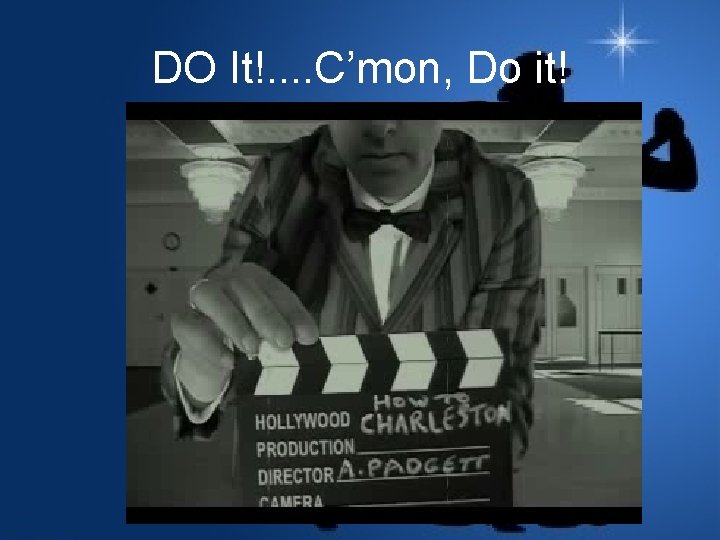
The Charleston • 'Runnin Wild', in the song 'The Charleston'. • Performed by the African-Americans living at Charleston, South Carolina, before it was popularized after its debut in 1923. • Fast movements of hands and feet. • Highly energetic; involves a little bit of hopping, too. • Graceful • Can be done solo, with a partner or with a group.
The Charleston
DO It!. . C’mon, Do it!
Try this one, then…
Summary • Evolved to lighten up the mood and to escape terror atmosphere caused by horror of wars • Used to be a way to vent out the feeling of distress put by the wars on public. • Hence, it can be seen that most of these dance forms are energetic and fast paced. • Much more popular amongst the youth than older people
MISCELLANEOUS NOTES 1920 S
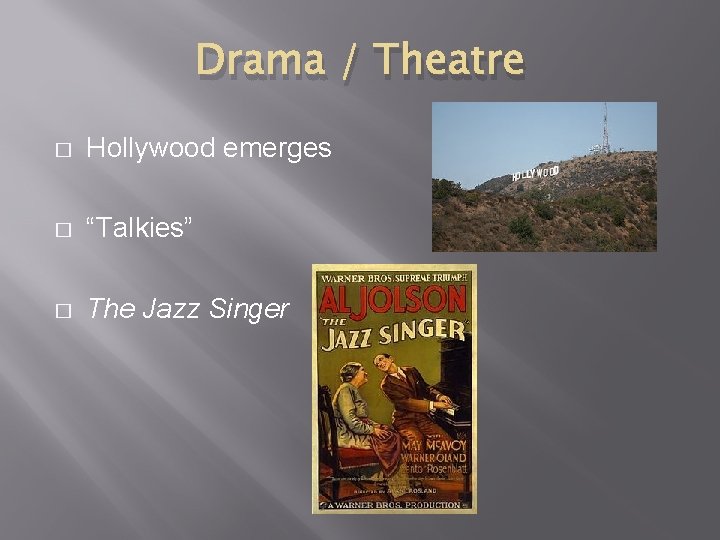
Drama / Theatre � Hollywood emerges � “Talkies” � The Jazz Singer
Fashion – 1920 s Art � On your page of notes, describe the female fashion you saw in Gatsby. Describe headwear, hairstyles, popular styles of dress, etc. Then, do the same for male fashion. � Look at the handouts on fashion. Compare the styles of men and women of the 20 s to that of the 1890 s.
Exit Slip Additional Question � � � Describe how different the fashions were of the 1890 s and 1920 s. Why are they so different? How does fashion explain the generation gap of the time period?
- Slides: 28