
1920 A Memorable Year Background The Progressive Era

1920: A Memorable Year

Background: The Progressive Era 1890 - 1920 • The Progressive Era was a period of unprecedented social activism and political reform. • It arose in reaction to the rapid pace of industrialization, urbanization and mass immigration. • All Progressives held four basic beliefs in common: Government should 1. Be more accountable to its citizens 2. Curb the power and influence of wealthy interests 3. Be given expanded powers, so that it could be more active in improving the lives of citizens 4. Be more efficient and less corrupt, so that it could competently handle an expanded role. • The Progressives sought regulation of monopolies (Trust Busting) through antitrust laws, which were seen as a way to promote equal competition for the advantage of legitimate competitors. • The foot soldiers of Progressivism included middle class women, who agitated for women’s suffrage, prohibition, public healthcare for women and children and housing reform. • The “Muckrakers” were journalists who exposed waste, corruption, and scandal in the highly influential new medium of national magazines, such as Mc. Clure's and Time. They included Jacob Riis, Upton Sinclair , Ida Tarbell and Lincoln Steffens. • Progressives supported four amendment to the U. S. Constitution: imposition of an income tax with the Sixteenth Amendment (1913), direct election of Senators with the Seventeenth Amendment (1913), Prohibition with the Eighteenth Amendment (1920), and women's suffrage through the Nineteenth Amendment (1920). ]
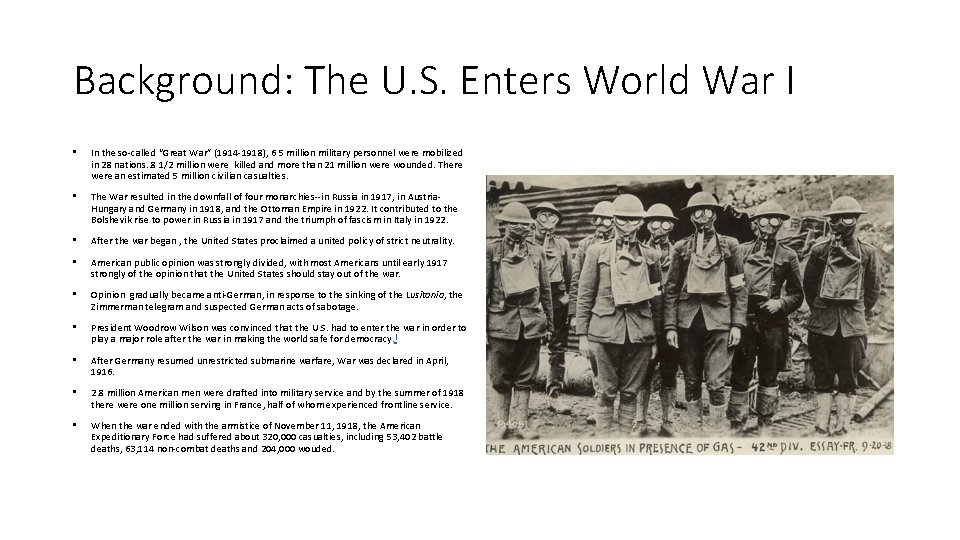
Background: The U. S. Enters World War I • In the so-called “Great War” (1914 -1918), 6 5 million military personnel were mobilized in 28 nations. . 8 1/2 million were killed and more than 21 million were wounded. There were an estimated 5 million civilian casualties. • The War resulted in the downfall of four monarchies--in Russia in 1917, in Austria. Hungary and Germany in 1918, and the Ottoman Empire in 1922. It contributed to the Bolshevik rise to power in Russia in 1917 and the triumph of fascism in Italy in 1922. • After the war began , the United States proclaimed a united policy of strict neutrality. • American public opinion was strongly divided, with most Americans until early 1917 strongly of the opinion that the United States should stay out of the war. • Opinion gradually became anti-German, in response to the sinking of the Lusitania, the Zimmerman telegram and suspected German acts of sabotage. • President Woodrow Wilson was convinced that the U. S. had to enter the war in order to play a major role after the war in making the world safe for democracy. [ • After Germany resumed unrestricted submarine warfare, War was declared in April, 1916. • 2. 8 million American men were drafted into military service and by the summer of 1918 there were one million serving in France, half of whom experienced frontline service. • When the war ended with the armistice of November 11, 1918, the American Expeditionary Force had suffered about 320, 000 casualties, including 53, 402 battle deaths, 63, 114 non-combat deaths and 204, 000 wouded.
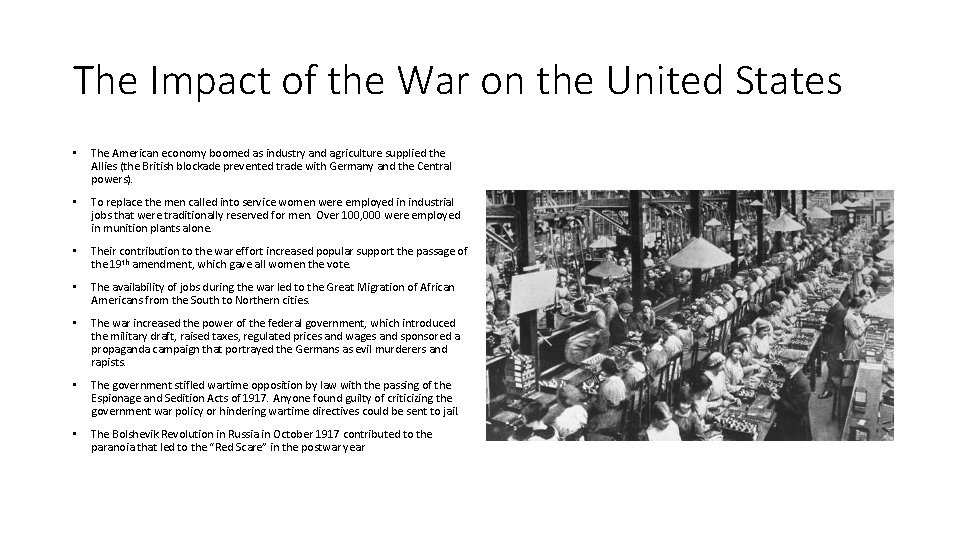
The Impact of the War on the United States • The American economy boomed as industry and agriculture supplied the Allies (the British blockade prevented trade with Germany and the Central powers). • To replace the men called into service women were employed in industrial jobs that were traditionally reserved for men. Over 100, 000 were employed in munition plants alone. • Their contribution to the war effort increased popular support the passage of the 19 th amendment, which gave all women the vote. • The availability of jobs during the war led to the Great Migration of African Americans from the South to Northern cities. • The war increased the power of the federal government, which introduced the military draft, raised taxes, regulated prices and wages and sponsored a propaganda campaign that portrayed the Germans as evil murderers and rapists. • The government stifled wartime opposition by law with the passing of the Espionage and Sedition Acts of 1917. Anyone found guilty of criticizing the government war policy or hindering wartime directives could be sent to jail. • The Bolshevik Revolution in Russia in October 1917 contributed to the paranoia that led to the “Red Scare” in the postwar year
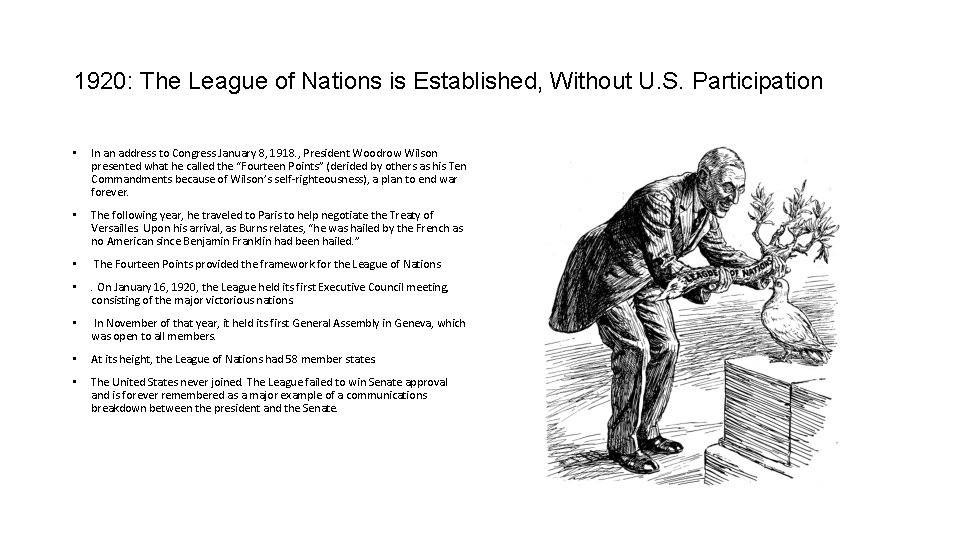
1920: The League of Nations is Established, Without U. S. Participation • In an address to Congress January 8, 1918. , President Woodrow Wilson presented what he called the “Fourteen Points” (derided by others as his Ten Commandments because of Wilson’s self-righteousness), a plan to end war forever. • The following year, he traveled to Paris to help negotiate the Treaty of Versailles. Upon his arrival, as Burns relates, “he was hailed by the French as no American since Benjamin Franklin had been hailed. ” • The Fourteen Points provided the framework for the League of Nations • . On January 16, 1920, the League held its first Executive Council meeting, consisting of the major victorious nations. • In November of that year, it held its first General Assembly in Geneva, which was open to all members. • At its height, the League of Nations had 58 member states. • The United States never joined. The League failed to win Senate approval and is forever remembered as a major example of a communications breakdown between the president and the Senate.
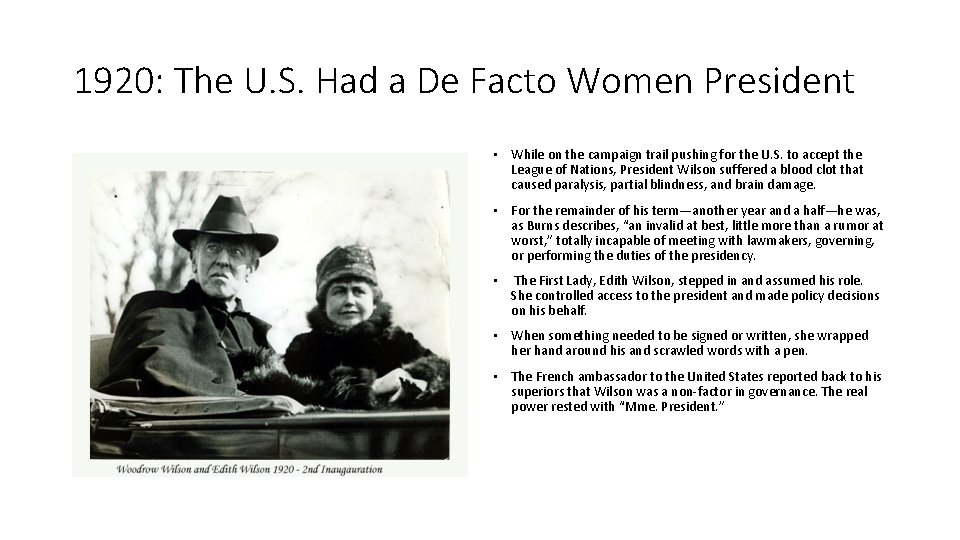
1920: The U. S. Had a De Facto Women President • While on the campaign trail pushing for the U. S. to accept the League of Nations, President Wilson suffered a blood clot that caused paralysis, partial blindness, and brain damage. • For the remainder of his term—another year and a half—he was, as Burns describes, “an invalid at best, little more than a rumor at worst, ” totally incapable of meeting with lawmakers, governing, or performing the duties of the presidency. • The First Lady, Edith Wilson, stepped in and assumed his role. She controlled access to the president and made policy decisions on his behalf. • When something needed to be signed or written, she wrapped her hand around his and scrawled words with a pen. • The French ambassador to the United States reported back to his superiors that Wilson was a non-factor in governance. The real power rested with “Mme. President. ”
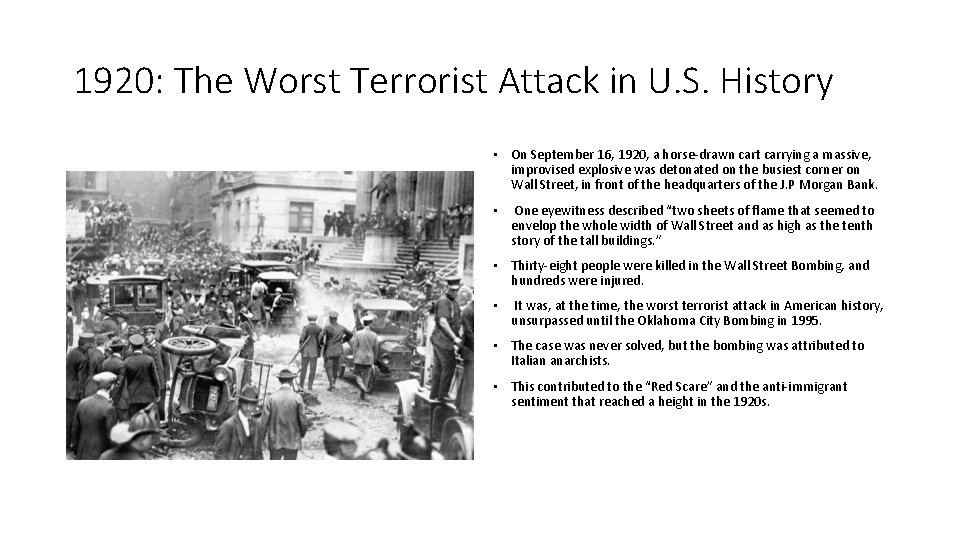
1920: The Worst Terrorist Attack in U. S. History • On September 16, 1920, a horse-drawn cart carrying a massive, improvised explosive was detonated on the busiest corner on Wall Street, in front of the headquarters of the J. P Morgan Bank. • One eyewitness described “two sheets of flame that seemed to envelop the whole width of Wall Street and as high as the tenth story of the tall buildings. ” • Thirty-eight people were killed in the Wall Street Bombing, and hundreds were injured. • It was, at the time, the worst terrorist attack in American history, unsurpassed until the Oklahoma City Bombing in 1995. • The case was never solved, but the bombing was attributed to Italian anarchists. • This contributed to the “Red Scare” and the anti-immigrant sentiment that reached a height in the 1920 s.
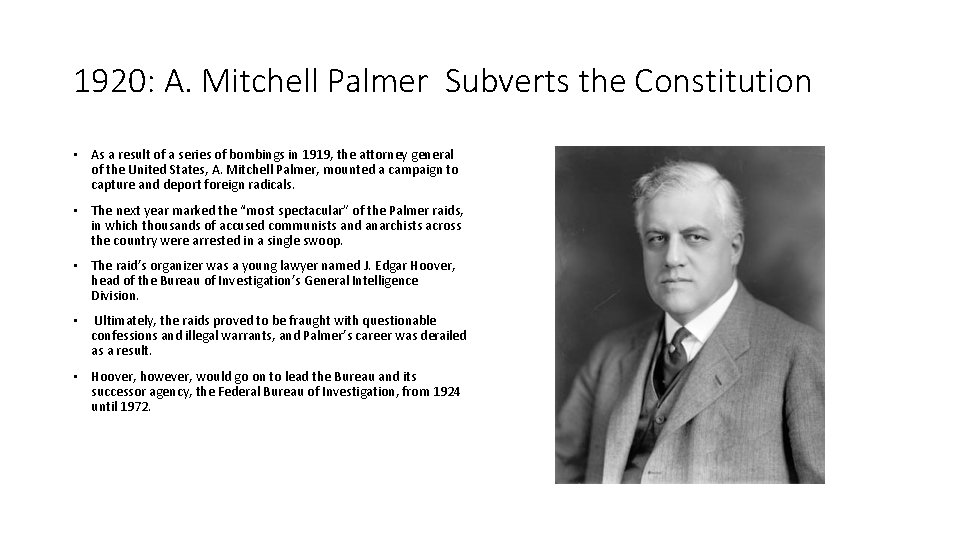
1920: A. Mitchell Palmer Subverts the Constitution • As a result of a series of bombings in 1919, the attorney general of the United States, A. Mitchell Palmer, mounted a campaign to capture and deport foreign radicals. • The next year marked the “most spectacular” of the Palmer raids, in which thousands of accused communists and anarchists across the country were arrested in a single swoop. • The raid’s organizer was a young lawyer named J. Edgar Hoover, head of the Bureau of Investigation’s General Intelligence Division. • Ultimately, the raids proved to be fraught with questionable confessions and illegal warrants, and Palmer’s career was derailed as a result. • Hoover, however, would go on to lead the Bureau and its successor agency, the Federal Bureau of Investigation, from 1924 until 1972.
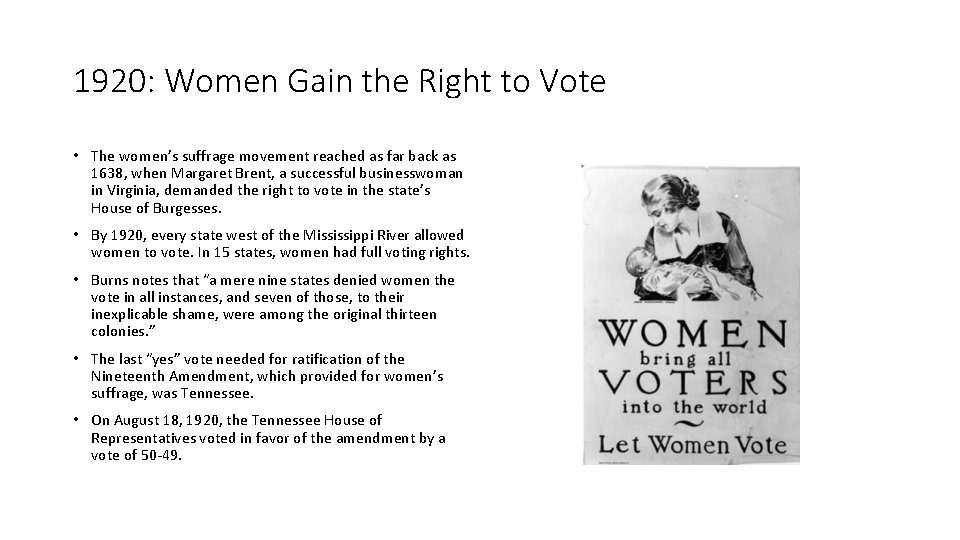
1920: Women Gain the Right to Vote • The women’s suffrage movement reached as far back as 1638, when Margaret Brent, a successful businesswoman in Virginia, demanded the right to vote in the state’s House of Burgesses. • By 1920, every state west of the Mississippi River allowed women to vote. In 15 states, women had full voting rights. • Burns notes that “a mere nine states denied women the vote in all instances, and seven of those, to their inexplicable shame, were among the original thirteen colonies. ” • The last “yes” vote needed for ratification of the Nineteenth Amendment, which provided for women’s suffrage, was Tennessee. • On August 18, 1920, the Tennessee House of Representatives voted in favor of the amendment by a vote of 50 -49.
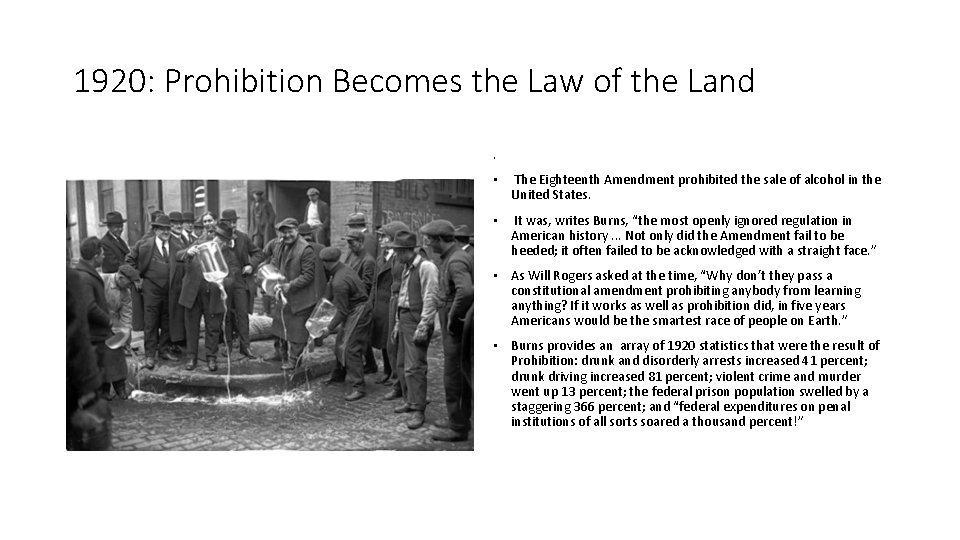
1920: Prohibition Becomes the Law of the Land. • The Eighteenth Amendment prohibited the sale of alcohol in the United States. • It was, writes Burns, “the most openly ignored regulation in American history. . . Not only did the Amendment fail to be heeded; it often failed to be acknowledged with a straight face. ” • As Will Rogers asked at the time, “Why don’t they pass a constitutional amendment prohibiting anybody from learning anything? If it works as well as prohibition did, in five years Americans would be the smartest race of people on Earth. ” • Burns provides an array of 1920 statistics that were the result of Prohibition: drunk and disorderly arrests increased 41 percent; drunk driving increased 81 percent; violent crime and murder went up 13 percent; the federal prison population swelled by a staggering 366 percent; and “federal expenditures on penal institutions of all sorts soared a thousand percent!”
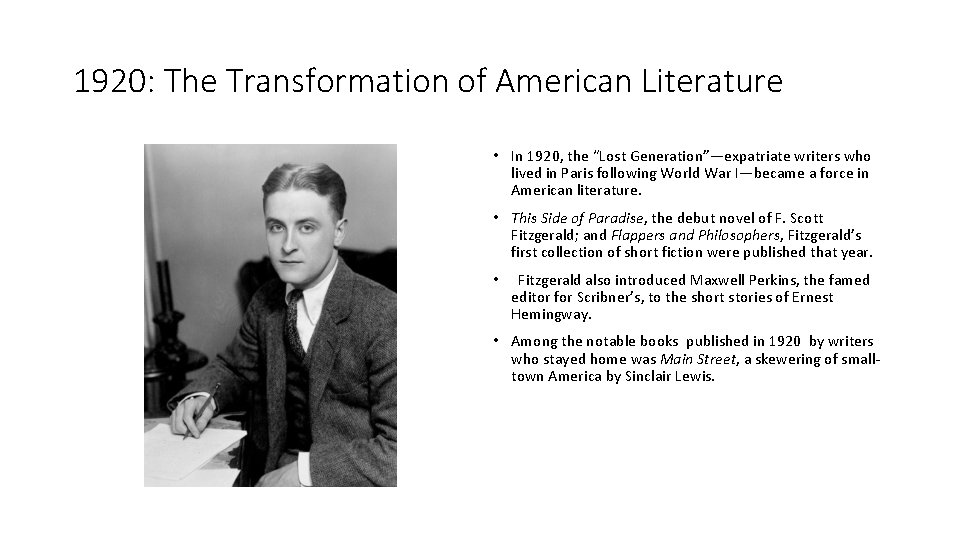
1920: The Transformation of American Literature • In 1920, the “Lost Generation”—expatriate writers who lived in Paris following World War I—became a force in American literature. • This Side of Paradise, the debut novel of F. Scott Fitzgerald; and Flappers and Philosophers, Fitzgerald’s first collection of short fiction were published that year. • Fitzgerald also introduced Maxwell Perkins, the famed editor for Scribner’s, to the short stories of Ernest Hemingway. • Among the notable books published in 1920 by writers who stayed home was Main Street, a skewering of smalltown America by Sinclair Lewis.
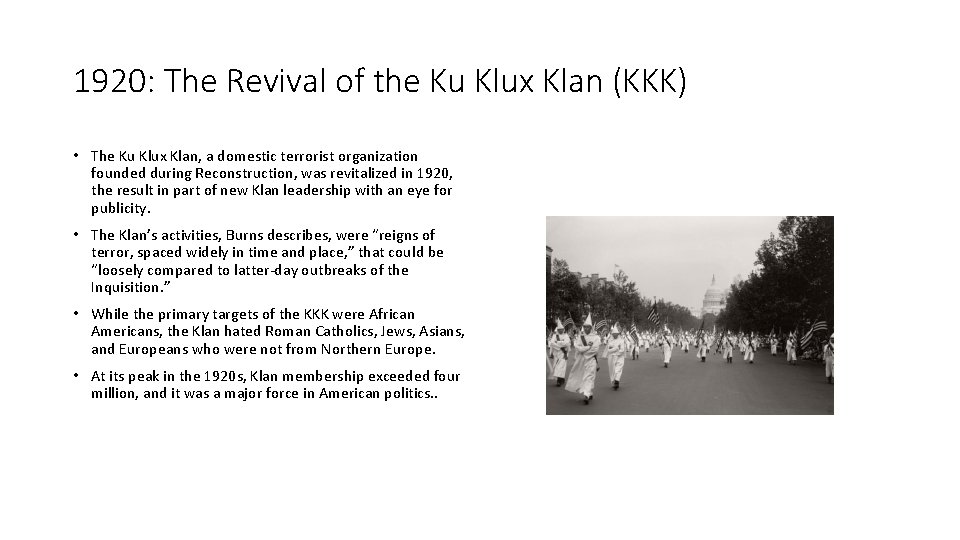
1920: The Revival of the Ku Klux Klan (KKK) • The Ku Klux Klan, a domestic terrorist organization founded during Reconstruction, was revitalized in 1920, the result in part of new Klan leadership with an eye for publicity. • The Klan’s activities, Burns describes, were “reigns of terror, spaced widely in time and place, ” that could be “loosely compared to latter-day outbreaks of the Inquisition. ” • While the primary targets of the KKK were African Americans, the Klan hated Roman Catholics, Jews, Asians, and Europeans who were not from Northern Europe. • At its peak in the 1920 s, Klan membership exceeded four million, and it was a major force in American politics. .
- Slides: 12