
1916 Easter Rising James Connolly Early Life James
- Slides: 9
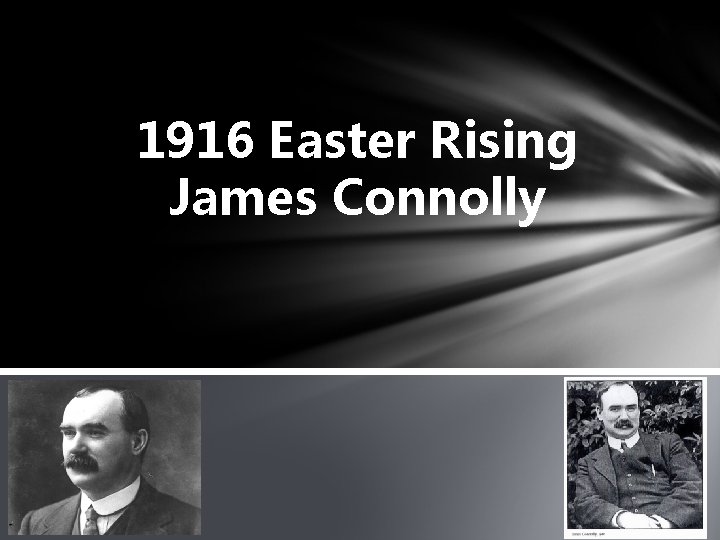
1916 Easter Rising James Connolly
Early Life James Connolly was born on June 5, 1868, at 107, the Cowgate, Edinburgh. His parents, John and Mary Connolly, had emigrated to Edinburgh from County Monaghan in the 1850 s. His father worked as a manure carter, removing dung from the streets at night, and his mother was a domestic servant who suffered from chronic bronchitis and was to die young from that ailment. James Connolly went to St Patricks School in the Cowgate, as did his two older brothers, Thomas and John. At ten years of age, James left school and got a job with Edinburgh's ’Evening News ’ newspaper, where he worked as a 'Devil', cleaning inky rollers and fetching beer and food for the adult workers. His brother Thomas also worked with the same newspaper. In 1882, aged 14, he joined
Irish Organisation Connolly accepted an invitation to work in Dublin for the Dublin Socialist Club. Shortly after his arrival he established the Irish Socialist Republican Party, which had branches in Belfast, Cork, and Dublin. In his first public statement on behalf of the ISRP, Connolly wrote: “The struggle for Irish freedom has two aspects: it is national and it is social. The national ideal can never be realised until Ireland stands forth before the world as a nation, free and independent. It is social and economic, because no matter what the form of government may be, as long as one class owns as private property the land the instruments of labour from which mankind derive their substance, that class will always have it in their power to plunder and enslave the remainder of their fellowcreatures. ”
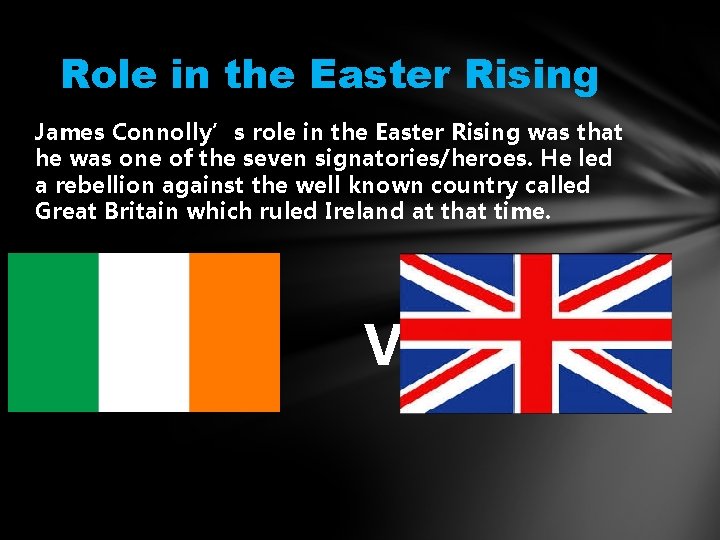
Role in the Easter Rising James Connolly’s role in the Easter Rising was that he was one of the seven signatories/heroes. He led a rebellion against the well known country called Great Britain which ruled Ireland at that time. VS
Role in the Easter Rising (Part 2) He became secretary of the Scottish Socialist Federation. At the time his brother John was secretary; after John spoke at a rally in favour of the eight-hour day, however, he was fired from his job with the Edinburgh Corporation, so while he looked for work, James took over as secretary. During this time, Connolly became involved with the Independent Labour Party which Keir Hardie had formed in 1893. By 1892 he was involved in the Scottish Socialist Federation, acting as its secretary from 1895. Two months after the birth of his third daughter, word came to Connolly that the Dublin Socialist Club was looking for a fulltime secretary, a job that offered a salary of a pound a week.
Death Connolly was not actually held in gaol, but in a room now called the ‘Connolly Room’ at the State Apartments in Dublin Castle, which had been converted to a first-aid station for troops recovering from the war. Connolly was sentenced to death by firing squad for his part in the rising. On 12 May 1916 he was taken by military ambulance to Royal Hospital Kilmainham, across the road from Kilmainham Gaol, and from there taken to the gaol, where he was to be executed. Visited by his wife, and asking about public opinion, he commented, “They will all forget that I am an Irishman. ”
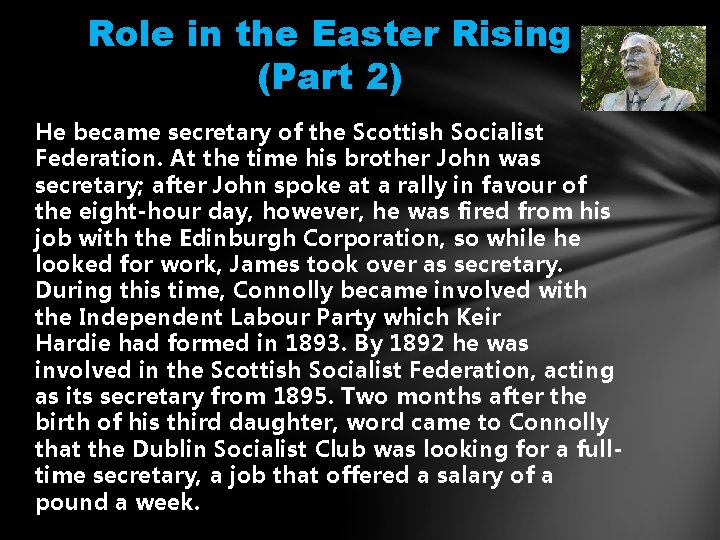
Legacy Connolly's legacy in Ireland is mainly due to his contribution to the republican cause and while his legacy as a socialist has been claimed by a variety of left-wing and left-republican groups, he is primarily associated with the Labour Party which he founded. Connolly was among the few European members of the Second International who opposed, outright, World War I. This put him at odds with most of the socialist leaders of Europe. There is a statue of James Connolly in Dublin, outside Liberty Hall, the offices of the SIPTU trade union. Another statue of Connolly stands in Union Park, Chicago near the offices of the Chicago branch of the IWW and UE.
Interesting Facts James Connolly was survived by his wife Lillie and several children, of whom Nora became an influential writer and campaigner within the Irishrepublican movement as an adult, and Roddy continued his father's politics. In later years, both became members of the Oireachtas (Irish parliament). Three months after James Connolly's execution his wife was received into the Catholic Church, at Church St. on 15 August.
Thank You For Listening. We Hope You Enjoyed!