
19081970 Abraham Maslow was a psychologist the title

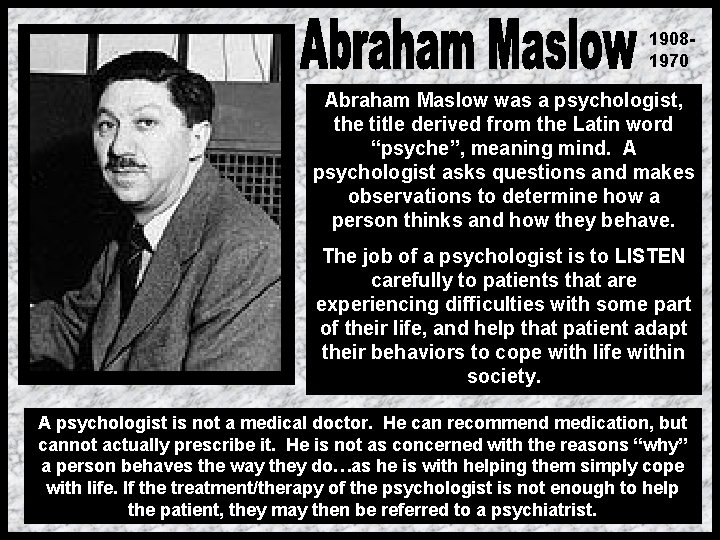
19081970 Abraham Maslow was a psychologist, the title derived from the Latin word “psyche”, meaning mind. A psychologist asks questions and makes observations to determine how a person thinks and how they behave. The job of a psychologist is to LISTEN carefully to patients that are experiencing difficulties with some part of their life, and help that patient adapt their behaviors to cope with life within society. A psychologist is not a medical doctor. He can recommend medication, but cannot actually prescribe it. He is not as concerned with the reasons “why” a person behaves the way they do…as he is with helping them simply cope with life. If the treatment/therapy of the psychologist is not enough to help the patient, they may then be referred to a psychiatrist.

Abraham Maslow identified 5 basic human needs…needs that every human being must have met in order to survive. A “heirarchy” simply means that some needs are more important than others. In order to teach others which needs were more important than others, Maslow illustrated his theory with a pyramid. He used a pyramid instead of a graph or a circle, because when you construct a pyramid the bottom layers are more important than the top.
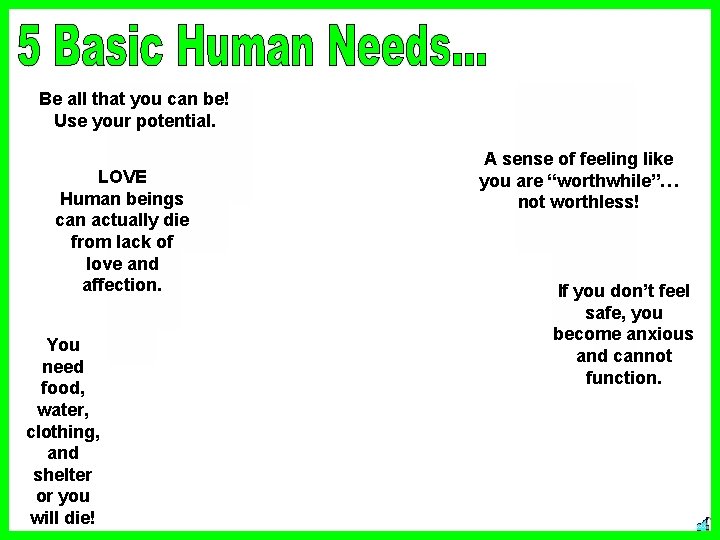
Be all that you can be! Use your potential. LOVE Human beings can actually die from lack of love and affection. You need food, water, clothing, and shelter or you will die! A sense of feeling like you are “worthwhile”… not worthless! If you don’t feel safe, you become anxious and cannot function.

A value is a STRONG BELIEF. Can you think of values associated with these illustrations? Good health Money or what it can buy Career Miss Popularity Education Country Religious faith Friends Family

We learn values, usually from our parents. Sometimes our values are influenced by friends, teachers, coaches, advisors, religious leaders, grandparents, siblings, etc.
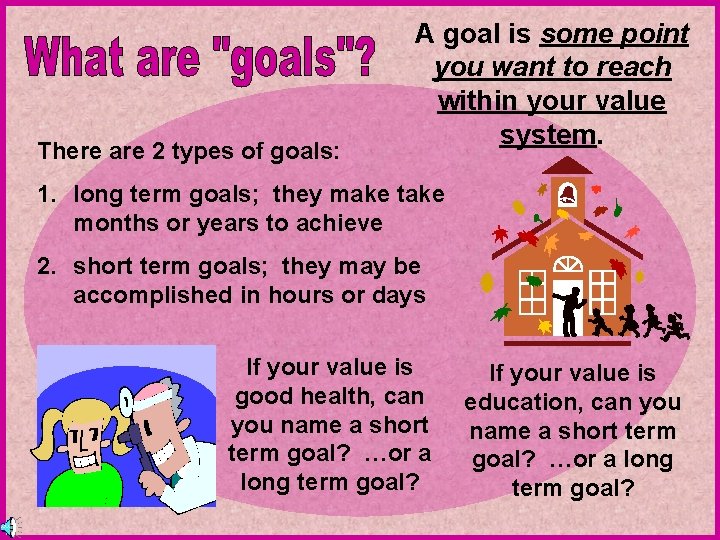
There are 2 types of goals: A goal is some point you want to reach within your value system. 1. long term goals; they make take months or years to achieve 2. short term goals; they may be accomplished in hours or days If your value is good health, can you name a short term goal? …or a long term goal? If your value is education, can you name a short term goal? …or a long term goal?
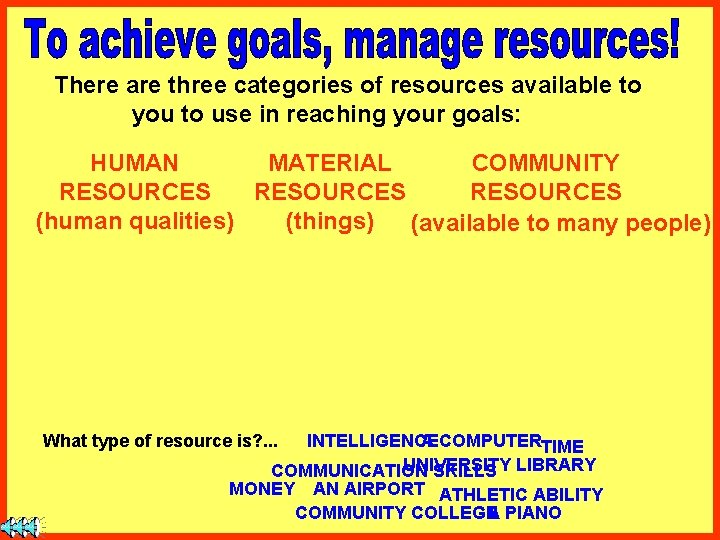
There are three categories of resources available to you to use in reaching your goals: HUMAN MATERIAL COMMUNITY RESOURCES (human qualities) (things) (available to many people) What type of resource is? . . . INTELLIGENCE A COMPUTERTIME UNIVERSITY COMMUNICATION SKILLS LIBRARY MONEY AN AIRPORT ATHLETIC ABILITY COMMUNITY COLLEGE A PIANO

I have a lot to do, but I think I’ll wait and do it tomorrow! Procrastinate means to “put things off” until another time. Procrastination stands in the way of reaching goals!!!!!

Homework late again? First things first young man! List your goals in order of importance. This gives you a sense of direction and helps you manage your resources wisely.
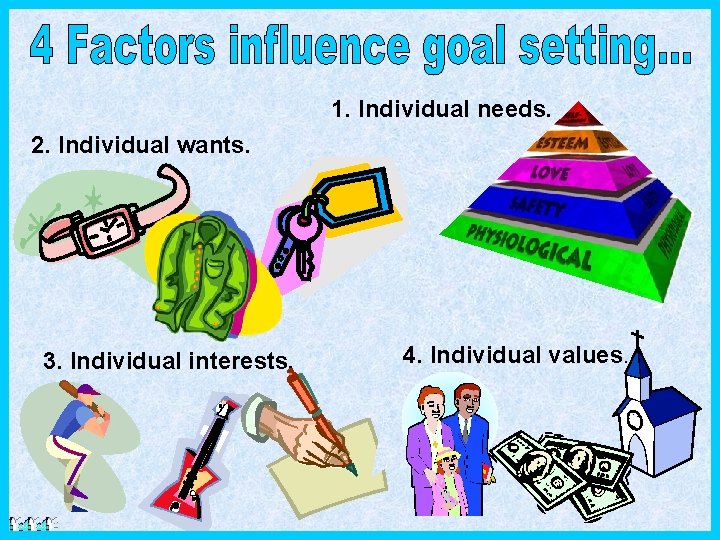
1. Individual needs. 2. Individual wants. 3. Individual interests. 4. Individual values.
Standards are “limits or conditions or the manner” in which you go about reaching your goals. When expressing standards verbally, you tend to use words like… …only if …as long as …even if …no matter what
Morality is defined as “a person’s ideas of fairness and justice and right and wrong”. Your sense of morality influences the standards you live by. Morality is sometimes referred to as one’s conscience or scruples. The term ethics refers to morality and standards… especially in relationship to ‘how moral standards affect conduct’. A person does not always choose to act in accordance with their values or conscience. Many students truly believe in honesty and agree that cheating is wrong… but they choose to cheat anyway.
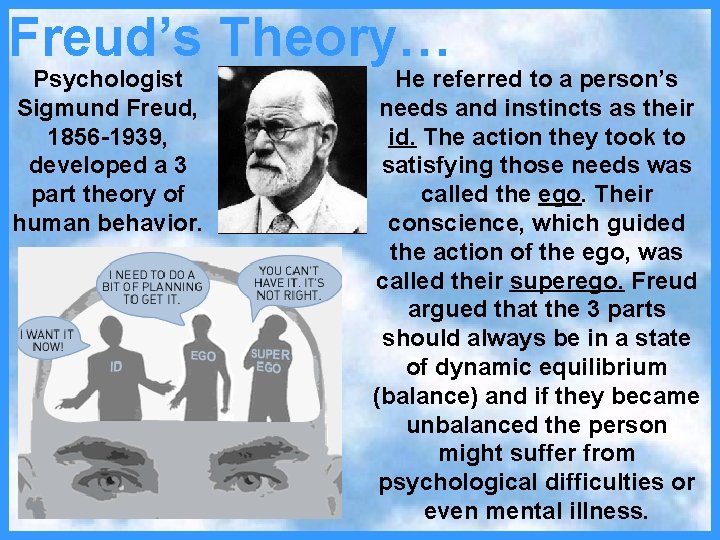
Freud’s Theory… Psychologist Sigmund Freud, 1856 -1939, developed a 3 part theory of human behavior. He referred to a person’s needs and instincts as their id. The action they took to satisfying those needs was called the ego. Their conscience, which guided the action of the ego, was called their superego. Freud argued that the 3 parts should always be in a state of dynamic equilibrium (balance) and if they became unbalanced the person might suffer from psychological difficulties or even mental illness.
Piaget’s Theory… Psychologist Jean Piaget, 1896 -1980, developed a two part theory on how morality develops. Part 1: The first stage of moral development, called moral realism, emerges during middle childhood. Rules are real, and must be followed strictly as if they are ‘set in stone’. Rules are ‘black and white’. Part 2: The second stage is called moral relativism and develops later. At this stage, children understand that rules are created and agreed upon cooperatively by individuals… and can be changed if necessary. Rules may have some ‘shades of gray’. Would you consider yourself to be a ‘moral realist’ or a ‘moral relativist’?
Kohlberg’s Theory… Psychologist Lawrence Kohlberg, 1927 -1987, expanded Piaget’s work into his own 6 stage theory. In his research, he read stories to individuals and asked them to judge the character’s behavior as moral or immoral. Level A: Preconventional moral reasoning Stage 1: Obey rules to avoid punishment’ Stage 2: Obey rules to have favors returned Level B: Conventional moral reasoning Stage 3: Conform to win the approval of others Stage 4: Conform to avoid disapproval of others Level C: Postconventional moral reasoning Stage 5: Abide by laws for the community’s welfare Stage 6: Abide by ethical principles that may exceed society’s laws or expectations Kohlberg believed less than 25% of all people reach level 6. He gave Jesus, Gandhi, and Martin Luther King, Jr. as examples.


- Slides: 18