
19 th Century Responses to Liberalism Utopian Socialism
19 th Century Responses to Liberalism Utopian Socialism, Socialism and Karl Marx (Marxism)

Socialist Ideologies �An ideology based on collectivist values �Specifics Resources should be controlled by the public for the benefit of everyone in society and not by private interests and not for the benefit of the individual Economic equality Security Cooperation Control and direction in the economy �Developed out of a want ___________________________
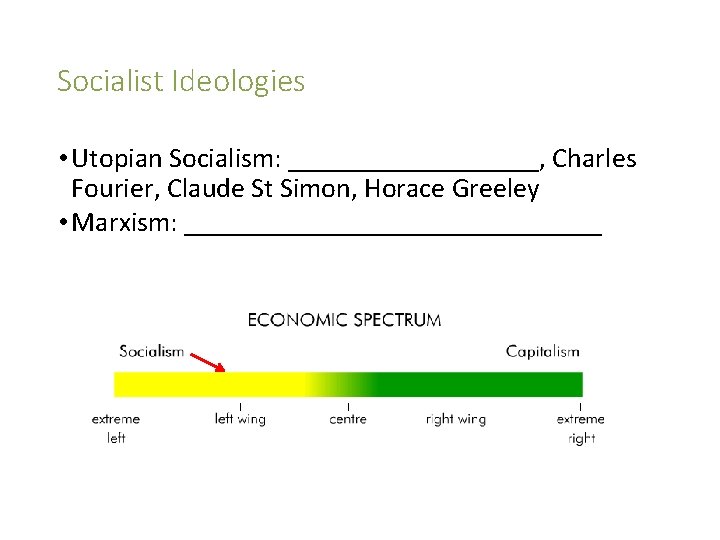
Socialist Ideologies • Utopian Socialism: _________, Charles Fourier, Claude St Simon, Horace Greeley • Marxism: _______________
Socialist Views Towards Industrial Revolution �Did not need violence to achieve social justice. �Elimination of private property, competition, capitalism, and machinery. �Only _________________. �Collective ownership. �__________________.
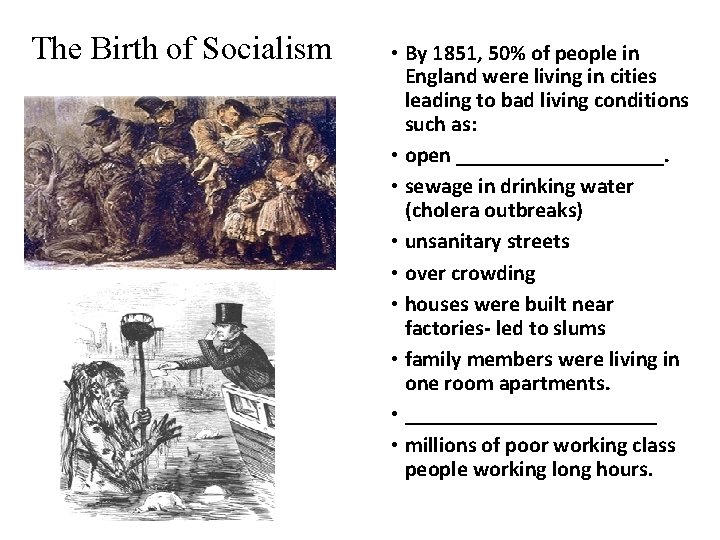
The Birth of Socialism • By 1851, 50% of people in England were living in cities leading to bad living conditions such as: • open __________. • sewage in drinking water (cholera outbreaks) • unsanitary streets • over crowding • houses were built near factories- led to slums • family members were living in one room apartments. • ____________ • millions of poor working class people working long hours.
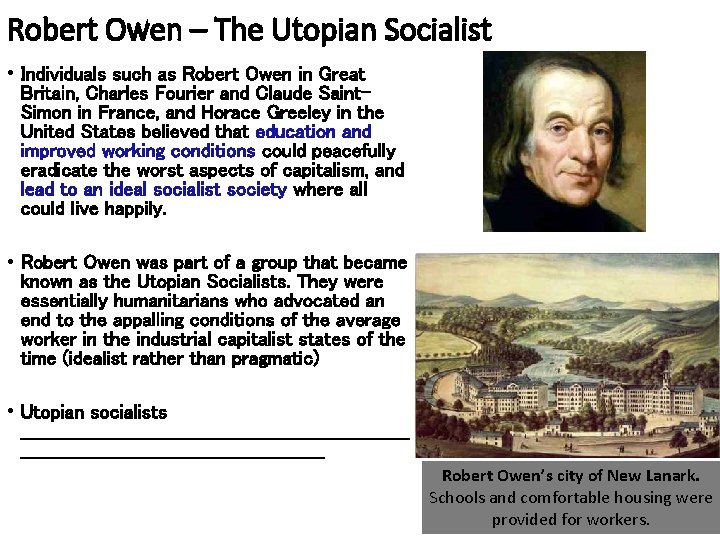
Robert Owen – The Utopian Socialist • Individuals such as Robert Owen in Great Britain, Charles Fourier and Claude Saint. Simon in France, and Horace Greeley in the United States believed that education and improved working conditions could peacefully eradicate the worst aspects of capitalism, and lead to an ideal socialist society where all could live happily. • Robert Owen was part of a group that became known as the Utopian Socialists. They were essentially humanitarians who advocated an end to the appalling conditions of the average worker in the industrial capitalist states of the time (idealist rather than pragmatic) • Utopian socialists ________________________________ Robert Owen’s city of New Lanark. Schools and comfortable housing were provided for workers.
Beliefs of Socialists • Unlike Utopians, _______________________________________________________ • Beliefs ranged from moderate and democratic social reform to radical revolutionary Marxism. • However, socialists agreed on the following principles: • Private ownership of the means of production permits exploitation • The state should direct the economy to achieve economic equality for all citizens • Society should be classless
Marxism – Based on the work of MARX • Radical form of socialism. • Also termed _________________. • Many of Marx’s ideas were socialist and collectivist in nature, but many of _________________________________________________ • Marx believed that society would undergo a major revolution in order for the proletariat to rule. See Figure 46, page 136
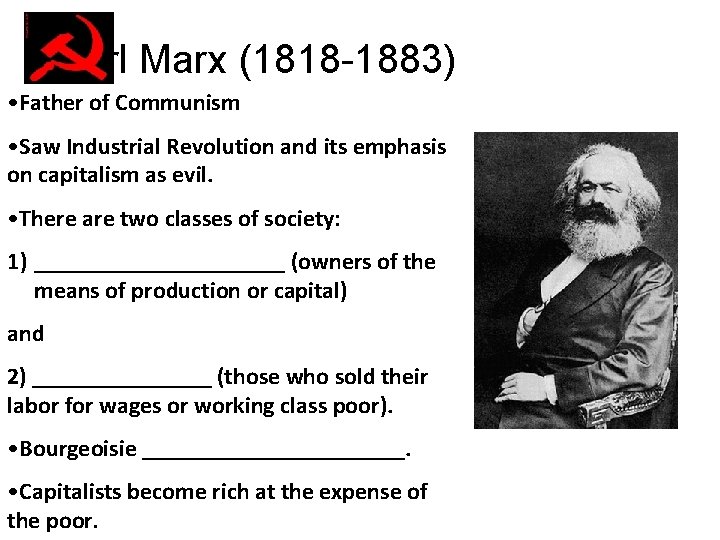
Karl Marx (1818 -1883) • Father of Communism • Saw Industrial Revolution and its emphasis on capitalism as evil. • There are two classes of society: 1) ___________ (owners of the means of production or capital) and 2) ________ (those who sold their labor for wages or working class poor). • Bourgeoisie ___________. • Capitalists become rich at the expense of the poor.
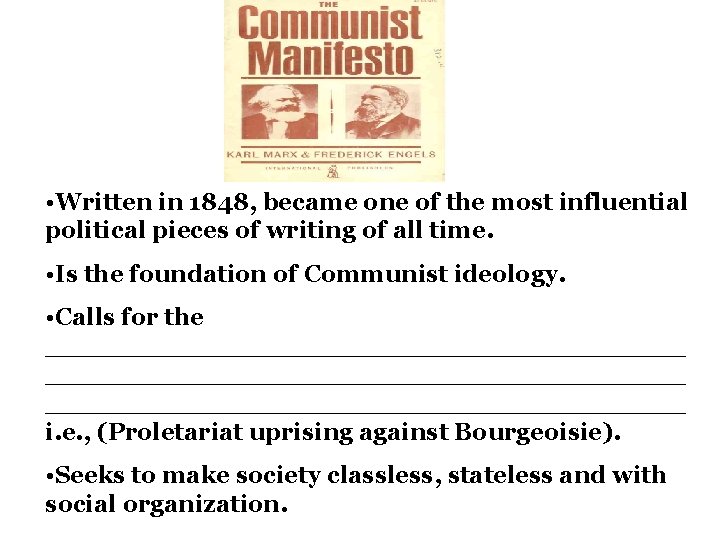
• Written in 1848, became one of the most influential political pieces of writing of all time. • Is the foundation of Communist ideology. • Calls for the ______________________________________ i. e. , (Proletariat uprising against Bourgeoisie). • Seeks to make society classless, stateless and with social organization.

Continued…. • The abolition of private property and the centralization of the means of production (such as factories and machinery) in ________________________________________ • Also known as ____________________ (government planners make decisions and means of production are owned by the state. )
• Socialism and Marxism , while sharing common views, differed greatly in the ways that their goal of transforming liberal capitalist society should be achieved…___________________________________ • As a result, Marxist thought was not as widely accepted in classical liberal society • Socialism, which favoured reform, was more popular • By the 1930 s, Marxism gained some popularity in places such as France and USSR (obviously!).
- Slides: 12