
19 January 2022 Discrete random variables and distributions
19 January 2022 Discrete random variables and distributions LO: To understand use discrete random variable distributions www. mathssupport. org
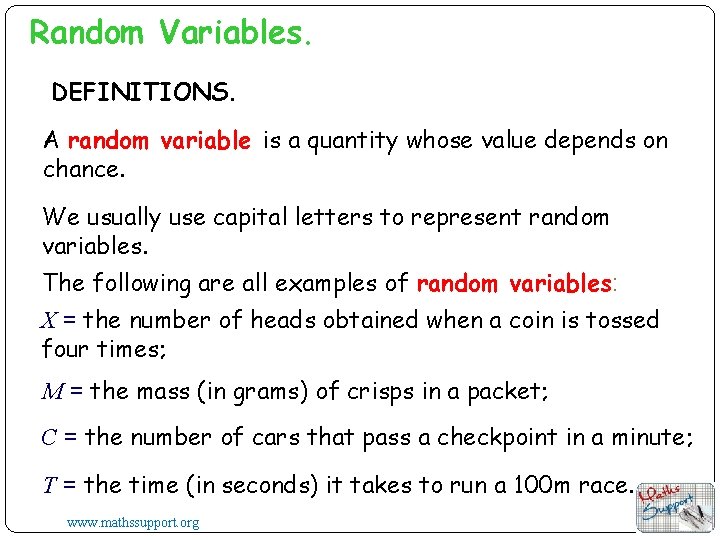
Random Variables. DEFINITIONS. A random variable is a quantity whose value depends on chance. We usually use capital letters to represent random variables. The following are all examples of random variables: X = the number of heads obtained when a coin is tossed four times; M = the mass (in grams) of crisps in a packet; C = the number of cars that pass a checkpoint in a minute; T = the time (in seconds) it takes to run a 100 m race. www. mathssupport. org
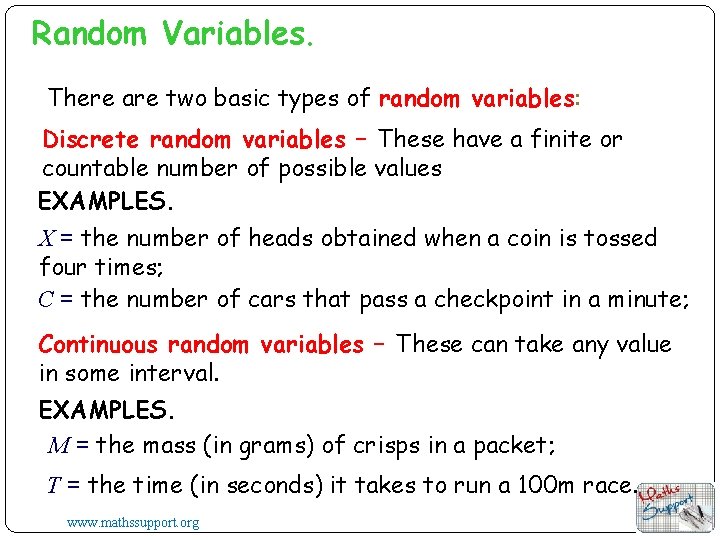
Random Variables. There are two basic types of random variables: Discrete random variables – These have a finite or countable number of possible values EXAMPLES. X = the number of heads obtained when a coin is tossed four times; C = the number of cars that pass a checkpoint in a minute; Continuous random variables – These can take any value in some interval. EXAMPLES. M = the mass (in grams) of crisps in a packet; T = the time (in seconds) it takes to run a 100 m race. www. mathssupport. org
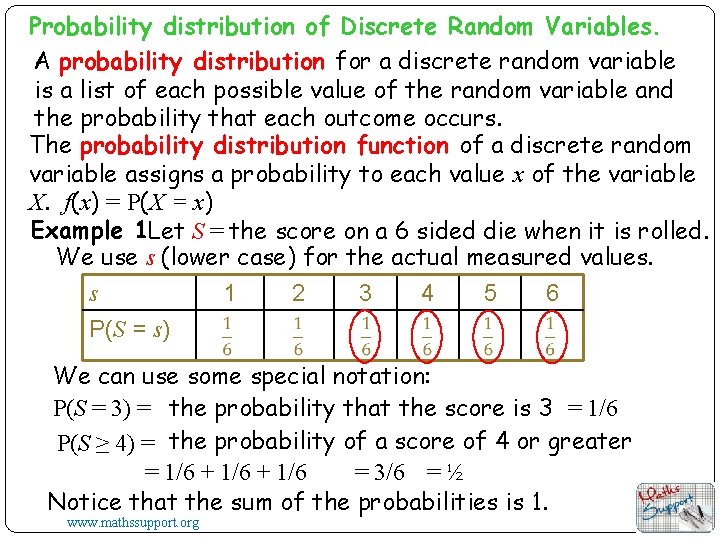
Probability distribution of Discrete Random Variables. A probability distribution for a discrete random variable is a list of each possible value of the random variable and the probability that each outcome occurs. The probability distribution function of a discrete random variable assigns a probability to each value x of the variable X. f(x) = P(X = x) Example 1 Let S = the score on a 6 sided die when it is rolled. We use s (lower case) for the actual measured values. s 1 2 3 4 5 6 P(S = s) We can use some special notation: P(S = 3) = the probability that the score is 3 = 1/6 P(S ≥ 4) = the probability of a score of 4 or greater = 3/6 = ½ = 1/6 + 1/6 Notice that the sum of the probabilities is 1. www. mathssupport. org
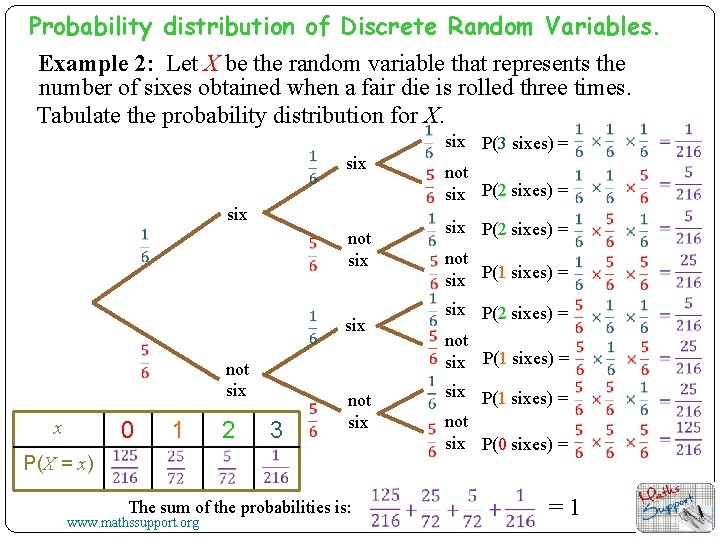
Probability distribution of Discrete Random Variables. Example 2: Let X be the random variable that represents the number of sixes obtained when a fair die is rolled three times. Tabulate the probability distribution for X. six P(3 sixes) = six six not six x 0 1 2 3 not six P(X = x) The sum of the probabilities is: www. mathssupport. org not six P(2 sixes) = not six P(1 sixes) = not six P(0 sixes) = =1

Probability distribution of Discrete Random Variables. In the Example 1 The sum of the probabilities is: =1 In the Example 2 The sum of the probabilities is: =1 For any random variable X =1 Means that the sum of the probabilities will always be 1. 0 f(x) 1 Means that a probability must always be between 0 and 1. www. mathssupport. org
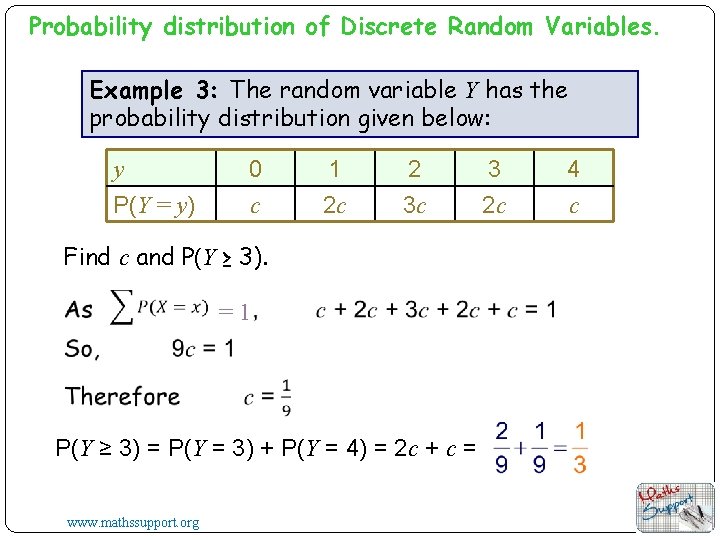
Probability distribution of Discrete Random Variables. Example 3: The random variable Y has the probability distribution given below: y P(Y = y) 0 c 1 2 c 2 3 c Find c and P(Y ≥ 3). =1 P(Y ≥ 3) = P(Y = 3) + P(Y = 4) = 2 c + c = www. mathssupport. org 3 2 c 4 c

Thank you for using resources from For more resources visit our website https: //www. mathssupport. org If you have a special request, drop us an email info@mathssupport. org www. mathssupport. org
- Slides: 8