
19 December 2021 Continuous random variables LO To
19 December 2021 Continuous random variables LO: To understand identify the probability density function of a continuous random variable. www. mathssupport. org
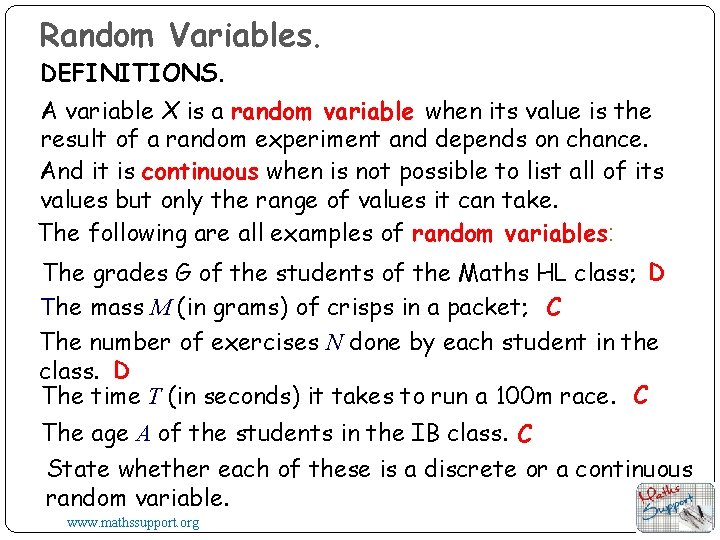
Random Variables. DEFINITIONS. A variable X is a random variable when its value is the result of a random experiment and depends on chance. And it is continuous when is not possible to list all of its values but only the range of values it can take. The following are all examples of random variables: The grades G of the students of the Maths HL class; D The mass M (in grams) of crisps in a packet; C The number of exercises N done by each student in the class. D The time T (in seconds) it takes to run a 100 m race. C The age A of the students in the IB class. C State whether each of these is a discrete or a continuous random variable. www. mathssupport. org
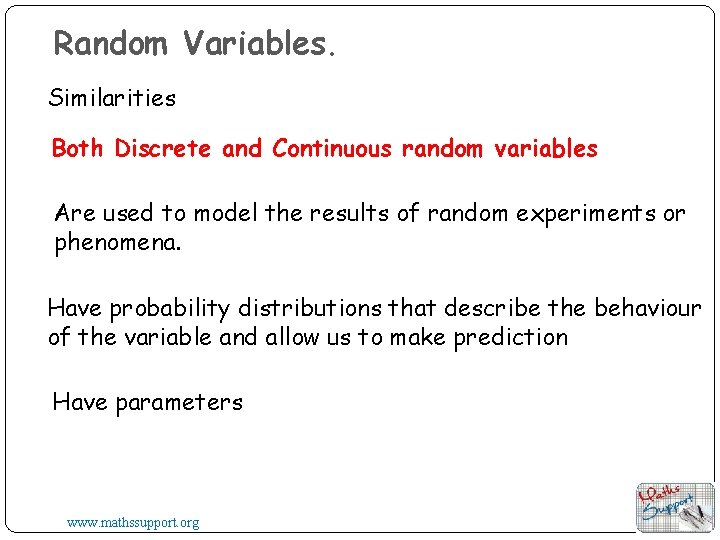
Random Variables. Similarities Both Discrete and Continuous random variables Are used to model the results of random experiments or phenomena. Have probability distributions that describe the behaviour of the variable and allow us to make prediction Have parameters www. mathssupport. org
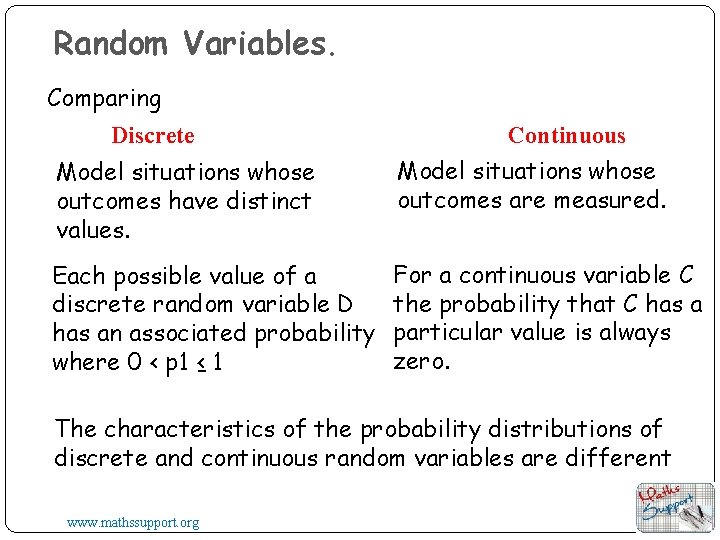
Random Variables. Comparing Discrete Continuous Model situations whose outcomes have distinct values. Model situations whose outcomes are measured. Each possible value of a discrete random variable D has an associated probability where 0 < p 1 ≤ 1 For a continuous variable C the probability that C has a particular value is always zero. The characteristics of the probability distributions of discrete and continuous random variables are different www. mathssupport. org
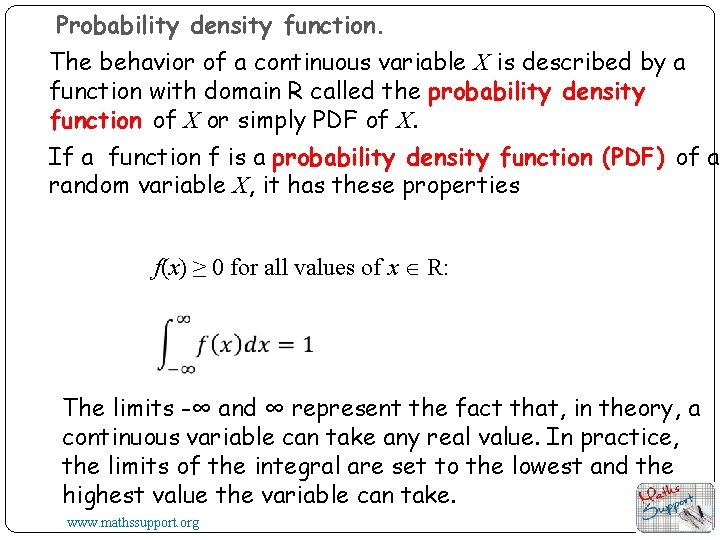
Probability density function. The behavior of a continuous variable X is described by a function with domain R called the probability density function of X or simply PDF of X. If a function f is a probability density function (PDF) of a random variable X, it has these properties f(x) ≥ 0 for all values of x R: The limits -∞ and ∞ represent the fact that, in theory, a continuous variable can take any real value. In practice, the limits of the integral are set to the lowest and the highest value the variable can take. www. mathssupport. org
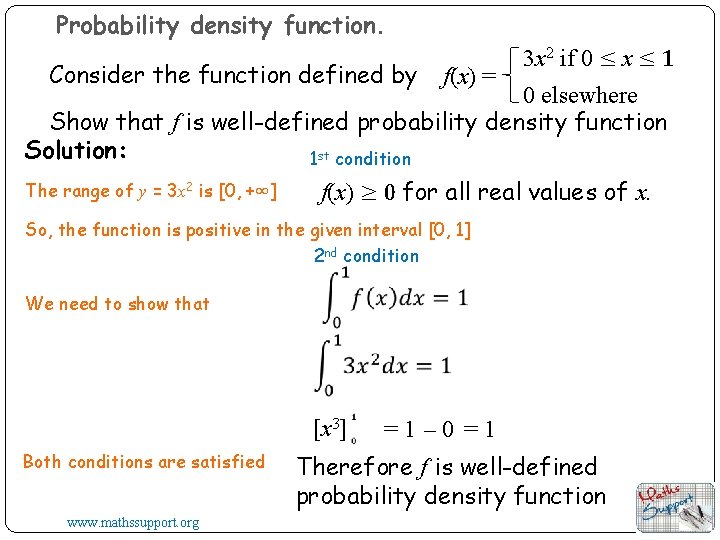
Probability density function. Consider the function defined by f(x) = 3 x 2 if 0 ≤ x ≤ 1 0 elsewhere Show that f is well-defined probability density function Solution: 1 st condition The range of y = 3 x 2 is [0, +∞] f(x) ≥ 0 for all real values of x. So, the function is positive in the given interval [0, 1] 2 nd condition We need to show that [x 3] Both conditions are satisfied www. mathssupport. org =1 – 0 =1 Therefore f is well-defined probability density function

Thank you for using resources from For more resources visit our website https: //www. mathssupport. org If you have a special request, drop us an email info@mathssupport. org www. mathssupport. org
- Slides: 7