
19 December 2021 An Inspector Calls dramatic Tension
19 December 2021 An Inspector Calls dramatic Tension § § To understand the meaning and purpose of dramatic tension To explore how and why Priestley uses tension in the play v Dramatic techniques v Tension “Why – you fool – he knows. Of course he knows. And I hate to think how much he knows that we don't know yet. You'll see. ”
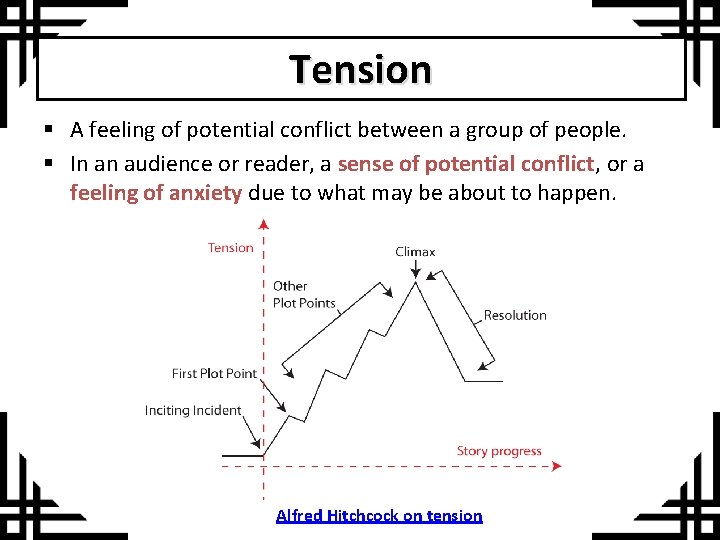
Tension § A feeling of potential conflict between a group of people. § In an audience or reader, a sense of potential conflict, or a feeling of anxiety due to what may be about to happen. Alfred Hitchcock on tension
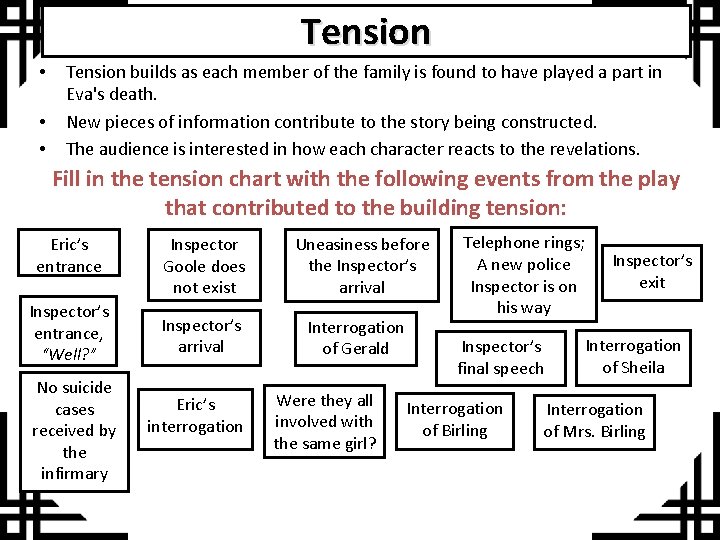
Tension • • • Tension builds as each member of the family is found to have played a part in Eva's death. New pieces of information contribute to the story being constructed. The audience is interested in how each character reacts to the revelations. Fill in the tension chart with the following events from the play that contributed to the building tension: Eric’s entrance Inspector’s entrance, “Well? ” No suicide cases received by the infirmary Inspector Goole does not exist Inspector’s arrival Eric’s interrogation Uneasiness before the Inspector’s arrival Interrogation of Gerald Were they all involved with the same girl? Telephone rings; A new police Inspector is on his way Inspector’s final speech Interrogation of Birling Inspector’s exit Interrogation of Sheila Interrogation of Mrs. Birling
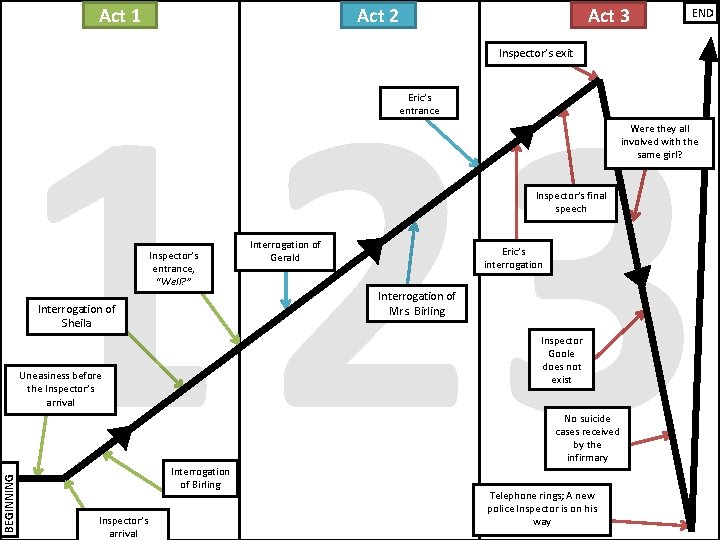
Act 1 Act 2 Act 3 END 1 23 Inspector’s exit Eric’s entrance Were they all involved with the same girl? Inspector’s final speech Inspector’s entrance, “Well? ” Inspector Goole does not exist Uneasiness before the Inspector’s arrival BEGINNING Eric’s interrogation Interrogation of Mrs. Birling Interrogation of Sheila Interrogation of Birling Inspector’s arrival Interrogation of Gerald No suicide cases received by the infirmary Telephone rings; A new police Inspector is on his way
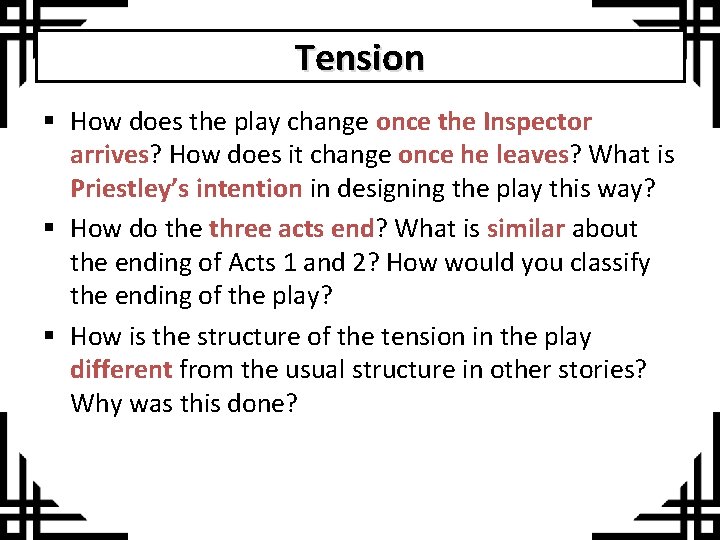
Tension § How does the play change once the Inspector arrives? How does it change once he leaves? What is Priestley’s intention in designing the play this way? § How do the three acts end? What is similar about the ending of Acts 1 and 2? How would you classify the ending of the play? § How is the structure of the tension in the play different from the usual structure in other stories? Why was this done?
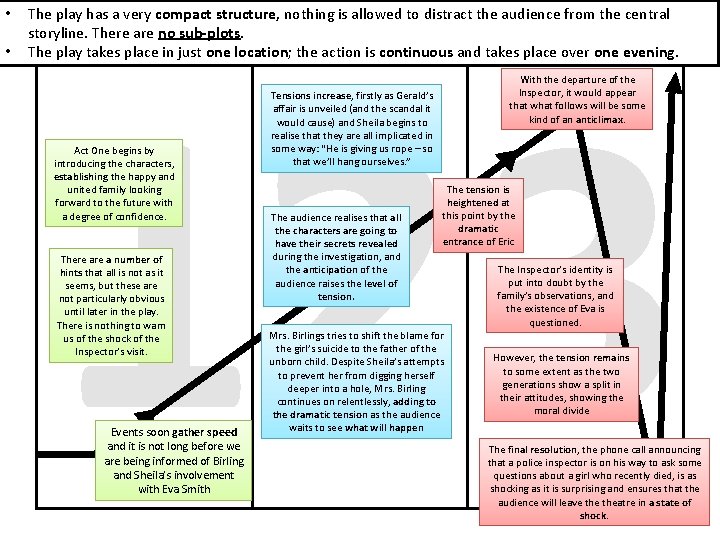
• • The play has a very compact structure, nothing is allowed to distract the audience from the central storyline. There are no sub-plots. The play takes place in just one location; the action is continuous and takes place over one evening. 123 Act One begins by introducing the characters, establishing the happy and united family looking forward to the future with a degree of confidence. There a number of hints that all is not as it seems, but these are not particularly obvious until later in the play. There is nothing to warn us of the shock of the Inspector’s visit. Events soon gather speed and it is not long before we are being informed of Birling and Sheila’s involvement with Eva Smith With the departure of the Inspector, it would appear that what follows will be some kind of an anticlimax. Tensions increase, firstly as Gerald’s affair is unveiled (and the scandal it would cause) and Sheila begins to realise that they are all implicated in some way: “He is giving us rope – so that we’ll hang ourselves. ” The audience realises that all the characters are going to have their secrets revealed during the investigation, and the anticipation of the audience raises the level of tension. The tension is heightened at this point by the dramatic entrance of Eric Mrs. Birlings tries to shift the blame for the girl’s suicide to the father of the unborn child. Despite Sheila’s attempts to prevent her from digging herself deeper into a hole, Mrs. Birling continues on relentlessly, adding to the dramatic tension as the audience waits to see what will happen The Inspector’s identity is put into doubt by the family’s observations, and the existence of Eva is questioned. However, the tension remains to some extent as the two generations show a split in their attitudes, showing the moral divide The final resolution, the phone call announcing that a police inspector is on his way to ask some questions about a girl who recently died, is as shocking as it is surprising and ensures that the audience will leave theatre in a state of shock.
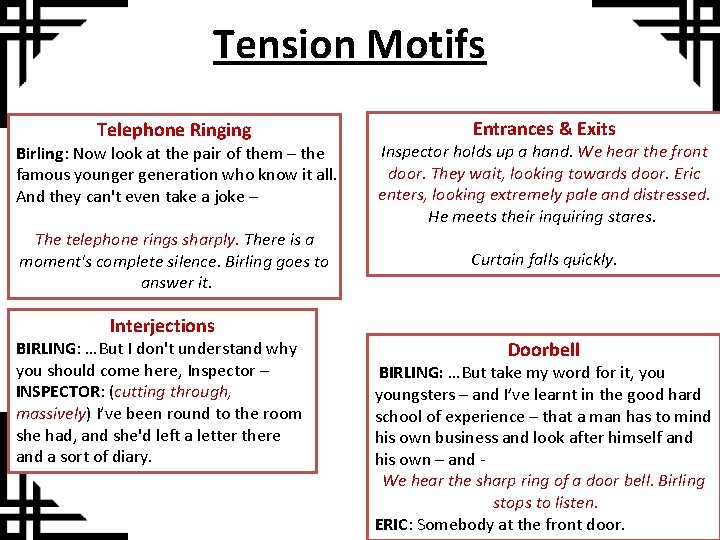
Tension Motifs Telephone Ringing Birling: Now look at the pair of them – the famous younger generation who know it all. And they can't even take a joke – The telephone rings sharply. There is a moment's complete silence. Birling goes to answer it. Interjections BIRLING: …But I don't understand why you should come here, Inspector – INSPECTOR: (cutting through, massively) I’ve been round to the room she had, and she'd left a letter there and a sort of diary. Entrances & Exits Inspector holds up a hand. We hear the front door. They wait, looking towards door. Eric enters, looking extremely pale and distressed. He meets their inquiring stares. Curtain falls quickly. Doorbell BIRLING: …But take my word for it, youngsters – and I’ve learnt in the good hard school of experience – that a man has to mind his own business and look after himself and his own – and We hear the sharp ring of a door bell. Birling stops to listen. ERIC: Somebody at the front door.
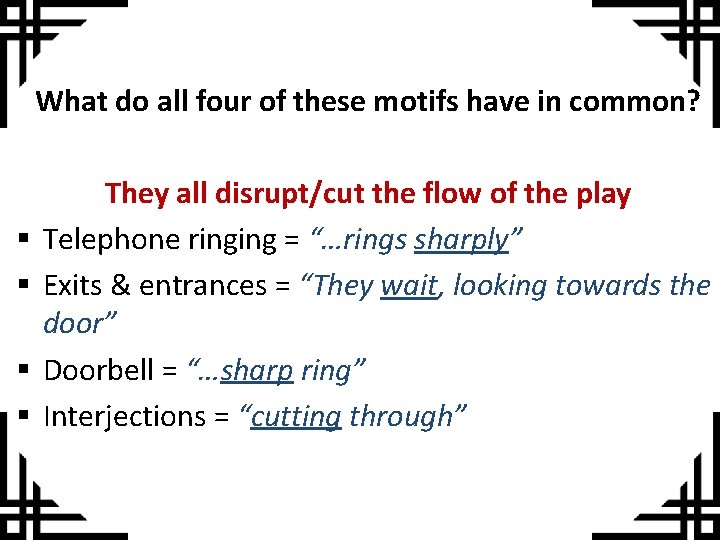
What do all four of these motifs have in common? § § They all disrupt/cut the flow of the play Telephone ringing = “…rings sharply” Exits & entrances = “They wait, looking towards the door” Doorbell = “…sharp ring” Interjections = “cutting through”
Dramatic Tension Essay Choose one of the four motifs of tension that are used in the play, and write an essay exploring the use and effect of the motif on the play: How does Priestley create tension in the play?
![How does Priestley create tension in the play? P = Priestley uses [tension motif]](http://slidetodoc.com/presentation_image_h2/1a4a0fedeae4e04fc2508e7ba59f499c/image-10.jpg "How does Priestley create tension in the play? P = Priestley uses [tension motif]")
How does Priestley create tension in the play? P = Priestley uses [tension motif] to create dramatic tension. Ev = This can be seen when… Ex = This creates tension because… In addition, it links to the play’s theme of ____ because… L = In the quote, Priestley uses [technique] because… In addition, the word “_______” connotes… Also, the word “______” connotes… A = Priestley creates tension through [tension motif] because… He wanted the audience to feel/think about… For a Level 4+, remember to: q Answer directly the essay question q Focus on your point throughout the paragraph q Repeat keywords q Use 2 -3 quotations to support your point q Explain the connection between the point and the evidence q Discuss how the evidence links to themes/symbols of the play q Explain the purpose of the techniques in your evidence (find 2 -3 techniques) q Explain the connotations of the keywords in your evidence, and link them to the point (2 -3 words) q Link the evidence to the context of 1945/6 (World War II, Suffragette Movement, strikes, socialism/capitalism, Priestley’s life) q Use specific words to answer your question (playwright, connotations, act, themes, symbols, characters, genre)
- Slides: 10