
19 1 EARTHQUAKES FORCES WITHIN EARTH OBJECTIVES STANDARDS
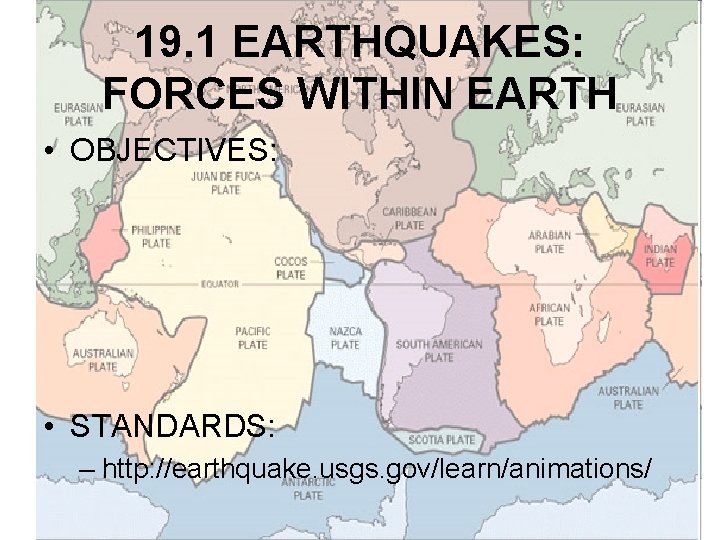
19. 1 EARTHQUAKES: FORCES WITHIN EARTH • OBJECTIVES: • STANDARDS: – http: //earthquake. usgs. gov/learn/animations/
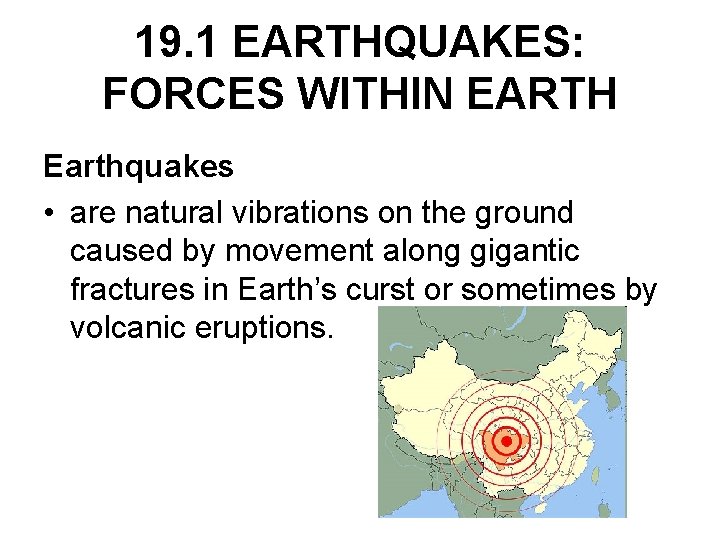
19. 1 EARTHQUAKES: FORCES WITHIN EARTH Earthquakes • are natural vibrations on the ground caused by movement along gigantic fractures in Earth’s curst or sometimes by volcanic eruptions.
2. What is the difference between stress and strain? Stress: • forces per unit area that act on a material • compression, tension and shear. Strain: • deformation of materials in response to stress.
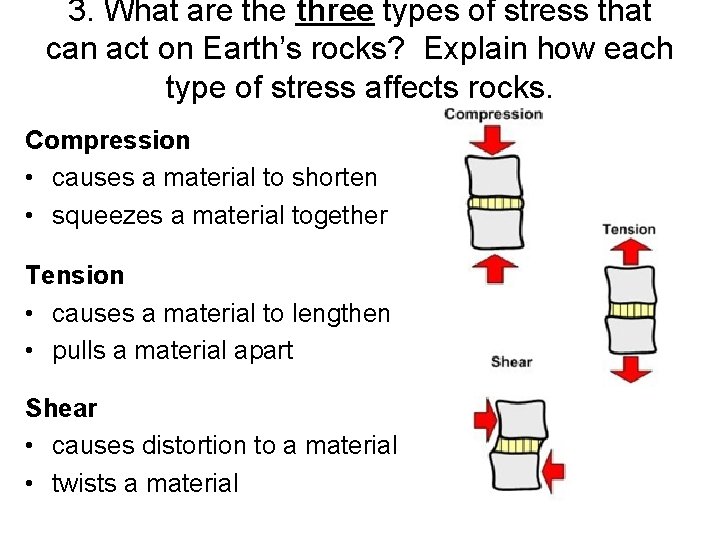
3. What are three types of stress that can act on Earth’s rocks? Explain how each type of stress affects rocks. Compression • causes a material to shorten • squeezes a material together Tension • causes a material to lengthen • pulls a material apart Shear • causes distortion to a material • twists a material
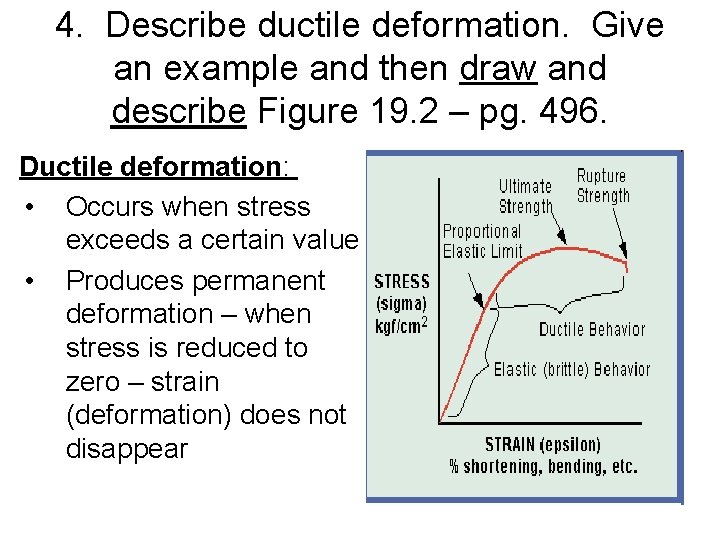
4. Describe ductile deformation. Give an example and then draw and describe Figure 19. 2 – pg. 496. Ductile deformation: • Occurs when stress exceeds a certain value • Produces permanent deformation – when stress is reduced to zero – strain (deformation) does not disappear
Continue #4 Example: • Rubber band being stretched beyond its elastic limit – results in holes, enlarged size, and eventually failure (breaking) – causing rubber band to snap • Brittle material – glass, certain plastics, wood • Ductile material – rubber, silicon putty, metals
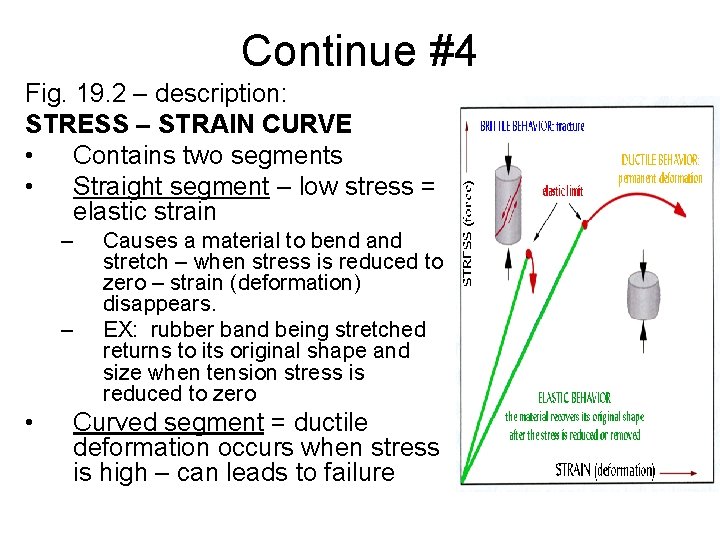
Continue #4 Fig. 19. 2 – description: STRESS – STRAIN CURVE • Contains two segments • Straight segment – low stress = elastic strain – – • Causes a material to bend and stretch – when stress is reduced to zero – strain (deformation) disappears. EX: rubber band being stretched returns to its original shape and size when tension stress is reduced to zero Curved segment = ductile deformation occurs when stress is high – can leads to failure
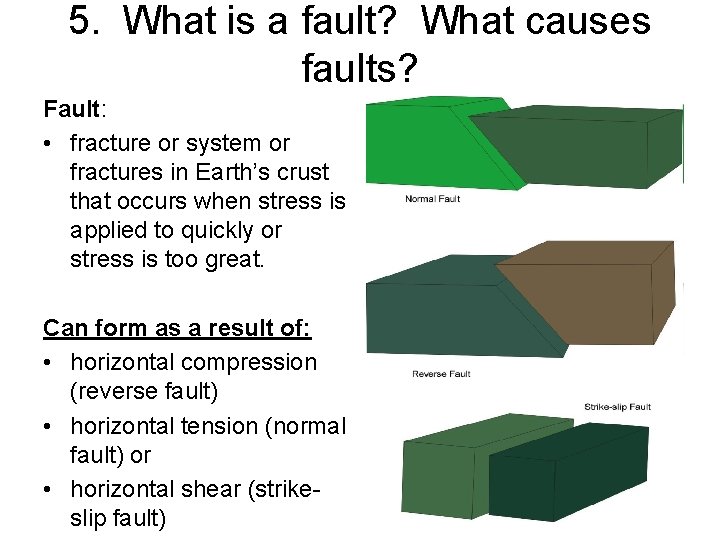
5. What is a fault? What causes faults? Fault: • fracture or system or fractures in Earth’s crust that occurs when stress is applied to quickly or stress is too great. Can form as a result of: • horizontal compression (reverse fault) • horizontal tension (normal fault) or • horizontal shear (strikeslip fault)
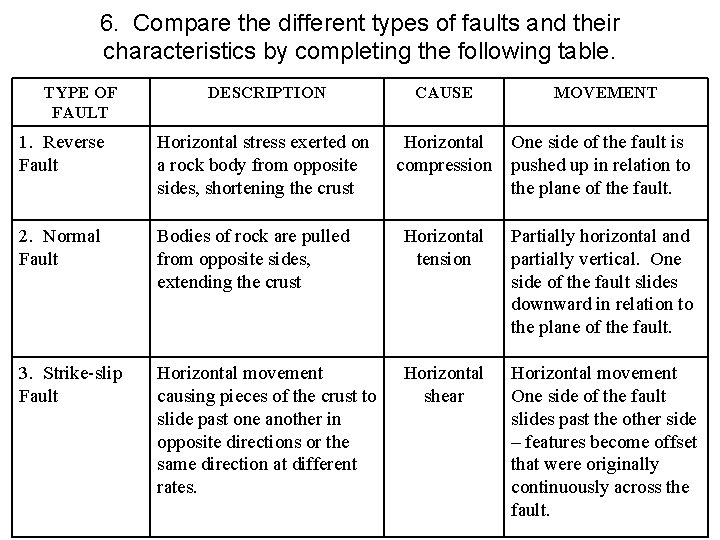
6. Compare the different types of faults and their characteristics by completing the following table. TYPE OF FAULT DESCRIPTION CAUSE MOVEMENT 1. Reverse Fault Horizontal stress exerted on a rock body from opposite sides, shortening the crust Horizontal compression One side of the fault is pushed up in relation to the plane of the fault. 2. Normal Fault Bodies of rock are pulled from opposite sides, extending the crust Horizontal tension Partially horizontal and partially vertical. One side of the fault slides downward in relation to the plane of the fault. 3. Strike-slip Fault Horizontal movement causing pieces of the crust to slide past one another in opposite directions or the same direction at different rates. Horizontal shear Horizontal movement One side of the fault slides past the other side – features become offset that were originally continuously across the fault.
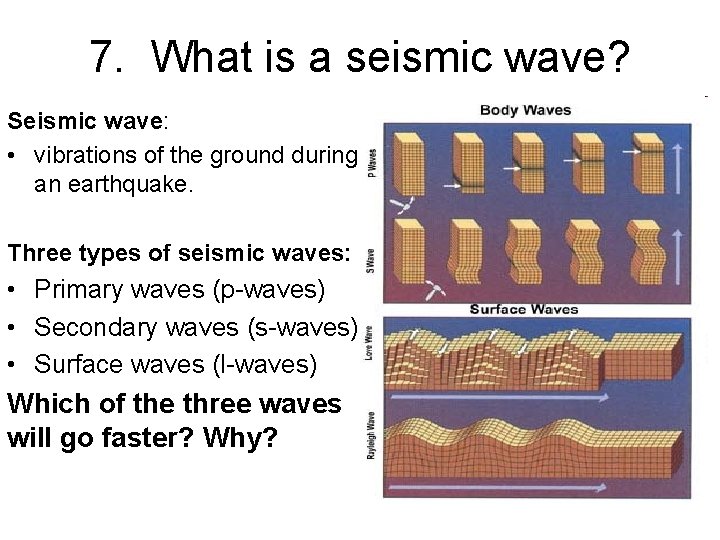
7. What is a seismic wave? Seismic wave: • vibrations of the ground during an earthquake. Three types of seismic waves: • Primary waves (p-waves) • Secondary waves (s-waves) • Surface waves (l-waves) Which of the three waves will go faster? Why?
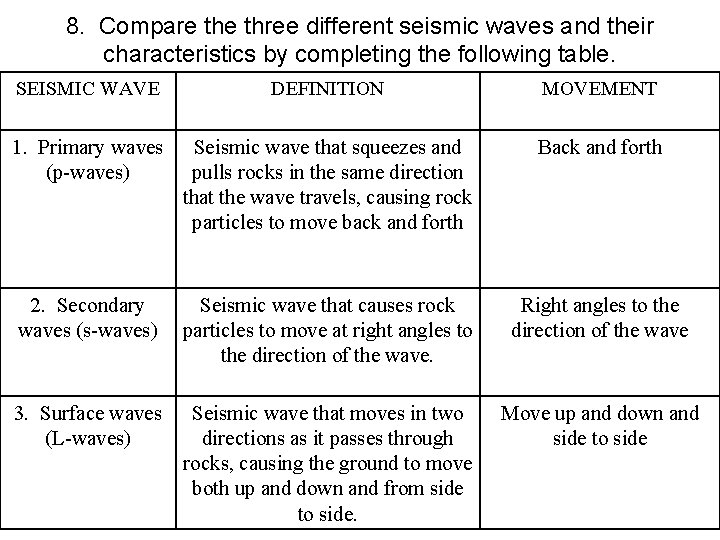
8. Compare three different seismic waves and their characteristics by completing the following table. SEISMIC WAVE DEFINITION MOVEMENT 1. Primary waves (p-waves) Seismic wave that squeezes and pulls rocks in the same direction that the wave travels, causing rock particles to move back and forth Back and forth 2. Secondary waves (s-waves) Seismic wave that causes rock particles to move at right angles to the direction of the wave. Right angles to the direction of the wave 3. Surface waves (L-waves) Seismic wave that moves in two directions as it passes through rocks, causing the ground to move both up and down and from side to side. Move up and down and side to side
Which of the three waves will go faster? Why? Which type of wave will cause more damage?
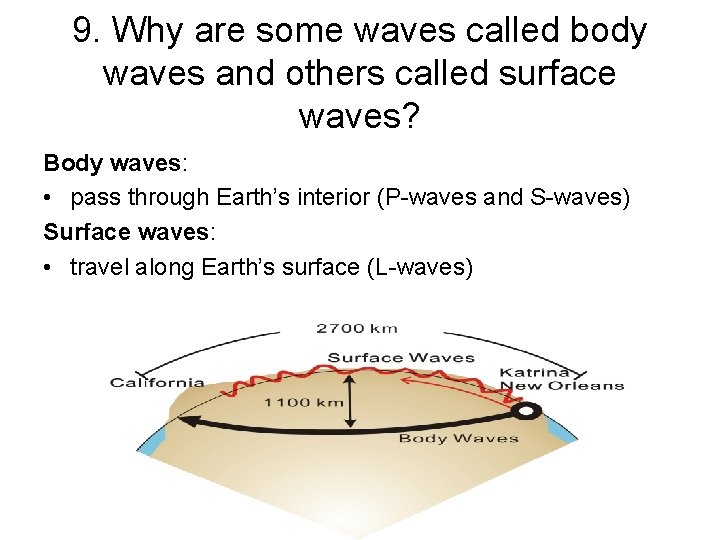
9. Why are some waves called body waves and others called surface waves? Body waves: • pass through Earth’s interior (P-waves and S-waves) Surface waves: • travel along Earth’s surface (L-waves)
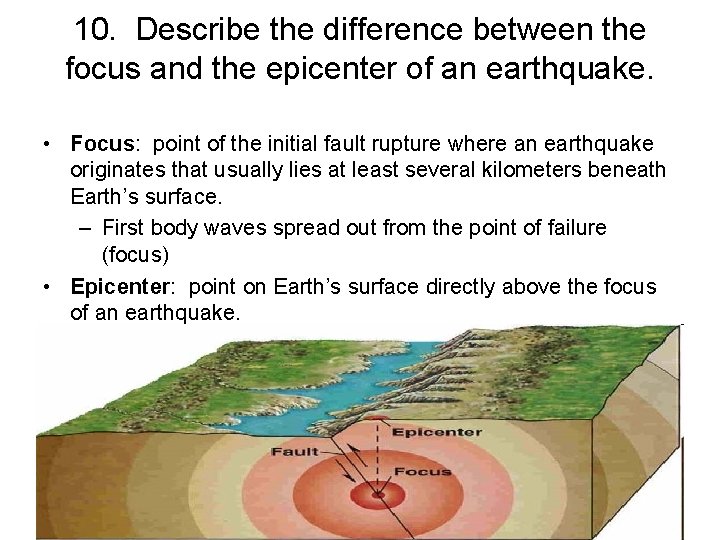
10. Describe the difference between the focus and the epicenter of an earthquake. • Focus: point of the initial fault rupture where an earthquake originates that usually lies at least several kilometers beneath Earth’s surface. – First body waves spread out from the point of failure (focus) • Epicenter: point on Earth’s surface directly above the focus of an earthquake.
- Slides: 14