
18734 Foundations of Privacy Fairness in Classification Anupam







- Slides: 62
18734: Foundations of Privacy Fairness in Classification Anupam Datta With many slides from Moritz Hardt Fall 2017
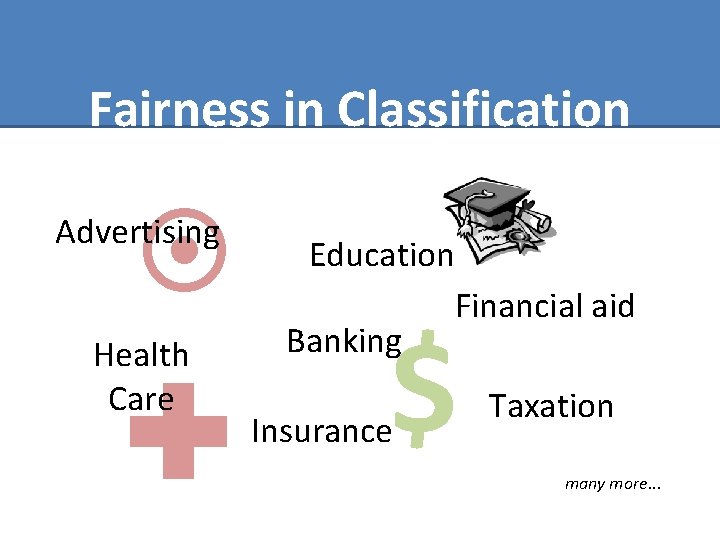
Fairness in Classification Advertising Health Care ✚ Education Financial aid Banking $ Insurance Taxation many more. . .
Concern: Discrimination • Certain attributes should be irrelevant! • Population includes minorities – Ethnic, religious, medical, geographic • Protected by law, policy, ethics
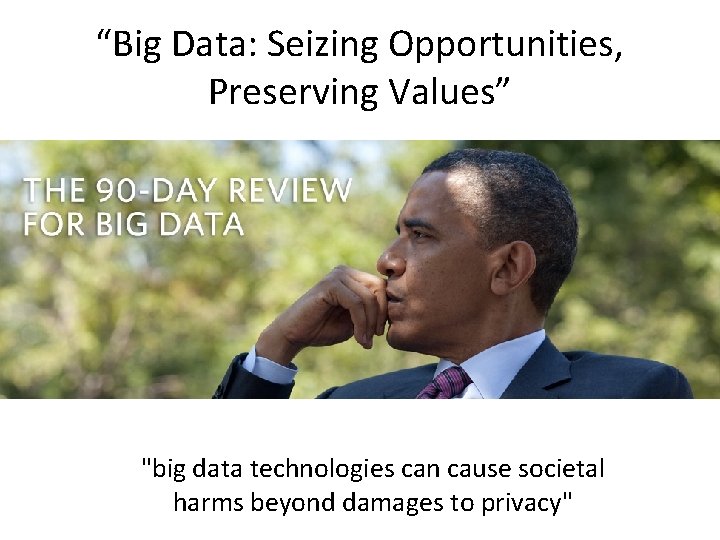
“Big Data: Seizing Opportunities, Preserving Values” "big data technologies can cause societal harms beyond damages to privacy"
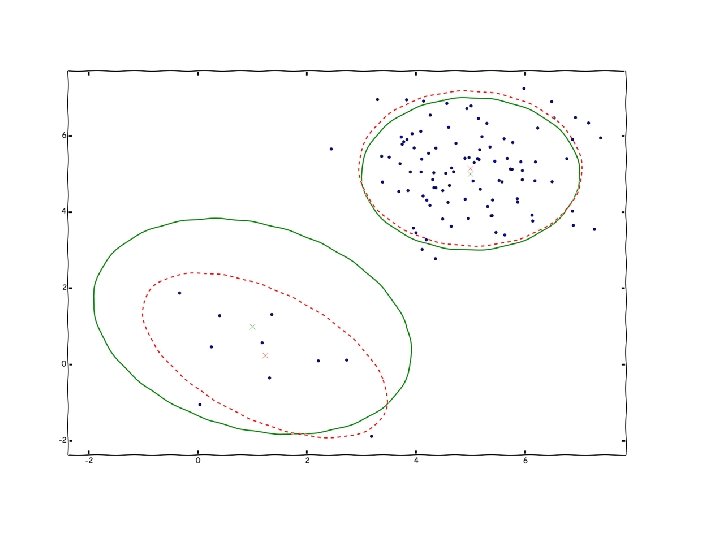
Discrimination arises even when nobody’s evil • Google+ tries to classify real vs fake names • Fairness problem: – Most training examples standard white American names: John, Jennifer, Peter, Jacob, . . . – Ethnic names often unique, much fewer training examples Likely outcome: Prediction accuracy worse on ethnic names “Due to Google's ethnocentricity I was prevented from using my real last name (my nationality is: Tungus and Sami)” - Katya Casio. Google Product Forums.
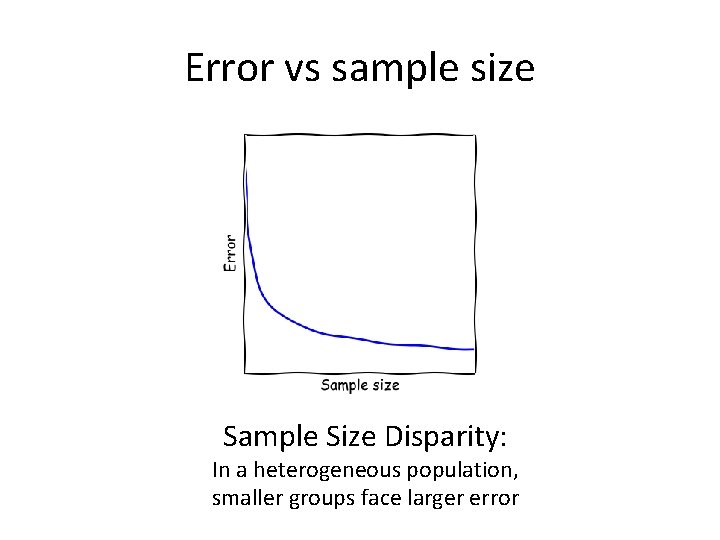
Error vs sample size Sample Size Disparity: In a heterogeneous population, smaller groups face larger error
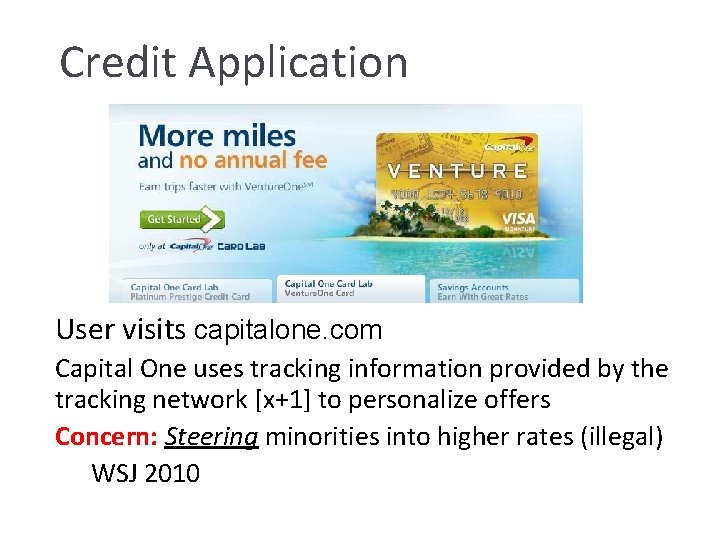
Credit Application User visits capitalone. com Capital One uses tracking information provided by the tracking network [x+1] to personalize offers Concern: Steering minorities into higher rates (illegal) WSJ 2010
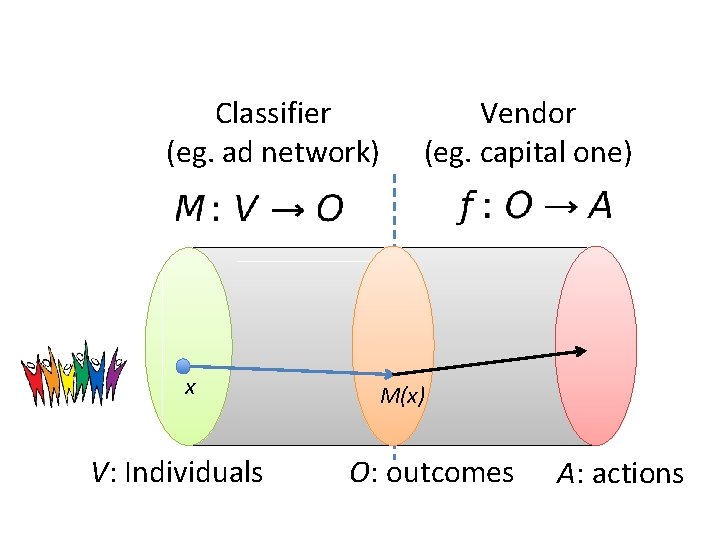
Classifier (eg. ad network) x V: Individuals Vendor (eg. capital one) M(x) O: outcomes A: actions
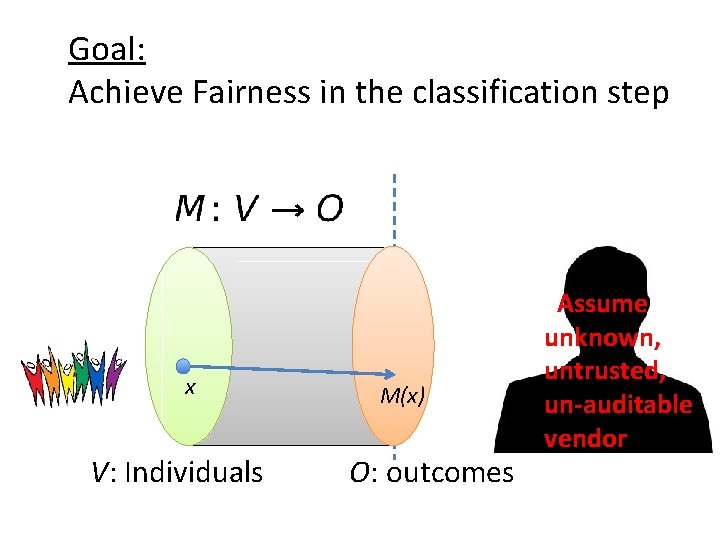
Goal: Achieve Fairness in the classification step x V: Individuals M(x) O: outcomes Assume unknown, untrusted, un-auditable vendor
First attempt…
Fairness through Blindness
Fairness through Blindness Ignore all irrelevant/protected attributes “We don’t even look at ‘race’!”
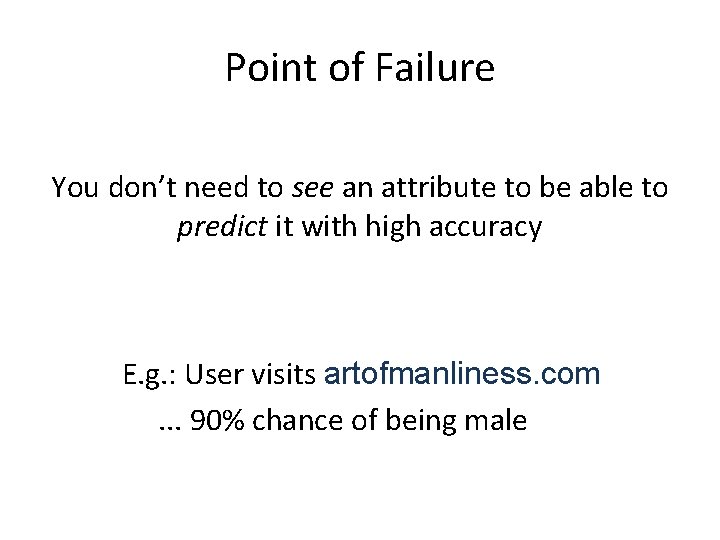
Point of Failure You don’t need to see an attribute to be able to predict it with high accuracy E. g. : User visits artofmanliness. com. . . 90% chance of being male
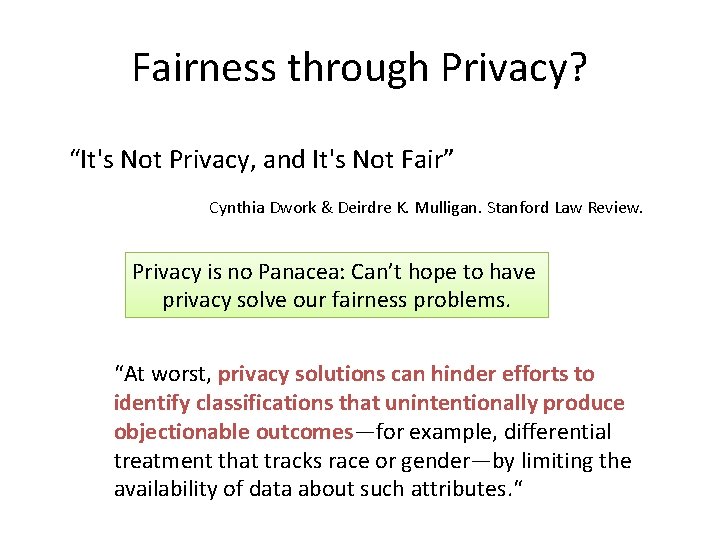
Fairness through Privacy? “It's Not Privacy, and It's Not Fair” Cynthia Dwork & Deirdre K. Mulligan. Stanford Law Review. Privacy is no Panacea: Can’t hope to have privacy solve our fairness problems. “At worst, privacy solutions can hinder efforts to identify classifications that unintentionally produce objectionable outcomes—for example, differential treatment that tracks race or gender—by limiting the availability of data about such attributes. “
Second attempt…
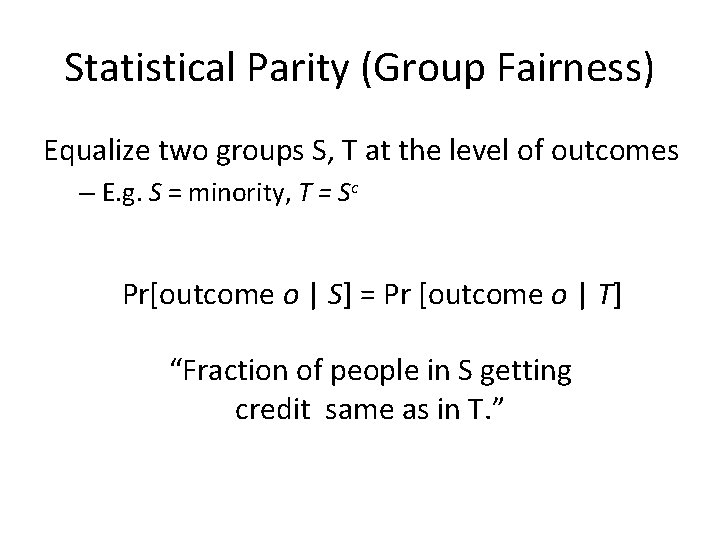
Statistical Parity (Group Fairness) Equalize two groups S, T at the level of outcomes – E. g. S = minority, T = Sc Pr[outcome o | S] = Pr [outcome o | T] “Fraction of people in S getting credit same as in T. ”
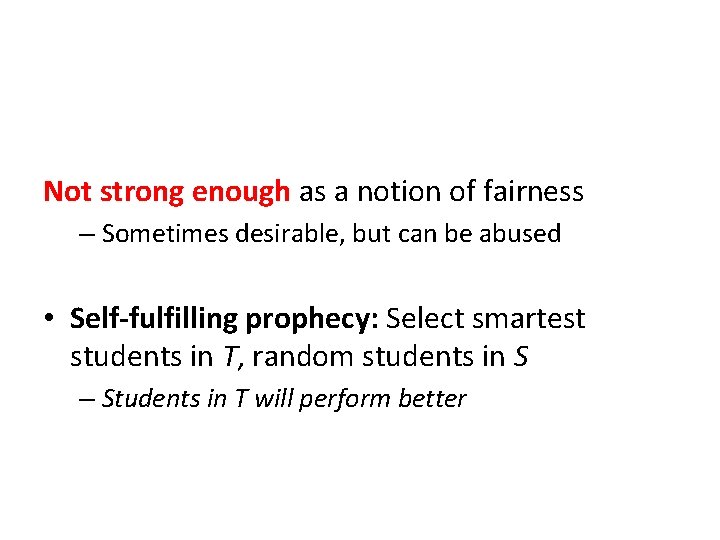
Not strong enough as a notion of fairness – Sometimes desirable, but can be abused • Self-fulfilling prophecy: Select smartest students in T, random students in S – Students in T will perform better
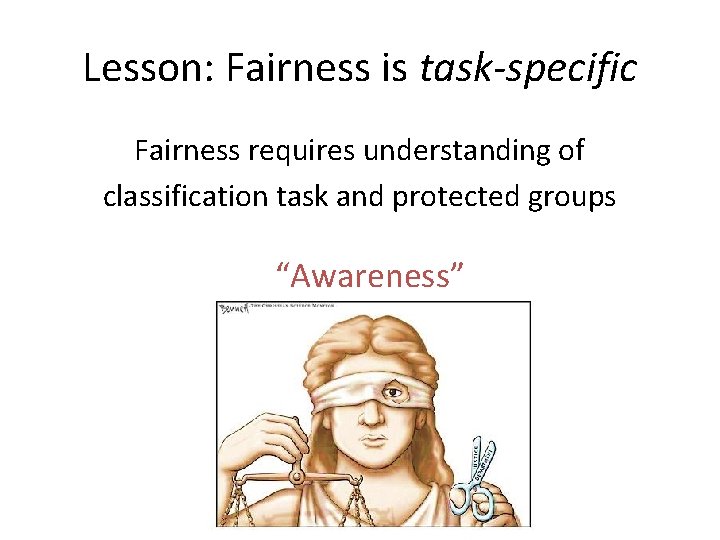
Lesson: Fairness is task-specific Fairness requires understanding of classification task and protected groups “Awareness”
Individual Fairness Approach
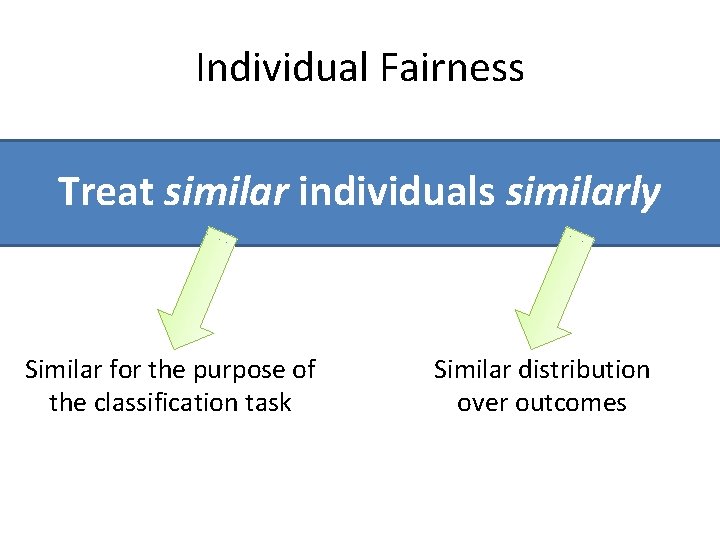
Individual Fairness Treat similar individuals similarly Similar for the purpose of the classification task Similar distribution over outcomes
The Similarity Metric
Metric • Assume task-specific similarity metric – Extent to which two individuals are similar w. r. t. the classification task at hand • Ideally captures ground truth – Or, society’s best approximation • Open to public discussion, refinement – In the spirit of Rawls • Typically, does not suggest classificiation!
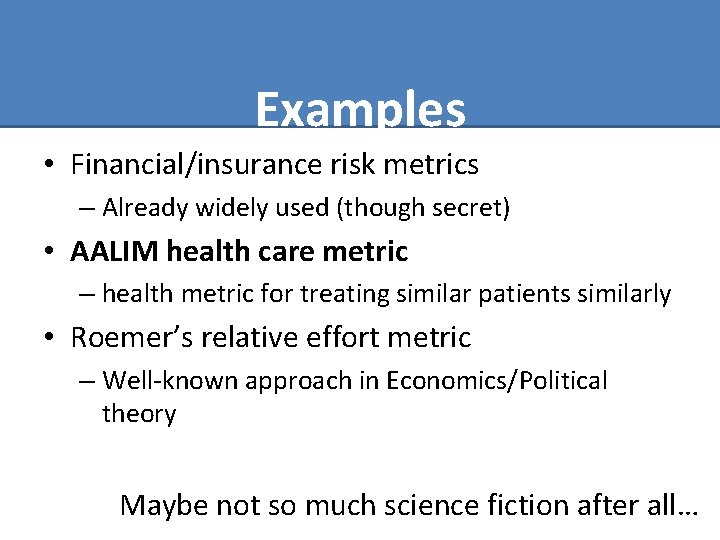
Examples • Financial/insurance risk metrics – Already widely used (though secret) • AALIM health care metric – health metric for treating similar patients similarly • Roemer’s relative effort metric – Well-known approach in Economics/Political theory Maybe not so much science fiction after all…
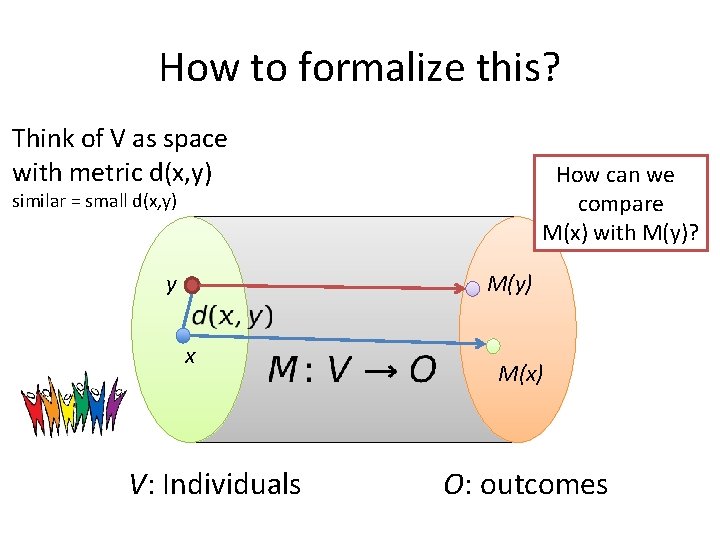
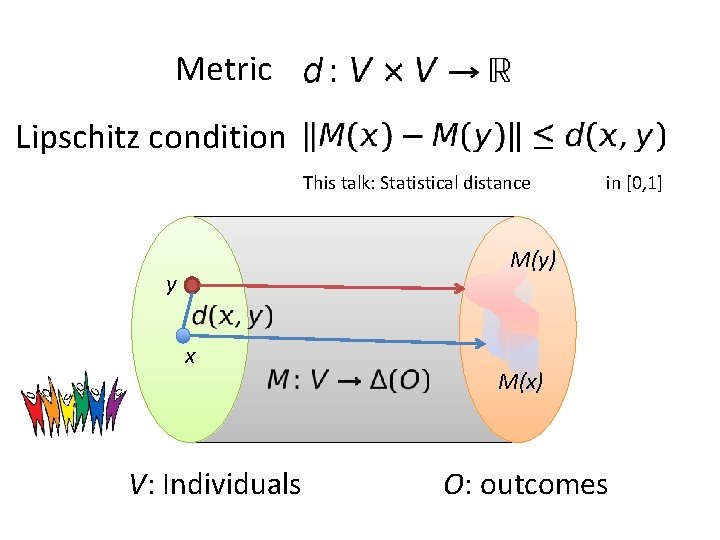
How to formalize this? Think of V as space with metric d(x, y) How can we compare M(x) with M(y)? similar = small d(x, y) y M(y) x V: Individuals M(x) O: outcomes
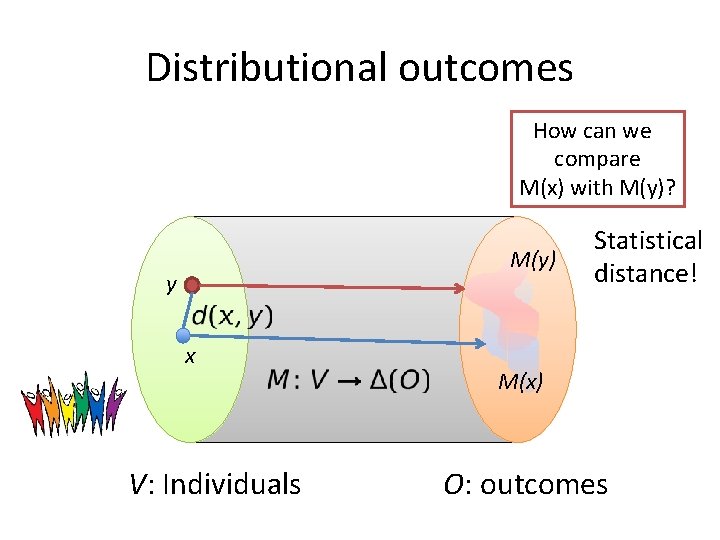
Distributional outcomes How can we compare M(x) with M(y)? M(y) y x V: Individuals Statistical distance! M(x) O: outcomes
Metric Lipschitz condition This talk: Statistical distance in [0, 1] M(y) y x V: Individuals M(x) O: outcomes
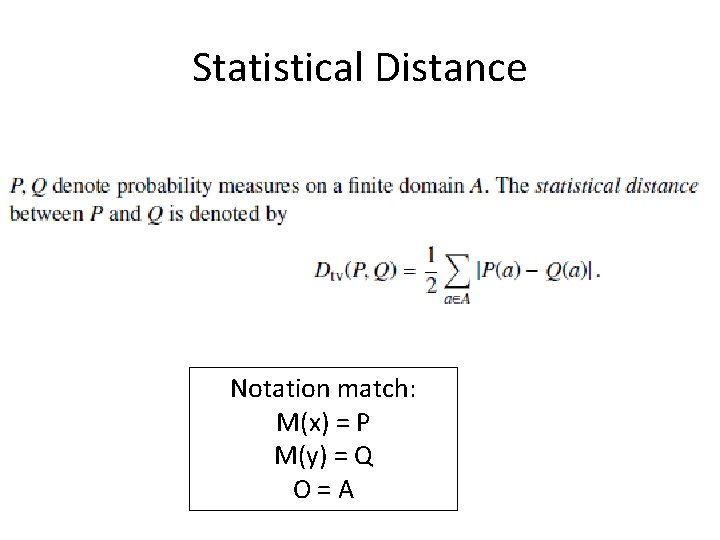
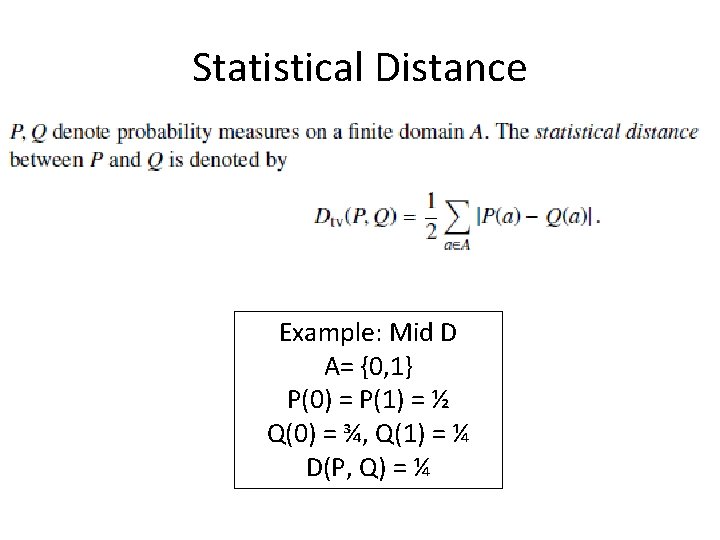
Statistical Distance Notation match: M(x) = P M(y) = Q O=A
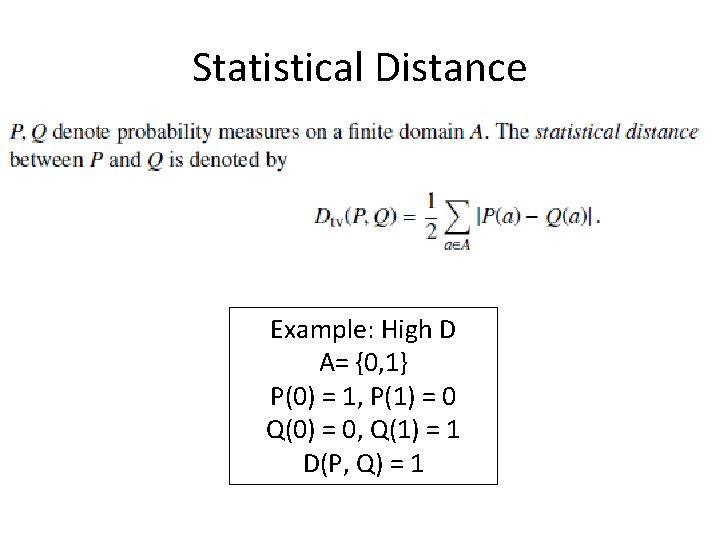
Statistical Distance Example: High D A= {0, 1} P(0) = 1, P(1) = 0 Q(0) = 0, Q(1) = 1 D(P, Q) = 1
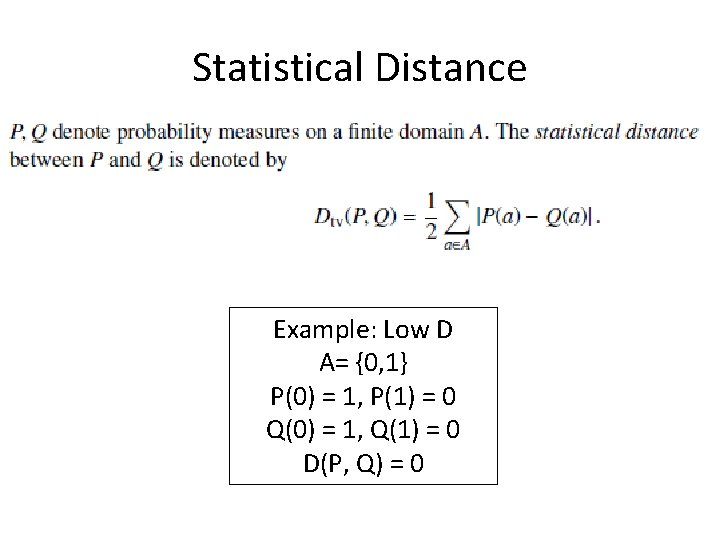
Statistical Distance Example: Low D A= {0, 1} P(0) = 1, P(1) = 0 Q(0) = 1, Q(1) = 0 D(P, Q) = 0
Statistical Distance Example: Mid D A= {0, 1} P(0) = P(1) = ½ Q(0) = ¾, Q(1) = ¼ D(P, Q) = ¼
Existence Proof There exists a classifier that satisfies the Lipschitz condition • Idea: Map all individuals to the same distribution over outcomes • Are we done?
Key elements of approach…
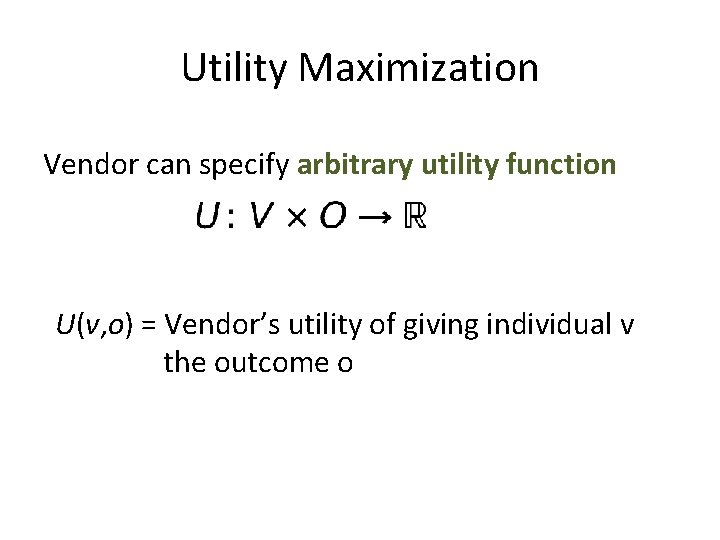
Utility Maximization Vendor can specify arbitrary utility function U(v, o) = Vendor’s utility of giving individual v the outcome o
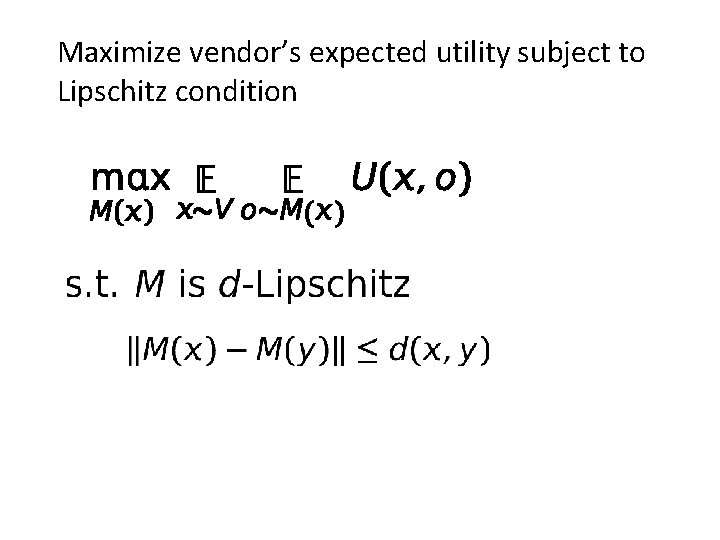
Maximize vendor’s expected utility subject to Lipschitz condition
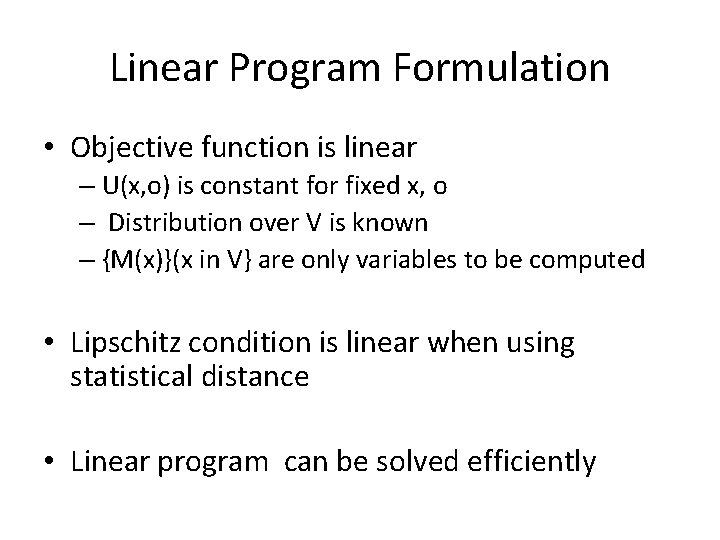
Linear Program Formulation • Objective function is linear – U(x, o) is constant for fixed x, o – Distribution over V is known – {M(x)}(x in V} are only variables to be computed • Lipschitz condition is linear when using statistical distance • Linear program can be solved efficiently
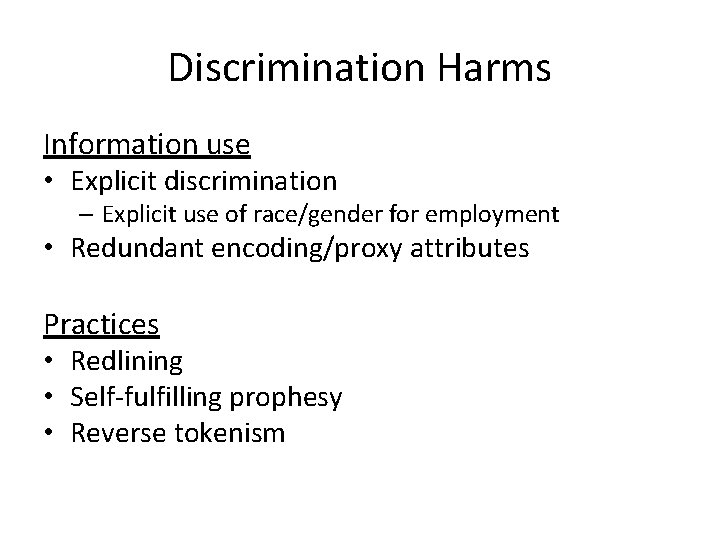
Discrimination Harms Information use • Explicit discrimination – Explicit use of race/gender for employment • Redundant encoding/proxy attributes Practices • Redlining • Self-fulfilling prophesy • Reverse tokenism
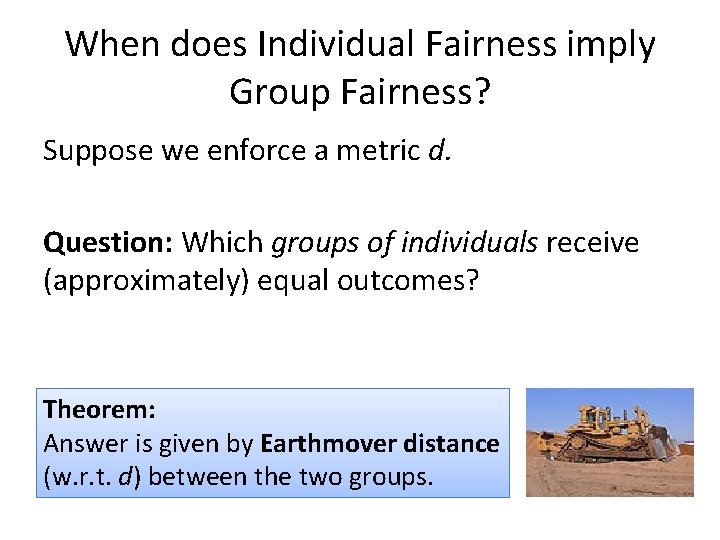
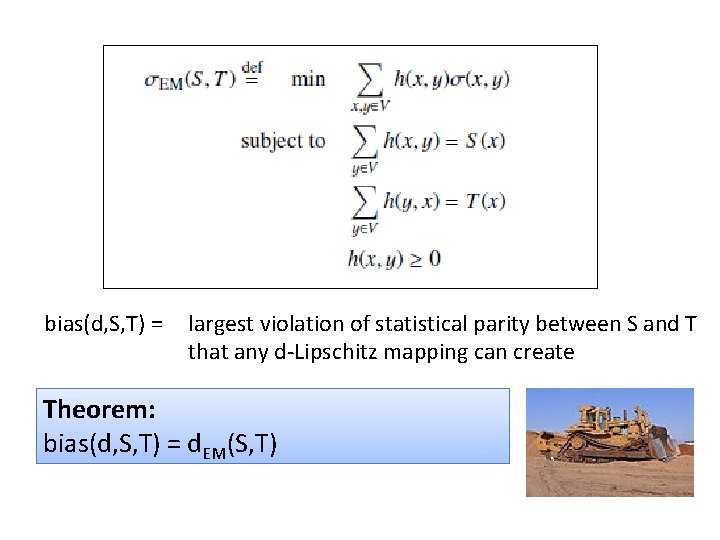
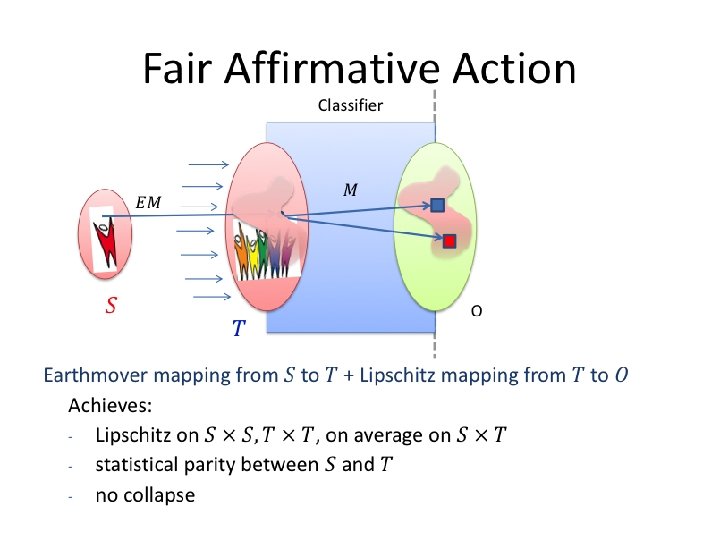
When does Individual Fairness imply Group Fairness? Suppose we enforce a metric d. Question: Which groups of individuals receive (approximately) equal outcomes? Theorem: Answer is given by Earthmover distance (w. r. t. d) between the two groups.
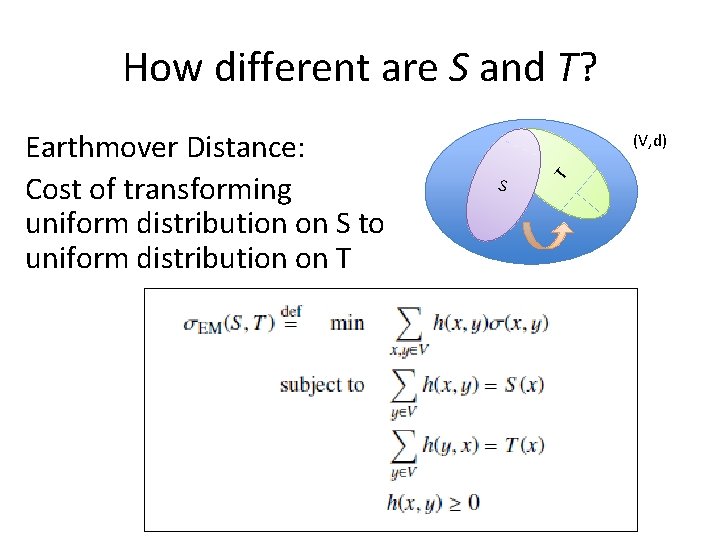
How different are S and T? (V, d) S T Earthmover Distance: Cost of transforming uniform distribution on S to uniform distribution on T
bias(d, S, T) = largest violation of statistical parity between S and T that any d-Lipschitz mapping can create Theorem: bias(d, S, T) = d. EM(S, T)
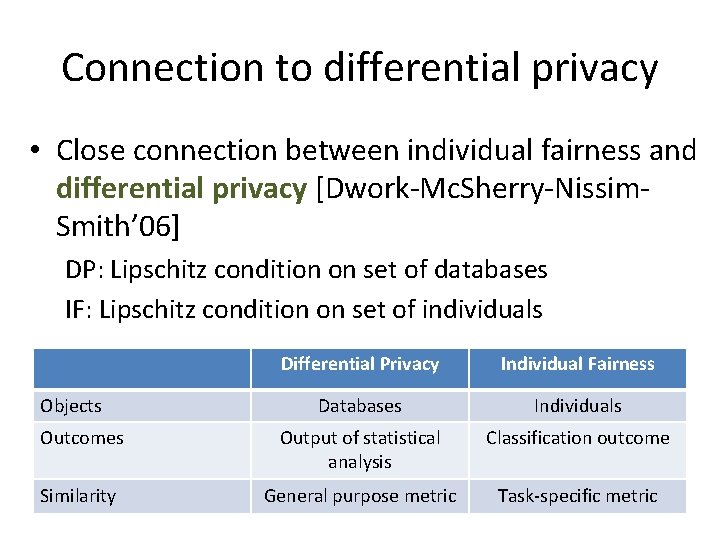
Connection to differential privacy • Close connection between individual fairness and differential privacy [Dwork-Mc. Sherry-Nissim. Smith’ 06] DP: Lipschitz condition on set of databases IF: Lipschitz condition on set of individuals Differential Privacy Individual Fairness Databases Individuals Outcomes Output of statistical analysis Classification outcome Similarity General purpose metric Task-specific metric Objects
Summary: Individual Fairness • Formalized fairness property based on treating similar individuals similarly – Incorporates vendor’s utility • Explored relationship between individual fairness and group fairness – Earthmover distance
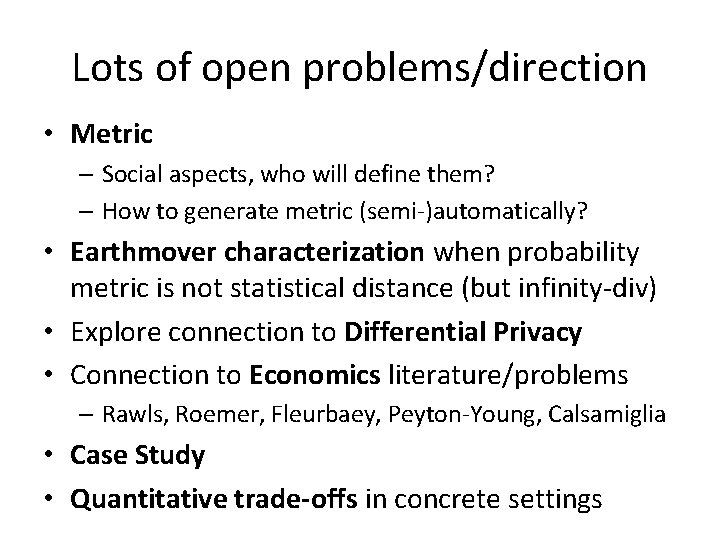
Lots of open problems/direction • Metric – Social aspects, who will define them? – How to generate metric (semi-)automatically? • Earthmover characterization when probability metric is not statistical distance (but infinity-div) • Explore connection to Differential Privacy • Connection to Economics literature/problems – Rawls, Roemer, Fleurbaey, Peyton-Young, Calsamiglia • Case Study • Quantitative trade-offs in concrete settings
Questions?
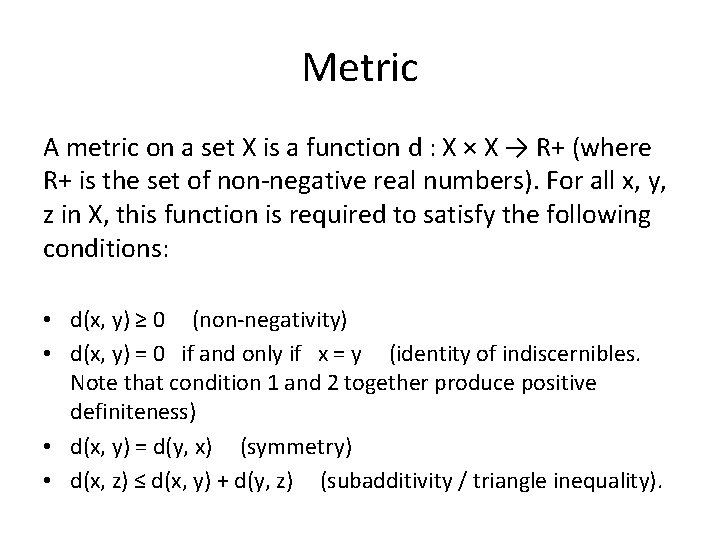
Metric A metric on a set X is a function d : X × X → R+ (where R+ is the set of non-negative real numbers). For all x, y, z in X, this function is required to satisfy the following conditions: • d(x, y) ≥ 0 (non-negativity) • d(x, y) = 0 if and only if x = y (identity of indiscernibles. Note that condition 1 and 2 together produce positive definiteness) • d(x, y) = d(y, x) (symmetry) • d(x, z) ≤ d(x, y) + d(y, z) (subadditivity / triangle inequality).
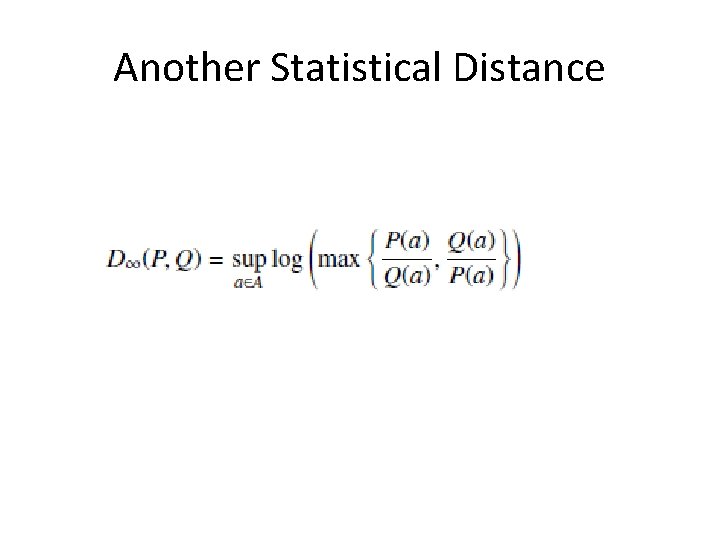
Another Statistical Distance
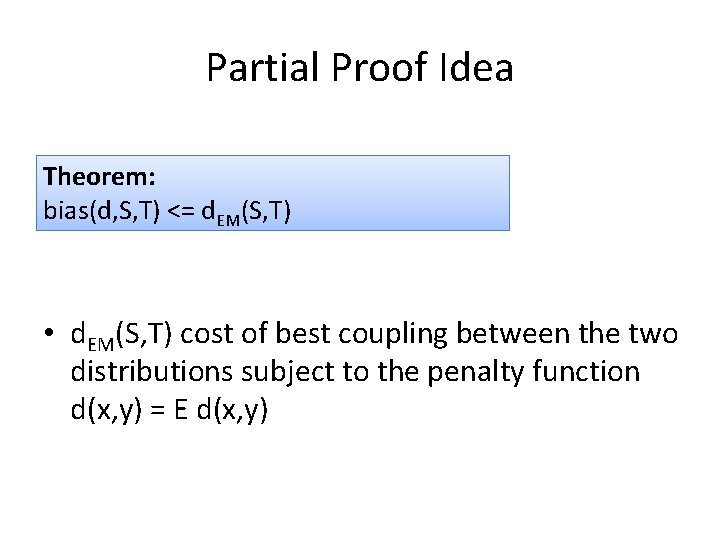
Partial Proof Idea Theorem: bias(d, S, T) <= d. EM(S, T) • d. EM(S, T) cost of best coupling between the two distributions subject to the penalty function d(x, y) = E d(x, y)
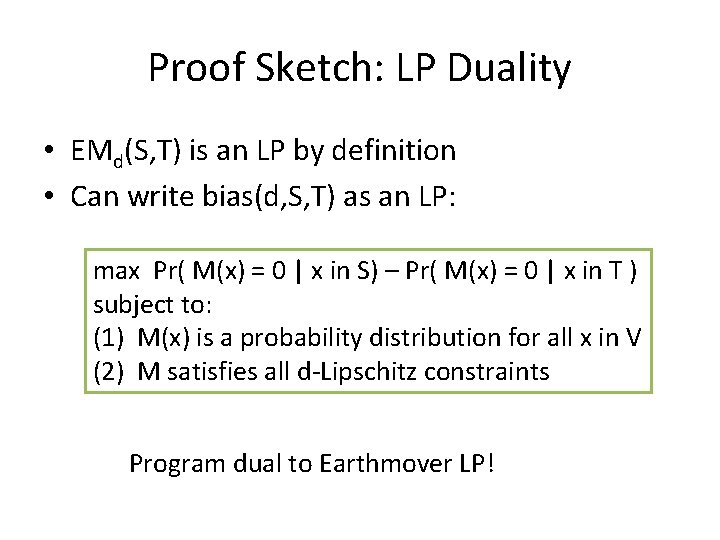
Proof Sketch: LP Duality • EMd(S, T) is an LP by definition • Can write bias(d, S, T) as an LP: max Pr( M(x) = 0 | x in S) – Pr( M(x) = 0 | x in T ) subject to: (1) M(x) is a probability distribution for all x in V (2) M satisfies all d-Lipschitz constraints Program dual to Earthmover LP!
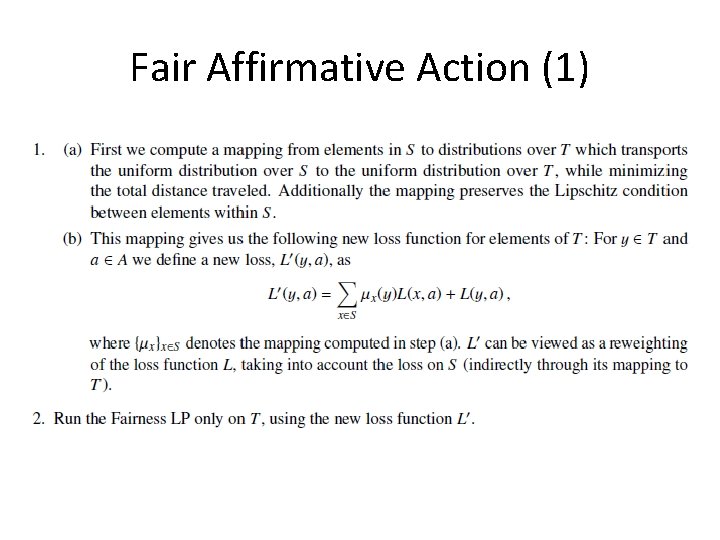
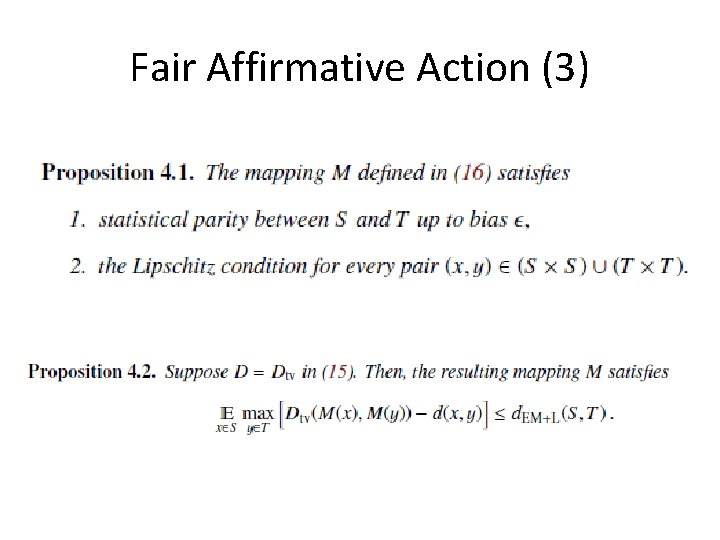
Fair Affirmative Action (1)
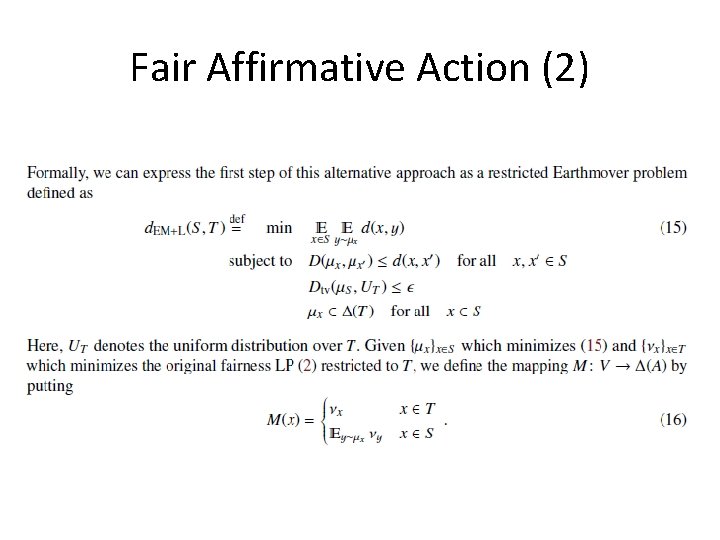
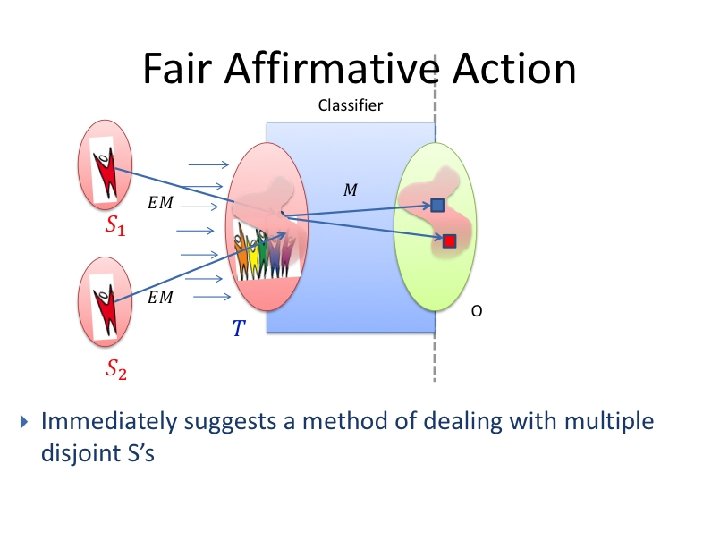
Fair Affirmative Action (2)
Fair Affirmative Action (3)
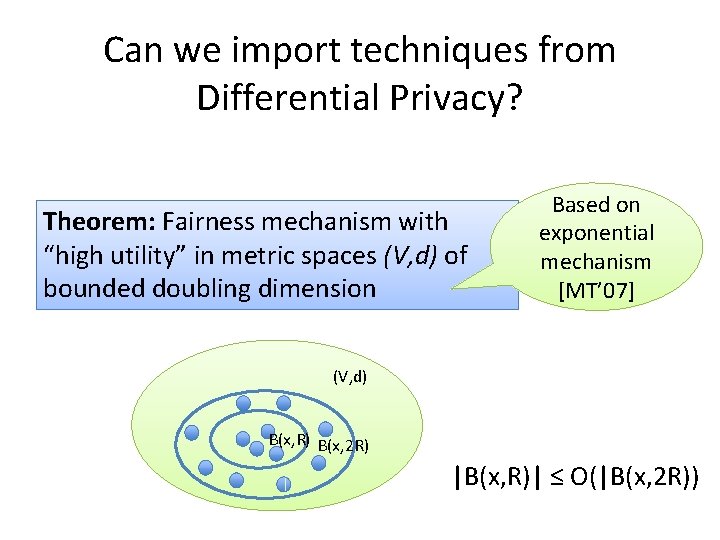
Can we import techniques from Differential Privacy? Theorem: Fairness mechanism with “high utility” in metric spaces (V, d) of bounded doubling dimension Based on exponential mechanism [MT’ 07] (V, d) B(x, R) B(x, 2 R) |B(x, R)| ≤ O(|B(x, 2 R))
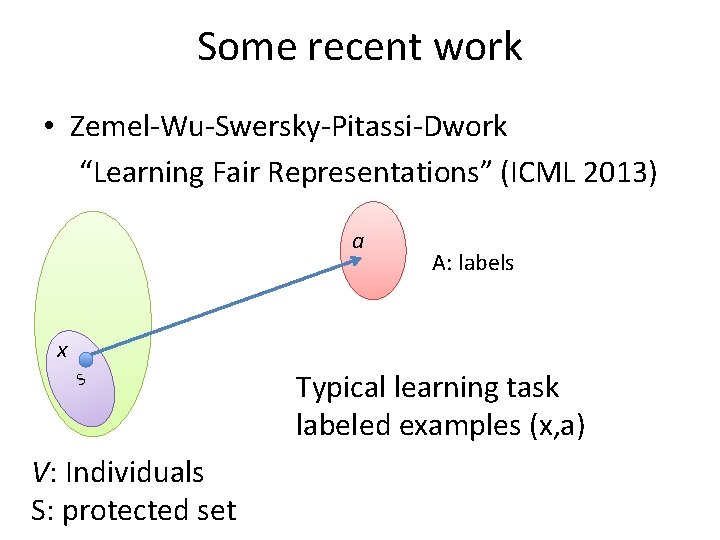
Some recent work • Zemel-Wu-Swersky-Pitassi-Dwork “Learning Fair Representations” (ICML 2013) a A: labels x S V: Individuals S: protected set Typical learning task labeled examples (x, a)
Web Fairness Measurement How do we measure the “fairness of the web”? – Need to model/understand user browsing behavior – Evaluate how web sites respond to different behavior/attributes – Cope with noisy measurements • Exciting progress by Datta, Tschantz
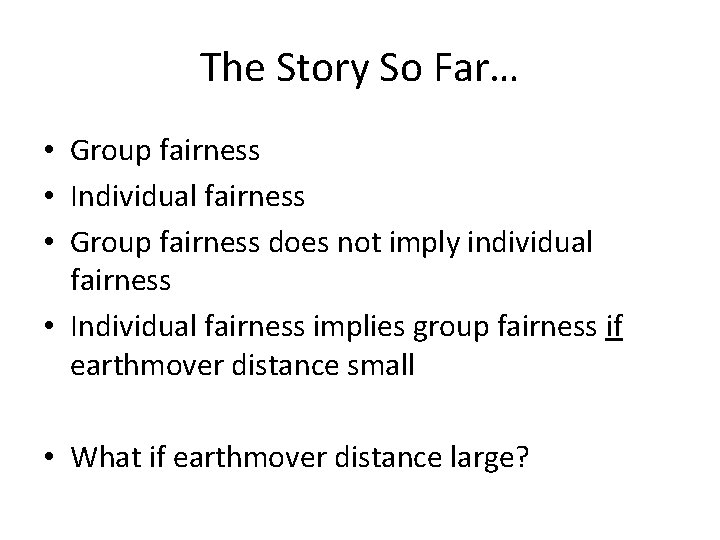
The Story So Far… • Group fairness • Individual fairness • Group fairness does not imply individual fairness • Individual fairness implies group fairness if earthmover distance small • What if earthmover distance large?