
18734 Foundations of Privacy Anonymous Credentials Piotr Mardziel


- Slides: 48
18734: Foundations of Privacy Anonymous Credentials Piotr Mardziel (most slides borrowed from Anupam Datta) CMU Fall 2017
Credentials: Motivation • ID cards – Sometimes used for other uses • E. g. prove you’re over 21, or verify your address – Don’t necessarily need to reveal all of your information – Don’t necessarily want issuer of ID to track all of it’s uses – How can we get the functionality/verifiability of an physical id in electronic form without extra privacy loss 2
Credentials: Motivation • The goal – Users should be able to • Obtain credentials • Show some properties – Without • Revealing additional information • Allowing tracking 3
Credentials: Motivation • Other applications – Transit tokens/passes – Electronic currency (today) – Online polling • Implementations – Idemix (IBM), UProve (Microsoft) 4
5
6
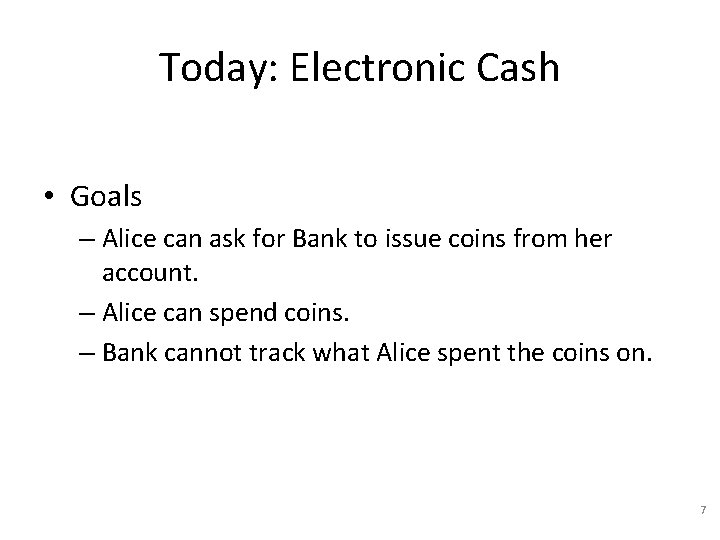
Today: Electronic Cash • Goals – Alice can ask for Bank to issue coins from her account. – Alice can spend coins. – Bank cannot track what Alice spent the coins on. 7
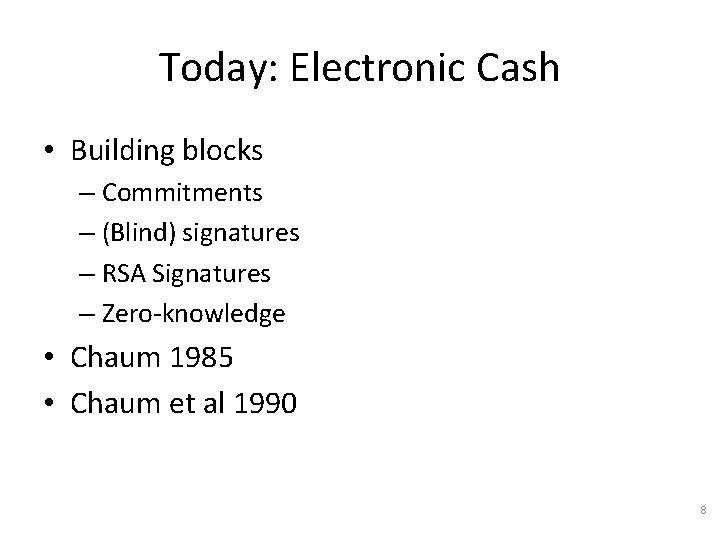
Today: Electronic Cash • Building blocks – Commitments – (Blind) signatures – RSA Signatures – Zero-knowledge • Chaum 1985 • Chaum et al 1990 8
BUILDING BLOCKS
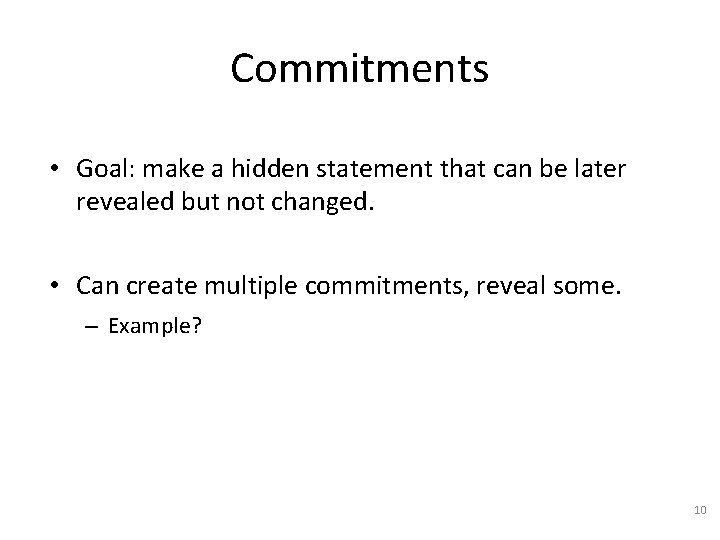
Commitments • Goal: make a hidden statement that can be later revealed but not changed. • Can create multiple commitments, reveal some. – Example? 10
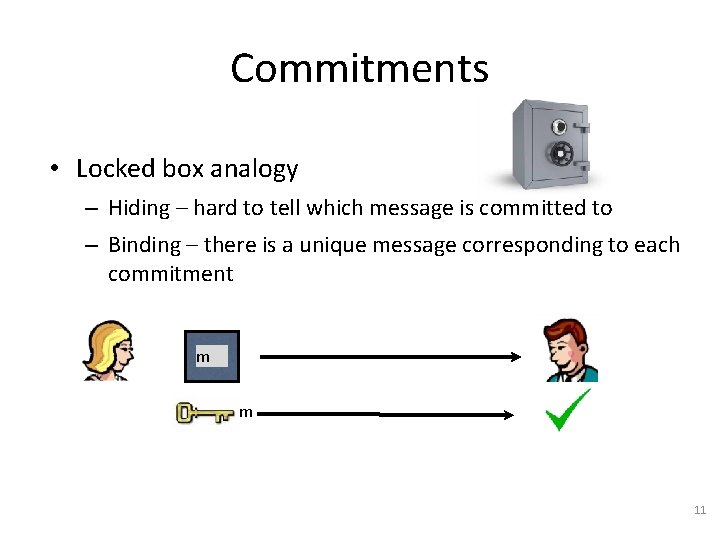
Commitments • Locked box analogy – Hiding – hard to tell which message is committed to – Binding – there is a unique message corresponding to each commitment m m 11
Signatures • Goal: Can sign a message such that everyone else can verify that you have signed it. – Non-forgeable – Independently verifiable 12
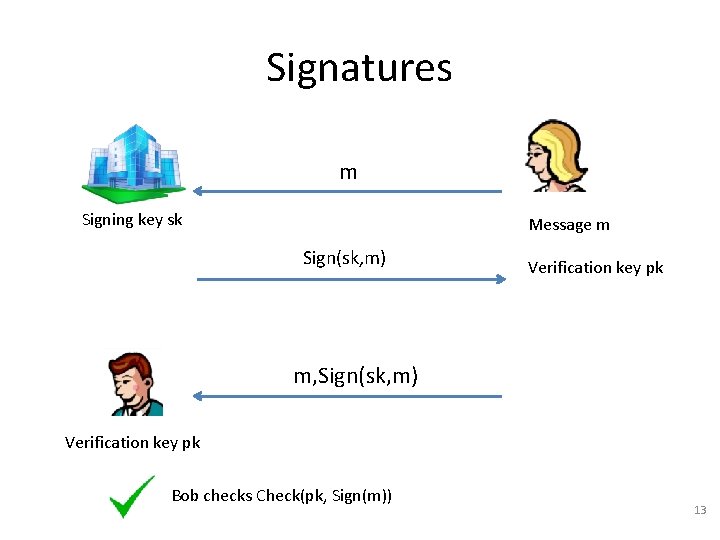
Signatures m Signing key sk Message m Sign(sk, m) Verification key pk m, Sign(sk, m) Verification key pk Bob checks Check(pk, Sign(m)) 13
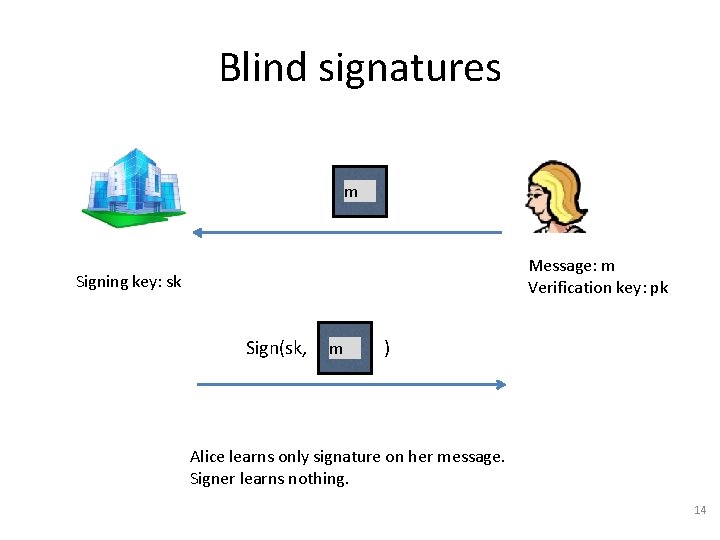
Blind signatures m Message: m Verification key: pk Signing key: sk Sign(sk, m ) Alice learns only signature on her message. Signer learns nothing. 14
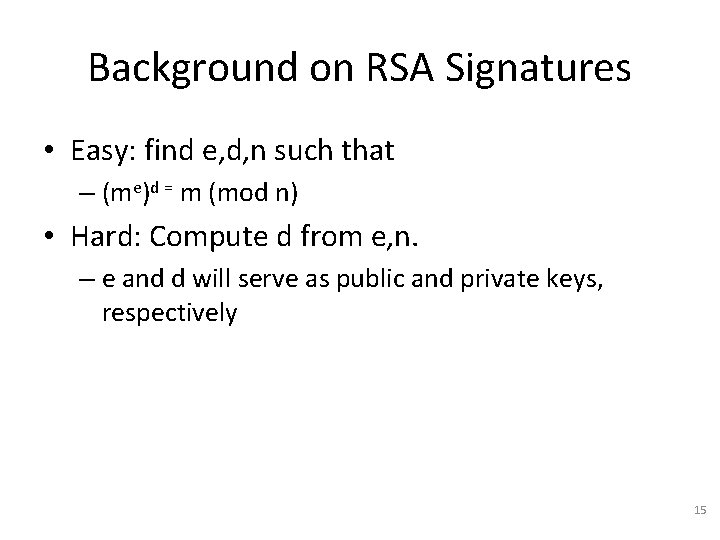
Background on RSA Signatures • Easy: find e, d, n such that – (me)d = m (mod n) • Hard: Compute d from e, n. – e and d will serve as public and private keys, respectively 15
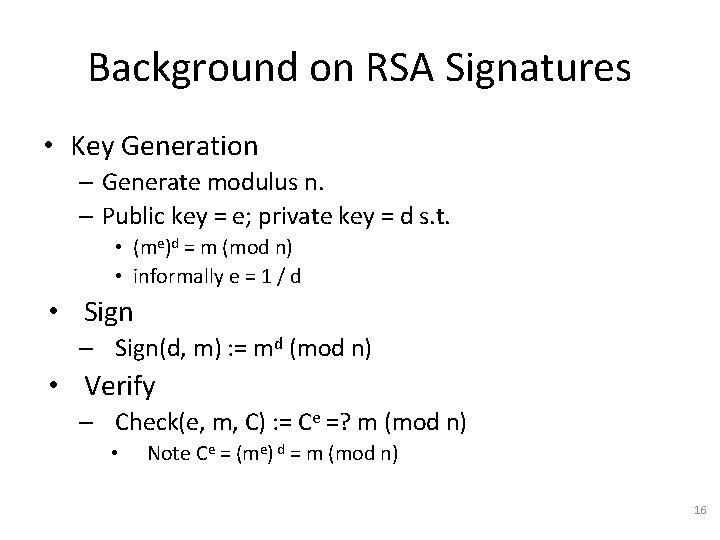
Background on RSA Signatures • Key Generation – Generate modulus n. – Public key = e; private key = d s. t. • (me)d = m (mod n) • informally e = 1 / d • Sign – Sign(d, m) : = md (mod n) • Verify – Check(e, m, C) : = Ce =? m (mod n) • Note Ce = (me) d = m (mod n) 16
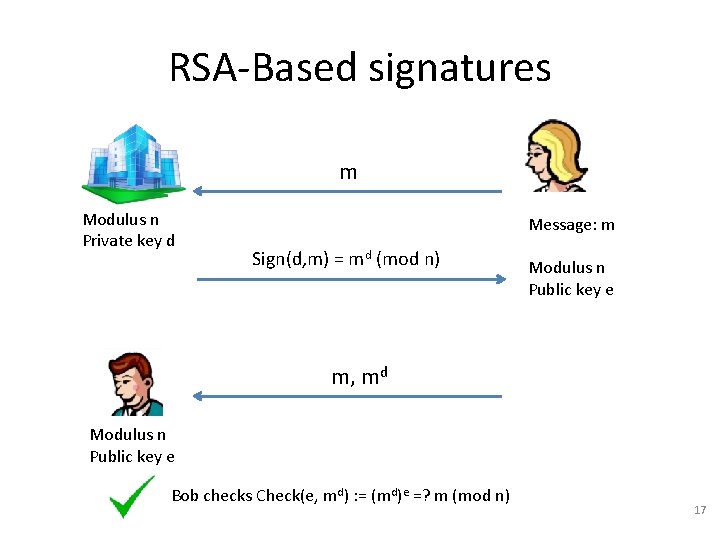
RSA-Based signatures m Modulus n Private key d Message: m Sign(d, m) = md (mod n) Modulus n Public key e m, md Modulus n Public key e Bob checks Check(e, md) : = (md)e =? m (mod n) 17
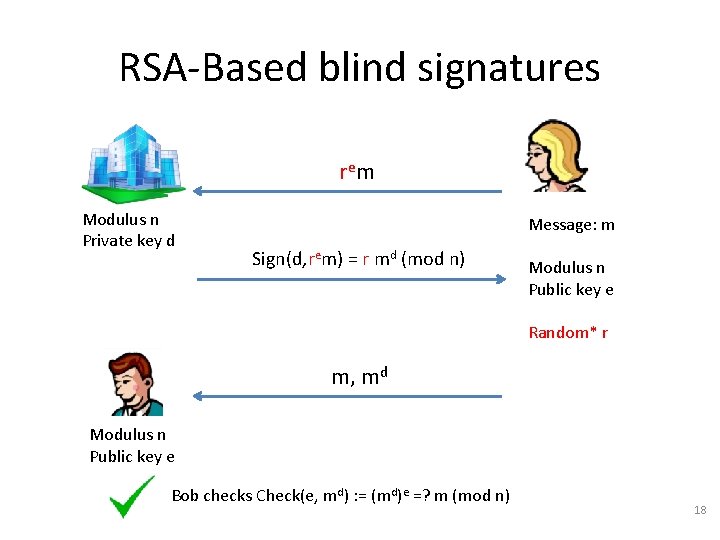
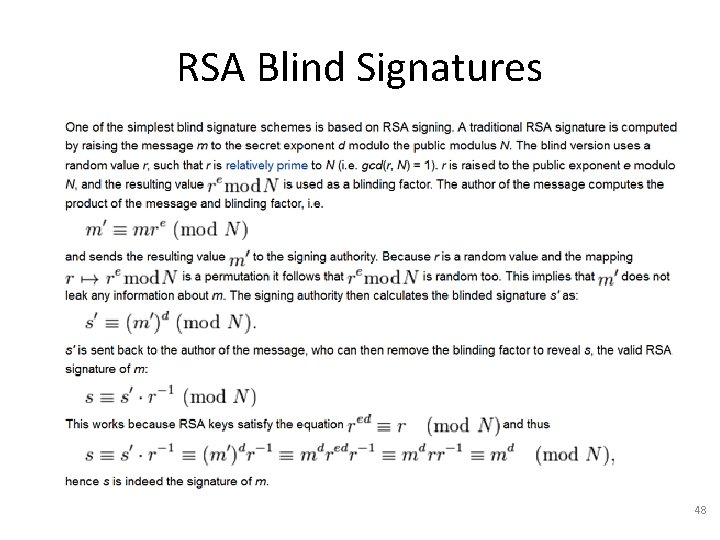
RSA-Based blind signatures r em Modulus n Private key d Message: m Sign(d, rem) = r md (mod n) Modulus n Public key e Random* r m, md Modulus n Public key e Bob checks Check(e, md) : = (md)e =? m (mod n) 18
Security without Identification Transaction Systems to Make Big Brother Obsolete David Chaum 1985 19
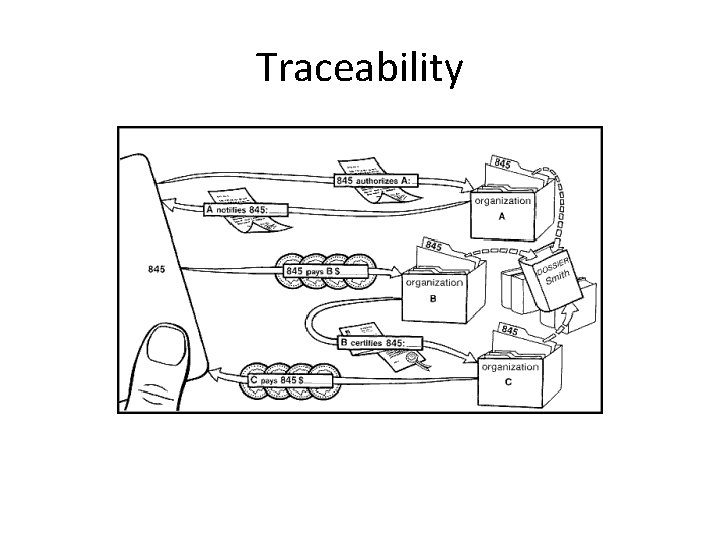
Traceability
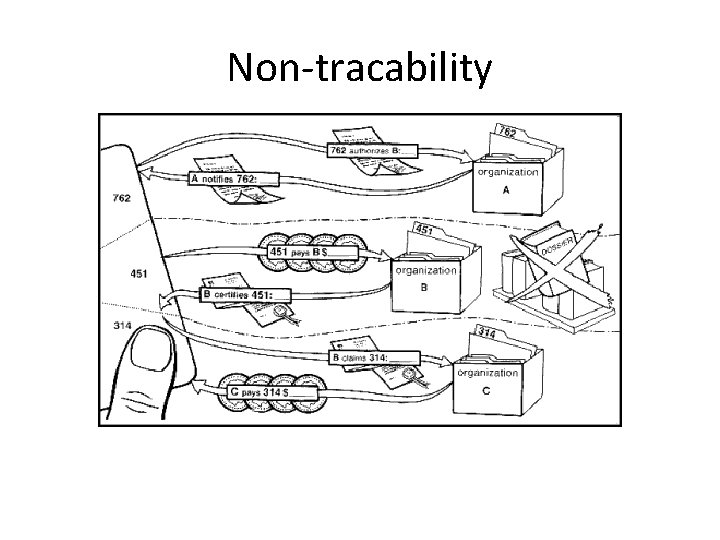
Non-tracability
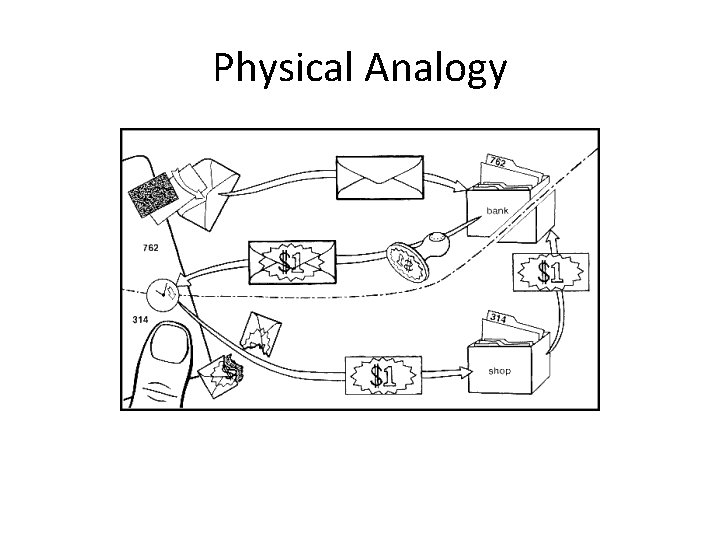
Physical Analogy
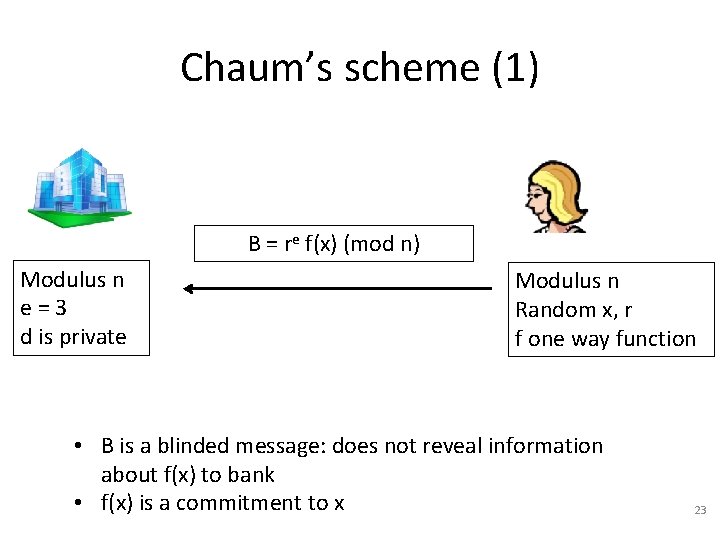
Chaum’s scheme (1) B = re f(x) (mod n) Modulus n e=3 d is private Modulus n Random x, r f one way function • B is a blinded message: does not reveal information about f(x) to bank • f(x) is a commitment to x 23
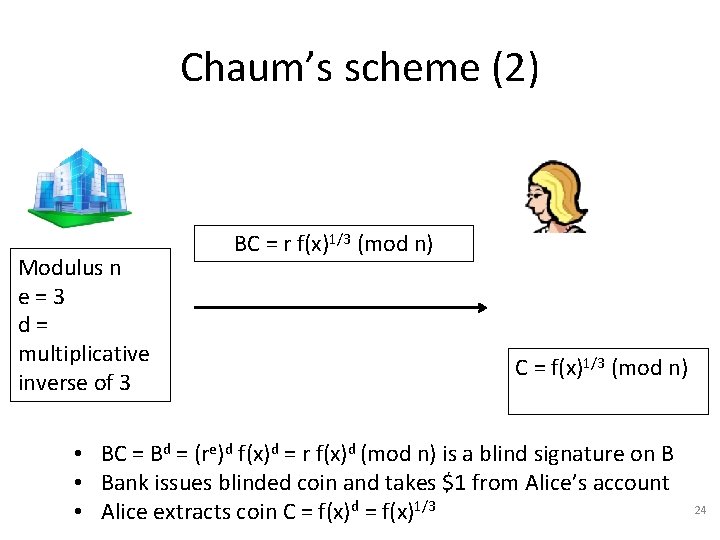
Chaum’s scheme (2) Modulus n e=3 d= multiplicative inverse of 3 BC = r f(x)1/3 (mod n) C = f(x)1/3 (mod n) • BC = Bd = (re)d f(x)d = r f(x)d (mod n) is a blind signature on B • Bank issues blinded coin and takes $1 from Alice’s account • Alice extracts coin C = f(x)d = f(x)1/3 24
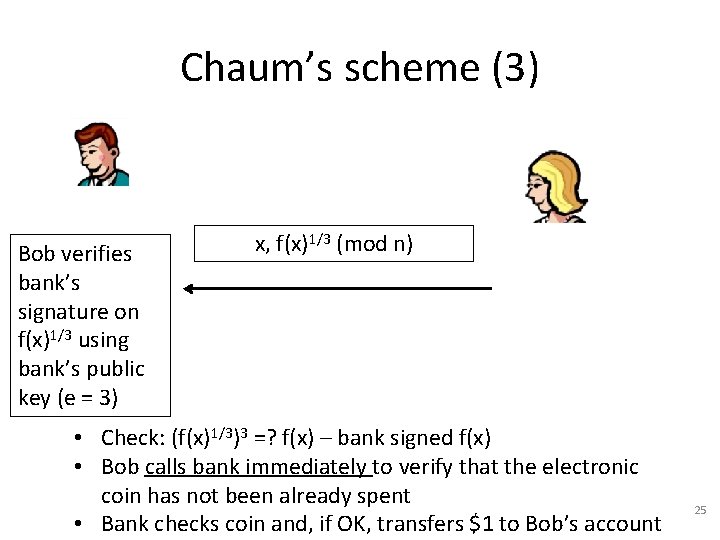
Chaum’s scheme (3) Bob verifies bank’s signature on f(x)1/3 using bank’s public key (e = 3) x, f(x)1/3 (mod n) • Check: (f(x)1/3)3 =? f(x) – bank signed f(x) • Bob calls bank immediately to verify that the electronic coin has not been already spent • Bank checks coin and, if OK, transfers $1 to Bob’s account 25
Can we do better? • Do not require Bob to call Bank immediately • Catch Alice if she tries to spend the same coin twice 26
Untraceable Electronic Cash Chaum, Fiat, Naor 1990 27
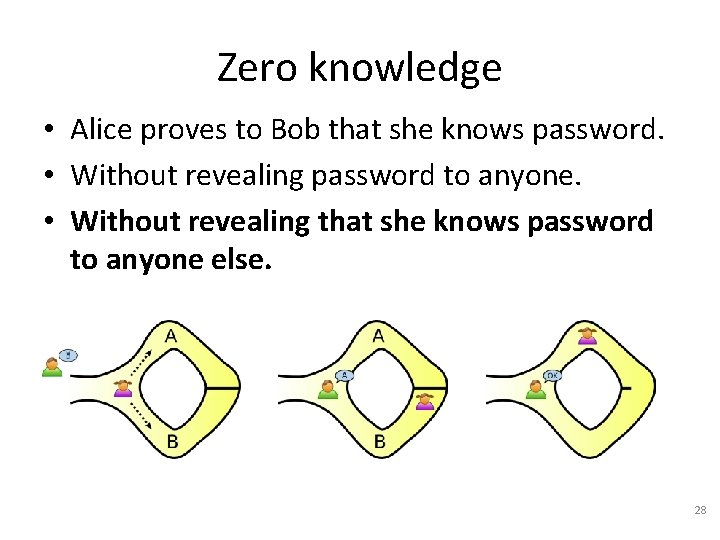
Zero knowledge • Alice proves to Bob that she knows password. • Without revealing password to anyone. • Without revealing that she knows password to anyone else. 28
Zero knowledge in Chaum et al 1990 • Use 1: attest protocol is being followed • Use 2: double-spending results in deanonymization 29
CFN 90 scheme (1) modulus n e=3 d is private • f, g are collision-resistant functions • k is a security parameter • more details 30
Obtaining an Electronic Coin 31
CFN 90 scheme (2) r ie Bi = f(xi, yi) (mod n) 1 ≤ i ≤ k where xi = g(ai, ci) yi = g(ai ⊕ (u. (v+i)), di) Account#: u Counter: v Random ai , c i , d i , r i 1≤i≤k • Bi is a blinded message: does not reveal information about f(xi, yi) to bank • f(xi, yi) is a commitment to (xi, yi) • xi, yi are constructed to reveal u in case Alice tries to spend the same coin twice 32
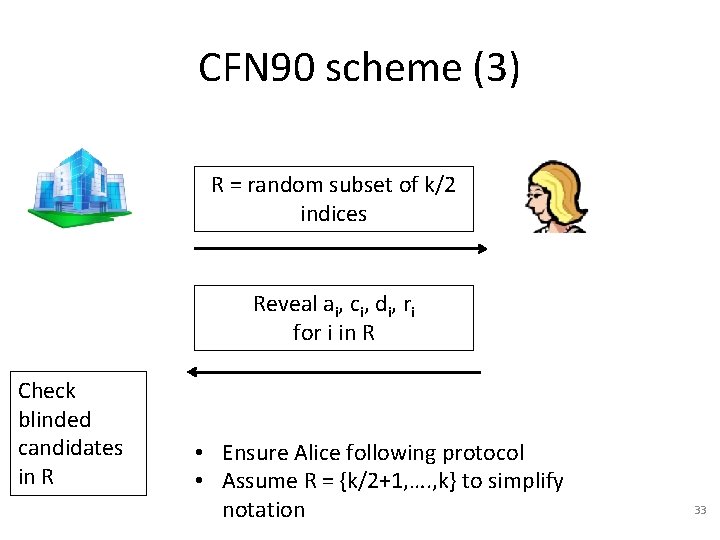
CFN 90 scheme (3) R = random subset of k/2 indices Reveal ai, ci, di, ri for i in R Check blinded candidates in R • Ensure Alice following protocol • Assume R = {k/2+1, …. , k} to simplify notation 33
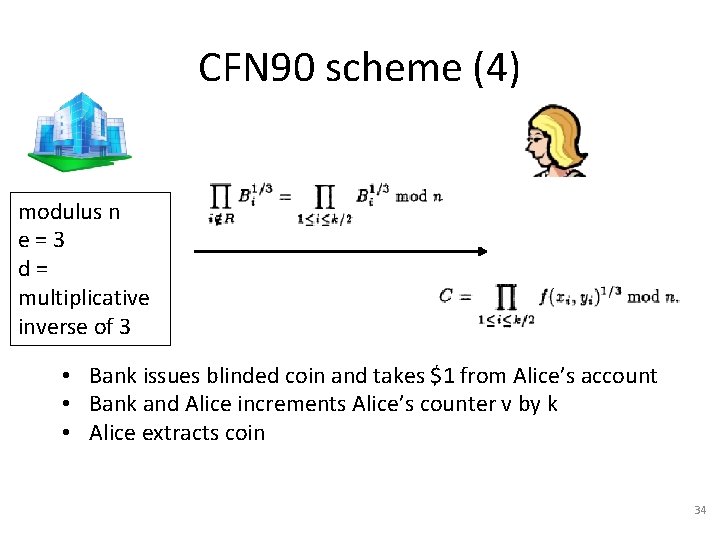
CFN 90 scheme (4) modulus n e=3 d= multiplicative inverse of 3 • Bank issues blinded coin and takes $1 from Alice’s account • Bank and Alice increments Alice’s counter v by k • Alice extracts coin 34
Paying with an Electronic Coin 35
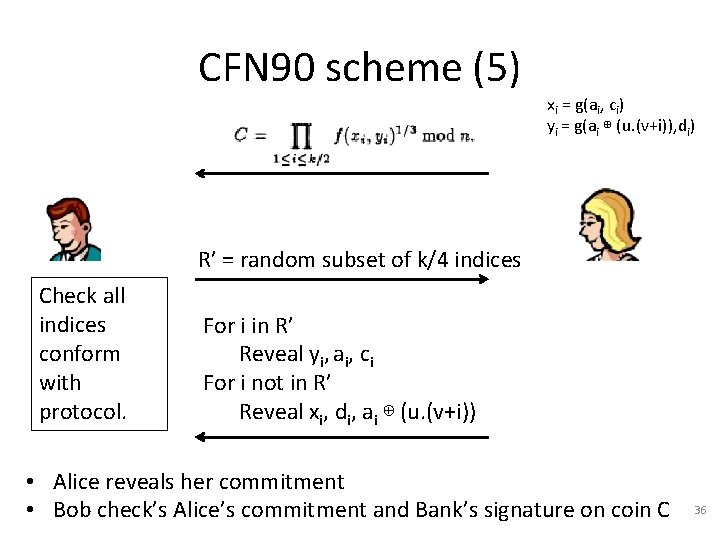
CFN 90 scheme (5) xi = g(ai, ci) yi = g(ai ⊕ (u. (v+i)), di) R’ = random subset of k/4 indices Check all indices conform with protocol. For i in R’ Reveal yi, ai, ci For i not in R’ Reveal xi, di, ai ⊕ (u. (v+i)) • Alice reveals her commitment • Bob check’s Alice’s commitment and Bank’s signature on coin C 36
Redeeming Electronic Coin 37
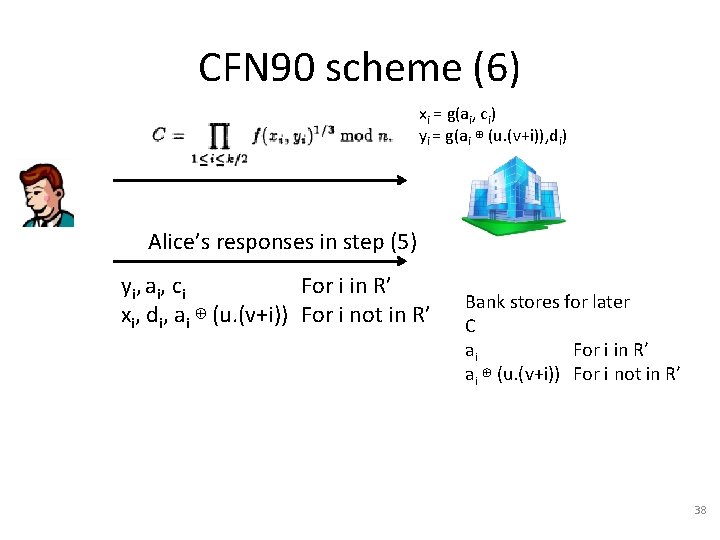
CFN 90 scheme (6) xi = g(ai, ci) yi = g(ai ⊕ (u. (v+i)), di) Alice’s responses in step (5) y i , ai , c i For i in R’ xi, di, ai ⊕ (u. (v+i)) For i not in R’ Bank stores for later C ai For i in R’ ai ⊕ (u. (v+i)) For i not in R’ 38
CFN 90 scheme (6) • What if Alice double-spends (gives the same coin to both Bob and Charlie)? • If Alice double spends, then wp ½ Bank obtains ai and ai ⊕ (u. (v+i)) for the same i and thus obtains Alice’s identity and transaction counter u. (v+i) 39
CFN 90 scheme (7) • What if Alice colludes with merchant Charlie and sends the same coin C and the same z to him as she did with Bob? • Bank knows that one of Bob and Charlie are lying but not who; cannot trace back to Alice • Solution: Every merchant has a fixed query string different from every other merchant + a random query string 40
Summary • Electronic Cash – Untraceable if issued coins are used only once – Traceable if coin is double spent – (Some) collusion resistance • Instance of Anonymous Credentials 41
Questions 42
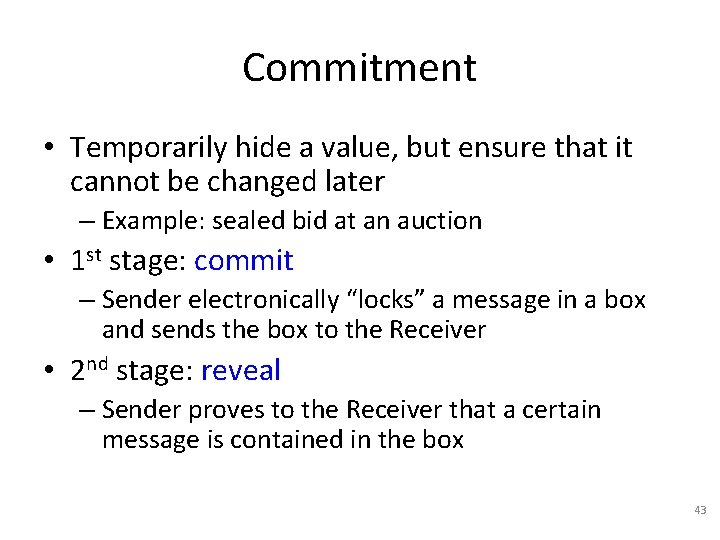
Commitment • Temporarily hide a value, but ensure that it cannot be changed later – Example: sealed bid at an auction • 1 st stage: commit – Sender electronically “locks” a message in a box and sends the box to the Receiver • 2 nd stage: reveal – Sender proves to the Receiver that a certain message is contained in the box 43
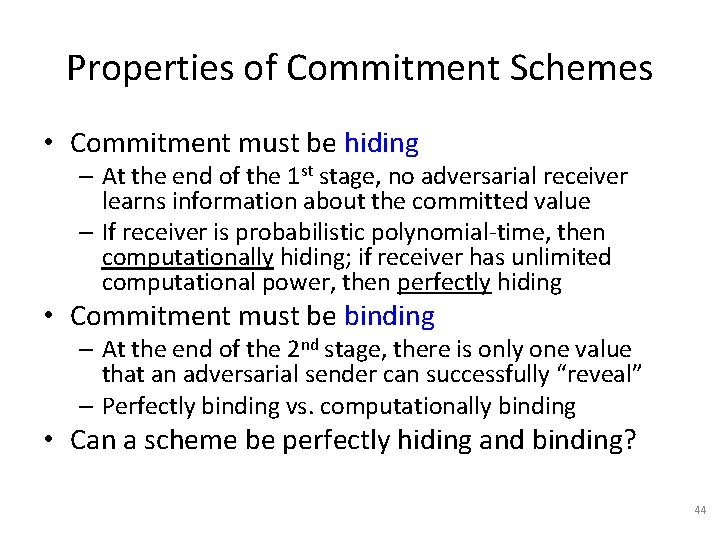
Properties of Commitment Schemes • Commitment must be hiding – At the end of the 1 st stage, no adversarial receiver learns information about the committed value – If receiver is probabilistic polynomial-time, then computationally hiding; if receiver has unlimited computational power, then perfectly hiding • Commitment must be binding – At the end of the 2 nd stage, there is only one value that an adversarial sender can successfully “reveal” – Perfectly binding vs. computationally binding • Can a scheme be perfectly hiding and binding? 44
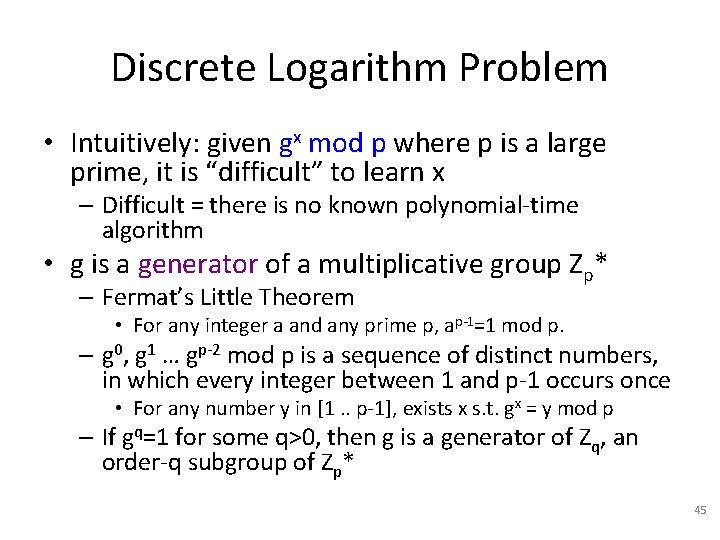
Discrete Logarithm Problem • Intuitively: given gx mod p where p is a large prime, it is “difficult” to learn x – Difficult = there is no known polynomial-time algorithm • g is a generator of a multiplicative group Zp* – Fermat’s Little Theorem • For any integer a and any prime p, ap-1=1 mod p. – g 0, g 1 … gp-2 mod p is a sequence of distinct numbers, in which every integer between 1 and p-1 occurs once • For any number y in [1. . p-1], exists x s. t. gx = y mod p – If gq=1 for some q>0, then g is a generator of Zq, an order-q subgroup of Zp* 45
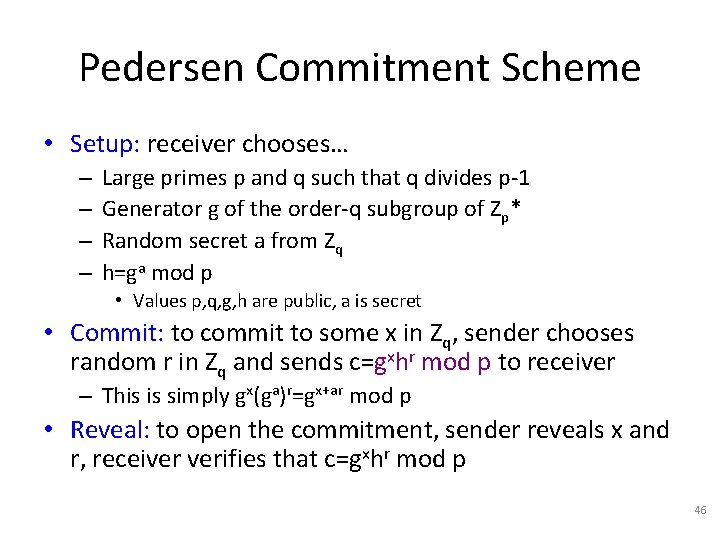
Pedersen Commitment Scheme • Setup: receiver chooses… – – Large primes p and q such that q divides p-1 Generator g of the order-q subgroup of Zp* Random secret a from Zq h=ga mod p • Values p, q, g, h are public, a is secret • Commit: to commit to some x in Zq, sender chooses random r in Zq and sends c=gxhr mod p to receiver – This is simply gx(ga)r=gx+ar mod p • Reveal: to open the commitment, sender reveals x and r, receiver verifies that c=gxhr mod p 46
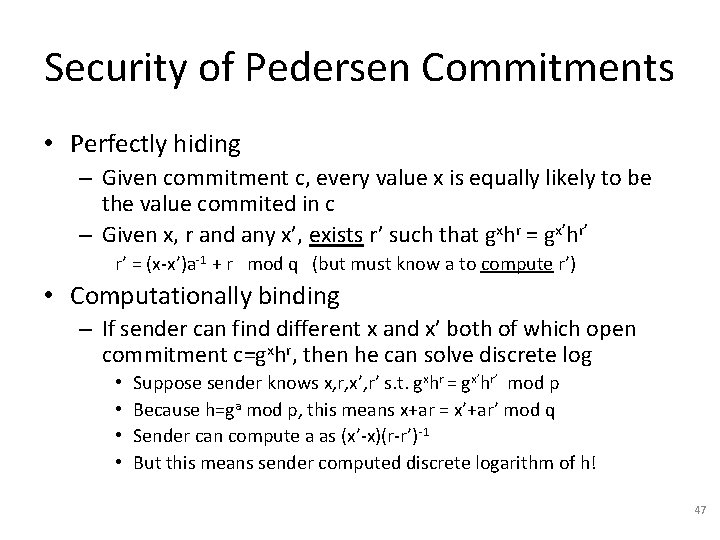
Security of Pedersen Commitments • Perfectly hiding – Given commitment c, every value x is equally likely to be the value commited in c – Given x, r and any x’, exists r’ such that gxhr = gx’hr’ r’ = (x-x’)a-1 + r mod q (but must know a to compute r’) • Computationally binding – If sender can find different x and x’ both of which open commitment c=gxhr, then he can solve discrete log • • Suppose sender knows x, r, x’, r’ s. t. gxhr = gx’hr’ mod p Because h=ga mod p, this means x+ar = x’+ar’ mod q Sender can compute a as (x’-x)(r-r’)-1 But this means sender computed discrete logarithm of h! 47
RSA Blind Signatures 48