
1871 Junior Cadet Training Programme RAF BRIEFING Scope
1871 Junior Cadet Training Programme RAF BRIEFING?
Scope • Re-cap who’s who in the ATC • Re-cap ranks and classifications • Basic history of the ATC • Basic history of the RAF • Security threats • Mastermind!

Who is who in the ATC
Who is who in the ATC Air Commodore- In- Chief = HRH, The Duke of Edinburgh, Prince Philip Air Commodore = Air Commodore Mc. Cafferty HQAC = RAF College Cranwell Region = Wales & West Regional Commandant = Group Captain Allen Based at RAF Cosford Wing = Staffordshire Wing Commander = Wing Commander Sharrad-Williams Based at RAF Cosford 1871 (Rugeley) Squadron Commander = Officer Cadet Grocott

Uniformed Staff Ranks Officers NCOs Pilot Officer Adult Sergeant Flying Officer Flight Lieutenant Squadron Leader Wing Commander Adult Flight Sergeant Adult Warrant Officer
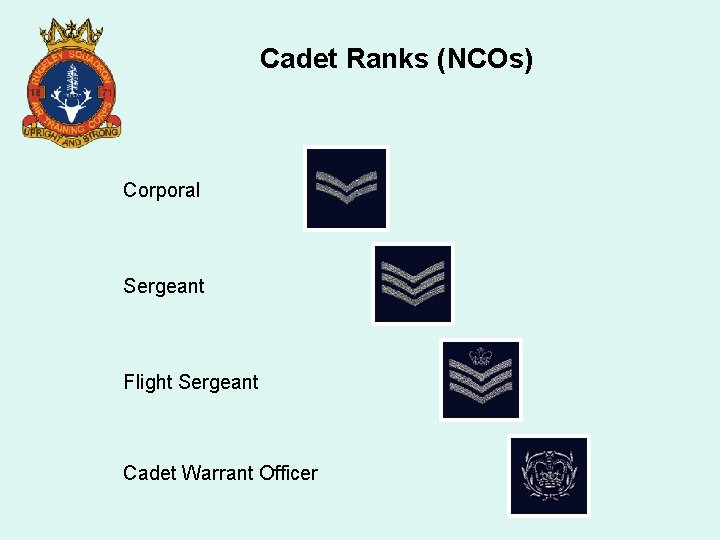
Cadet Ranks (NCOs) Corporal Sergeant Flight Sergeant Cadet Warrant Officer
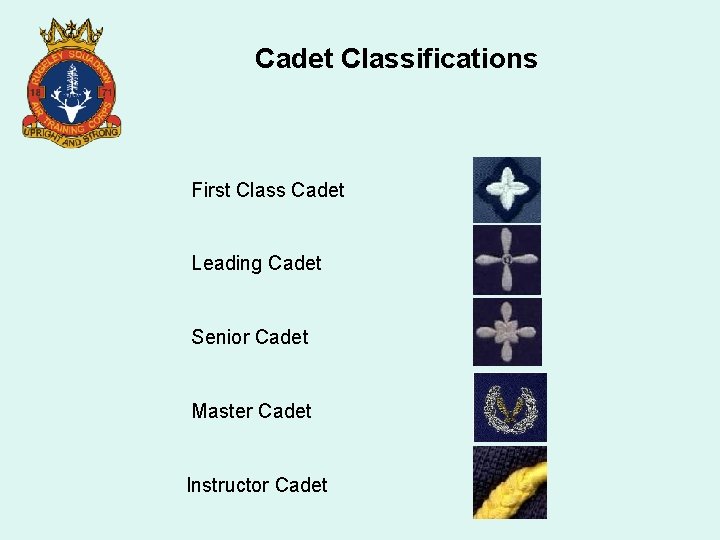
Cadet Classifications First Class Cadet Leading Cadet Senior Cadet Master Cadet Instructor Cadet
History of the ATC • In 1938 Air Commodore JA Chamier (Father of the ATC) founded the Air Defence Cadet Corps (ADCC) • The ADCC prepared Cadets for joining the RAF/ Fleet Air Arm • The first 50 Squadrons were called Founder Squadrons and are identified by the letter “F” after there Squadron number • During WW 2 many of the ADCC Officers were drafted into the RAF, Squadron buildings were commandeered by the military and Cadets were sent to work on RAF bases • After the war the Government realised how valuable an asset the ADCC had been, so took control and on the 5 th February 1941 the Air Training Corps was born
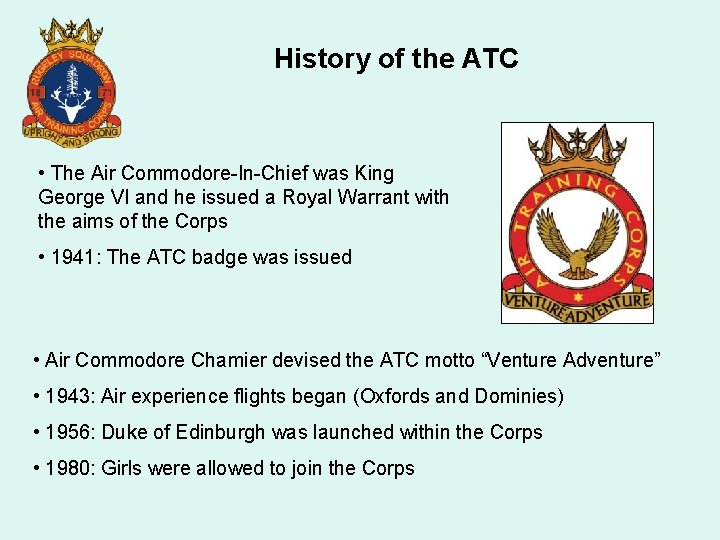
History of the ATC • The Air Commodore-In-Chief was King George VI and he issued a Royal Warrant with the aims of the Corps • 1941: The ATC badge was issued • Air Commodore Chamier devised the ATC motto “Venture Adventure” • 1943: Air experience flights began (Oxfords and Dominies) • 1956: Duke of Edinburgh was launched within the Corps • 1980: Girls were allowed to join the Corps
History of the RAF • Military flying began in 1912 with the formation of Royal Flying Corps • In 1914 the navy broke away to form Royal Naval Air Service • Near the end of WW 1 the British Government decided to invest in a new air service. On 1 st April 1918 the Royal Air Force was born through the amalgamation of the existing RFC and RNAS. • During the inter-war years: Ø Lord Trenchard (Father of the RAF) and Sir Winston Churchill built the RAF into a sound training organisation Ø Auxilary Air Arm formed Ø Navy regained control of the shipborne aircraft of Fleet Air Arm Ø RADAR Ø RAF won the Schneider Trophy for high speed flight.
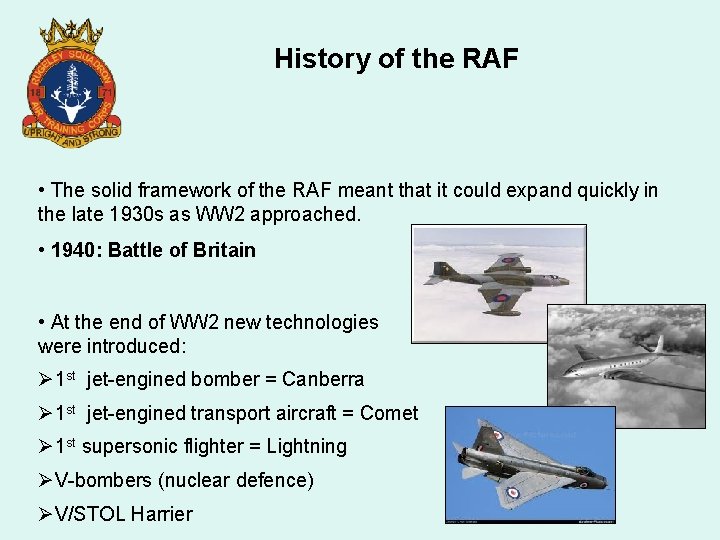
History of the RAF • The solid framework of the RAF meant that it could expand quickly in the late 1930 s as WW 2 approached. • 1940: Battle of Britain • At the end of WW 2 new technologies were introduced: Ø 1 st jet-engined bomber = Canberra Ø 1 st jet-engined transport aircraft = Comet Ø 1 st supersonic flighter = Lightning ØV-bombers (nuclear defence) ØV/STOL Harrier
History of the RAF • 4 th April 1949: North Atlantic Treaty Organisation (NATO) was signed to help promote peace, stability and to create a military and political alliance between its member countries which still exists today. • Cold War (1947 -1991)- between Western Europe and the Soviet Union • Since the 1980 s the RAF have been involved in a number of major conflicts: Ø The Falklands War in 1982 ØThe Gulf War in 1990 – Operation Desert Storm
Security • Every Cadet is responsible for the security of their Squadron • If you ever see anything suspicious (e. g. a suspicious package or people acting suspiciously) whilst on an RAF base or on the Squadron, report it immediately to a member of Staff • There are several countries and organisations which see the UK as an enemy and actively gather information about our countries defence. The threat is small for the ATC, however it is important that we remain vigilant at all times.
Security • Written material is categorized as either non-classified (has no security value) or classified. • Classified material has a security value and is categorized into 4 categories: 1. Restricted 2. Confidential 3. Secret 4. Top Secret • If you ever see anything labelled “Secret” or “Top Secret” report it immediately to make sure no unauthorised personnel access it.
Security • In summary: If you see anything suspicious… REPORT IT
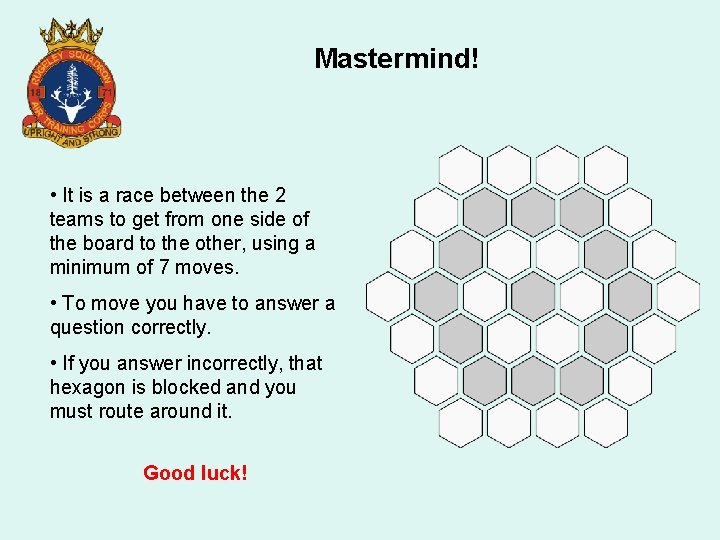
Mastermind! • It is a race between the 2 teams to get from one side of the board to the other, using a minimum of 7 moves. • To move you have to answer a question correctly. • If you answer incorrectly, that hexagon is blocked and you must route around it. Good luck!
- Slides: 16