
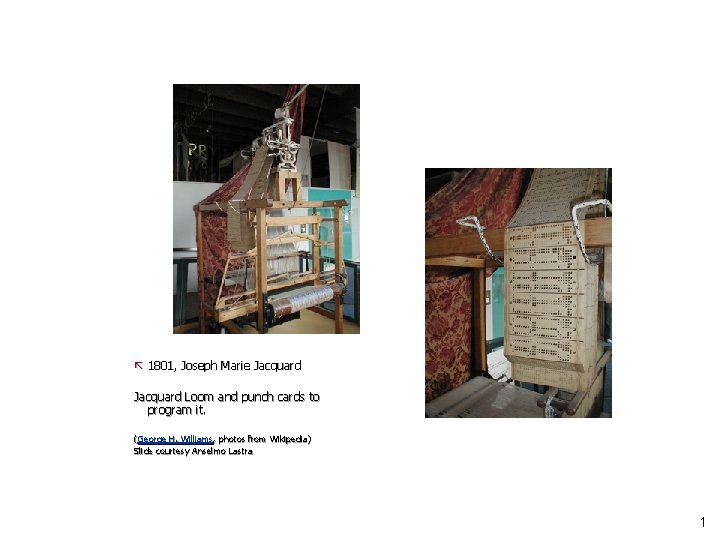
1801 Joseph Marie Jacquard Loom and punch cards
- Slides: 20
ã 1801, Joseph Marie Jacquard Loom and punch cards to program it. (George H. Williams, photos from Wikipedia) Slide courtesy Anselmo Lastra 1
COMP 740 (formerly 206): Computer Architecture and Implementation Montek Singh Tue, Jan 13, 2009 Lecture 1 2
Computer Architecture Is … Term coined by Fred Brooks and colleagues at IBM: “…the structure of a computer that a machine language programmer must understand to write a correct (timing independent) program for that machine. ” Amdahl, Blaauw, and Brooks, 1964 “Architecture of the IBM System 360”, IBM Journal of Research and Development Do you know about System 360 family? Term used differently by Hennessy and Patterson (our textbook) Includes much implementation 3
Outline ã Course Information l Logistics l Grading l Syllabus l Course Overview ã Technology Trends l Moore’s Law l The CPU-Memory Gap 4
Course Information (1) Time and Place l Tue/Thu 11 am-12: 15 pm, Sitterson Hall 155 Instructor l Montek Singh l montek@cs. unc. edu (not singh@cs!) l Brooks 234, 962 -1832 l Office hours: TBA Course Web Page l Linked from mine: http: //www. cs. unc. edu/~montek 5
Course Information (2) Prerequisites l Undergrad comp. org. (COMP 120) and digital logic l I assume you know the following topics Ø CPU: ALU, control unit, registers, buses, memory management Ø Control Unit: register transfer language, implementation, hardwired and microprogrammed control Ø Memory: address space, memory capacity Ø I/O: CPU-controlled (polling, interrupt), autonomous (DMA) l Representative books (available in Brauer Library) Ø Baron & Higbie: Computer Architecture. Addison Wesley, 1992 Ø Kuck: The Structure of Computers and Computations (Vol. 1). Wiley 1978 Ø Stallings: Computer Organization and Architecture: Designing for Performance (4 th edition). Prentice Hall, 1996 Ø Patterson & Hennessy: Computer Organization and Design: The Hardware/Software Interface. Morgan Kaufmann Publishers. 6
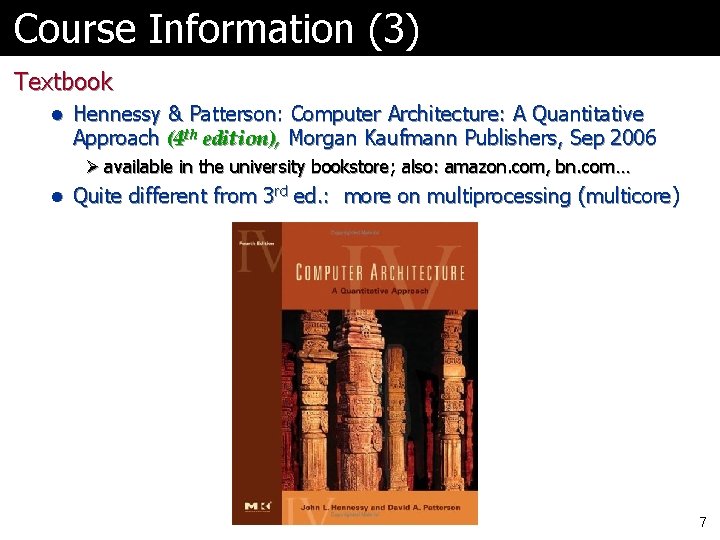
Course Information (3) Textbook l Hennessy & Patterson: Computer Architecture: A Quantitative Approach (4 th edition), Morgan Kaufmann Publishers, Sep 2006 Ø available in the university bookstore; also: amazon. com, bn. com… l Quite different from 3 rd ed. : more on multiprocessing (multicore) 7
Course Information (4) Textbook (contd. ) l We will cover the following material: Ø Fundamentals of Computer Design (Chapter 1) Ø Instruction Set Principles and Examples (App B & J) Ø Pipelining: Basic and Intermediate Concepts (App A) Ø Instruction-Level Parallelism (Chapter 2 & 3) Ø VLIW Architectures (App G) Ø Vector Architectures (App F) Ø Multiprocessors (Chapter 4) Ø Memory-Hierarchy Design (App C & Chapter 5) Ø Storage Systems (Chapter 6) Additional readings/papers may be handed out l e. g. , case studies 8
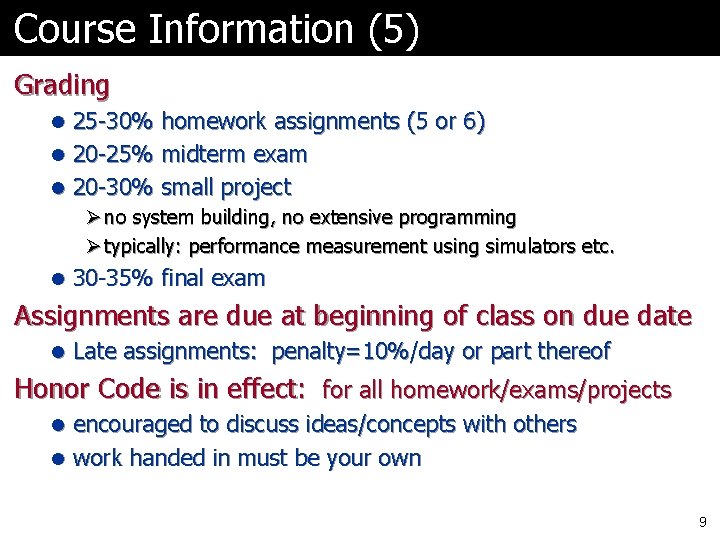
Course Information (5) Grading l 25 -30% homework assignments (5 or 6) l 20 -25% midterm exam l 20 -30% small project Ø no system building, no extensive programming Ø typically: performance measurement using simulators etc. l 30 -35% final exam Assignments are due at beginning of class on due date l Late assignments: penalty=10%/day or part thereof Honor Code is in effect: for all homework/exams/projects l encouraged to discuss ideas/concepts with others l work handed in must be your own 9
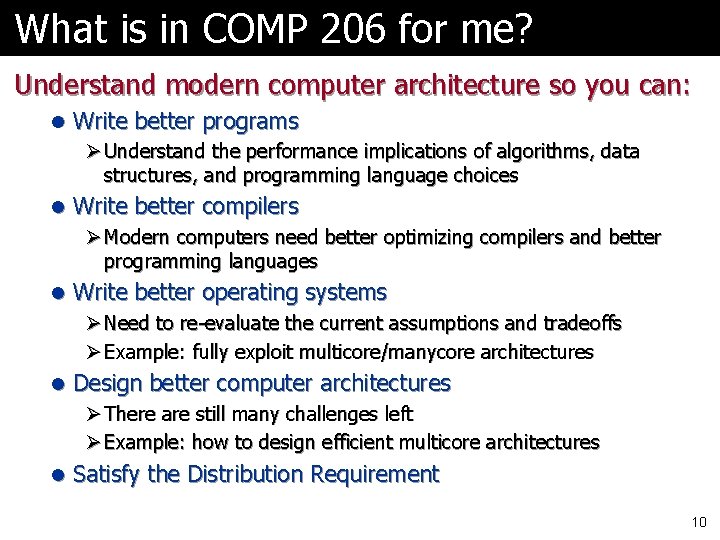
What is in COMP 206 for me? Understand modern computer architecture so you can: l Write better programs Ø Understand the performance implications of algorithms, data structures, and programming language choices l Write better compilers Ø Modern computers need better optimizing compilers and better programming languages l Write better operating systems Ø Need to re-evaluate the current assumptions and tradeoffs Ø Example: fully exploit multicore/manycore architectures l Design better computer architectures Ø There are still many challenges left Ø Example: how to design efficient multicore architectures l Satisfy the Distribution Requirement 10
Acknowledgements ã Material for this class taken from l My old COMP 206 course notes l Prof. Anselmo Lastra’s 740 slides l Prof. Sid Chatterjee’s old 206 slides l Professor David Patterson’s (Berkeley) course notes l Textbook web site 11
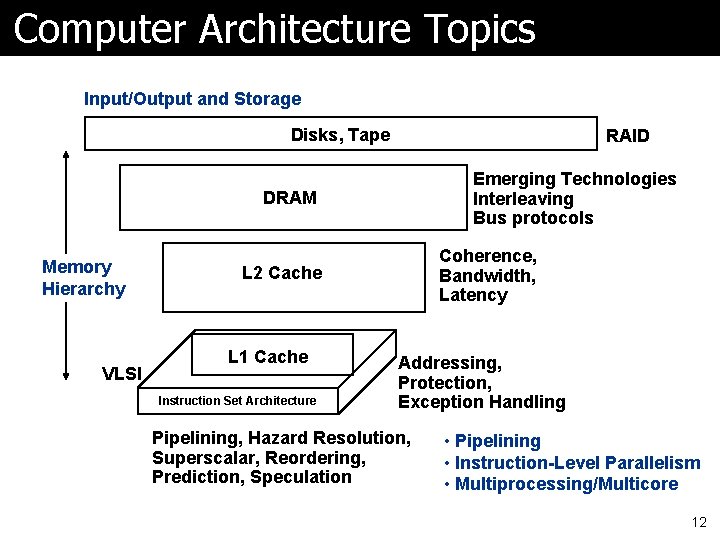
Computer Architecture Topics Input/Output and Storage Disks, Tape RAID Emerging Technologies Interleaving Bus protocols DRAM Memory Hierarchy VLSI Coherence, Bandwidth, Latency L 2 Cache L 1 Cache Instruction Set Architecture Addressing, Protection, Exception Handling Pipelining, Hazard Resolution, Superscalar, Reordering, Prediction, Speculation • Pipelining • Instruction-Level Parallelism • Multiprocessing/Multicore 12
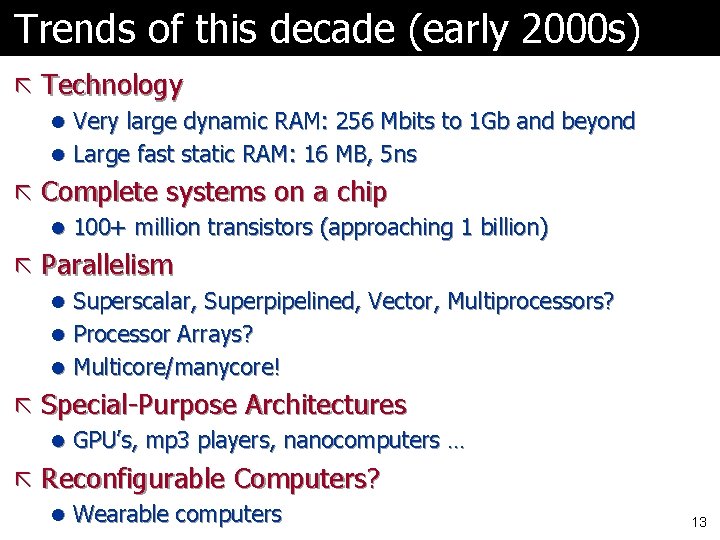
Trends of this decade (early 2000 s) ã Technology l Very large dynamic RAM: 256 Mbits to 1 Gb and beyond l Large fast static RAM: 16 MB, 5 ns ã Complete systems on a chip l 100+ million transistors (approaching 1 billion) ã Parallelism l Superscalar, Superpipelined, Vector, Multiprocessors? l Processor Arrays? l Multicore/manycore! ã Special-Purpose Architectures l GPU’s, mp 3 players, nanocomputers … ã Reconfigurable Computers? l Wearable computers 13
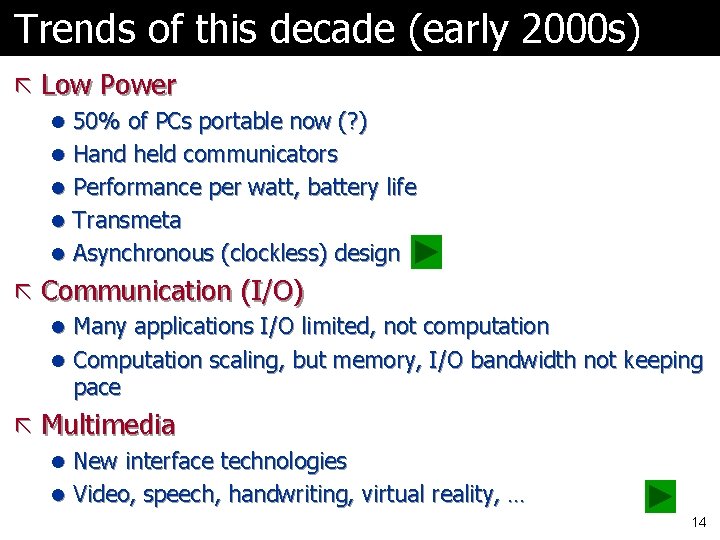
Trends of this decade (early 2000 s) ã Low Power l 50% of PCs portable now (? ) l Hand held communicators l Performance per watt, battery life l Transmeta l Asynchronous (clockless) design ã Communication (I/O) l Many applications I/O limited, not computation l Computation scaling, but memory, I/O bandwidth not keeping pace ã Multimedia l New interface technologies l Video, speech, handwriting, virtual reality, … 14
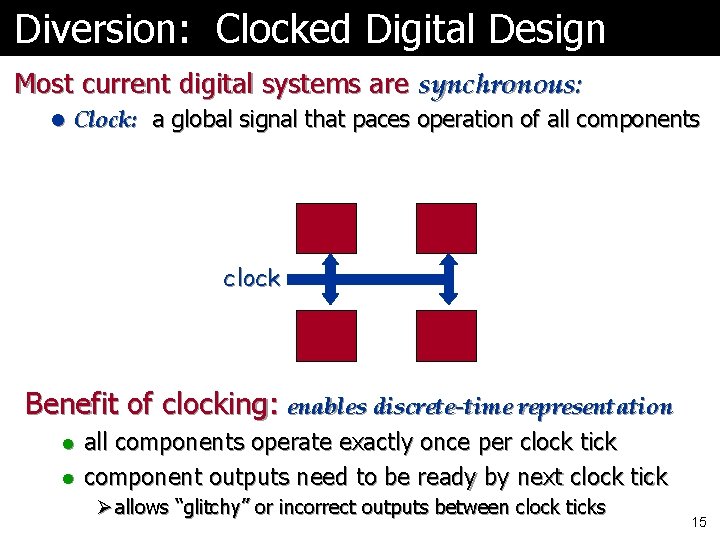
Diversion: Clocked Digital Design Most current digital systems are synchronous: l Clock: a global signal that paces operation of all components clock Benefit of clocking: enables discrete-time representation l l all components operate exactly once per clock tick component outputs need to be ready by next clock tick Ø allows “glitchy” or incorrect outputs between clock ticks 15
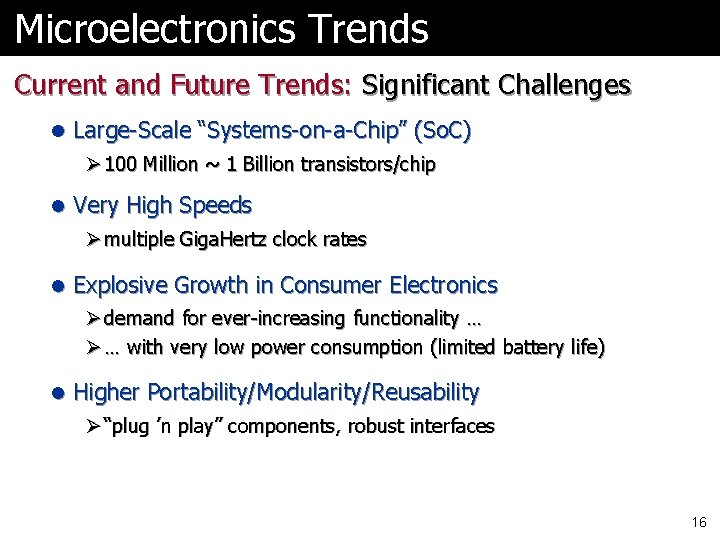
Microelectronics Trends Current and Future Trends: Significant Challenges l Large-Scale “Systems-on-a-Chip” (So. C) Ø 100 Million ~ 1 Billion transistors/chip l Very High Speeds Ø multiple Giga. Hertz clock rates l Explosive Growth in Consumer Electronics Ø demand for ever-increasing functionality … Ø … with very low power consumption (limited battery life) l Higher Portability/Modularity/Reusability Ø “plug ’n play” components, robust interfaces 16
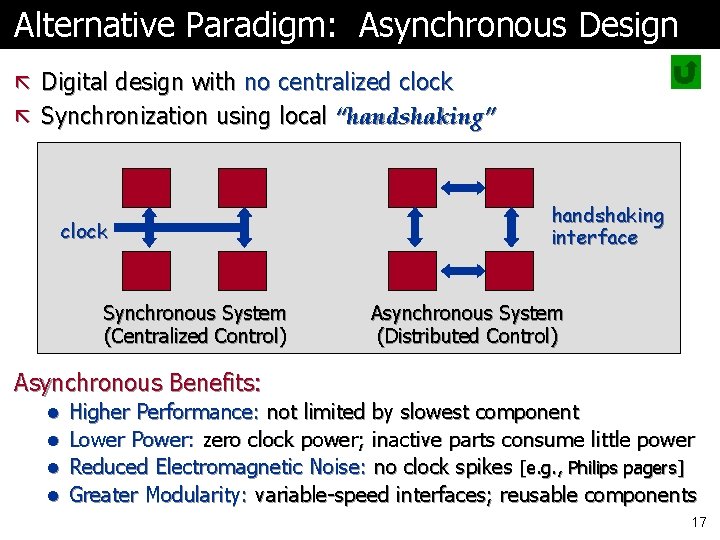
Alternative Paradigm: Asynchronous Design ã Digital design with no centralized clock ã Synchronization using local “handshaking” clock Synchronous System (Centralized Control) handshaking interface Asynchronous System (Distributed Control) Asynchronous Benefits: l Higher Performance: not limited by slowest component l Lower Power: zero clock power; inactive parts consume little power l Reduced Electromagnetic Noise: no clock spikes [e. g. , Philips pagers] l Greater Modularity: variable-speed interfaces; reusable components 17
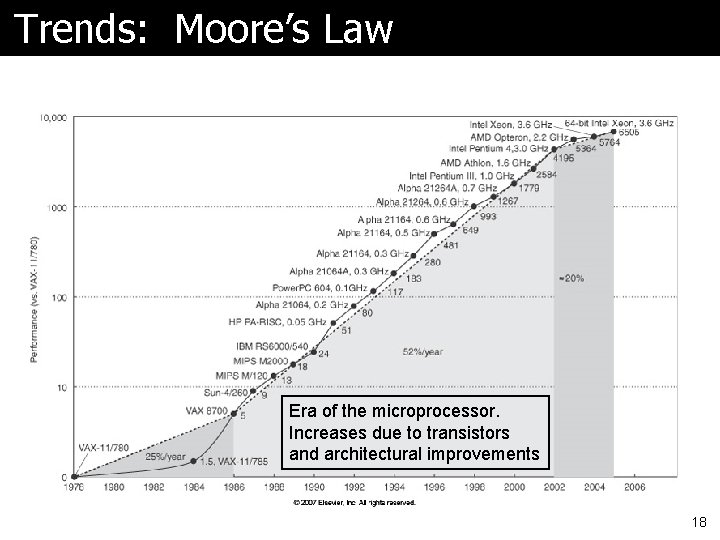
Trends: Moore’s Law Era of the microprocessor. Increases due to transistors and architectural improvements 18
Performance ã Increase around 2002 was 7 X faster than would have been due to fabrication tech (e. g. 0. 13 micron) alone ã What has slowed the trend? l Note what is really being built Ø A commodity device! Ø So cost is very important l Problems Ø Amount of heat that can be removed economically Ø Limits to instruction level parallelism Ø Memory latency 19
Moore’s Law ã Originally: Number of transistors on a chip l at the lowest cost/component ã It’s not quite clear what it really is l Moore’s original paper, doubling yearly l Often quoted as doubling every 18 months l Sometimes as doubling every two years ã Moore’s article worth reading l http: //download. intel. com/research/silicon/moorespaper. pdf 20