
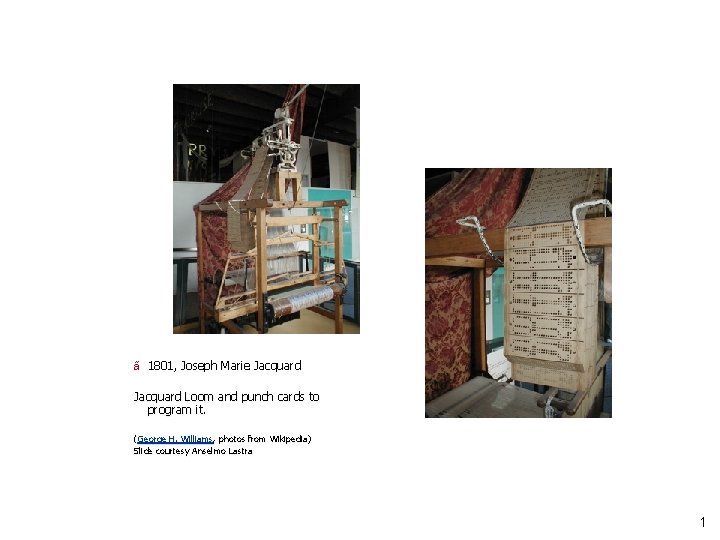
1801 Joseph Marie Jacquard Loom and punch cards
- Slides: 73
ã 1801, Joseph Marie Jacquard Loom and punch cards to program it. (George H. Williams, photos from Wikipedia) Slide courtesy Anselmo Lastra 1
COMP 740: Computer Architecture and Implementation Montek Singh Aug 24, 2016 Lecture 1 2
What is “Computer Architecture”? Term coined by Fred Brooks and colleagues at IBM: “…the structure of a computer that a machine language programmer must understand to write a correct (timing independent) program for that machine. ” Amdahl, Blaauw, and Brooks, 1964 “Architecture of the IBM System 360”, IBM Journal of Research and Development Do you know about System 360 family? 3
What is “Computer Architecture”? Term used differently by Hennessy and Patterson (our textbook) l includes much implementation Several years ago, the term computer architecture often referred only to instruction set design. Other aspects of computer design were called implementation, often insinuating that implementation is uninteresting or less challenging. We believe this view is incorrect. The architect’s or designer’s job is much more than instruction set design, and the technical hurdles in the other aspects of the project are likely more challenging than those encountered in instruction set design. - Patterson & Hennessy 4
Outline ã Course Information l Logistics l Grading l Syllabus l Course Overview ã Technology Trends l Moore's Law 5
Course Information (1) Time and Place l Mon/Wed 1: 25 -2: 40 pm, FB 007 Instructor l Montek Singh l montek@cs. unc. edu l FB 234, 919 -590 -6132 l Office hours: TBA Course Web Page l Linked from mine: http: //www. cs. unc. edu/~montek 6
Course Information (2) Prerequisites l Undergrad comp. org. (Comp 411) and digital logic (Comp 541) l I assume you know the following topics Ø CPU: ALU, control unit, registers, buses, memory management Ø Control Unit: register transfer language, implementation, hardwired and microprogrammed control Ø Memory: address space, memory capacity Ø I/O: CPU-controlled (polling, interrupt), autonomous (DMA ) Ø Pipelining (at least an overview) l Representative books (available in Brauer Library) Ø Patterson & Hennessy: Computer Organization and Design: The Hardware/Software Interface. Morgan Kaufmann Publishers. Ø Harris & Harris: Digital Design and Computer Architecture, 2 nd ed. (July 2012), Morgan Kaufmann Publishers. 7
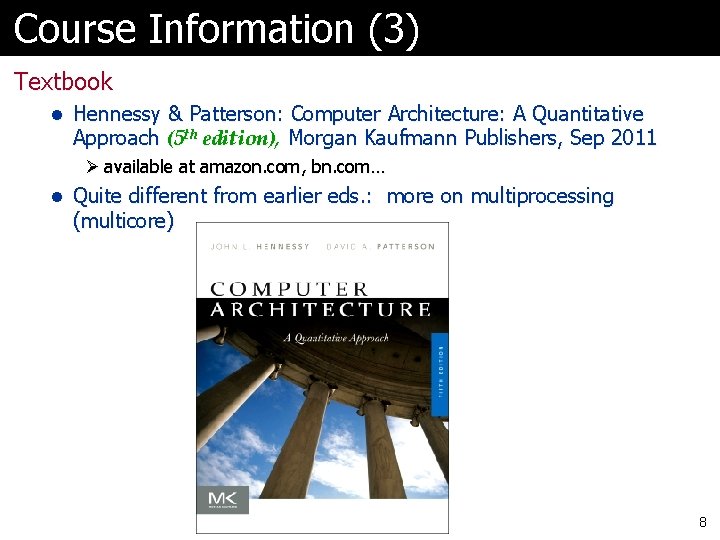
Course Information (3) Textbook l Hennessy & Patterson: Computer Architecture: A Quantitative Approach (5 th edition), Morgan Kaufmann Publishers, Sep 2011 Ø available at amazon. com, bn. com… l Quite different from earlier eds. : more on multiprocessing (multicore) 8
Course Information (4) Textbook (contd. ) l We will cover the following material: Ø Fundamentals of Computer Design (Chapter 1) Ø Instruction Set Principles and Examples (App A & K) Ø Memory-Hierarchy Design (App B & Chapter 2) Ø Pipelining: Basic and Intermediate Concepts (App C) Ø Instruction-Level Parallelism (Chapter 3) Ø Data-Level Parallelism (Chapter 4) Ø Thread-Level Parallelism (Chapter 5) Ø Storage Systems (App D) Ø On-Chip Networks (selected readings) Ø Emerging Technologies of Computation (selected readings) Additional readings/papers may be handed out l e. g. , case studies on the last two topics above 9
Course Information (5) Grading l 30% homework assignments l 10% quizzes l 20% midterm exam l 30% final exam l 10% class presentation Ø e. g. , present a survey or case study on multicore Ø e. g. , present a paper on DNA-based computing technologies Assignments are due at beginning of class on due date l Late assignments: penalty=10%/day or part thereof Honor Code is in effect: for all homework/exams/projects l encouraged to discuss ideas/concepts with others l work handed in must be your own 10
What is in COMP 740 for me? Understand modern computer architecture so you can: l Write better programs Ø Understand the performance implications of algorithms, data structures, and programming language choices l Write better compilers Ø Modern computers need better optimizing compilers and better programming languages l Write better operating systems Ø Need to re-evaluate the current assumptions and tradeoffs Ø Example: fully exploit multicore/manycore architectures l Design better computer architectures Ø There are still many challenges left Ø Example: how to design efficient multicore architectures l Satisfy the Distribution Requirement 11
Acknowledgements ã Material for this class taken from l My old COMP 206 course notes l Prof. Anselmo Lastra's 740 slides l Prof. Sid Chatterjee's old 206 slides l Professor David Patterson's (Berkeley) course notes l Textbook web site l Other websites 12
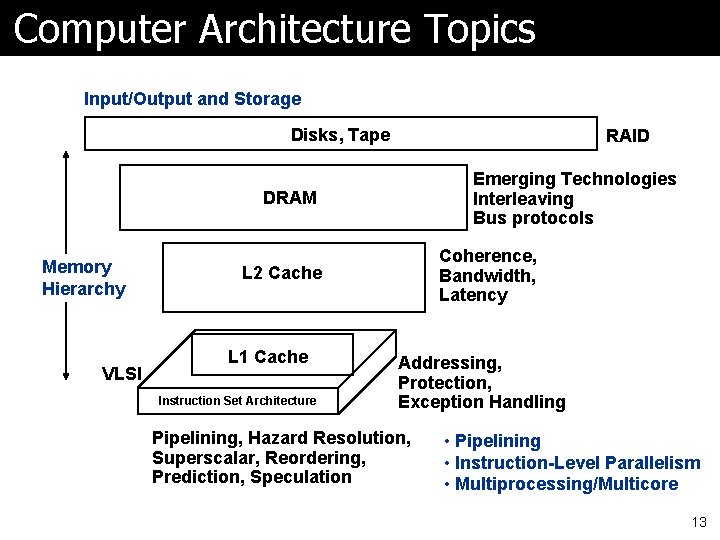
Computer Architecture Topics Input/Output and Storage Disks, Tape RAID Emerging Technologies Interleaving Bus protocols DRAM Memory Hierarchy VLSI Coherence, Bandwidth, Latency L 2 Cache L 1 Cache Instruction Set Architecture Addressing, Protection, Exception Handling Pipelining, Hazard Resolution, Superscalar, Reordering, Prediction, Speculation • Pipelining • Instruction-Level Parallelism • Multiprocessing/Multicore 13
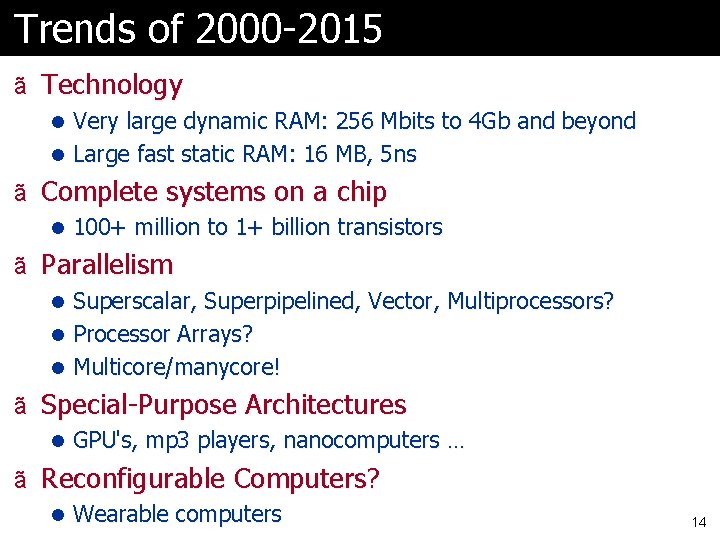
Trends of 2000 -2015 ã Technology l Very large dynamic RAM: 256 Mbits to 4 Gb and beyond l Large fast static RAM: 16 MB, 5 ns ã Complete systems on a chip l 100+ million to 1+ billion transistors ã Parallelism l Superscalar, Superpipelined, Vector, Multiprocessors? l Processor Arrays? l Multicore/manycore! ã Special-Purpose Architectures l GPU's, mp 3 players, nanocomputers … ã Reconfigurable Computers? l Wearable computers 14
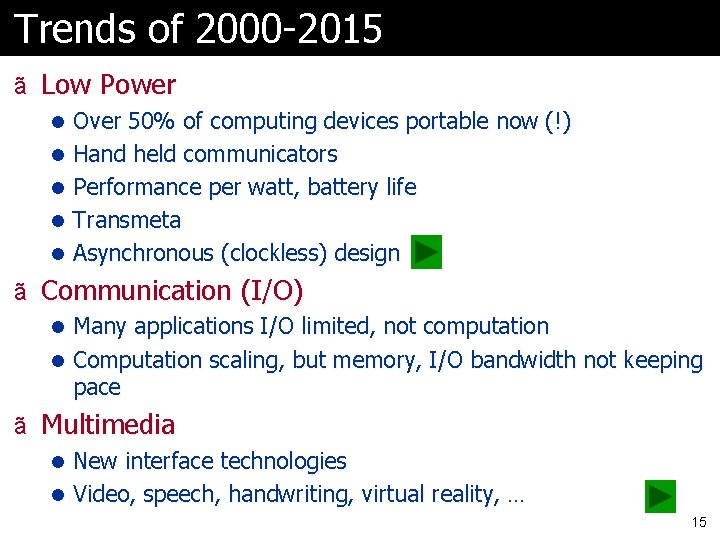
Trends of 2000 -2015 ã Low Power l Over 50% of computing devices portable now (!) l Hand held communicators l Performance per watt, battery life l Transmeta l Asynchronous (clockless) design ã Communication (I/O) l Many applications I/O limited, not computation l Computation scaling, but memory, I/O bandwidth not keeping pace ã Multimedia l New interface technologies l Video, speech, handwriting, virtual reality, … 15
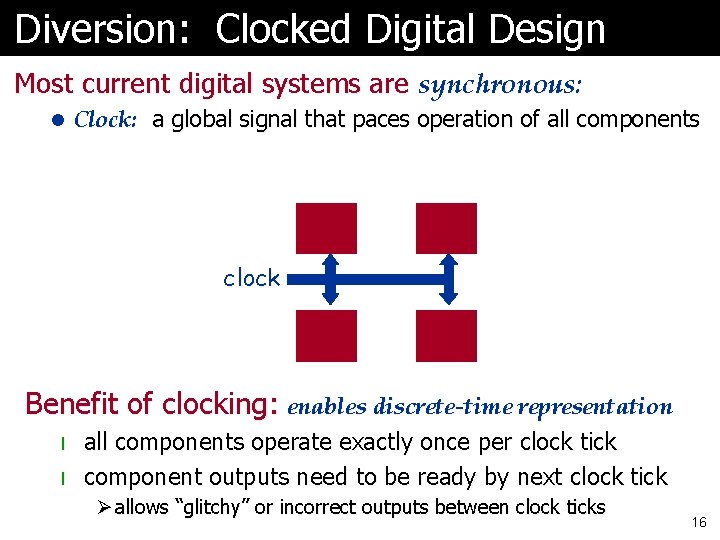
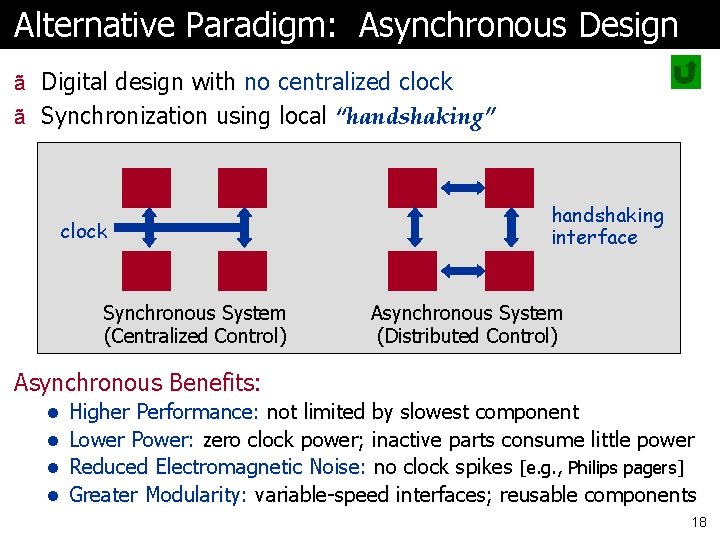
Diversion: Clocked Digital Design Most current digital systems are synchronous: l Clock: a global signal that paces operation of all components clock Benefit of clocking: enables discrete-time representation l l all components operate exactly once per clock tick component outputs need to be ready by next clock tick Ø allows “glitchy” or incorrect outputs between clock ticks 16
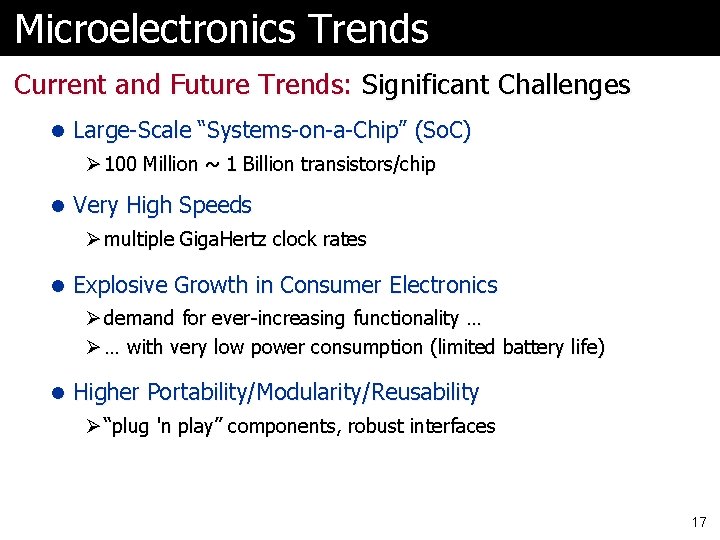
Microelectronics Trends Current and Future Trends: Significant Challenges l Large-Scale “Systems-on-a-Chip” (So. C) Ø 100 Million ~ 1 Billion transistors/chip l Very High Speeds Ø multiple Giga. Hertz clock rates l Explosive Growth in Consumer Electronics Ø demand for ever-increasing functionality … Ø … with very low power consumption (limited battery life) l Higher Portability/Modularity/Reusability Ø “plug 'n play” components, robust interfaces 17
Alternative Paradigm: Asynchronous Design ã Digital design with no centralized clock ã Synchronization using local “handshaking” clock Synchronous System (Centralized Control) handshaking interface Asynchronous System (Distributed Control) Asynchronous Benefits: l Higher Performance: not limited by slowest component l Lower Power: zero clock power; inactive parts consume little power l Reduced Electromagnetic Noise: no clock spikes [e. g. , Philips pagers] l Greater Modularity: variable-speed interfaces; reusable components 18
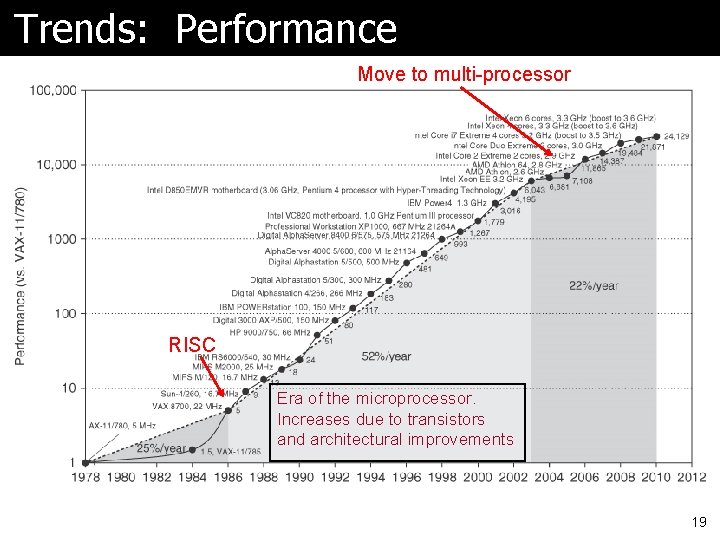
Trends: Performance Move to multi-processor RISC Era of the microprocessor. Increases due to transistors and architectural improvements 19
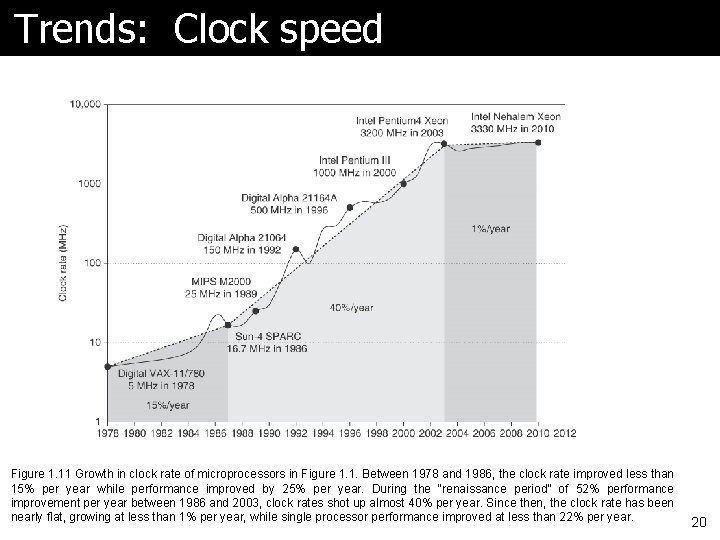
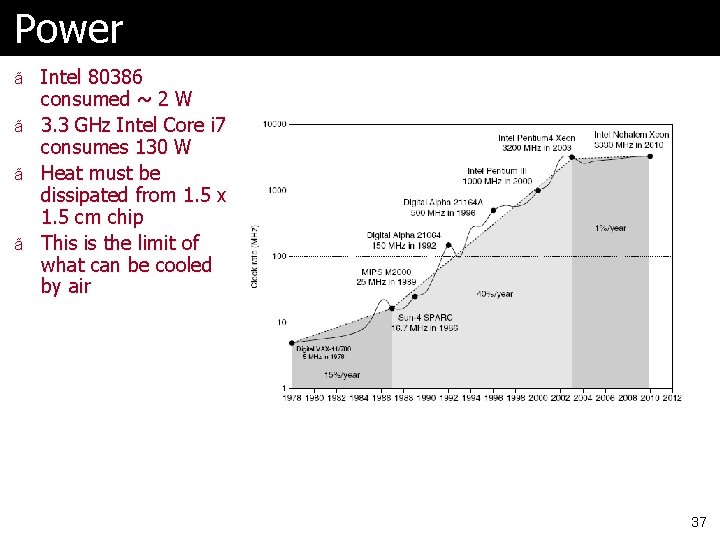
Trends: Clock speed Figure 1. 11 Growth in clock rate of microprocessors in Figure 1. 1. Between 1978 and 1986, the clock rate improved less than 15% per year while performance improved by 25% per year. During the “renaissance period” of 52% performance improvement per year between 1986 and 2003, clock rates shot up almost 40% per year. Since then, the clock rate has been nearly flat, growing at less than 1% per year, while single processor performance improved at less than 22% per year. 20
Performance ã Increase by 2002 was much faster than would have been due to fabrication tech (e. g. 0. 13 micron) alone ã What has slowed the trend? l Note what is really being built Ø A commodity device! Ø So cost is very important l Problems Ø Amount of heat that can be removed economically Ø Limits to instruction level parallelism Ø Memory latency 21
Moore's Law ã What is Moore’s Law? ã Originally: Number of transistors on a chip l at the lowest cost/component ã It's not quite clear what it really is l Moore's original paper, doubling yearly Ø Didn't make it in 1975 l Often quoted as doubling every 18 months l Sometimes as doubling every two years ã Moore's article worth reading l http: //download. intel. com/research/silicon/moorespaper. pdf 22
Quantitative Principles of Computer Design Performance Rate of producing results Throughput Bandwidth Execution time Response time Latency 23
Quick Look: Classes of Computers ã Used to be l mainframe, l mini, and l micro ã Now l Desktop Ø Price/performance, single app, graphics l Server Ø Reliability, scalability, throughput l Embedded Ø Not only “toasters”, but also cell phones, etc. Ø Cost, power, real-time performance l Mobile Ø smartphones, tablets, fitness devices, etc. 24
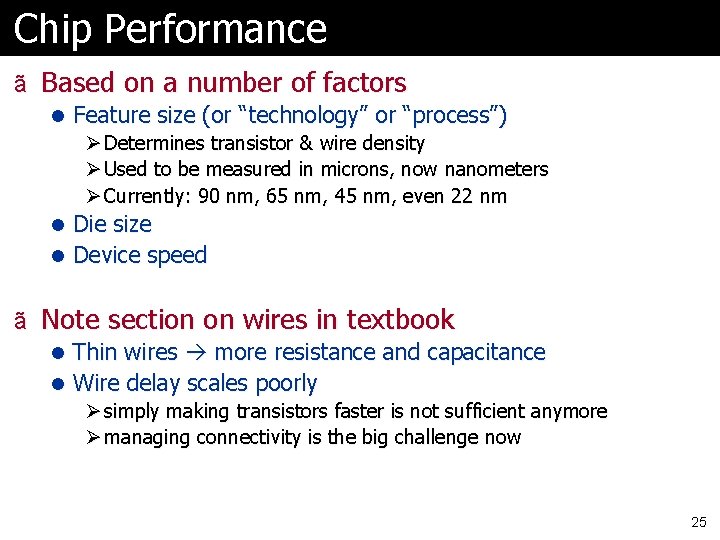
Chip Performance ã Based on a number of factors l Feature size (or “technology” or “process”) Ø Determines transistor & wire density Ø Used to be measured in microns, now nanometers Ø Currently: 90 nm, 65 nm, 45 nm, even 22 nm l Die size l Device speed ã Note section on wires in textbook l Thin wires more resistance and capacitance l Wire delay scales poorly Ø simply making transistors faster is not sufficient anymore Ø managing connectivity is the big challenge now 25
ITRS International Technology Roadmap for Semiconductors l http: //www. itrs 2. net/ l An industry consortium l predicts trends l take a look at the yearly report on their website Ø take a few minutes to skim the “executive summary” 26
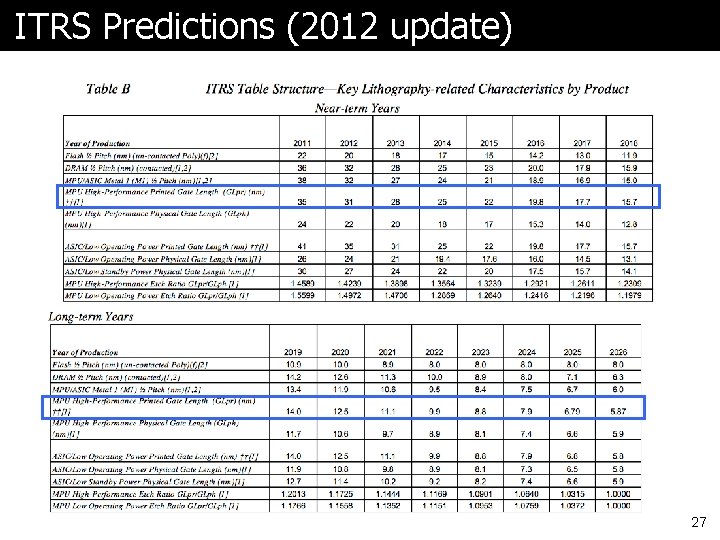
ITRS Predictions (2012 update) 27
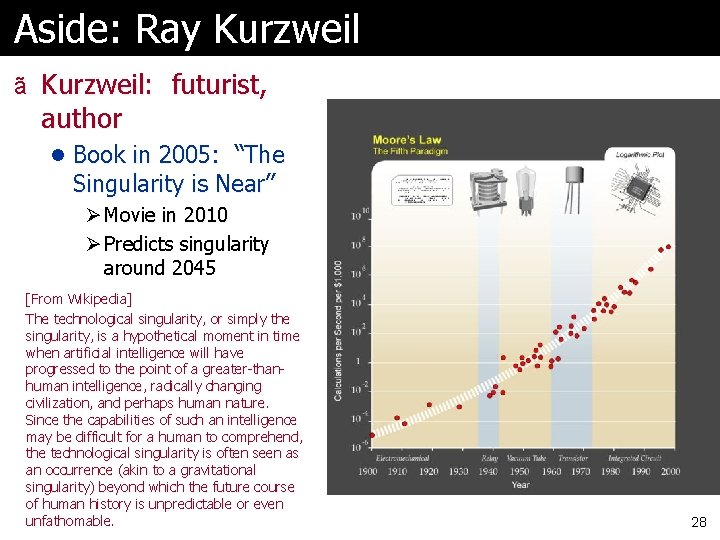
Aside: Ray Kurzweil ã Kurzweil: futurist, author l Book in 2005: “The Singularity is Near” Ø Movie in 2010 Ø Predicts singularity around 2045 [From Wikipedia] The technological singularity, or simply the singularity, is a hypothetical moment in time when artificial intelligence will have progressed to the point of a greater-thanhuman intelligence, radically changing civilization, and perhaps human nature. Since the capabilities of such an intelligence may be difficult for a human to comprehend, the technological singularity is often seen as an occurrence (akin to a gravitational singularity) beyond which the future course of human history is unpredictable or even unfathomable. 28
Trends ã Now let’s look at trends in l Bandwidth (Throughput) vs. Latency l Power l Cost l Dependability l Performance 29
Bandwidth vs. Latency ã What is “bandwidth”? l or “throughput” l total amount of work done per time l e. g. : MB/sec for disk or network transfer l e. g. : billions of instructions/sec executed by CPU ã What is “latency”? l or “response time” l time between start and completion l e. g. : milliseconds for a disk access l e. g. : time lag for video game to respond to user input 30
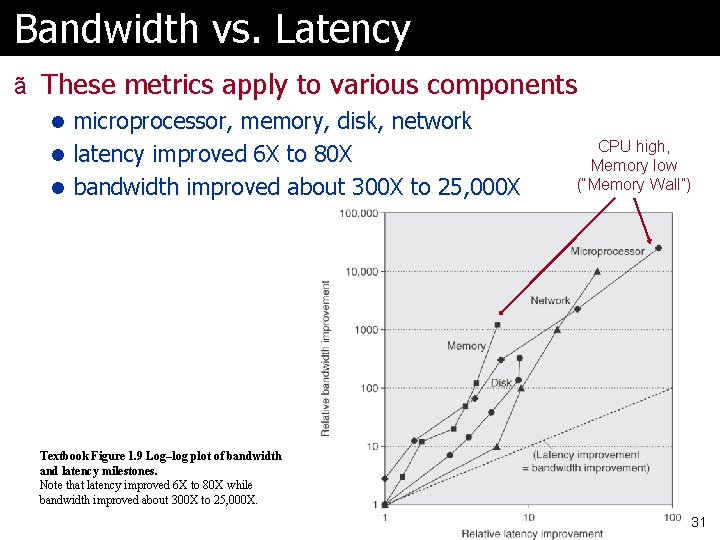
Bandwidth vs. Latency ã These metrics apply to various components l microprocessor, memory, disk, network l latency improved 6 X to 80 X l bandwidth improved about 300 X to 25, 000 X CPU high, Memory low (“Memory Wall”) Textbook Figure 1. 9 Log–log plot of bandwidth and latency milestones. Note that latency improved 6 X to 80 X while bandwidth improved about 300 X to 25, 000 X. 31
Bandwidth vs. Latency ã Bandwidth improves much faster than latency l In the time that bandwidth doubles, latency improves by no more than a factor of 1. 2 to 1. 4 l (and capacity improves faster than bandwidth) ã Or: l bandwidth improves by more than the square of the improvement in latency l what could be the reason for bandwidth to improve faster than latency? Ø easier to exploit parallelism of more transistors to improve bandwidth Ø improvements to latency limited by delays, sequentiality, etc. 32
Why Less Improvement? ã Moore’s Law helps bandwidth l Longer distance for signal to travel, so longer latency l Which offsets faster transistors ã Distance limits latency l Speed of light lower bound ã Bandwidth sells l Capacity, processor “speed” and benchmark scores ã Latency can help bandwidth l Often bandwidth is increased by adding latency ã OS introduces latency 33
Techniques to Ameliorate ã Caching l Use capacity (“bandwidth”) to reduce average latency ã Replication l Again, leverage capacity ã Prediction l Use extra processing transistors to pre-fetch l Maybe also to recompute instead of fetch 34
Trends ã Now let’s look at trends in l Bandwidth vs. Latency l Power l Cost l Dependability l Performance 35
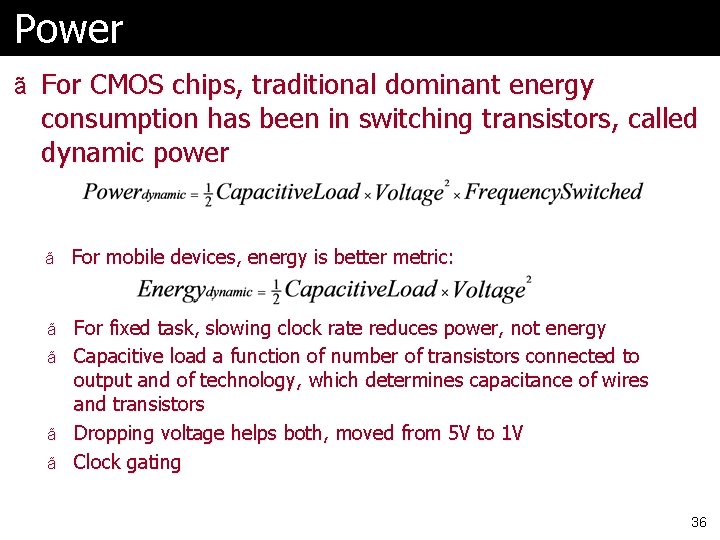
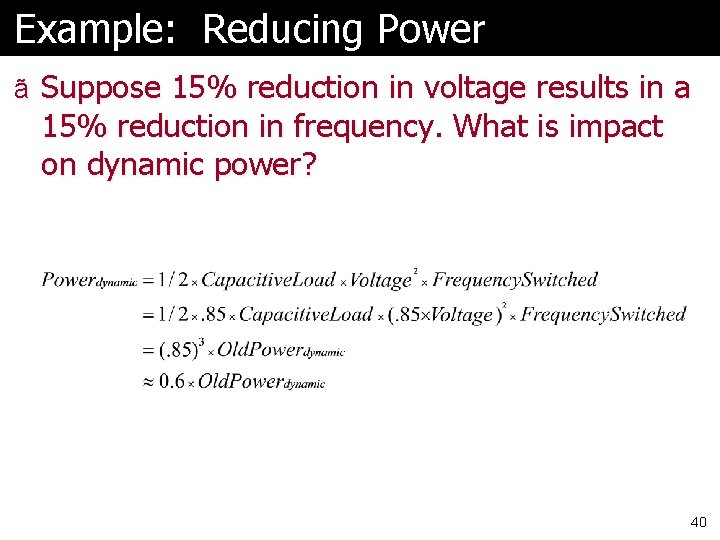
Power ã For CMOS chips, traditional dominant energy consumption has been in switching transistors, called dynamic power ã For mobile devices, energy is better metric: ã For fixed task, slowing clock rate reduces power, not energy ã Capacitive load a function of number of transistors connected to output and of technology, which determines capacitance of wires and transistors ã Dropping voltage helps both, moved from 5 V to 1 V ã Clock gating 36
Power ã Intel 80386 consumed ~ 2 W ã 3. 3 GHz Intel Core i 7 consumes 130 W ã Heat must be dissipated from 1. 5 x 1. 5 cm chip ã This is the limit of what can be cooled by air 37
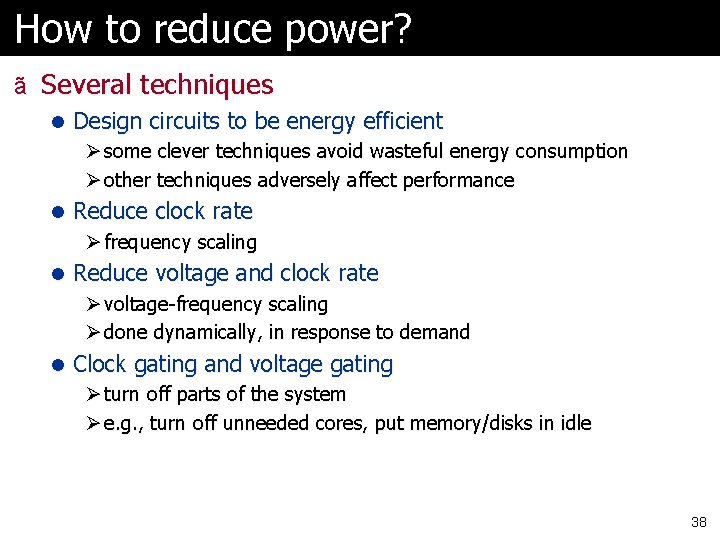
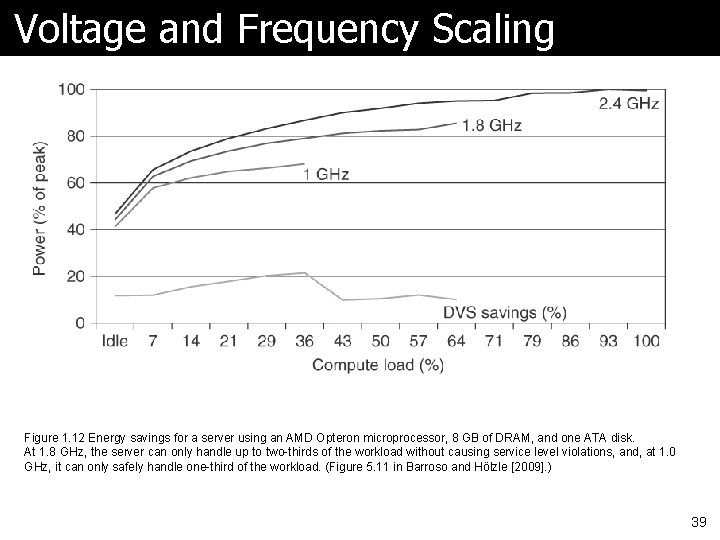
How to reduce power? ã Several techniques l Design circuits to be energy efficient Ø some clever techniques avoid wasteful energy consumption Ø other techniques adversely affect performance l Reduce clock rate Ø frequency scaling l Reduce voltage and clock rate Ø voltage-frequency scaling Ø done dynamically, in response to demand l Clock gating and voltage gating Ø turn off parts of the system Ø e. g. , turn off unneeded cores, put memory/disks in idle 38
Voltage and Frequency Scaling Figure 1. 12 Energy savings for a server using an AMD Opteron microprocessor, 8 GB of DRAM, and one ATA disk. At 1. 8 GHz, the server can only handle up to two-thirds of the workload without causing service level violations, and, at 1. 0 GHz, it can only safely handle one-third of the workload. (Figure 5. 11 in Barroso and Hölzle [2009]. ) 39
Example: Reducing Power ã Suppose 15% reduction in voltage results in a 15% reduction in frequency. What is impact on dynamic power? 40
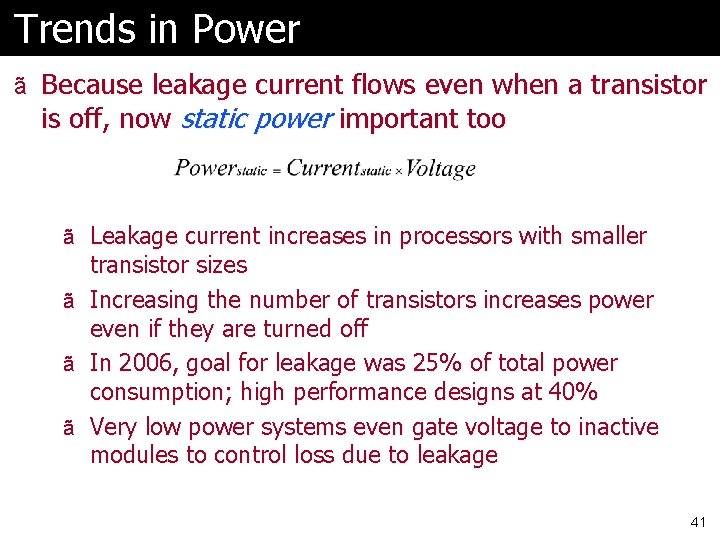
Trends in Power ã Because leakage current flows even when a transistor is off, now static power important too ã Leakage current increases in processors with smaller ã ã ã transistor sizes Increasing the number of transistors increases power even if they are turned off In 2006, goal for leakage was 25% of total power consumption; high performance designs at 40% Very low power systems even gate voltage to inactive modules to control loss due to leakage 41
Trends ã Now let’s look at trends in l Bandwidth vs. Latency l Power l Cost l Dependability l Performance 42
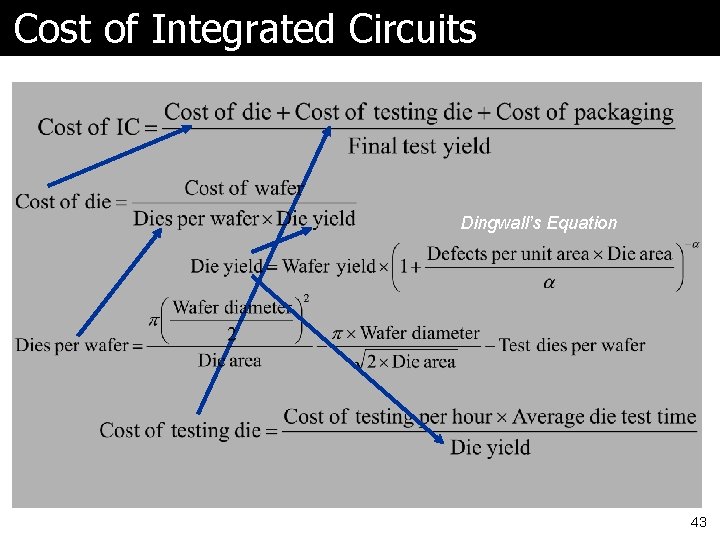
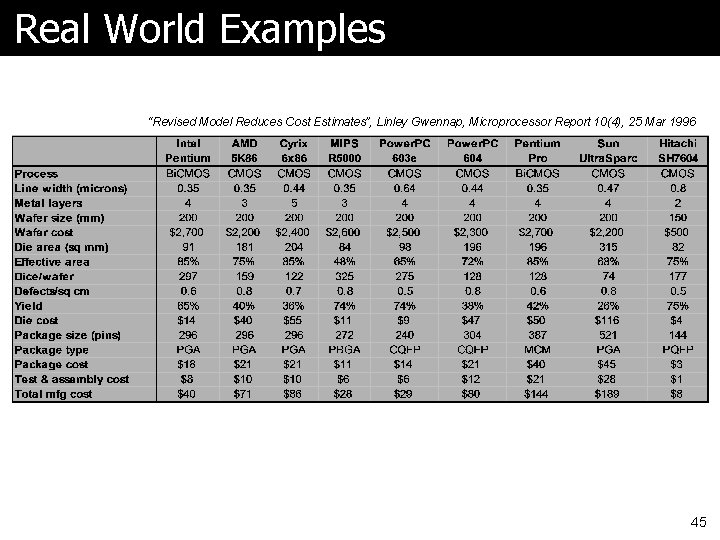
Cost of Integrated Circuits Dingwall’s Equation 43
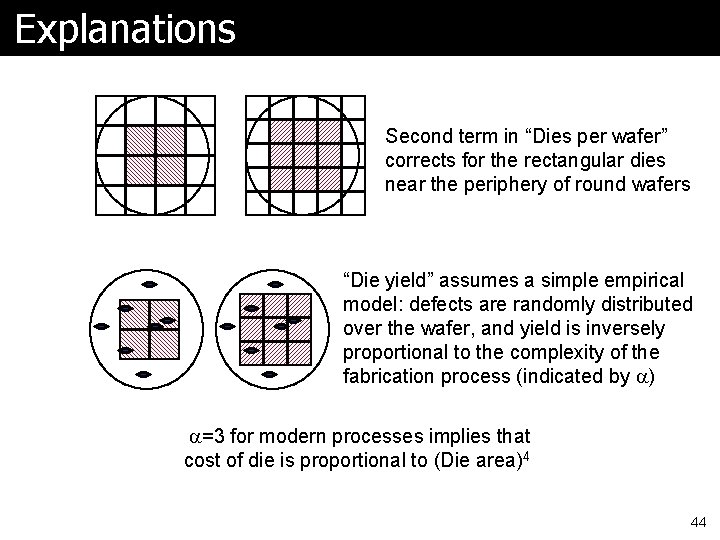
Explanations Second term in “Dies per wafer” corrects for the rectangular dies near the periphery of round wafers “Die yield” assumes a simple empirical model: defects are randomly distributed over the wafer, and yield is inversely proportional to the complexity of the fabrication process (indicated by a) a=3 for modern processes implies that cost of die is proportional to (Die area)4 44
Real World Examples “Revised Model Reduces Cost Estimates”, Linley Gwennap, Microprocessor Report 10(4), 25 Mar 1996 45
Trends ã Now let’s look at trends in l Bandwidth vs. Latency l Power l Cost l Dependability l Performance 46
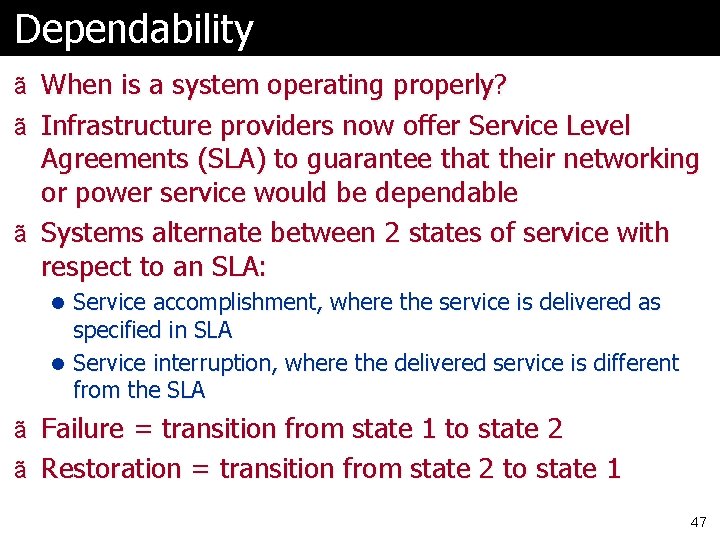
Dependability ã When is a system operating properly? ã Infrastructure providers now offer Service Level Agreements (SLA) to guarantee that their networking or power service would be dependable ã Systems alternate between 2 states of service with respect to an SLA: l Service accomplishment, where the service is delivered as specified in SLA l Service interruption, where the delivered service is different from the SLA ã Failure = transition from state 1 to state 2 ã Restoration = transition from state 2 to state 1 47
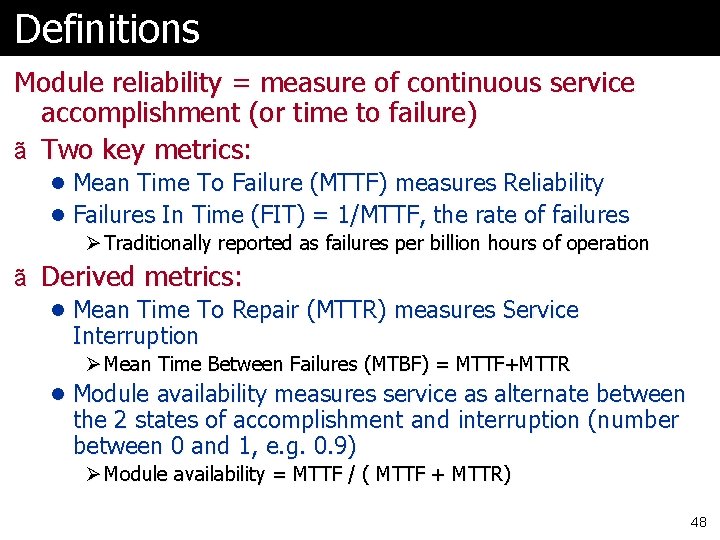
Definitions Module reliability = measure of continuous service accomplishment (or time to failure) ã Two key metrics: l Mean Time To Failure (MTTF) measures Reliability l Failures In Time (FIT) = 1/MTTF, the rate of failures Ø Traditionally reported as failures per billion hours of operation ã Derived metrics: l Mean Time To Repair (MTTR) measures Service Interruption Ø Mean Time Between Failures (MTBF) = MTTF+MTTR l Module availability measures service as alternate between the 2 states of accomplishment and interruption (number between 0 and 1, e. g. 0. 9) Ø Module availability = MTTF / ( MTTF + MTTR) 48
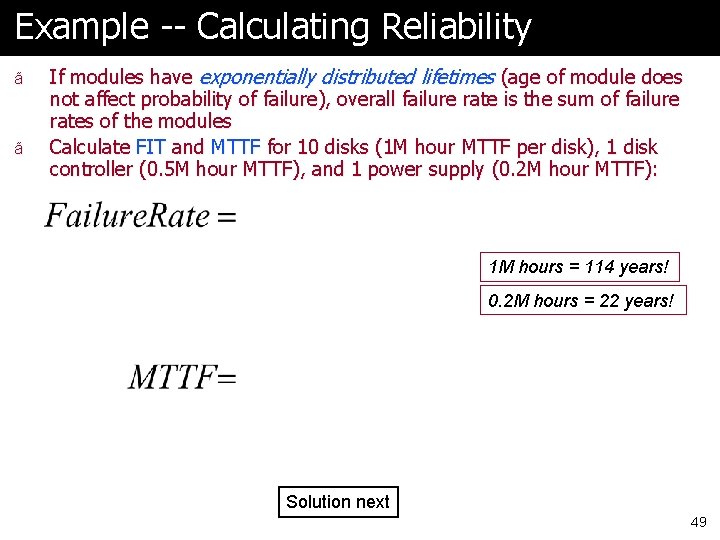
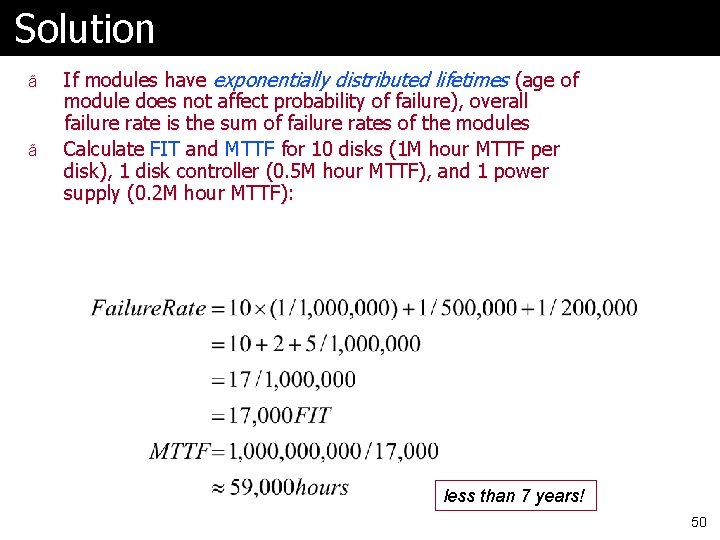
Example -- Calculating Reliability ã ã If modules have exponentially distributed lifetimes (age of module does not affect probability of failure), overall failure rate is the sum of failure rates of the modules Calculate FIT and MTTF for 10 disks (1 M hour MTTF per disk), 1 disk controller (0. 5 M hour MTTF), and 1 power supply (0. 2 M hour MTTF): 1 M hours = 114 years! 0. 2 M hours = 22 years! Solution next 49
Solution ã ã If modules have exponentially distributed lifetimes (age of module does not affect probability of failure), overall failure rate is the sum of failure rates of the modules Calculate FIT and MTTF for 10 disks (1 M hour MTTF per disk), 1 disk controller (0. 5 M hour MTTF), and 1 power supply (0. 2 M hour MTTF): less than 7 years! 50
Trends ã Now let’s look at trends in l Bandwidth vs. Latency l Power l Cost l Dependability l Performance 51
First, What is Performance? ã The starting point is universally accepted l “The time required to perform a specified amount of computation is the ultimate measure of computer performance” ã How should we summarize (reduce to a single number) the measured execution times (or measured performance values) of several benchmark programs? l Two properties Ø A single-number performance measure for a set of benchmarks expressed in units of time should be directly proportional to the total (weighted) time consumed by the benchmarks. Ø A single-number performance measure for a set of benchmarks expressed as a rate should be inversely proportional to the total (weighted) time consumed by the benchmarks. from “Characterizing Computer Performance with a Single Number”, J. E. Smith, CACM, October 1988, pp. 1202 -1206 52
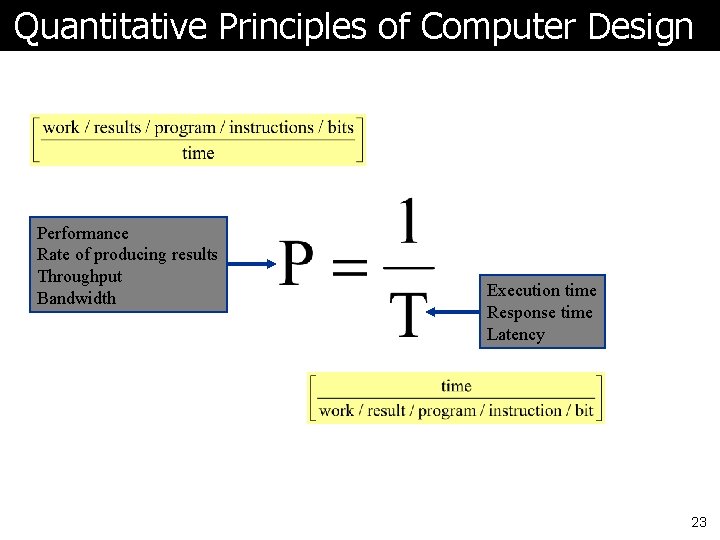
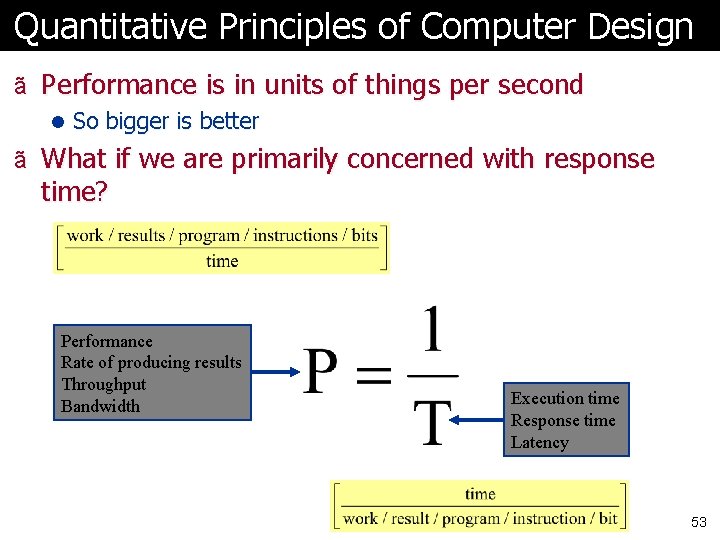
Quantitative Principles of Computer Design ã Performance is in units of things per second l So bigger is better ã What if we are primarily concerned with response time? Performance Rate of producing results Throughput Bandwidth Execution time Response time Latency 53
Performance: What to measure? ã What about just MIPS and MFLOPS? ã Usually rely on benchmarks vs. real workloads ã Older measures were l Kernels or l Small programs designed to mimic real workloads ã Whetstone, Dhrystone ã http: //www. netlib. org/benchmark ã Note LINPACK and Top 500 54
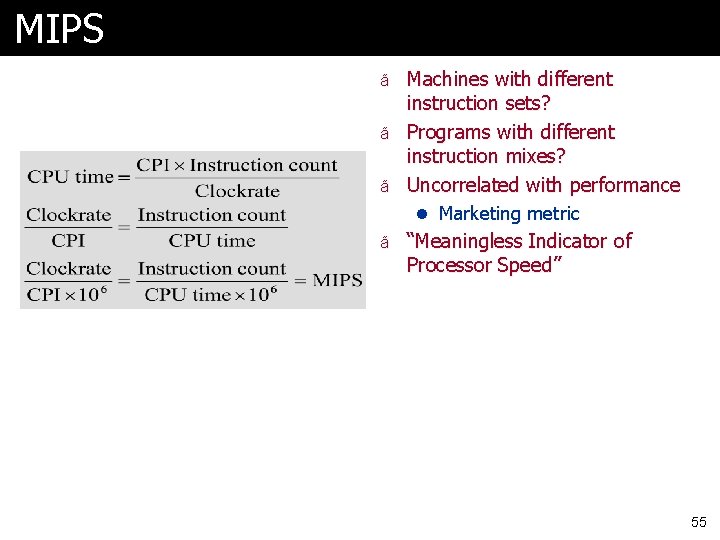
MIPS ã Machines with different instruction sets? ã Programs with different instruction mixes? ã Uncorrelated with performance l Marketing metric ã “Meaningless Indicator of Processor Speed” 55
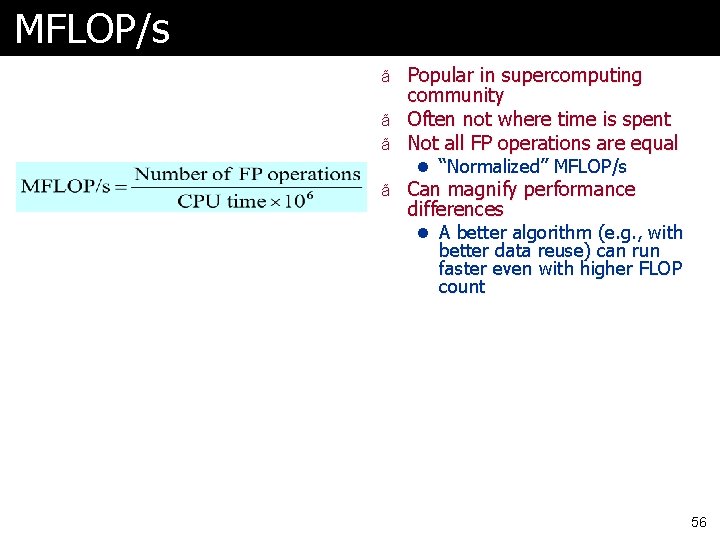
MFLOP/s ã Popular in supercomputing community ã Often not where time is spent ã Not all FP operations are equal l “Normalized” MFLOP/s ã Can magnify performance differences l A better algorithm (e. g. , with better data reuse) can run faster even with higher FLOP count 56
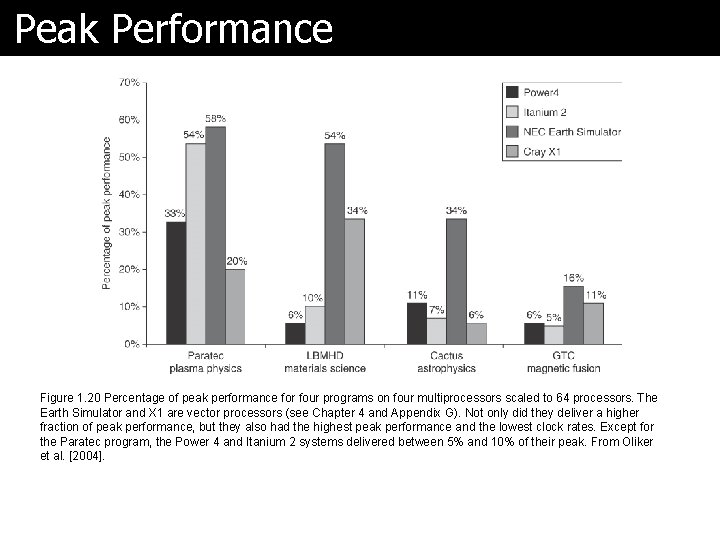
Peak Performance Figure 1. 20 Percentage of peak performance for four programs on four multiprocessors scaled to 64 processors. The Earth Simulator and X 1 are vector processors (see Chapter 4 and Appendix G). Not only did they deliver a higher fraction of peak performance, but they also had the highest peak performance and the lowest clock rates. Except for the Paratec program, the Power 4 and Itanium 2 systems delivered between 5% and 10% of their peak. From Oliker et al. [2004].
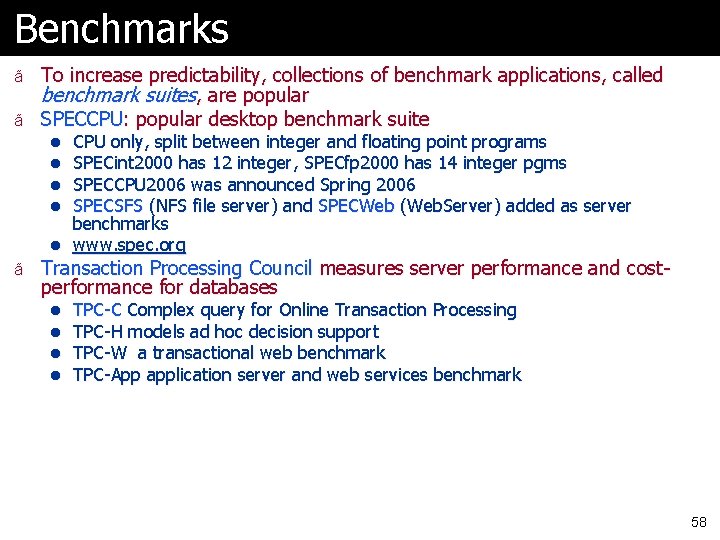
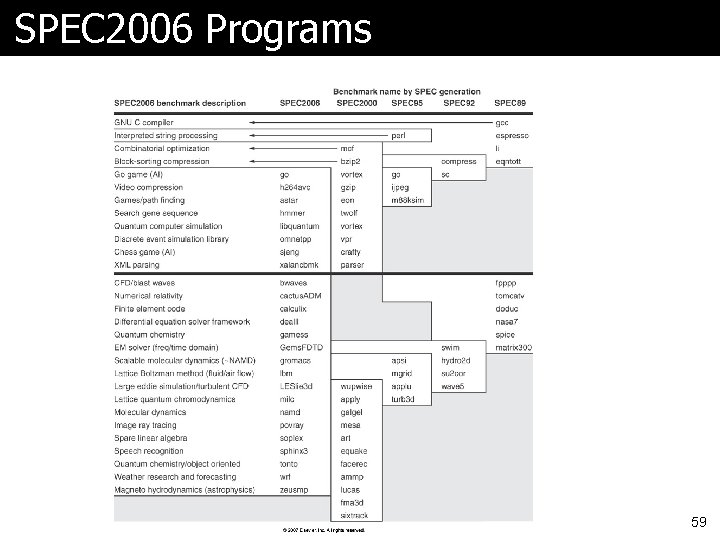
Benchmarks ã To increase predictability, collections of benchmark applications, called benchmark suites, are popular ã SPECCPU: popular desktop benchmark suite l CPU only, split between integer and floating point programs l SPECint 2000 has 12 integer, SPECfp 2000 has 14 integer pgms l SPECCPU 2006 was announced Spring 2006 l SPECSFS (NFS file server) and SPECWeb (Web. Server) added as server benchmarks l www. spec. org ã Transaction Processing Council measures server performance and cost- performance for databases l l TPC-C Complex query for Online Transaction Processing TPC-H models ad hoc decision support TPC-W a transactional web benchmark TPC-App application server and web services benchmark 58
SPEC 2006 Programs 59
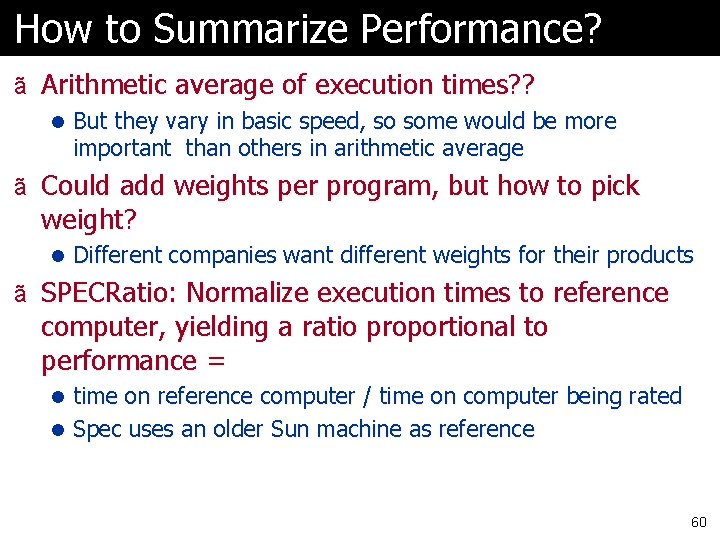
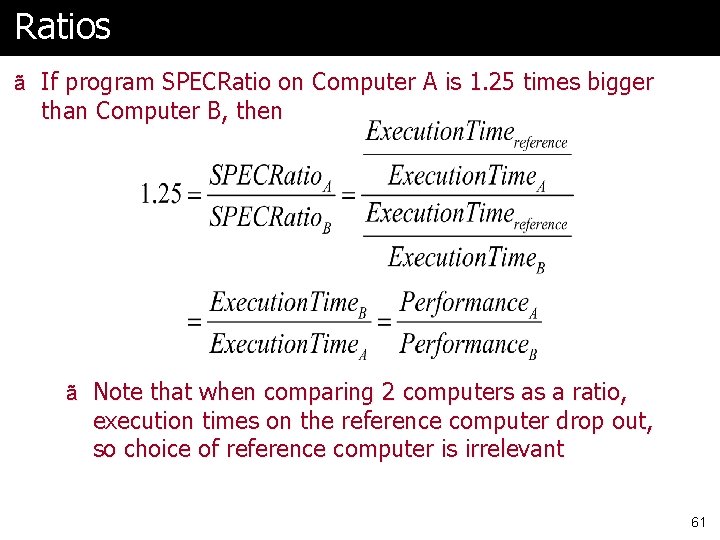
How to Summarize Performance? ã Arithmetic average of execution times? ? l But they vary in basic speed, so some would be more important than others in arithmetic average ã Could add weights per program, but how to pick weight? l Different companies want different weights for their products ã SPECRatio: Normalize execution times to reference computer, yielding a ratio proportional to performance = l time on reference computer / time on computer being rated l Spec uses an older Sun machine as reference 60
Ratios ã If program SPECRatio on Computer A is 1. 25 times bigger than Computer B, then ã Note that when comparing 2 computers as a ratio, execution times on the reference computer drop out, so choice of reference computer is irrelevant 61
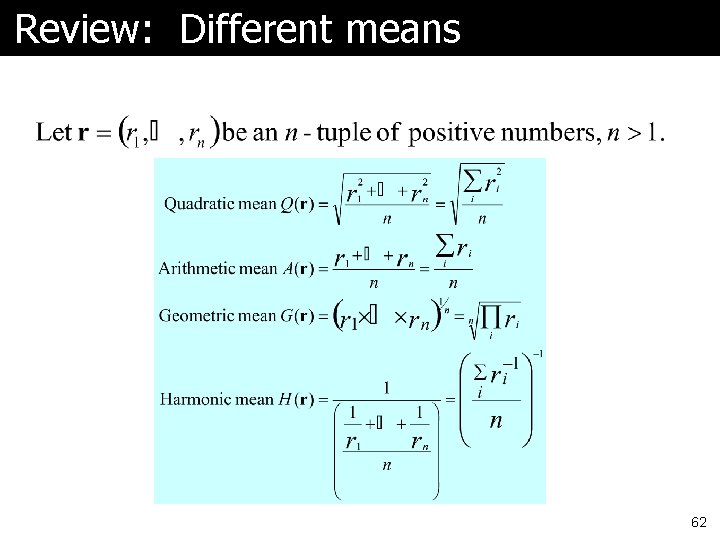
Review: Different means 62
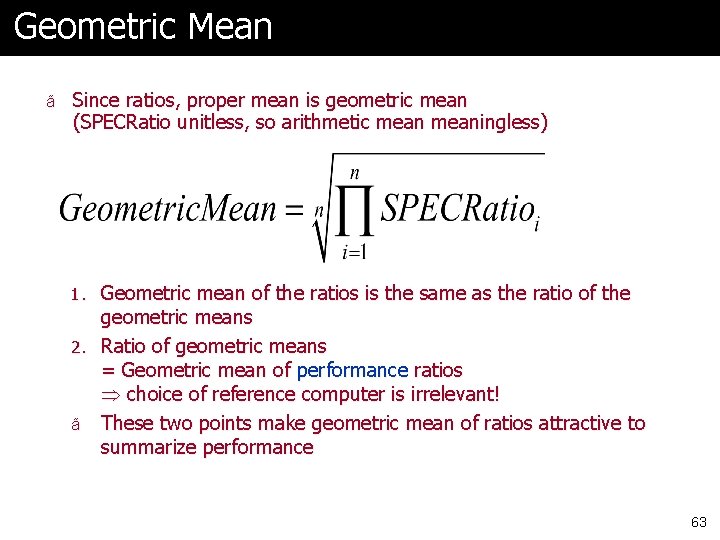
Geometric Mean ã Since ratios, proper mean is geometric mean (SPECRatio unitless, so arithmetic meaningless) 1. Geometric mean of the ratios is the same as the ratio of the geometric means 2. Ratio of geometric means = Geometric mean of performance ratios choice of reference computer is irrelevant! ã These two points make geometric mean of ratios attractive to summarize performance 63
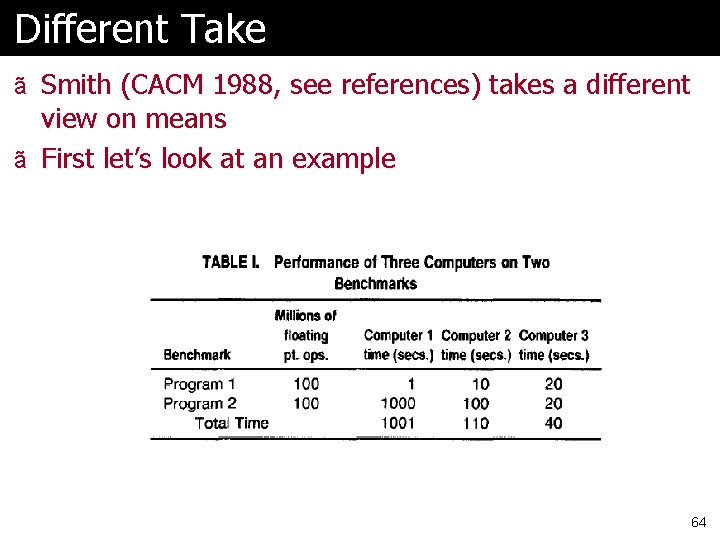
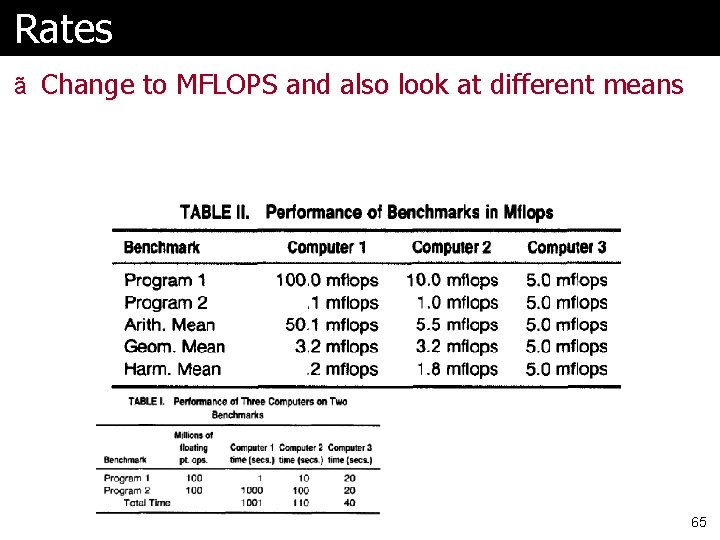
Different Take ã Smith (CACM 1988, see references) takes a different view on means ã First let’s look at an example 64
Rates ã Change to MFLOPS and also look at different means 65
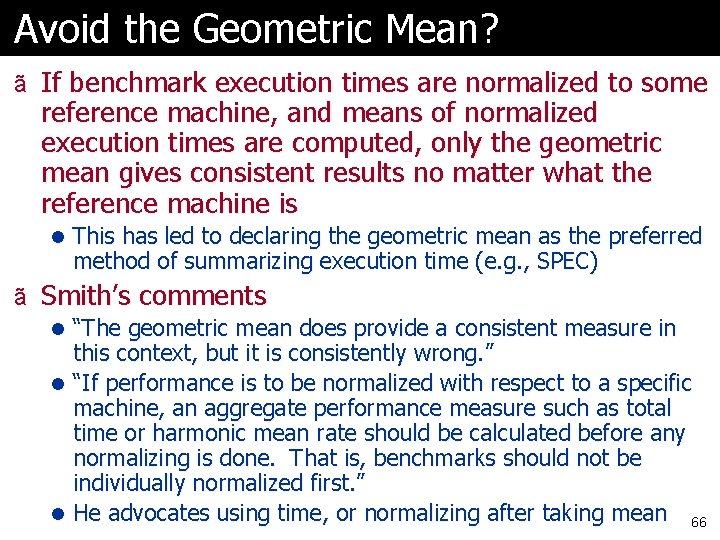
Avoid the Geometric Mean? ã If benchmark execution times are normalized to some reference machine, and means of normalized execution times are computed, only the geometric mean gives consistent results no matter what the reference machine is l This has led to declaring the geometric mean as the preferred method of summarizing execution time (e. g. , SPEC) ã Smith’s comments l “The geometric mean does provide a consistent measure in this context, but it is consistently wrong. ” l “If performance is to be normalized with respect to a specific machine, an aggregate performance measure such as total time or harmonic mean rate should be calculated before any normalizing is done. That is, benchmarks should not be individually normalized first. ” l He advocates using time, or normalizing after taking mean 66
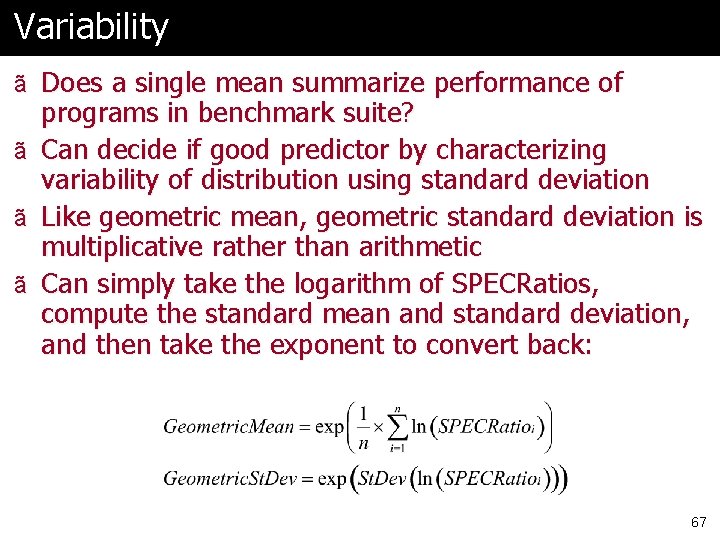
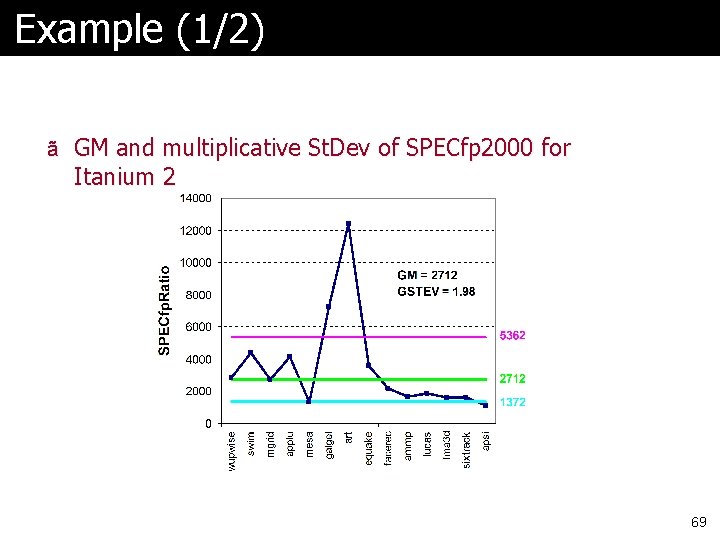
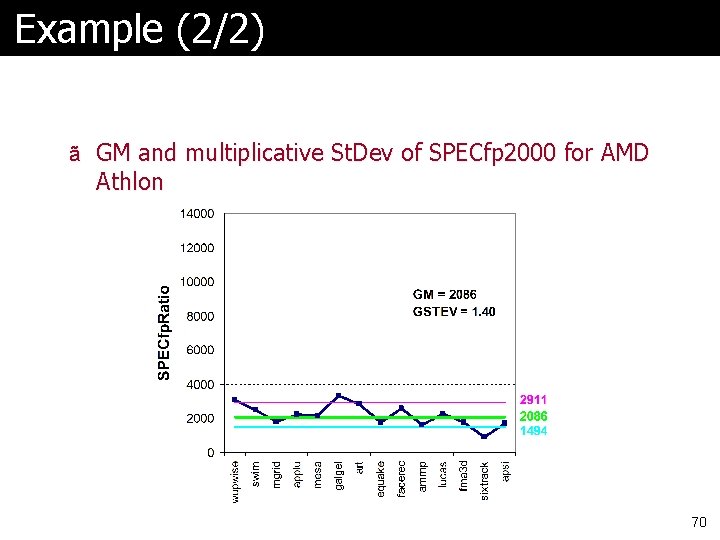
Variability ã Does a single mean summarize performance of programs in benchmark suite? ã Can decide if good predictor by characterizing variability of distribution using standard deviation ã Like geometric mean, geometric standard deviation is multiplicative rather than arithmetic ã Can simply take the logarithm of SPECRatios, compute the standard mean and standard deviation, and then take the exponent to convert back: 67
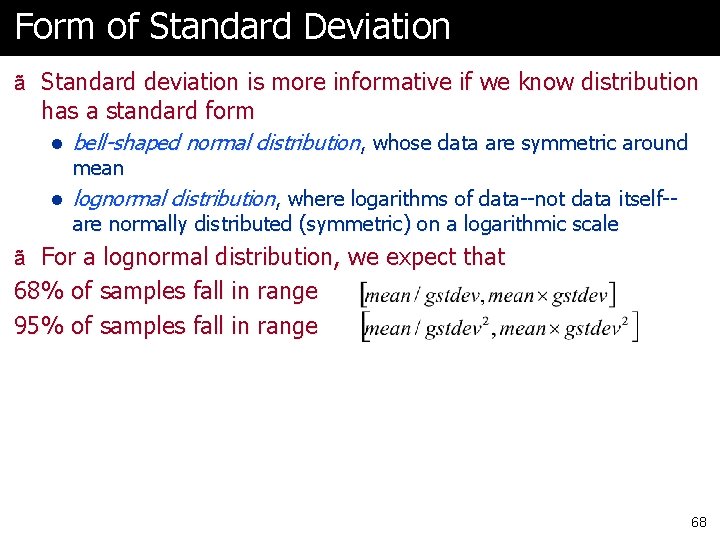
Form of Standard Deviation ã Standard deviation is more informative if we know distribution has a standard form l bell-shaped normal distribution, whose data are symmetric around l lognormal distribution, where logarithms of data--not data itself-- mean are normally distributed (symmetric) on a logarithmic scale ã For a lognormal distribution, we expect that 68% of samples fall in range 95% of samples fall in range 68
Example (1/2) ã GM and multiplicative St. Dev of SPECfp 2000 for Itanium 2 69
Example (2/2) ã GM and multiplicative St. Dev of SPECfp 2000 for AMD Athlon 70
Comments ã Standard deviation of 1. 98 for Itanium 2 is much higher-- vs. 1. 40 --so results will differ more widely from the mean, and therefore are likely less predictable ã Falling within one standard deviation: l 10 of 14 benchmarks (71%) for Itanium 2 l 11 of 14 benchmarks (78%) for Athlon ã Thus, the results are quite compatible with a lognormal distribution (expect 68%) 71
Next Lecture ã Principles of Computer Design ã Amdahl’s Law 72
Readings/References ã Gordon Moore’s paper l http: //www. intel. com/pressroom/kits/events/moores_law_40 th/index. htm l http: //download. intel. com/museum/Moores_Law/Articles- Press_Releases/Gordon_Moore_1965_Article. pdf ã Paper on which latency section is based l Patterson, D. A. 2004. Latency lags bandwidth. 47, 10 (Oct. 2004), 71 -75. Commun. ACM ã “Characterizing Computer Performance with a Single Number”, J. E. Smith, CACM, October 1988, pp. 1202 -1206 73