
18 U S C 205a2 From Doctrine to


- Slides: 25
18 U. S. C. § 205(a)(2): From Doctrine to Implementation Leigh Francis, OGE Rachel Dowell , OGE Susan Heller, DHS 1
18 U. S. C. § 205 (a)(1) Clause 1 Bars employees, other than in the discharge of their official duties, from acting as agent or attorney for another for prosecuting any claims against the U. S. (a)(1) Clause 2 Bars employees, other than in the discharge of their official duties, from receiving any compensation in consideration of assistance in the prosecution of a claim against the U. S. (a)(2) Bars employees, other than in the discharge of their official duties, from acting as agent or attorney for another before any department, agency, or court in connection with a covered matter in which the U. S. is a party or has a direct and substantial interest. (b) Prohibitions applicable to employees of D. C. in connection with claims against D. C. and matters in which D. C. is a party of has a direct and substantial interest (c) Provides that all SGEs are subject to section 205(a) and (b) only in relation to certain covered matters involving specific parties (d)-(g); (i) (h) Exceptions Definition of “covered matter” 2
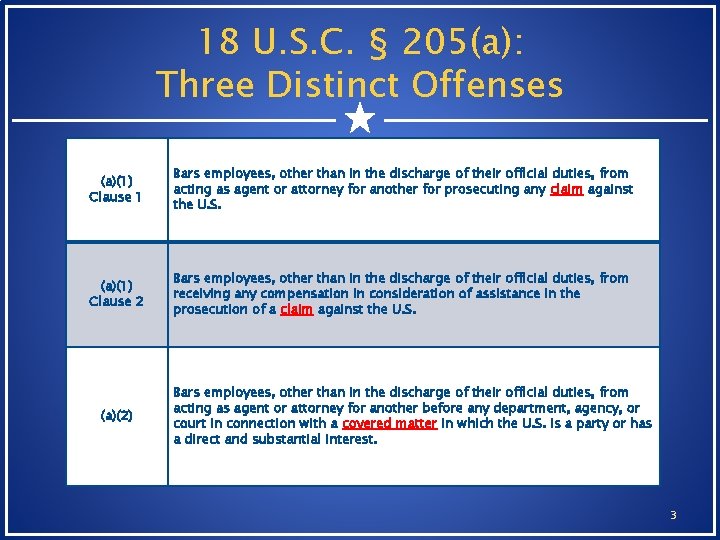
18 U. S. C. § 205(a): Three Distinct Offenses (a)(1) Clause 1 Bars employees, other than in the discharge of their official duties, from acting as agent or attorney for another for prosecuting any claim against the U. S. (a)(1) Clause 2 Bars employees, other than in the discharge of their official duties, from receiving any compensation in consideration of assistance in the prosecution of a claim against the U. S. (a)(2) Bars employees, other than in the discharge of their official duties, from acting as agent or attorney for another before any department, agency, or court in connection with a covered matter in which the U. S. is a party or has a direct and substantial interest. 3
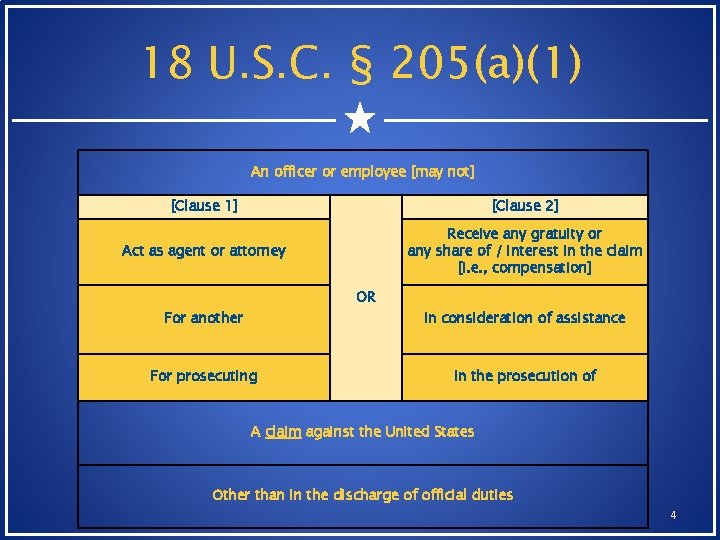
18 U. S. C. § 205(a)(1) An officer or employee [may not] [Clause 1] [Clause 2] Act as agent or attorney Receive any gratuity or any share of / interest in the claim [i. e. , compensation] OR For another For prosecuting In consideration of assistance In the prosecution of A claim against the United States Other than in the discharge of official duties 4
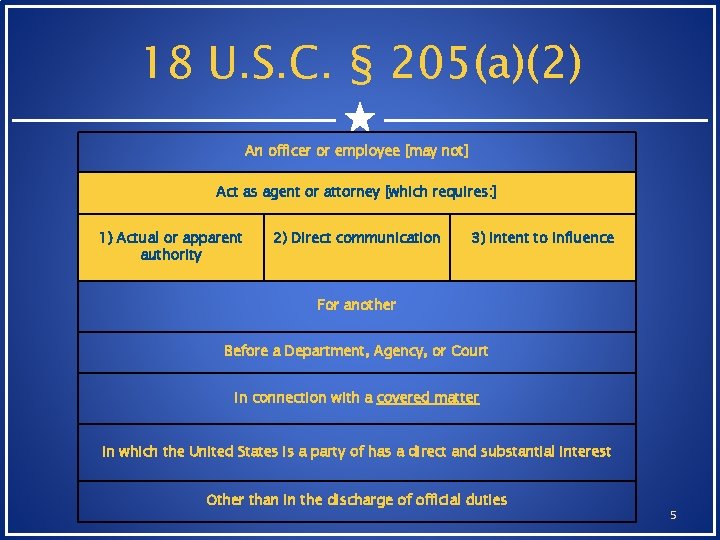
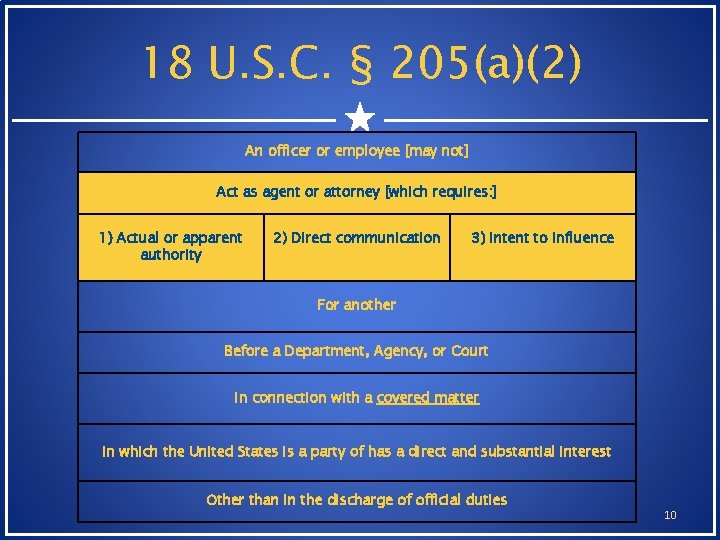
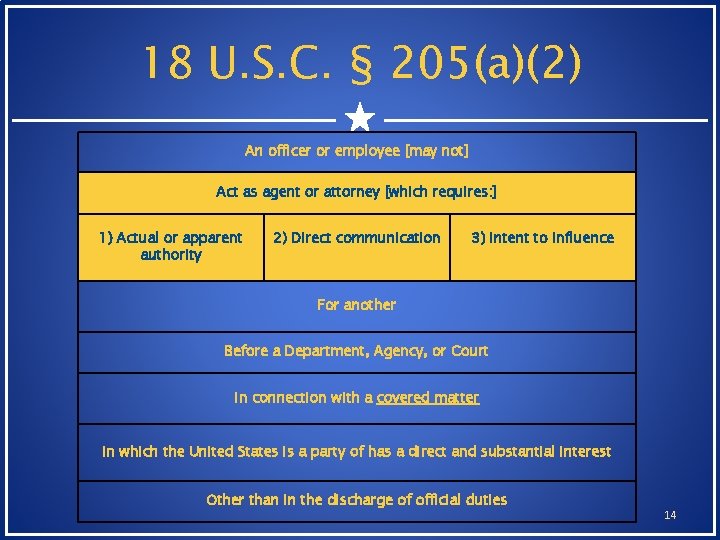
18 U. S. C. § 205(a)(2) An officer or employee [may not] Act as agent or attorney [which requires: ] 1) Actual or apparent authority 2) Direct communication 3) Intent to influence For another Before a Department, Agency, or Court In connection with a covered matter In which the United States is a party of has a direct and substantial interest Other than in the discharge of official duties 5
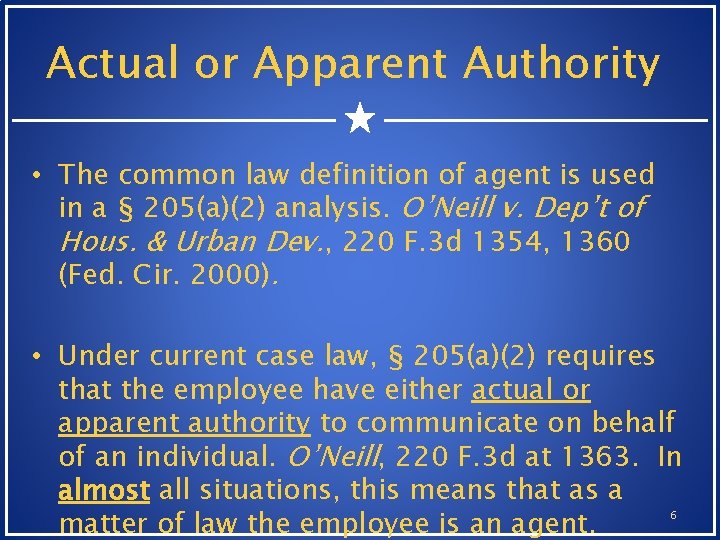
Actual or Apparent Authority • The common law definition of agent is used in a § 205(a)(2) analysis. O’Neill v. Dep’t of Hous. & Urban Dev. , 220 F. 3 d 1354, 1360 (Fed. Cir. 2000). • Under current case law, § 205(a)(2) requires that the employee have either actual or apparent authority to communicate on behalf of an individual. O’Neill, 220 F. 3 d at 1363. In almost all situations, this means that as a 6 matter of law the employee is an agent.
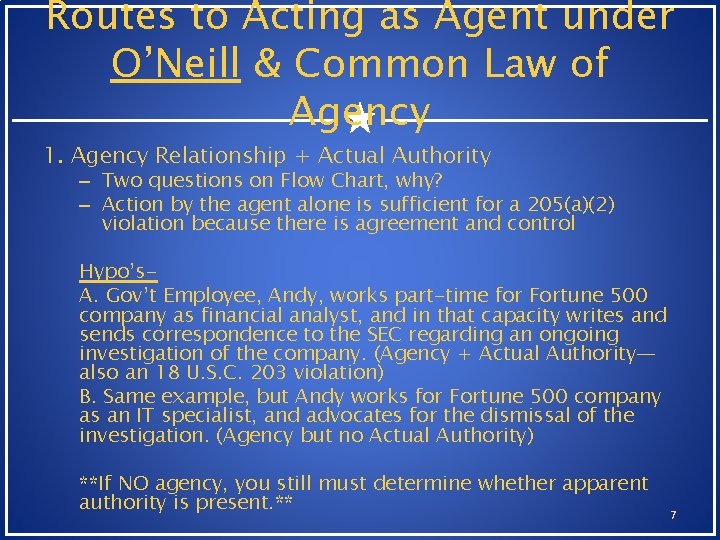
Routes to Acting as Agent under O’Neill & Common Law of Agency 1. Agency Relationship + Actual Authority – Two questions on Flow Chart, why? – Action by the agent alone is sufficient for a 205(a)(2) violation because there is agreement and control Hypo’s. A. Gov’t Employee, Andy, works part-time for Fortune 500 company as financial analyst, and in that capacity writes and sends correspondence to the SEC regarding an ongoing investigation of the company. (Agency + Actual Authority— also an 18 U. S. C. 203 violation) B. Same example, but Andy works for Fortune 500 company as an IT specialist, and advocates for the dismissal of the investigation. (Agency but no Actual Authority) **If NO agency, you still must determine whether apparent authority is present. ** 7
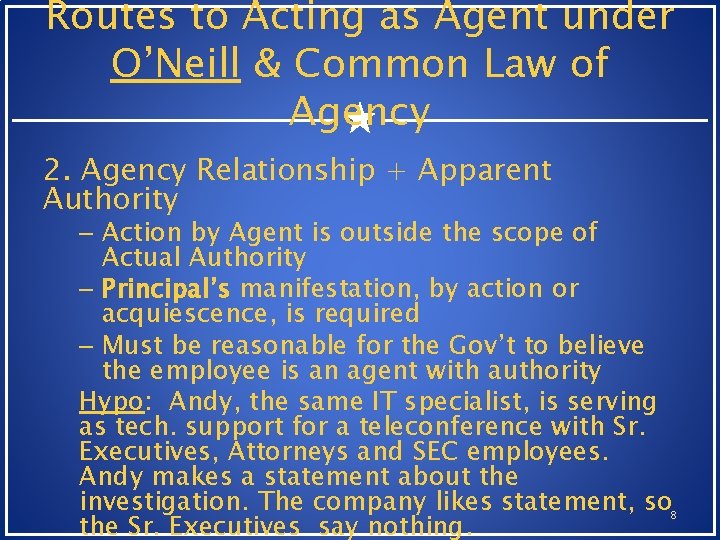
Routes to Acting as Agent under O’Neill & Common Law of Agency 2. Agency Relationship + Apparent Authority – Action by Agent is outside the scope of Actual Authority – Principal’s manifestation, by action or acquiescence, is required – Must be reasonable for the Gov’t to believe the employee is an agent with authority Hypo: Andy, the same IT specialist, is serving as tech. support for a teleconference with Sr. Executives, Attorneys and SEC employees. Andy makes a statement about the investigation. The company likes statement, so 8 the Sr. Executives say nothing.
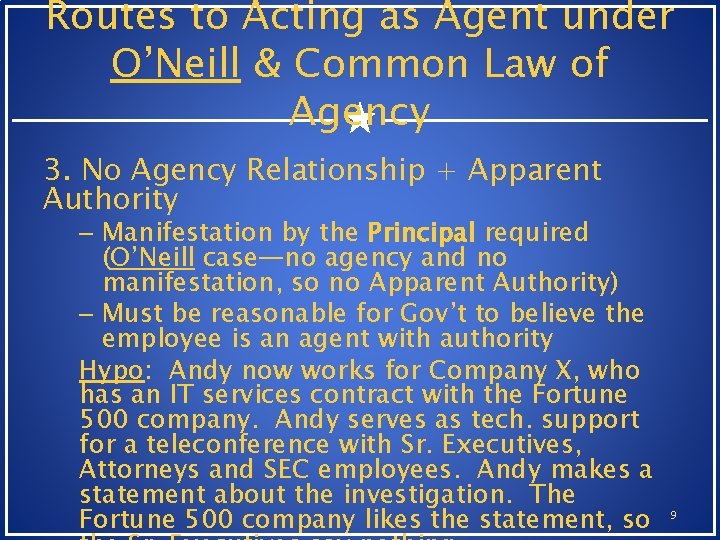
Routes to Acting as Agent under O’Neill & Common Law of Agency 3. No Agency Relationship + Apparent Authority – Manifestation by the Principal required (O’Neill case—no agency and no manifestation, so no Apparent Authority) – Must be reasonable for Gov’t to believe the employee is an agent with authority Hypo: Andy now works for Company X, who has an IT services contract with the Fortune 500 company. Andy serves as tech. support for a teleconference with Sr. Executives, Attorneys and SEC employees. Andy makes a statement about the investigation. The Fortune 500 company likes the statement, so 9
18 U. S. C. § 205(a)(2) An officer or employee [may not] Act as agent or attorney [which requires: ] 1) Actual or apparent authority 2) Direct communication 3) Intent to influence For another Before a Department, Agency, or Court In connection with a covered matter In which the United States is a party of has a direct and substantial interest Other than in the discharge of official duties 10
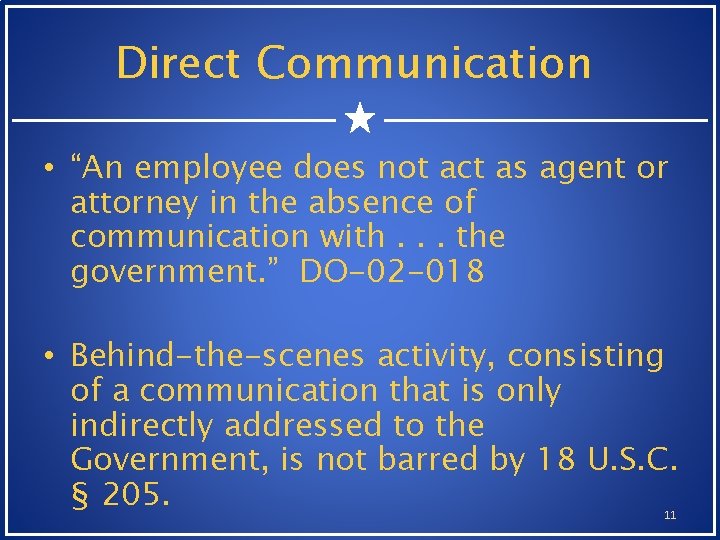
Direct Communication • “An employee does not act as agent or attorney in the absence of communication with. . . the government. ” DO-02 -018 • Behind-the-scenes activity, consisting of a communication that is only indirectly addressed to the Government, is not barred by 18 U. S. C. § 205. 11
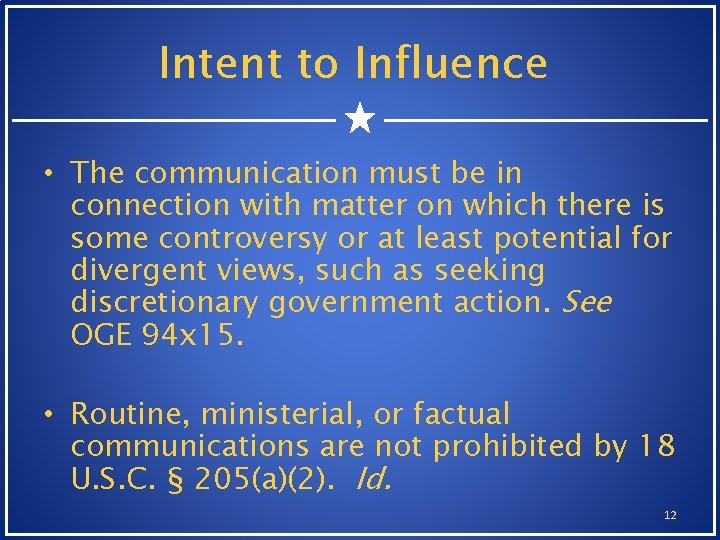
Intent to Influence • The communication must be in connection with matter on which there is some controversy or at least potential for divergent views, such as seeking discretionary government action. See OGE 94 x 15. • Routine, ministerial, or factual communications are not prohibited by 18 U. S. C. § 205(a)(2). Id. 12
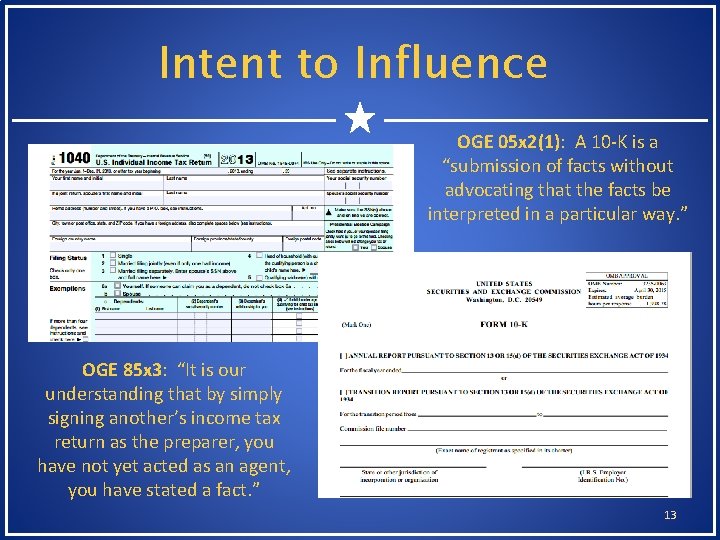
Intent to Influence OGE 05 x 2(1): A 10 -K is a “submission of facts without advocating that the facts be interpreted in a particular way. ” OGE 85 x 3: “It is our understanding that by simply signing another’s income tax return as the preparer, you have not yet acted as an agent, you have stated a fact. ” 13
18 U. S. C. § 205(a)(2) An officer or employee [may not] Act as agent or attorney [which requires: ] 1) Actual or apparent authority 2) Direct communication 3) Intent to influence For another Before a Department, Agency, or Court In connection with a covered matter In which the United States is a party of has a direct and substantial interest Other than in the discharge of official duties 14
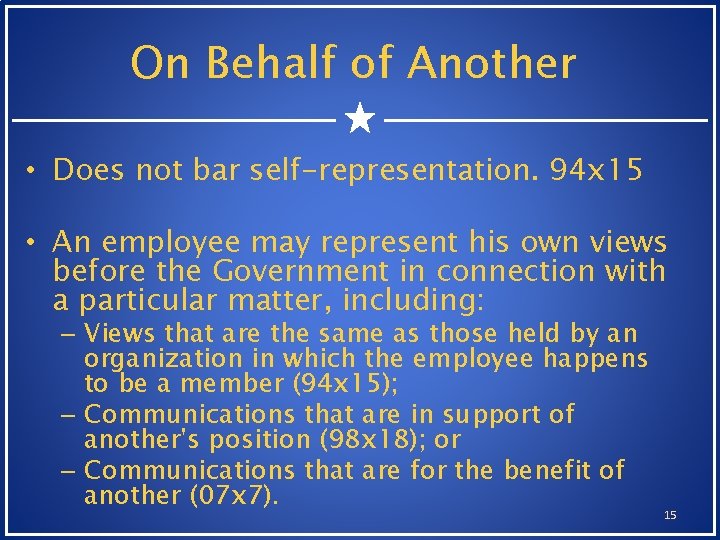
On Behalf of Another • Does not bar self-representation. 94 x 15 • An employee may represent his own views before the Government in connection with a particular matter, including: – Views that are the same as those held by an organization in which the employee happens to be a member (94 x 15); – Communications that are in support of another's position (98 x 18); or – Communications that are for the benefit of another (07 x 7). 15
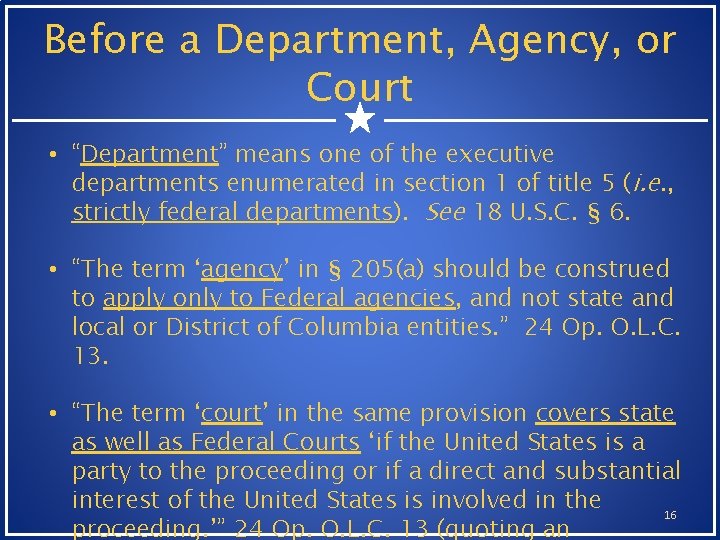
Before a Department, Agency, or Court • “Department” means one of the executive departments enumerated in section 1 of title 5 (i. e. , strictly federal departments). See 18 U. S. C. § 6. • “The term ‘agency’ in § 205(a) should be construed to apply only to Federal agencies, and not state and local or District of Columbia entities. ” 24 Op. O. L. C. 13. • “The term ‘court’ in the same provision covers state as well as Federal Courts ‘if the United States is a party to the proceeding or if a direct and substantial interest of the United States is involved in the 16 proceeding. ’” 24 Op. O. L. C. 13 (quoting an
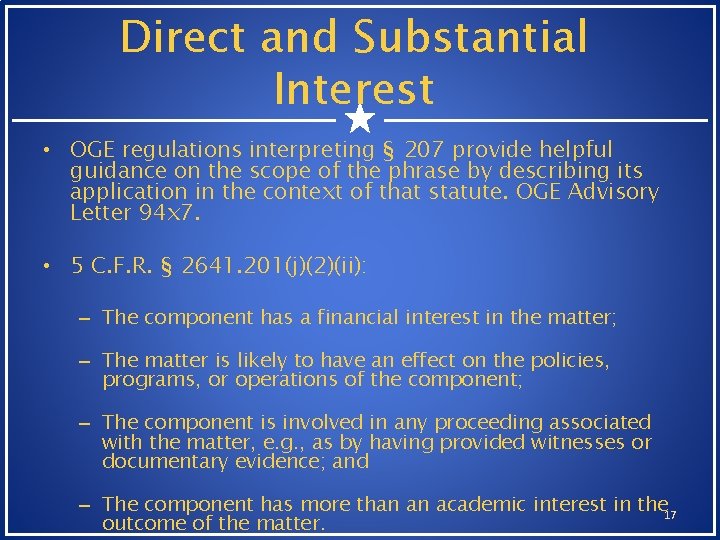
Direct and Substantial Interest • OGE regulations interpreting § 207 provide helpful guidance on the scope of the phrase by describing its application in the context of that statute. OGE Advisory Letter 94 x 7. • 5 C. F. R. § 2641. 201(j)(2)(ii): – The component has a financial interest in the matter; – The matter is likely to have an effect on the policies, programs, or operations of the component; – The component is involved in any proceeding associated with the matter, e. g. , as by having provided witnesses or documentary evidence; and – The component has more than an academic interest in the 17 outcome of the matter.
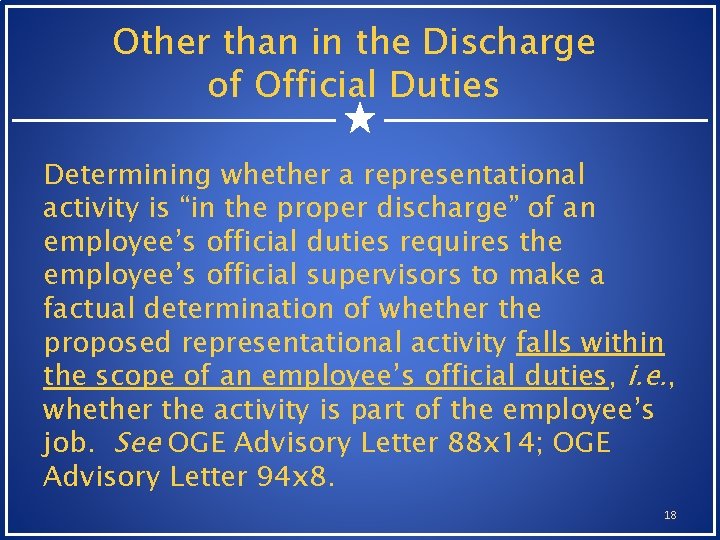
Other than in the Discharge of Official Duties Determining whether a representational activity is “in the proper discharge” of an employee’s official duties requires the employee’s official supervisors to make a factual determination of whether the proposed representational activity falls within the scope of an employee’s official duties, i. e. , whether the activity is part of the employee’s job. See OGE Advisory Letter 88 x 14; OGE Advisory Letter 94 x 8. 18
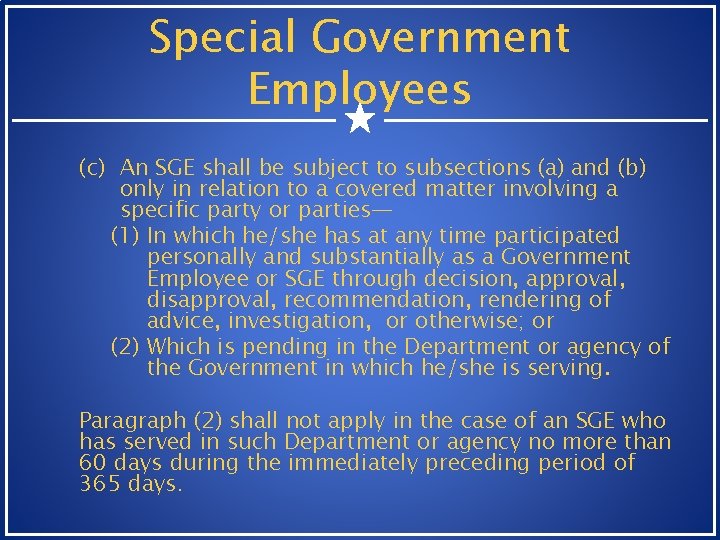
Special Government Employees (c) An SGE shall be subject to subsections (a) and (b) only in relation to a covered matter involving a specific party or parties— (1) In which he/she has at any time participated personally and substantially as a Government Employee or SGE through decision, approval, disapproval, recommendation, rendering of advice, investigation, or otherwise; or (2) Which is pending in the Department or agency of the Government in which he/she is serving. Paragraph (2) shall not apply in the case of an SGE who has served in such Department or agency no more than 60 days during the immediately preceding period of 365 days.
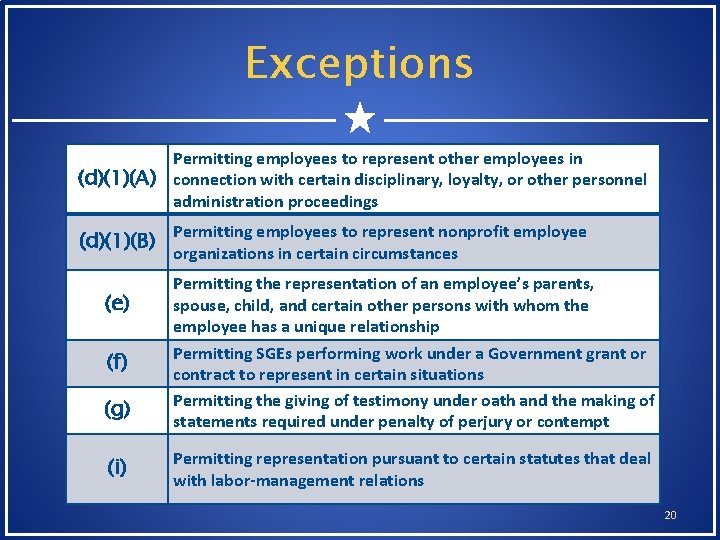
Exceptions Permitting employees to represent other employees in (d)(1)(A) connection with certain disciplinary, loyalty, or other personnel administration proceedings (d)(1)(B) Permitting employees to represent nonprofit employee organizations in certain circumstances (g) Permitting the representation of an employee’s parents, spouse, child, and certain other persons with whom the employee has a unique relationship Permitting SGEs performing work under a Government grant or contract to represent in certain situations Permitting the giving of testimony under oath and the making of statements required under penalty of perjury or contempt (i) Permitting representation pursuant to certain statutes that deal with labor-management relations (e) (f) 20
18 U. S. C. § 205(g) Nothing in this section prevents an officer or employee from giving testimony under oath or from making statements required to be made under penalty for perjury or contempt. 21
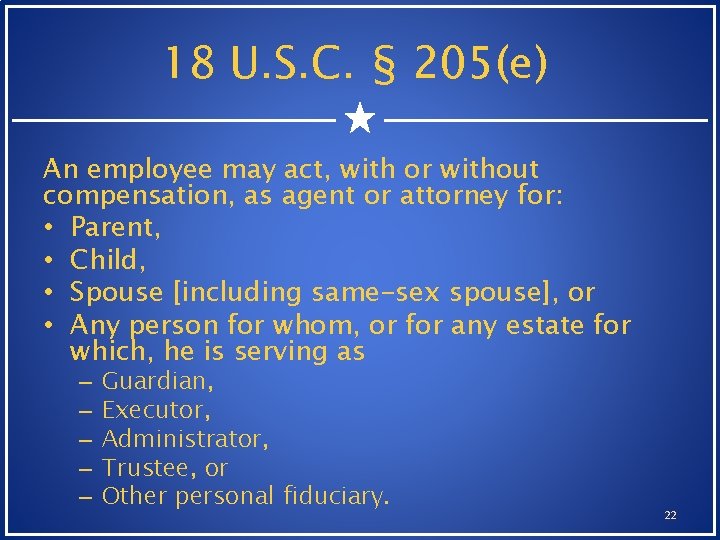
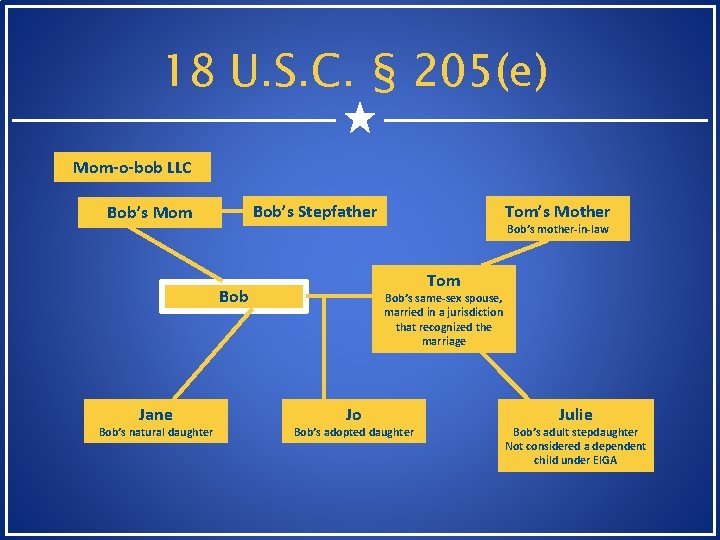
18 U. S. C. § 205(e) An employee may act, with or without compensation, as agent or attorney for: • Parent, • Child, • Spouse [including same-sex spouse], or • Any person for whom, or for any estate for which, he is serving as – – – Guardian, Executor, Administrator, Trustee, or Other personal fiduciary. 22
18 U. S. C. § 205(e) Mom-o-bob LLC Bob’s Stepfather Bob’s Mom Bob’s natural daughter Bob’s mother-in-law Tom Bob Jane Tom’s Mother Bob’s same-sex spouse, married in a jurisdiction that recognized the marriage Jo Bob’s adopted daughter Julie Bob’s adult stepdaughter Not considered a dependent child under EIGA
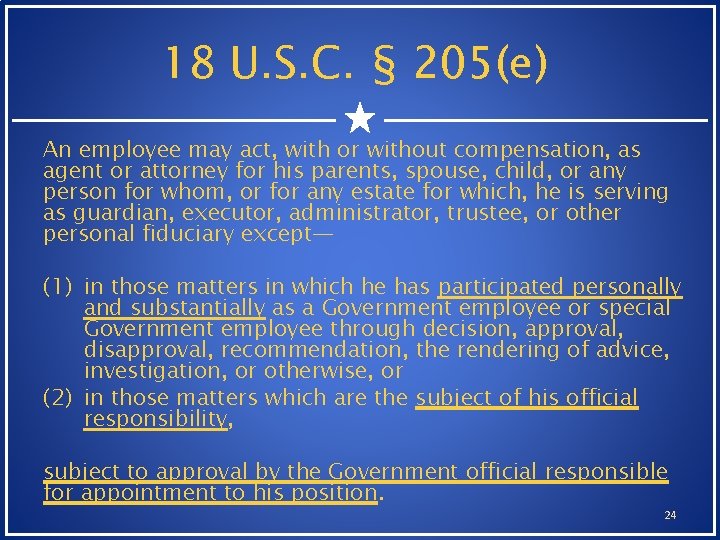
18 U. S. C. § 205(e) An employee may act, with or without compensation, as agent or attorney for his parents, spouse, child, or any person for whom, or for any estate for which, he is serving as guardian, executor, administrator, trustee, or other personal fiduciary except— (1) in those matters in which he has participated personally and substantially as a Government employee or special Government employee through decision, approval, disapproval, recommendation, the rendering of advice, investigation, or otherwise, or (2) in those matters which are the subject of his official responsibility, subject to approval by the Government official responsible for appointment to his position. 24
Further Questions? Contact: Rachel Dowell Assistant Counsel 202 -482 -9267 Leigh Francis Assistant Counsel 202 -482 -9313 25