
18 th International SPICE Conference SPICE 2018 Thessaloniki
![6 PRO 2 PI use: WORK 4 E Method [Salviano 2018], part of PRO](https://slidetodoc.com/presentation_image_h/ddfb0186adc3fff27bce1913ccecd8d0/image-6.jpg "6 PRO 2 PI use: WORK 4 E Method [Salviano 2018], part of PRO")
![15 6. Theory of SPI SLR/SMS on SPI [Kuhrmann et al. 2016] concludes: “There](https://slidetodoc.com/presentation_image_h/ddfb0186adc3fff27bce1913ccecd8d0/image-15.jpg "15 6. Theory of SPI SLR/SMS on SPI [Kuhrmann et al. 2016] concludes: “There")
- Slides: 18
18 th International SPICE Conference SPICE 2018 Thessaloniki, Greece 9 -10 October 2018 g n i v y l g o l Evo o d o h t e M I es g n P a h 2 c s and e g PRO n e l l t cha cen e r g n i r conside PI context in the S C ano i v l a S. lenio F
2 Outline Context and Objectives PRO 2 PI Methodology Recent PRO 2 PI use: WORK 4 E and CERTICS Recent six SPI challenges Conclusion 2
3 Context Since 1998, SPI R&D and SPI in about 100 organizations Since 2002, PRO 2 PI Methodology Process Capability/Modeling Profile to Process Improvement Initial motivation: select processes to drive improvement Challenge: support better SPI using current SPI technology [2011 -2017] other projects, less effort in PRO 2 PI 2018: resume more effort in PRO 2 PI evolution 3
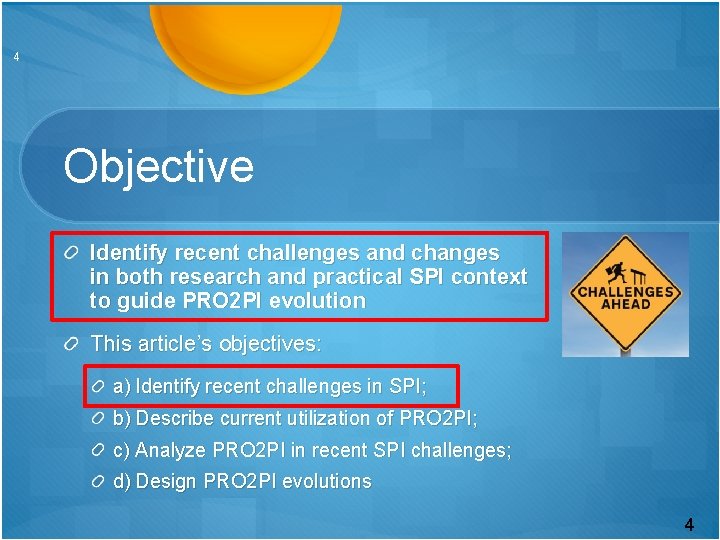
4 Objective Identify recent challenges and changes in both research and practical SPI context to guide PRO 2 PI evolution This article’s objectives: a) Identify recent challenges in SPI; b) Describe current utilization of PRO 2 PI; c) Analyze PRO 2 PI in recent SPI challenges; d) Design PRO 2 PI evolutions 4
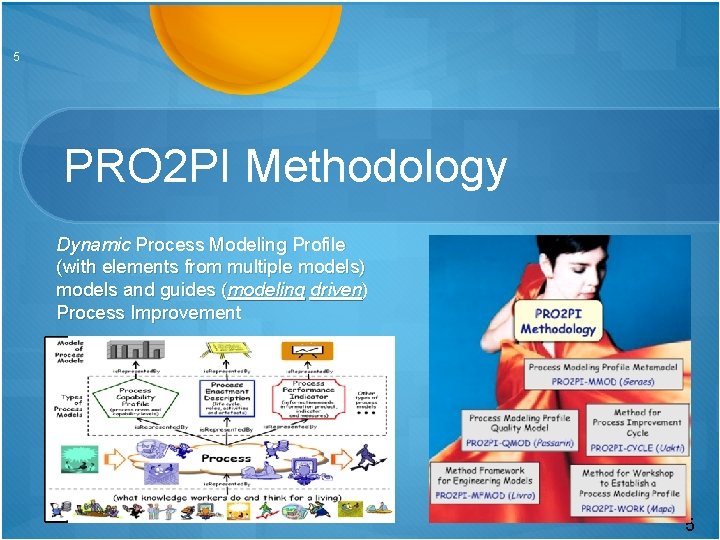
5 PRO 2 PI Methodology Dynamic Process Modeling Profile (with elements from multiple models) models and guides (modeling driven) Process Improvement 5
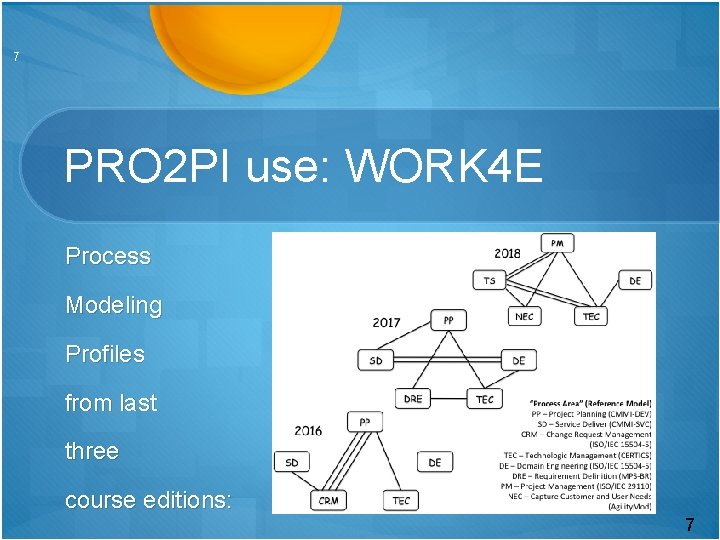
6 PRO 2 PI use: WORK 4 E Method [Salviano 2018], part of PRO 2 PI Methodology, to guide SPI Introduction course with “learning SPI by doing SPI” by starting a SPI Cycle in student/professional work environment using PRO 2 PI 6
7 PRO 2 PI use: WORK 4 E Process Modeling Profiles from last three course editions: 7
8 PRO 2 PI use: CERTICS ISO/IEC 15504 conformity Proc. Asses. Model and Method to certify whether a given software is resulting from “technological development and technological innovation carried out in the Country (Brazil)” [Salviano et al 2014] Developed using PRO 2 PI Eng. Model (MFMOD) CERTICS-SAE (Simplified, Adapted and Extended) for: SPI with CERTICS and other models, and Two courses: CERTICS Proc. Model and Proc. Assessment 8
9 Recent challenges in SPI Other Process Quality Characteristic Specific Practices for Capability Evolution SPI with Agility and More Models for Innovation SPI Education Theory of SPI 9
10 1. Other Process Quality Characteristic Before 330 xx: SPI related to only Capability SPI Methodologies needs to consider other PQC PRO 2 PI has a starting direction [Salviano 2011]: The modeling view of SPI with three types of profiles: Capability, Enactment, Performance Need to review Meta Model and Model Eng. to consider capability and other PQC 10
11 2. Specific Practices ISO/IEC 15504/330 xx expects generic practice for capability or other measurement framework CMMI v 2. 0 [2018] defines specific practices for capabilities levels in each process ISO/IEC 29110 defines distinct process practices in generic profile group for VSE Need to review Meta Model and Model Eng. to consider both generic and specific practices 11
12 3. SPI with Agility SPI and Agility (with Lean and other) are both successfully, disseminated and towards integration SLR/SMS on SPI [Kuhrmann et al. 2016]: From 769 publications, four research trends: New or customized SPI models (295) (38%), SPI success factors (126) (16. 4%), SPI for SMEs (116) (15. 1%), and SPI and agility (73) (9. 5%). No need to a significant additional PRO 2 PI revision 12
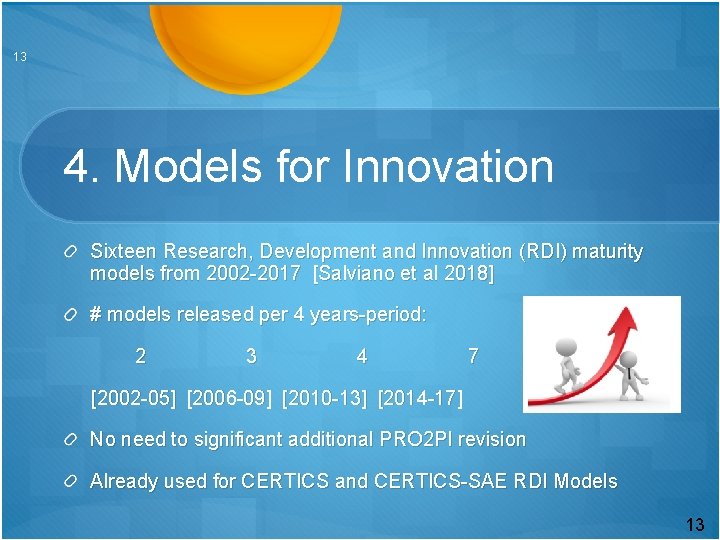
13 4. Models for Innovation Sixteen Research, Development and Innovation (RDI) maturity models from 2002 -2017 [Salviano et al 2018] # models released per 4 years-period: 2 3 4 7 [2002 -05] [2006 -09] [2010 -13] [2014 -17] No need to significant additional PRO 2 PI revision Already used for CERTICS and CERTICS-SAE RDI Models 13
14 5. SPI Education Challenging effort of education of SPI Recent international workshop [O’Connor, Mitasiunas, Ross (Eds. ) 2015] “in spite of its [SPI] importance, increasing its coverage in educational settings is still challenging” [p. 7 -17] No need to significant additional PRO 2 PI revision PRO 2 PI has been successfully be used in SPI Education with PRO 2 PI-WORK 4 E Method 14
15 6. Theory of SPI SLR/SMS on SPI [Kuhrmann et al. 2016] concludes: “There is a lack of discussions and critical comparisons of the approaches in practice and few on theories and models of SPI”. “Although SPI is around for decades, we still miss a sound theory about SPI” [p. 26] David Card [2004]: [SPI approaches] are considered competitors. In reality they are all based on very similar concepts and techniques. The packaging obscures the underlying principles. Eliciting and refining underlying principles is the role of science. ” 15
16 6. Theory of SPI As SPI is mature, a theory is useful and feasible ISO/IEC 33003: 2015 Process Measurement Framework is based on strong theory a SPI Theory from Process Capability is not enough anymore Efforts to a model theory of Model Driven Engineering (MDE) [Favre 2004] [Bézivin 2005] [Seidwitz 2003] [Muller et al. 2012] PRO 2 PI needs a model theory of modeling driven SPI 16
17 Limitation of this research Identification of these six challenges did not follow a systematic approach. Subjective experience and observation, and PRO 2 PI Methodology, Each one of them, however, is supported by independent objective results. 17
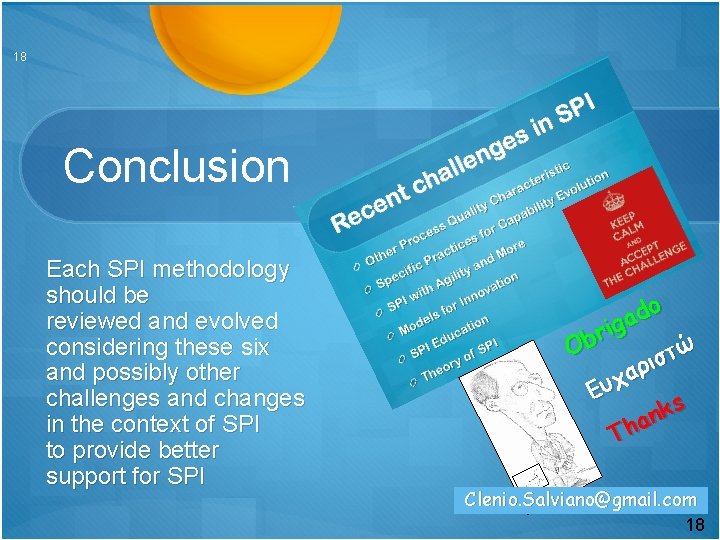
18 Conclusion Each SPI methodology should be reviewed and evolved considering these six and possibly other challenges and changes in the context of SPI to provide better support for SPI o d a rig b ώ O τ σ ρι α χ Ευ s k n a Th Clenio. Salviano@gmail. com 18