
18 th Century England In 1702 Queen Anne
- Slides: 20
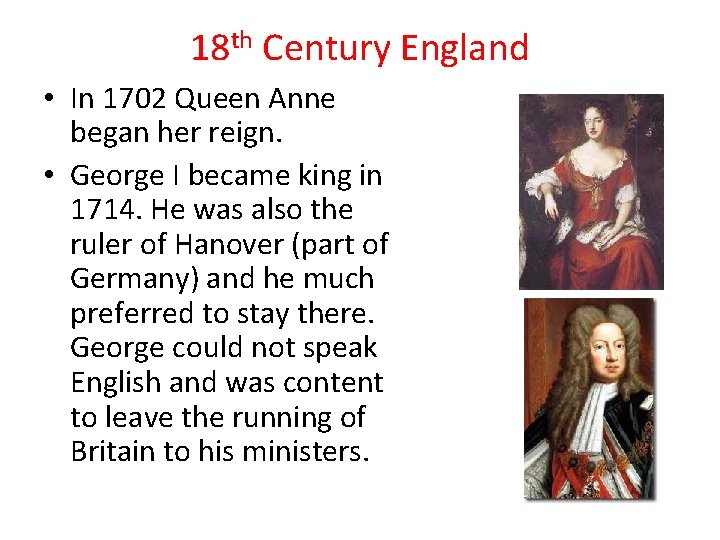
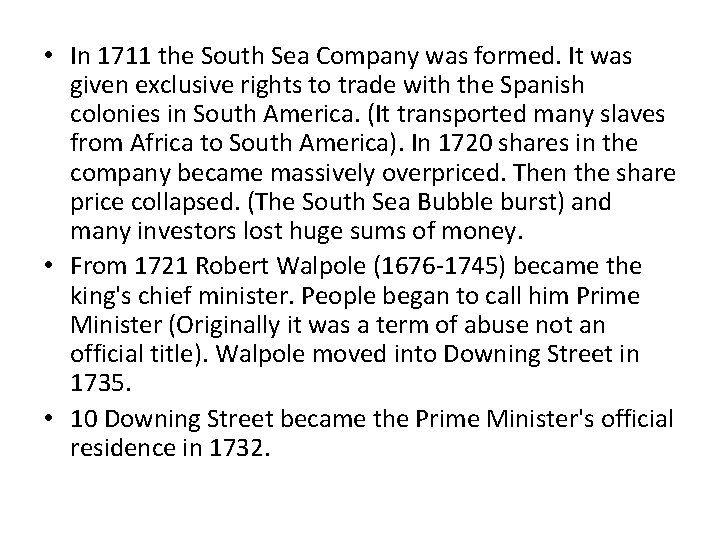
18 th Century England • In 1702 Queen Anne began her reign. • George I became king in 1714. He was also the ruler of Hanover (part of Germany) and he much preferred to stay there. George could not speak English and was content to leave the running of Britain to his ministers.
• In 1711 the South Sea Company was formed. It was given exclusive rights to trade with the Spanish colonies in South America. (It transported many slaves from Africa to South America). In 1720 shares in the company became massively overpriced. Then the share price collapsed. (The South Sea Bubble burst) and many investors lost huge sums of money. • From 1721 Robert Walpole (1676 -1745) became the king's chief minister. People began to call him Prime Minister (Originally it was a term of abuse not an official title). Walpole moved into Downing Street in 1735. • 10 Downing Street became the Prime Minister's official residence in 1732.
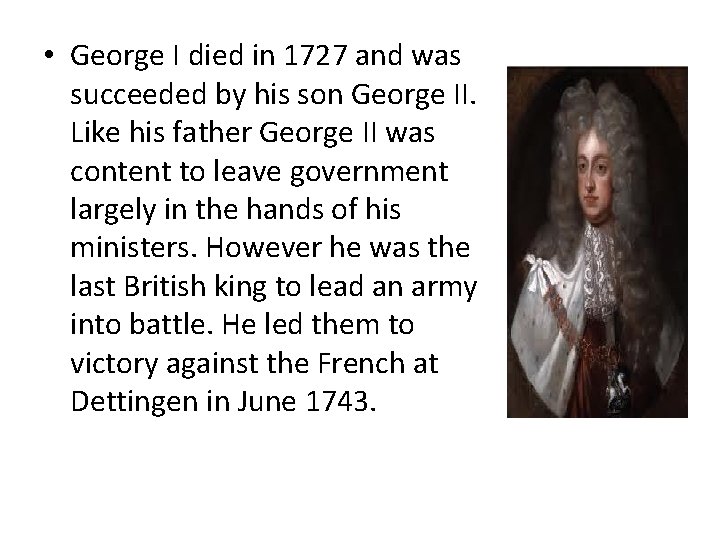
• George I died in 1727 and was succeeded by his son George II. Like his father George II was content to leave government largely in the hands of his ministers. However he was the last British king to lead an army into battle. He led them to victory against the French at Dettingen in June 1743.
Religion in the 18 th C. • In the early 18 th century England was notable for its lack of religious zeal. • Most people went to church on Sunday but very often they were indifferent. • Some of the clergy continued to do good work but generally there was a lack of energy in the church. • This began to change in the 1730 s. First a man named George Whitefield (1714 -1770) became a great preacher. It was said that he could preach to crowds of 20, 000 people (without a microphone). • Then in 1738 John Wesley (1703 -1791) founded the Methodists. Wesley did not want to break with the Church of England. He wanted his followers to remain within it but in the end this proved impossible and the Methodists were forced to become a separate denomination. • Meanwhile at the end of the 18 th century religious enthusiasm began to revive. Within the Church of England there were a number of Evangelicals campaigning for an end to slavery.
The agricultural revolution • in 1701 Jethro Tull invented the seed drill. This machine dropped seeds at a controllable rate in the straight lines. A harrow at the back of the machine covered the seeds to prevent birds eating them. Tull also invented a horse drawn hoe, which killed weeds between rows of seeds.
• new forms of crop rotation were introduced. Under the old system land was divided into 3 fields and each year one was left fallow. This was, obviously, wasteful. • In the 17 th century the Dutch began to use new forms of crop rotation with clover and root crops such as turnips and swedes instead of letting the land grow fallow. (Root crops restored fertility to the soil). • In the 18 th century these new methods became common in England. A man named Charles 'Turnip' Townshend did much to popularize growing turnips. • Turnips had another advantage. They provided winter feed for cattle. Previously most cattle were slaughtered at the beginning of winter because there was not enough food to keep them through the season. Now fresh milk and butter became available all year round. • Moreover in the early 18 th century farmers began to improve their livestock by selective breeding. One of the most famous pioneers of selective breeding was Robert Bakewell.
• Finally in the 18 th century there was a wave of enclosures. • When an act of enclosure was passed commissioners divided up the land in the village so each farmer had all his land in one place. • In 1756 Britain became embroiled in the Seven Years War (1756 -1763) with France. • They won a great victory at Quebec. That ensured that Canada became a British colony rather than a French one.
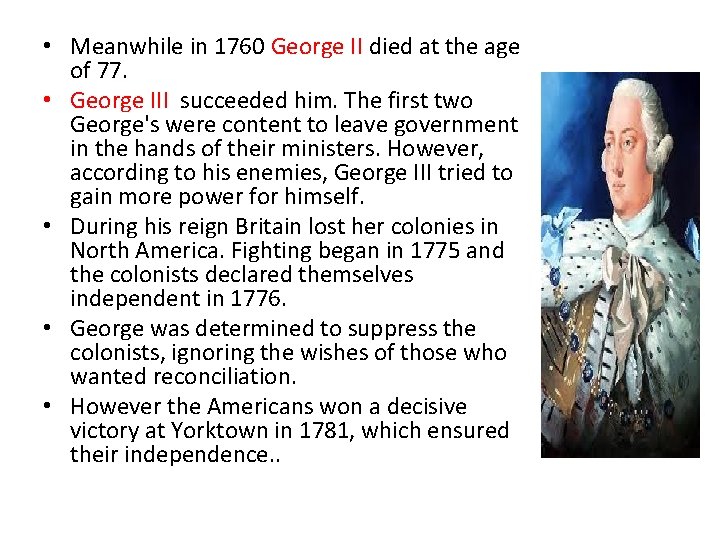
• Meanwhile in 1760 George II died at the age of 77. • George III succeeded him. The first two George's were content to leave government in the hands of their ministers. However, according to his enemies, George III tried to gain more power for himself. • During his reign Britain lost her colonies in North America. Fighting began in 1775 and the colonists declared themselves independent in 1776. • George was determined to suppress the colonists, ignoring the wishes of those who wanted reconciliation. • However the Americans won a decisive victory at Yorktown in 1781, which ensured their independence. .
• Meanwhile London was rocked by the anti-Catholic Gordon riots in 1780. • Riots were common in the 18 th century. The workers could not vote and there were no trade unions so if the workers were disaffected they rioted. • The Gordon riot was the worst. Lord George Gordon (1751 -1793) was an MP who led a huge crowd to parliament to present a petition demanding the repeal of a 1778 act, which removed certain restrictions on Roman Catholics. • The demonstration became a riot. With cries of 'No Popery!' the rioters held London for several days until the army restored order. About 300 people died in the rioting.
The Industrial Revolution • In the late 18 th century everyday life in Britain was transformed by the industrial revolution. Towns, industry and trade had been growing for centuries but about 1780 economic growth took off. • A number of technological advances made the revolution possible. • The first industry to become mechanized was the textile industry. • In 1771 Richard Arkwright opened a cotton-spinning mill with a machine called a water frame, which was powered by a water mill. • Then, in 1779, Samuel Crompton invented a new cottonspinning machine called a spinning mule. • Finally in 1785 Edmund Cartwright invented a loom that could be powered by a steam engine. • As a result of these new inventions cotton production boomed.
• During the 19 th century Britain was transformed by the industrial revolution. In 1801, at the time of the first census, only about 20% of the population lived in towns. By 1851 the figure had risen to over 50%. By 1881 about two thirds of the population lived in towns.
Society in the 18 th C. Britain • Britain built up a great overseas empire. • The North American colonies were lost after the War of Independence 1776 -1783. • On the other hand after the Seven Years War 17561763 Britain captured Canada and India. Britain also took Dominica, Grenada, St Vincent and Tobago in the West Indies. • In 1707 the Act of Union was passed. Scotland was united with England Wales. England became part of Great Britain. • In the mid 18 th century the population of Britain was about 6 1/2 million. In the late 18 th century it grew rapidly and by 1801 it was over 9 million.
• Owning land was the main form of wealth in the 18 th century. • Political power and influence was in the hands of rich landowners. • At the top were the nobility. Below them were a class of nearly rich landowners called the gentry. • However other middle class people such as merchants and professional men became richer and more numerous, especially in the towns. • Below them were the great mass of the population, craftsmen and labourers.
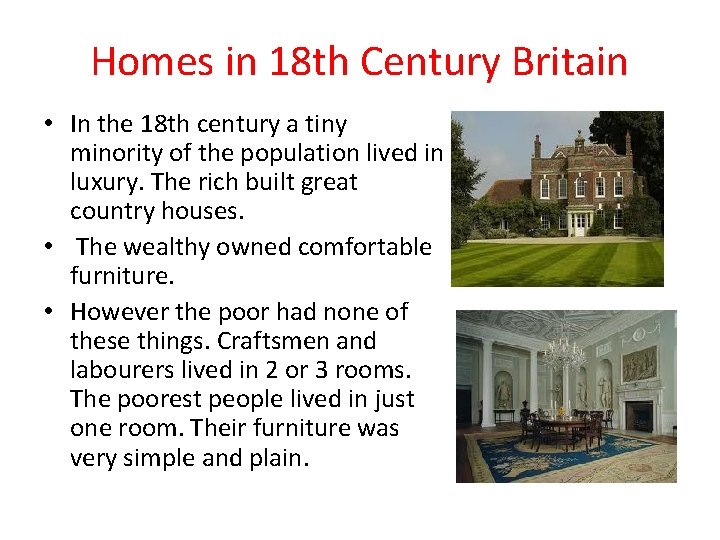
Homes in 18 th Century Britain • In the 18 th century a tiny minority of the population lived in luxury. The rich built great country houses. • The wealthy owned comfortable furniture. • However the poor had none of these things. Craftsmen and labourers lived in 2 or 3 rooms. The poorest people lived in just one room. Their furniture was very simple and plain.
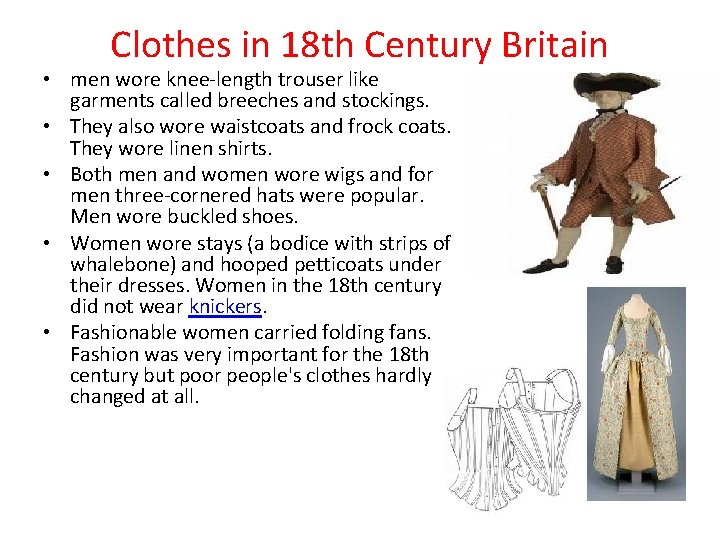
Clothes in 18 th Century Britain • men wore knee-length trouser like garments called breeches and stockings. • They also wore waistcoats and frock coats. They wore linen shirts. • Both men and women wore wigs and for men three-cornered hats were popular. Men wore buckled shoes. • Women wore stays (a bodice with strips of whalebone) and hooped petticoats under their dresses. Women in the 18 th century did not wear knickers. • Fashionable women carried folding fans. Fashion was very important for the 18 th century but poor people's clothes hardly changed at all.
Leisure in 18 th Century Britain • Traditional games remained popular in the 18 th century. These included games such as chess, draughts and backgammon. They also tennis and a rough version of football. • Horse racing was carried on for centuries before the 18 th century but at this time it became a professional sport. The Jockey Club was formed in 1727. The Derby began in 1780. • For the rich card games and gambling were popular. The theatre was also popular. • In London pleasure gardens were created.
• Reading was also a popular pastime in the 18 th century and the first novels were published at this time. Books were still expensive but in many towns you could pay to join a circulating library. The first daily newspaper in England was printed in 1702. The Times began in 1785. • Rich people liked fox hunting. • Public executions were also popular and they drew large crowds.
18 th c. Education • In the early 18 th century charity schools were founded in many towns in England. • They were sometimes called Blue Coat Schools because of the colour of the children's uniforms. • Boys from well off families went to grammar schools. Girls from well off families also went to school but it was felt important for them to learn 'accomplishments' like embroidery and music rather than academic subjects. • However non-comformists or dissenters (Protestants who did not belong to the Church of England) were not allowed to attend most public schools. Instead they went to their own dissenting academies.
Philosophy • The Age of Enlightenment (or simply the. Enlightenment or Age of Reason) was a cultural movement of intellectuals in 18 th century Europe and the American colonies. • Its purpose was to reform society using reason (rather than tradition, faith and revelation) and advance knowledge through science. • It promoted science and intellectual interchange and opposed superstition, intolerance and some abuses by church and state.
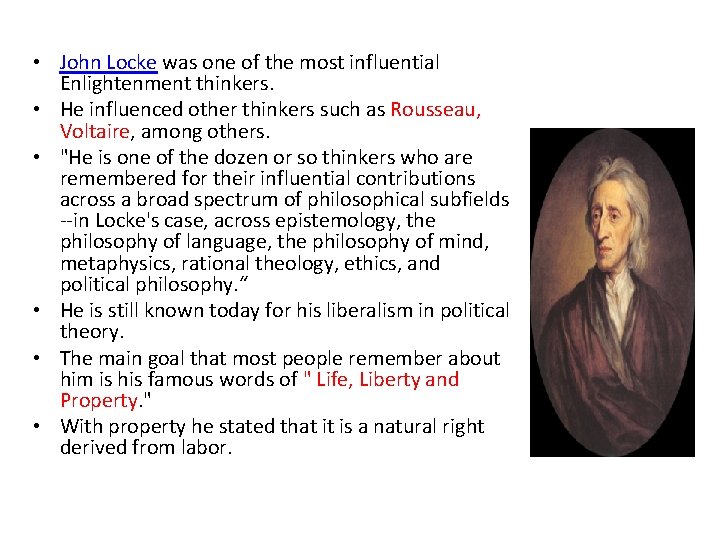
• John Locke was one of the most influential Enlightenment thinkers. • He influenced other thinkers such as Rousseau, Voltaire, among others. • "He is one of the dozen or so thinkers who are remembered for their influential contributions across a broad spectrum of philosophical subfields --in Locke's case, across epistemology, the philosophy of language, the philosophy of mind, metaphysics, rational theology, ethics, and political philosophy. “ • He is still known today for his liberalism in political theory. • The main goal that most people remember about him is his famous words of " Life, Liberty and Property. " • With property he stated that it is a natural right derived from labor.