
18 SECONDORDER DIFFERENTIAL EQUATIONS SECONDORDER DIFFERENTIAL EQUATIONS 18
- Slides: 38
18 SECOND-ORDER DIFFERENTIAL EQUATIONS
SECOND-ORDER DIFFERENTIAL EQUATIONS 18. 4 Series Solutions In this section, we will learn how to solve: Certain differential equations using the power series.
SERIES SOLUTIONS Equation 1 Many differential equations can’t be solved explicitly in terms of finite combinations of simple familiar functions. This is true even for a simple-looking equation like: y’’ – 2 xy’ + y = 0
SERIES SOLUTIONS However, it is important to be able to solve equations such as Equation 1 because they arise from physical problems. § In particular, they occur in connection with the Schrödinger equation in quantum mechanics.
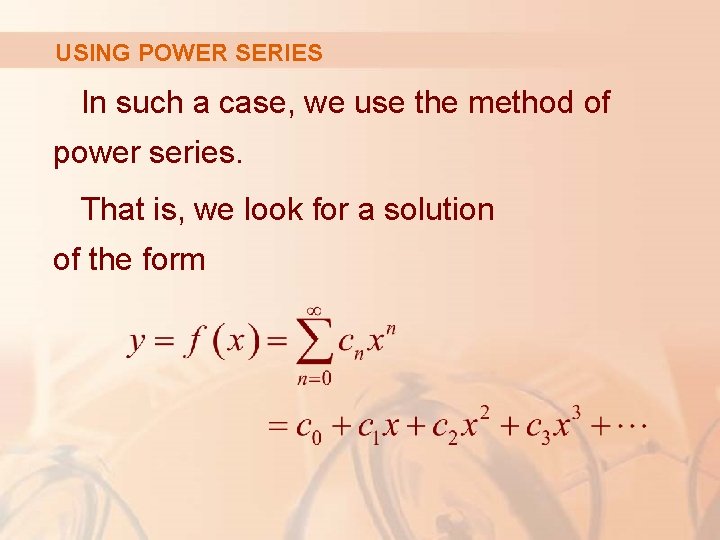
USING POWER SERIES In such a case, we use the method of power series. That is, we look for a solution of the form
USING POWER SERIES The method is to substitute this expression into the differential equation and determine the values of the coefficients c 0, c 1, c 2, … § This technique resembles the method of undetermined coefficients discussed in Section 17. 2
USING POWER SERIES Before using power series to solve Equation 1, we illustrate the method on the simpler equation y’’ + y = 0 in Example 1. § It’s true that we already know how to solve this equation by the techniques of Section 17. 1 § Still, it’s easier to understand the power series method when it is applied to this simpler equation.
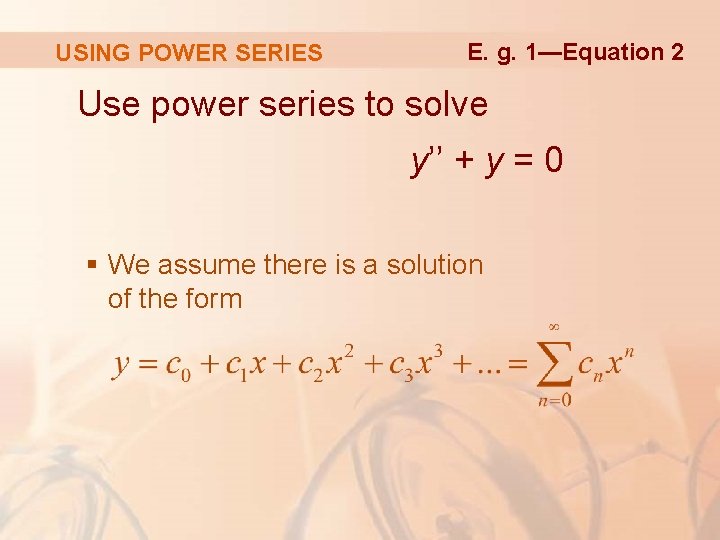
USING POWER SERIES E. g. 1—Equation 2 Use power series to solve y’’ + y = 0 § We assume there is a solution of the form
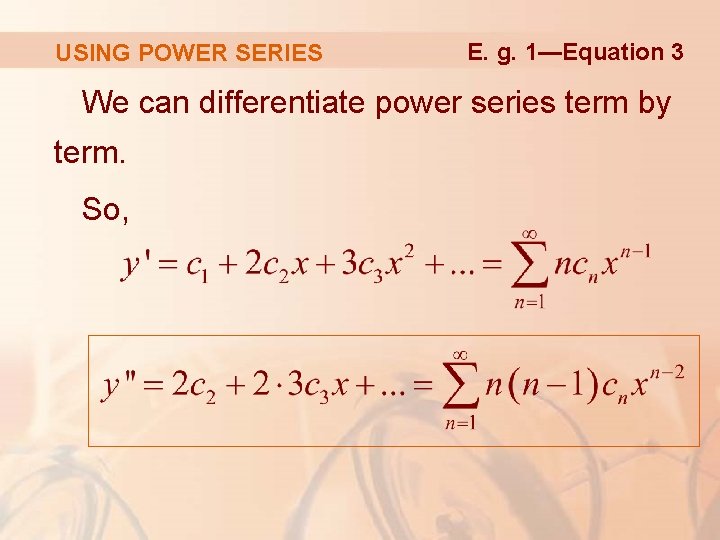
USING POWER SERIES E. g. 1—Equation 3 We can differentiate power series term by term. So,
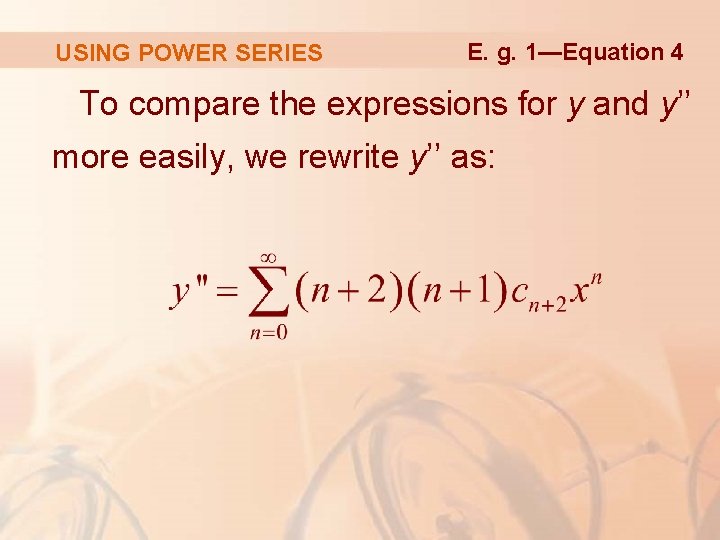
USING POWER SERIES E. g. 1—Equation 4 To compare the expressions for y and y’’ more easily, we rewrite y’’ as:
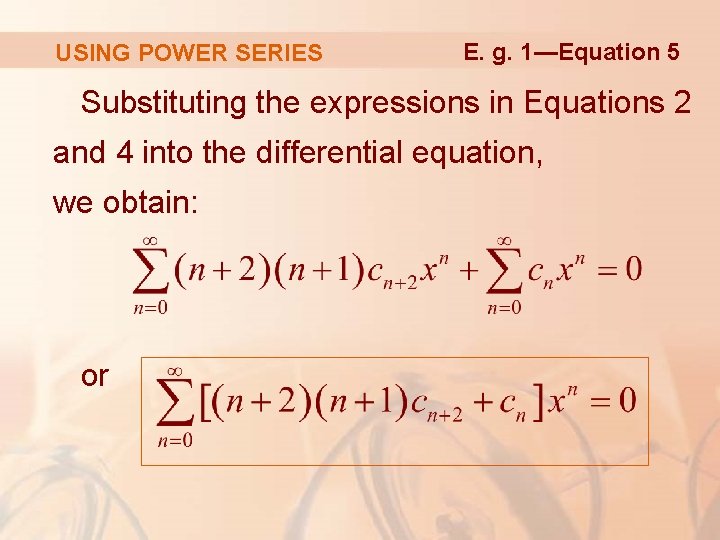
USING POWER SERIES E. g. 1—Equation 5 Substituting the expressions in Equations 2 and 4 into the differential equation, we obtain: or
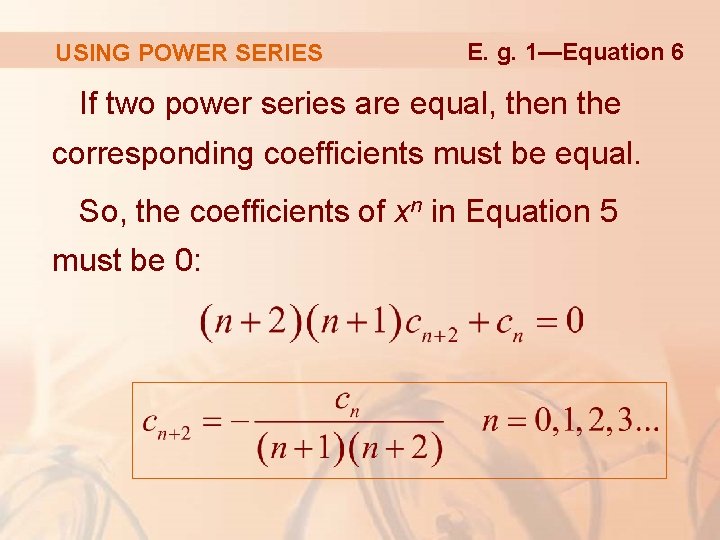
USING POWER SERIES E. g. 1—Equation 6 If two power series are equal, then the corresponding coefficients must be equal. So, the coefficients of xn in Equation 5 must be 0:
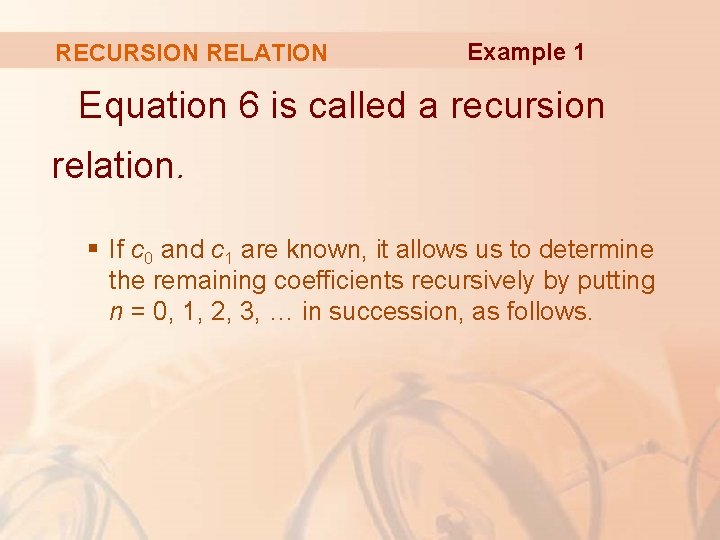
RECURSION RELATION Example 1 Equation 6 is called a recursion relation. § If c 0 and c 1 are known, it allows us to determine the remaining coefficients recursively by putting n = 0, 1, 2, 3, … in succession, as follows.
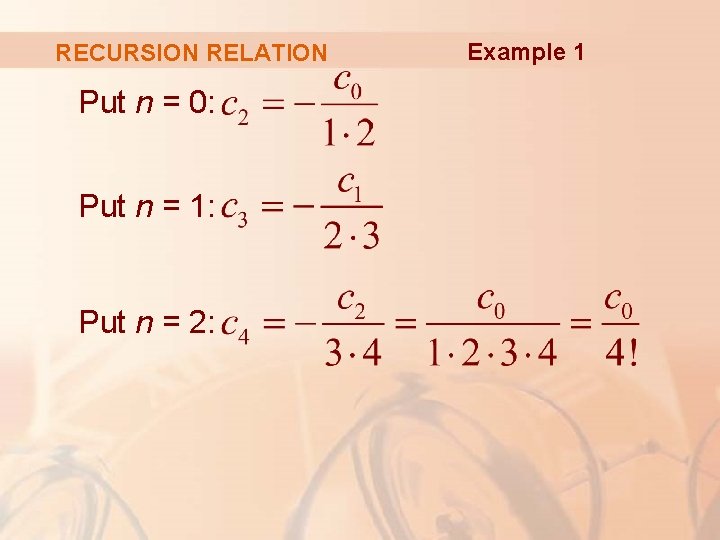
RECURSION RELATION Put n = 0: Put n = 1: Put n = 2: Example 1
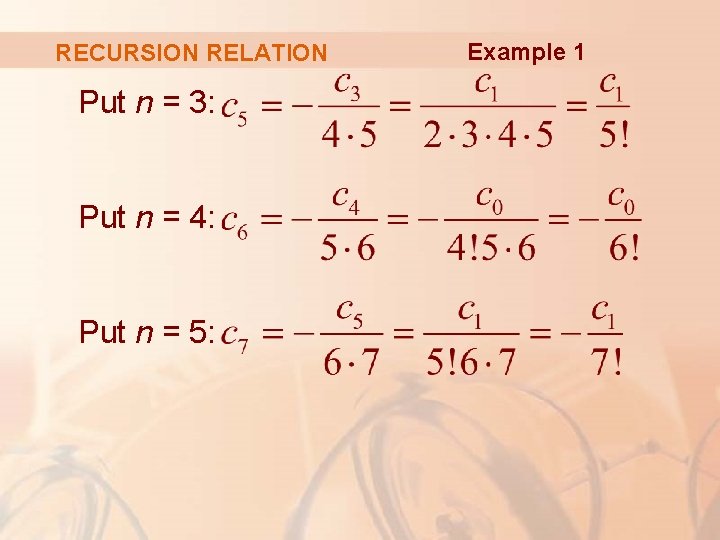
RECURSION RELATION Put n = 3: Put n = 4: Put n = 5: Example 1
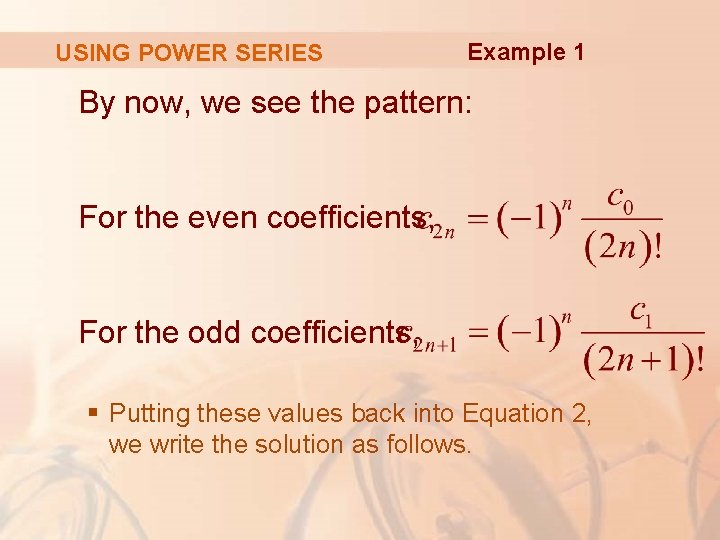
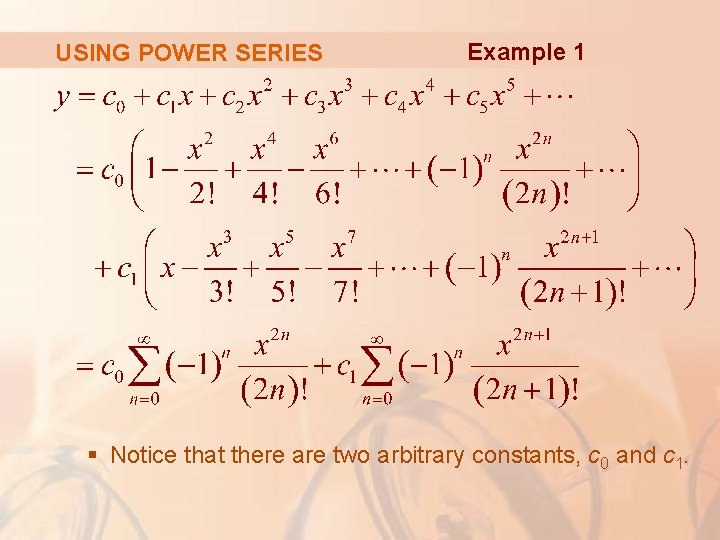
USING POWER SERIES Example 1 By now, we see the pattern: For the even coefficients, For the odd coefficients, § Putting these values back into Equation 2, we write the solution as follows.
USING POWER SERIES Example 1 § Notice that there are two arbitrary constants, c 0 and c 1.
NOTE 1 We recognize the series obtained in Example 1 as being the Maclaurin series for cos x and sin x. § See Equations 15 and 16 in Section 11. 10
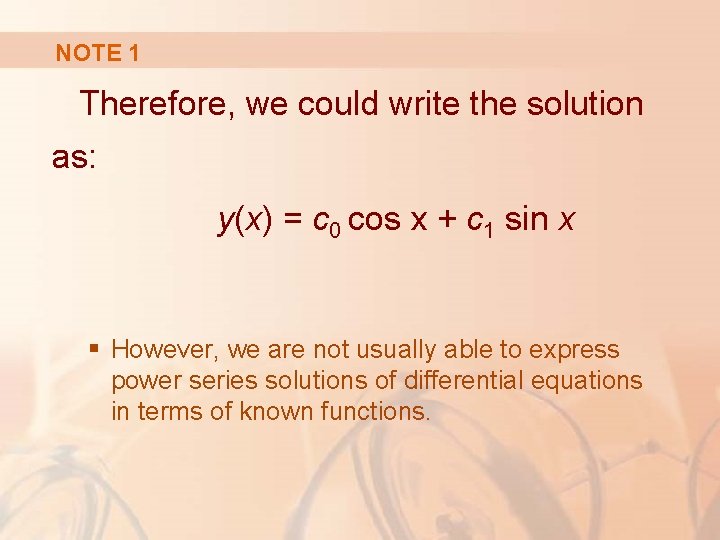
NOTE 1 Therefore, we could write the solution as: y(x) = c 0 cos x + c 1 sin x § However, we are not usually able to express power series solutions of differential equations in terms of known functions.
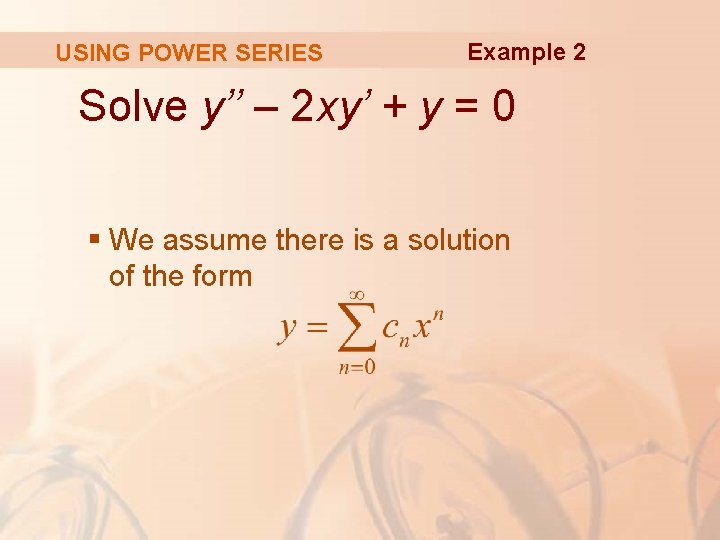
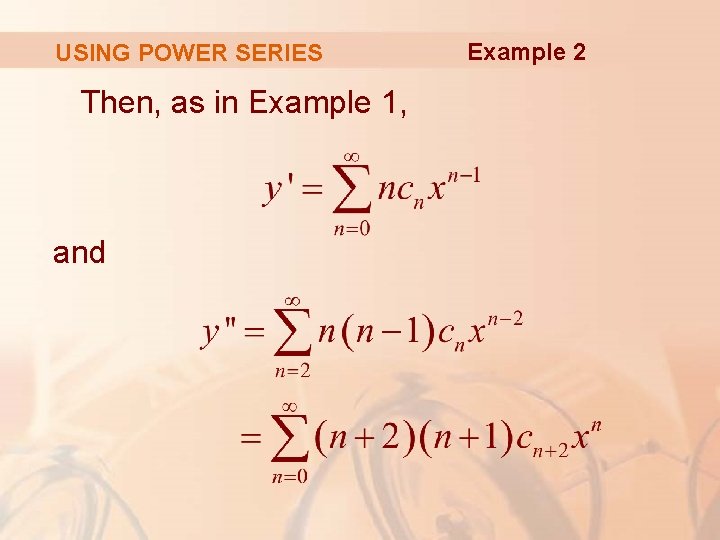
USING POWER SERIES Example 2 Solve y’’ – 2 xy’ + y = 0 § We assume there is a solution of the form
USING POWER SERIES Then, as in Example 1, and Example 2
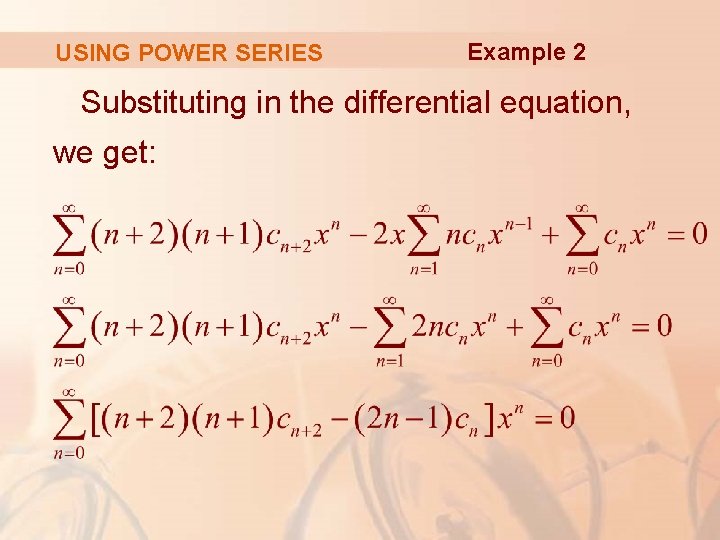
USING POWER SERIES Example 2 Substituting in the differential equation, we get:
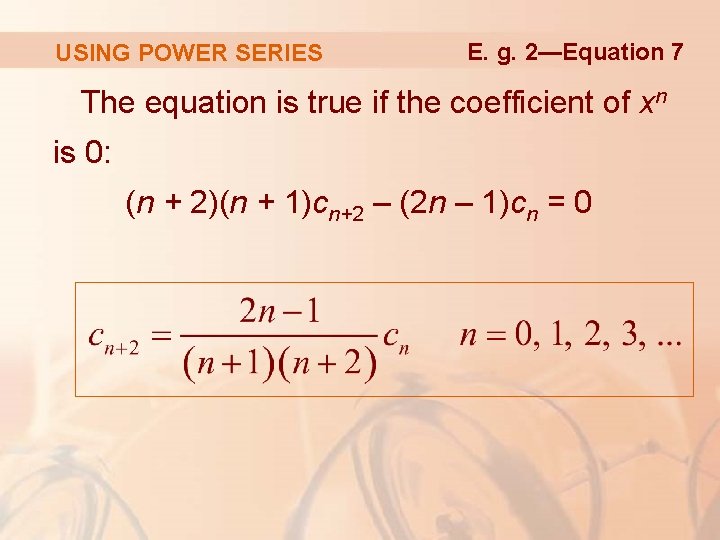
USING POWER SERIES E. g. 2—Equation 7 The equation is true if the coefficient of xn is 0: (n + 2)(n + 1)cn+2 – (2 n – 1)cn = 0
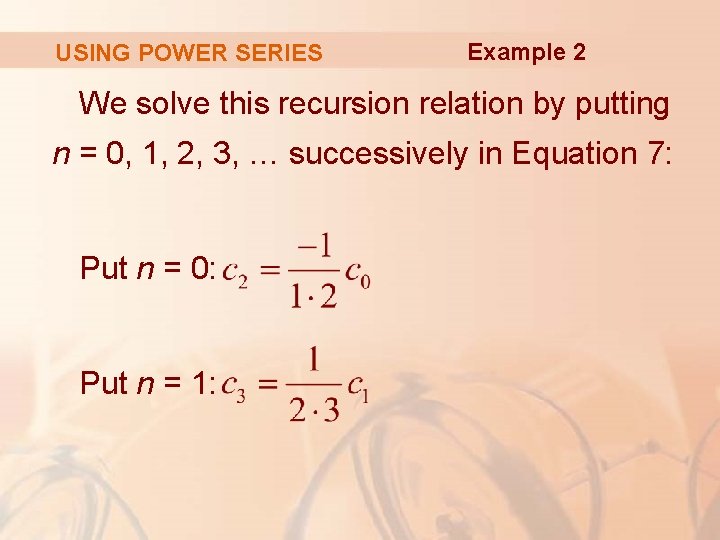
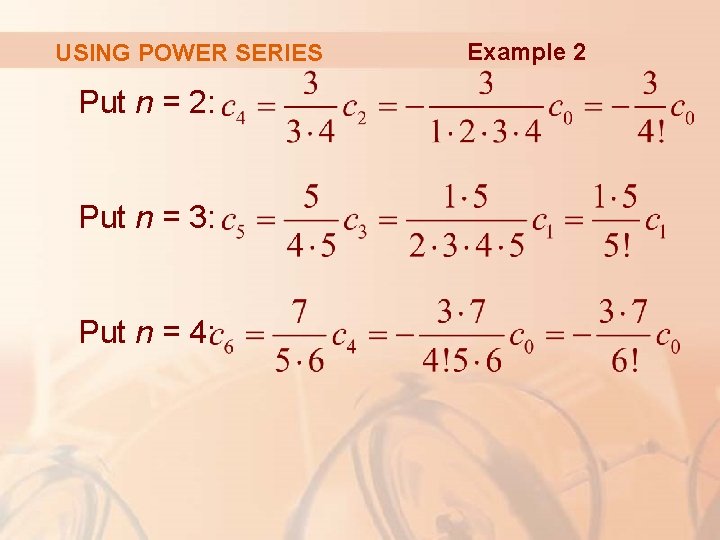
USING POWER SERIES Example 2 We solve this recursion relation by putting n = 0, 1, 2, 3, … successively in Equation 7: Put n = 0: Put n = 1:
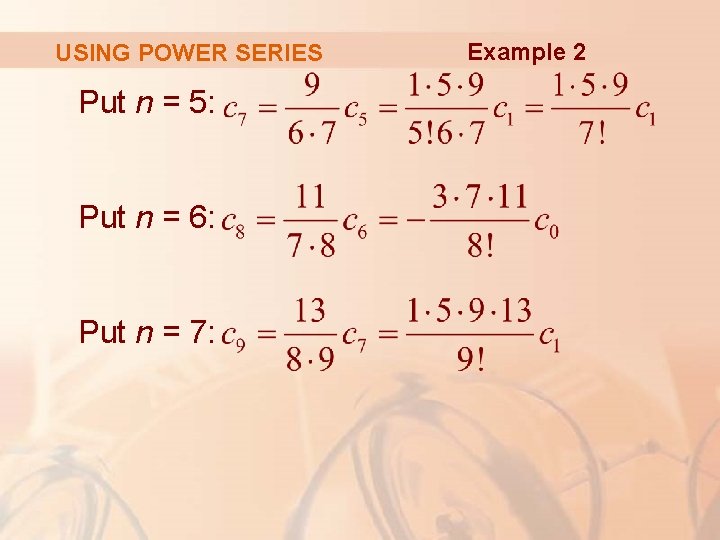
USING POWER SERIES Put n = 2: Put n = 3: Put n = 4: Example 2
USING POWER SERIES Put n = 5: Put n = 6: Put n = 7: Example 2
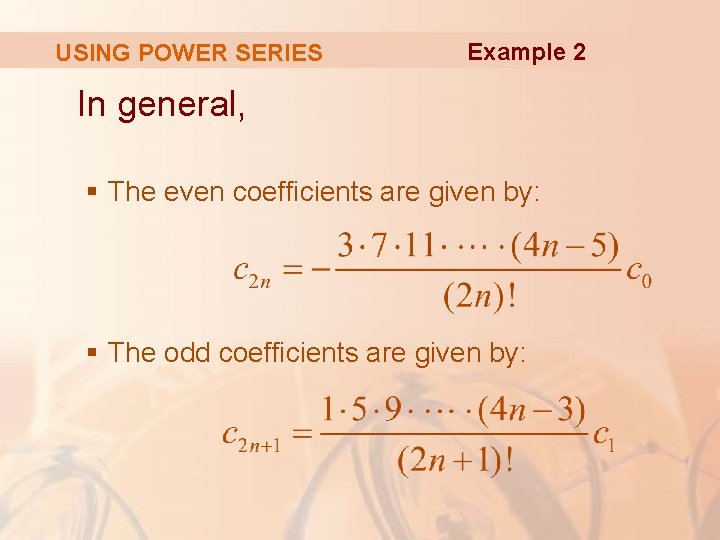
USING POWER SERIES Example 2 In general, § The even coefficients are given by: § The odd coefficients are given by:
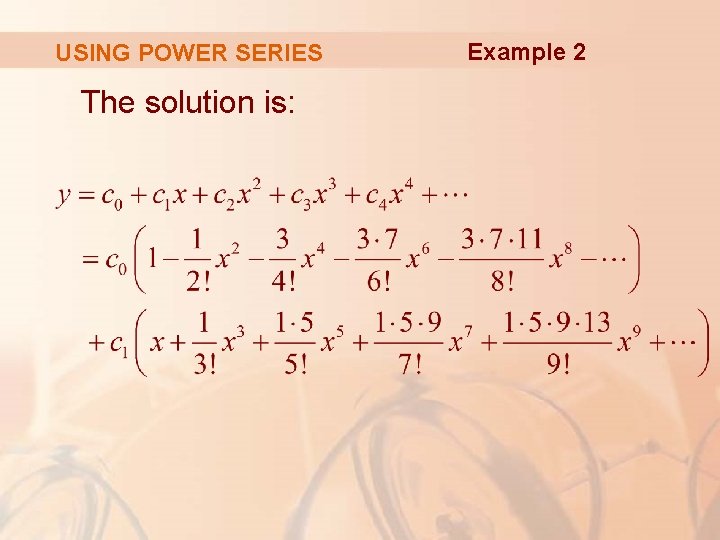
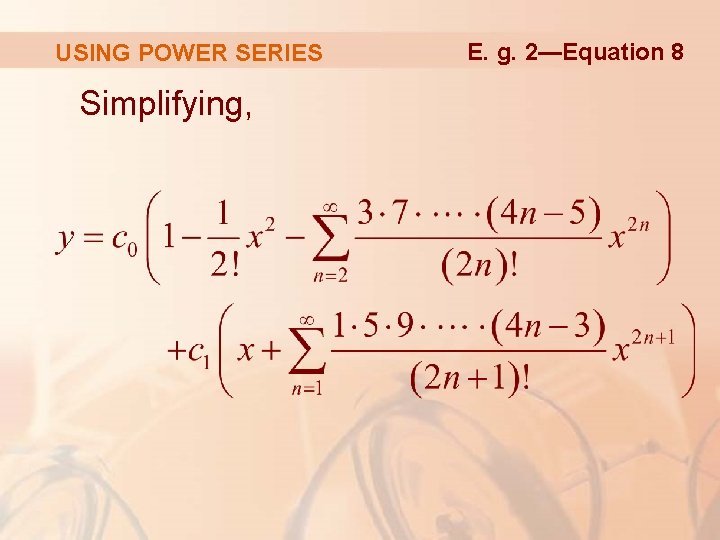
USING POWER SERIES The solution is: Example 2
USING POWER SERIES Simplifying, E. g. 2—Equation 8
NOTE 2 In Example 2, we had to assume that the differential equation had a series solution. Now, however, we could verify directly that the function given by Equation 8 is indeed a solution.
NOTE 3 Unlike the situation of Example 1, the power series that arise in the solution of Example 2 do not define elementary functions.
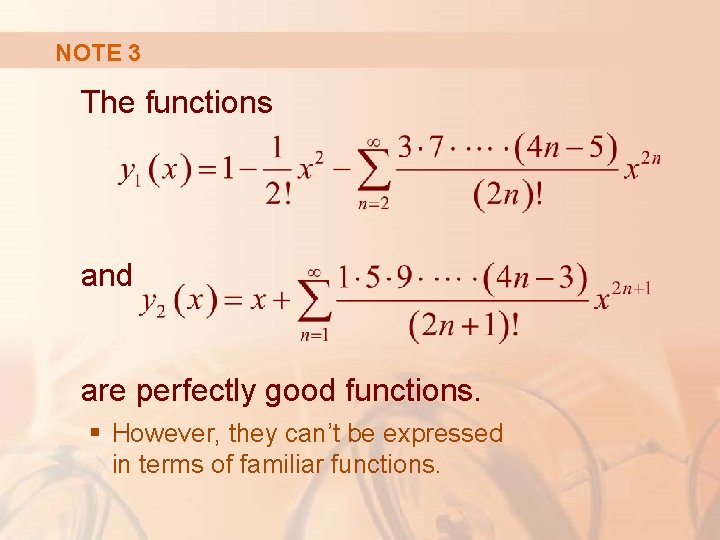
NOTE 3 The functions and are perfectly good functions. § However, they can’t be expressed in terms of familiar functions.
NOTE 3 We can use these power series expressions for y 1 and y 2 to compute approximate values of the functions and even to graph them.
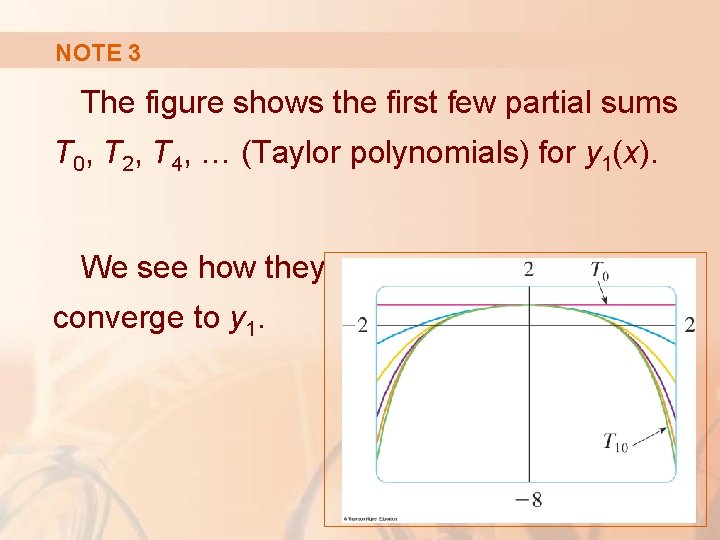
NOTE 3 The figure shows the first few partial sums T 0, T 2, T 4, … (Taylor polynomials) for y 1(x). We see how they converge to y 1.
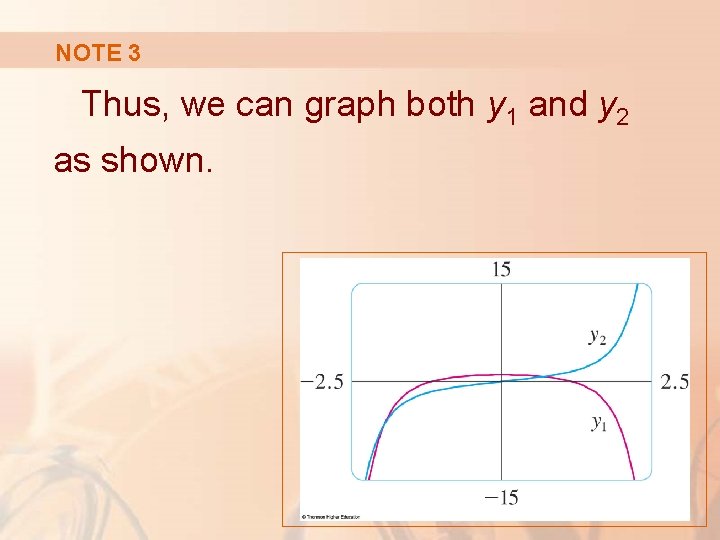
NOTE 3 Thus, we can graph both y 1 and y 2 as shown.
NOTE 4 Suppose we were asked to solve the initial-value problem y’’ – 2 xy’ + y = 0 y(0) = 0 y’(0) = 1
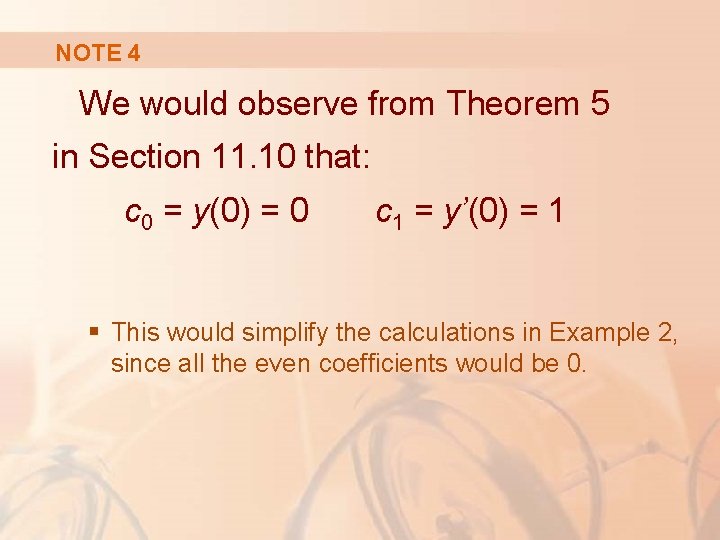
NOTE 4 We would observe from Theorem 5 in Section 11. 10 that: c 0 = y(0) = 0 c 1 = y’(0) = 1 § This would simplify the calculations in Example 2, since all the even coefficients would be 0.
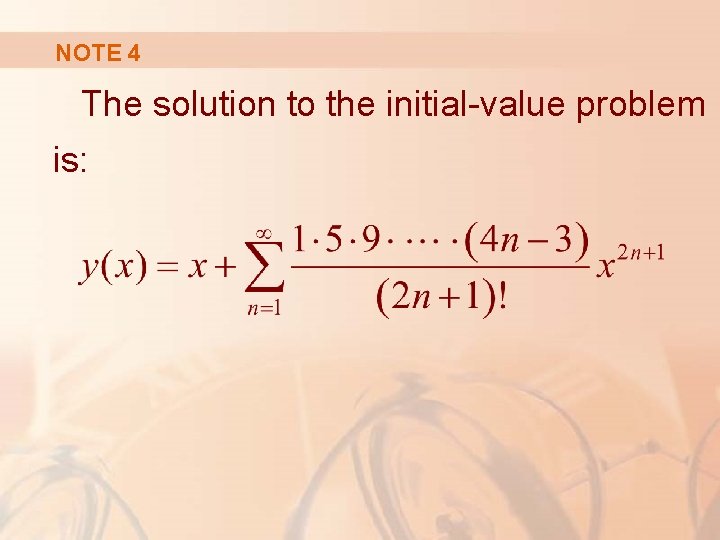
NOTE 4 The solution to the initial-value problem is: