
18 Controlling a Pneumatic System Learning Objectives Explain
18 Controlling a Pneumatic System
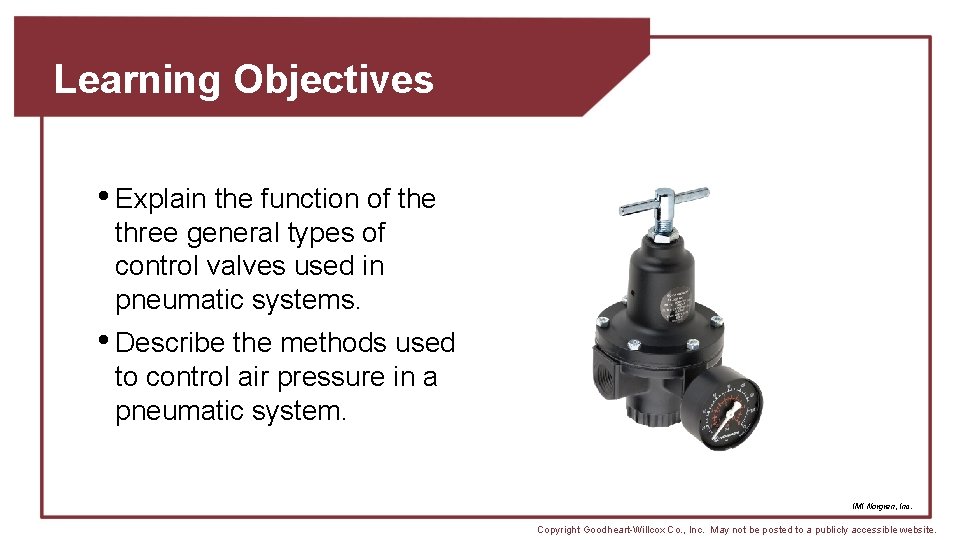
Learning Objectives • Explain the function of the three general types of control valves used in pneumatic systems. • Describe the methods used to control air pressure in a pneumatic system. IMI Norgren, Inc. Copyright Goodheart-Willcox Co. , Inc. May not be posted to a publicly accessible website.
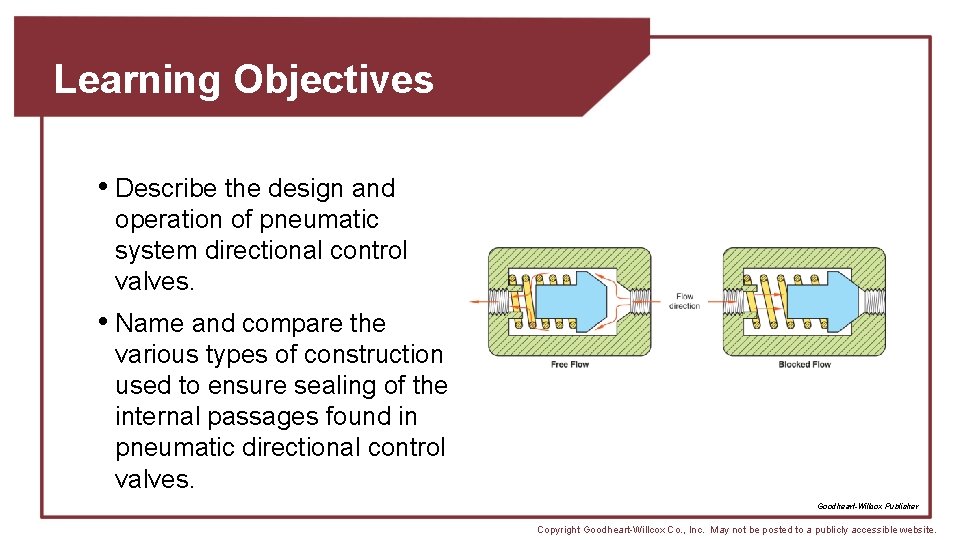
Learning Objectives • Describe the design and operation of pneumatic system directional control valves. • Name and compare the various types of construction used to ensure sealing of the internal passages found in pneumatic directional control valves. Goodheart-Willcox Publisher Copyright Goodheart-Willcox Co. , Inc. May not be posted to a publicly accessible website.
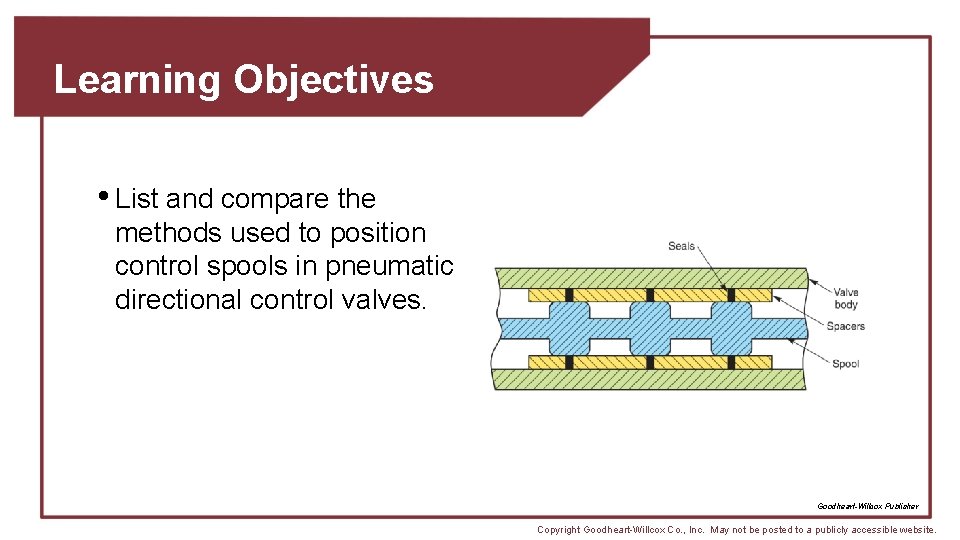
Learning Objectives • List and compare the methods used to position control spools in pneumatic directional control valves. Goodheart-Willcox Publisher Copyright Goodheart-Willcox Co. , Inc. May not be posted to a publicly accessible website.
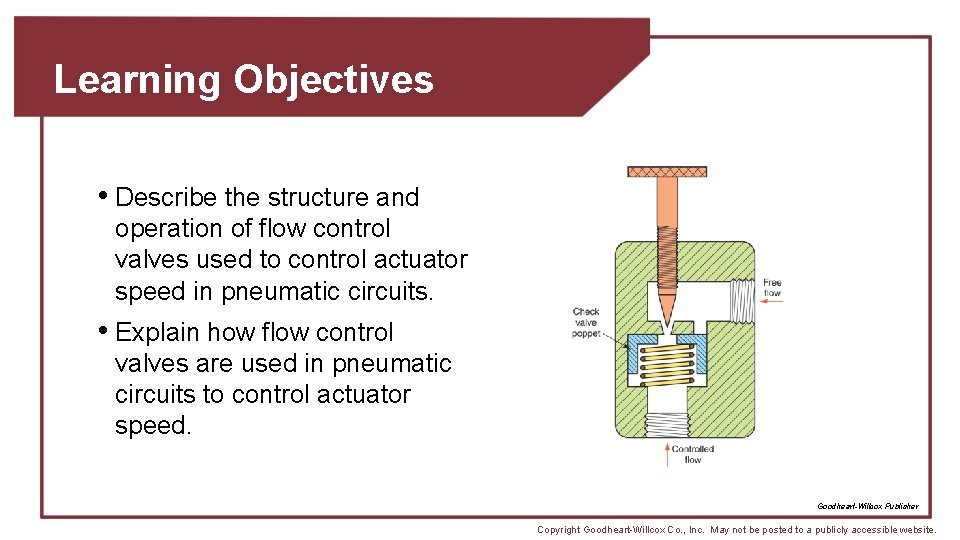
Learning Objectives • Describe the structure and operation of flow control valves used to control actuator speed in pneumatic circuits. • Explain how flow control valves are used in pneumatic circuits to control actuator speed. Goodheart-Willcox Publisher Copyright Goodheart-Willcox Co. , Inc. May not be posted to a publicly accessible website.
Primary Control Functions in a Pneumatic Circuit • Control valves allow circuits to produce type of motion and level of force required for machine operation • Air pressure controlled to provide pressure required to produce actuator force • Direction of airflow controlled to provide way to control direction of actuator movement • Rate of airflow controlled to provide way to control operating speed of actuator Copyright Goodheart-Willcox Co. , Inc. May not be posted to a publicly accessible website.
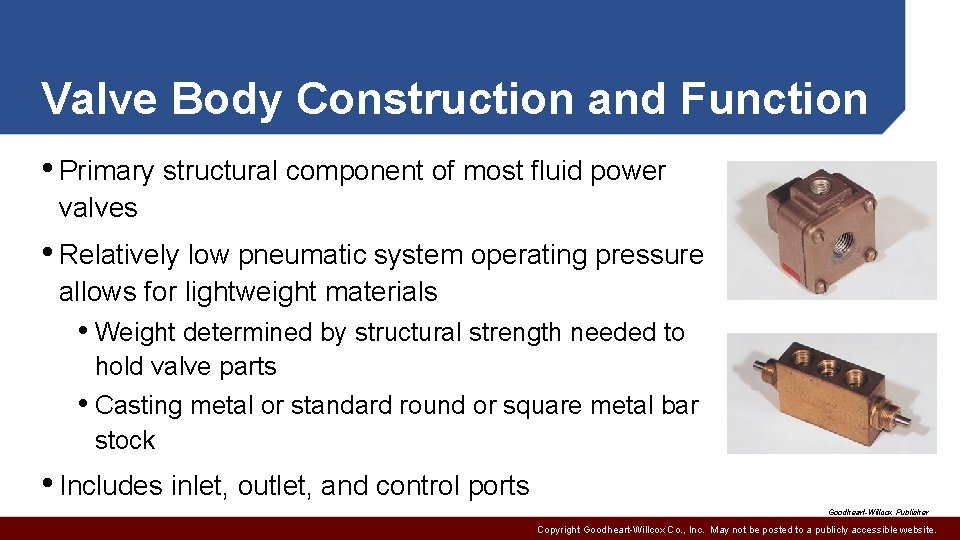
Valve Body Construction and Function • Primary structural component of most fluid power valves • Relatively low pneumatic system operating pressure allows for lightweight materials • Weight determined by structural strength needed to hold valve parts • Casting metal or standard round or square metal bar stock • Includes inlet, outlet, and control ports Goodheart-Willcox Publisher Copyright Goodheart-Willcox Co. , Inc. May not be posted to a publicly accessible website.
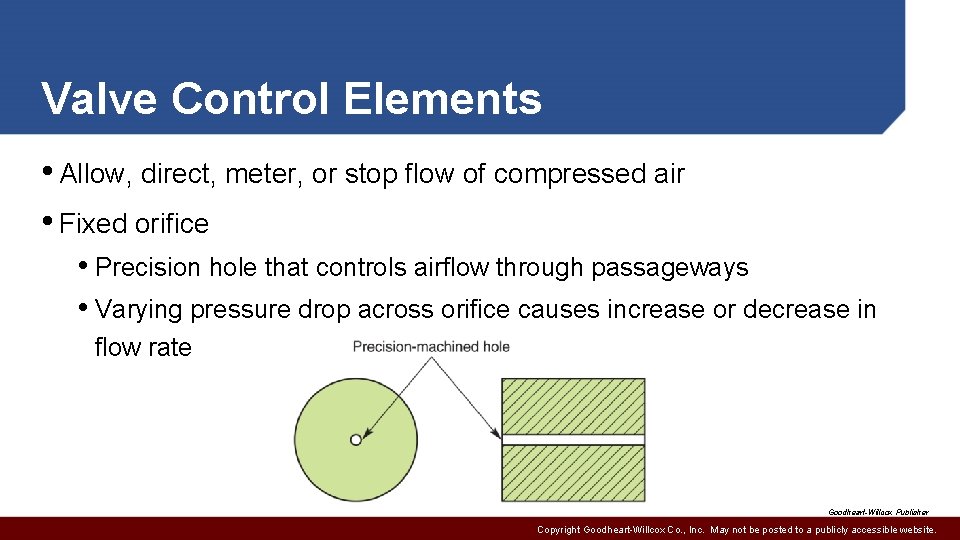
Valve Control Elements • Allow, direct, meter, or stop flow of compressed air • Fixed orifice • Precision hole that controls airflow through passageways • Varying pressure drop across orifice causes increase or decrease in flow rate Goodheart-Willcox Publisher Copyright Goodheart-Willcox Co. , Inc. May not be posted to a publicly accessible website.
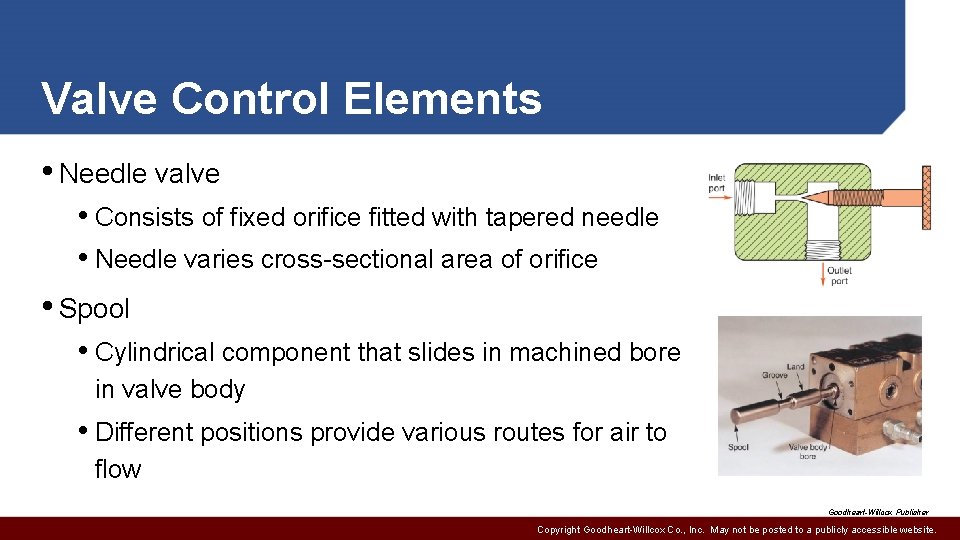
Valve Control Elements • Needle valve • Consists of fixed orifice fitted with tapered needle • Needle varies cross-sectional area of orifice • Spool • Cylindrical component that slides in machined bore in valve body • Different positions provide various routes for air to flow Goodheart-Willcox Publisher Copyright Goodheart-Willcox Co. , Inc. May not be posted to a publicly accessible website.
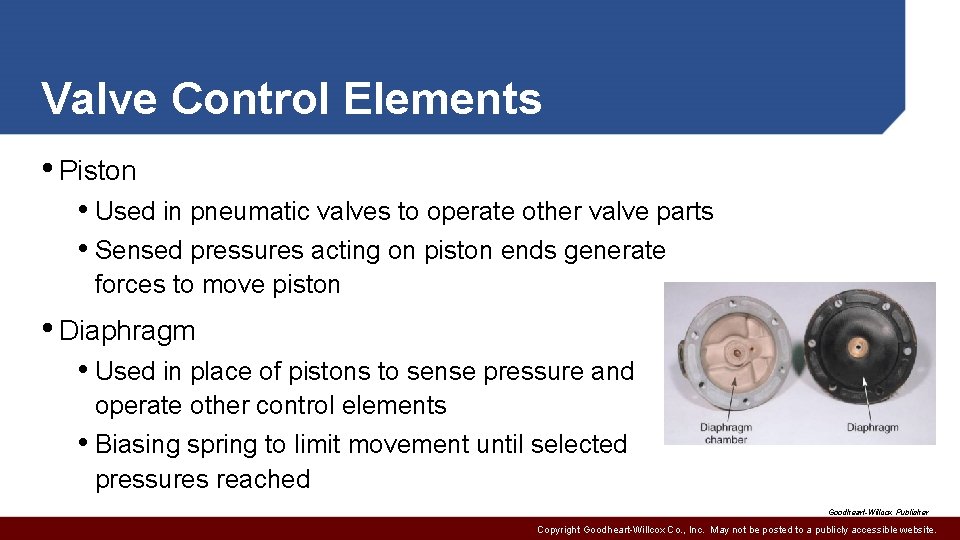
Valve Control Elements • Piston • Used in pneumatic valves to operate other valve parts • Sensed pressures acting on piston ends generate forces to move piston • Diaphragm • Used in place of pistons to sense pressure and operate other control elements • Biasing spring to limit movement until selected pressures reached Goodheart-Willcox Publisher Copyright Goodheart-Willcox Co. , Inc. May not be posted to a publicly accessible website.
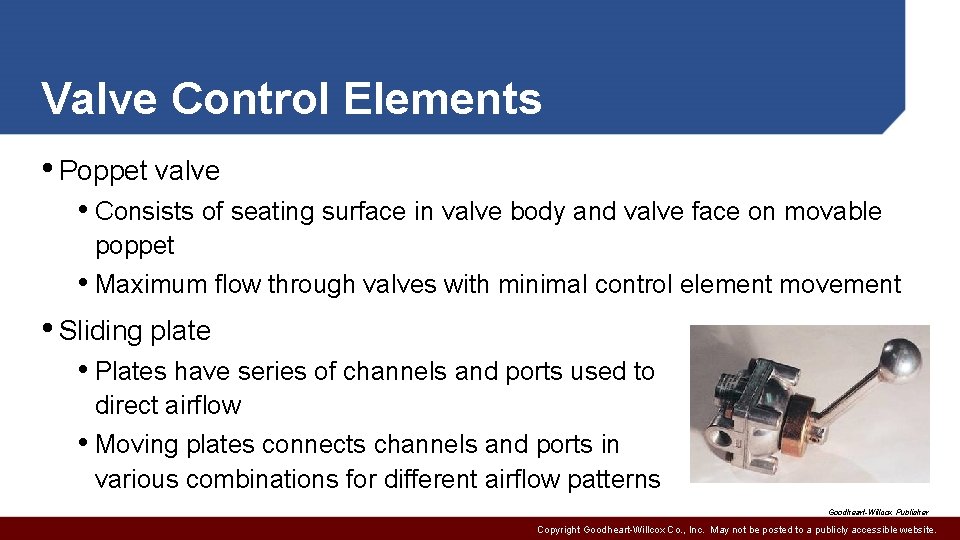
Valve Control Elements • Poppet valve • Consists of seating surface in valve body and valve face on movable poppet • Maximum flow through valves with minimal control element movement • Sliding plate • Plates have series of channels and ports used to direct airflow • Moving plates connects channels and ports in various combinations for different airflow patterns Goodheart-Willcox Publisher Copyright Goodheart-Willcox Co. , Inc. May not be posted to a publicly accessible website.
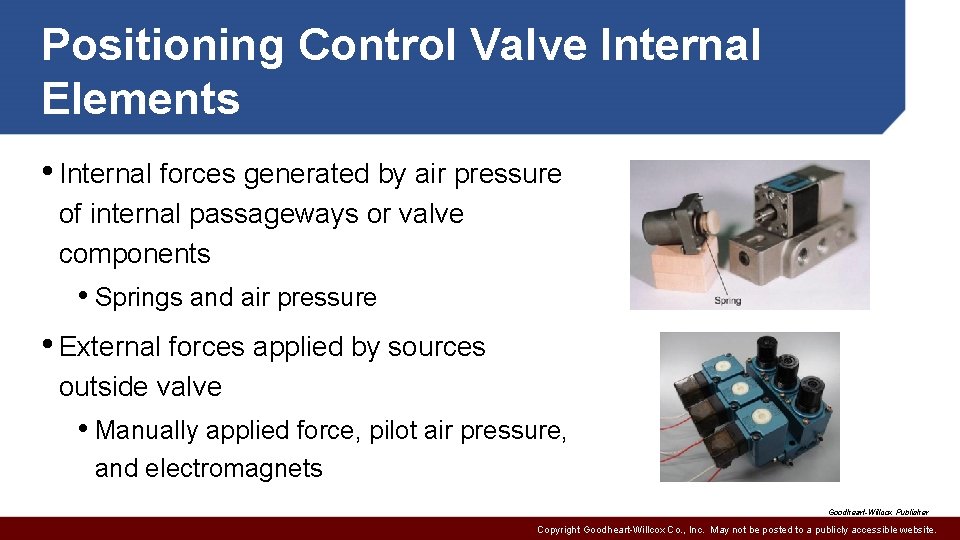
Positioning Control Valve Internal Elements • Internal forces generated by air pressure of internal passageways or valve components • Springs and air pressure • External forces applied by sources outside valve • Manually applied force, pilot air pressure, and electromagnets Goodheart-Willcox Publisher Copyright Goodheart-Willcox Co. , Inc. May not be posted to a publicly accessible website.
Pressure Control Methods and Devices • Pressure control provided in three specific areas of system: • System distribution lines • Workstations providing compressed air to various circuits • Portions of circuits requiring pressures above or below level set by workstation controls Copyright Goodheart-Willcox Co. , Inc. May not be posted to a publicly accessible website.
System Distribution Line Pressure Control • Bypass control system bleeds excess compressor air to atmosphere • Compressor continuously operates at constant speed • Considered inefficient except in certain situations Copyright Goodheart-Willcox Co. , Inc. May not be posted to a publicly accessible website.
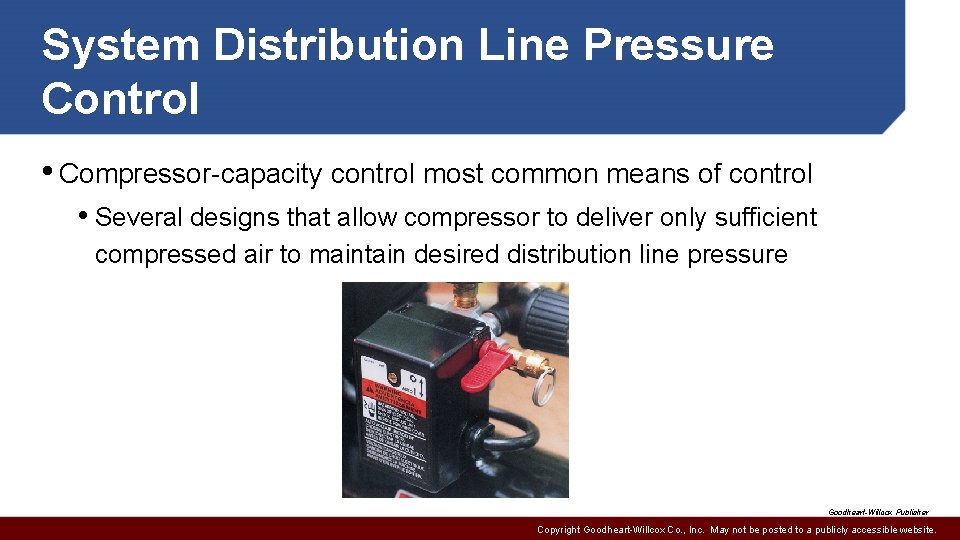
System Distribution Line Pressure Control • Compressor-capacity control most common means of control • Several designs that allow compressor to deliver only sufficient compressed air to maintain desired distribution line pressure Goodheart-Willcox Publisher Copyright Goodheart-Willcox Co. , Inc. May not be posted to a publicly accessible website.
Workstation Pressure Control • Filter/pressure regulator/lubricator (FRL) unit further controls air pressure • Distribution line air pressure higher than needed for working circuit operation • Varying distribution line pressure caused by compressor-capacity control system Copyright Goodheart-Willcox Co. , Inc. May not be posted to a publicly accessible website.
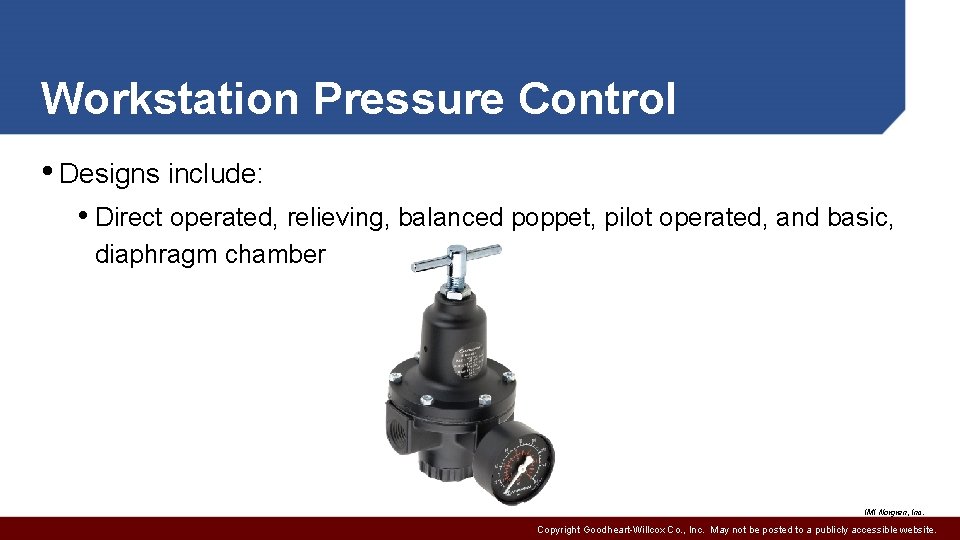
Workstation Pressure Control • Designs include: • Direct operated, relieving, balanced poppet, pilot operated, and basic, diaphragm chamber IMI Norgren, Inc. Copyright Goodheart-Willcox Co. , Inc. May not be posted to a publicly accessible website.
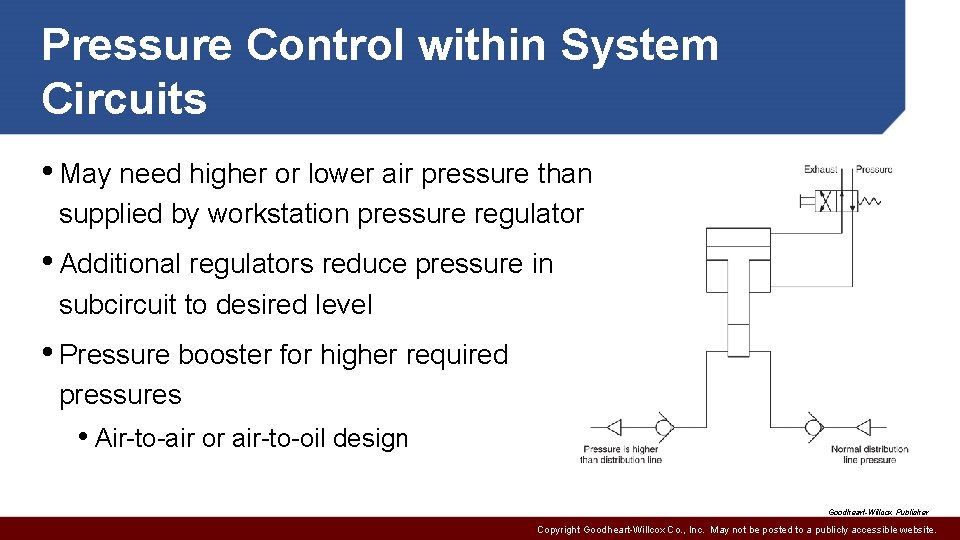
Pressure Control within System Circuits • May need higher or lower air pressure than supplied by workstation pressure regulator • Additional regulators reduce pressure in subcircuit to desired level • Pressure booster for higher required pressures • Air-to-air or air-to-oil design Goodheart-Willcox Publisher Copyright Goodheart-Willcox Co. , Inc. May not be posted to a publicly accessible website.
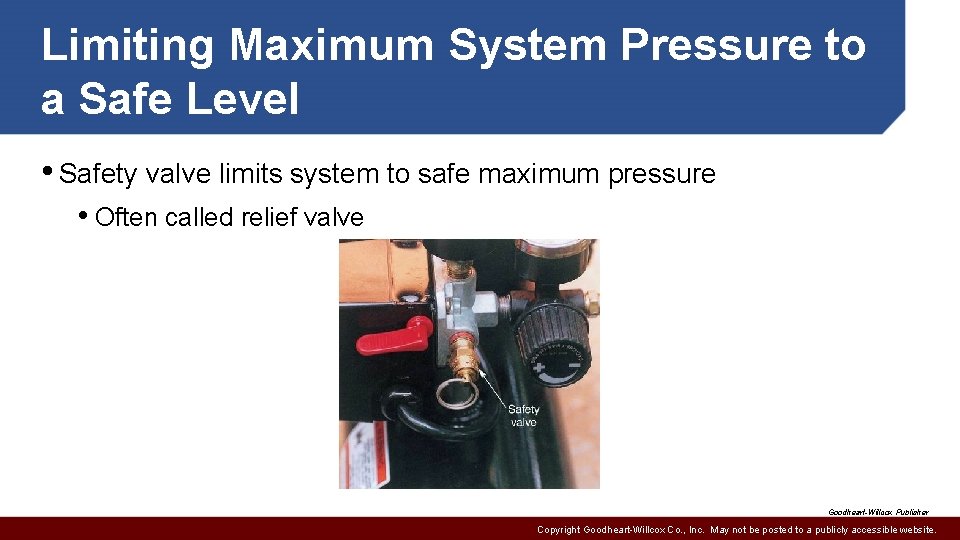
Limiting Maximum System Pressure to a Safe Level • Safety valve limits system to safe maximum pressure • Often called relief valve Goodheart-Willcox Publisher Copyright Goodheart-Willcox Co. , Inc. May not be posted to a publicly accessible website.
Limiting Maximum System Pressure to a Safe Level • Designed to fully open as soon as pressure setting is reached • Installed between compressor and first point airflow can shut off in air distribution line • Valve pressure setting depends on system operating pressure Copyright Goodheart-Willcox Co. , Inc. May not be posted to a publicly accessible website.
Directional Control Methods and Devices • Channel compressed air to cylinders, air motors, or other system work devices • Four general classifications: • Shutoff valves • Check valves • Three-way valves • Four-way valves Copyright Goodheart-Willcox Co. , Inc. May not be posted to a publicly accessible website.
Shutoff Valves • Allow or block airflow in distribution lines • Single internal passageway connecting two external ports • Commonly used to isolate circuit components for system service • Classification includes globe, gate, ball, spool, and needle valves Copyright Goodheart-Willcox Co. , Inc. May not be posted to a publicly accessible website.
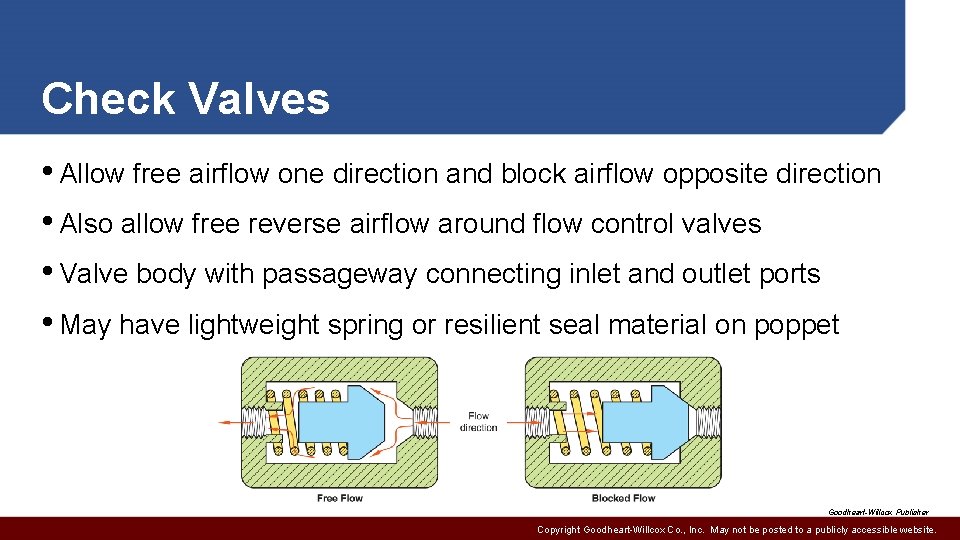
Check Valves • Allow free airflow one direction and block airflow opposite direction • Also allow free reverse airflow around flow control valves • Valve body with passageway connecting inlet and outlet ports • May have lightweight spring or resilient seal material on poppet Goodheart-Willcox Publisher Copyright Goodheart-Willcox Co. , Inc. May not be posted to a publicly accessible website.
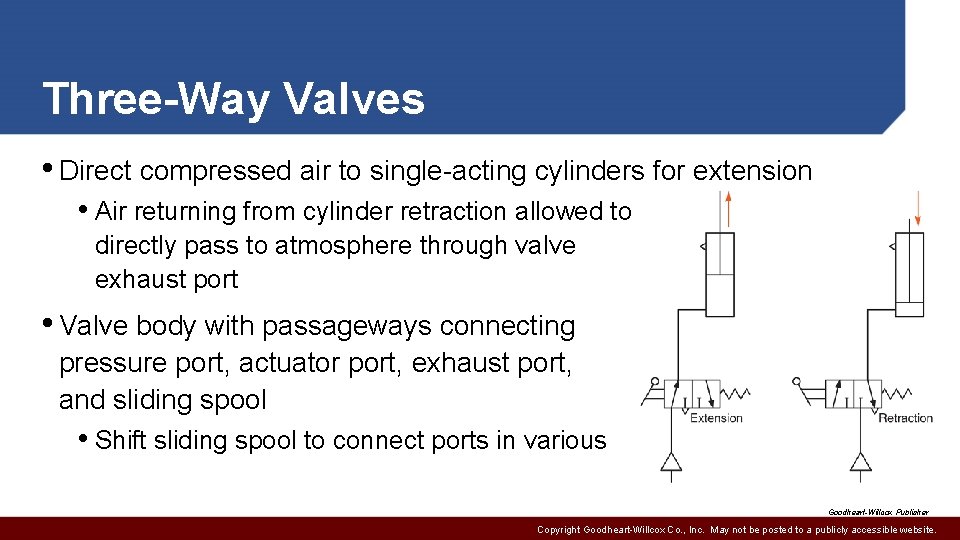
Three-Way Valves • Direct compressed air to single-acting cylinders for extension • Air returning from cylinder retraction allowed to directly pass to atmosphere through valve exhaust port • Valve body with passageways connecting pressure port, actuator port, exhaust port, and sliding spool • Shift sliding spool to connect ports in various combinations Goodheart-Willcox Publisher Copyright Goodheart-Willcox Co. , Inc. May not be posted to a publicly accessible website.
Four-Way Valves • Direct extension and retraction of double-acting cylinders • Select direction of air motor rotation • Operate other workstation circuits requiring alternate compressed air delivery • Minimum of four external port connections Copyright Goodheart-Willcox Co. , Inc. May not be posted to a publicly accessible website.
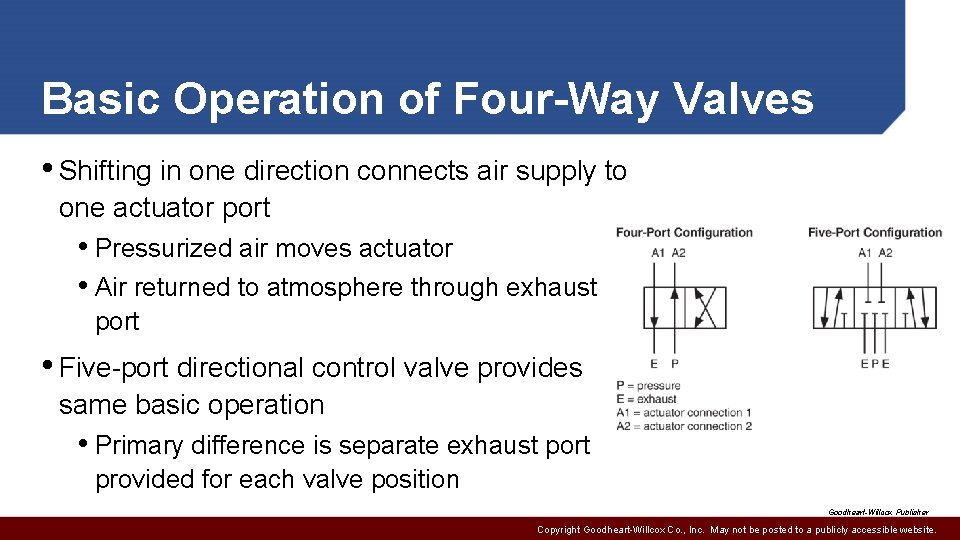
Basic Operation of Four-Way Valves • Shifting in one direction connects air supply to one actuator port • Pressurized air moves actuator • Air returned to atmosphere through exhaust port • Five-port directional control valve provides same basic operation • Primary difference is separate exhaust port provided for each valve position Goodheart-Willcox Publisher Copyright Goodheart-Willcox Co. , Inc. May not be posted to a publicly accessible website.
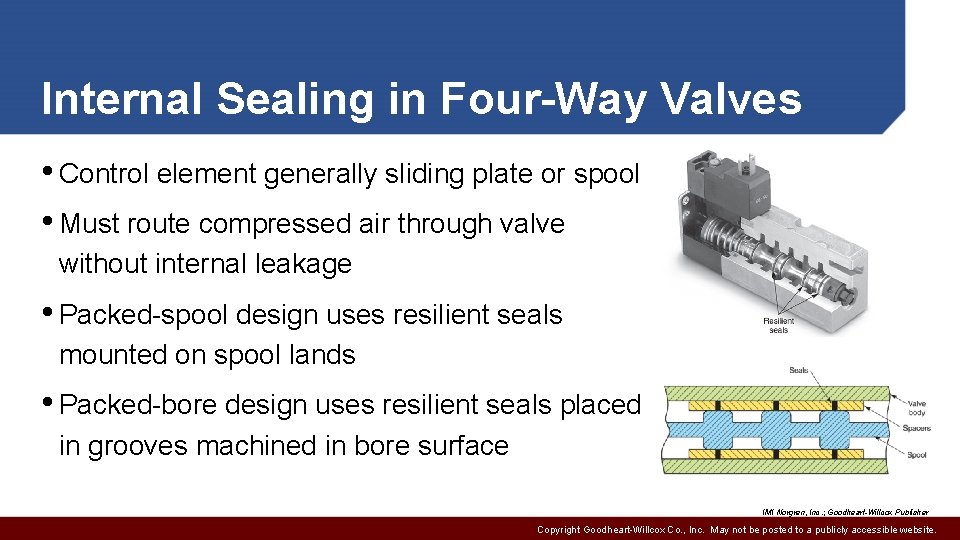
Internal Sealing in Four-Way Valves • Control element generally sliding plate or spool • Must route compressed air through valve without internal leakage • Packed-spool design uses resilient seals mounted on spool lands • Packed-bore design uses resilient seals placed in grooves machined in bore surface IMI Norgren, Inc. ; Goodheart-Willcox Publisher Copyright Goodheart-Willcox Co. , Inc. May not be posted to a publicly accessible website.
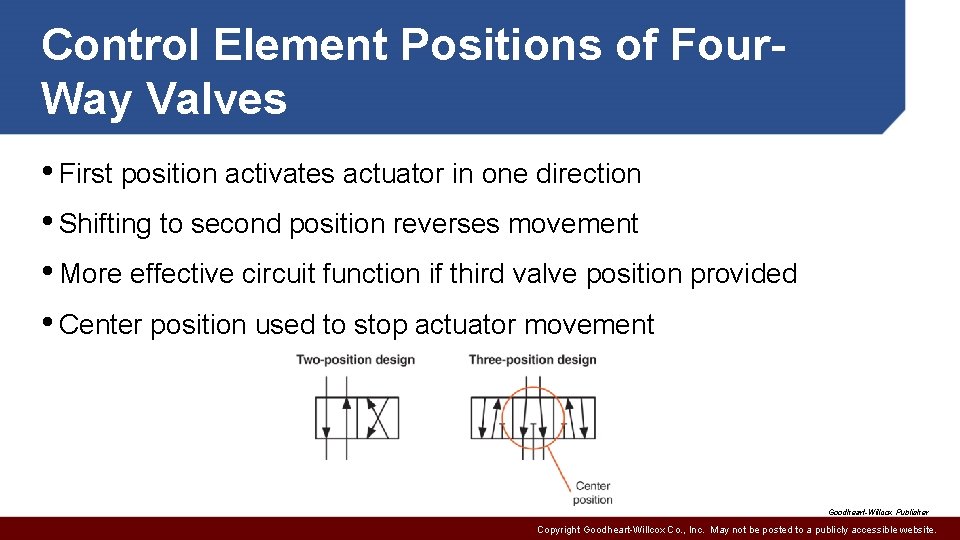
Control Element Positions of Four. Way Valves • First position activates actuator in one direction • Shifting to second position reverses movement • More effective circuit function if third valve position provided • Center position used to stop actuator movement Goodheart-Willcox Publisher Copyright Goodheart-Willcox Co. , Inc. May not be posted to a publicly accessible website.
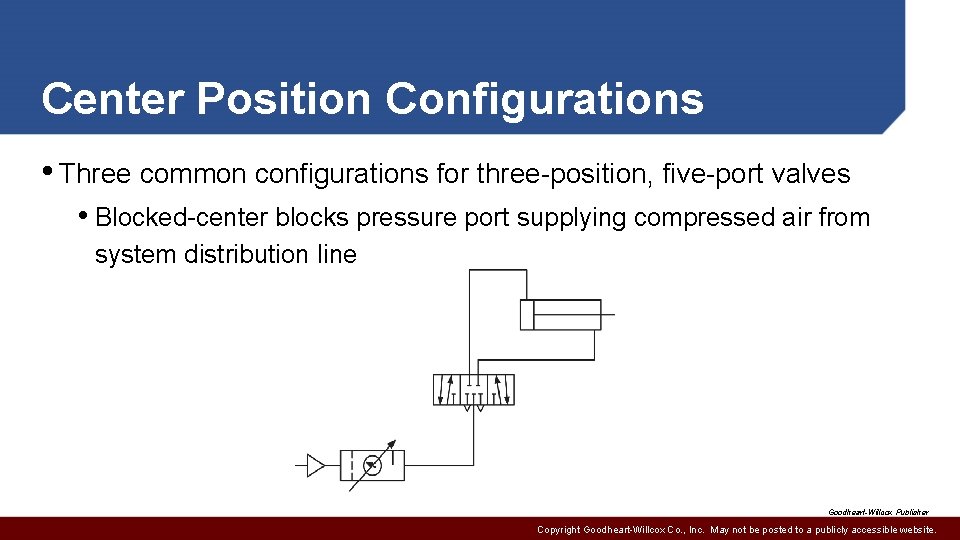
Center Position Configurations • Three common configurations for three-position, five-port valves • Blocked-center blocks pressure port supplying compressed air from system distribution line Goodheart-Willcox Publisher Copyright Goodheart-Willcox Co. , Inc. May not be posted to a publicly accessible website.
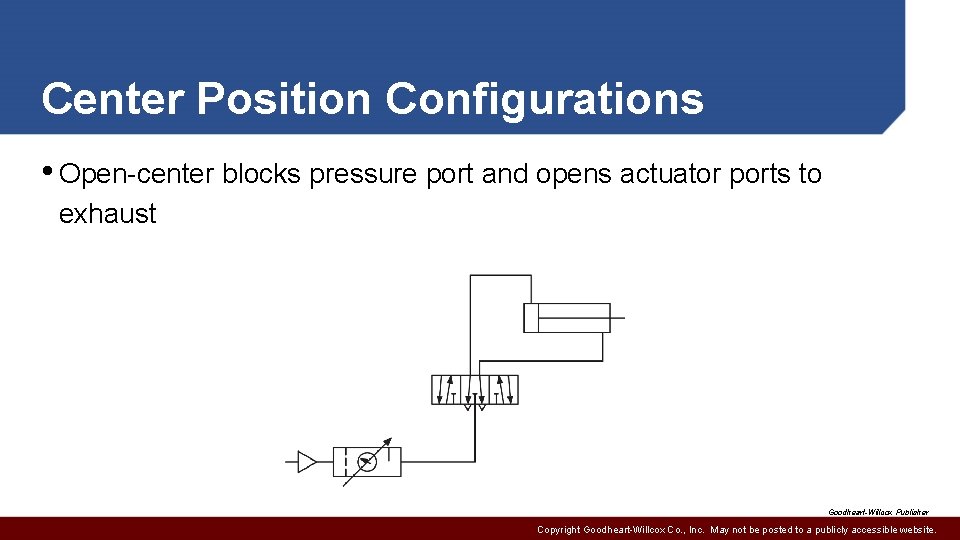
Center Position Configurations • Open-center blocks pressure port and opens actuator ports to exhaust Goodheart-Willcox Publisher Copyright Goodheart-Willcox Co. , Inc. May not be posted to a publicly accessible website.
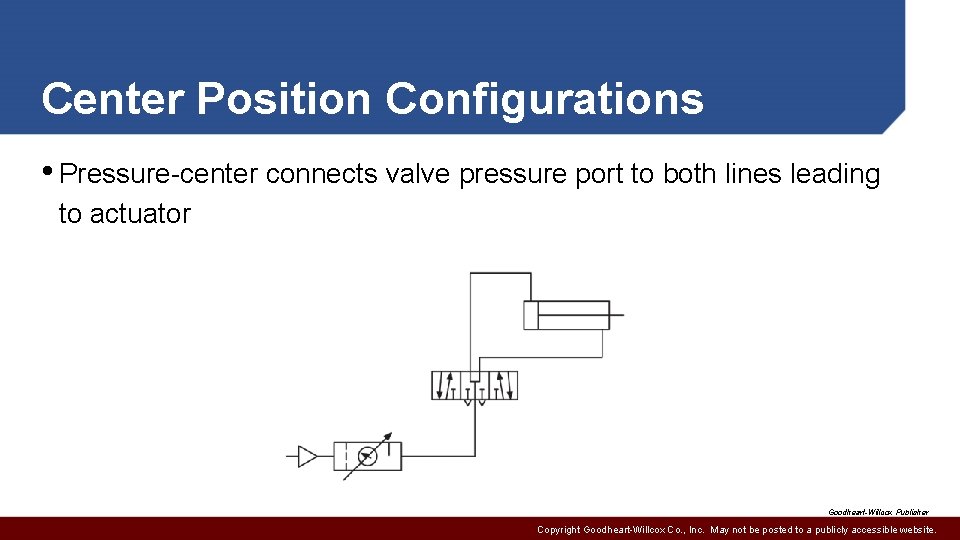
Center Position Configurations • Pressure-center connects valve pressure port to both lines leading to actuator Goodheart-Willcox Publisher Copyright Goodheart-Willcox Co. , Inc. May not be posted to a publicly accessible website.
Flow Control Methods and Devices • Control operating speed of cylinders, air motors, and other actuators • Flow control valve accuracy influenced by system load changes that cause: • System pressure variation • Internal system friction changes • Increases or decreases in compressed air temperature Copyright Goodheart-Willcox Co. , Inc. May not be posted to a publicly accessible website.
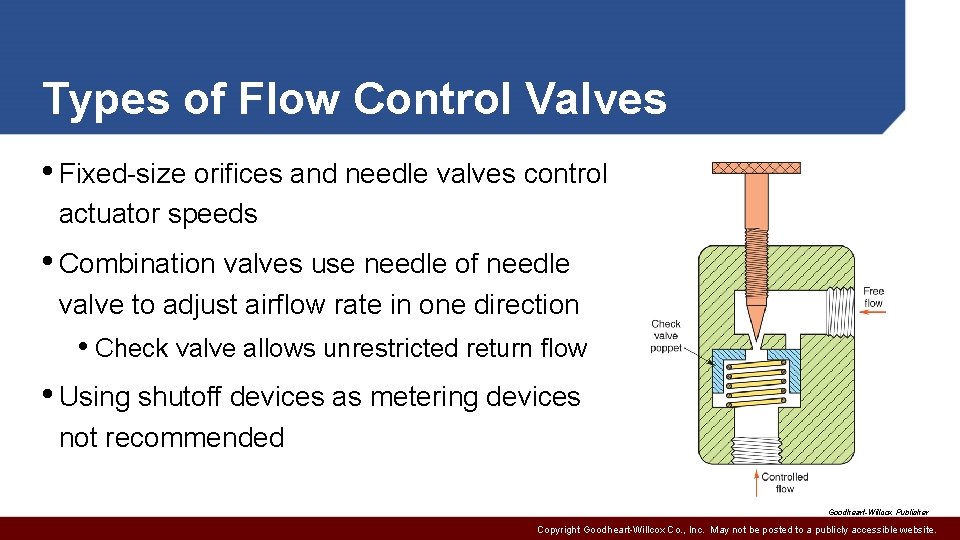
Types of Flow Control Valves • Fixed-size orifices and needle valves control actuator speeds • Combination valves use needle of needle valve to adjust airflow rate in one direction • Check valve allows unrestricted return flow • Using shutoff devices as metering devices not recommended Goodheart-Willcox Publisher Copyright Goodheart-Willcox Co. , Inc. May not be posted to a publicly accessible website.
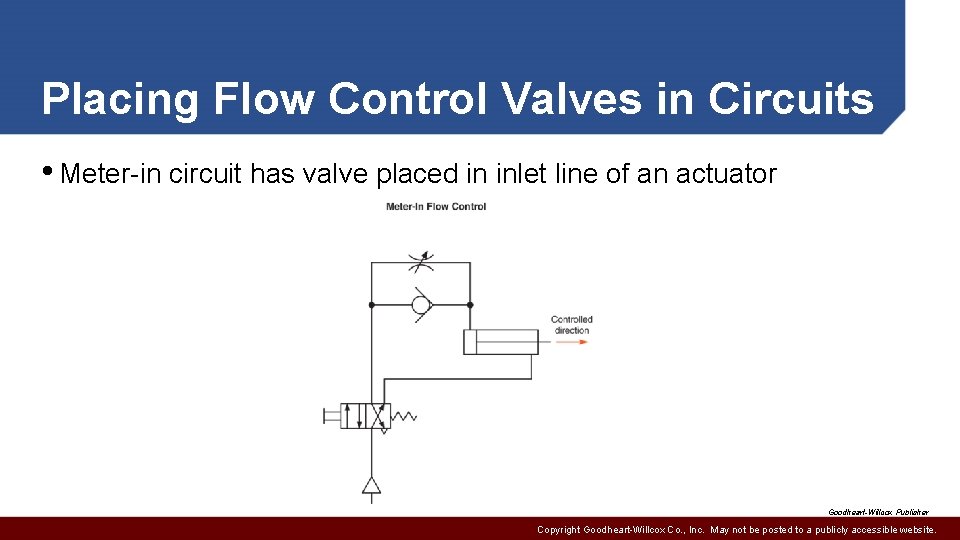
Placing Flow Control Valves in Circuits • Meter-in circuit has valve placed in inlet line of an actuator Goodheart-Willcox Publisher Copyright Goodheart-Willcox Co. , Inc. May not be posted to a publicly accessible website.
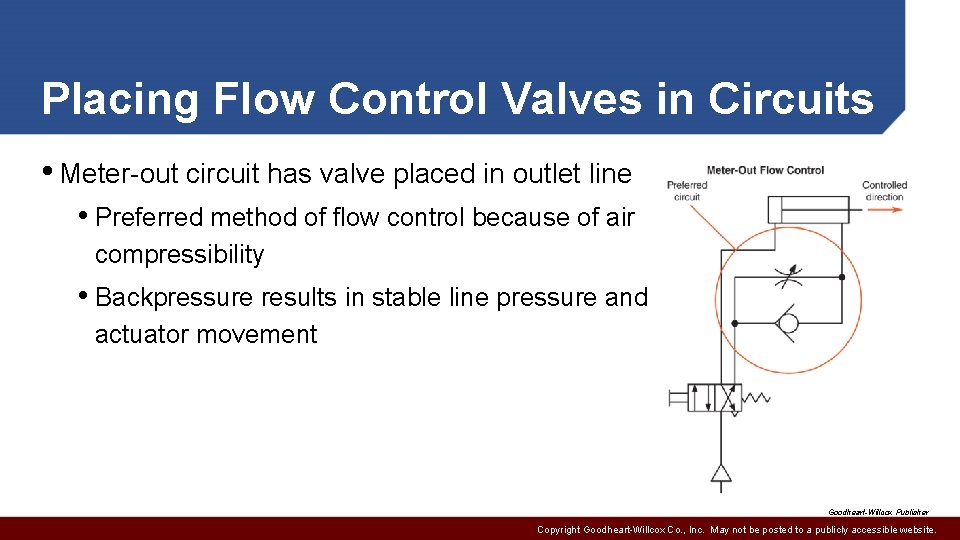
Placing Flow Control Valves in Circuits • Meter-out circuit has valve placed in outlet line • Preferred method of flow control because of air compressibility • Backpressure results in stable line pressure and actuator movement Goodheart-Willcox Publisher Copyright Goodheart-Willcox Co. , Inc. May not be posted to a publicly accessible website.
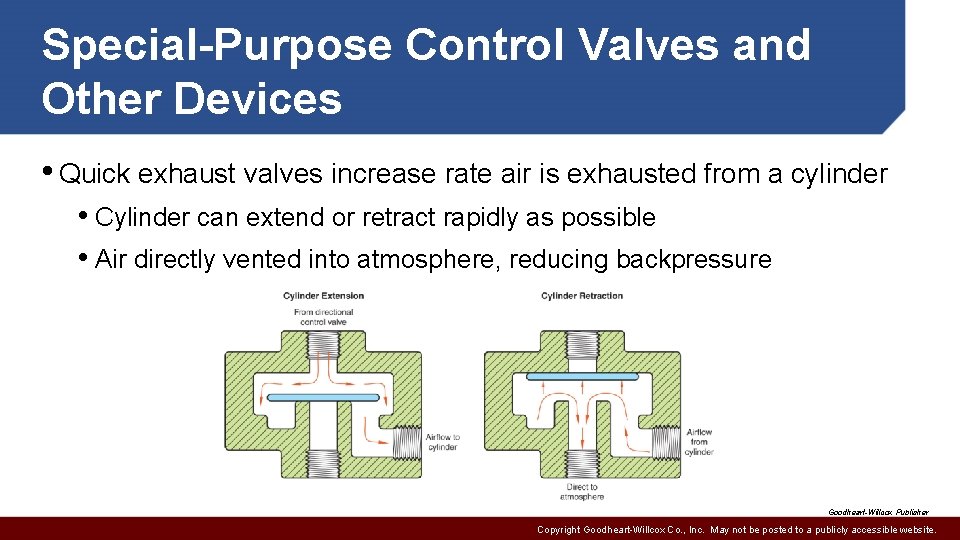
Special-Purpose Control Valves and Other Devices • Quick exhaust valves increase rate air is exhausted from a cylinder • Cylinder can extend or retract rapidly as possible • Air directly vented into atmosphere, reducing backpressure Goodheart-Willcox Publisher Copyright Goodheart-Willcox Co. , Inc. May not be posted to a publicly accessible website.
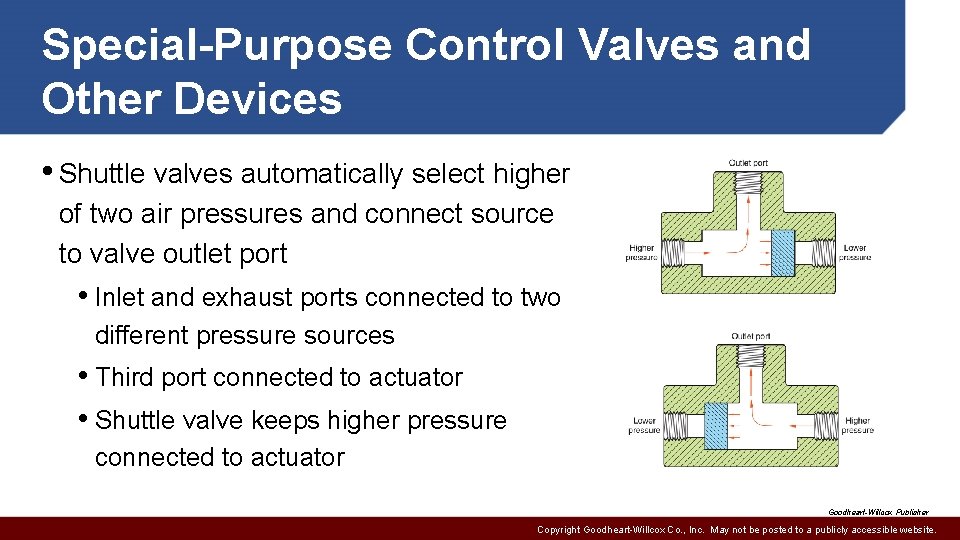
Special-Purpose Control Valves and Other Devices • Shuttle valves automatically select higher of two air pressures and connect source to valve outlet port • Inlet and exhaust ports connected to two different pressure sources • Third port connected to actuator • Shuttle valve keeps higher pressure connected to actuator Goodheart-Willcox Publisher Copyright Goodheart-Willcox Co. , Inc. May not be posted to a publicly accessible website.
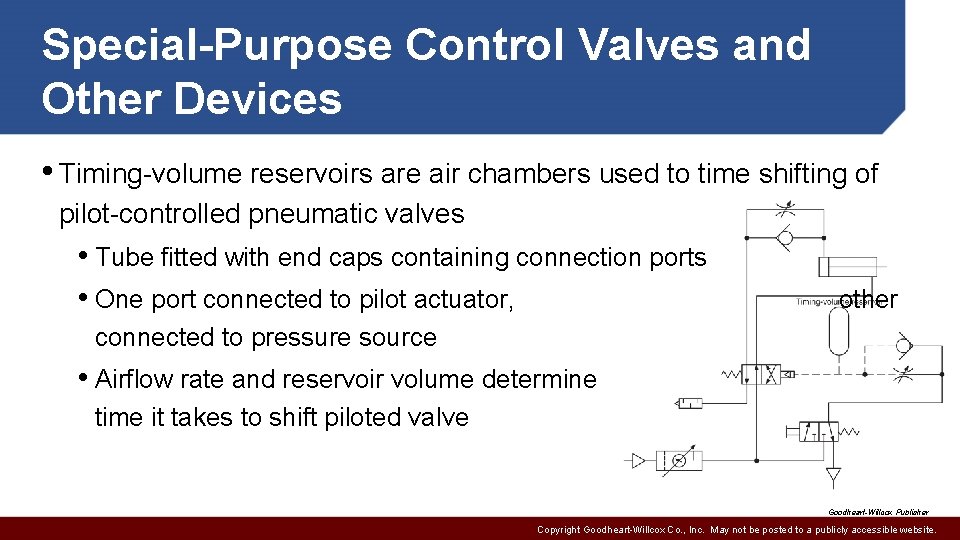
Special-Purpose Control Valves and Other Devices • Timing-volume reservoirs are air chambers used to time shifting of pilot-controlled pneumatic valves • Tube fitted with end caps containing connection ports • One port connected to pilot actuator, other connected to pressure source • Airflow rate and reservoir volume determine time it takes to shift piloted valve Goodheart-Willcox Publisher Copyright Goodheart-Willcox Co. , Inc. May not be posted to a publicly accessible website.
Special-Purpose Control Valves and Other Devices • Mufflers commonly used to reduce level of air exhaust noise • Prevent dirt and other foreign materials from entering system • Airflow resistance increases as oil and other particles build up • Inspect periodically for cleaning or replacement Copyright Goodheart-Willcox Co. , Inc. May not be posted to a publicly accessible website.
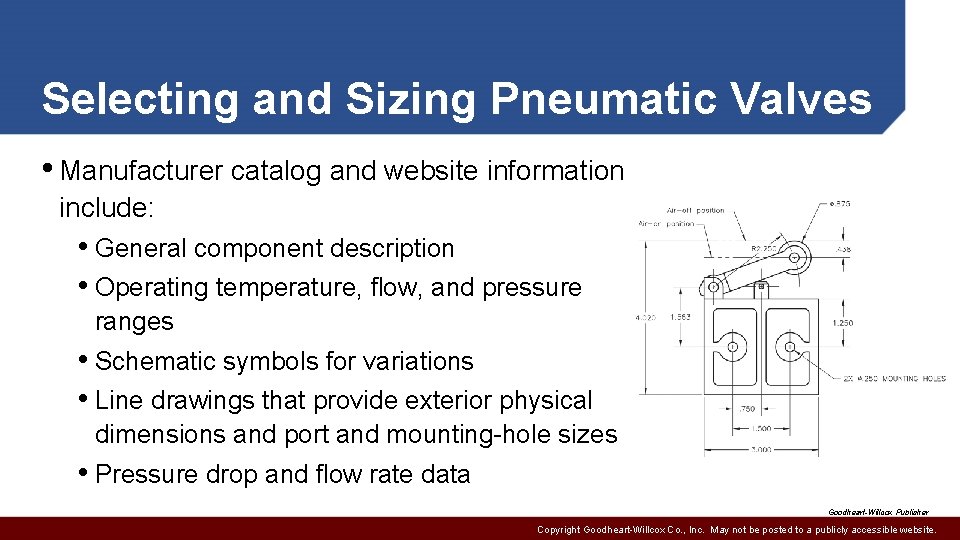
Selecting and Sizing Pneumatic Valves • Manufacturer catalog and website information include: • General component description • Operating temperature, flow, and pressure ranges • Schematic symbols for variations • Line drawings that provide exterior physical dimensions and port and mounting-hole sizes • Pressure drop and flow rate data Goodheart-Willcox Publisher Copyright Goodheart-Willcox Co. , Inc. May not be posted to a publicly accessible website.
Selecting and Sizing Pneumatic Valves • Selecting properly sized control valve critical for effective system operation • Several approaches to determine appropriate valve capacity • Most begin with relatively simple calculation Copyright Goodheart-Willcox Co. , Inc. May not be posted to a publicly accessible website.
Selecting and Sizing Pneumatic Valves • Typical data required for calculation: • Cylinder piston area • Cylinder stroke • System compression • System pressure drop • Cylinder stroke time • Printed brochures and Internet-based calculators often provided by companies Copyright Goodheart-Willcox Co. , Inc. May not be posted to a publicly accessible website.
- Slides: 43