
18 447 Computer Architecture Lecture 29 Cache Coherence

- Slides: 53
18 -447 Computer Architecture Lecture 29: Cache Coherence Prof. Onur Mutlu Carnegie Mellon University Spring 2015, 4/10/2015
A Note on 740 Next Semester n n n If you like 447, 740 is the next course in sequence Tentative Time: Lect. MW 7: 30 -9: 20 pm, Rect. T 7: 30 pm Content: q q q Lectures: More advanced, with a different perspective Recitations: Delving deeper into papers, advanced topics Readings: Many fundamental and research readings; will do many reviews Project: More open ended research project. Proposal milestones final poster and presentation Exams: lighter and fewer Homeworks: None 2
Where We Are in Lecture Schedule n n n The memory hierarchy Caches, caches, more caches Virtualizing the memory hierarchy: Virtual Memory Main memory: DRAM Main memory control, scheduling Memory latency tolerance techniques Non-volatile memory Multiprocessors Coherence and consistency Interconnection networks Multi-core issues (e. g. , heterogeneous multi-core) 3
Cache Coherence 4
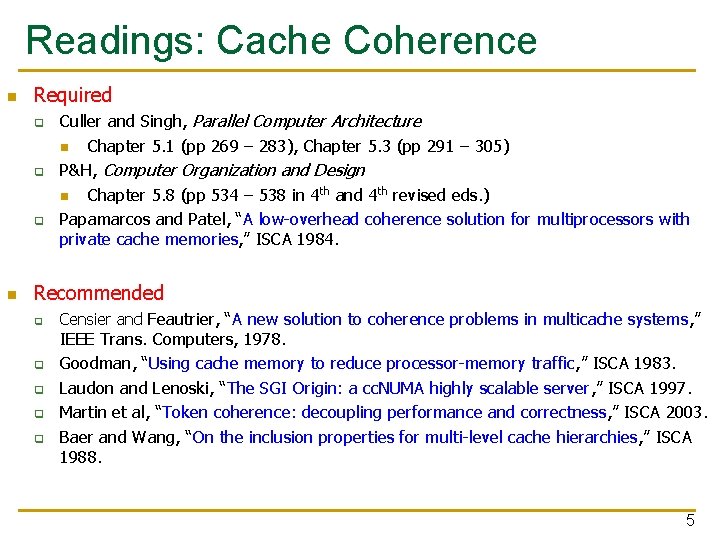
Readings: Cache Coherence n Required q q q n Culler and Singh, Parallel Computer Architecture n Chapter 5. 1 (pp 269 – 283), Chapter 5. 3 (pp 291 – 305) P&H, Computer Organization and Design n Chapter 5. 8 (pp 534 – 538 in 4 th and 4 th revised eds. ) Papamarcos and Patel, “A low-overhead coherence solution for multiprocessors with private cache memories, ” ISCA 1984. Recommended q q q Censier and Feautrier, “A new solution to coherence problems in multicache systems, ” IEEE Trans. Computers, 1978. Goodman, “Using cache memory to reduce processor-memory traffic, ” ISCA 1983. Laudon and Lenoski, “The SGI Origin: a cc. NUMA highly scalable server, ” ISCA 1997. Martin et al, “Token coherence: decoupling performance and correctness, ” ISCA 2003. Baer and Wang, “On the inclusion properties for multi-level cache hierarchies, ” ISCA 1988. 5
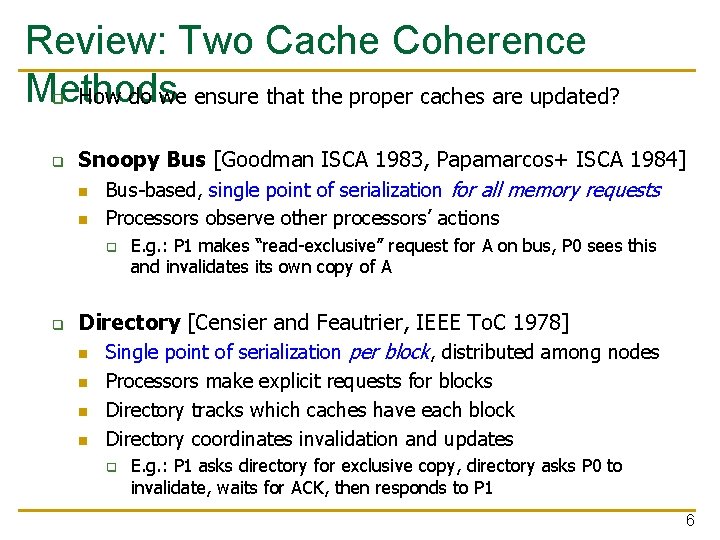
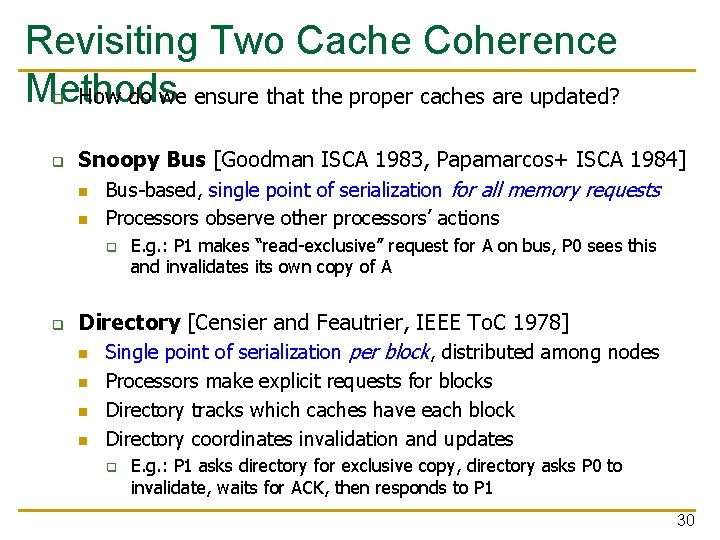
Review: Two Cache Coherence Methods How do we ensure that the proper caches are updated? q q Snoopy Bus [Goodman ISCA 1983, Papamarcos+ ISCA 1984] n Bus-based, single point of serialization for all memory requests n Processors observe other processors’ actions q q E. g. : P 1 makes “read-exclusive” request for A on bus, P 0 sees this and invalidates its own copy of A Directory [Censier and Feautrier, IEEE To. C 1978] n Single point of serialization per block, distributed among nodes n n n Processors make explicit requests for blocks Directory tracks which caches have each block Directory coordinates invalidation and updates q E. g. : P 1 asks directory for exclusive copy, directory asks P 0 to invalidate, waits for ACK, then responds to P 1 6
Directory Based Cache Coherence 7
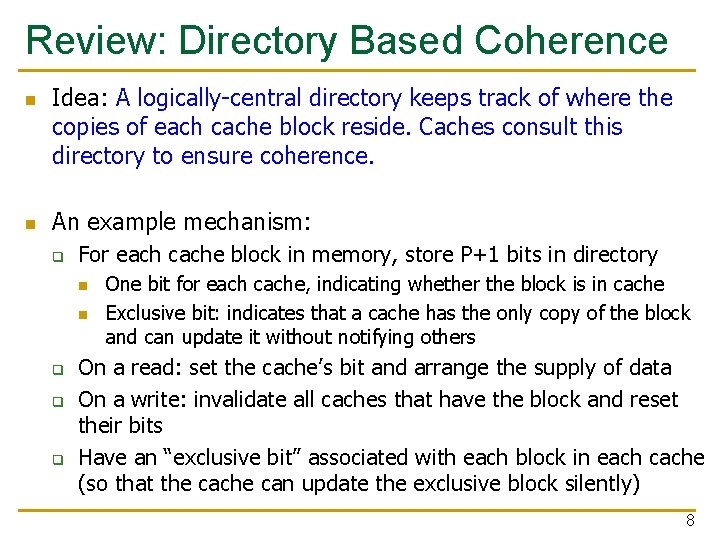
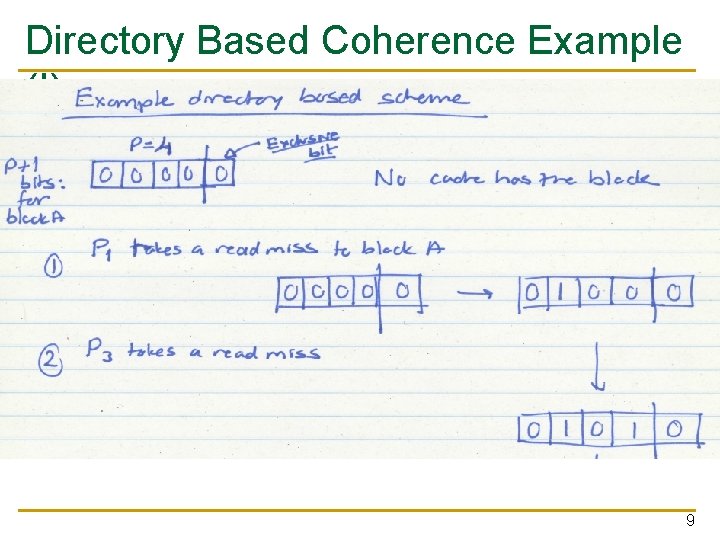
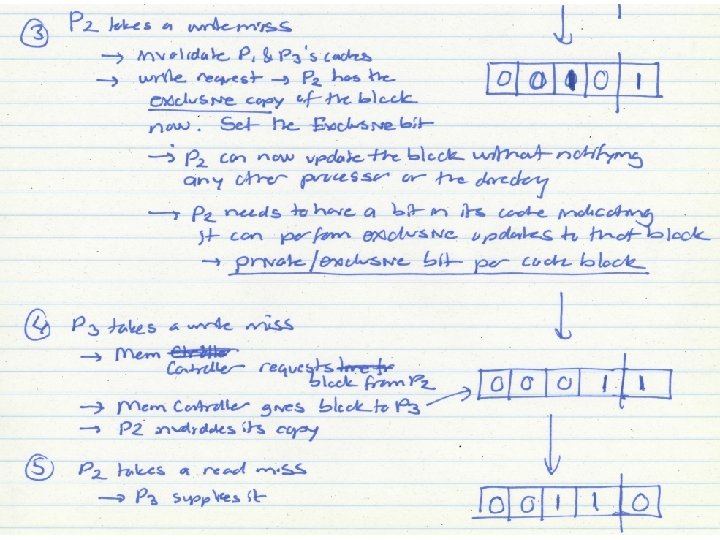
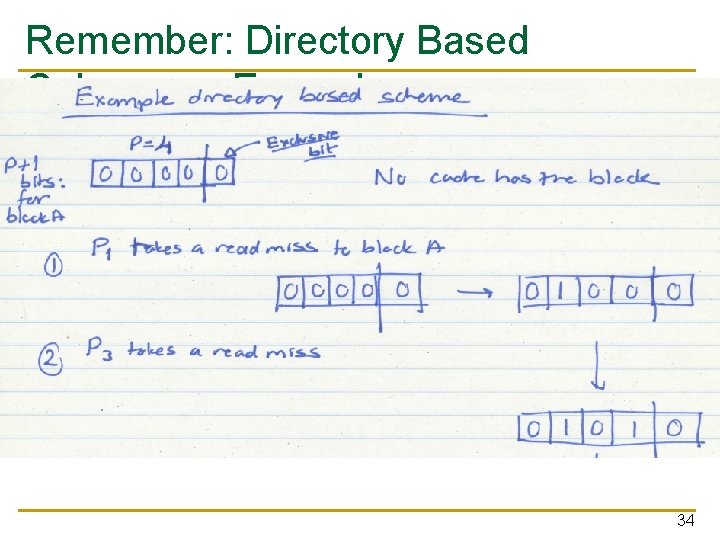
Review: Directory Based Coherence n n Idea: A logically-central directory keeps track of where the copies of each cache block reside. Caches consult this directory to ensure coherence. An example mechanism: q For each cache block in memory, store P+1 bits in directory n n q q q One bit for each cache, indicating whether the block is in cache Exclusive bit: indicates that a cache has the only copy of the block and can update it without notifying others On a read: set the cache’s bit and arrange the supply of data On a write: invalidate all caches that have the block and reset their bits Have an “exclusive bit” associated with each block in each cache (so that the cache can update the exclusive block silently) 8
Directory Based Coherence Example (I) 9
Directory Based Coherence Example (I) 10
Snoopy Cache Coherence 11
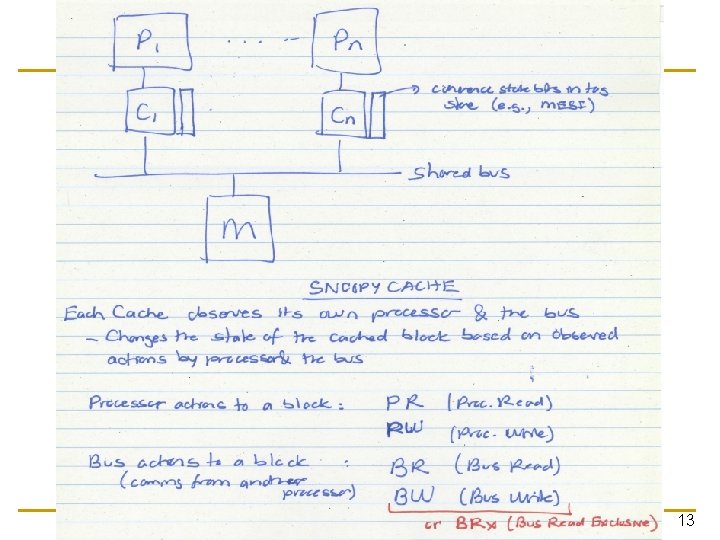
Snoopy Cache Coherence n Idea: q q n All caches “snoop” all other caches’ read/write requests and keep the cache block coherent Each cache block has “coherence metadata” associated with it in the tag store of each cache Easy to implement if all caches share a common bus q q q Each cache broadcasts its read/write operations on the bus Good for small-scale multiprocessors What if you would like to have a 1000 -node multiprocessor? 12
13
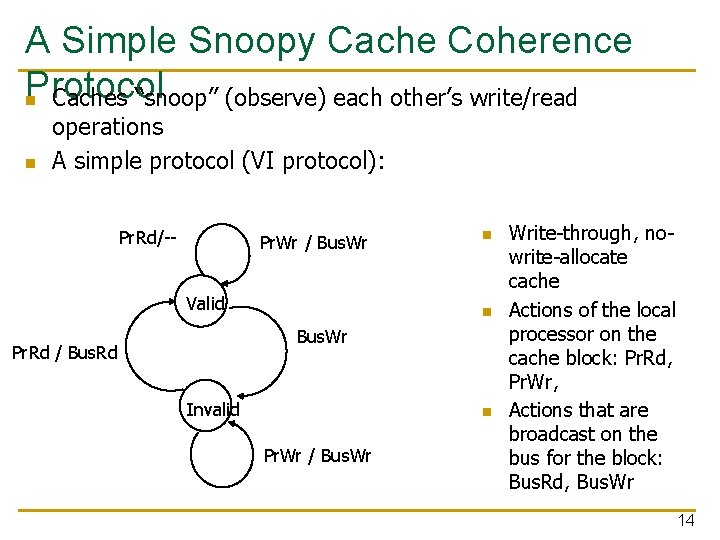
A Simple Snoopy Cache Coherence Protocol n Caches “snoop” (observe) each other’s write/read n operations A simple protocol (VI protocol): Pr. Rd/-- Pr. Wr / Bus. Wr Valid n n Bus. Wr Pr. Rd / Bus. Rd Invalid n Pr. Wr / Bus. Wr Write-through, nowrite-allocate cache Actions of the local processor on the cache block: Pr. Rd, Pr. Wr, Actions that are broadcast on the bus for the block: Bus. Rd, Bus. Wr 14
Extending the Protocol n What if you want write-back caches? q We want a “modified” state 15
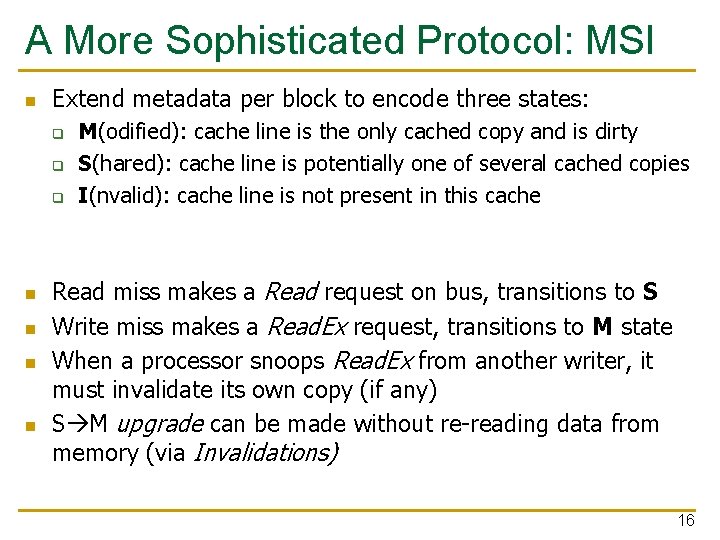
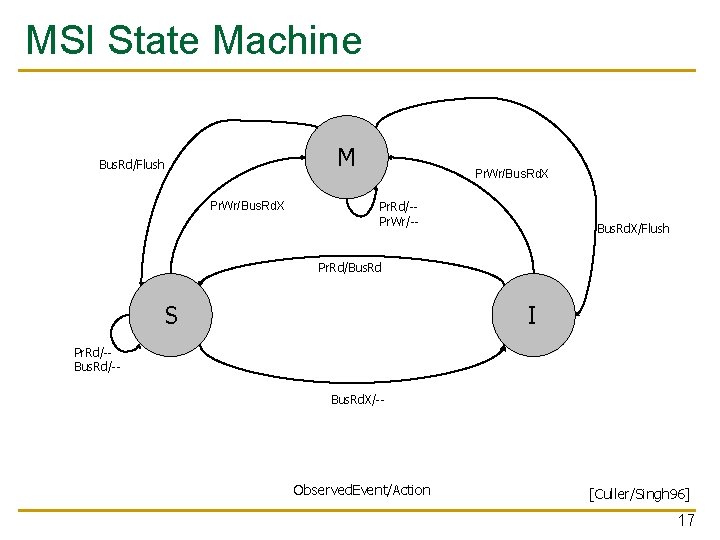
A More Sophisticated Protocol: MSI n Extend metadata per block to encode three states: q q q n n M(odified): cache line is the only cached copy and is dirty S(hared): cache line is potentially one of several cached copies I(nvalid): cache line is not present in this cache Read miss makes a Read request on bus, transitions to S Write miss makes a Read. Ex request, transitions to M state When a processor snoops Read. Ex from another writer, it must invalidate its own copy (if any) S M upgrade can be made without re-reading data from memory (via Invalidations) 16
MSI State Machine M Bus. Rd/Flush Pr. Wr/Bus. Rd. X Pr. Rd/-Pr. Wr/-- Bus. Rd. X/Flush Pr. Rd/Bus. Rd S I Pr. Rd/-Bus. Rd. X/-- Observed. Event/Action [Culler/Singh 96] 17
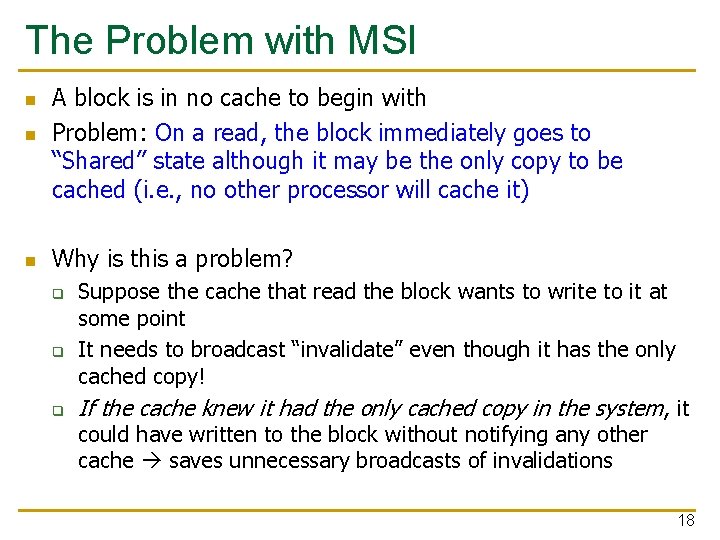
The Problem with MSI n A block is in no cache to begin with Problem: On a read, the block immediately goes to “Shared” state although it may be the only copy to be cached (i. e. , no other processor will cache it) n Why is this a problem? n q q q Suppose the cache that read the block wants to write to it at some point It needs to broadcast “invalidate” even though it has the only cached copy! If the cache knew it had the only cached copy in the system, it could have written to the block without notifying any other cache saves unnecessary broadcasts of invalidations 18
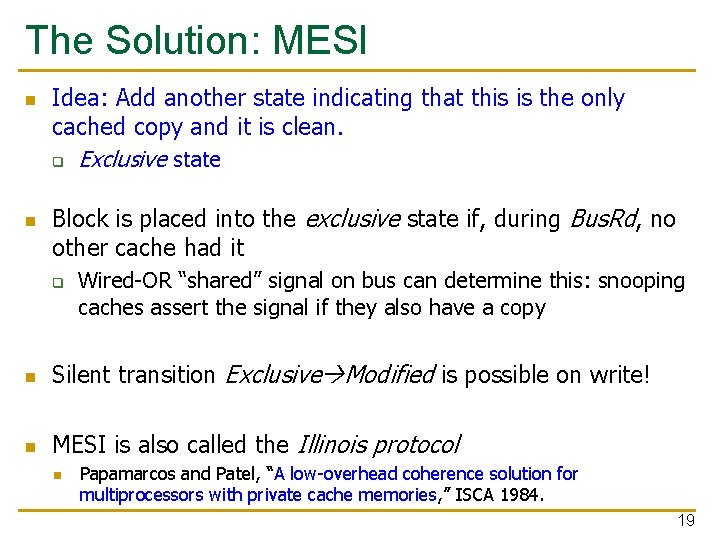
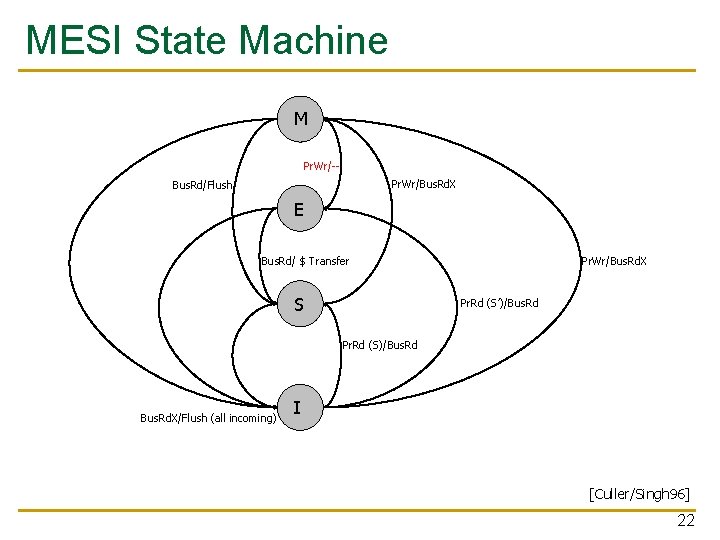
The Solution: MESI n n Idea: Add another state indicating that this is the only cached copy and it is clean. q Exclusive state Block is placed into the exclusive state if, during Bus. Rd, no other cache had it q Wired-OR “shared” signal on bus can determine this: snooping caches assert the signal if they also have a copy n Silent transition Exclusive Modified is possible on write! n MESI is also called the Illinois protocol n Papamarcos and Patel, “A low-overhead coherence solution for multiprocessors with private cache memories, ” ISCA 1984. 19
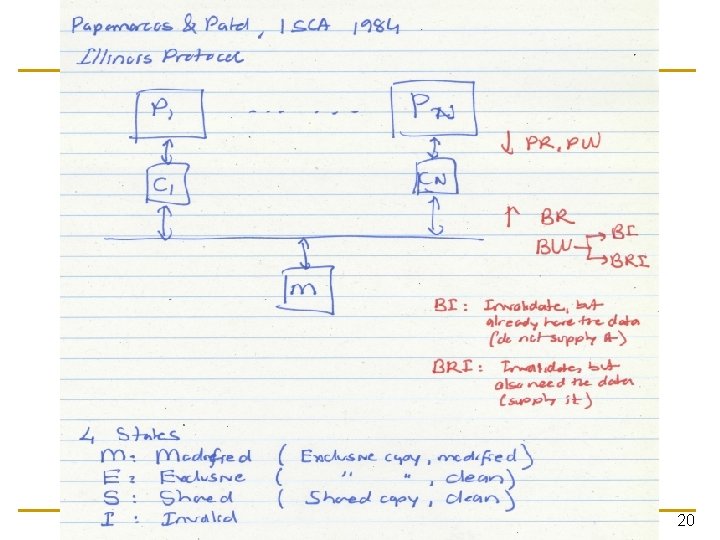
20
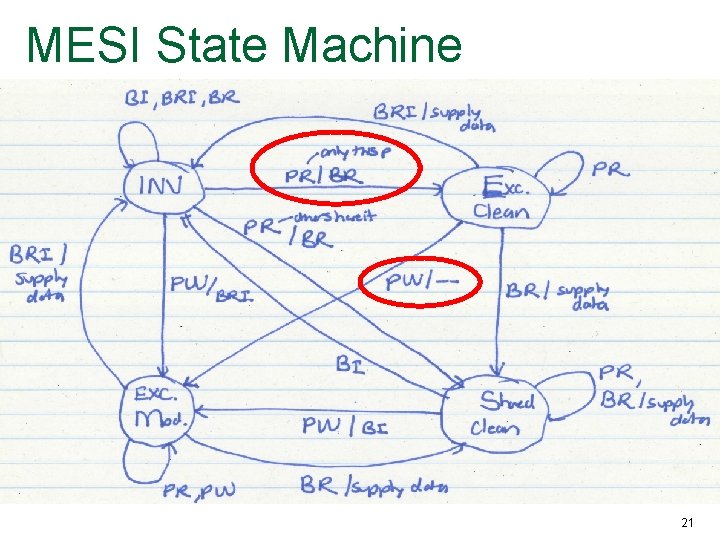
MESI State Machine 21
MESI State Machine M Pr. Wr/-Pr. Wr/Bus. Rd. X Bus. Rd/Flush E Bus. Rd/ $ Transfer S Pr. Wr/Bus. Rd. X Pr. Rd (S’)/Bus. Rd Pr. Rd (S)/Bus. Rd. X/Flush (all incoming) I [Culler/Singh 96] 22
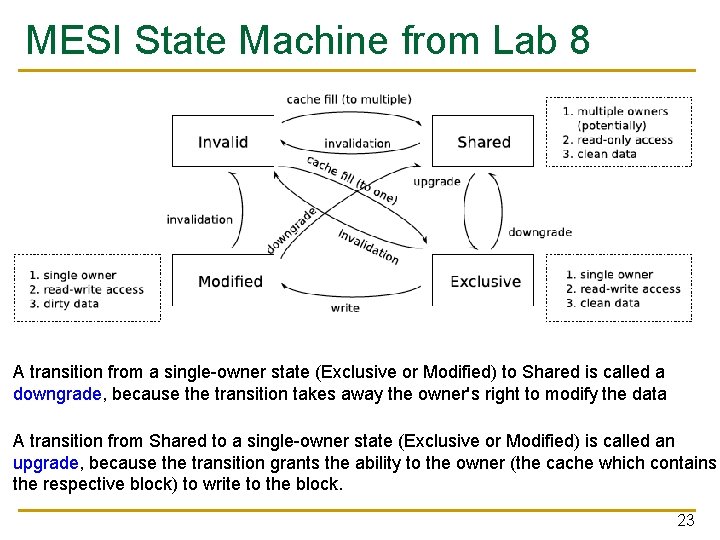
MESI State Machine from Lab 8 A transition from a single-owner state (Exclusive or Modified) to Shared is called a downgrade, because the transition takes away the owner's right to modify the data A transition from Shared to a single-owner state (Exclusive or Modified) is called an upgrade, because the transition grants the ability to the owner (the cache which contains the respective block) to write to the block. 23
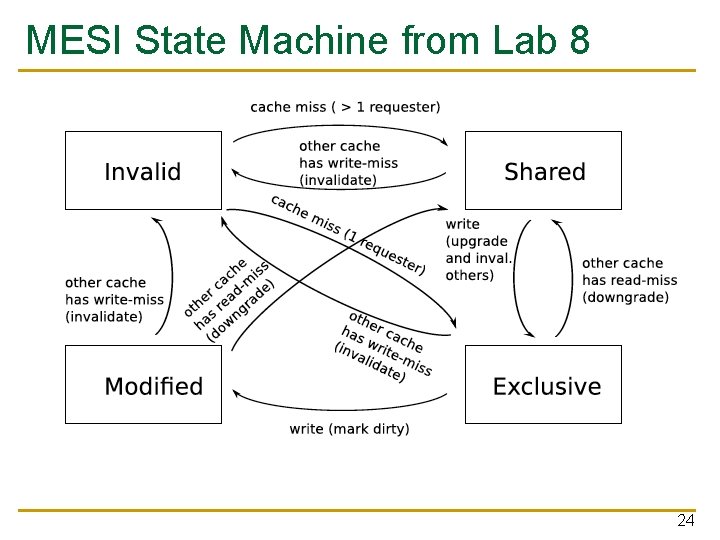
MESI State Machine from Lab 8 24
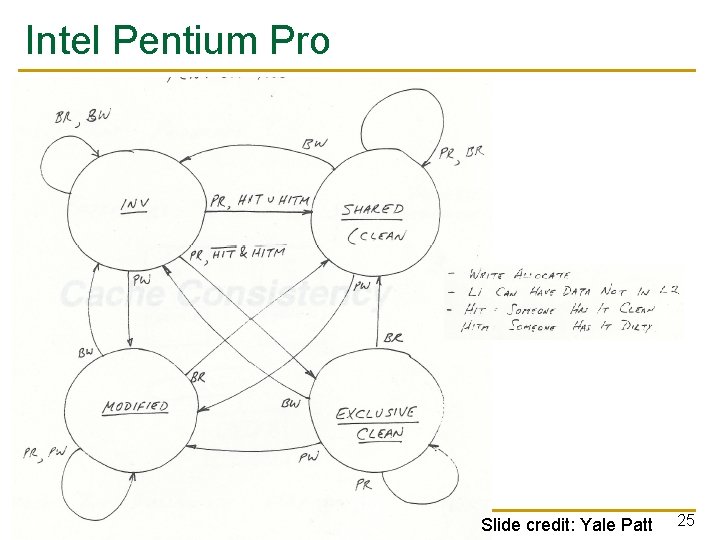
Intel Pentium Pro Slide credit: Yale Patt 25
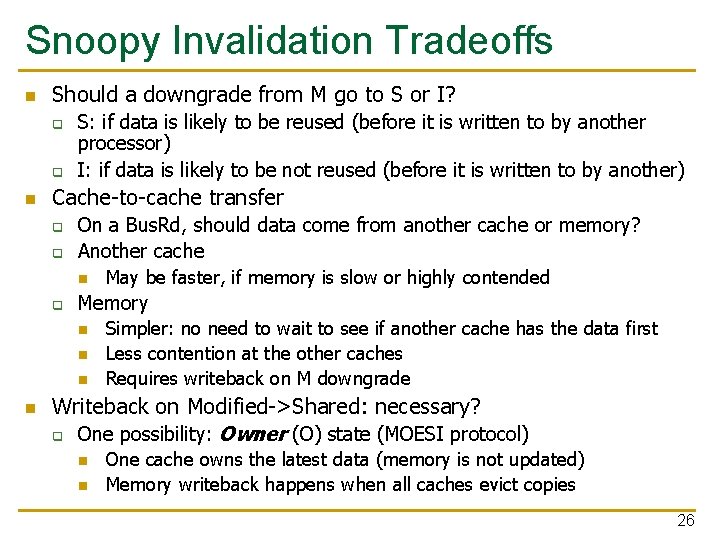
Snoopy Invalidation Tradeoffs n Should a downgrade from M go to S or I? q q n S: if data is likely to be reused (before it is written to by another processor) I: if data is likely to be not reused (before it is written to by another) Cache-to-cache transfer q q On a Bus. Rd, should data come from another cache or memory? Another cache n q Memory n n May be faster, if memory is slow or highly contended Simpler: no need to wait to see if another cache has the data first Less contention at the other caches Requires writeback on M downgrade Writeback on Modified->Shared: necessary? q One possibility: Owner (O) state (MOESI protocol) n n One cache owns the latest data (memory is not updated) Memory writeback happens when all caches evict copies 26
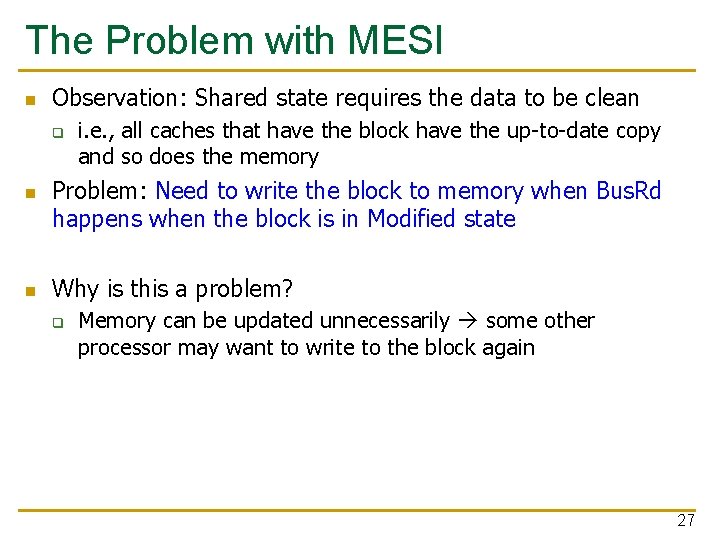
The Problem with MESI n Observation: Shared state requires the data to be clean q n n i. e. , all caches that have the block have the up-to-date copy and so does the memory Problem: Need to write the block to memory when Bus. Rd happens when the block is in Modified state Why is this a problem? q Memory can be updated unnecessarily some other processor may want to write to the block again 27
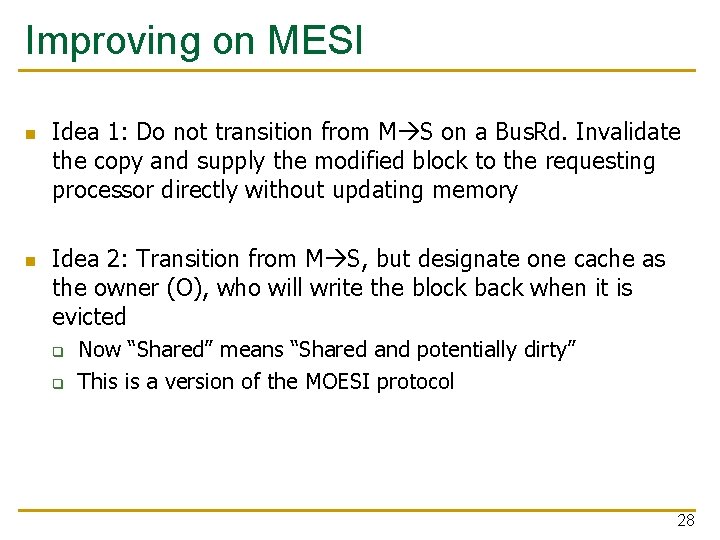
Improving on MESI n n Idea 1: Do not transition from M S on a Bus. Rd. Invalidate the copy and supply the modified block to the requesting processor directly without updating memory Idea 2: Transition from M S, but designate one cache as the owner (O), who will write the block back when it is evicted q q Now “Shared” means “Shared and potentially dirty” This is a version of the MOESI protocol 28
Tradeoffs in Sophisticated Cache Coherence Protocols n The protocol can be optimized with more states and prediction mechanisms to + Reduce unnecessary invalidates and transfers of blocks n However, more states and optimizations -- Are more difficult to design and verify (lead to more cases to take care of, race conditions) -- Provide diminishing returns 29
Revisiting Two Cache Coherence Methods How do we ensure that the proper caches are updated? q q Snoopy Bus [Goodman ISCA 1983, Papamarcos+ ISCA 1984] n Bus-based, single point of serialization for all memory requests n Processors observe other processors’ actions q q E. g. : P 1 makes “read-exclusive” request for A on bus, P 0 sees this and invalidates its own copy of A Directory [Censier and Feautrier, IEEE To. C 1978] n Single point of serialization per block, distributed among nodes n n n Processors make explicit requests for blocks Directory tracks which caches have each block Directory coordinates invalidation and updates q E. g. : P 1 asks directory for exclusive copy, directory asks P 0 to invalidate, waits for ACK, then responds to P 1 30
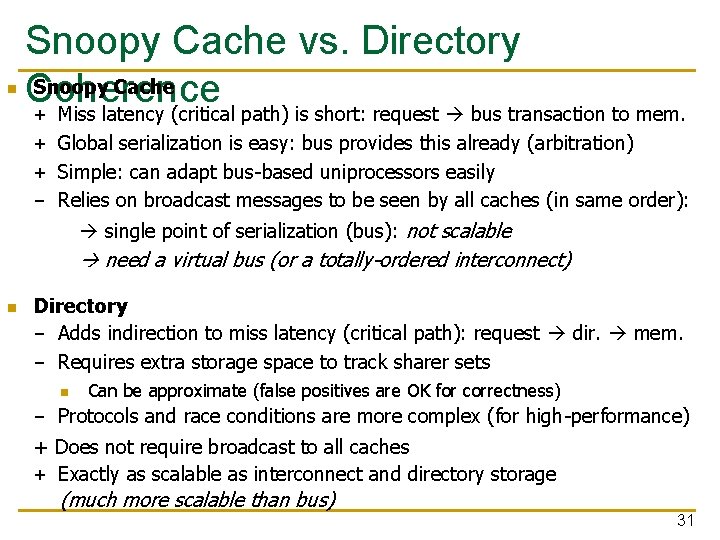
n Snoopy Cache vs. Directory Snoopy Cache Coherence + Miss latency (critical path) is short: request bus transaction to mem. + Global serialization is easy: bus provides this already (arbitration) + Simple: can adapt bus-based uniprocessors easily - Relies on broadcast messages to be seen by all caches (in same order): single point of serialization (bus): not scalable need a virtual bus (or a totally-ordered interconnect) n Directory - Adds indirection to miss latency (critical path): request dir. mem. - Requires extra storage space to track sharer sets n Can be approximate (false positives are OK for correctness) - Protocols and race conditions are more complex (for high-performance) + Does not require broadcast to all caches + Exactly as scalable as interconnect and directory storage (much more scalable than bus) 31
Revisiting Directory-Based Cache Coherence 32
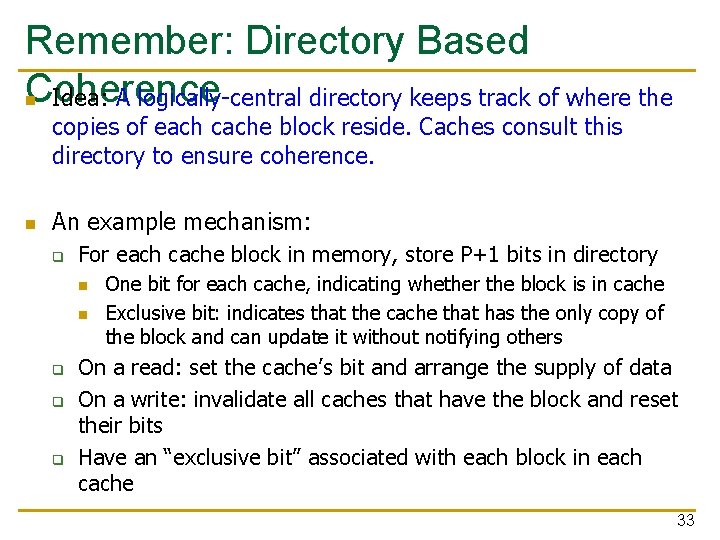
Remember: Directory Based Coherence n Idea: A logically-central directory keeps track of where the copies of each cache block reside. Caches consult this directory to ensure coherence. n An example mechanism: q For each cache block in memory, store P+1 bits in directory n n q q q One bit for each cache, indicating whether the block is in cache Exclusive bit: indicates that the cache that has the only copy of the block and can update it without notifying others On a read: set the cache’s bit and arrange the supply of data On a write: invalidate all caches that have the block and reset their bits Have an “exclusive bit” associated with each block in each cache 33
Remember: Directory Based Coherence Example 34
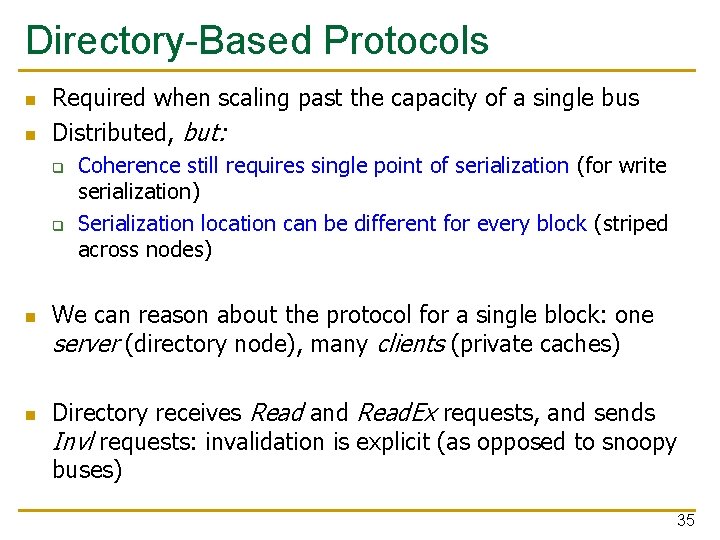
Directory-Based Protocols n n Required when scaling past the capacity of a single bus Distributed, but: q q n n Coherence still requires single point of serialization (for write serialization) Serialization location can be different for every block (striped across nodes) We can reason about the protocol for a single block: one server (directory node), many clients (private caches) Directory receives Read and Read. Ex requests, and sends Invl requests: invalidation is explicit (as opposed to snoopy buses) 35
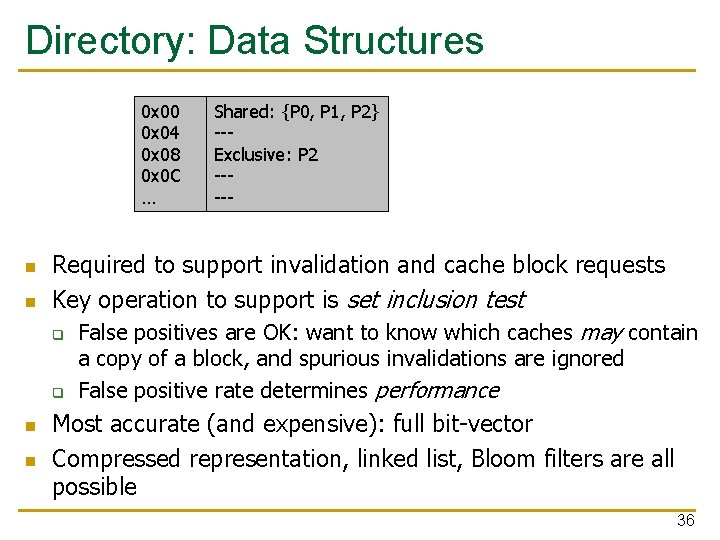
Directory: Data Structures 0 x 00 0 x 04 0 x 08 0 x 0 C … n n Required to support invalidation and cache block requests Key operation to support is set inclusion test q False positives are OK: want to know which caches may contain q n n Shared: {P 0, P 1, P 2} --Exclusive: P 2 ----- a copy of a block, and spurious invalidations are ignored False positive rate determines performance Most accurate (and expensive): full bit-vector Compressed representation, linked list, Bloom filters are all possible 36
Directory: Basic Operations n Follow semantics of snoop-based system q n Directory: q q n but with explicit request, reply messages Receives Read, Read. Ex, Upgrade requests from nodes Sends Inval/Downgrade messages to sharers if needed Forwards request to memory if needed Replies to requestor and updates sharing state Protocol design is flexible q q Exact forwarding paths depend on implementation For example, do cache-to-cache transfer? 37
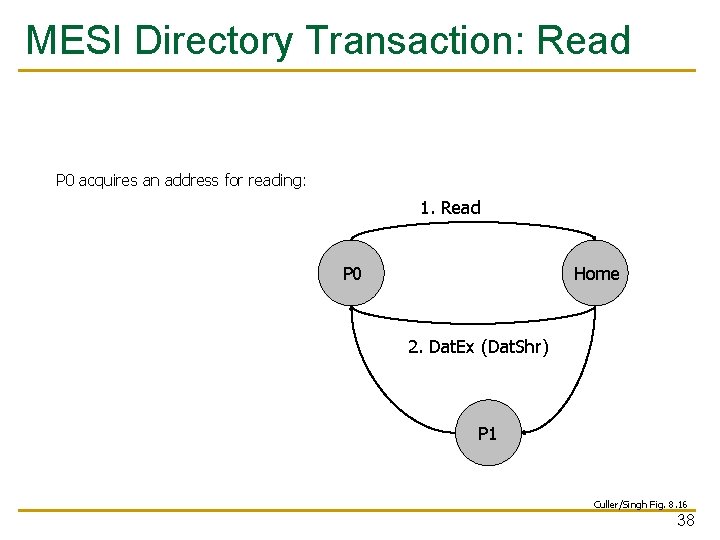
MESI Directory Transaction: Read P 0 acquires an address for reading: 1. Read P 0 Home 2. Dat. Ex (Dat. Shr) P 1 Culler/Singh Fig. 8. 16 38
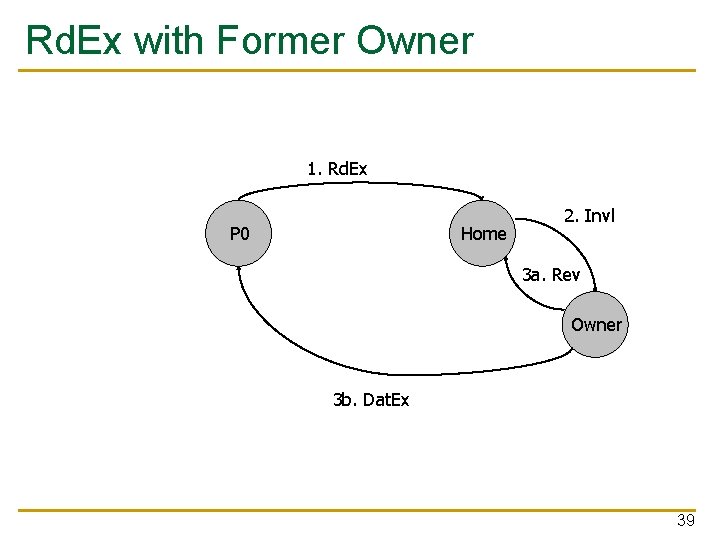
Rd. Ex with Former Owner 1. Rd. Ex P 0 Home 2. Invl 3 a. Rev Owner 3 b. Dat. Ex 39
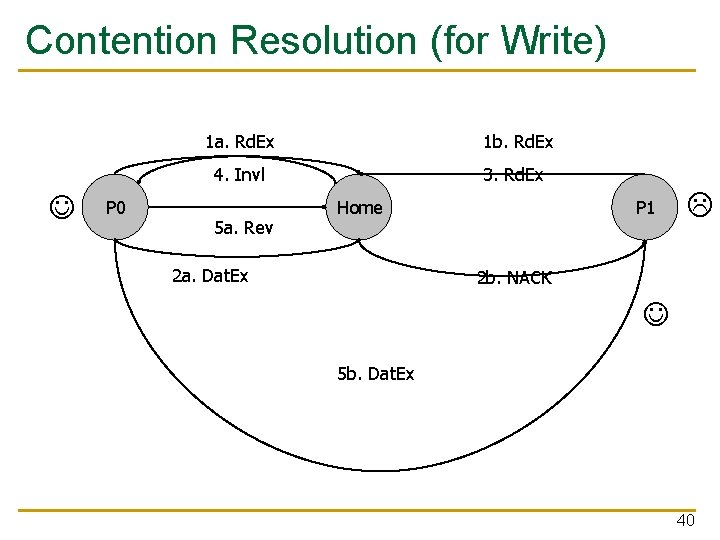
Contention Resolution (for Write) P 0 1 a. Rd. Ex 1 b. Rd. Ex 4. Invl 3. Rd. Ex 5 a. Rev Home 2 a. Dat. Ex P 1 2 b. NACK 5 b. Dat. Ex 40
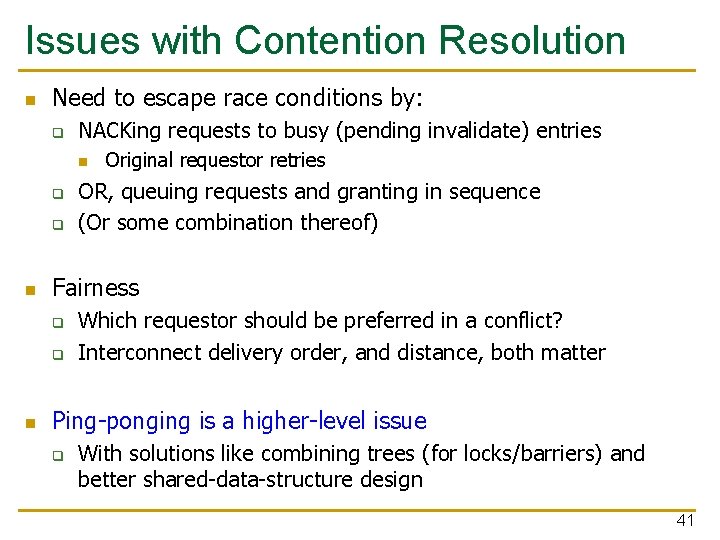
Issues with Contention Resolution n Need to escape race conditions by: q NACKing requests to busy (pending invalidate) entries n q q n OR, queuing requests and granting in sequence (Or some combination thereof) Fairness q q n Original requestor retries Which requestor should be preferred in a conflict? Interconnect delivery order, and distance, both matter Ping-ponging is a higher-level issue q With solutions like combining trees (for locks/barriers) and better shared-data-structure design 41
Scaling the Directory: Some Questions n How large is the directory? n How can we reduce the access latency to the directory? n How can we scale the system to thousands of nodes? n Can we get the best of snooping and directory protocols? q q Heterogeneity E. g. , token coherence [Martin+, ISCA 2003] 42
Advancing Coherence 43
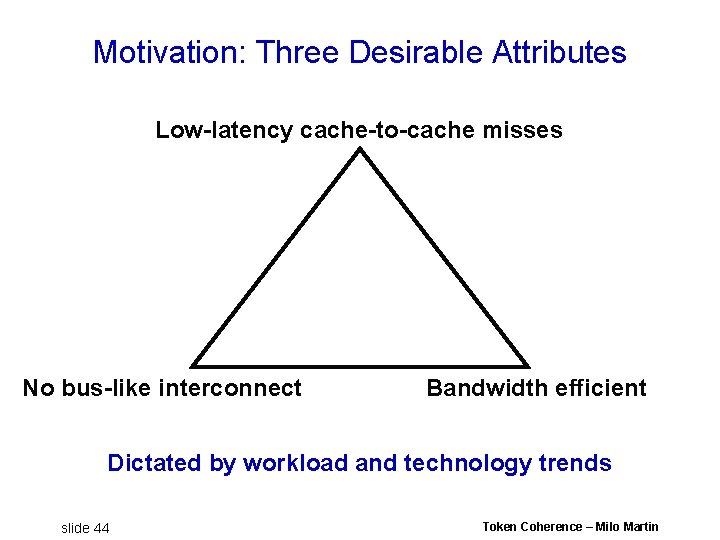
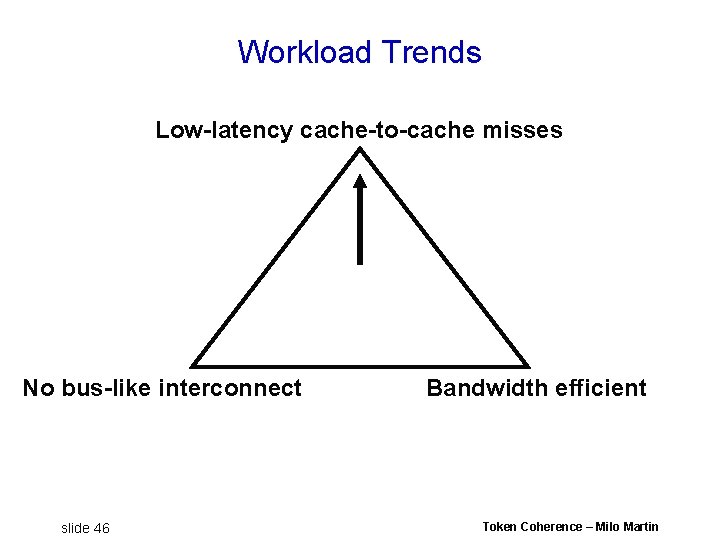
Motivation: Three Desirable Attributes Low-latency cache-to-cache misses No bus-like interconnect Bandwidth efficient Dictated by workload and technology trends slide 44 Token Coherence – Milo Martin
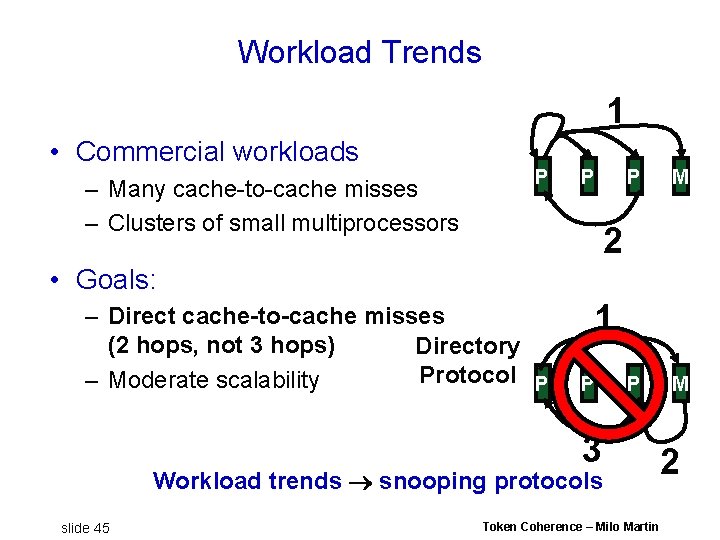
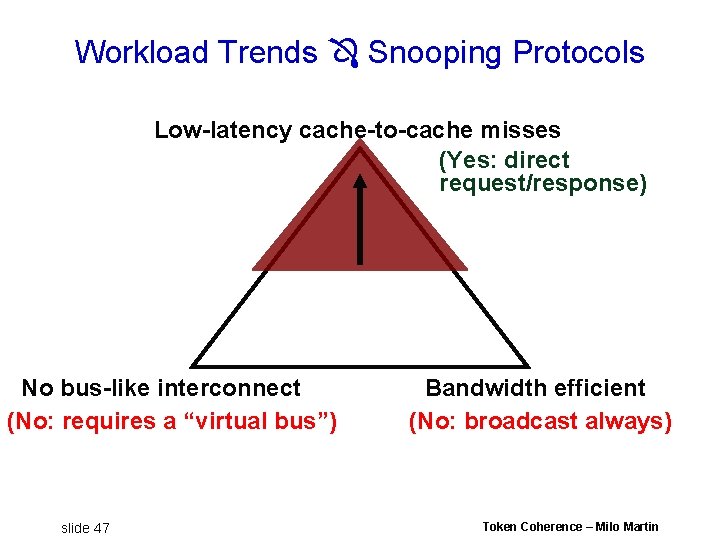
Workload Trends 1 • Commercial workloads – Many cache-to-cache misses – Clusters of small multiprocessors P P P M 2 • Goals: – Direct cache-to-cache misses (2 hops, not 3 hops) Directory Protocol P – Moderate scalability 1 P 3 Workload trends snooping protocols slide 45 Token Coherence – Milo Martin 2
Workload Trends Low-latency cache-to-cache misses No bus-like interconnect slide 46 Bandwidth efficient Token Coherence – Milo Martin
Workload Trends Snooping Protocols Low-latency cache-to-cache misses (Yes: direct request/response) No bus-like interconnect (No: requires a “virtual bus”) slide 47 Bandwidth efficient (No: broadcast always) Token Coherence – Milo Martin
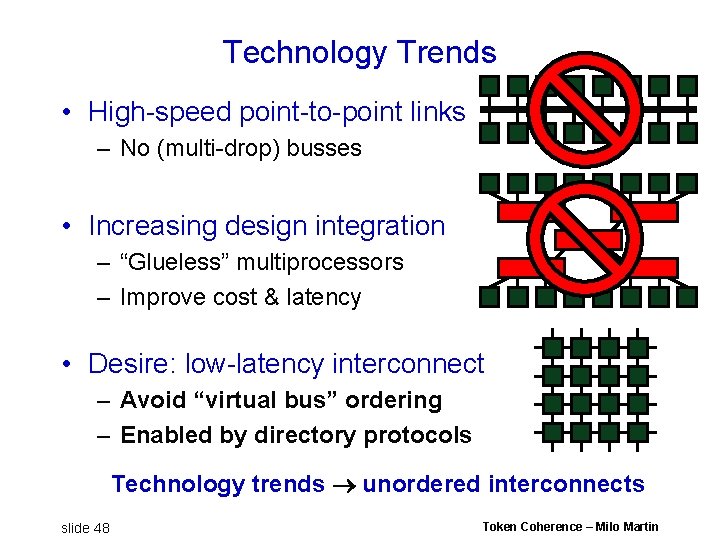
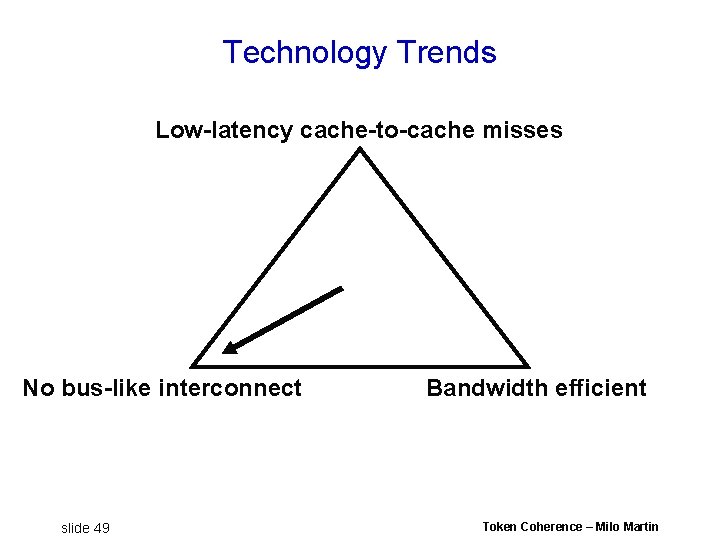
Technology Trends • High-speed point-to-point links – No (multi-drop) busses • Increasing design integration – “Glueless” multiprocessors – Improve cost & latency • Desire: low-latency interconnect – Avoid “virtual bus” ordering – Enabled by directory protocols Technology trends unordered interconnects slide 48 Token Coherence – Milo Martin
Technology Trends Low-latency cache-to-cache misses No bus-like interconnect slide 49 Bandwidth efficient Token Coherence – Milo Martin
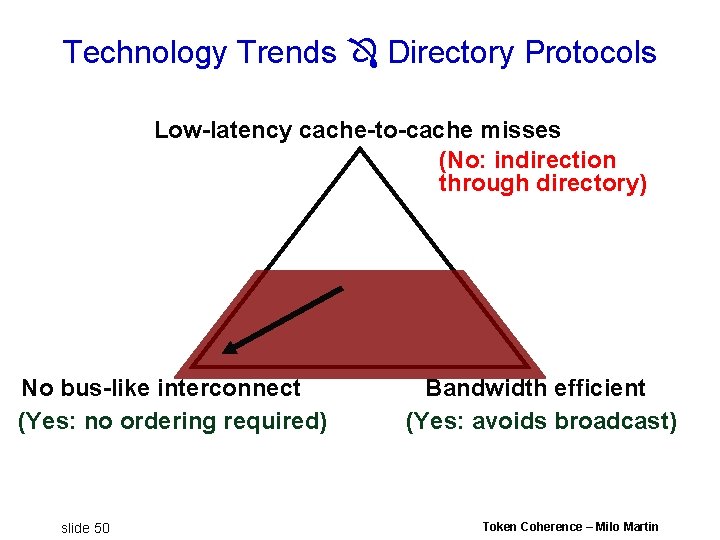
Technology Trends Directory Protocols Low-latency cache-to-cache misses (No: indirection through directory) No bus-like interconnect (Yes: no ordering required) slide 50 Bandwidth efficient (Yes: avoids broadcast) Token Coherence – Milo Martin
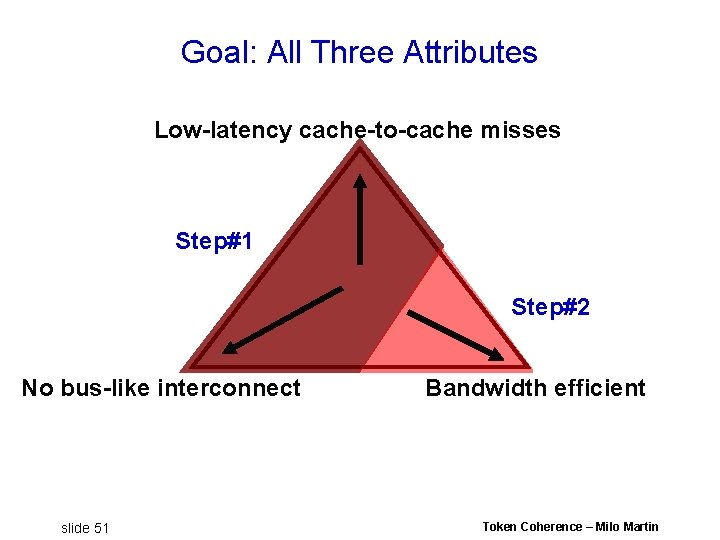
Goal: All Three Attributes Low-latency cache-to-cache misses Step#1 Step#2 No bus-like interconnect slide 51 Bandwidth efficient Token Coherence – Milo Martin
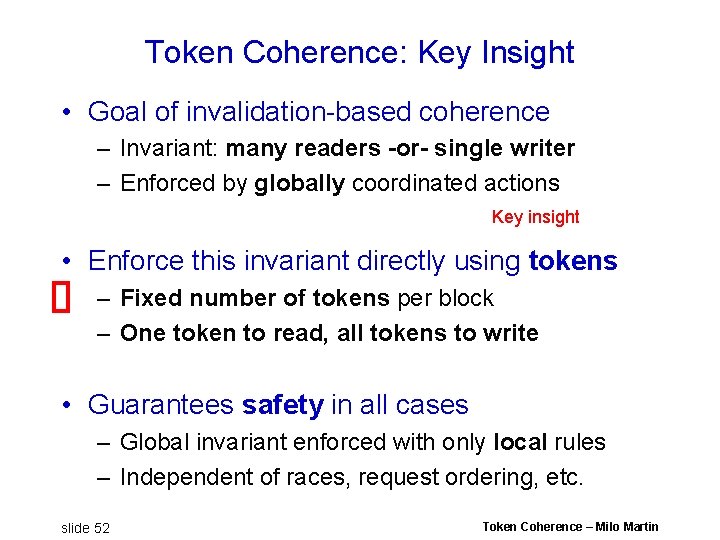
Token Coherence: Key Insight • Goal of invalidation-based coherence – Invariant: many readers -or- single writer – Enforced by globally coordinated actions Key insight • Enforce this invariant directly using tokens – Fixed number of tokens per block – One token to read, all tokens to write • Guarantees safety in all cases – Global invariant enforced with only local rules – Independent of races, request ordering, etc. slide 52 Token Coherence – Milo Martin
A Case for Asymmetry Everywhere Onur Mutlu, "Asymmetry Everywhere (with Automatic Resource Management)" CRA Workshop on Advancing Computer Architecture Research: Popular Parallel Programming, San Diego, CA, February 2010. Position paper 53