
18 447 Computer Architecture Lecture 24 Advanced Caches



- Slides: 47
18 -447: Computer Architecture Lecture 24: Advanced Caches Prof. Onur Mutlu Carnegie Mellon University Spring 2013, 4/1/2013
Reminder: Homework 5 (Wednesday) n Due April 3 (Wednesday!) n Topics: Vector processing, VLIW, Virtual memory, Caching 2
Reminder: Lab Assignment 5 (Friday) n Lab Assignment 5 q Due Friday, April 5 Modeling caches and branch prediction at the microarchitectural level (cycle level) in C q Extra credit: Cache design optimization q n n n Size, block size, associativity Replacement and insertion policies Cache indexing policies Anything else you would like TAs will go over the baseline simulator in lab sessions 3
Heads Up: Midterm II Coming n Originally scheduled for April 10 n Will likely move to the week after 4
Last Lecture n More caching q q q Replacement policy Sectored caches Multi-level caching Write policies Virtual memory – cache interaction n n VIVT, PIPT, VIPT caches Homonyms and synonyms 5
Today n Wrap up virtual memory – cache interaction n Improving cache (and memory hierarchy) performance n Enabling multiple accesses in parallel 6
Virtual Memory and Cache Interaction
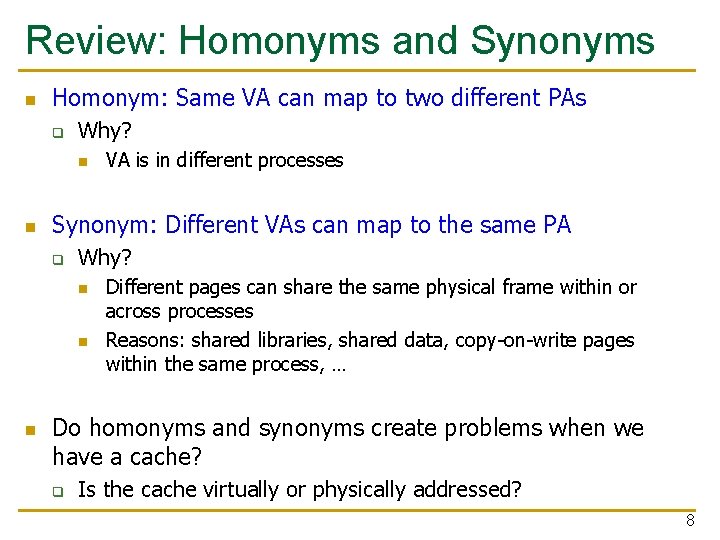
Review: Homonyms and Synonyms n Homonym: Same VA can map to two different PAs q Why? n n Synonym: Different VAs can map to the same PA q Why? n n n VA is in different processes Different pages can share the same physical frame within or across processes Reasons: shared libraries, shared data, copy-on-write pages within the same process, … Do homonyms and synonyms create problems when we have a cache? q Is the cache virtually or physically addressed? 8
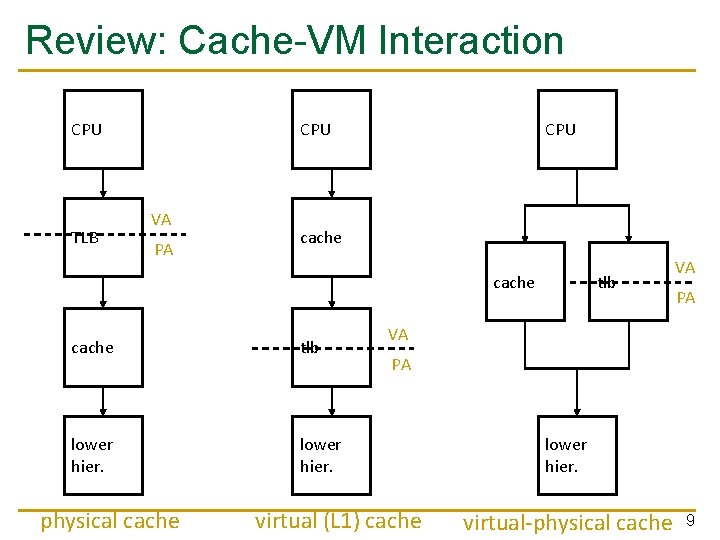
Review: Cache-VM Interaction CPU TLB CPU VA PA CPU cache tlb lower hier. physical cache tlb VA PA virtual (L 1) cache lower hier. virtual-physical cache 9
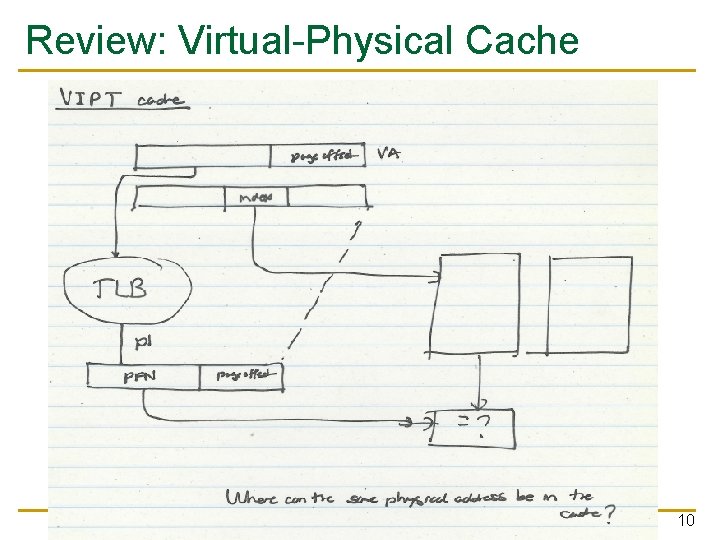
Review: Virtual-Physical Cache 10
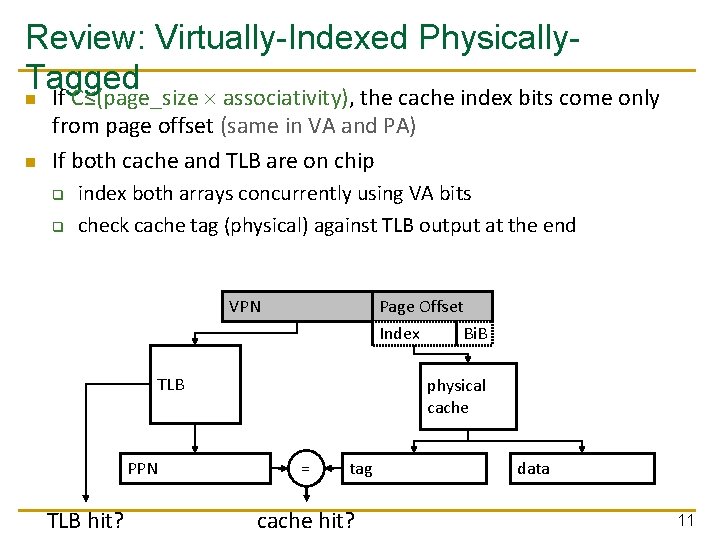
Review: Virtually-Indexed Physically. Tagged n If C≤(page_size associativity), the cache index bits come only n from page offset (same in VA and PA) If both cache and TLB are on chip q q index both arrays concurrently using VA bits check cache tag (physical) against TLB output at the end VPN Page Offset Index Bi. B TLB PPN TLB hit? physical cache = tag cache hit? data 11
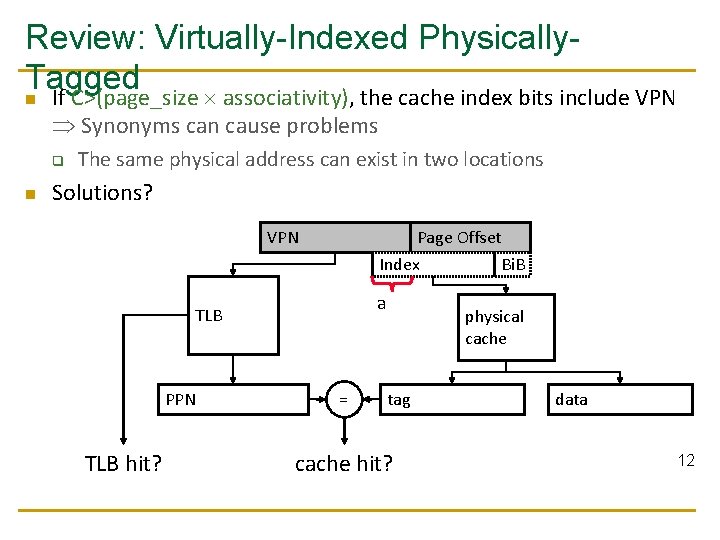
Review: Virtually-Indexed Physically. Tagged n If C>(page_size associativity), the cache index bits include VPN Synonyms can cause problems q n The same physical address can exist in two locations Solutions? VPN Page Offset Index Bi. B a TLB PPN TLB hit? = physical cache tag cache hit? data 12
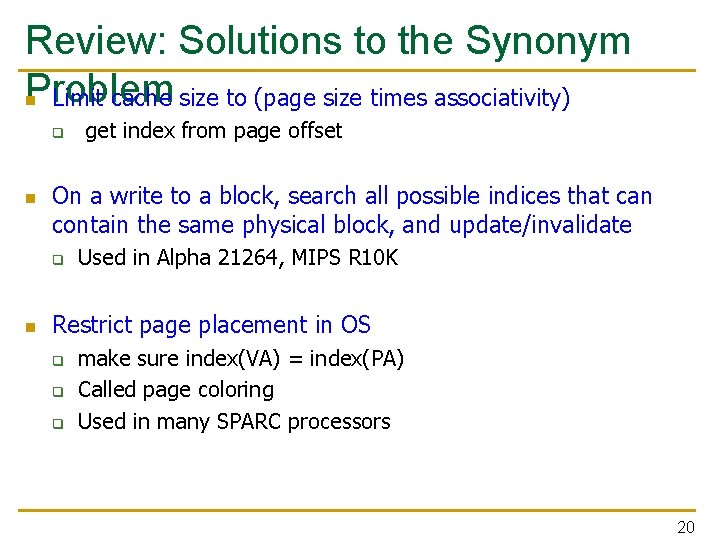
Review: Solutions to the Synonym Problem n Limit cache size to (page size times associativity) q n On a write to a block, search all possible indices that can contain the same physical block, and update/invalidate q n get index from page offset Used in Alpha 21264, MIPS R 10 K Restrict page placement in OS q q q make sure index(VA) = index(PA) Called page coloring Used in many SPARC processors 13
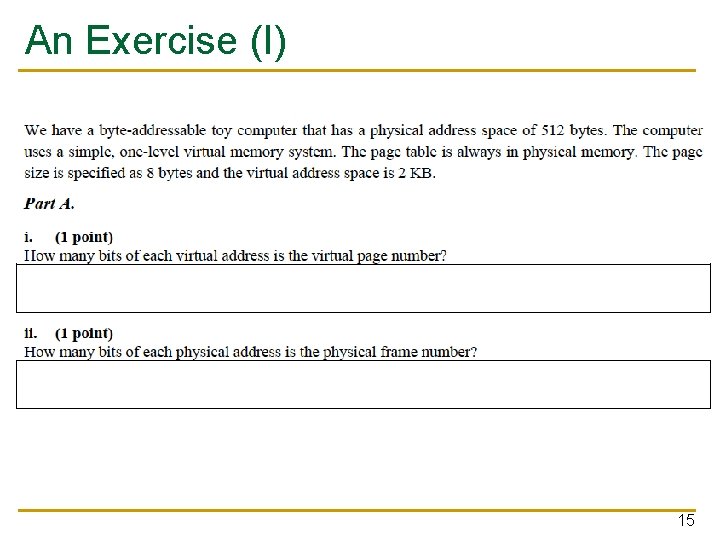
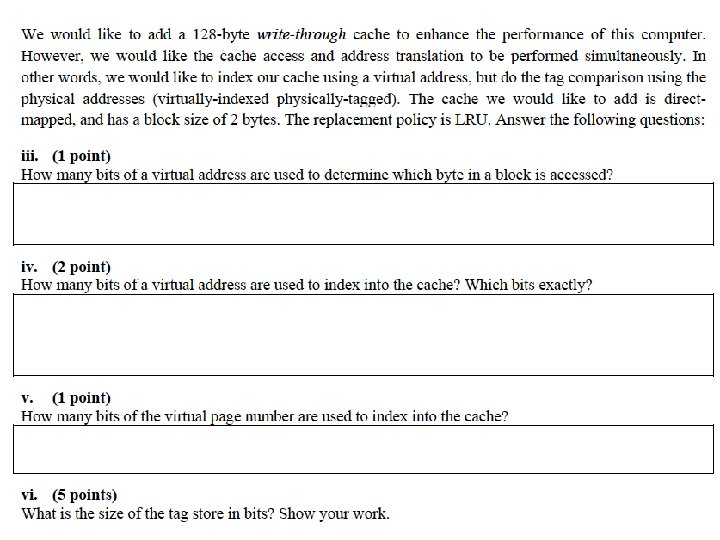
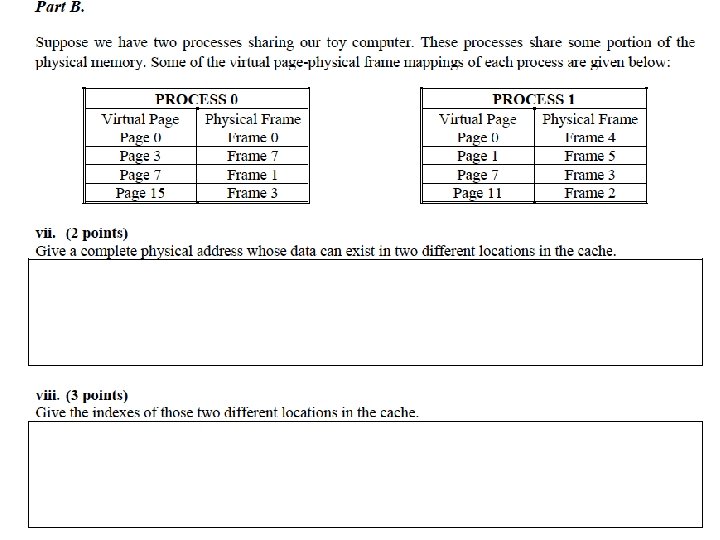
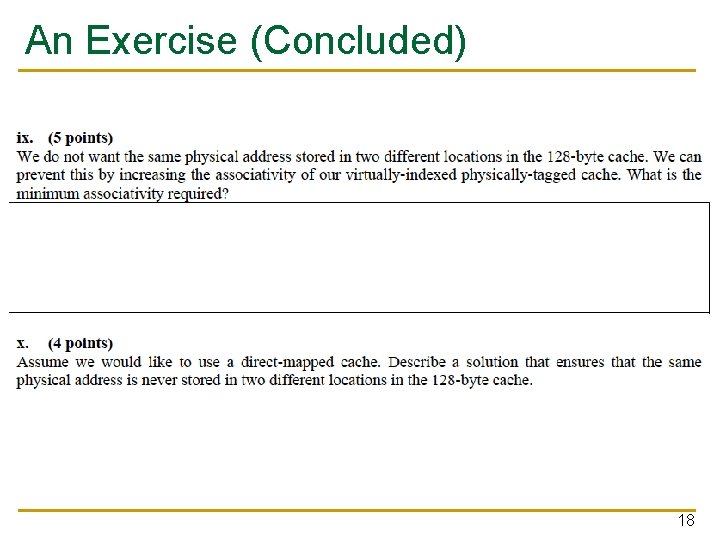
An Exercise n Problem 5 from q q ECE 741 midterm exam Problem 5, Spring 2009 http: //www. ece. cmu. edu/~ece 740/f 11/lib/exe/fetch. php? medi a=wiki: midterm_s 09. pdf 14
An Exercise (I) 15
An Exercise (II) 16
17
An Exercise (Concluded) 18
Solutions to the Exercise n n http: //www. ece. cmu. edu/~ece 740/f 11/lib/exe/fetch. php? m edia=wiki: midterm_s 09_solution. pdf And, more exercises are in past exams and in your homeworks… 19
Review: Solutions to the Synonym Problem n Limit cache size to (page size times associativity) q n On a write to a block, search all possible indices that can contain the same physical block, and update/invalidate q n get index from page offset Used in Alpha 21264, MIPS R 10 K Restrict page placement in OS q q q make sure index(VA) = index(PA) Called page coloring Used in many SPARC processors 20
Some Questions to Ponder n n n At what cache level should we worry about the synonym and homonym problems? What levels of the memory hierarchy does the system software’s page mapping algorithms influence? What are the potential benefits and downsides of page coloring? 21
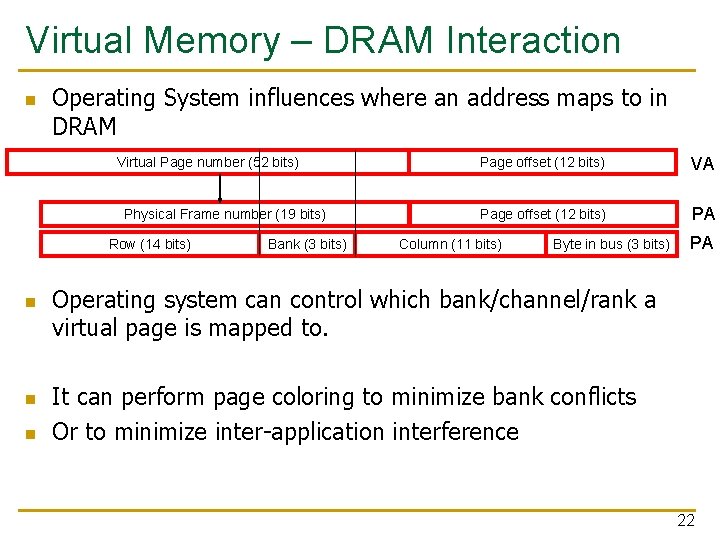
Virtual Memory – DRAM Interaction n Operating System influences where an address maps to in DRAM Virtual Page number (52 bits) Physical Frame number (19 bits) Row (14 bits) n n n Bank (3 bits) Page offset (12 bits) VA Page offset (12 bits) PA Column (11 bits) Byte in bus (3 bits) PA Operating system can control which bank/channel/rank a virtual page is mapped to. It can perform page coloring to minimize bank conflicts Or to minimize inter-application interference 22
Cache Performance
Cache Parameters vs. Miss Rate n Cache size n Block size n Associativity n n Replacement policy Insertion/Placement policy 24
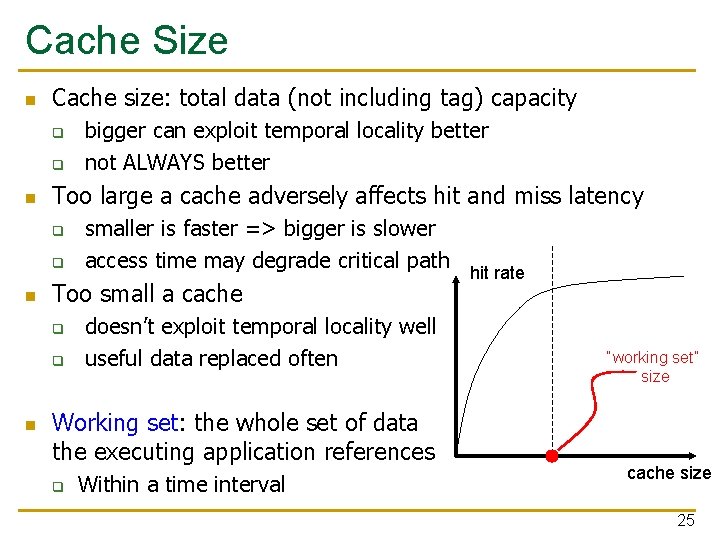
Cache Size n Cache size: total data (not including tag) capacity q q n Too large a cache adversely affects hit and miss latency q q n smaller is faster => bigger is slower access time may degrade critical path Too small a cache q q n bigger can exploit temporal locality better not ALWAYS better doesn’t exploit temporal locality well useful data replaced often Working set: the whole set of data the executing application references q Within a time interval hit rate “working set” size cache size 25
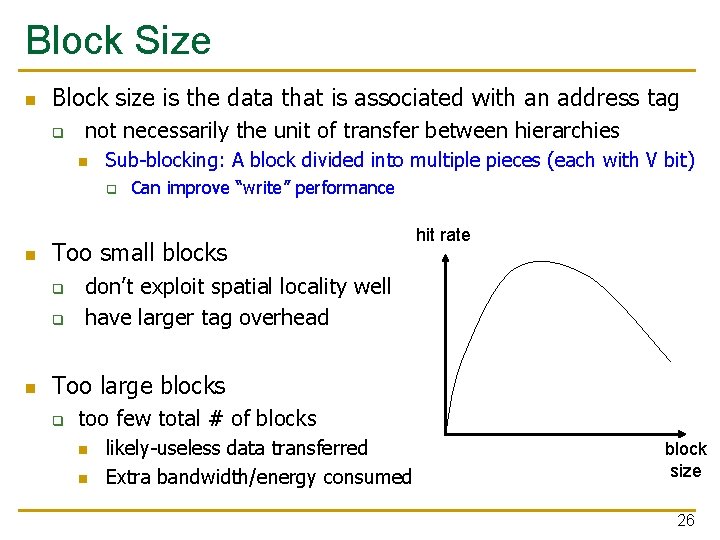
Block Size n Block size is the data that is associated with an address tag q not necessarily the unit of transfer between hierarchies n Sub-blocking: A block divided into multiple pieces (each with V bit) q n Too small blocks q q n Can improve “write” performance hit rate don’t exploit spatial locality well have larger tag overhead Too large blocks q too few total # of blocks n n likely-useless data transferred Extra bandwidth/energy consumed block size 26
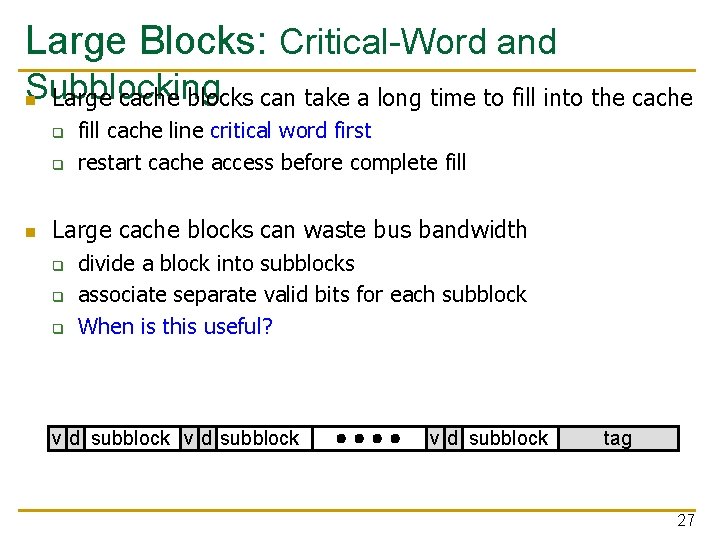
Large Blocks: Critical-Word and Subblocking n Large cache blocks can take a long time to fill into the cache q q n fill cache line critical word first restart cache access before complete fill Large cache blocks can waste bus bandwidth q q q divide a block into subblocks associate separate valid bits for each subblock When is this useful? v d subblock tag 27
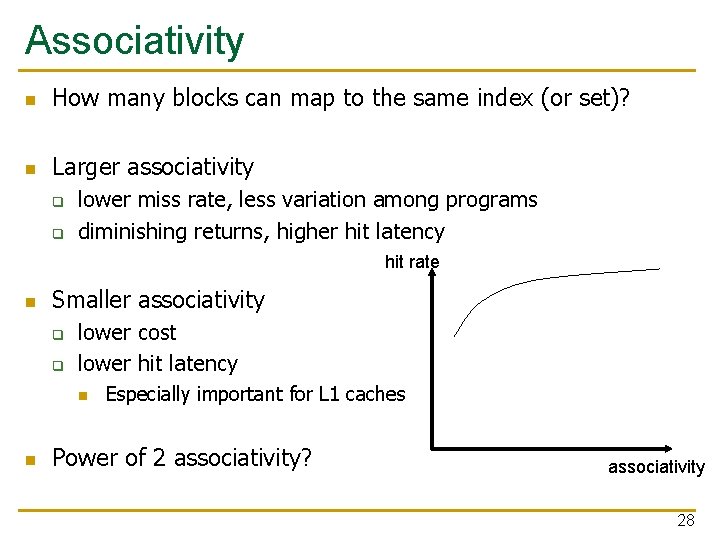
Associativity n How many blocks can map to the same index (or set)? n Larger associativity q q lower miss rate, less variation among programs diminishing returns, higher hit latency hit rate n Smaller associativity q q lower cost lower hit latency n n Especially important for L 1 caches Power of 2 associativity? associativity 28
Classification of Cache Misses n Compulsory miss q q q n Capacity miss q q n first reference to an address (block) always results in a miss subsequent references should hit unless the cache block is displaced for the reasons below dominates when locality is poor cache is too small to hold everything needed defined as the misses that would occur even in a fully-associative cache (with optimal replacement) of the same capacity Conflict miss q defined as any miss that is neither a compulsory nor a capacity miss 29
How to Reduce Each Miss Type n Compulsory q q n Caching cannot help Prefetching Conflict q q More associativity Other ways to get more associativity without making the cache associative n n Victim cache Hashing Software hints? Capacity q q Utilize cache space better: keep blocks that will be referenced Software management: divide working set such that each “phase” fits in cache 30
Improving Cache “Performance” n Remember q Average memory access time (AMAT) = ( hit-rate * hit-latency ) + ( miss-rate * miss-latency ) n Reducing miss rate q Caveat: reducing miss rate can reduce performance if more costly-to-refetch blocks are evicted n Reducing miss latency/cost n Reducing hit latency 31
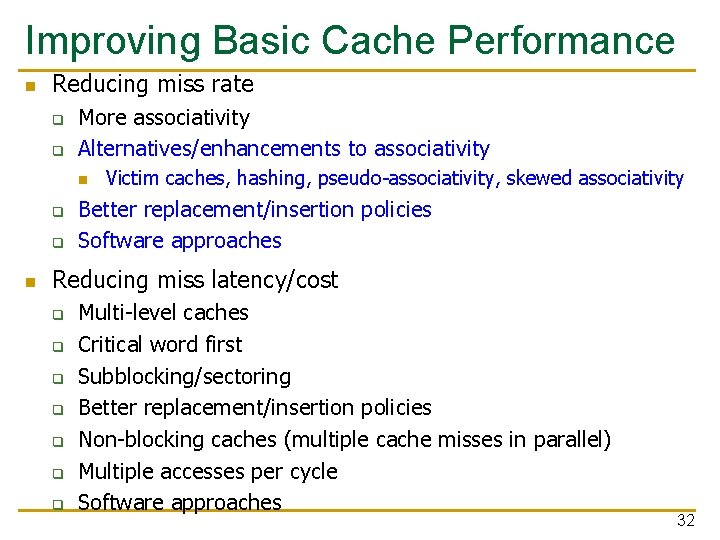
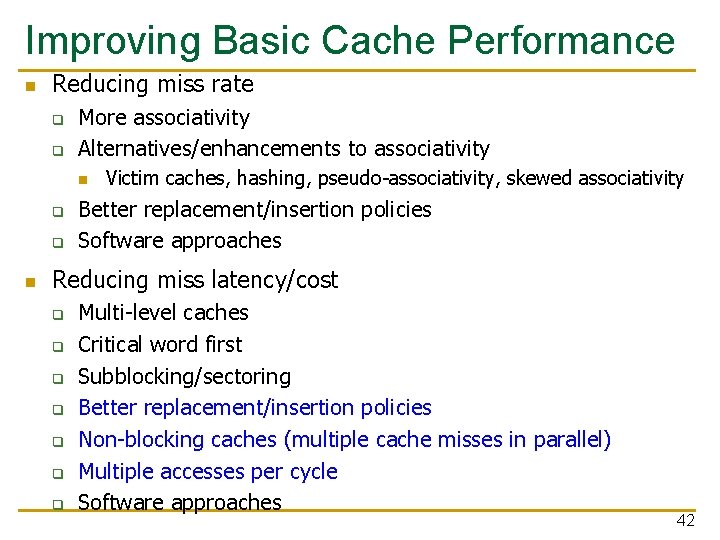
Improving Basic Cache Performance n Reducing miss rate q q More associativity Alternatives/enhancements to associativity n q q n Victim caches, hashing, pseudo-associativity, skewed associativity Better replacement/insertion policies Software approaches Reducing miss latency/cost q q q q Multi-level caches Critical word first Subblocking/sectoring Better replacement/insertion policies Non-blocking caches (multiple cache misses in parallel) Multiple accesses per cycle Software approaches 32
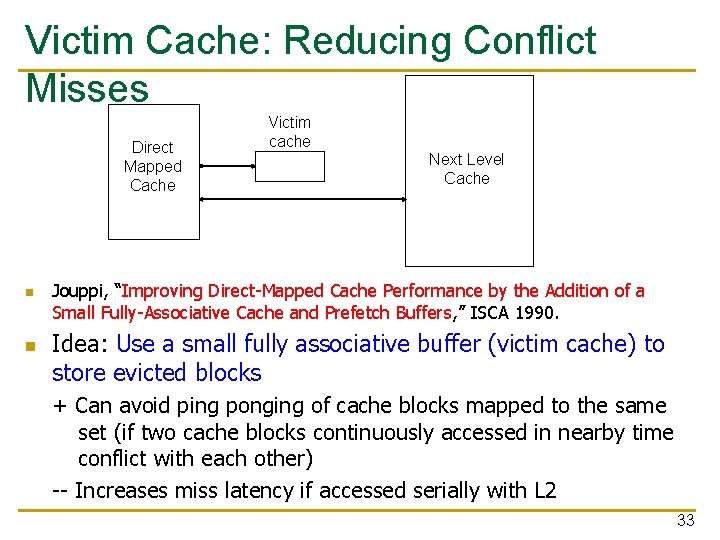
Victim Cache: Reducing Conflict Misses Direct Mapped Cache n n Victim cache Next Level Cache Jouppi, “Improving Direct-Mapped Cache Performance by the Addition of a Small Fully-Associative Cache and Prefetch Buffers, ” ISCA 1990. Idea: Use a small fully associative buffer (victim cache) to store evicted blocks + Can avoid ping ponging of cache blocks mapped to the same set (if two cache blocks continuously accessed in nearby time conflict with each other) -- Increases miss latency if accessed serially with L 2 33
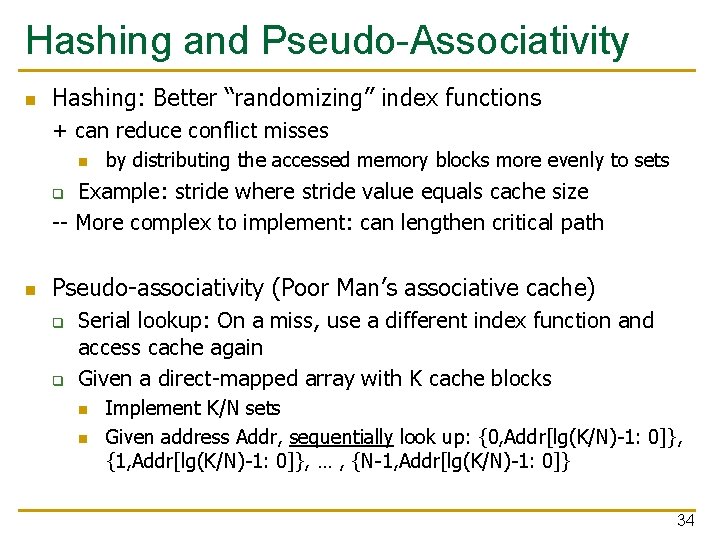
Hashing and Pseudo-Associativity n Hashing: Better “randomizing” index functions + can reduce conflict misses n by distributing the accessed memory blocks more evenly to sets Example: stride where stride value equals cache size -- More complex to implement: can lengthen critical path q n Pseudo-associativity (Poor Man’s associative cache) q q Serial lookup: On a miss, use a different index function and access cache again Given a direct-mapped array with K cache blocks n n Implement K/N sets Given address Addr, sequentially look up: {0, Addr[lg(K/N)-1: 0]}, {1, Addr[lg(K/N)-1: 0]}, … , {N-1, Addr[lg(K/N)-1: 0]} 34
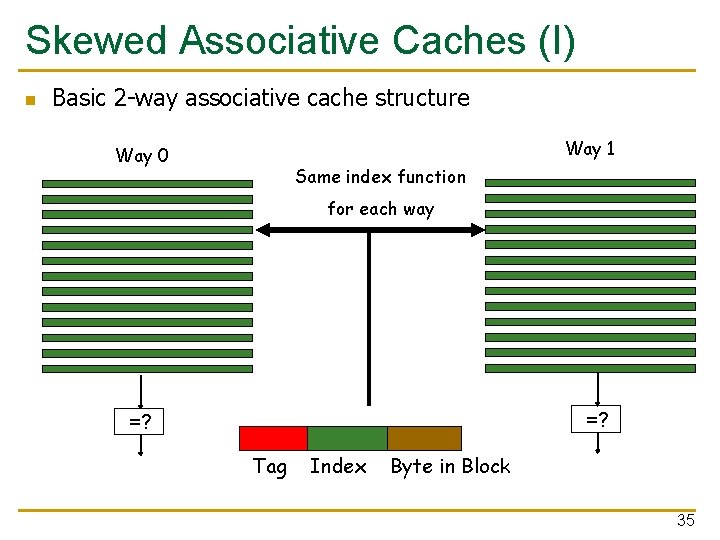
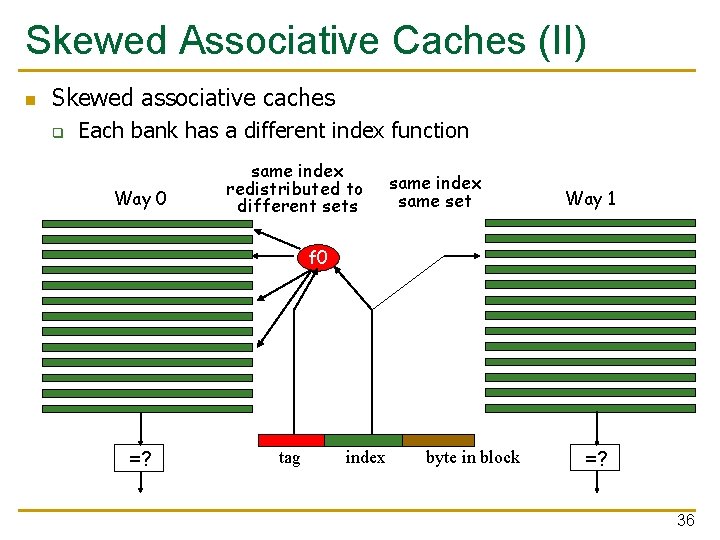
Skewed Associative Caches (I) n Basic 2 -way associative cache structure Way 1 Way 0 Same index function for each way =? Tag Index Byte in Block 35
Skewed Associative Caches (II) n Skewed associative caches q Each bank has a different index function Way 0 same index redistributed to different sets same index same set Way 1 f 0 =? tag index byte in block =? 36
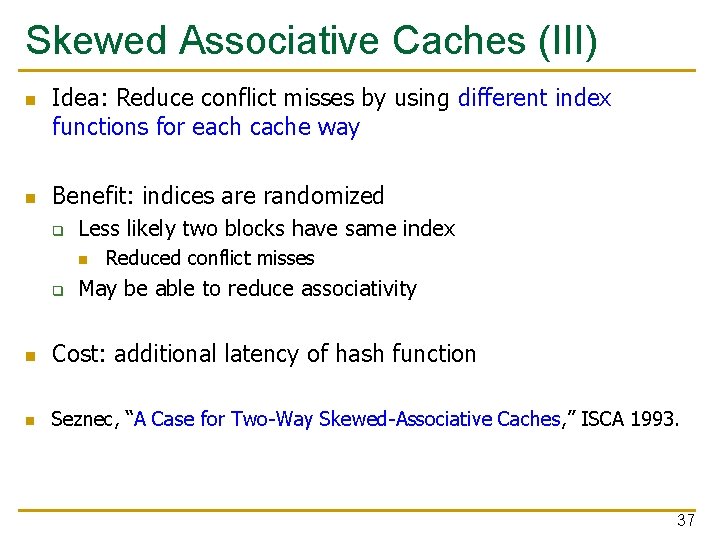
Skewed Associative Caches (III) n n Idea: Reduce conflict misses by using different index functions for each cache way Benefit: indices are randomized q Less likely two blocks have same index n q Reduced conflict misses May be able to reduce associativity n Cost: additional latency of hash function n Seznec, “A Case for Two-Way Skewed-Associative Caches, ” ISCA 1993. 37
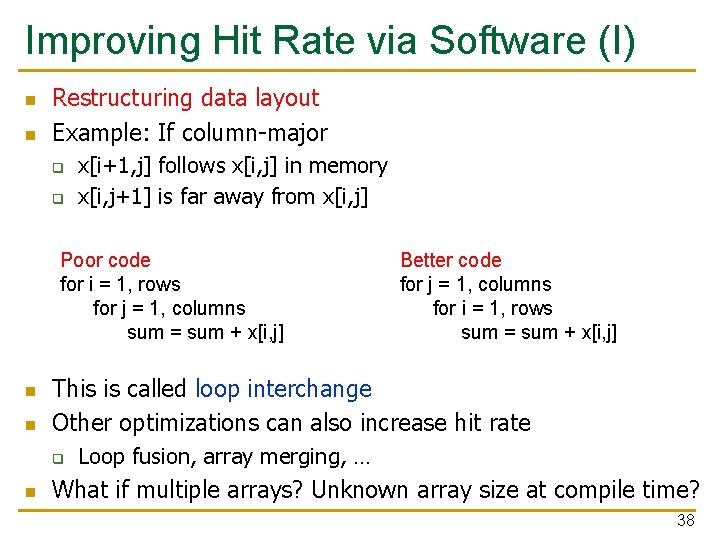
Improving Hit Rate via Software (I) n n Restructuring data layout Example: If column-major q q x[i+1, j] follows x[i, j] in memory x[i, j+1] is far away from x[i, j] Poor code for i = 1, rows for j = 1, columns sum = sum + x[i, j] n n This is called loop interchange Other optimizations can also increase hit rate q n Better code for j = 1, columns for i = 1, rows sum = sum + x[i, j] Loop fusion, array merging, … What if multiple arrays? Unknown array size at compile time? 38
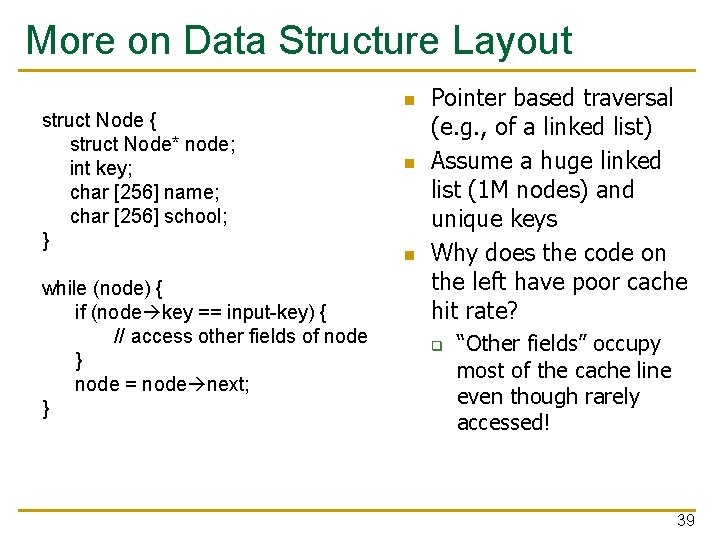
More on Data Structure Layout struct Node { struct Node* node; int key; char [256] name; char [256] school; } while (node) { if (node key == input-key) { // access other fields of node } node = node next; } n n n Pointer based traversal (e. g. , of a linked list) Assume a huge linked list (1 M nodes) and unique keys Why does the code on the left have poor cache hit rate? q “Other fields” occupy most of the cache line even though rarely accessed! 39
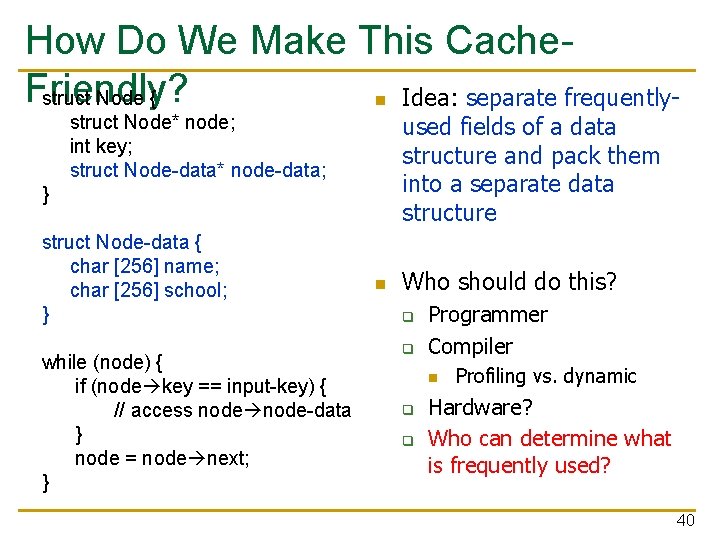
How Do We Make This Cache. Friendly? struct Node { n Idea: separate frequentlystruct Node* node; int key; struct Node-data* node-data; used fields of a data structure and pack them into a separate data structure } struct Node-data { char [256] name; char [256] school; } while (node) { if (node key == input-key) { // access node-data } node = node next; } n Who should do this? q q Programmer Compiler n q q Profiling vs. dynamic Hardware? Who can determine what is frequently used? 40
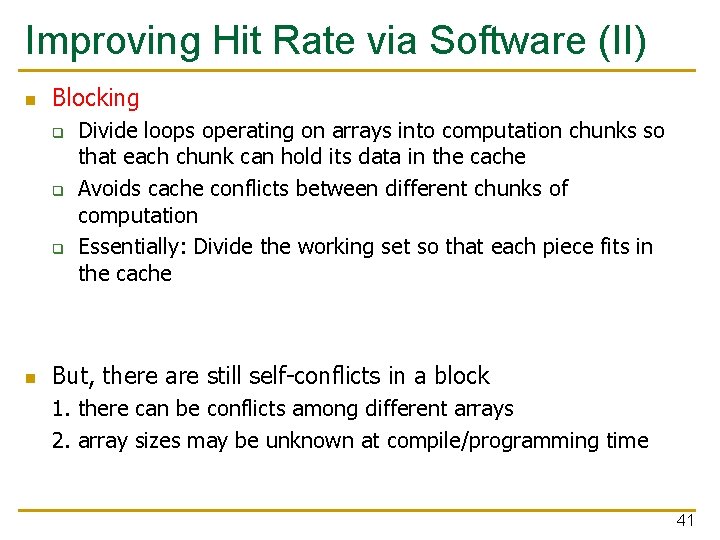
Improving Hit Rate via Software (II) n Blocking q q q n Divide loops operating on arrays into computation chunks so that each chunk can hold its data in the cache Avoids cache conflicts between different chunks of computation Essentially: Divide the working set so that each piece fits in the cache But, there are still self-conflicts in a block 1. there can be conflicts among different arrays 2. array sizes may be unknown at compile/programming time 41
Improving Basic Cache Performance n Reducing miss rate q q More associativity Alternatives/enhancements to associativity n q q n Victim caches, hashing, pseudo-associativity, skewed associativity Better replacement/insertion policies Software approaches Reducing miss latency/cost q q q q Multi-level caches Critical word first Subblocking/sectoring Better replacement/insertion policies Non-blocking caches (multiple cache misses in parallel) Multiple accesses per cycle Software approaches 42
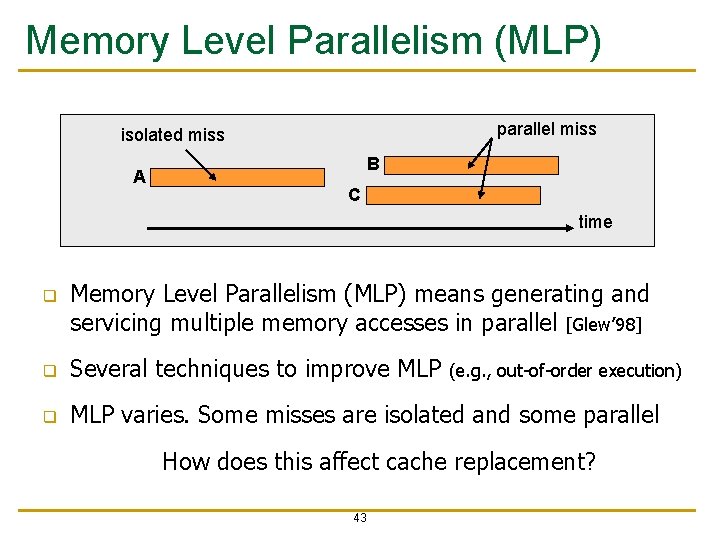
Memory Level Parallelism (MLP) parallel miss isolated miss A B C time q Memory Level Parallelism (MLP) means generating and servicing multiple memory accesses in parallel [Glew’ 98] q Several techniques to improve MLP q MLP varies. Some misses are isolated and some parallel (e. g. , out-of-order execution) How does this affect cache replacement? 43
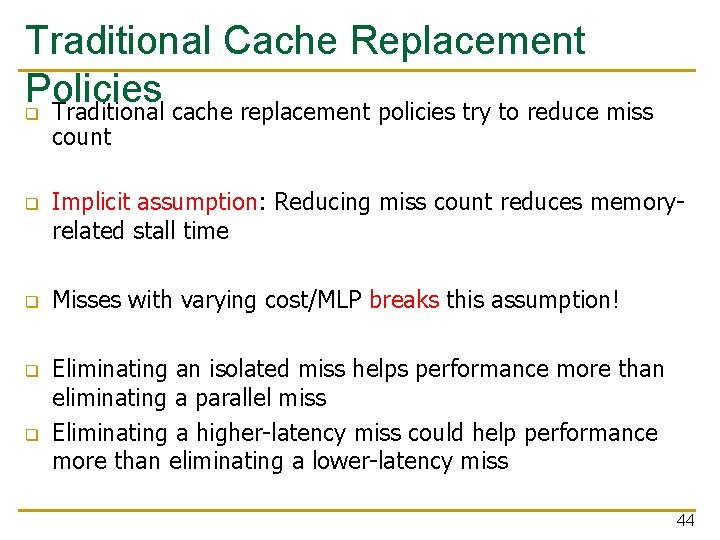
Traditional Cache Replacement Policies q Traditional cache replacement policies try to reduce miss count q q Implicit assumption: Reducing miss count reduces memoryrelated stall time Misses with varying cost/MLP breaks this assumption! Eliminating an isolated miss helps performance more than eliminating a parallel miss Eliminating a higher-latency miss could help performance more than eliminating a lower-latency miss 44
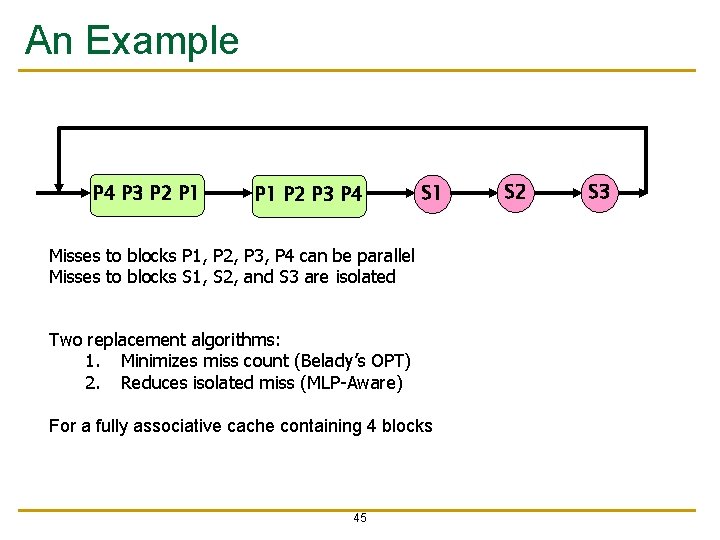
An Example P 4 P 3 P 2 P 1 P 2 P 3 P 4 S 1 Misses to blocks P 1, P 2, P 3, P 4 can be parallel Misses to blocks S 1, S 2, and S 3 are isolated Two replacement algorithms: 1. Minimizes miss count (Belady’s OPT) 2. Reduces isolated miss (MLP-Aware) For a fully associative cache containing 4 blocks 45 S 2 S 3
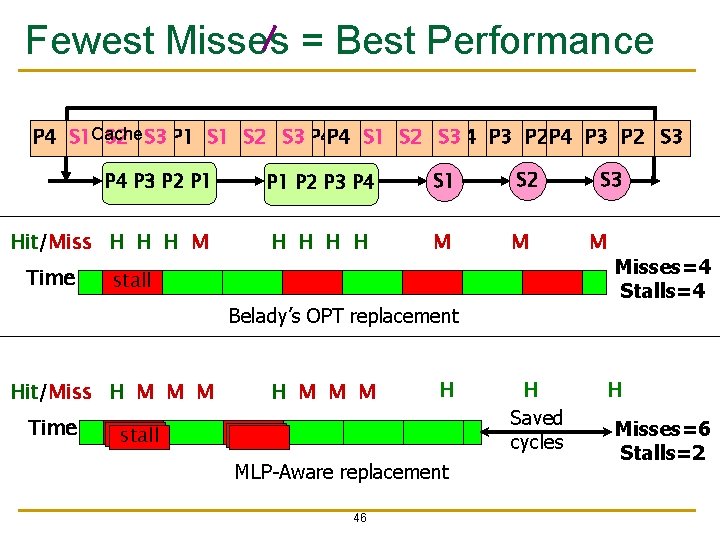
Fewest Misses = Best Performance P 4 P 3 S 1 Cache P 2 S 3 P 1 P 4 P 3 S 1 P 2 S 2 P 1 S 3 P 4 P 4 P 3 S 1 P 2 P 4 S 2 P 1 P 3 S 3 P 2 P 4 P 3 S 1 P 2 P 4 S 2 P 3 P 2 S 3 P 4 P 3 P 2 P 1 Hit/Miss H H H M Time P 1 P 2 P 3 P 4 S 1 S 2 H H M M stall S 3 M Misses=4 Stalls=4 Belady’s OPT replacement Hit/Miss H M M M Time H M M M H stall MLP-Aware replacement 46 H Saved cycles H Misses=6 Stalls=2
MLP-Aware Cache Replacement n n How do we incorporate MLP into replacement decisions? Qureshi et al. , “A Case for MLP-Aware Cache Replacement, ” ISCA 2006. q Required reading for this week 47