
18 447 Computer Architecture Lecture 22 Memory Hierarchy


- Slides: 55
18 -447: Computer Architecture Lecture 22: Memory Hierarchy and Caches Prof. Onur Mutlu Carnegie Mellon University Spring 2013, 3/27/2013
Reminder: Homework 5 n n Due April 1 Topics: Vector processing, VLIW, Virtual memory, Caching 2
Reminder: Lab Assignment 5 n Lab Assignment 5 q Due Friday, April 5 Modeling caches and branch prediction at the microarchitectural level (cycle level) in C q Extra credit: Cache design optimization q n n n Size, block size, associativity Replacement and insertion policies Cache indexing policies Anything else you would like TAs will go over the baseline simulator in lab sessions 3
Readings for Today and Next Lecture n n Memory Hierarchy and Caches Cache chapters from P&H: 5. 1 -5. 3 Memory/cache chapters from Hamacher+: 8. 1 -8. 7 An early cache paper by Maurice Wilkes q Wilkes, “Slave Memories and Dynamic Storage Allocation, ” IEEE Trans. On Electronic Computers, 1965. 4
Today n The memory hierarchy n Caches 5
Also Today: Oracle Tech Day n n n “What Keeps Us Up at Night” March 27, 2013 (Today!) 4: 30 – 6: 30 pm Singleton Room, Roberts Engineering Hall Hardware and software engineers must balance customers’ wants and needs with an eye towards the future and make the right choices and tradeoffs today for how technologies will unfold in the next five years. … even in industry, a solution may arise only after many sleepless nights. 6
Also Today: Oracle Tech Day n n n “What Keeps Us Up at Night” March 27, 2013 (Today!) 4: 30 – 6: 30 pm Singleton Room, Roberts Engineering Hall Please join Oracle senior engineers and engineering managers from Database, Exadata, Times. Ten, Solaris, and Oracle Virtualization and SPARC Architecture teams to see what problems keep them up at night. There will be a one-hour presentation, followed by a onehour reception where Oracle engineers are available for ample discussion and commiseration. 7
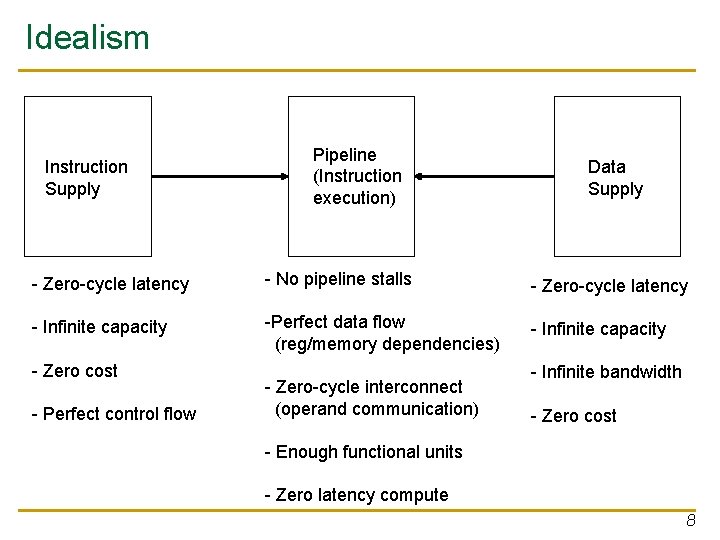
Idealism Instruction Supply Pipeline (Instruction execution) Data Supply - Zero-cycle latency - No pipeline stalls - Zero-cycle latency - Infinite capacity -Perfect data flow (reg/memory dependencies) - Infinite capacity - Zero cost - Perfect control flow - Zero-cycle interconnect (operand communication) - Infinite bandwidth - Zero cost - Enough functional units - Zero latency compute 8
The Memory Hierarchy
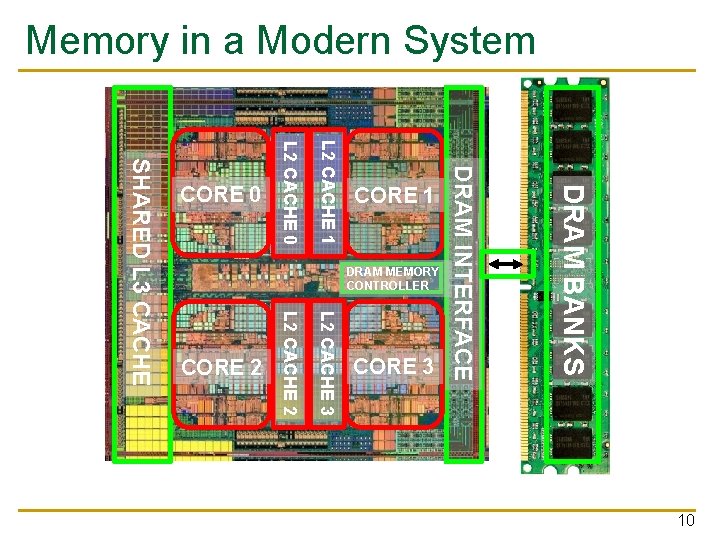
Memory in a Modern System DRAM BANKS L 2 CACHE 3 L 2 CACHE 2 SHARED L 3 CACHE DRAM MEMORY CONTROLLER DRAM INTERFACE L 2 CACHE 1 L 2 CACHE 0 CORE 3 CORE 2 CORE 1 CORE 0 10
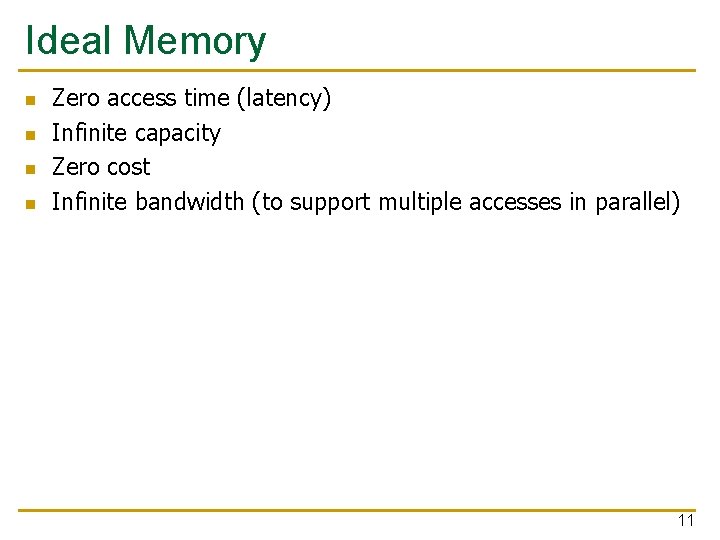
Ideal Memory n n Zero access time (latency) Infinite capacity Zero cost Infinite bandwidth (to support multiple accesses in parallel) 11
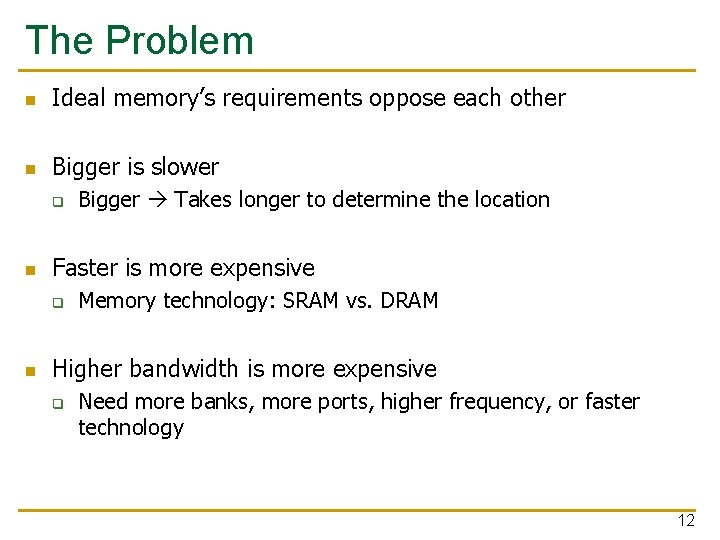
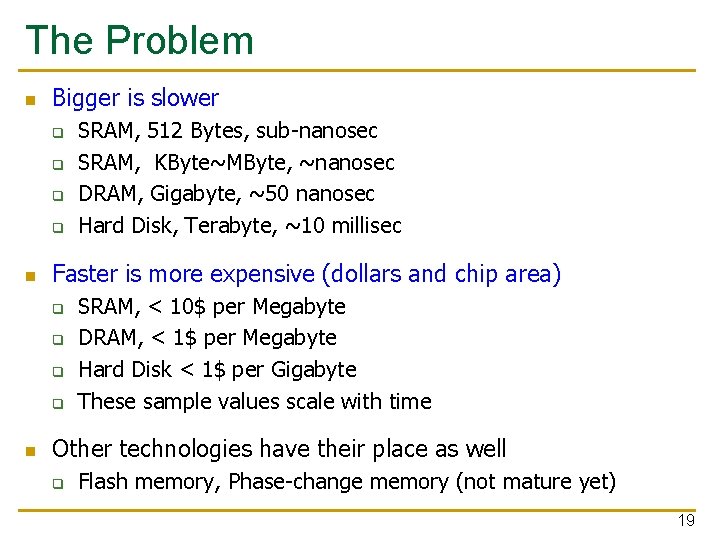
The Problem n Ideal memory’s requirements oppose each other n Bigger is slower q n Faster is more expensive q n Bigger Takes longer to determine the location Memory technology: SRAM vs. DRAM Higher bandwidth is more expensive q Need more banks, more ports, higher frequency, or faster technology 12
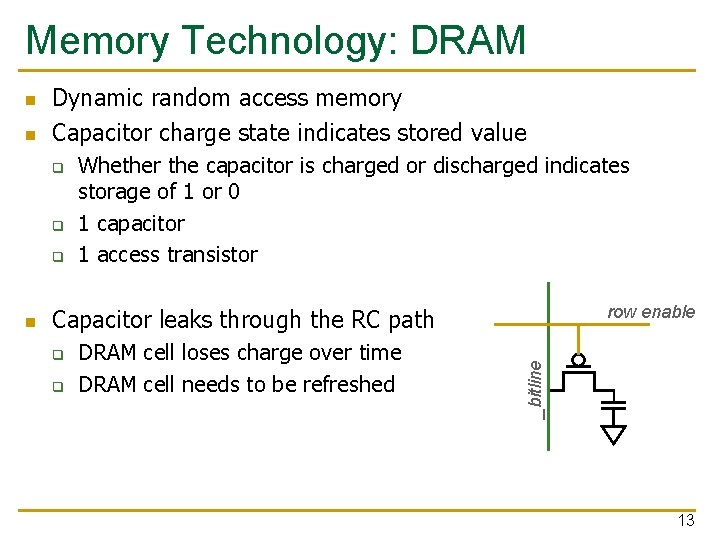
Memory Technology: DRAM n Dynamic random access memory Capacitor charge state indicates stored value q q q n Whether the capacitor is charged or discharged indicates storage of 1 or 0 1 capacitor 1 access transistor row enable Capacitor leaks through the RC path q q DRAM cell loses charge over time DRAM cell needs to be refreshed _bitline n 13
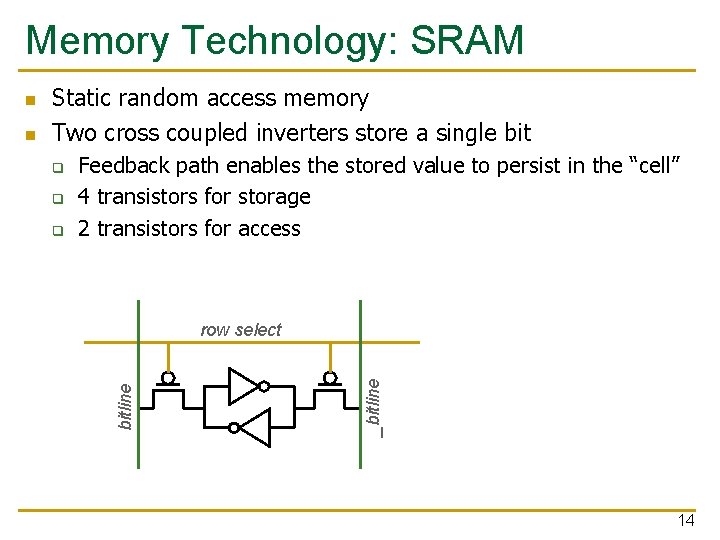
Memory Technology: SRAM q q q Feedback path enables the stored value to persist in the “cell” 4 transistors for storage 2 transistors for access row select _bitline n Static random access memory Two cross coupled inverters store a single bitline n 14
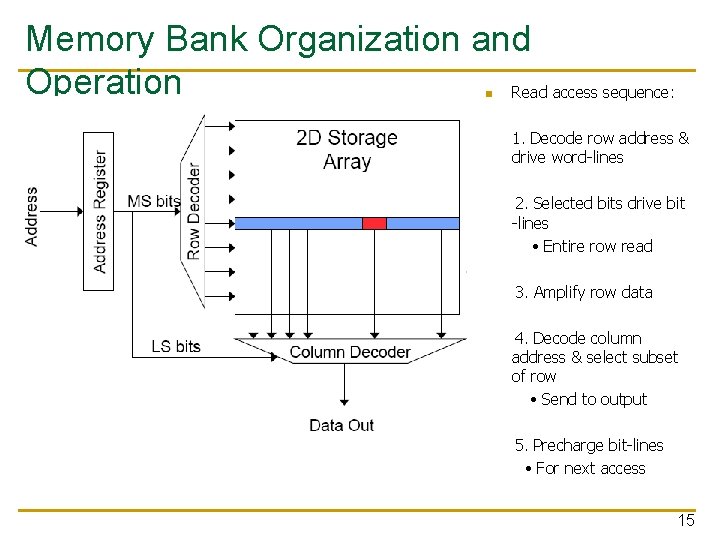
Memory Bank Organization and Operation Read access sequence: n 1. Decode row address & drive word-lines 2. Selected bits drive bit -lines • Entire row read 3. Amplify row data 4. Decode column address & select subset of row • Send to output 5. Precharge bit-lines • For next access 15
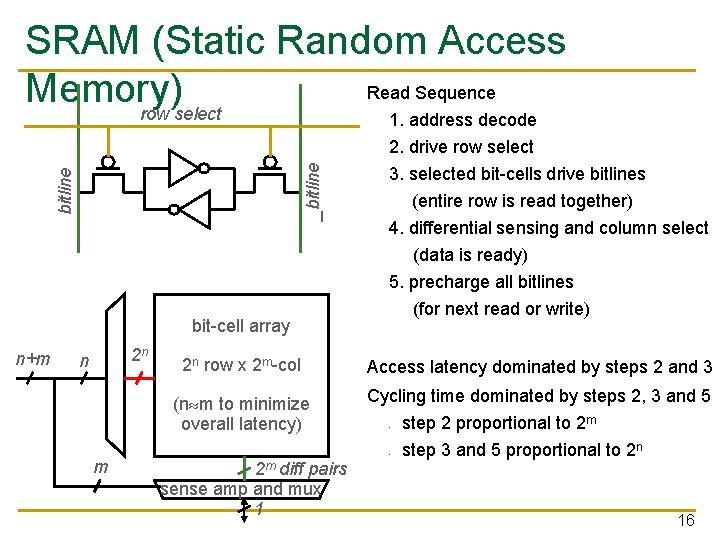
bitline _bitline SRAM (Static Random Access Read Sequence Memory) row select bit-cell array n+m 2 n n m 1. address decode 2. drive row select 3. selected bit-cells drive bitlines (entire row is read together) 4. differential sensing and column select (data is ready) 5. precharge all bitlines (for next read or write) 2 n row x 2 m-col Access latency dominated by steps 2 and 3 (n m to minimize overall latency) Cycling time dominated by steps 2, 3 and 5 - 2 m diff pairs sense amp and mux 1 step 2 proportional to 2 m step 3 and 5 proportional to 2 n 16
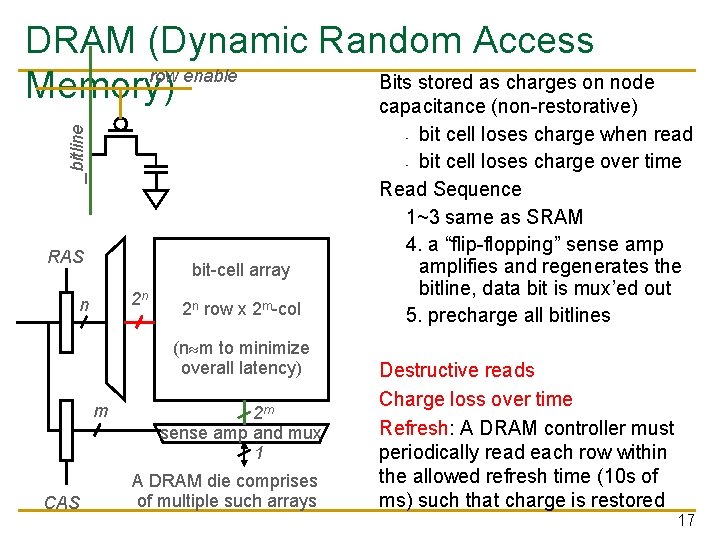
_bitline DRAM (Dynamic Random Access row enable Bits stored as charges on node Memory) capacitance (non-restorative) RAS bit-cell array 2 n n 2 n row x 2 m-col (n m to minimize overall latency) m CAS bit cell loses charge when read - bit cell loses charge over time Read Sequence 1~3 same as SRAM 4. a “flip-flopping” sense amplifies and regenerates the bitline, data bit is mux’ed out 5. precharge all bitlines - 2 m sense amp and mux 1 A DRAM die comprises of multiple such arrays Destructive reads Charge loss over time Refresh: A DRAM controller must periodically read each row within the allowed refresh time (10 s of ms) such that charge is restored 17
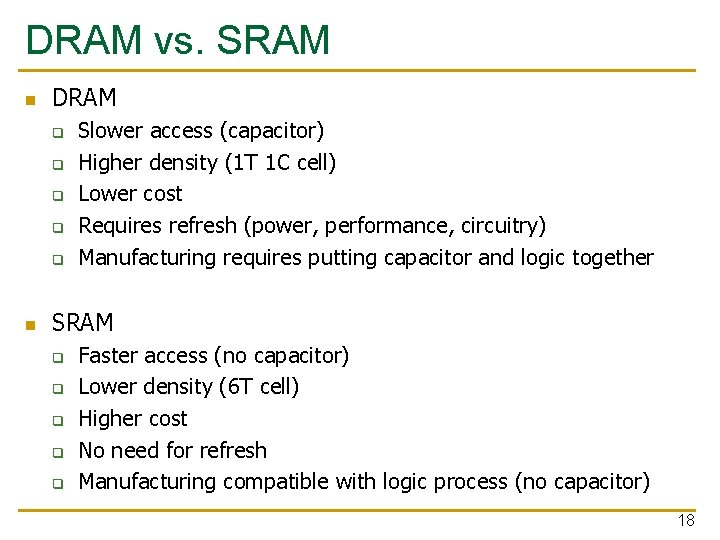
DRAM vs. SRAM n DRAM q q q n Slower access (capacitor) Higher density (1 T 1 C cell) Lower cost Requires refresh (power, performance, circuitry) Manufacturing requires putting capacitor and logic together SRAM q q q Faster access (no capacitor) Lower density (6 T cell) Higher cost No need for refresh Manufacturing compatible with logic process (no capacitor) 18
The Problem n Bigger is slower q q n Faster is more expensive (dollars and chip area) q q n SRAM, 512 Bytes, sub-nanosec SRAM, KByte~MByte, ~nanosec DRAM, Gigabyte, ~50 nanosec Hard Disk, Terabyte, ~10 millisec SRAM, < 10$ per Megabyte DRAM, < 1$ per Megabyte Hard Disk < 1$ per Gigabyte These sample values scale with time Other technologies have their place as well q Flash memory, Phase-change memory (not mature yet) 19
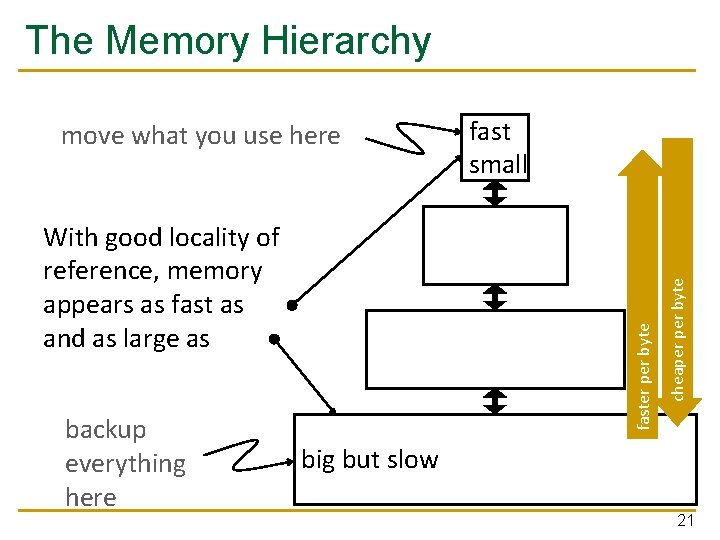
Why Memory Hierarchy? n We want both fast and large n But we cannot achieve both with a single level of memory n Idea: Have multiple levels of storage (progressively bigger and slower as the levels are farther from the processor) and ensure most of the data the processor needs is kept in the fast(er) level(s) 20
The Memory Hierarchy backup everything here faster per byte With good locality of reference, memory appears as fast as and as large as fast small cheaper byte move what you use here big but slow 21
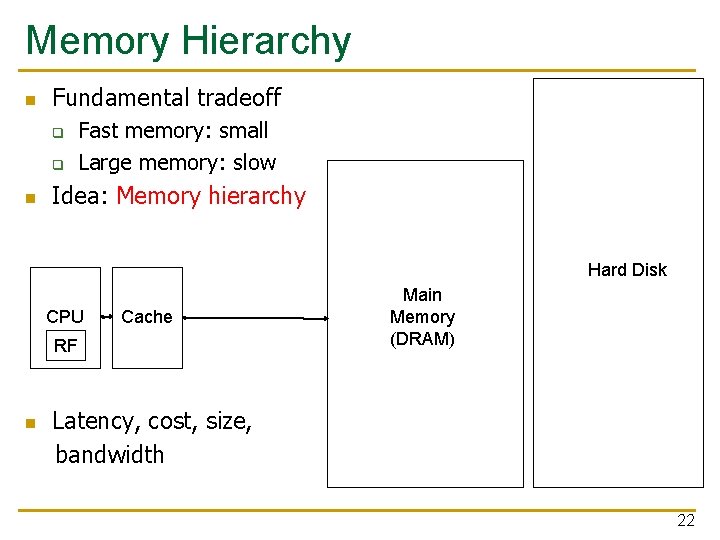
Memory Hierarchy n Fundamental tradeoff q q n Fast memory: small Large memory: slow Idea: Memory hierarchy Hard Disk CPU Cache RF n Main Memory (DRAM) Latency, cost, size, bandwidth 22
Locality n n One’s recent past is a very good predictor of his/her near future. Temporal Locality: If you just did something, it is very likely that you will do the same thing again soon q n since you are here today, there is a good chance you will be here again and again regularly Spatial Locality: If you did something, it is very likely you will do something similar/related (in space) q every time I find you in this room, you are probably sitting close to the same people 23
Memory Locality n A “typical” program has a lot of locality in memory references q n n typical programs are composed of “loops” Temporal: A program tends to reference the same memory location many times and all within a small window of time Spatial: A program tends to reference a cluster of memory locations at a time q most notable examples: n n 1. instruction memory references 2. array/data structure references 24
Caching Basics: Exploit Temporal Locality n Idea: Store recently accessed data in automatically n managed fast memory (called cache) Anticipation: the data will be accessed again soon n Temporal locality principle q q Recently accessed data will be again accessed in the near future This is what Maurice Wilkes had in mind: n n Wilkes, “Slave Memories and Dynamic Storage Allocation, ” IEEE Trans. On Electronic Computers, 1965. “The use is discussed of a fast core memory of, say 32000 words as a slave to a slower core memory of, say, one million words in such a way that in practical cases the effective access time is nearer that of the fast memory than that of the slow memory. ” 25
Caching Basics: Exploit Spatial Locality n Idea: Store addresses adjacent to the recently accessed one in automatically managed fast memory q q Logically divide memory into equal size blocks Fetch to cache the accessed block in its entirety n Anticipation: nearby data will be accessed soon n Spatial locality principle q Nearby data in memory will be accessed in the near future n q E. g. , sequential instruction access, array traversal This is what IBM 360/85 implemented n n 16 Kbyte cache with 64 byte blocks Liptay, “Structural aspects of the System/360 Model 85 II: the cache, ” IBM Systems Journal, 1968. 26
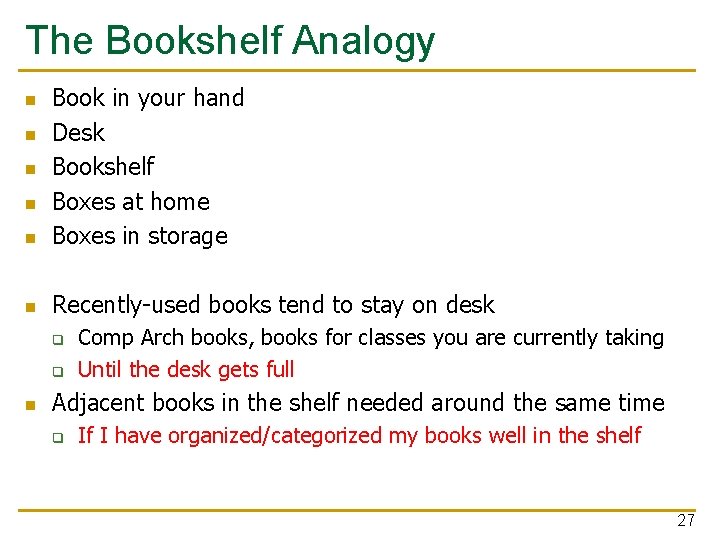
The Bookshelf Analogy n Book in your hand Desk Bookshelf Boxes at home Boxes in storage n Recently-used books tend to stay on desk n n q q n Comp Arch books, books for classes you are currently taking Until the desk gets full Adjacent books in the shelf needed around the same time q If I have organized/categorized my books well in the shelf 27
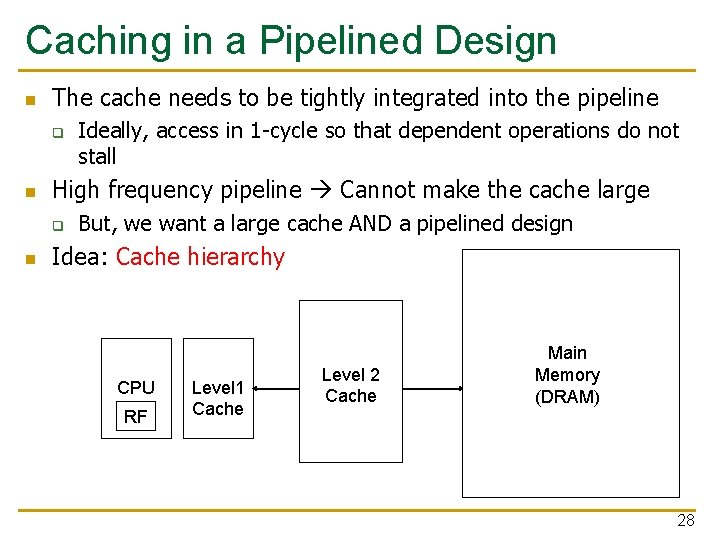
Caching in a Pipelined Design n The cache needs to be tightly integrated into the pipeline q n High frequency pipeline Cannot make the cache large q n Ideally, access in 1 -cycle so that dependent operations do not stall But, we want a large cache AND a pipelined design Idea: Cache hierarchy CPU RF Level 1 Cache Level 2 Cache Main Memory (DRAM) 28
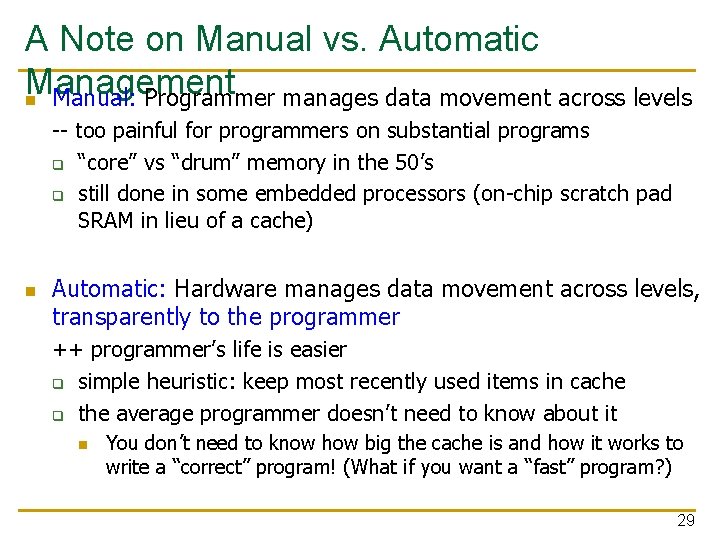
A Note on Manual vs. Automatic Management n Manual: Programmer manages data movement across levels -- too painful for programmers on substantial programs q “core” vs “drum” memory in the 50’s q still done in some embedded processors (on-chip scratch pad SRAM in lieu of a cache) n Automatic: Hardware manages data movement across levels, transparently to the programmer ++ programmer’s life is easier q simple heuristic: keep most recently used items in cache q the average programmer doesn’t need to know about it n You don’t need to know how big the cache is and how it works to write a “correct” program! (What if you want a “fast” program? ) 29
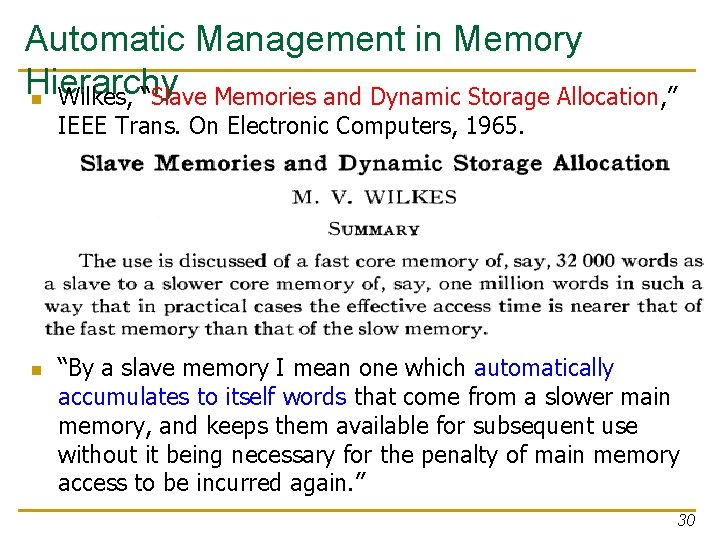
Automatic Management in Memory Hierarchy n Wilkes, “Slave Memories and Dynamic Storage Allocation, ” IEEE Trans. On Electronic Computers, 1965. n “By a slave memory I mean one which automatically accumulates to itself words that come from a slower main memory, and keeps them available for subsequent use without it being necessary for the penalty of main memory access to be incurred again. ” 30
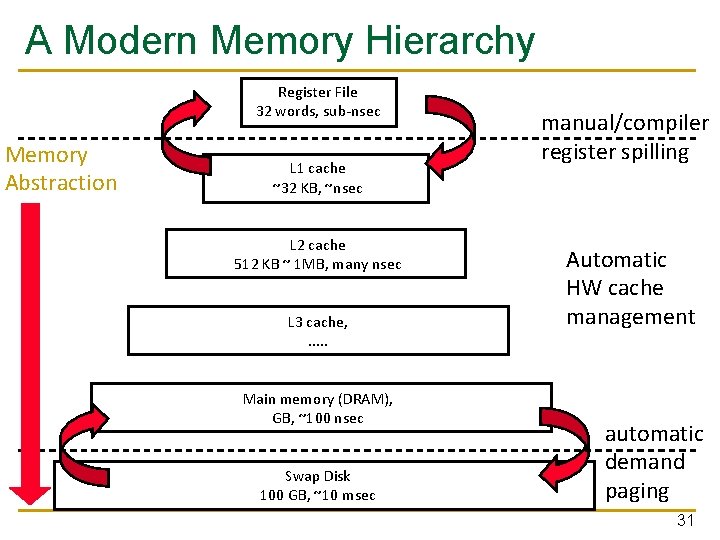
A Modern Memory Hierarchy Register File 32 words, sub-nsec Memory Abstraction L 1 cache ~32 KB, ~nsec L 2 cache 512 KB ~ 1 MB, many nsec L 3 cache, . . . Main memory (DRAM), GB, ~100 nsec Swap Disk 100 GB, ~10 msec manual/compiler register spilling Automatic HW cache management automatic demand paging 31
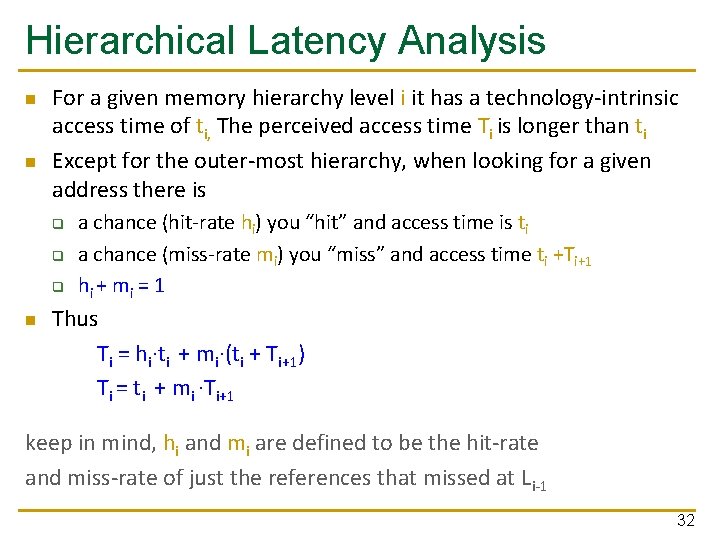
Hierarchical Latency Analysis n n For a given memory hierarchy level i it has a technology-intrinsic access time of ti, The perceived access time Ti is longer than ti Except for the outer-most hierarchy, when looking for a given address there is q q q n a chance (hit-rate hi) you “hit” and access time is ti a chance (miss-rate mi) you “miss” and access time ti +Ti+1 hi + m i = 1 Thus Ti = hi·ti + mi·(ti + Ti+1) Ti = ti + mi ·Ti+1 keep in mind, hi and mi are defined to be the hit-rate and miss-rate of just the references that missed at Li-1 32
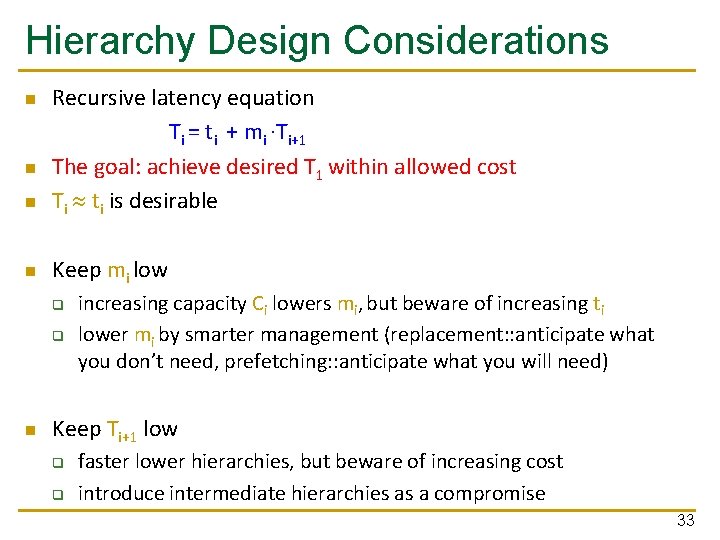
Hierarchy Design Considerations n Recursive latency equation Ti = ti + mi ·Ti+1 The goal: achieve desired T 1 within allowed cost Ti ti is desirable n Keep mi low n n q q n increasing capacity Ci lowers mi, but beware of increasing ti lower mi by smarter management (replacement: : anticipate what you don’t need, prefetching: : anticipate what you will need) Keep Ti+1 low q q faster lower hierarchies, but beware of increasing cost introduce intermediate hierarchies as a compromise 33
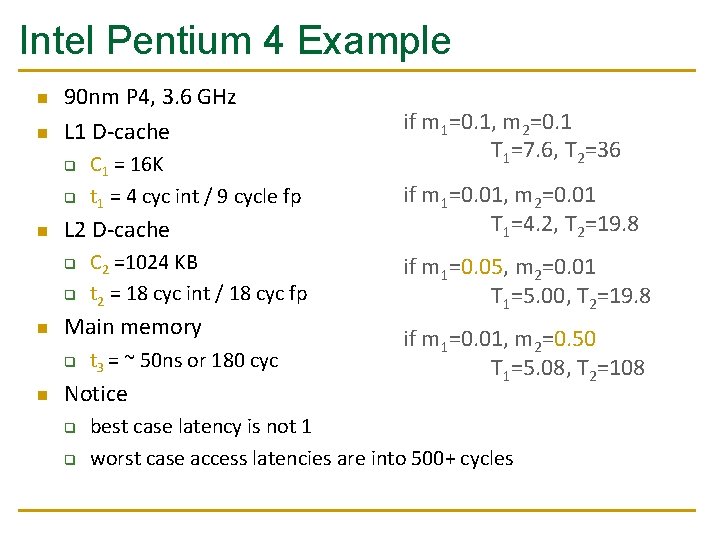
Intel Pentium 4 Example n n 90 nm P 4, 3. 6 GHz L 1 D-cache q q n L 2 D-cache q q n C 2 =1024 KB t 2 = 18 cyc int / 18 cyc fp Main memory q n C 1 = 16 K t 1 = 4 cyc int / 9 cycle fp t 3 = ~ 50 ns or 180 cyc Notice q q if m 1=0. 1, m 2=0. 1 T 1=7. 6, T 2=36 if m 1=0. 01, m 2=0. 01 T 1=4. 2, T 2=19. 8 if m 1=0. 05, m 2=0. 01 T 1=5. 00, T 2=19. 8 if m 1=0. 01, m 2=0. 50 T 1=5. 08, T 2=108 best case latency is not 1 worst case access latencies are into 500+ cycles
Cache Basics and Operation
Cache n n Generically, any structure that “memoizes” frequently used results to avoid repeating the long-latency operations required to reproduce the results from scratch, e. g. a web cache Most commonly, an automatically-managed memory hierarchy based on SRAM q memoize in SRAM the most frequently accessed DRAM memory locations to avoid repeatedly paying for the DRAM access latency 36
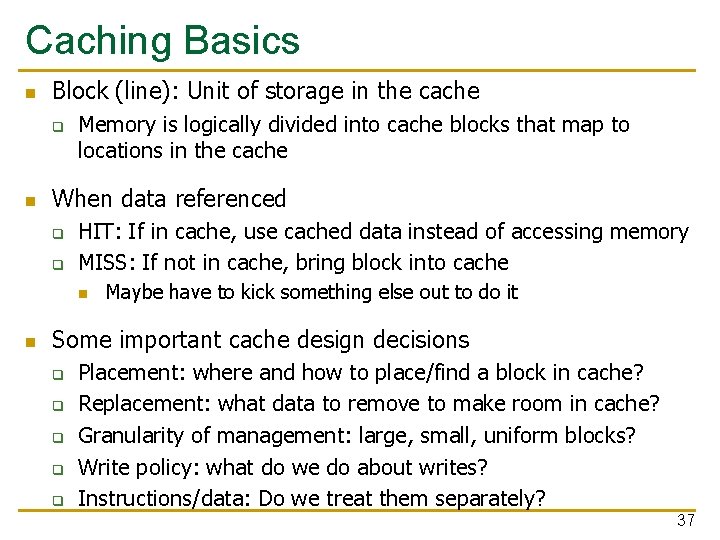
Caching Basics n Block (line): Unit of storage in the cache q n Memory is logically divided into cache blocks that map to locations in the cache When data referenced q q HIT: If in cache, use cached data instead of accessing memory MISS: If not in cache, bring block into cache n n Maybe have to kick something else out to do it Some important cache design decisions q q q Placement: where and how to place/find a block in cache? Replacement: what data to remove to make room in cache? Granularity of management: large, small, uniform blocks? Write policy: what do we do about writes? Instructions/data: Do we treat them separately? 37
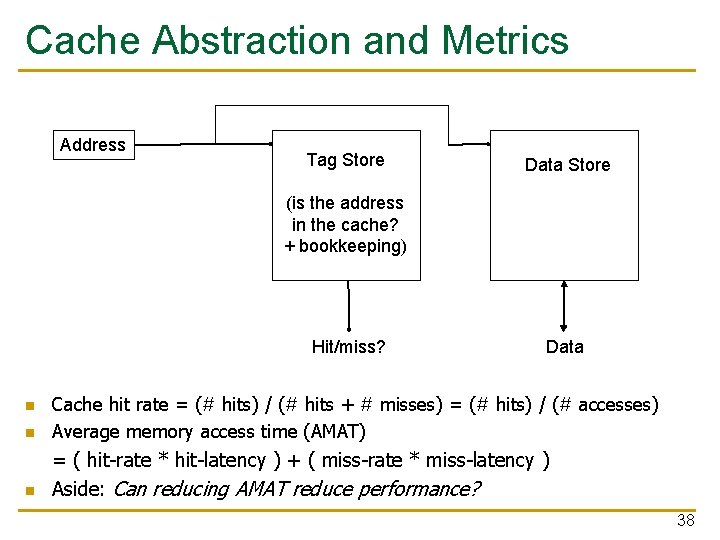
Cache Abstraction and Metrics Address Tag Store Data Store (is the address in the cache? + bookkeeping) Hit/miss? Data n Cache hit rate = (# hits) / (# hits + # misses) = (# hits) / (# accesses) Average memory access time (AMAT) n = ( hit-rate * hit-latency ) + ( miss-rate * miss-latency ) Aside: Can reducing AMAT reduce performance? n 38
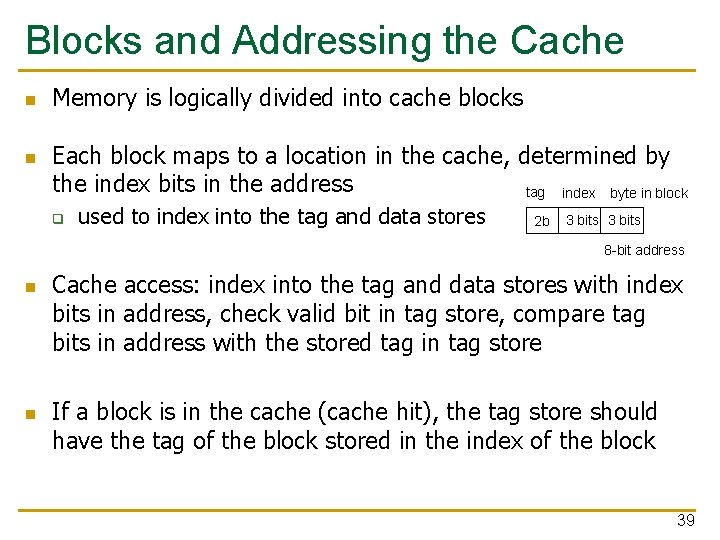
Blocks and Addressing the Cache n n Memory is logically divided into cache blocks Each block maps to a location in the cache, determined by the index bits in the address tag index byte in block q used to index into the tag and data stores 2 b 3 bits 8 -bit address n n Cache access: index into the tag and data stores with index bits in address, check valid bit in tag store, compare tag bits in address with the stored tag in tag store If a block is in the cache (cache hit), the tag store should have the tag of the block stored in the index of the block 39
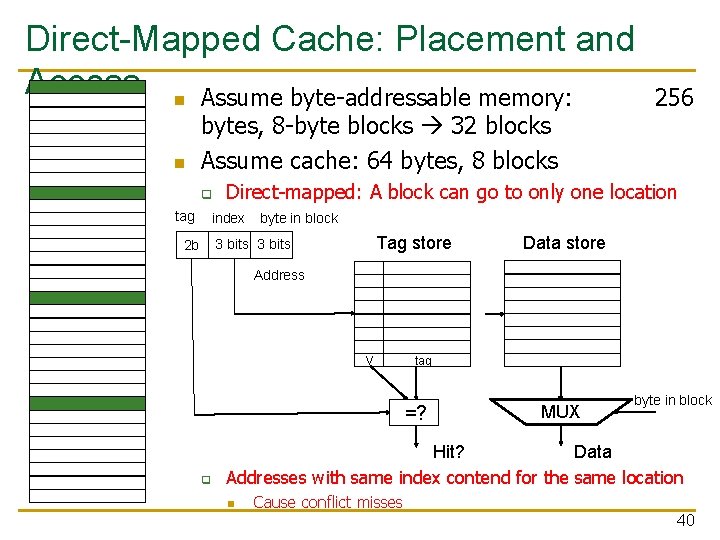
Direct-Mapped Cache: Placement and Access n Assume byte-addressable memory: n bytes, 8 -byte blocks 32 blocks Assume cache: 64 bytes, 8 blocks q tag Direct-mapped: A block can go to only one location index byte in block Tag store 3 bits 2 b 256 Data store Address V tag =? q MUX byte in block Hit? Data Addresses with same index contend for the same location n Cause conflict misses 40
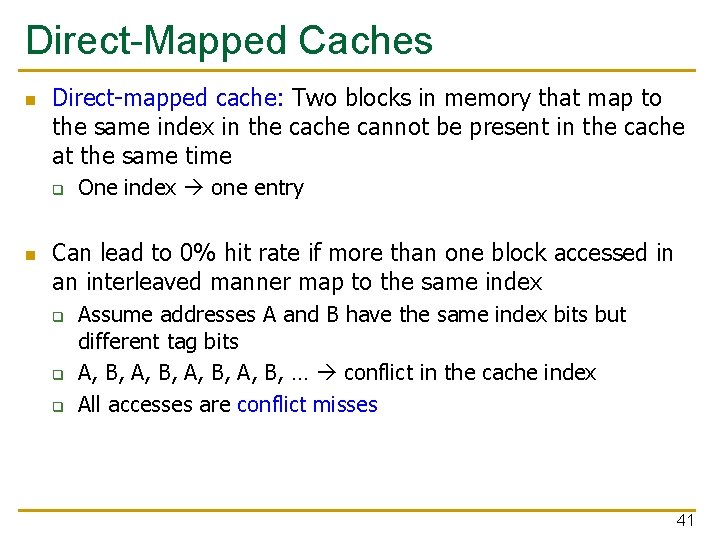
Direct-Mapped Caches n Direct-mapped cache: Two blocks in memory that map to the same index in the cache cannot be present in the cache at the same time q n One index one entry Can lead to 0% hit rate if more than one block accessed in an interleaved manner map to the same index q q q Assume addresses A and B have the same index bits but different tag bits A, B, … conflict in the cache index All accesses are conflict misses 41
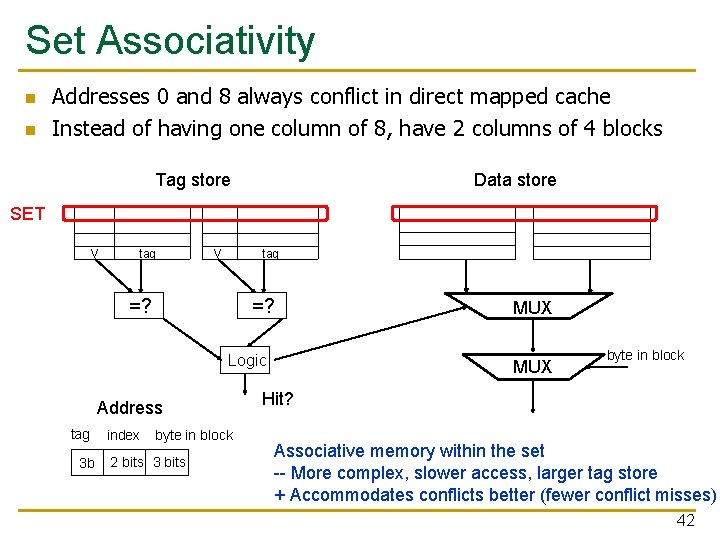
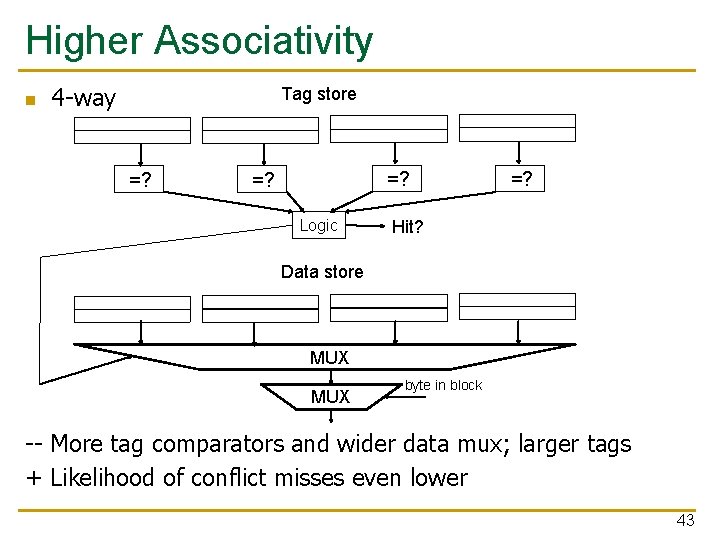
Set Associativity n n Addresses 0 and 8 always conflict in direct mapped cache Instead of having one column of 8, have 2 columns of 4 blocks Tag store Data store SET V tag V =? Logic Address tag 3 b index byte in block 2 bits 3 bits MUX byte in block Hit? Associative memory within the set -- More complex, slower access, larger tag store + Accommodates conflicts better (fewer conflict misses) 42
Higher Associativity n 4 -way Tag store =? =? Logic =? Hit? Data store MUX byte in block -- More tag comparators and wider data mux; larger tags + Likelihood of conflict misses even lower 43
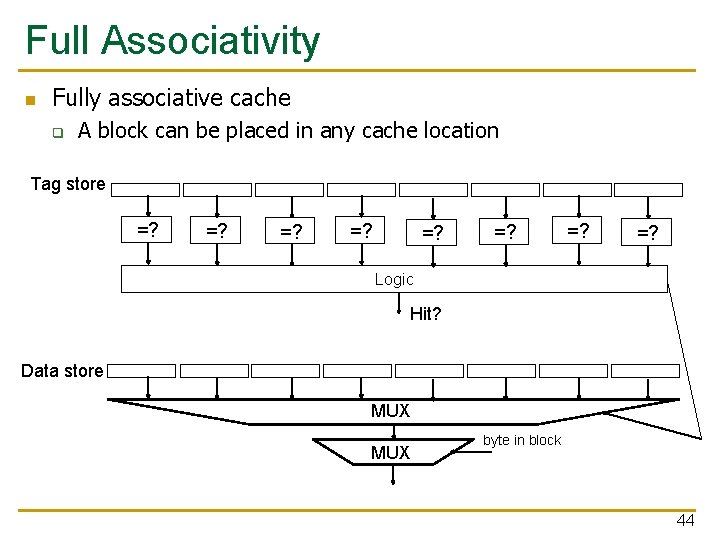
Full Associativity n Fully associative cache q A block can be placed in any cache location Tag store =? =? Logic Hit? Data store MUX byte in block 44
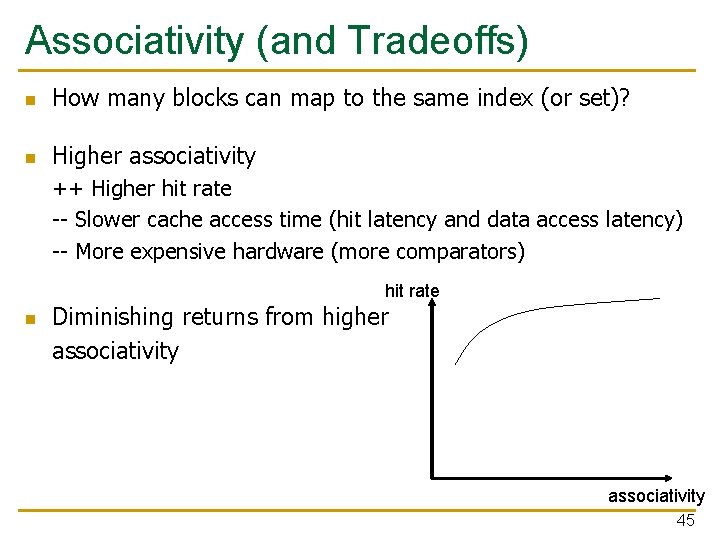
Associativity (and Tradeoffs) n How many blocks can map to the same index (or set)? n Higher associativity ++ Higher hit rate -- Slower cache access time (hit latency and data access latency) -- More expensive hardware (more comparators) hit rate n Diminishing returns from higher associativity 45
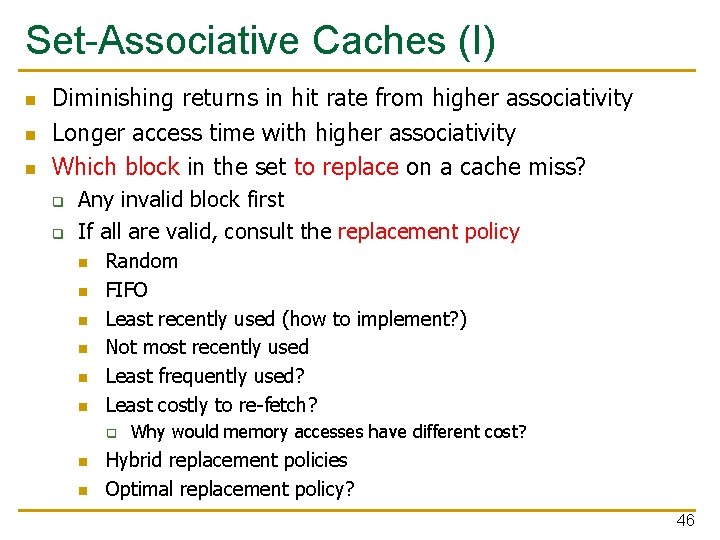
Set-Associative Caches (I) n n n Diminishing returns in hit rate from higher associativity Longer access time with higher associativity Which block in the set to replace on a cache miss? q q Any invalid block first If all are valid, consult the replacement policy n n n Random FIFO Least recently used (how to implement? ) Not most recently used Least frequently used? Least costly to re-fetch? q n n Why would memory accesses have different cost? Hybrid replacement policies Optimal replacement policy? 46
Implementing LRU n Idea: Evict the least recently accessed block Problem: Need to keep track of access ordering of blocks n Question: 2 -way set associative cache: n q n What do you need to implement LRU? Question: 4 -way set associative cache: q q q How many different orderings possible for the 4 blocks in the set? How many bits needed to encode the LRU order of a block? What is the logic needed to determine the LRU victim? 47
Approximations of LRU n n Most modern processors do not implement “true LRU” in highly-associative caches Why? q q n True LRU is complex LRU is an approximation to predict locality anyway (i. e. , not the best possible replacement policy) Examples: q q q Not MRU (not most recently used) Hierarchical LRU: divide the 4 -way set into 2 -way “groups”, track the MRU group and the MRU way in each group Victim-Next. Victim Replacement: Only keep track of the victim and the next victim 48
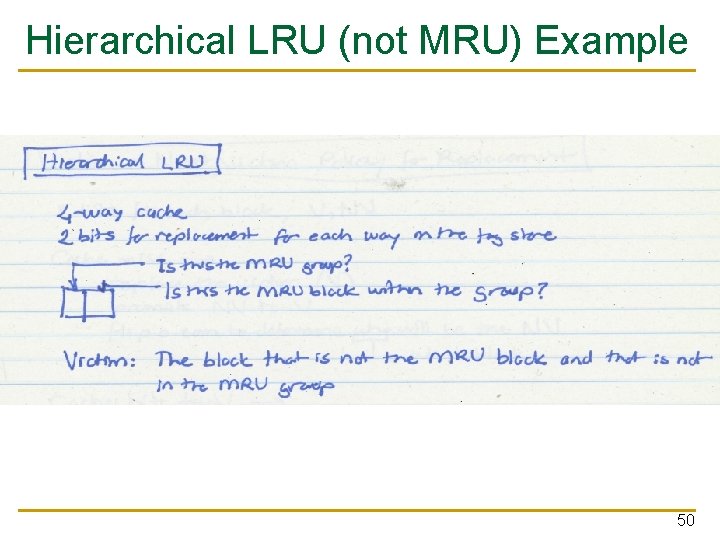
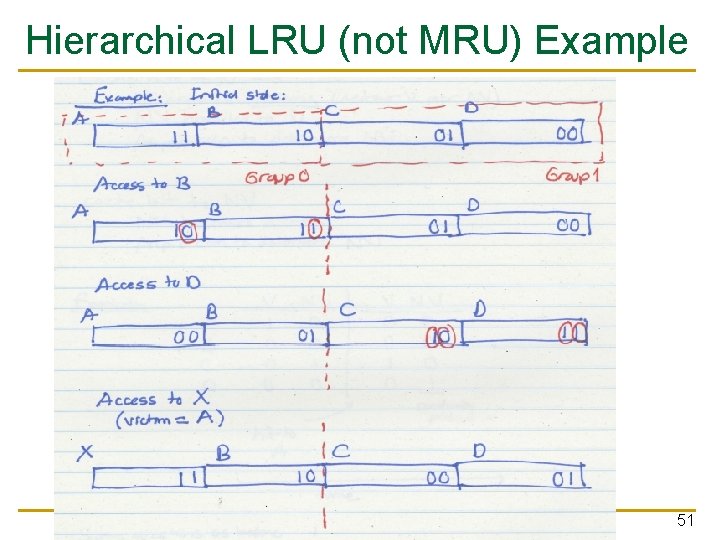
Hierarchical LRU (not MRU) n Divide a set into multiple groups Keep track of the MRU group Keep track of the MRU block in each group n On replacement, select victim as: n n q A not-MRU block in one of the not-MRU groups 49
Hierarchical LRU (not MRU) Example 50
Hierarchical LRU (not MRU) Example 51
Hierarchical LRU (not MRU): Questions n 8 -way cache n n n 2 4 -way groups What is an access pattern that performs worse than true LRU? What is an access pattern that performs better than true LRU? 52
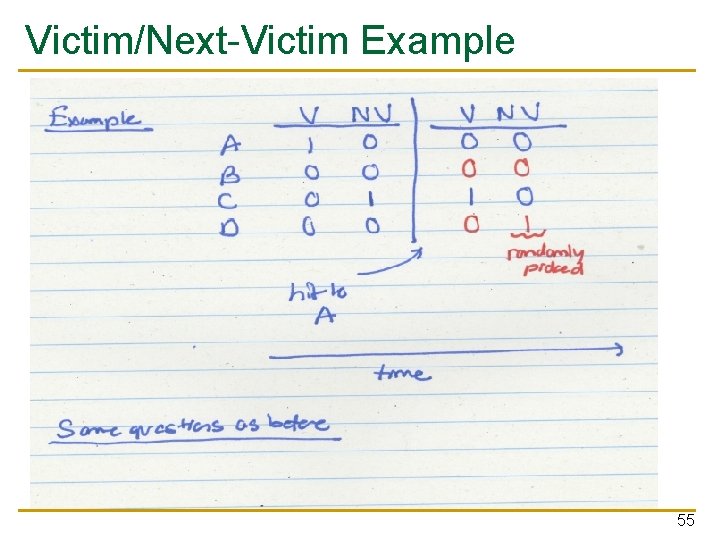
Victim/Next-Victim Policy n Only 2 blocks’ status tracked in each set: q q n On a cache miss q q q n victim (V), next victim (NV) all other blocks denoted as (O) – Ordinary block Replace V Promote NV to V Randomly pick an O block as NV On a cache hit to V q q q Promote NV to V Randomly pick an O block as NV Turn V to O 53
Victim/Next-Victim Policy (II) n On a cache hit to NV q q n Randomly pick an O block as NV Turn NV to O On a cache hit to O q Do nothing 54
Victim/Next-Victim Example 55