
18 3 Behavior of Light Water is transparent
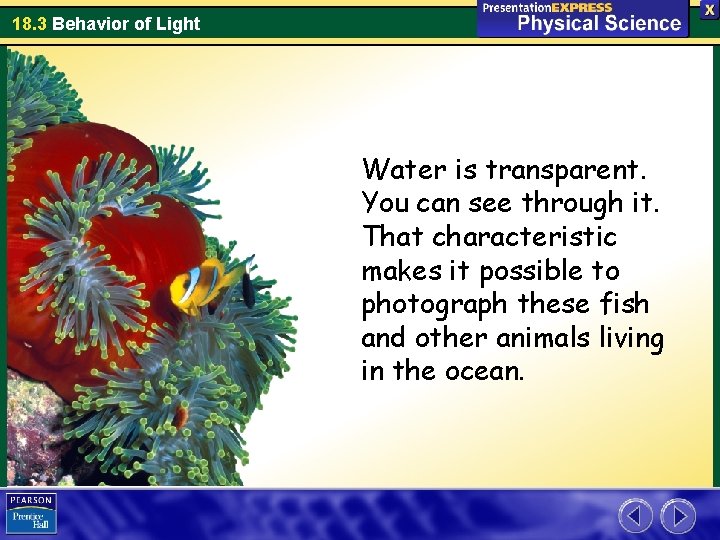
18. 3 Behavior of Light Water is transparent. You can see through it. That characteristic makes it possible to photograph these fish and other animals living in the ocean.

18. 3 Behavior of Light and Materials Without light, nothing is visible. When you look at the reef animals, what you are really seeing is light. You can see a reef through the water because light passes through the water between the reef and your eyes. But you can’t see the reef through the bottom of a boat because light doesn’t pass through the boat.

18. 3 Behavior of Light and Materials A transparent material transmits light, which means it allows most of the light that strikes it to pass through it. The water where the fish and coral live is transparent. While riding on a bus, you can see buildings and trees outside because the bus windows are transparent.
18. 3 Behavior of Light and Materials A translucent material scatters light. If you can see through a material, but the objects you see through it do not look clear or distinct, then the material is translucent. Looking into a room through a frosted glass door, you can make out shapes, but they are fuzzy and lack detail.
18. 3 Behavior of Light and Materials An opaque material either absorbs or reflects all of the light that strikes it. Most materials are opaque. An opaque object does not allow any light to pass through it. Wood and metal are examples of opaque materials.
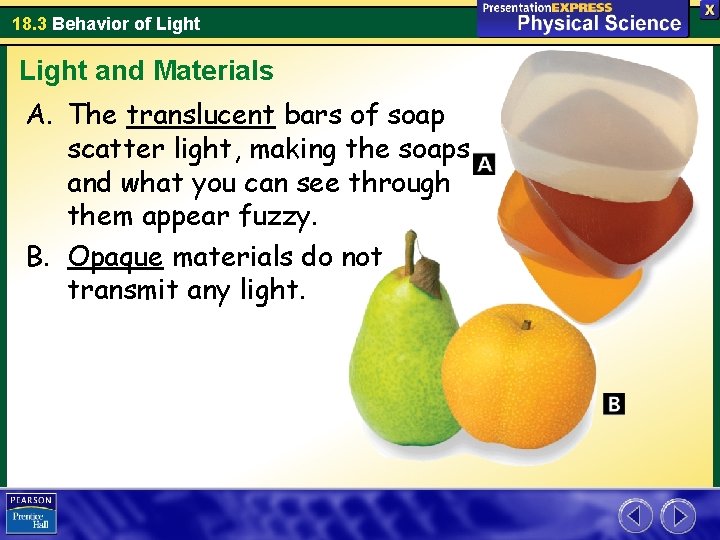
18. 3 Behavior of Light and Materials A. The translucent bars of soap scatter light, making the soaps and what you can see through them appear fuzzy. B. Opaque materials do not transmit any light.
18. 3 Behavior of Light Interactions of Light When light encounters matter, some or all of the energy in the light can be transferred to the matter. Just as light can affect matter, matter can affect light.

18. 3 Behavior of Light Interactions of Light Reflection An image is a copy of an object formed by reflected (or refracted) waves of light.
18. 3 Behavior of Light Regular reflection occurs when parallel light waves strike a surface and reflect all in the same direction. Diffuse reflection occurs when parallel light waves strike a rough, uneven surface and reflect in many different directions.
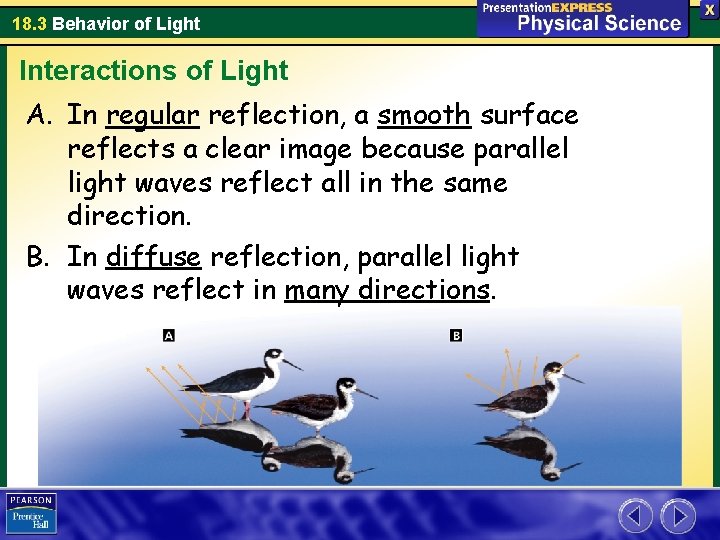
18. 3 Behavior of Light Interactions of Light A. In regular reflection, a smooth surface reflects a clear image because parallel light waves reflect all in the same direction. B. In diffuse reflection, parallel light waves reflect in many directions.
18. 3 Behavior of Light Interactions of Light Refraction A light wave can refract, or bend, when it passes at an angle from one medium into another. Refraction makes underwater objects appear closer and larger than they really are. Refraction can also make an object appear to break at the surface of the water.
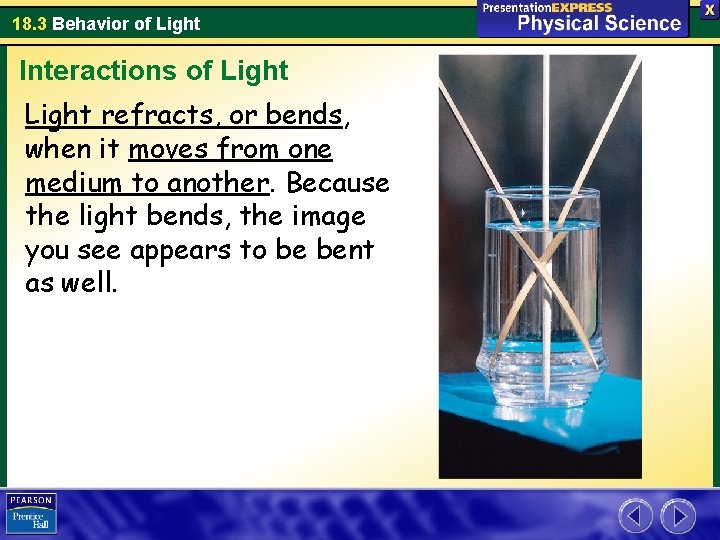
18. 3 Behavior of Light Interactions of Light refracts, or bends, when it moves from one medium to another. Because the light bends, the image you see appears to be bent as well.
18. 3 Behavior of Light Interactions of Light Refraction can also sometimes cause a mirage, a false or distorted image.
18. 3 Behavior of Light • Mirages occur because light travels faster in hot air than in cooler, denser air. • Refraction causes some of the light to follow a curved path, rather than a straight path to the ground. • Light that reaches your eyes after traveling in this manner can look as if it was reflected from a layer of water.
18. 3 Behavior of Light Interactions of Light Polarization Light with waves that vibrate in only one plane is polarized light. Light reflecting from a nonmetallic flat surface, such as a window or the surface of a lake, can become polarized.
18. 3 Behavior of Light Horizontally polarized light reflects more strongly than the rest of the sunlight. This reflection produces glare. Polarized sunglasses have vertically polarized filters to block the horizontally polarized light.
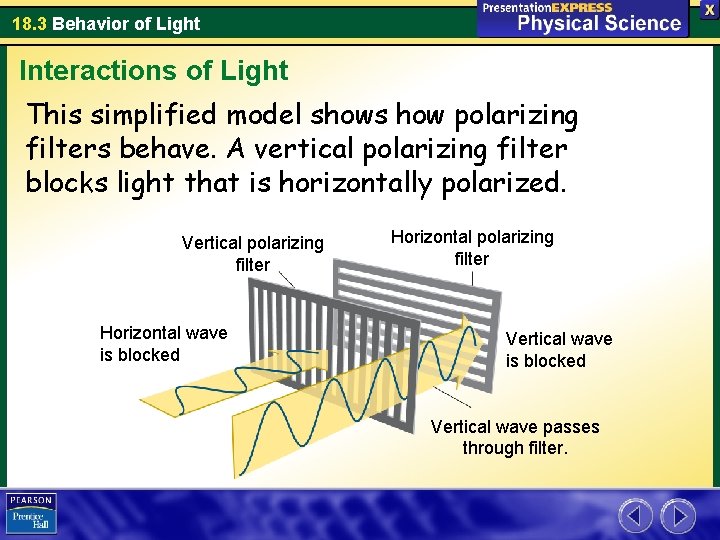
18. 3 Behavior of Light Interactions of Light This simplified model shows how polarizing filters behave. A vertical polarizing filter blocks light that is horizontally polarized. Vertical polarizing filter Horizontal wave is blocked Horizontal polarizing filter Vertical wave is blocked Vertical wave passes through filter.
18. 3 Behavior of Light Interactions of Light Scattering In scattering, light is redirected as it passes through a medium.
18. 3 Behavior of Light • Most of the particles in the atmosphere are very small. Small particles scatter shorter-wavelength blue light more than light of longer wavelengths. • Blue light is scattered in all directions more than other colors of light, which makes the sky appear blue.
18. 3 Behavior of Light Interactions of Light A scattering effect reddens the sun at sunset and sunrise. • When the sun is close to the horizon, sunlight travels farther through the atmosphere. • By the time the sunlight reaches your eyes, most shorter-wavelength light has been scattered. • The remaining light consists mostly of red and orange wavelengths.
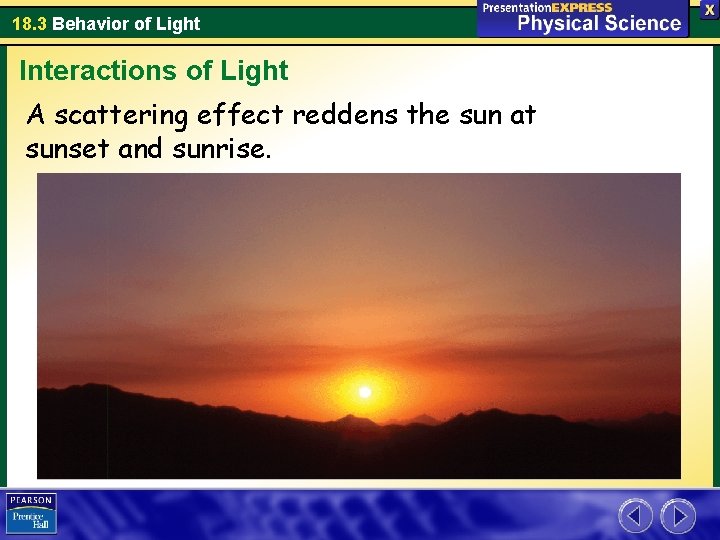
18. 3 Behavior of Light Interactions of Light A scattering effect reddens the sun at sunset and sunrise.
18. 3 Behavior of Light Assessment Questions 1. How do polarized sunglasses reduce glare? a. by scattering light as it passes through the glasses b. by providing a smooth surface that light can reflect off c. by absorbing all light d. by blocking horizontally polarized light
18. 3 Behavior of Light 1. How do polarized sunglasses reduce glare? a. by scattering light as it passes through the glasses b. by providing a smooth surface that light can reflect off c. by absorbing all light d. by blocking horizontally polarized light ANS: D
18. 3 Behavior of Light 2. An opaque material passes light through but scatters the light so that objects do not look clear. True False
18. 3 Behavior of Light 2. An opaque material passes light through but scatters the light so that objects do not look clear. True False ANS: F, translucent
- Slides: 25