
17 SECONDORDER DIFFERENTIAL EQUATIONS SECONDORDER DIFFERENTIAL EQUATIONS The










- Slides: 68
17 SECOND-ORDER DIFFERENTIAL EQUATIONS
SECOND-ORDER DIFFERENTIAL EQUATIONS The basic ideas of differential equations were explained in Chapter 9. § We concentrated on first-order equations.
SECOND-ORDER DIFFERENTIAL EQUATIONS In this chapter, we: § Study second-order linear differential equations. § Learn how they can be applied to solve problems concerning the vibrations of springs and the analysis of electric circuits. § See how infinite series can be used to solve differential equations.
SECOND-ORDER DIFFERENTIAL EQUATIONS 17. 1 Second-Order Linear Equations In this section, we will learn how to solve: Homogeneous linear equations for various cases and for initial- and boundary-value problems.
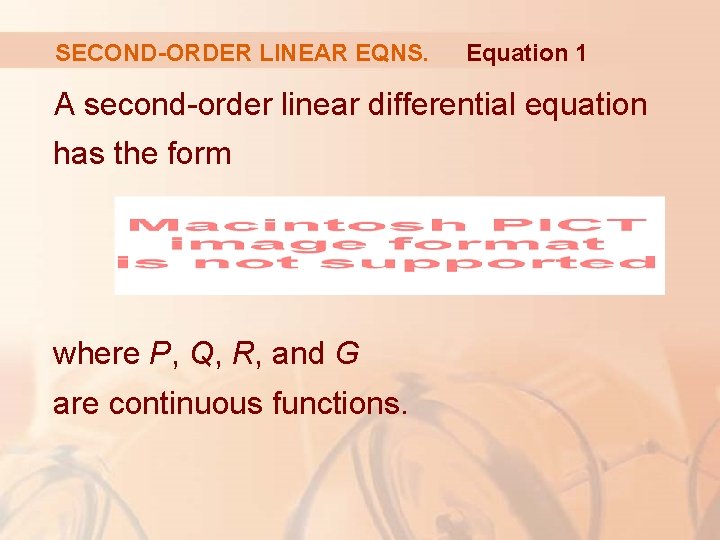
SECOND-ORDER LINEAR EQNS. Equation 1 A second-order linear differential equation has the form where P, Q, R, and G are continuous functions.
SECOND-ORDER LINEAR EQNS. We saw in Section 9. 1 that equations of this type arise in the study of the motion of a spring. In Section 17. 3, we will further pursue this application as well as the application to electric circuits.
HOMOGENEOUS LINEAR EQNS. In this section, we study the case where G(x) = 0, for all x, in Equation 1. § Such equations are called homogeneous linear equations.
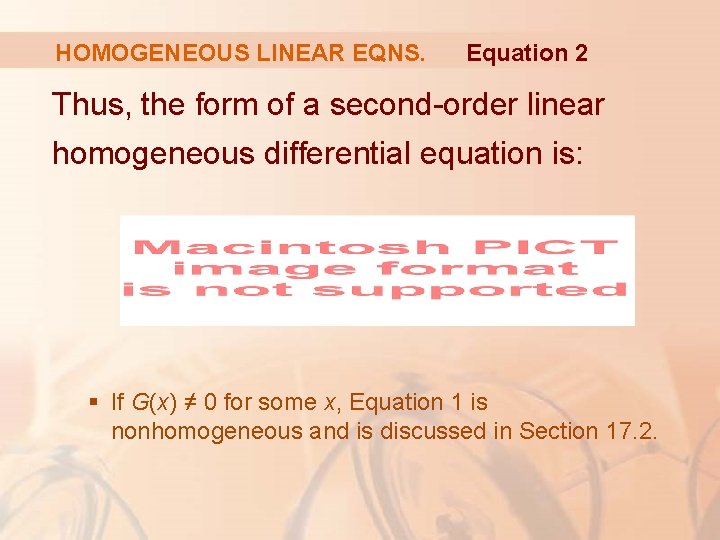
HOMOGENEOUS LINEAR EQNS. Equation 2 Thus, the form of a second-order linear homogeneous differential equation is: § If G(x) ≠ 0 for some x, Equation 1 is nonhomogeneous and is discussed in Section 17. 2.
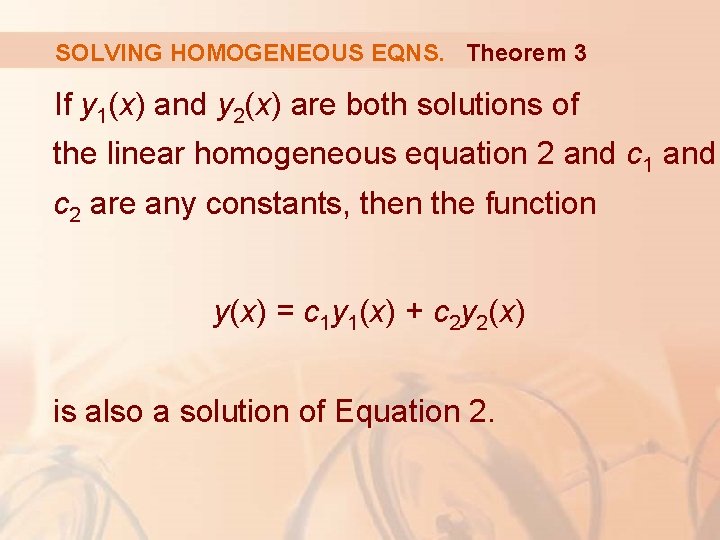
SOLVING HOMOGENEOUS EQNS. Two basic facts enable us to solve homogeneous linear equations. The first says that, if we know two solutions y 1 and y 2 of such an equation, then the linear combination y = c 1 y 1 + c 2 y 2 is also a solution.
SOLVING HOMOGENEOUS EQNS. Theorem 3 If y 1(x) and y 2(x) are both solutions of the linear homogeneous equation 2 and c 1 and c 2 are any constants, then the function y(x) = c 1 y 1(x) + c 2 y 2(x) is also a solution of Equation 2.
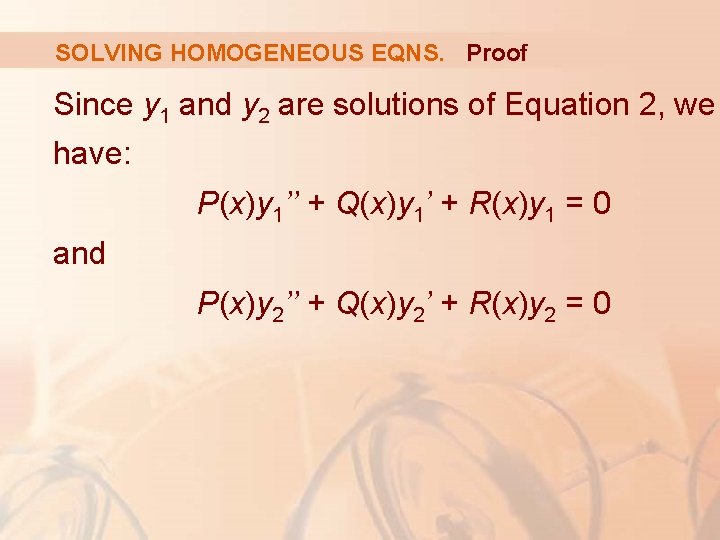
SOLVING HOMOGENEOUS EQNS. Proof Since y 1 and y 2 are solutions of Equation 2, we have: P(x)y 1’’ + Q(x)y 1’ + R(x)y 1 = 0 and P(x)y 2’’ + Q(x)y 2’ + R(x)y 2 = 0
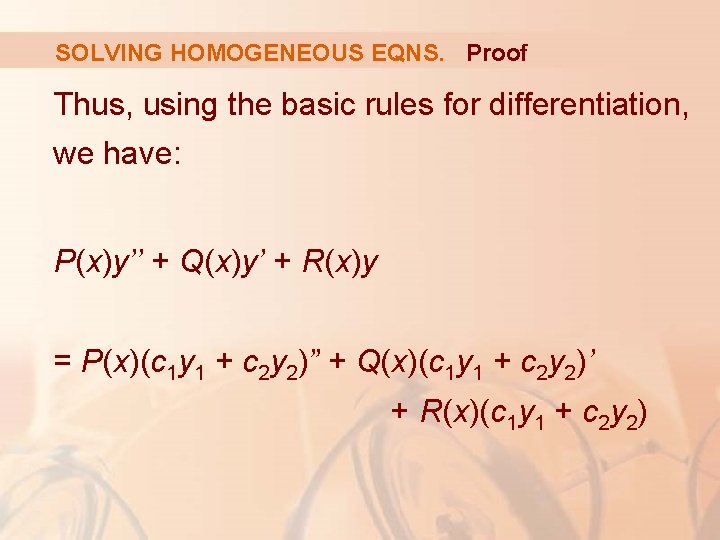
SOLVING HOMOGENEOUS EQNS. Proof Thus, using the basic rules for differentiation, we have: P(x)y’’ + Q(x)y’ + R(x)y = P(x)(c 1 y 1 + c 2 y 2)” + Q(x)(c 1 y 1 + c 2 y 2)’ + R(x)(c 1 y 1 + c 2 y 2)
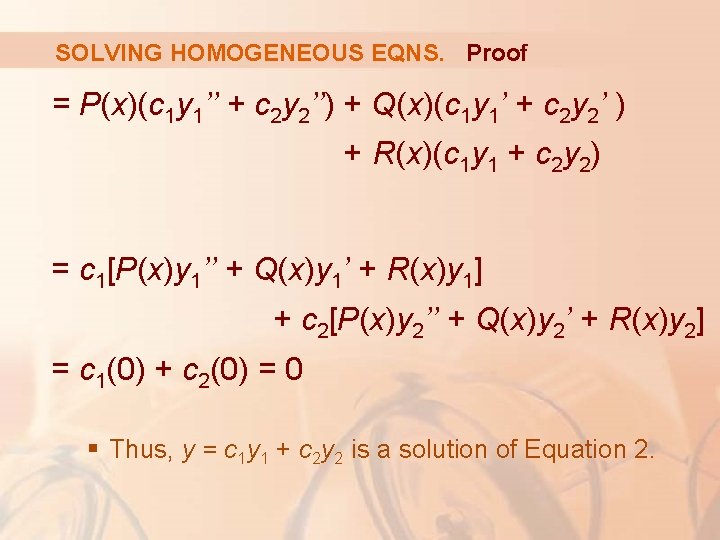
SOLVING HOMOGENEOUS EQNS. Proof = P(x)(c 1 y 1’’ + c 2 y 2’’) + Q(x)(c 1 y 1’ + c 2 y 2’ ) + R(x)(c 1 y 1 + c 2 y 2) = c 1[P(x)y 1’’ + Q(x)y 1’ + R(x)y 1] + c 2[P(x)y 2’’ + Q(x)y 2’ + R(x)y 2] = c 1(0) + c 2(0) = 0 § Thus, y = c 1 y 1 + c 2 y 2 is a solution of Equation 2.
SOLVING HOMOGENEOUS EQNS. The other fact we need is given by the following theorem, which is proved in more advanced courses. § It says that the general solution is a linear combination of two linearly independent solutions y 1 and y 2.
SOLVING HOMOGENEOUS EQNS. This means that neither y 1 nor y 2 is a constant multiple of the other. § For instance, the functions f(x) = x 2 and g(x) = 5 x 2 are linearly dependent, but f(x) = ex and g(x) = xex are linearly independent.
SOLVING HOMOGENEOUS EQNS. Theorem 4 If y 1 and y 2 are linearly independent solutions of Equation 2, and P(x) is never 0, then the general solution is given by: y(x) = c 1 y 1(x) + c 2 y 2(x) where c 1 and c 2 are arbitrary constants.
SOLVING HOMOGENEOUS EQNS. Theorem 4 is very useful because it says that, if we know two particular linearly independent solutions, then we know every solution.
SOLVING HOMOGENEOUS EQNS. In general, it is not easy to discover particular solutions to a second-order linear equation.
SOLVING HOMOGENEOUS EQNS. Equation 5 However, it is always possible to do so if the coefficient functions P, Q, and R are constant functions—that is, if the differential equation has the form ay’’ + by’ + cy = 0 where: § a, b, and c are constants. § a ≠ 0.
SOLVING HOMOGENEOUS EQNS. It’s not hard to think of some likely candidates for particular solutions of Equation 5 if we state the equation verbally. § We are looking for a function y such that a constant times its second derivative y’’ plus another constant times y’ plus a third constant times y is equal to 0.
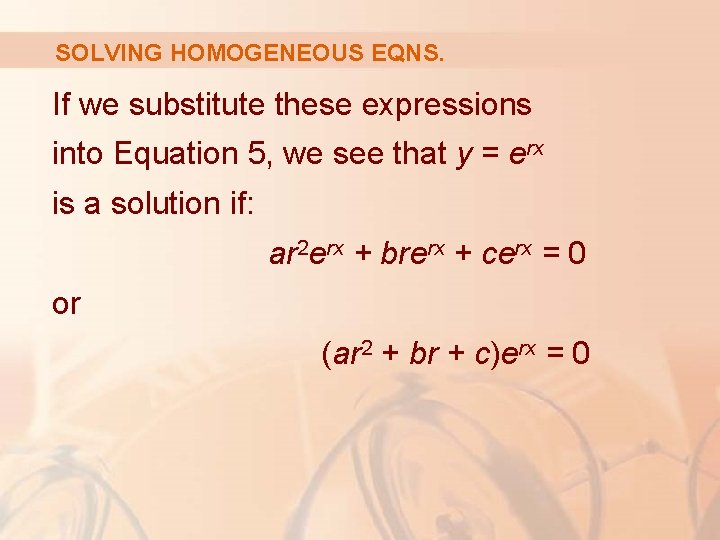
SOLVING HOMOGENEOUS EQNS. We know that the exponential function y = erx (where r is a constant) has the property that its derivative is a constant multiple of itself: y’ = rerx Furthermore, y’’ = r 2 erx
SOLVING HOMOGENEOUS EQNS. If we substitute these expressions into Equation 5, we see that y = erx is a solution if: ar 2 erx + brerx + cerx = 0 or (ar 2 + br + c)erx = 0
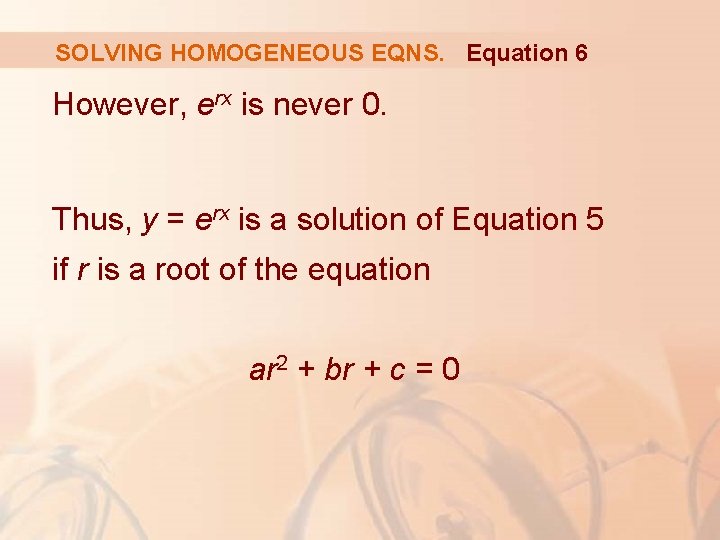
SOLVING HOMOGENEOUS EQNS. Equation 6 However, erx is never 0. Thus, y = erx is a solution of Equation 5 if r is a root of the equation ar 2 + br + c = 0
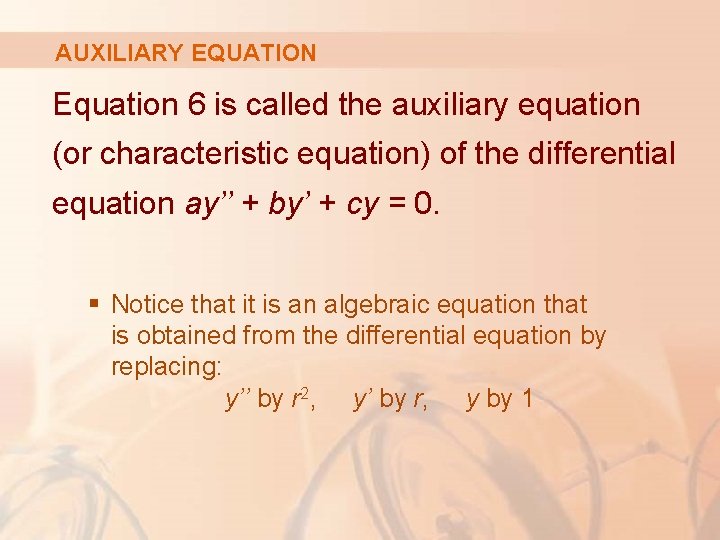
AUXILIARY EQUATION Equation 6 is called the auxiliary equation (or characteristic equation) of the differential equation ay’’ + by’ + cy = 0. § Notice that it is an algebraic equation that is obtained from the differential equation by replacing: y’’ by r 2, y’ by r, y by 1
FINDING r 1 and r 2 Sometimes, the roots r 1 and r 2 of the auxiliary equation can be found by factoring.
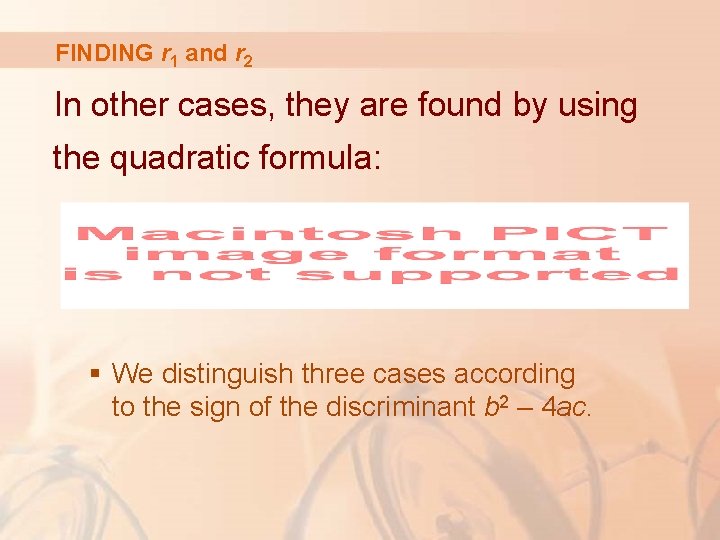
FINDING r 1 and r 2 In other cases, they are found by using the quadratic formula: § We distinguish three cases according to the sign of the discriminant b 2 – 4 ac.
CASE I 2 b – 4 ac > 0 § The roots r 1 and r 2 are real and distinct. § So, y 1 = er 1 x and y 2 = er 2 x are two linearly independent solutions of Equation 5. (Note that er 2 x is not a constant multiple of er 1 x. ) § Thus, by Theorem 4, we have the following fact.
CASE I Solution 8 If the roots r 1 and r 2 of the auxiliary equation ar 2 + br + c = 0 are real and unequal, then the general solution of ay’’ + by’ + cy = 0 is: y = c 1 er 1 x + c 2 er 2 x
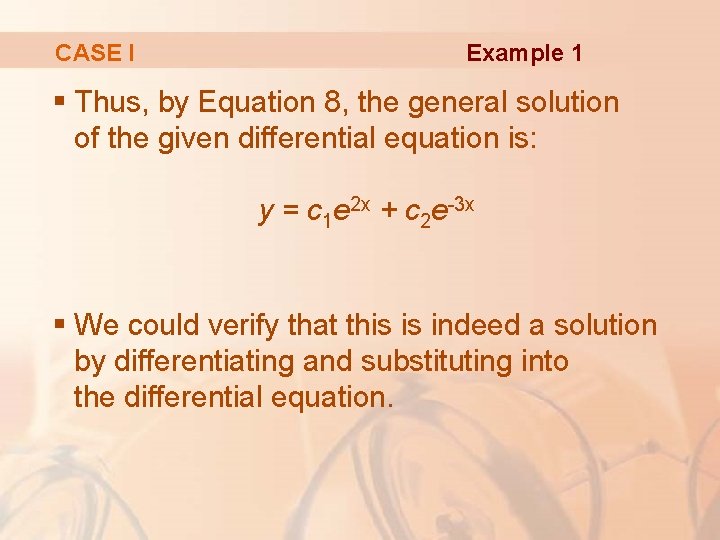
Example 1 CASE I Solve the equation y’’ + y’ – 6 y = 0 § The auxiliary equation is: r 2 + r – 6 = (r – 2)(r + 3) = 0 whose roots are r = 2, – 3.
CASE I Example 1 § Thus, by Equation 8, the general solution of the given differential equation is: y = c 1 e 2 x + c 2 e-3 x § We could verify that this is indeed a solution by differentiating and substituting into the differential equation.
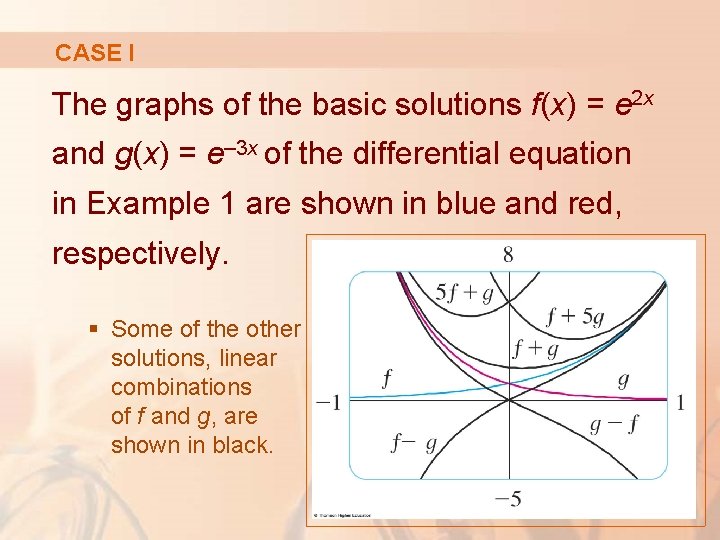
CASE I The graphs of the basic solutions f(x) = e 2 x and g(x) = e– 3 x of the differential equation in Example 1 are shown in blue and red, respectively. § Some of the other solutions, linear combinations of f and g, are shown in black.
CASE I Example 2 Solve § To solve the auxiliary equation 3 r 2 + r – 1 = 0, we use the quadratic formula: § Since the roots are real and distinct, the general solution is:
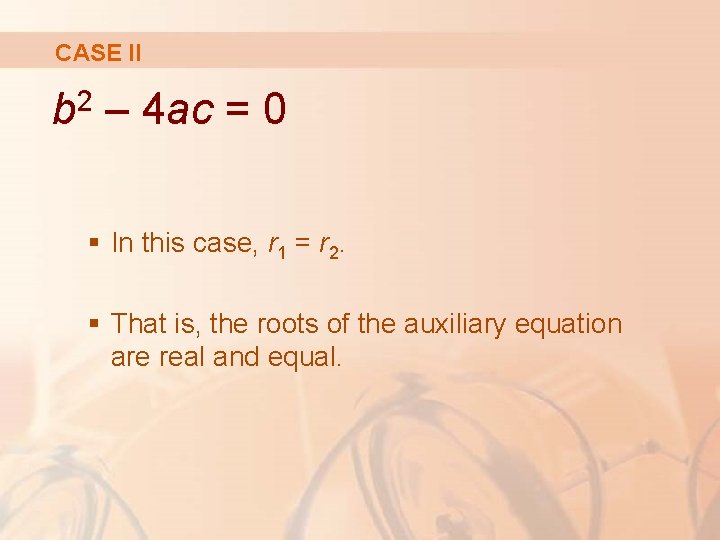
CASE II 2 b – 4 ac = 0 § In this case, r 1 = r 2. § That is, the roots of the auxiliary equation are real and equal.
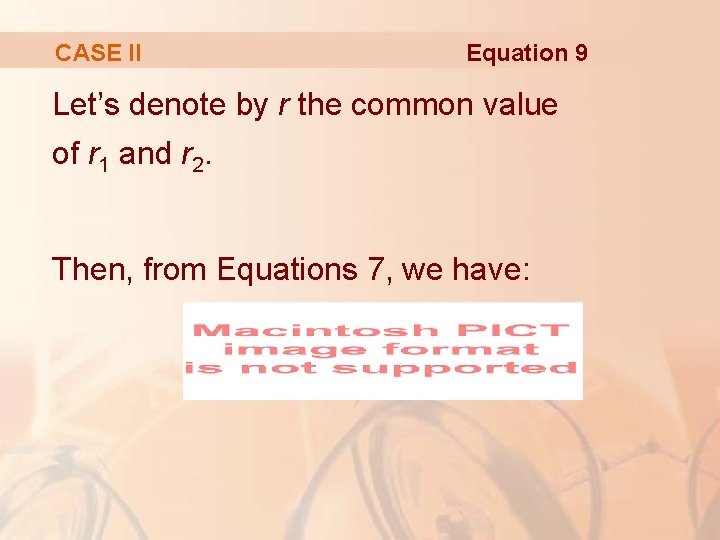
CASE II Equation 9 Let’s denote by r the common value of r 1 and r 2. Then, from Equations 7, we have:
CASE II We know that y 1 = erx is one solution of Equation 5. We now verify that y 2 = xerx is also a solution.
CASE II
CASE II The first term is 0 by Equations 9. The second term is 0 because r is a root of the auxiliary equation. § Since y 1 = erx and y 2 = xerx are linearly independent solutions, Theorem 4 provides us with the general solution.
Solution 10 CASE II If the auxiliary equation ar 2 + br + c = 0 has only one real root r, then the general solution of ay’’ + by’ + cy = 0 is: y = c 1 erx + c 2 xerx
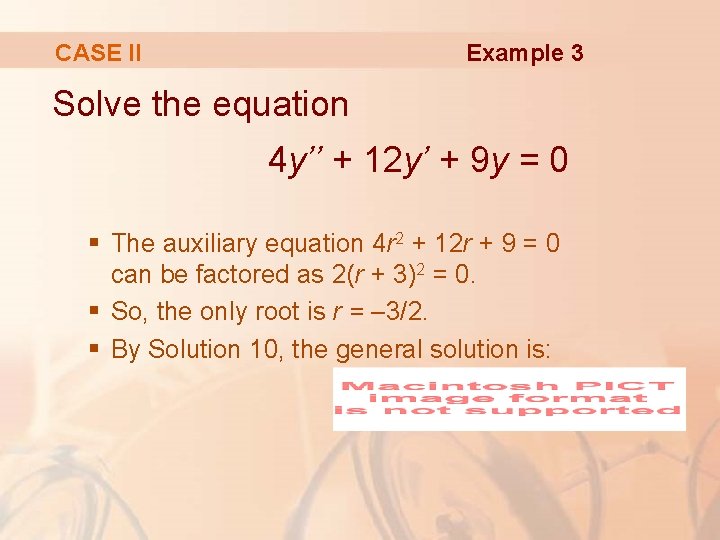
Example 3 CASE II Solve the equation 4 y’’ + 12 y’ + 9 y = 0 § The auxiliary equation 4 r 2 + 12 r + 9 = 0 can be factored as 2(r + 3)2 = 0. § So, the only root is r = – 3/2. § By Solution 10, the general solution is:
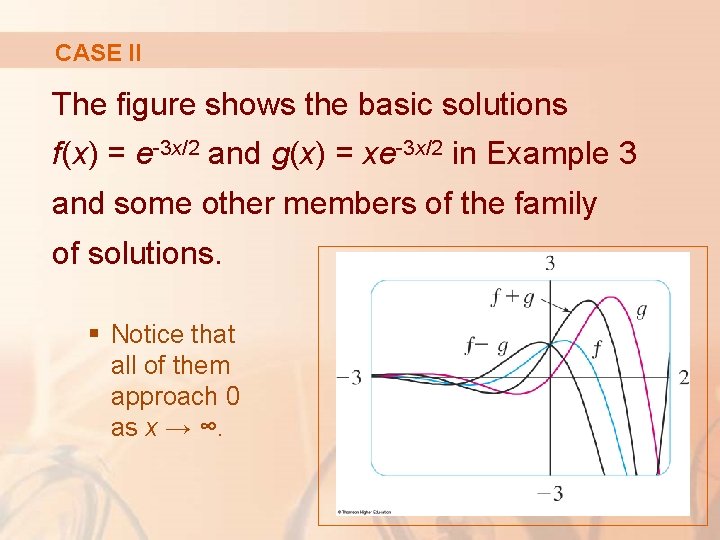
CASE II The figure shows the basic solutions f(x) = e-3 x/2 and g(x) = xe-3 x/2 in Example 3 and some other members of the family of solutions. § Notice that all of them approach 0 as x → ∞.
CASE III b 2 – 4 ac < 0 § In this case, the roots r 1 and r 2 of the auxiliary equation are complex numbers. § See Appendix H for information about complex numbers.
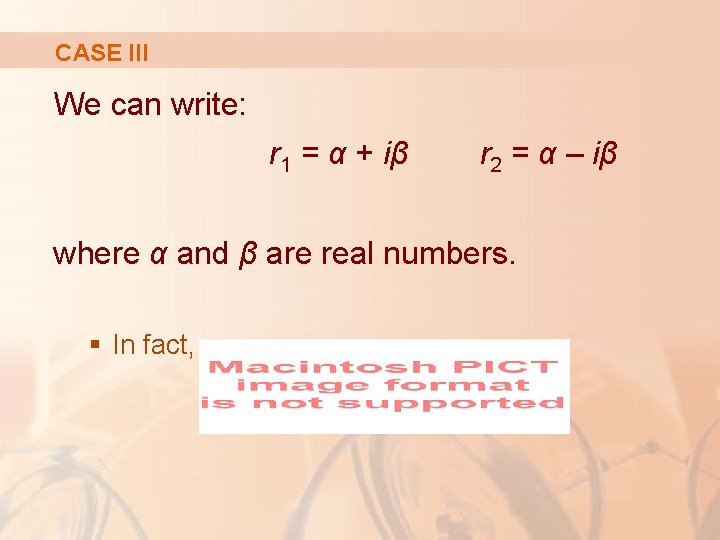
CASE III We can write: r 1 = α + iβ r 2 = α – iβ where α and β are real numbers. § In fact,
CASE III Then, using Euler’s equation eiθ = cos θ + i sin θ we write the solution of the differential equation as follows.
CASE III where c 1 = C 1 + C 2, c 2 = i(C 1 – C 2).
CASE III This gives all solutions (real or complex) of the differential equation. § The solutions are real when the constants c 1 and c 2 are real. § We summarize the discussion as follows.
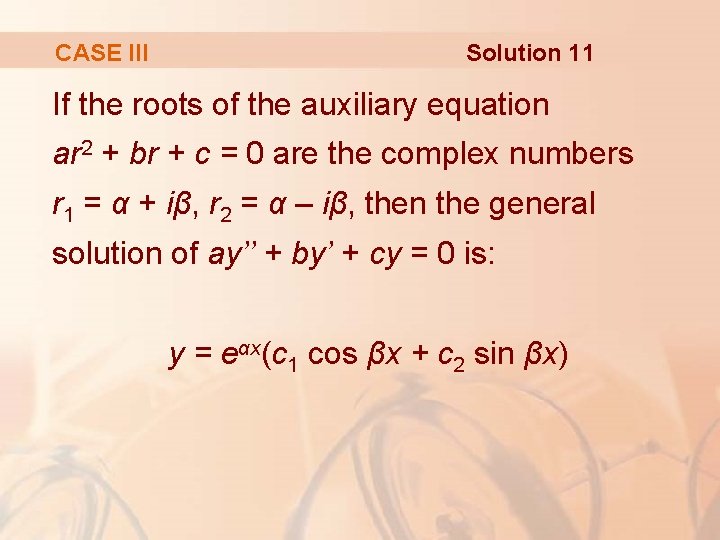
CASE III Solution 11 If the roots of the auxiliary equation ar 2 + br + c = 0 are the complex numbers r 1 = α + iβ, r 2 = α – iβ, then the general solution of ay’’ + by’ + cy = 0 is: y = eαx(c 1 cos βx + c 2 sin βx)
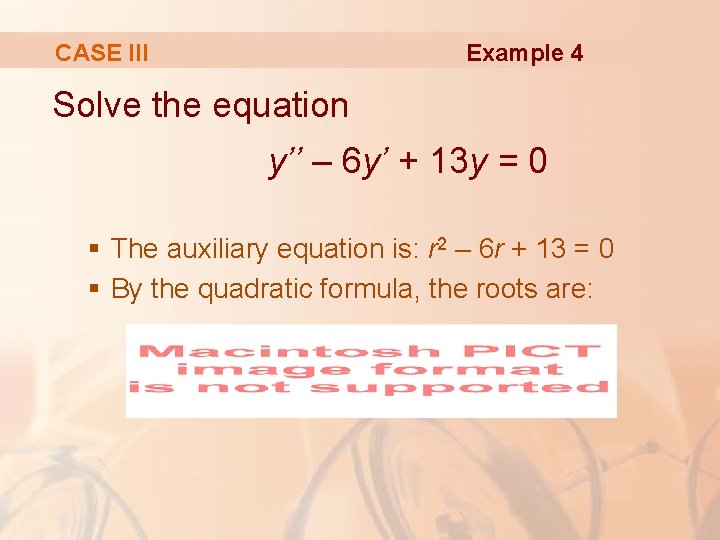
Example 4 CASE III Solve the equation y’’ – 6 y’ + 13 y = 0 § The auxiliary equation is: r 2 – 6 r + 13 = 0 § By the quadratic formula, the roots are:
CASE III Example 4 § So, by Fact 11, the general solution of the differential equation is: y = e 3 x(c 1 cos 2 x + c 2 sin 2 x)
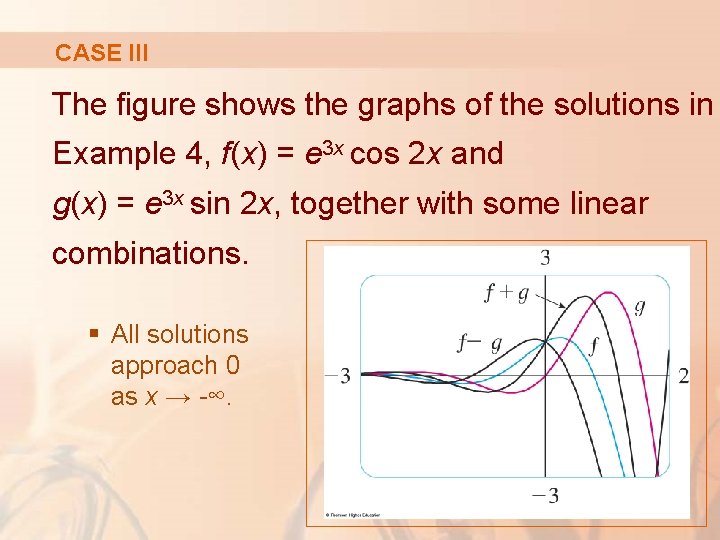
CASE III The figure shows the graphs of the solutions in Example 4, f(x) = e 3 x cos 2 x and g(x) = e 3 x sin 2 x, together with some linear combinations. § All solutions approach 0 as x → -∞.
INITIAL-VALUE PROBLEMS An initial-value problem for the second-order Equation 1 or 2 involves finding a solution y of the differential equation that also satisfies initial conditions of the form y(x 0) = y 0 y’(x 0) = y 1 where y 0 and y 1 are given constants.
INITIAL-VALUE PROBLEMS Suppose P, Q, R, and G are continuous on an interval and P(x) ≠ 0 there. Then, a theorem found in more advanced books guarantees the existence and uniqueness of a solution to this problem.
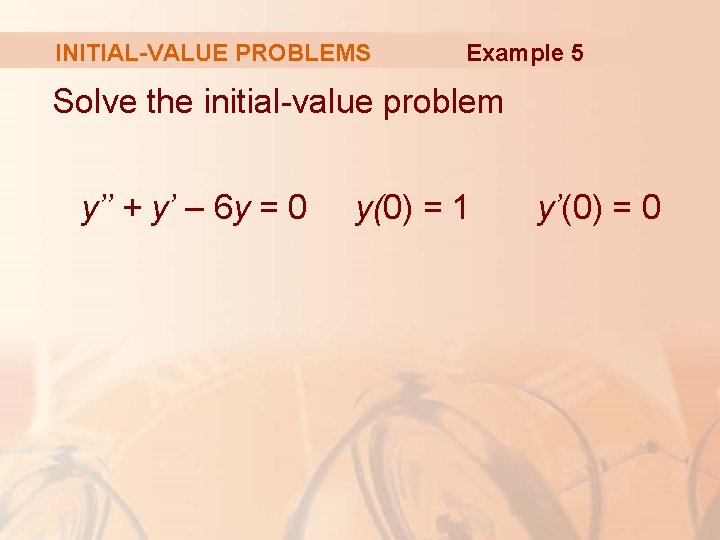
INITIAL-VALUE PROBLEMS Example 5 Solve the initial-value problem y’’ + y’ – 6 y = 0 y(0) = 1 y’(0) = 0
INITIAL-VALUE PROBLEMS Example 5 From Example 1, we know that the general solution of the differential equation is: y(x) = c 1 e 2 x + c 2 e– 3 x § Differentiating this solution, we get: y’(x) = 2 c 1 e 2 x – 3 c 2 e– 3 x
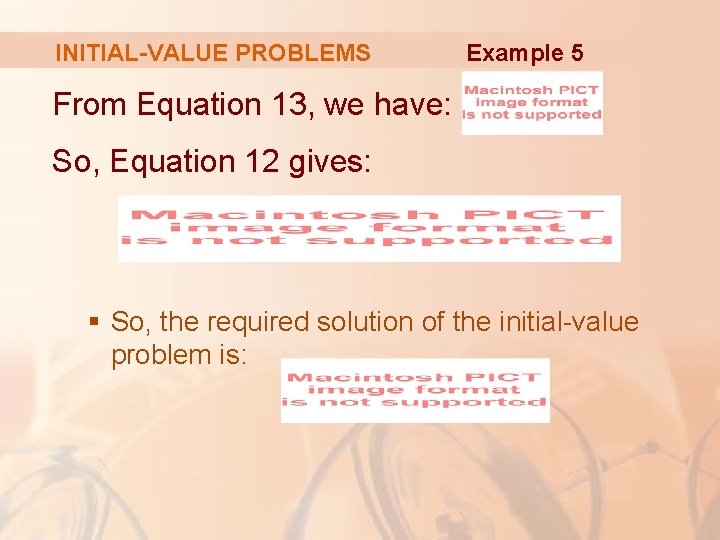
INITIAL-VALUE PROBLEMS E. g. 5—Eqns. 12 -13 To satisfy the initial conditions, we require that: y(0) = c 1 + c 2 = 1 y’(0) = 2 c 1 – 3 c 2 = 0
INITIAL-VALUE PROBLEMS Example 5 From Equation 13, we have: So, Equation 12 gives: § So, the required solution of the initial-value problem is:
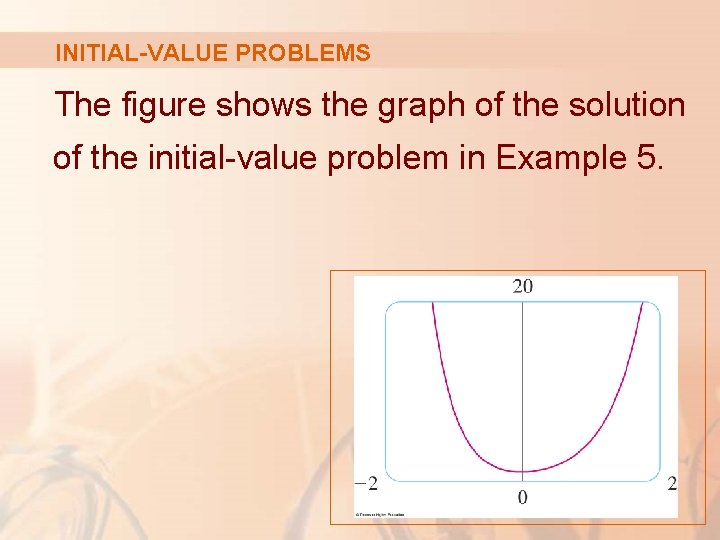
INITIAL-VALUE PROBLEMS The figure shows the graph of the solution of the initial-value problem in Example 5.
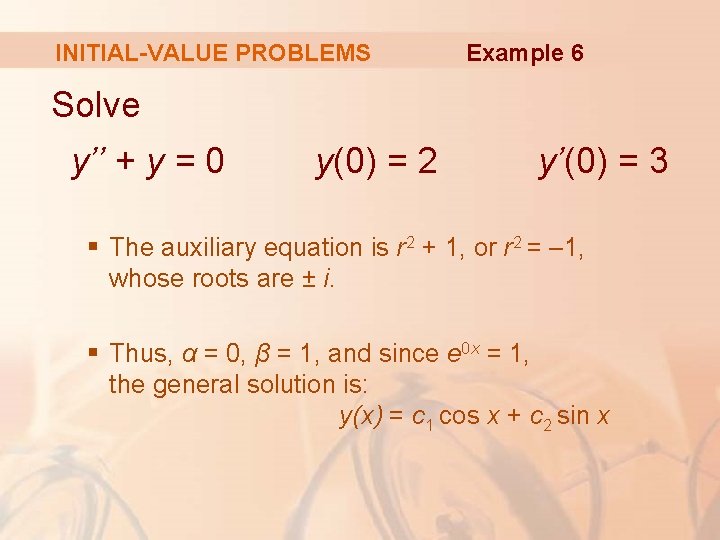
INITIAL-VALUE PROBLEMS Example 6 Solve y’’ + y = 0 y(0) = 2 y’(0) = 3 § The auxiliary equation is r 2 + 1, or r 2 = – 1, whose roots are ± i. § Thus, α = 0, β = 1, and since e 0 x = 1, the general solution is: y(x) = c 1 cos x + c 2 sin x
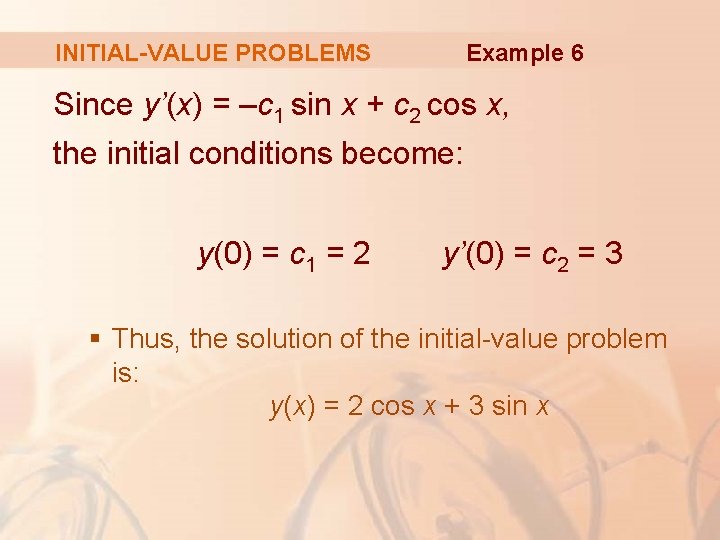
Example 6 INITIAL-VALUE PROBLEMS Since y’(x) = –c 1 sin x + c 2 cos x, the initial conditions become: y(0) = c 1 = 2 y’(0) = c 2 = 3 § Thus, the solution of the initial-value problem is: y(x) = 2 cos x + 3 sin x
INITIAL-VALUE PROBLEMS The solution to Example 6 appears to be a shifted sine curve. § Indeed, you can verify that another way of writing the solution is:
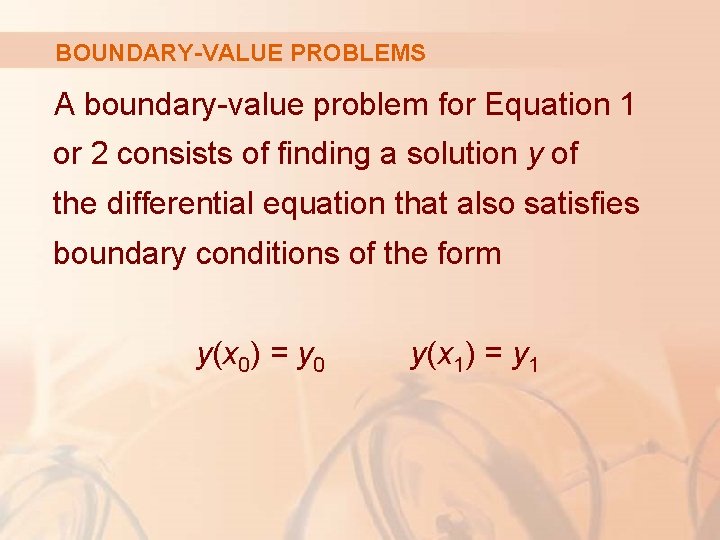
BOUNDARY-VALUE PROBLEMS A boundary-value problem for Equation 1 or 2 consists of finding a solution y of the differential equation that also satisfies boundary conditions of the form y(x 0) = y 0 y(x 1) = y 1
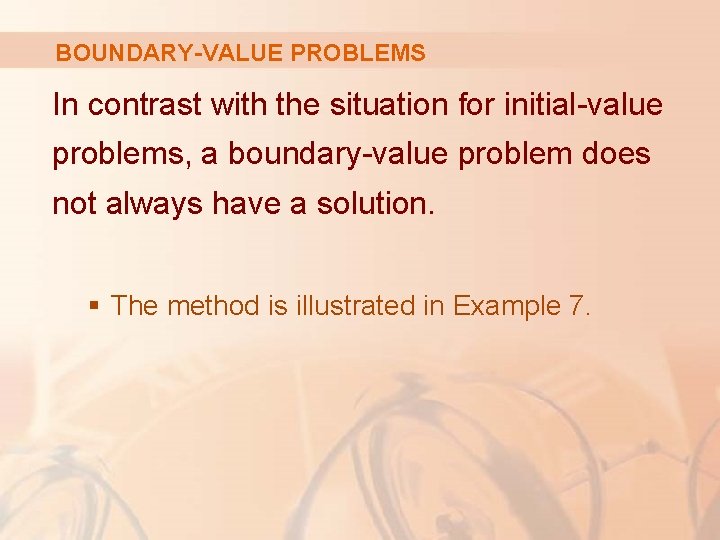
BOUNDARY-VALUE PROBLEMS In contrast with the situation for initial-value problems, a boundary-value problem does not always have a solution. § The method is illustrated in Example 7.
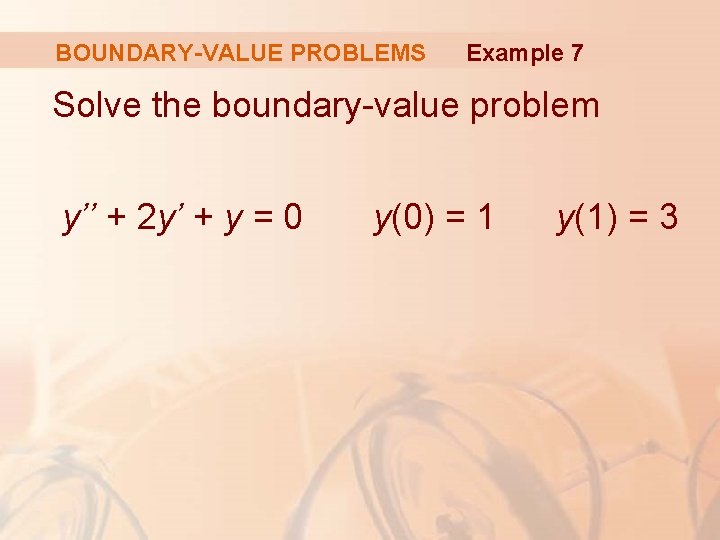
BOUNDARY-VALUE PROBLEMS Example 7 Solve the boundary-value problem y’’ + 2 y’ + y = 0 y(0) = 1 y(1) = 3
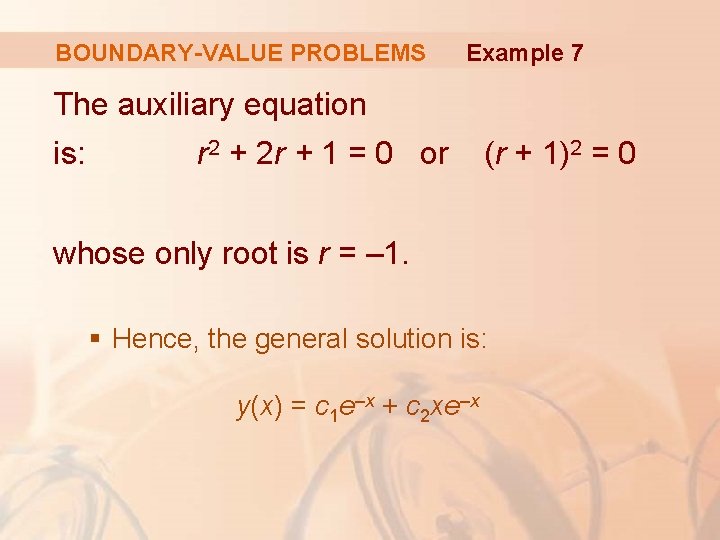
BOUNDARY-VALUE PROBLEMS Example 7 The auxiliary equation is: r 2 + 2 r + 1 = 0 or (r + 1)2 = 0 whose only root is r = – 1. § Hence, the general solution is: y(x) = c 1 e–x + c 2 xe–x
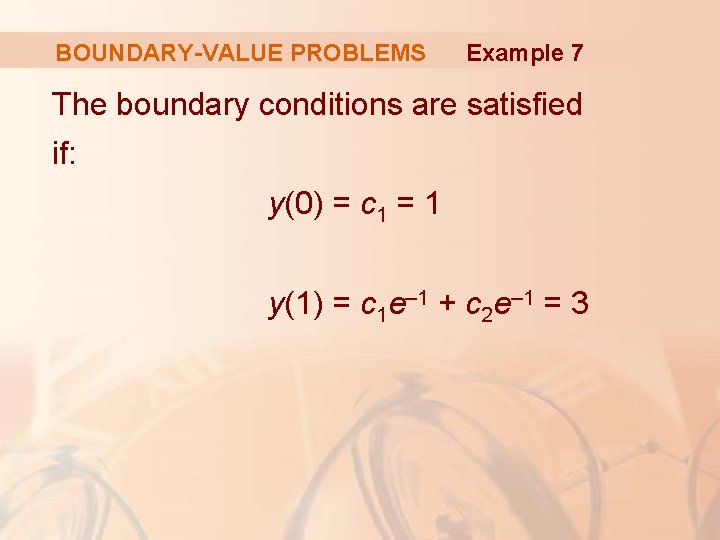
BOUNDARY-VALUE PROBLEMS Example 7 The boundary conditions are satisfied if: y(0) = c 1 = 1 y(1) = c 1 e– 1 + c 2 e– 1 = 3
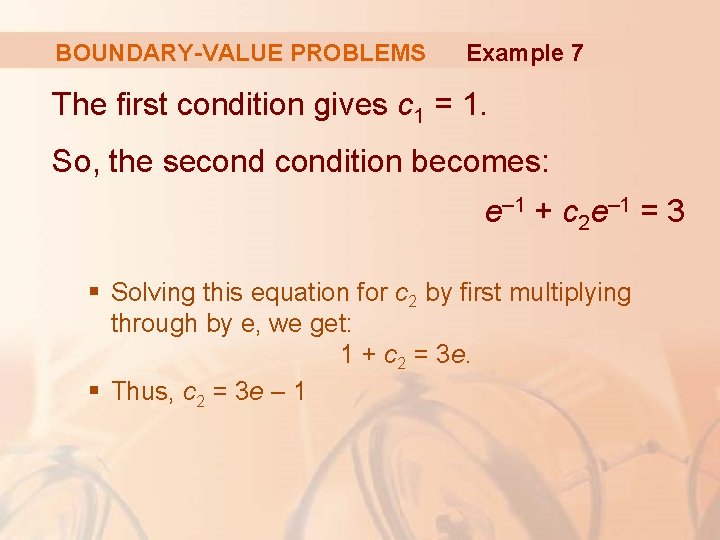
BOUNDARY-VALUE PROBLEMS Example 7 The first condition gives c 1 = 1. So, the secondition becomes: e– 1 + c 2 e– 1 = 3 § Solving this equation for c 2 by first multiplying through by e, we get: 1 + c 2 = 3 e. § Thus, c 2 = 3 e – 1
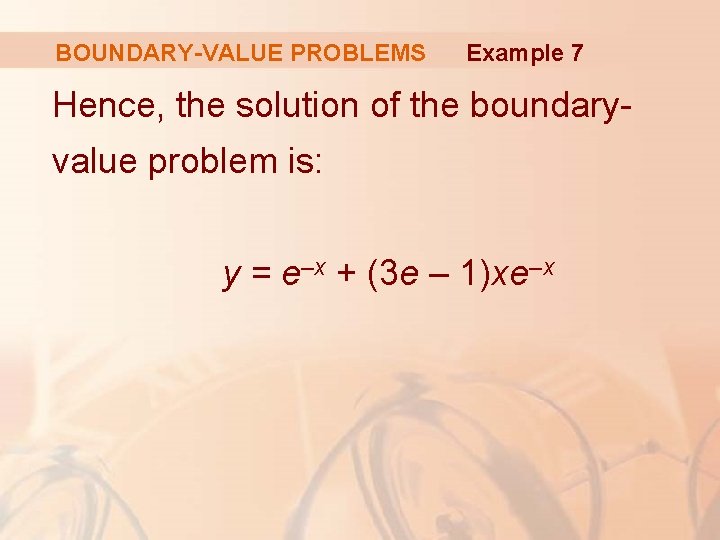
BOUNDARY-VALUE PROBLEMS Example 7 Hence, the solution of the boundaryvalue problem is: y = e–x + (3 e – 1)xe–x
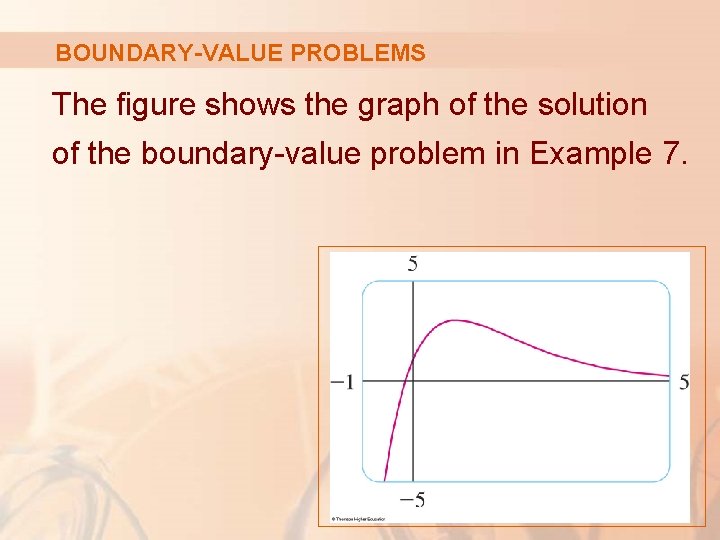
BOUNDARY-VALUE PROBLEMS The figure shows the graph of the solution of the boundary-value problem in Example 7.
SUMMARY The solutions of ay’’ + by’ + c = 0 are summarized here.