
17 Maintenance and Reliability Power Point presentation to
17 Maintenance and Reliability Power. Point presentation to accompany Heizer and Render Operations Management, 10 e Principles of Operations Management, 8 e Power. Point slides by Jeff Heyl Additional content from Gerry Cook © 2011 Pearson Education, Inc. publishing as Prentice Hall 17 - 1
Strategic Importance of Maintenance and Reliability The objective of maintenance and reliability is to maintain the capability of the system © 2011 Pearson Education, Inc. publishing as Prentice Hall 17 - 2

Maintenance and Reliability u Maintenance is all activities involved in keeping a system’s equipment in working order u Reliability is the probability that a machine will function properly for a specified time © 2011 Pearson Education, Inc. publishing as Prentice Hall 17 - 3
Important Tactics u Reliability u Improving individual components u Providing redundancy u Maintenance u Implementing or improving preventive maintenance u Increasing repair capability or speed © 2011 Pearson Education, Inc. publishing as Prentice Hall 17 - 4
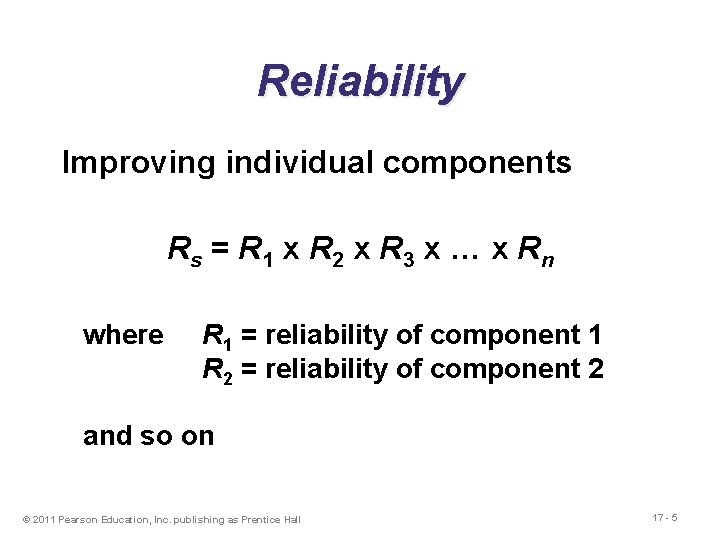
Reliability Improving individual components Rs = R 1 x R 2 x R 3 x … x R n where R 1 = reliability of component 1 R 2 = reliability of component 2 and so on © 2011 Pearson Education, Inc. publishing as Prentice Hall 17 - 5
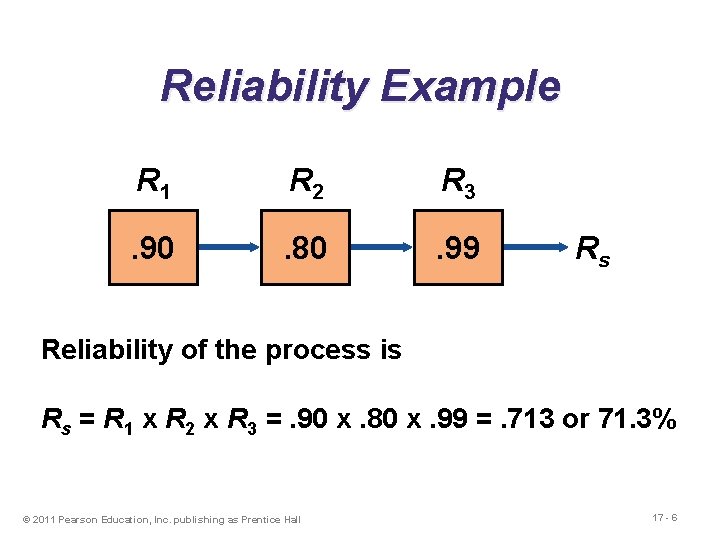
Reliability Example R 1 R 2 R 3 . 90 . 80 . 99 Rs Reliability of the process is Rs = R 1 x R 2 x R 3 =. 90 x. 80 x. 99 =. 713 or 71. 3% © 2011 Pearson Education, Inc. publishing as Prentice Hall 17 - 6
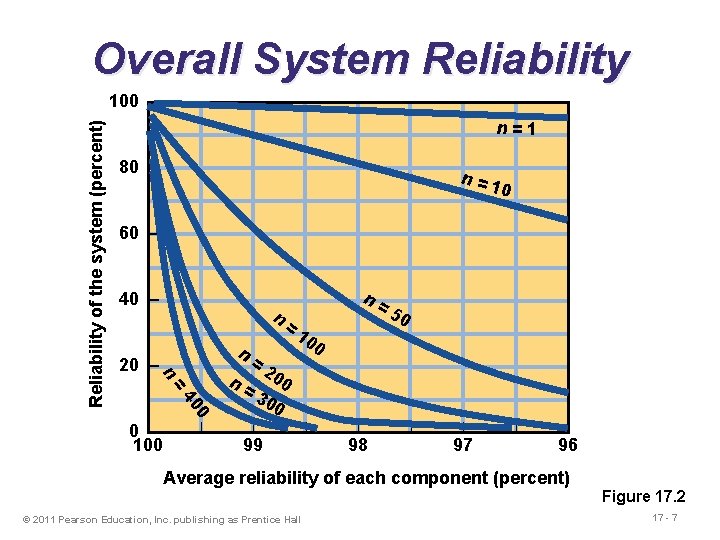
Overall System Reliability n=1 80 – n=1 0 60 – 40 – n n 20 – n = 40 Reliability of the system (percent) 100 – | 10 50 0 = 20 0 30 0 n= 0 0 |– 100 = n= | 99 | | 98 | | 97 | | 96 Average reliability of each component (percent) © 2011 Pearson Education, Inc. publishing as Prentice Hall Figure 17. 2 17 - 7
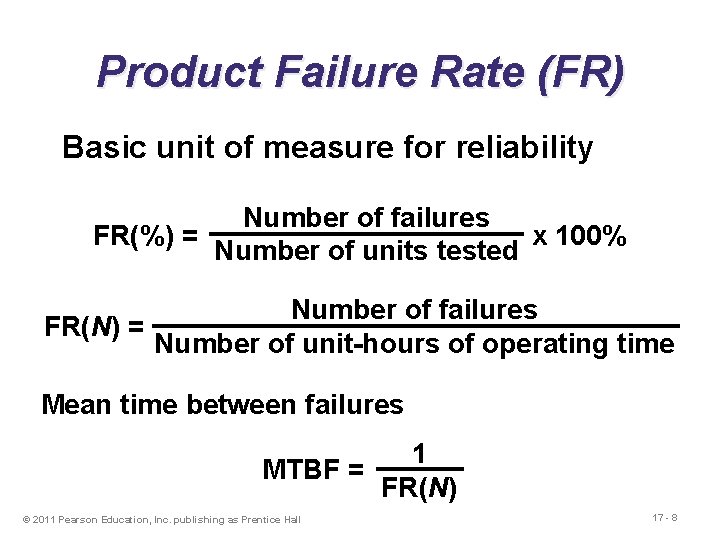
Product Failure Rate (FR) Basic unit of measure for reliability Number of failures FR(%) = x 100% Number of units tested Number of failures FR(N) = Number of unit-hours of operating time Mean time between failures 1 MTBF = FR(N) © 2011 Pearson Education, Inc. publishing as Prentice Hall 17 - 8
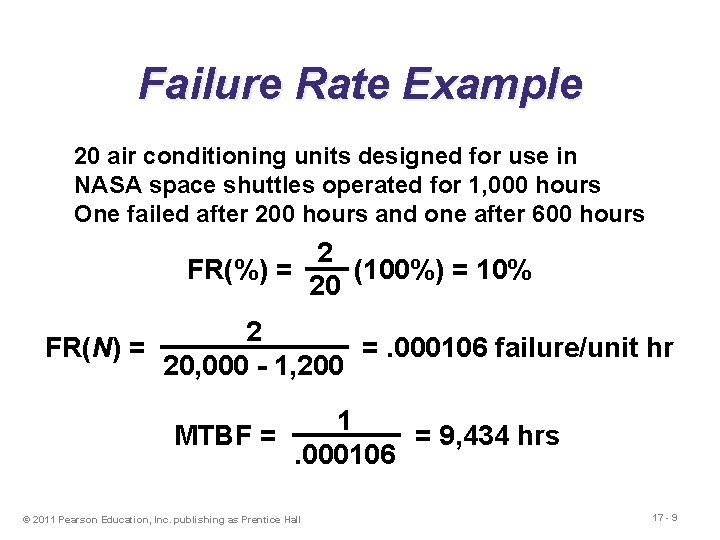
Failure Rate Example 20 air conditioning units designed for use in NASA space shuttles operated for 1, 000 hours One failed after 200 hours and one after 600 hours 2 FR(%) = (100%) = 10% 20 2 FR(N) = =. 000106 failure/unit hr 20, 000 - 1, 200 1 MTBF = = 9, 434 hrs. 000106 © 2011 Pearson Education, Inc. publishing as Prentice Hall 17 - 9
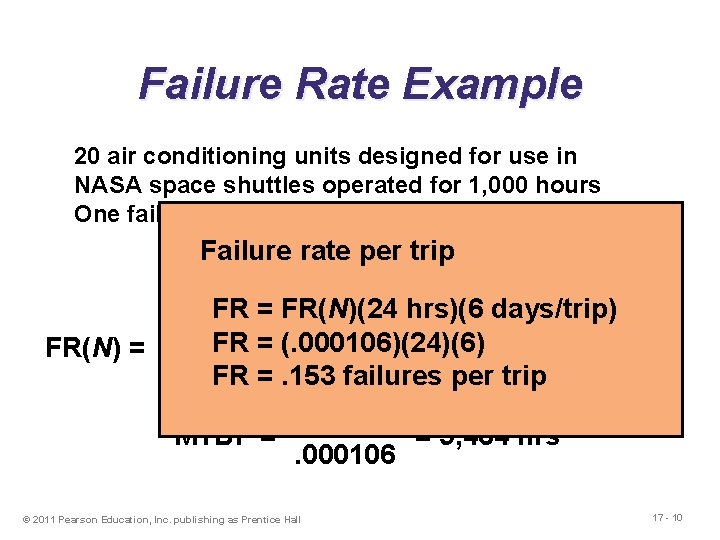
Failure Rate Example 20 air conditioning units designed for use in NASA space shuttles operated for 1, 000 hours One failed after 200 hours and one after 600 hours Failure rate 2 per trip FR(%) = (100%) = 10% 20 FR = FR(N)(24 hrs)(6 days/trip) 2= (. 000106)(24)(6) FR FR(N) = =. 000106 failure/unit hr 20, 000 FR -=1, 200. 153 failures per trip 1 MTBF = = 9, 434 hrs. 000106 © 2011 Pearson Education, Inc. publishing as Prentice Hall 17 - 10
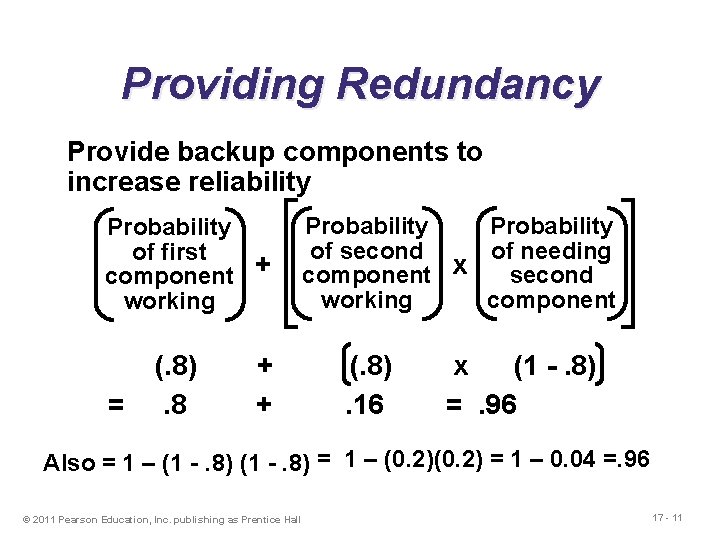
Providing Redundancy Provide backup components to increase reliability Probability of first component + working = (. 8). 8 + + Probability of second of needing component x second working component (. 8). 16 x (1 -. 8) =. 96 Also = 1 – (1 -. 8) = 1 – (0. 2) = 1 – 0. 04 =. 96 © 2011 Pearson Education, Inc. publishing as Prentice Hall 17 - 11
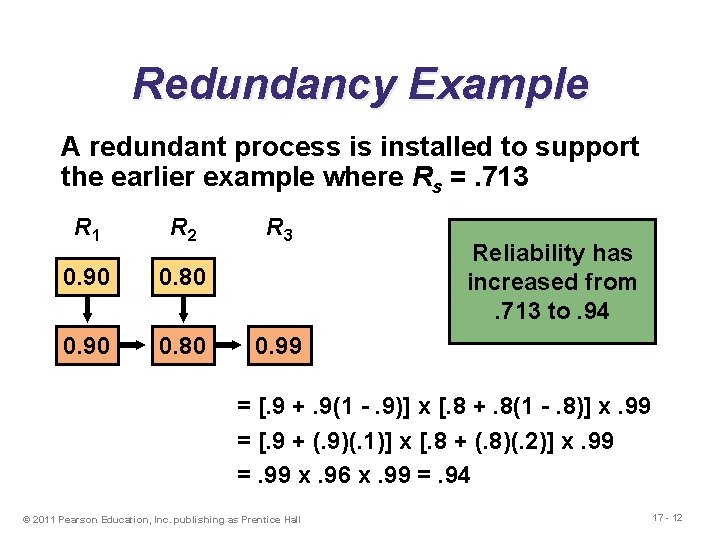
Redundancy Example A redundant process is installed to support the earlier example where Rs =. 713 R 1 R 2 0. 90 0. 80 R 3 Reliability has increased from. 713 to. 94 0. 99 = [. 9 +. 9(1 -. 9)] x [. 8 +. 8(1 -. 8)] x. 99 = [. 9 + (. 9)(. 1)] x [. 8 + (. 8)(. 2)] x. 99 =. 99 x. 96 x. 99 =. 94 © 2011 Pearson Education, Inc. publishing as Prentice Hall 17 - 12
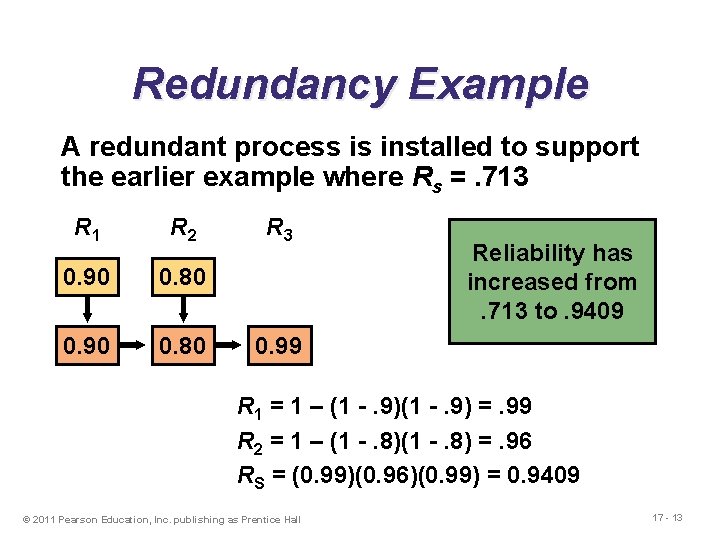
Redundancy Example A redundant process is installed to support the earlier example where Rs =. 713 R 1 R 2 0. 90 0. 80 R 3 Reliability has increased from. 713 to. 9409 0. 99 R 1 = 1 – (1 -. 9) =. 99 R 2 = 1 – (1 -. 8) =. 96 RS = (0. 99)(0. 96)(0. 99) = 0. 9409 © 2011 Pearson Education, Inc. publishing as Prentice Hall 17 - 13
Maintenance u Two types of maintenance u Preventive maintenance – routine inspection and servicing to keep facilities in good repair u Breakdown maintenance – emergency or priority repairs on failed equipment © 2011 Pearson Education, Inc. publishing as Prentice Hall 17 - 14
Implementing Preventive Maintenance u Need to know when a system requires service or is likely to fail u High initial failure rates are known as infant mortality u Once a product settles in, MTBF generally follows a normal distribution u Good reporting and record keeping can aid the decision on when preventive maintenance should be performed © 2011 Pearson Education, Inc. publishing as Prentice Hall 17 - 15
Maintenance Costs u The traditional view attempted to balance preventive and breakdown maintenance costs u Typically this approach failed to consider the true total cost of breakdowns u Inventory u Employee morale u Schedule unreliability © 2011 Pearson Education, Inc. publishing as Prentice Hall 17 - 16
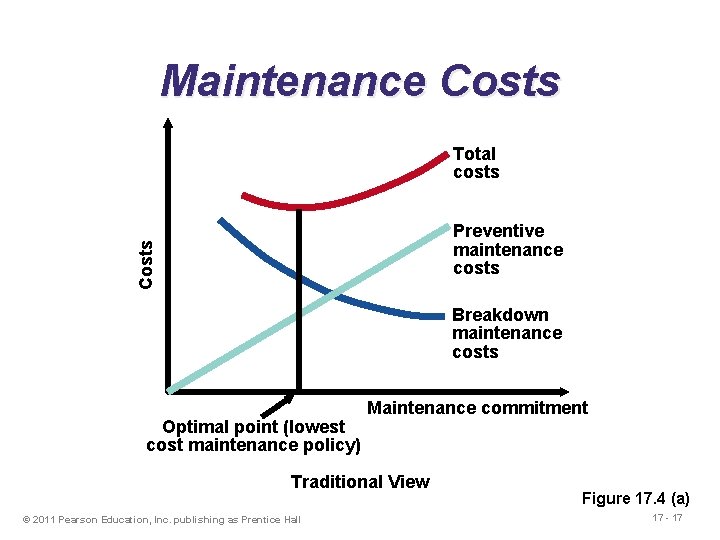
Maintenance Costs Total costs Costs Preventive maintenance costs Breakdown maintenance costs Optimal point (lowest cost maintenance policy) Maintenance commitment Traditional View © 2011 Pearson Education, Inc. publishing as Prentice Hall Figure 17. 4 (a) 17 - 17
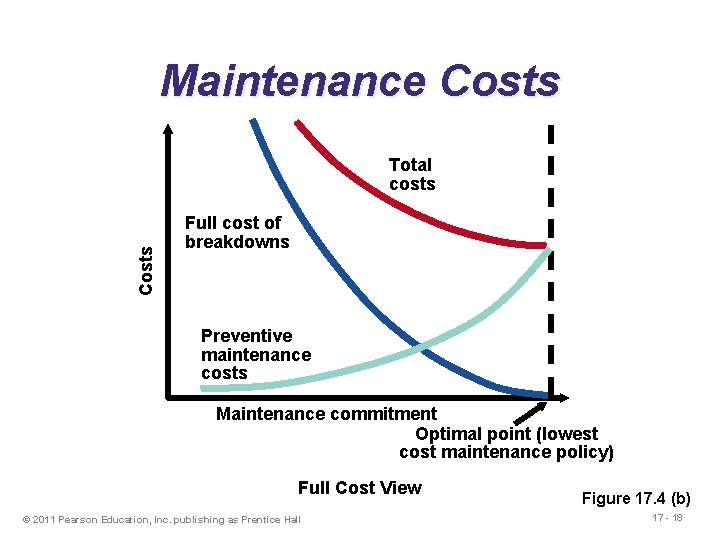
Maintenance Costs Total costs Full cost of breakdowns Preventive maintenance costs Maintenance commitment Optimal point (lowest cost maintenance policy) Full Cost View © 2011 Pearson Education, Inc. publishing as Prentice Hall Figure 17. 4 (b) 17 - 18
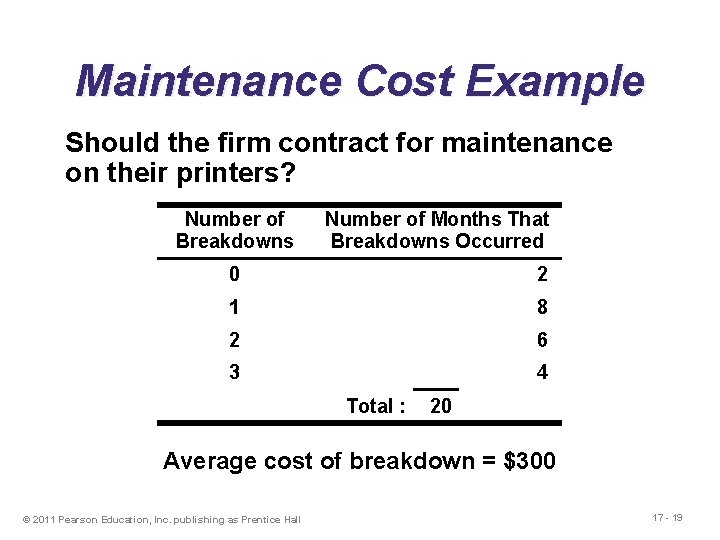
Maintenance Cost Example Should the firm contract for maintenance on their printers? Number of Breakdowns Number of Months That Breakdowns Occurred 0 2 1 8 2 6 3 4 Total : 20 Average cost of breakdown = $300 © 2011 Pearson Education, Inc. publishing as Prentice Hall 17 - 19
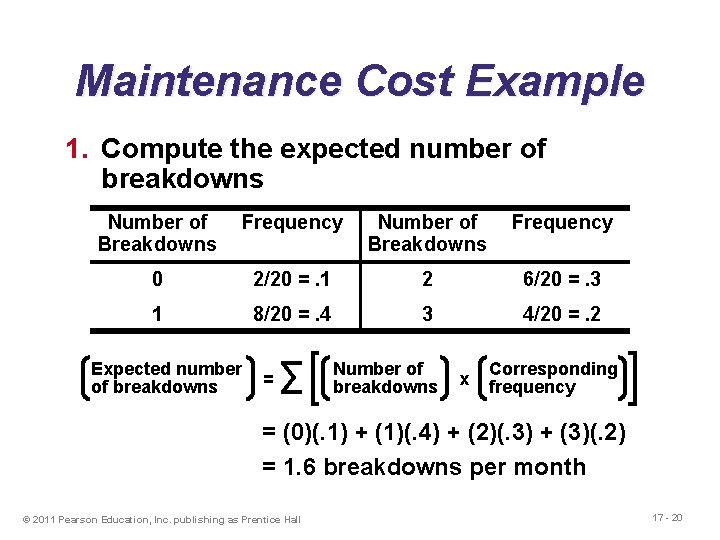
Maintenance Cost Example 1. Compute the expected number of breakdowns Number of Breakdowns Frequency 0 2/20 =. 1 2 6/20 =. 3 1 8/20 =. 4 3 4/20 =. 2 Expected number of breakdowns = ∑ Number of breakdowns x Corresponding frequency = (0)(. 1) + (1)(. 4) + (2)(. 3) + (3)(. 2) = 1. 6 breakdowns per month © 2011 Pearson Education, Inc. publishing as Prentice Hall 17 - 20
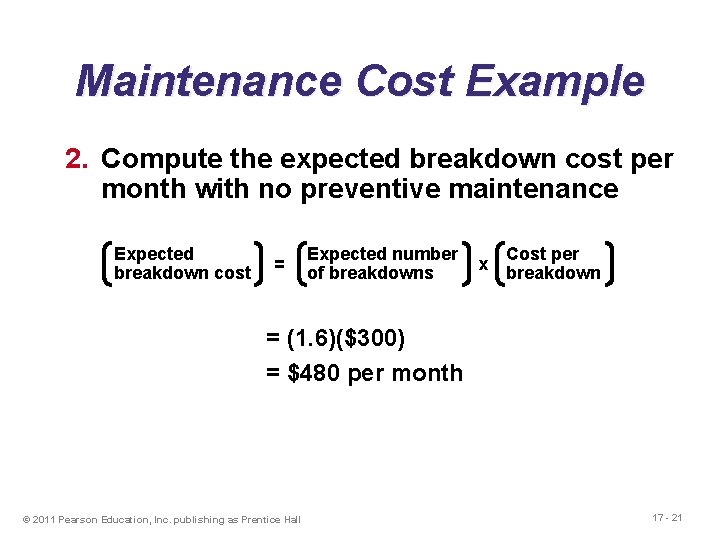
Maintenance Cost Example 2. Compute the expected breakdown cost per month with no preventive maintenance Expected breakdown cost = Expected number of breakdowns Cost per x breakdown = (1. 6)($300) = $480 per month © 2011 Pearson Education, Inc. publishing as Prentice Hall 17 - 21
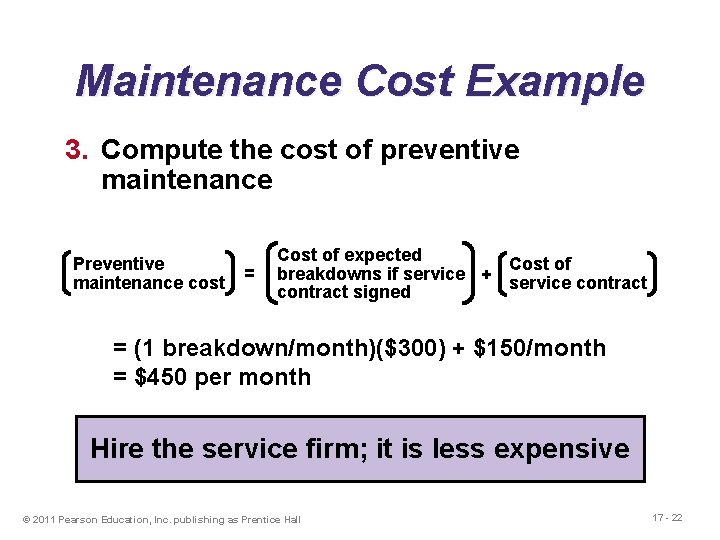
Maintenance Cost Example 3. Compute the cost of preventive maintenance = Preventive maintenance cost Cost of expected Cost of breakdowns if service + service contract signed = (1 breakdown/month)($300) + $150/month = $450 per month Hire the service firm; it is less expensive © 2011 Pearson Education, Inc. publishing as Prentice Hall 17 - 22
More on Maintenance – Supplemental Material u A simple redundancy formula u Problems with breakdown and preventive maintenance u Predictive maintenance tools u Maintenance strategy implementation u Effective reliability © 2011 Pearson Education, Inc. publishing as Prentice Hall 17 - 23
Problems With Breakdown Maintenance u “Run it till it breaks” u Might be ok for low criticality equipment or redundant systems u Could be disastrous for missioncritical plant machinery or equipment u Not permissible for systems that could imperil life or limb (like aircraft) © 2011 Pearson Education, Inc. publishing as Prentice Hall 17 - 24
Problems With Preventive Maintenance u “Fix it whether or not it is broken” u Scheduled replacement or adjustment of parts/equipment with a well-established service life u Typical example – plant relamping u Sometimes misapplied u Replacing old but still good bearings u Over-tightening electrical lugs in switchgear © 2011 Pearson Education, Inc. publishing as Prentice Hall 17 - 25
Another Maintenance Strategy u Predictive maintenance – Using advanced technology to monitor equipment and predict failures u Using technology to detect and predict imminent equipment failure u Visual inspection and/or scheduled measurements of vibration, temperature, oil and water quality u Measurements are compared to a “healthy” baseline u Equipment that is trending towards failure can be scheduled for repair © 2011 Pearson Education, Inc. publishing as Prentice Hall 17 - 26
Predictive Maintenance Tools u Vibration analysis u Infrared Thermography u Oil and Water Analysis u Other Tools: u Ultrasonic testing u Liquid Penetrant Dye testing u Shock Pulse Measurement (SPM) © 2011 Pearson Education, Inc. publishing as Prentice Hall 17 - 27
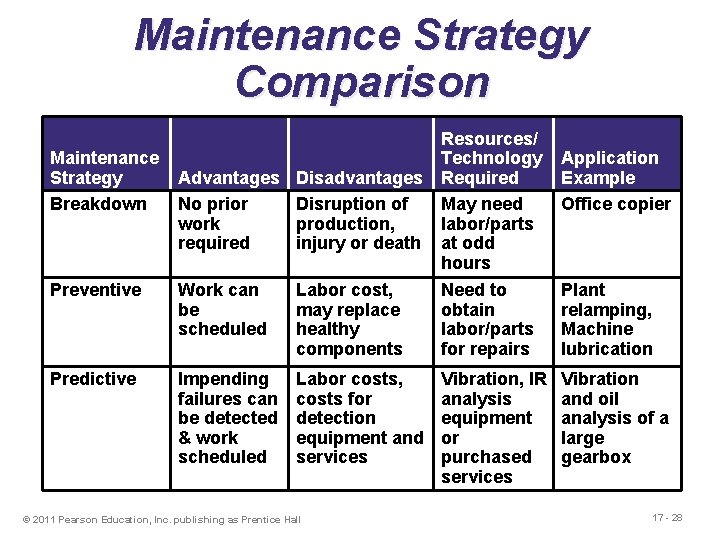
Maintenance Strategy Comparison Maintenance Strategy Breakdown Resources/ Technology Required May need labor/parts at odd hours Application Example Office copier Advantages No prior work required Disadvantages Disruption of production, injury or death Preventive Work can be scheduled Labor cost, may replace healthy components Need to obtain labor/parts for repairs Plant relamping, Machine lubrication Predictive Impending failures can be detected & work scheduled Labor costs, costs for detection equipment and services Vibration, IR analysis equipment or purchased services Vibration and oil analysis of a large gearbox © 2011 Pearson Education, Inc. publishing as Prentice Hall 17 - 28
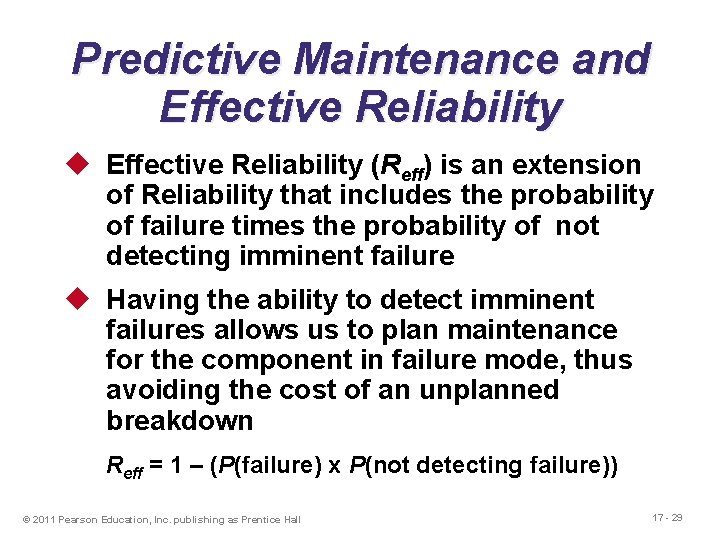
Predictive Maintenance and Effective Reliability u Effective Reliability (Reff) is an extension of Reliability that includes the probability of failure times the probability of not detecting imminent failure u Having the ability to detect imminent failures allows us to plan maintenance for the component in failure mode, thus avoiding the cost of an unplanned breakdown Reff = 1 – (P(failure) x P(not detecting failure)) © 2011 Pearson Education, Inc. publishing as Prentice Hall 17 - 29
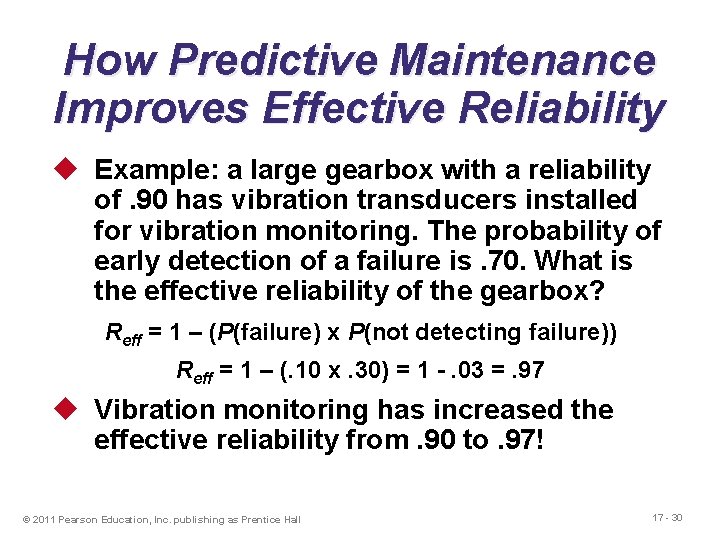
How Predictive Maintenance Improves Effective Reliability u Example: a large gearbox with a reliability of. 90 has vibration transducers installed for vibration monitoring. The probability of early detection of a failure is. 70. What is the effective reliability of the gearbox? Reff = 1 – (P(failure) x P(not detecting failure)) Reff = 1 – (. 10 x. 30) = 1 -. 03 =. 97 u Vibration monitoring has increased the effective reliability from. 90 to. 97! © 2011 Pearson Education, Inc. publishing as Prentice Hall 17 - 30
Effective Reliability Caveats u Predictive maintenance only increases effective reliability if: u You select the method that can detect the most likely failure mode u You monitor frequently enough to have high likelihood of detecting a change in component behavior before failure u Timely action is taken to fix the issue and forestall the failure (in other words you don’t ignore the warning!) © 2011 Pearson Education, Inc. publishing as Prentice Hall 17 - 31
- Slides: 31