
17 IMMUNIZATION AND IMMUNE TESTING Immunization Two Artificial
- Slides: 44
17 IMMUNIZATION AND IMMUNE TESTING
Immunization Two Artificial Methods of Immunity ◦ Active immunization ◦ Administration of antigens so patient actively mounts an adaptive immune response ◦ Passive immunization ◦ Individual acquires immunity through the transfer of antibodies formed by immune individual or animal
Immunization Brief History of Immunization ◦ Chinese noticed children who recovered from smallpox did not contract the disease again ◦ They infected children with material from a smallpox scab to induce immunity ◦ This process known as variolation ◦ Variolation spread to England America but was stopped due to risk of death
Immunization Brief History of Immunization ◦ 1796 – Edward Jenner discovered process of vaccination ◦ 1879 – Louis Pasteur developed a vaccine against Pasteurella multocida ◦ Antibody transfer developed when it was discovered vaccines protected through the action of antibodies
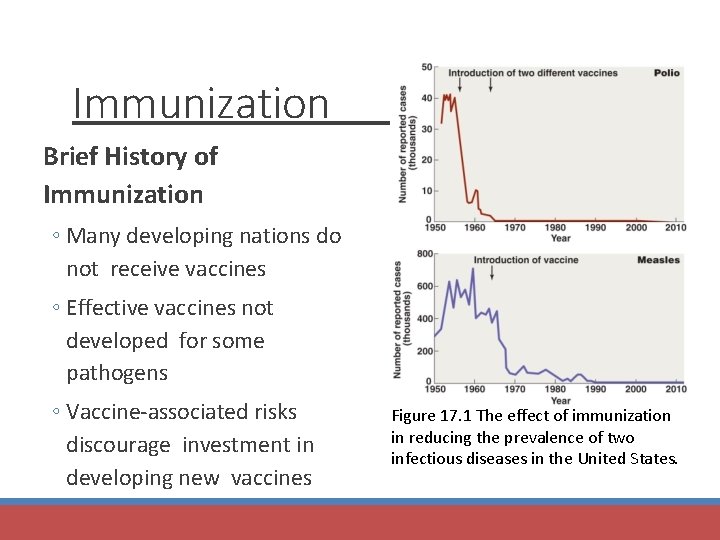
Immunization Brief History of Immunization ◦ Many developing nations do not receive vaccines ◦ Effective vaccines not developed for some pathogens ◦ Vaccine-associated risks discourage investment in developing new vaccines Figure 17. 1 The effect of immunization in reducing the prevalence of two infectious diseases in the United States.
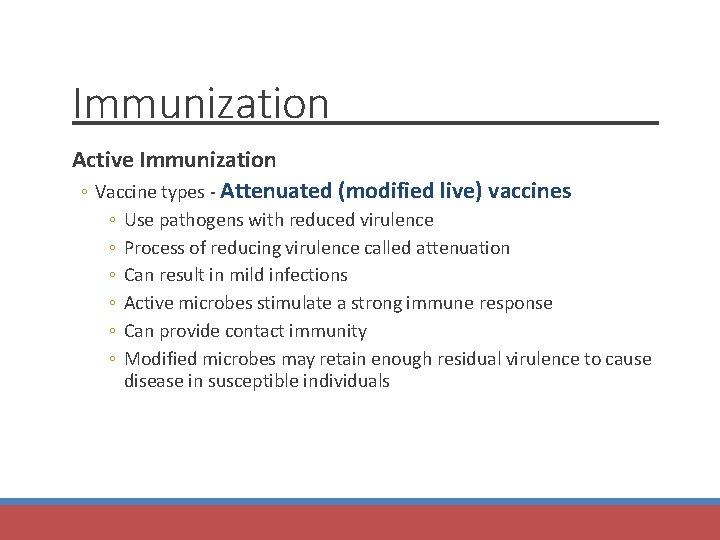
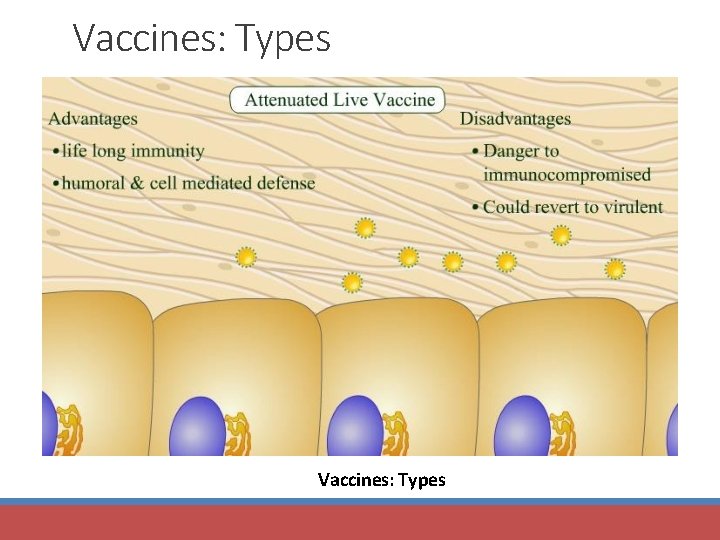
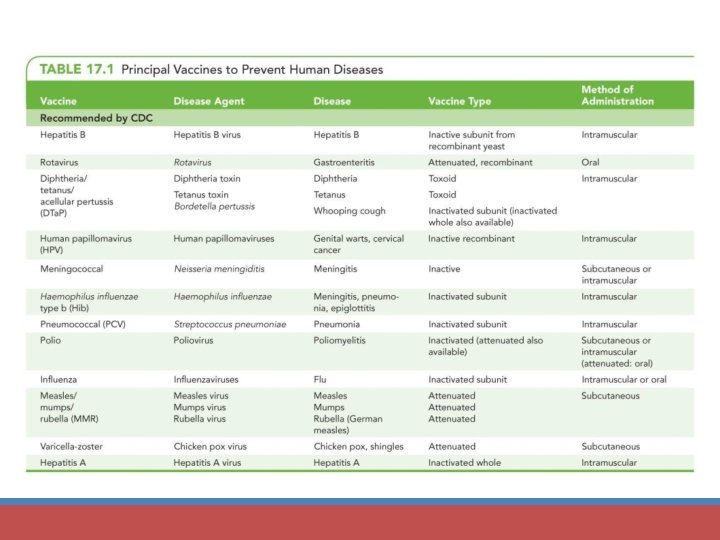
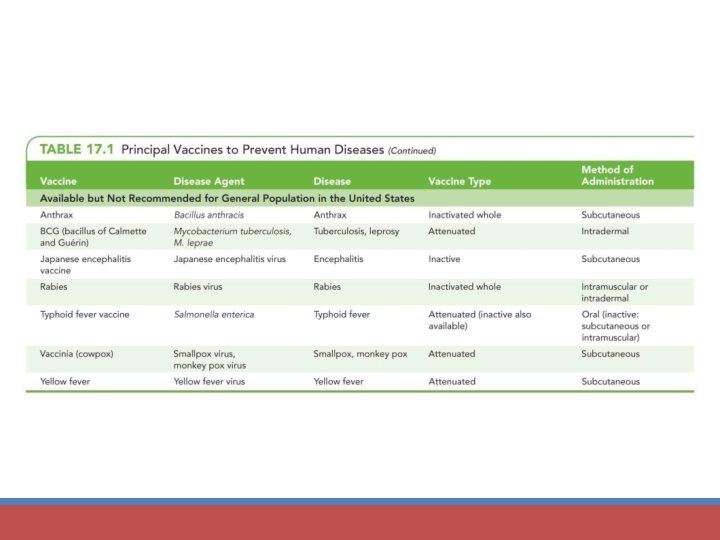
Immunization Active Immunization ◦ Vaccine types - Attenuated (modified live) vaccines ◦ ◦ ◦ Use pathogens with reduced virulence Process of reducing virulence called attenuation Can result in mild infections Active microbes stimulate a strong immune response Can provide contact immunity Modified microbes may retain enough residual virulence to cause disease in susceptible individuals
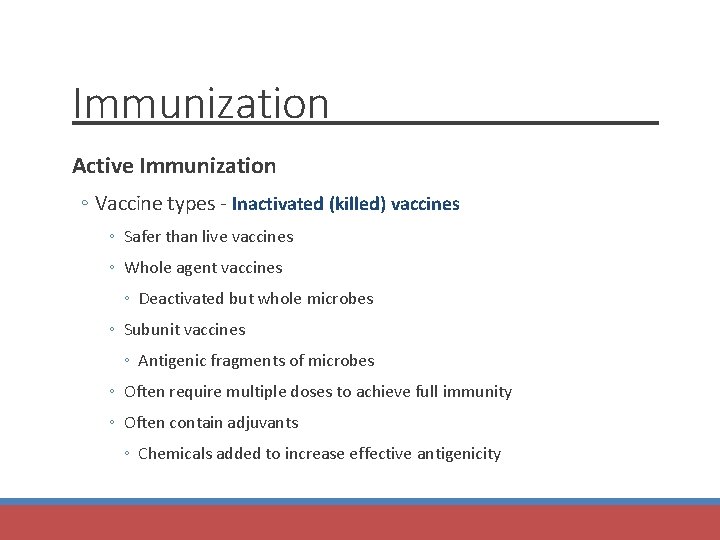
Immunization Active Immunization ◦ Vaccine types - Inactivated (killed) vaccines ◦ Safer than live vaccines ◦ Whole agent vaccines ◦ Deactivated but whole microbes ◦ Subunit vaccines ◦ Antigenic fragments of microbes ◦ Often require multiple doses to achieve full immunity ◦ Often contain adjuvants ◦ Chemicals added to increase effective antigenicity
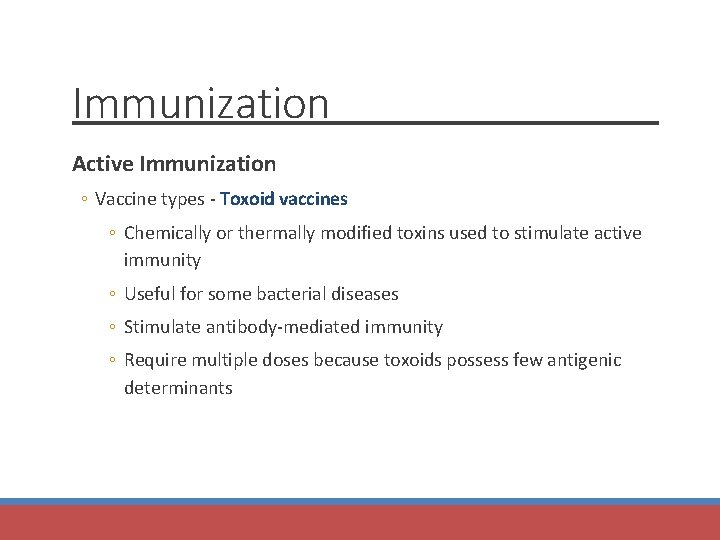
Immunization Active Immunization ◦ Vaccine types - Toxoid vaccines ◦ Chemically or thermally modified toxins used to stimulate active immunity ◦ Useful for some bacterial diseases ◦ Stimulate antibody-mediated immunity ◦ Require multiple doses because toxoids possess few antigenic determinants
Vaccines: Types
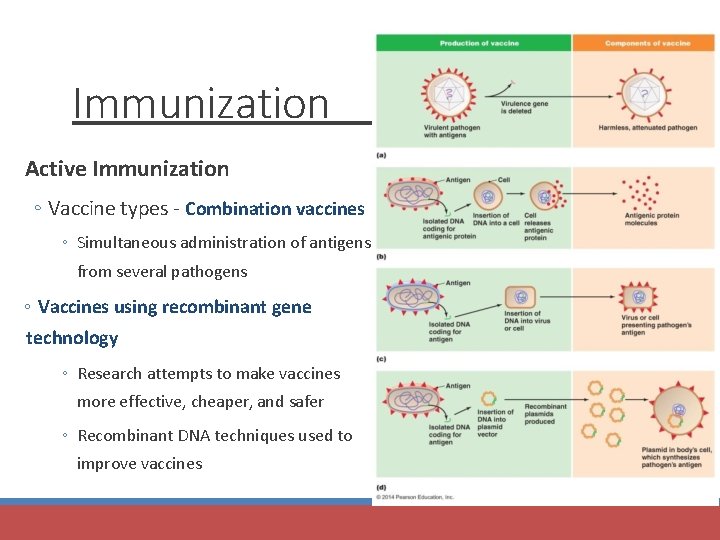
Immunization Active Immunization ◦ Vaccine types - Combination vaccines ◦ Simultaneous administration of antigens from several pathogens ◦ Vaccines using recombinant gene technology ◦ Research attempts to make vaccines more effective, cheaper, and safer ◦ Recombinant DNA techniques used to improve vaccines
Immunization Active Immunization ◦ Vaccine manufacture ◦ Mass-produce many vaccines by growing microbes in culture vessels ◦ Viruses are cultured inside chicken eggs ◦ Individuals with egg allergies must avoid some vaccines
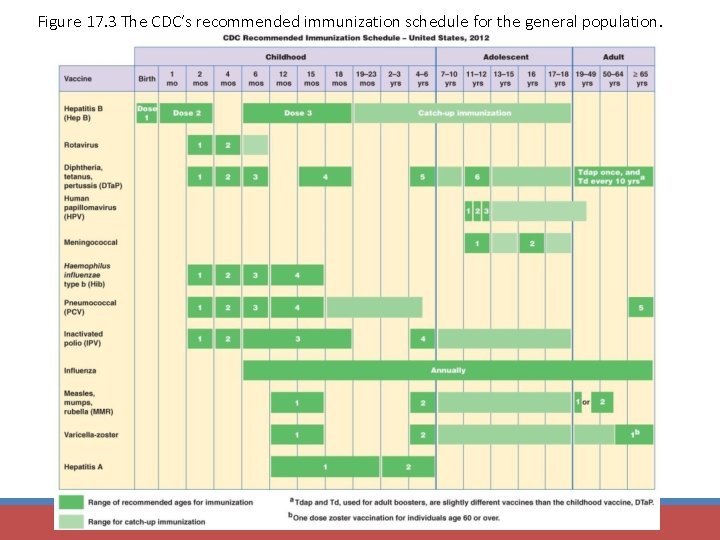
Figure 17. 3 The CDC’s recommended immunization schedule for the general population.
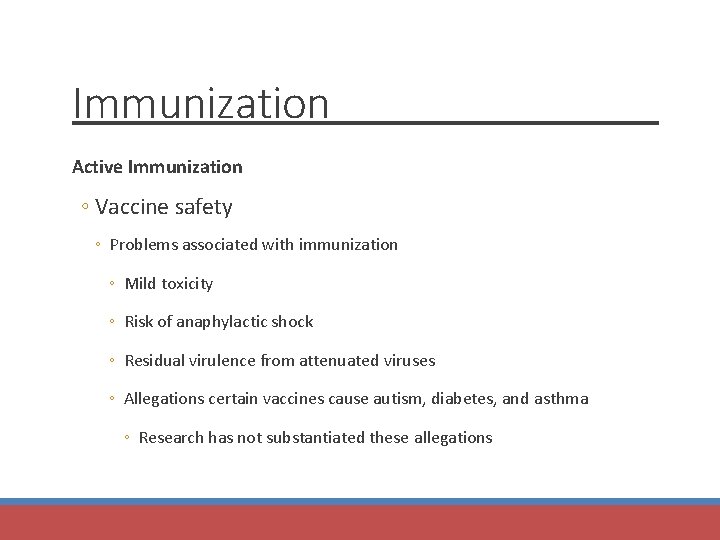
Immunization Active Immunization ◦ Vaccine safety ◦ Problems associated with immunization ◦ Mild toxicity ◦ Risk of anaphylactic shock ◦ Residual virulence from attenuated viruses ◦ Allegations certain vaccines cause autism, diabetes, and asthma ◦ Research has not substantiated these allegations
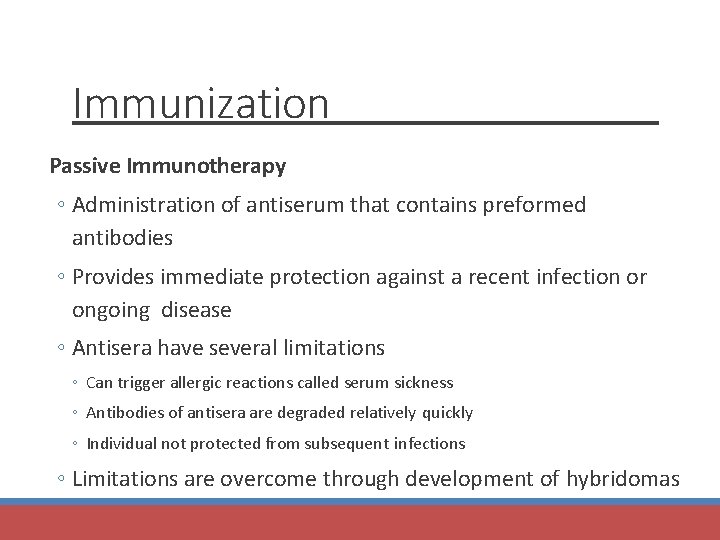
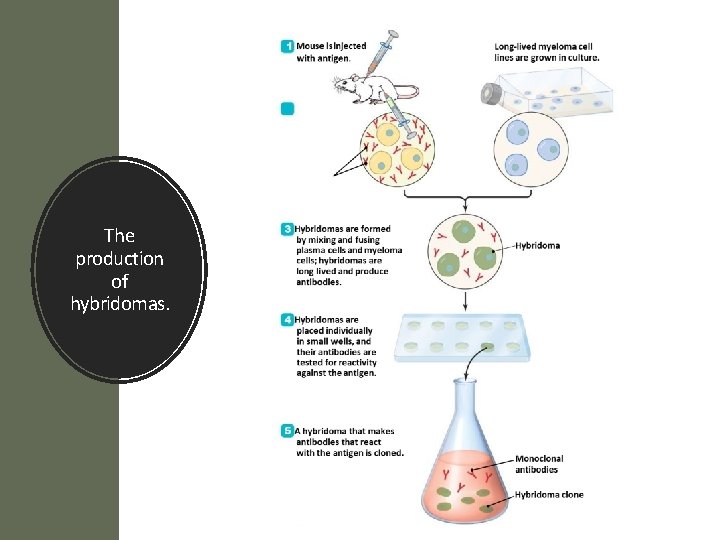
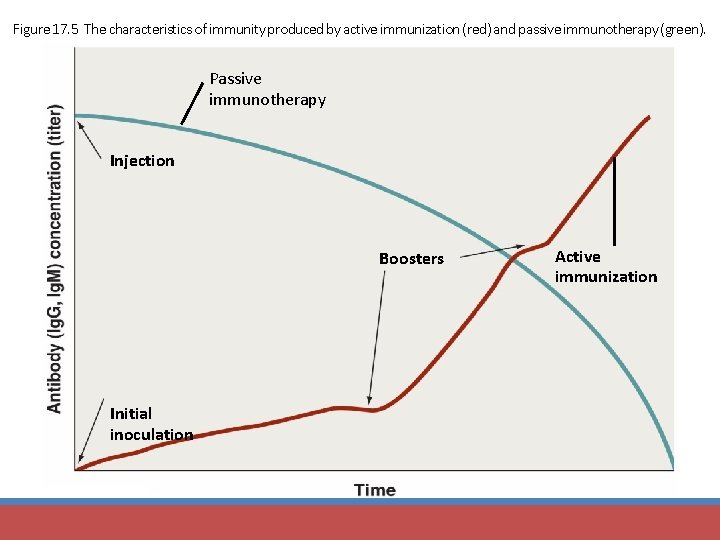
Immunization Passive Immunotherapy ◦ Administration of antiserum that contains preformed antibodies ◦ Provides immediate protection against a recent infection or ongoing disease ◦ Antisera have several limitations ◦ Can trigger allergic reactions called serum sickness ◦ Antibodies of antisera are degraded relatively quickly ◦ Individual not protected from subsequent infections ◦ Limitations are overcome through development of hybridomas
The production of hybridomas.
Figure 17. 5 The characteristics of immunity produced by active immunization (red) and passive immunotherapy (green). Passive immunotherapy Injection Boosters Initial inoculation Active immunization
Serological Tests That Use Antigens and Corresponding Antibodies § Serology is the determination of the presence of specific antigens or antibodies in blood serum § Serological tests available to identify a variety of § antigens and § antibodies in serum § Serological tests have several uses § Monitor the spread of infection within a population § Establish diagnosis of disease
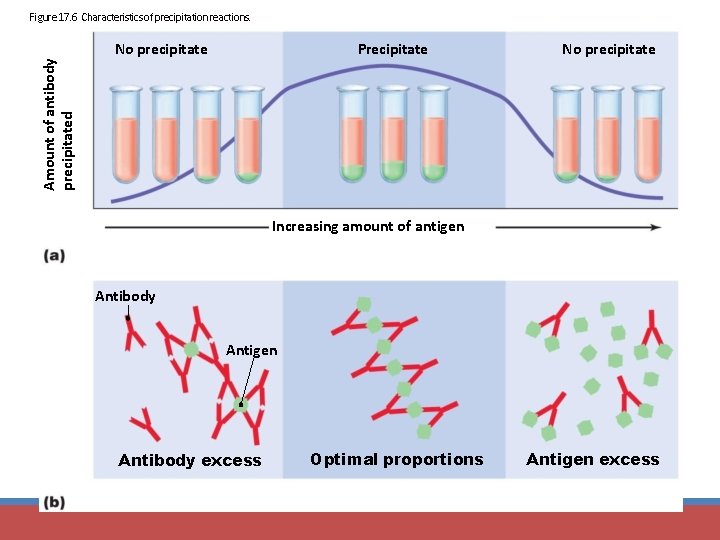
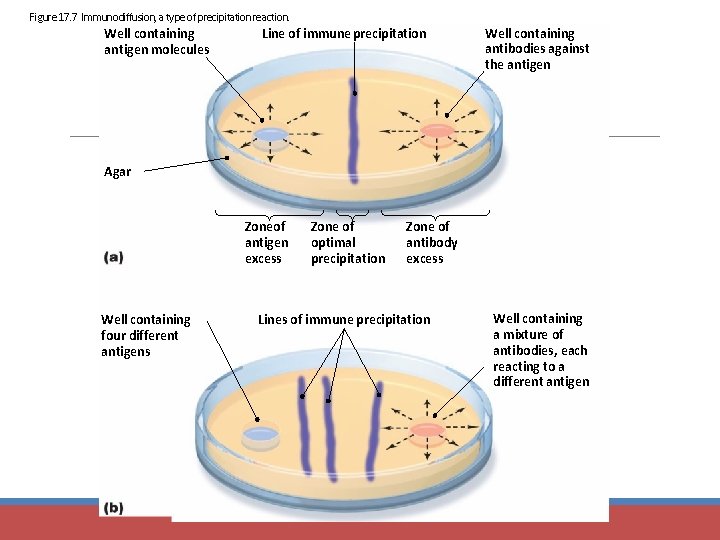
Serological Tests That Use Antigens and Corresponding Antibodies Precipitation Tests ◦ One of the simplest of serological tests ◦ Antigens and antibody mixed in the proper proportion form large complexes called precipitates ◦ Antigen-antibody complexes also called immune complexes
Amount of antibody precipitated Figure 17. 6 Characteristics of precipitation reactions. No precipitate Precipitate No precipitate Increasing amount of antigen Antibody Antigen Antibody excess Optimal proportions Antigen excess
Figure 17. 7 Immunodiffusion, a type of precipitation reaction. Well containing antigen molecules Line of immune precipitation Well containing antibodies against the antigen Agar Zoneof antigen excess Well containing four different antigens Zone of optimal precipitation Zone of antibody excess Lines of immune precipitation Well containing a mixture of antibodies, each reacting to a different antigen
Serological Tests That Use Antigens and Corresponding Antibodies Turbidimetric and Nephelometric Tests ◦ ◦ Turbidimetry and nephelometry measure the cloudiness of a solution Turbidimetry measures the light passing through a solution Nephelometry measures the light reflected from a solution Can be used to quantify the amounts of proteins in serum
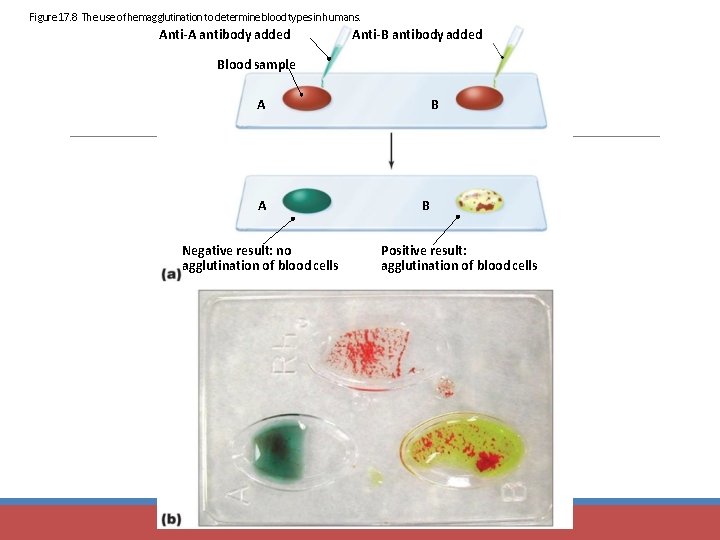
Serological Tests That Use Antigens and Corresponding Antibodies Agglutination Tests ◦ Agglutination occurs due to the cross-linking of antibodies with particulate antigens ◦ Agglutination is the clumping of insoluble particles ◦ Precipitation involves the aggregation of soluble molecules ◦ Reactions can be easy to see and interpret with the unaided eye ◦ Hemagglutination ◦ Agglutination of red blood cells ◦ Can be used to determine blood type
Figure 17. 8 The use of hemagglutination to determine blood types in humans. Anti-A antibody added Anti-B antibody added Blood sample B A A Negative result: no agglutination of blood cells B Positive result: agglutination of blood cells
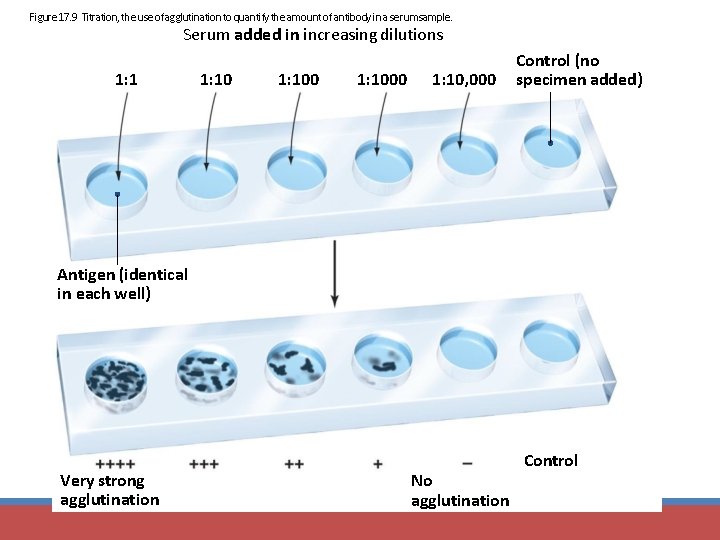
Figure 17. 9 Titration, the use of agglutination to quantify the amount of antibody in a serumsample. Serum added in increasing dilutions 1: 1000 1: 10, 000 Control (no specimen added) Antigen (identical in each well) Very strong agglutination No agglutination Control
Serological Tests That Use Antigens and Corresponding Antibodies ◦ Viral Neutralization ◦ Cytopathic effect ◦ Viruses introduced into appropriate cell cultures will kill the cells ◦ Ability of virus to kill culture cells is neutralized when virus is first mixed with antibodies against it ◦ Viral neutralization test ◦ Mixture of virus and serum added to cell culture ◦ Absence of cytopathic effect indicates presence of antibodies against the virus in the serum ◦ Identifies whether individual exposed to a particular virus
Serological Tests That Use Antigens and Corresponding Antibodies Neutralization Tests ◦ Viral hemagglutination inhibition test ◦ Useful for viruses that aren't cytopathic ◦ Based on viral hemagglutination ◦ Some viral surface proteins can clump red blood cells ◦ A serum sample that contains antibodies against a specific virus will inhibit viral hemagglutination ◦ Commonly used to detect antibodies against influenza, measles, and mumps
Serological Tests That Use Antigens and Corresponding Antibodies The Complement Fixation Test ◦ Based on generation of membrane attack complexes during complement activation ◦ Used to detect the presence of specific antibodies in an individual's serum ◦ Can detect antibody amounts too small to detect by agglutination ◦ Replaced by other serological methods
Serological Tests That Use Antigens and Corresponding Antibodies Labeled Antibody Test ◦ Uses antibody molecules linked to some "label" that enables them to be easily detected ◦ Used to detect either antigens or antibodies
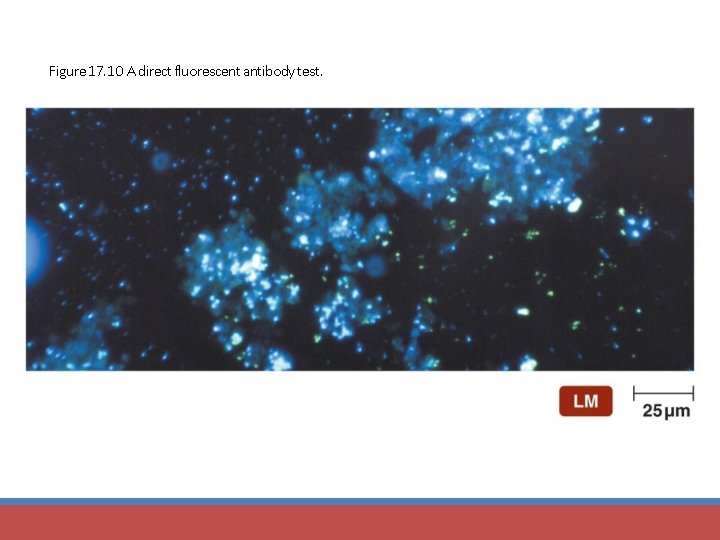
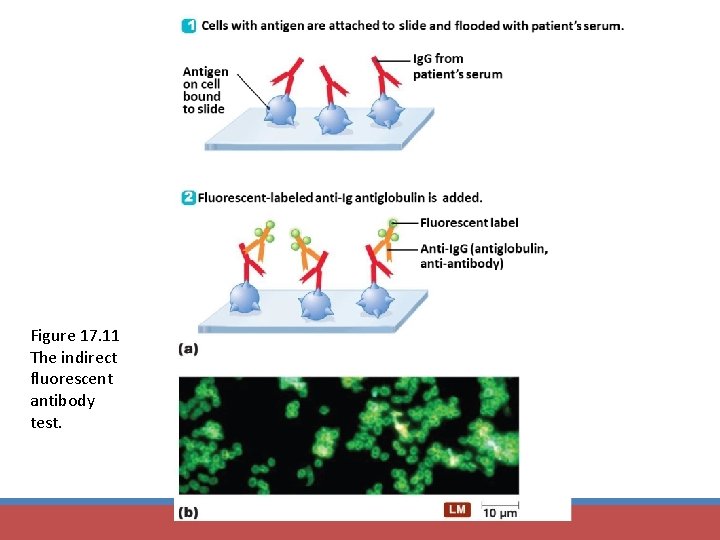
Serological Tests That Use Antigens and Corresponding Antibodies Labeled Antibody Test ◦ Fluorescent antibody tests ◦ Use fluorescent dyes as labels ◦ Fluorescently labeled antibodies used in two types of tests ◦ Direct fluorescent antibody tests ◦ Indirect fluorescent antibody tests
Figure 17. 10 A direct fluorescent antibody test.
Figure 17. 11 The indirect fluorescent antibody test.
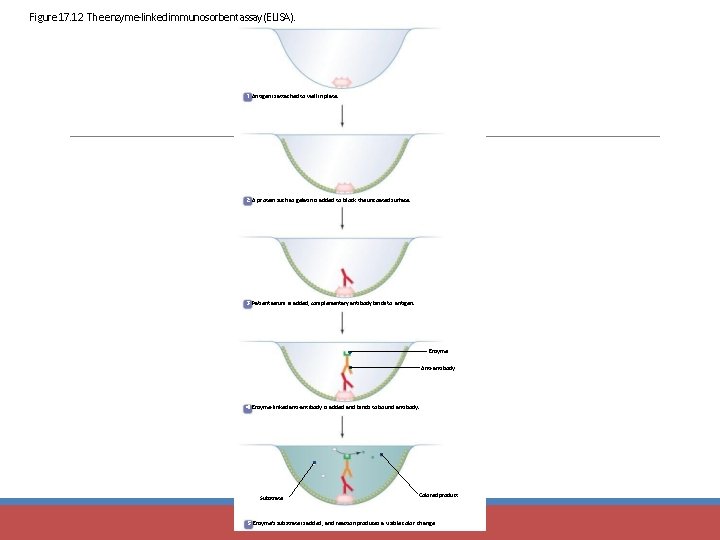
Serological Tests That Use Antigens and Corresponding Antibodies Labeled Antibody Test ◦ ELISAs ◦ Stands for enzyme-linked immunosorbent assay ◦ Uses an enzyme as the label ◦ Reaction of enzyme with its substrate produces a colored product indicating a positive test ◦ Commonly used to detect the presence of serum antibodies
Figure 17. 12 The enzyme-linked immunosorbent assay (ELISA). 1 Antigen is attached to well in plate. 2 A protein such as gelatin is added to block the uncoated surface. 3 Patient serum is added; complementary antibody binds to antigen. Enzyme Anti-antibody 4 Enzyme-linked anti-antibody is added and binds to bound antibody. Substrate Colored product 5 Enzyme’s substrate is added, and reaction produces a visible color change.
Serological Tests That Use Antigens and Corresponding Antibodies Labeled Antibody Test ◦ ELISAs ◦ Advantages of the ELISA ◦ Can detect either antibody or antigen ◦ Sensitive ◦ Can quantify amounts of antigen or antibody ◦ Easy to perform and can test many samples quickly ◦ Relatively inexpensive and easy to automate ◦ Plates coated with antigen can be stored for later testing
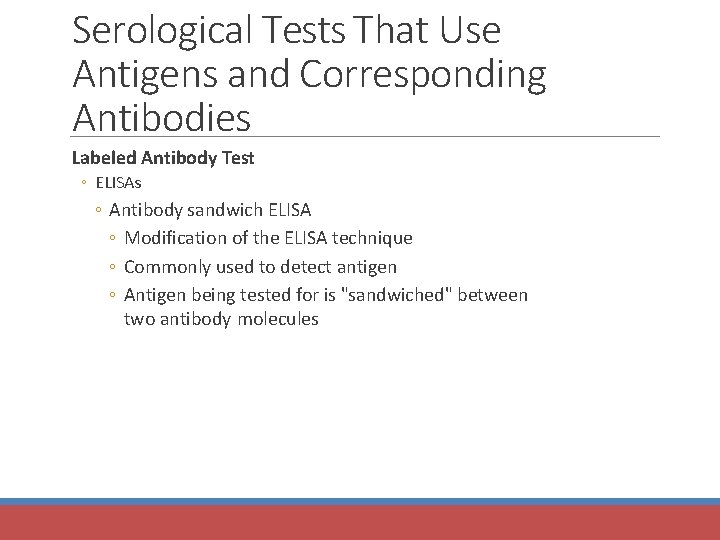
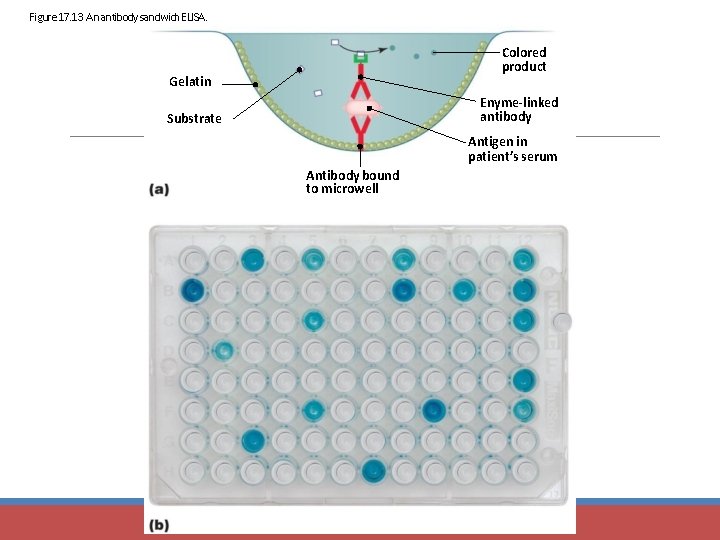
Serological Tests That Use Antigens and Corresponding Antibodies Labeled Antibody Test ◦ ELISAs ◦ Antibody sandwich ELISA ◦ Modification of the ELISA technique ◦ Commonly used to detect antigen ◦ Antigen being tested for is "sandwiched" between two antibody molecules
Figure 17. 13 An antibody sandwich ELISA. Colored product Gelatin Enyme-linked antibody Substrate Antigen in patient’s serum Antibody bound to microwell
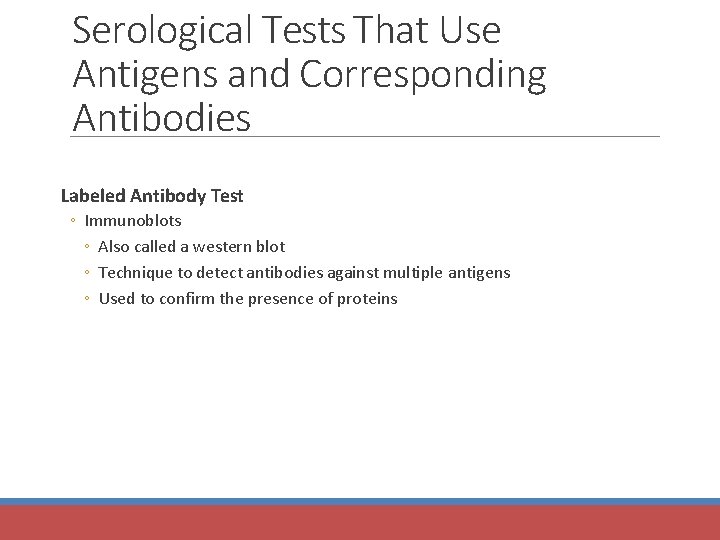
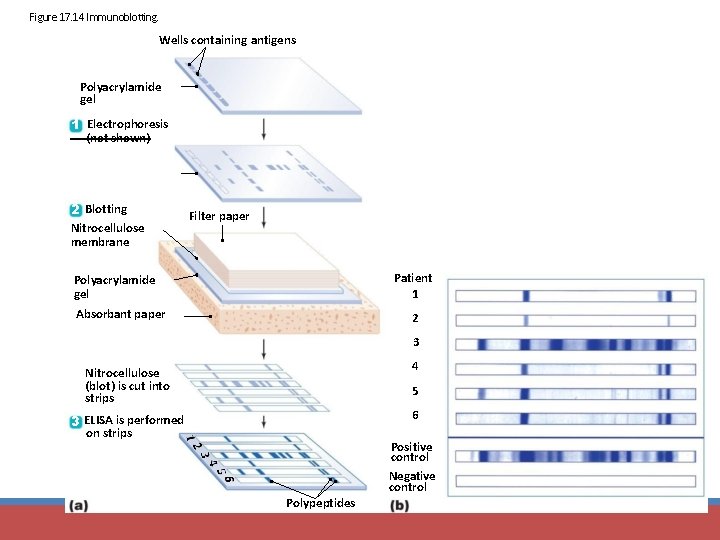
Serological Tests That Use Antigens and Corresponding Antibodies Labeled Antibody Test ◦ Immunoblots ◦ Also called a western blot ◦ Technique to detect antibodies against multiple antigens ◦ Used to confirm the presence of proteins
Figure 17. 14 Immunoblotting. Wells containing antigens Polyacrylamide gel 1 Electrophoresis (not shown) 2 Blotting Nitrocellulose membrane Filter paper Patient 1 Polyacrylamide gel Absorbant paper 2 3 4 Nitrocellulose (blot) is cut into strips 5 6 3 ELISA is performed on strips Positive control Negative control Polypeptides
Serological Tests That Use Antigens and Corresponding Antibodies Point-of-Care Testing ◦ Simple immunoassays that give results in minutes ◦ Useful in determining a quick diagnosis ◦ Common tests ◦ Immunofiltration assay ◦ Immunochromatography assay
Serological Tests That Use Antigens and Corresponding Antibodies Point-of-Care Testing ◦ Immunofiltration ◦ Rapid ELISA that uses antibodies bound to membrane filters rather than plates ◦ Reduced time to complete the assay ◦ Due to the large surface area of the membrane filter
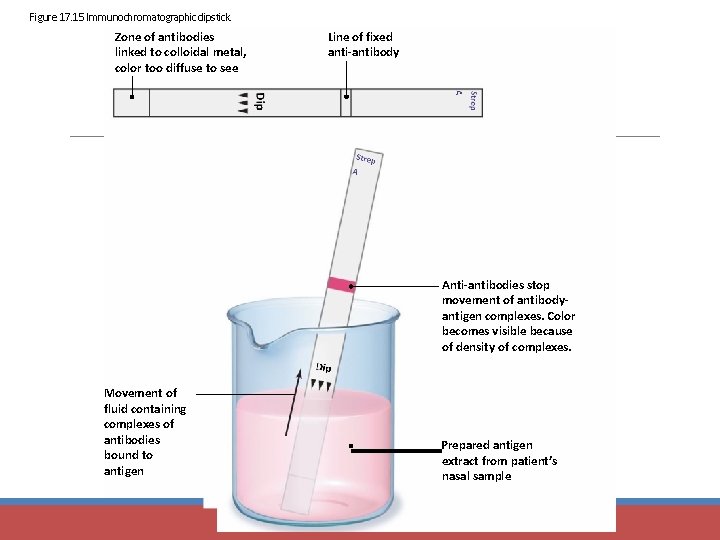
Serological Tests That Use Antigens and Corresponding Antibodies Recent Developments in Immune Testing ◦ Immunochromatography ◦ Very rapid and easy-to-read ELISAs ◦ Antigen solution flows through a porous strip ◦ Encounters labeled antibody ◦ Visible line produced when antigen-antibody immune complexes encounter antibody against them ◦ Used in pregnancy testing and for rapid identification of some infections
Figure 17. 15 Immunochromatographic dipstick. Zone of antibodies linked to colloidal metal, color too diffuse to see Line of fixed anti-antibody Anti-antibodies stop movement of antibodyantigen complexes. Color becomes visible because of density of complexes. Movement of fluid containing complexes of antibodies bound to antigen Prepared antigen extract from patient’s nasal sample