
17 4 RuleBased Expert Systems 19 l Expert
17. 4 Rule-Based Expert Systems (1/9) l Expert Systems ¨ One of the most successful applications of AI reasoning technique using facts and rules ¨ “AI Programs that achieve expert-level competence in solving problems by bringing to bear a body of knowledge [Feigenbaum, Mc. Corduck & Nii 1988]” Expert systems vs. knowledge-based systems l Rule-based expert systems l ¨ Often based on reasoning with propositional logic Horn clauses. (c) 2000 -2002 SNU CSE Biointelligence Lab 1
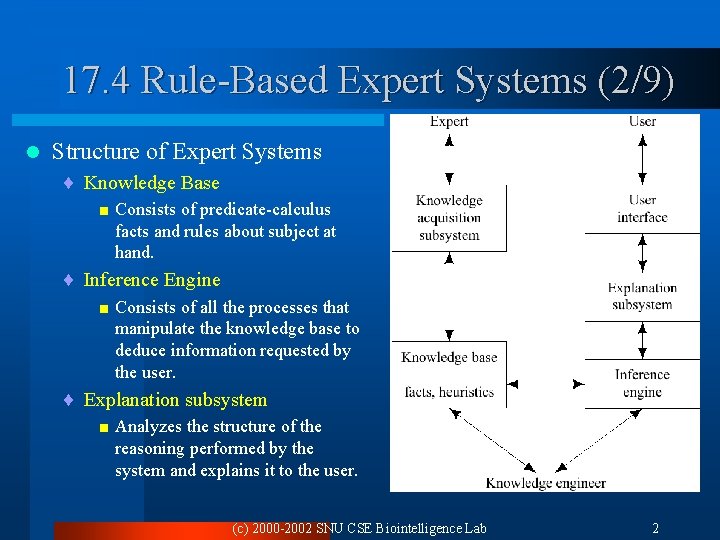
17. 4 Rule-Based Expert Systems (2/9) l Structure of Expert Systems ¨ Knowledge Base < Consists of predicate-calculus facts and rules about subject at hand. ¨ Inference Engine < Consists of all the processes that manipulate the knowledge base to deduce information requested by the user. ¨ Explanation subsystem < Analyzes the structure of the reasoning performed by the system and explains it to the user. (c) 2000 -2002 SNU CSE Biointelligence Lab 2
17. 4 Rule-Based Expert Systems (3/9) l Knowledge acquisition subsystem ¨ Checks the growing knowledge base for possible inconsistencies and incomplete information. l User interface ¨ Consists of some kind of natural language processing system or graphical user interfaces with menus. l “Knowledge engineer” ¨ Usually a computer scientist with AI training. ¨ Works with an expert in the field of application in order to represent the relevant knowledge of the expert in a forms of that can be entered into the knowledge base. (c) 2000 -2002 SNU CSE Biointelligence Lab 3
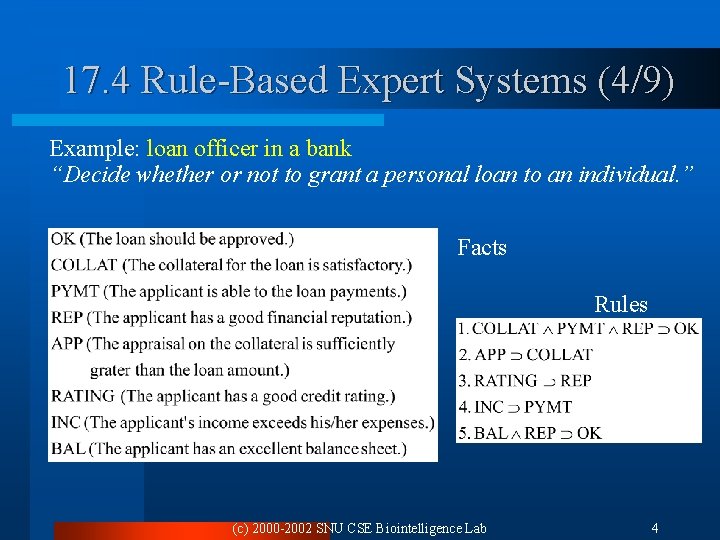
17. 4 Rule-Based Expert Systems (4/9) Example: loan officer in a bank “Decide whether or not to grant a personal loan to an individual. ” Facts Rules (c) 2000 -2002 SNU CSE Biointelligence Lab 4
17. 4 Rule-Based Expert Systems (5/9) l To prove OK ¨ The inference engine searches fro AND/OR proof tree using either backward or forward chaining. l AND/OR proof tree ¨ Root node: OK ¨ Leaf node: facts ¨ The root and leaves will be connected through the rules. l Using the preceding rule in a backward-chaining ¨ The user’s goal, to establish OK, can be done either by proving both BAL and REP or by proving each of COLLAT, PYMT, and REP. ¨ Applying the other rules, as shown, results in other sets of nodes to be proved. (c) 2000 -2002 SNU CSE Biointelligence Lab 5
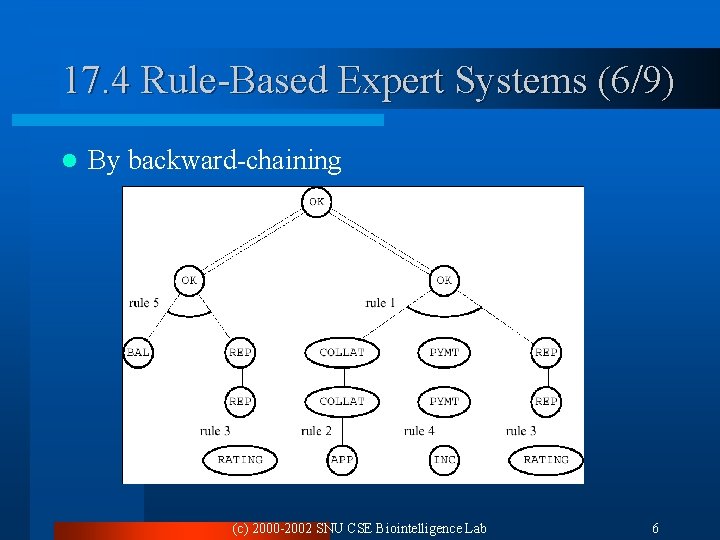
17. 4 Rule-Based Expert Systems (6/9) l By backward-chaining (c) 2000 -2002 SNU CSE Biointelligence Lab 6
17. 4 Rule-Based Expert Systems (7/9) l Consulting system ¨ Attempt to answer a user’s query by asking questions about the truth of propositions that they might know about. ¨ Backward-chaining through the rule is used to get to askable questions. ¨ If a user were to “volunteer” information, bottom-up, forward chaining through the rules could be used in an attempt to connect to the proof tree already built. ¨ The ability to give explanations for a conclusion < Very important for acceptance of expert system advice. ¨ Proof tree < Used to guide the explanation-generation process. (c) 2000 -2002 SNU CSE Biointelligence Lab 7
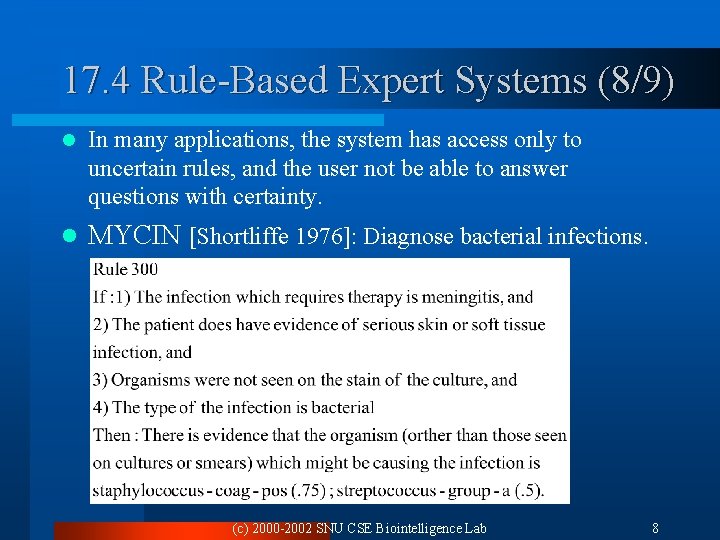
17. 4 Rule-Based Expert Systems (8/9) l In many applications, the system has access only to uncertain rules, and the user not be able to answer questions with certainty. l MYCIN [Shortliffe 1976]: Diagnose bacterial infections. (c) 2000 -2002 SNU CSE Biointelligence Lab 8
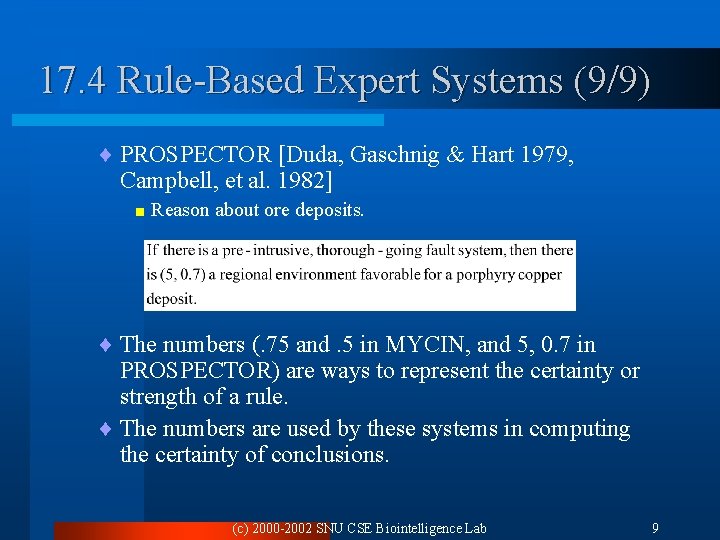
17. 4 Rule-Based Expert Systems (9/9) ¨ PROSPECTOR [Duda, Gaschnig & Hart 1979, Campbell, et al. 1982] < Reason about ore deposits. ¨ The numbers (. 75 and. 5 in MYCIN, and 5, 0. 7 in PROSPECTOR) are ways to represent the certainty or strength of a rule. ¨ The numbers are used by these systems in computing the certainty of conclusions. (c) 2000 -2002 SNU CSE Biointelligence Lab 9
17. 5 Rule Learning l Inductive rule learning ¨ Creates new rules about a domain, not derivable from any previous rules. ¨ Ex) Neural networks l Deductive rule learning ¨ Enhances the efficiency of a system’s performance by deducting additional rules from previously known domain rules and facts. ¨ Ex) EBG (explanation-based generalization) (c) 2000 -2002 SNU CSE Biointelligence Lab 10
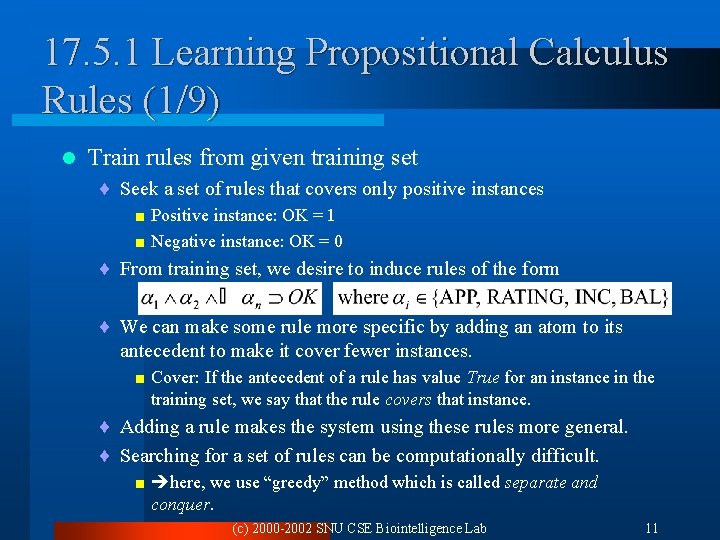
17. 5. 1 Learning Propositional Calculus Rules (1/9) l Train rules from given training set ¨ Seek a set of rules that covers only positive instances < Positive instance: OK = 1 < Negative instance: OK = 0 ¨ From training set, we desire to induce rules of the form ¨ We can make some rule more specific by adding an atom to its antecedent to make it cover fewer instances. < Cover: If the antecedent of a rule has value True for an instance in the training set, we say that the rule covers that instance. ¨ Adding a rule makes the system using these rules more general. ¨ Searching for a set of rules can be computationally difficult. < here, we use “greedy” method which is called separate and conquer. (c) 2000 -2002 SNU CSE Biointelligence Lab 11
17. 5. 1 Learning Propositional Calculus Rules (2/9) l Separate and conquer ¨ First attempt to find a single rule that covers only positive instances < Start with a rule that covers all instances < Gradually make it more specific by adding atoms to its antecedent. ¨ Gradually add rules until the entire set of rules covers all and only the positive instances. ¨ Trained rules can be simplified using pruning. < Operations and noise-tolerant modifications help minimize the risk of overfitting. (c) 2000 -2002 SNU CSE Biointelligence Lab 12
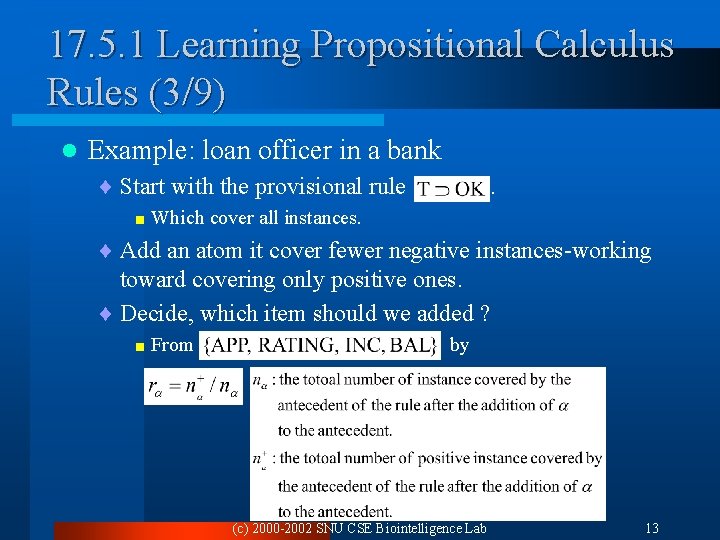
17. 5. 1 Learning Propositional Calculus Rules (3/9) l Example: loan officer in a bank ¨ Start with the provisional rule < Which . cover all instances. ¨ Add an atom it cover fewer negative instances-working toward covering only positive ones. ¨ Decide, which item should we added ? < From by (c) 2000 -2002 SNU CSE Biointelligence Lab 13
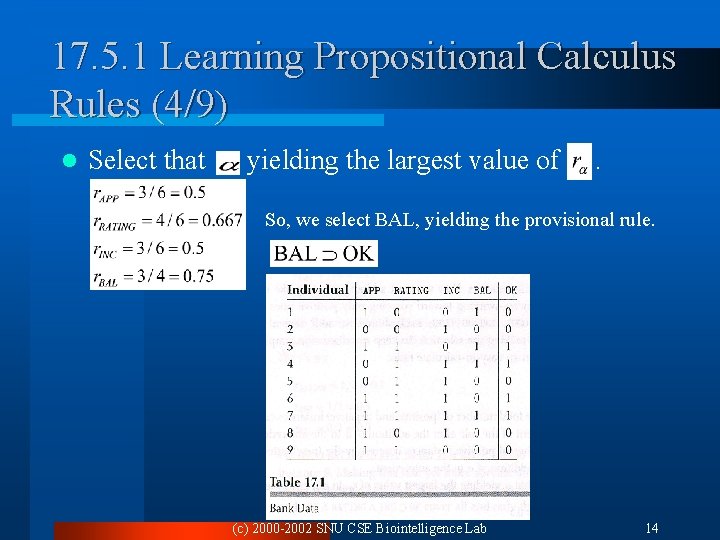
17. 5. 1 Learning Propositional Calculus Rules (4/9) l Select that yielding the largest value of . So, we select BAL, yielding the provisional rule. (c) 2000 -2002 SNU CSE Biointelligence Lab 14
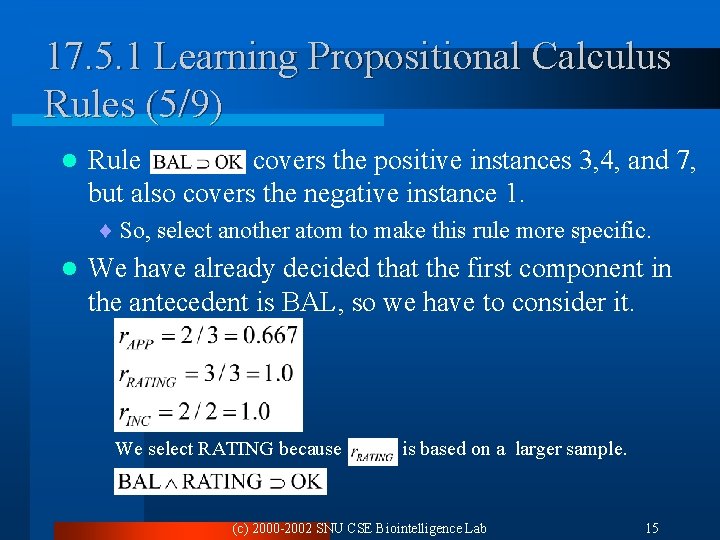
17. 5. 1 Learning Propositional Calculus Rules (5/9) l Rule covers the positive instances 3, 4, and 7, but also covers the negative instance 1. ¨ So, select another atom to make this rule more specific. l We have already decided that the first component in the antecedent is BAL, so we have to consider it. We select RATING because is based on a larger sample. (c) 2000 -2002 SNU CSE Biointelligence Lab 15
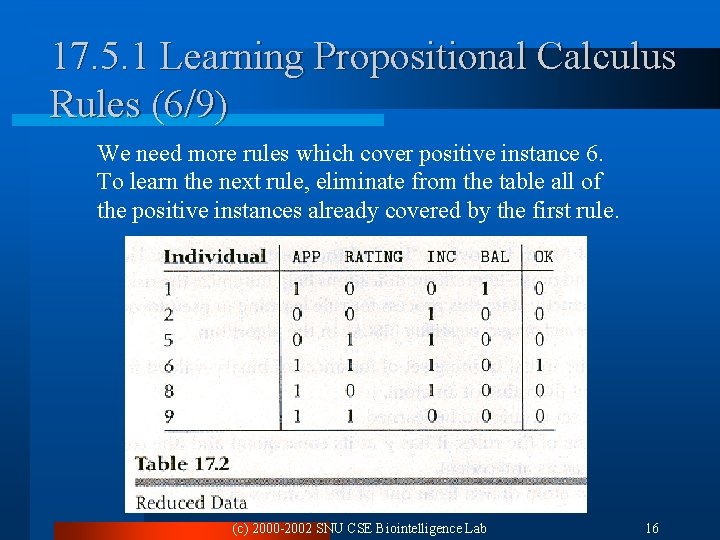
17. 5. 1 Learning Propositional Calculus Rules (6/9) We need more rules which cover positive instance 6. To learn the next rule, eliminate from the table all of the positive instances already covered by the first rule. (c) 2000 -2002 SNU CSE Biointelligence Lab 16
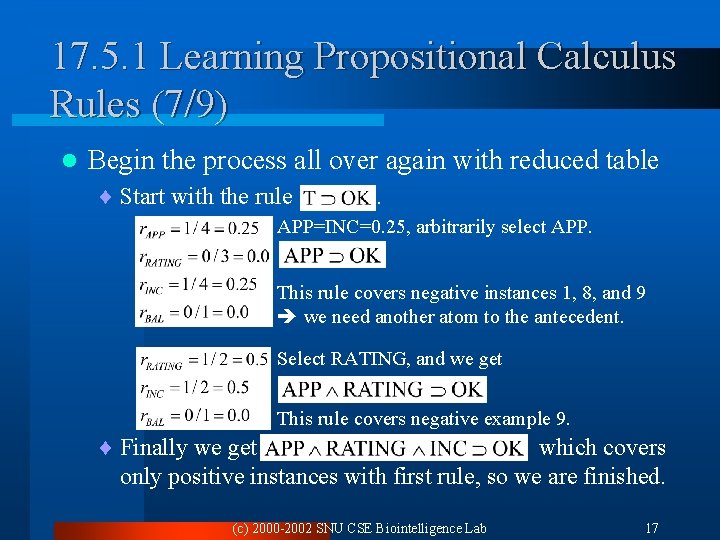
17. 5. 1 Learning Propositional Calculus Rules (7/9) l Begin the process all over again with reduced table ¨ Start with the rule . APP=INC=0. 25, arbitrarily select APP. This rule covers negative instances 1, 8, and 9 we need another atom to the antecedent. Select RATING, and we get This rule covers negative example 9. ¨ Finally we get which covers only positive instances with first rule, so we are finished. (c) 2000 -2002 SNU CSE Biointelligence Lab 17
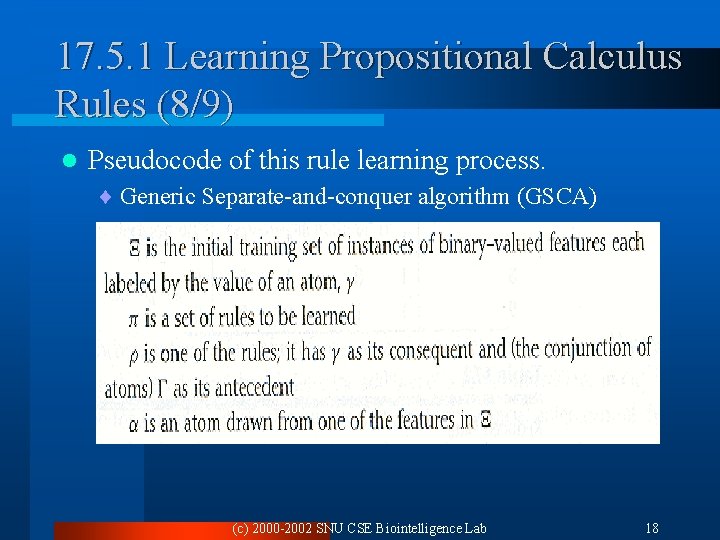
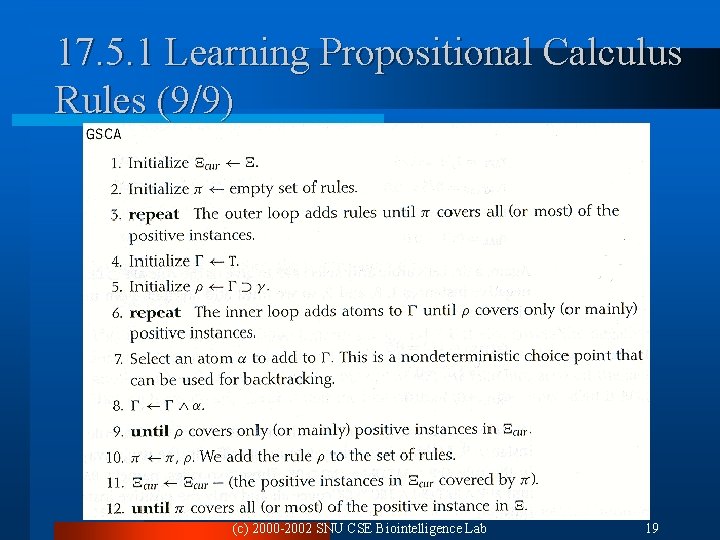
17. 5. 1 Learning Propositional Calculus Rules (8/9) l Pseudocode of this rule learning process. ¨ Generic Separate-and-conquer algorithm (GSCA) (c) 2000 -2002 SNU CSE Biointelligence Lab 18
17. 5. 1 Learning Propositional Calculus Rules (9/9) (c) 2000 -2002 SNU CSE Biointelligence Lab 19
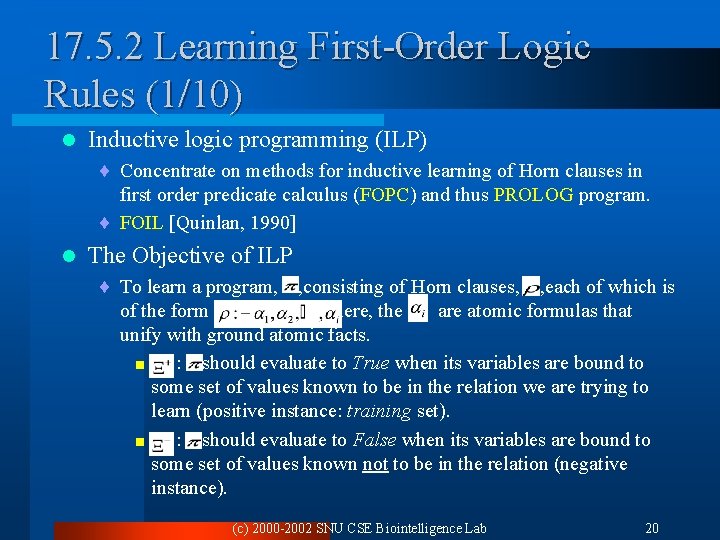
17. 5. 2 Learning First-Order Logic Rules (1/10) l Inductive logic programming (ILP) ¨ Concentrate on methods for inductive learning of Horn clauses in first order predicate calculus (FOPC) and thus PROLOG program. ¨ FOIL [Quinlan, 1990] l The Objective of ILP ¨ To learn a program, , consisting of Horn clauses, , each of which is of the form where, the are atomic formulas that unify with ground atomic facts. < : should evaluate to True when its variables are bound to some set of values known to be in the relation we are trying to learn (positive instance: training set). < : should evaluate to False when its variables are bound to some set of values known not to be in the relation (negative instance). (c) 2000 -2002 SNU CSE Biointelligence Lab 20
17. 5. 2 Learning First-Order Logic Rules (2/10) We want to cover the positives instances and not cover negative ones. l Background knowledge l ¨ The ground atomic facts with which the are to unify. ¨ They are given-as either subsidiary PROLOG programs, which can be run and evaluated, or explicitly in the form of a list of facts. l Example: A delivery robot navigating around in a building finds through experience, that it is easy to go between certain pairs of locations and not so easy to go between certain other pairs. (c) 2000 -2002 SNU CSE Biointelligence Lab 21
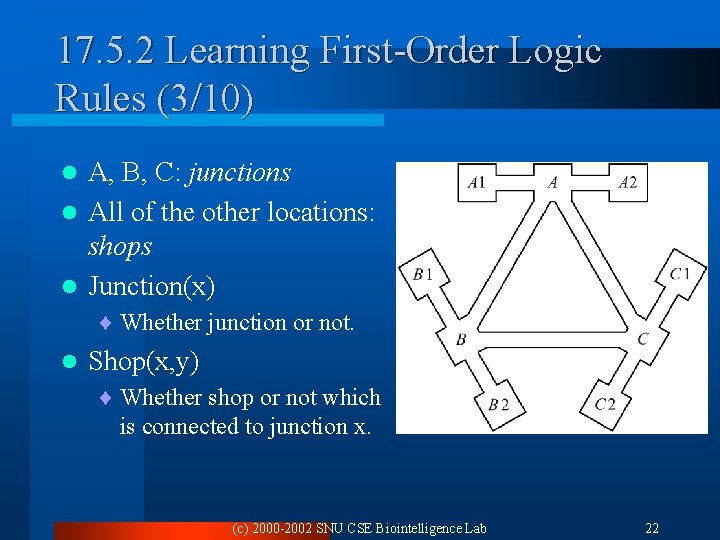
17. 5. 2 Learning First-Order Logic Rules (3/10) A, B, C: junctions l All of the other locations: shops l Junction(x) l ¨ Whether junction or not. l Shop(x, y) ¨ Whether shop or not which is connected to junction x. (c) 2000 -2002 SNU CSE Biointelligence Lab 22
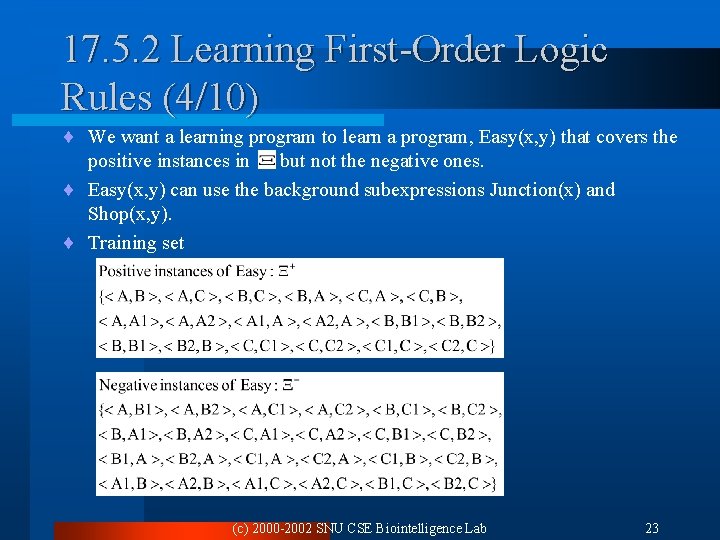
17. 5. 2 Learning First-Order Logic Rules (4/10) ¨ We want a learning program to learn a program, Easy(x, y) that covers the positive instances in but not the negative ones. ¨ Easy(x, y) can use the background subexpressions Junction(x) and Shop(x, y). ¨ Training set (c) 2000 -2002 SNU CSE Biointelligence Lab 23
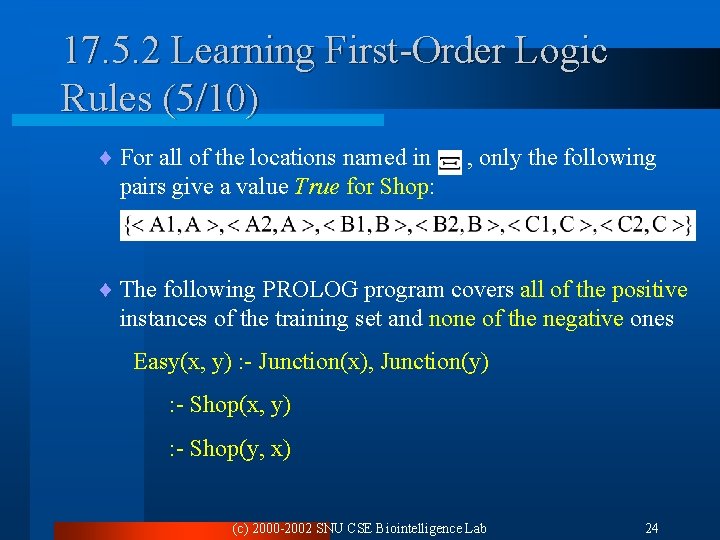
17. 5. 2 Learning First-Order Logic Rules (5/10) ¨ For all of the locations named in pairs give a value True for Shop: , only the following ¨ The following PROLOG program covers all of the positive instances of the training set and none of the negative ones Easy(x, y) : - Junction(x), Junction(y) : - Shop(x, y) : - Shop(y, x) (c) 2000 -2002 SNU CSE Biointelligence Lab 24
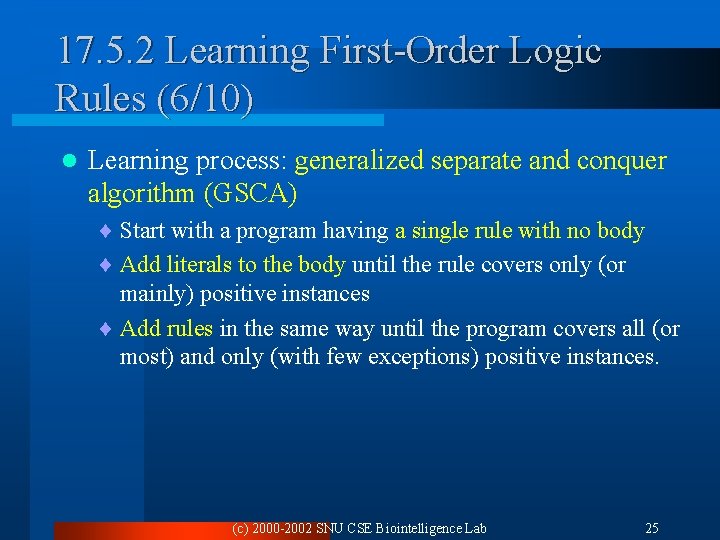
17. 5. 2 Learning First-Order Logic Rules (6/10) l Learning process: generalized separate and conquer algorithm (GSCA) ¨ Start with a program having a single rule with no body ¨ Add literals to the body until the rule covers only (or mainly) positive instances ¨ Add rules in the same way until the program covers all (or most) and only (with few exceptions) positive instances. (c) 2000 -2002 SNU CSE Biointelligence Lab 25
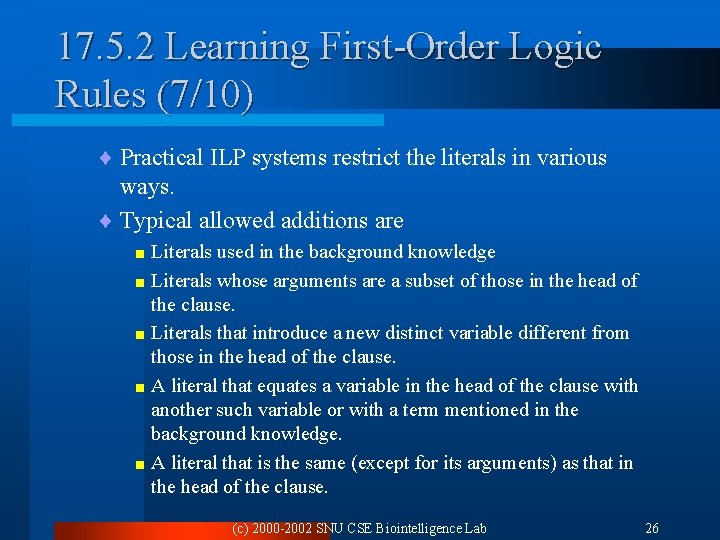
17. 5. 2 Learning First-Order Logic Rules (7/10) ¨ Practical ILP systems restrict the literals in various ways. ¨ Typical allowed additions are < Literals used in the background knowledge < Literals whose arguments are a subset of those in the head of the clause. < Literals that introduce a new distinct variable different from those in the head of the clause. < A literal that equates a variable in the head of the clause with another such variable or with a term mentioned in the background knowledge. < A literal that is the same (except for its arguments) as that in the head of the clause. (c) 2000 -2002 SNU CSE Biointelligence Lab 26
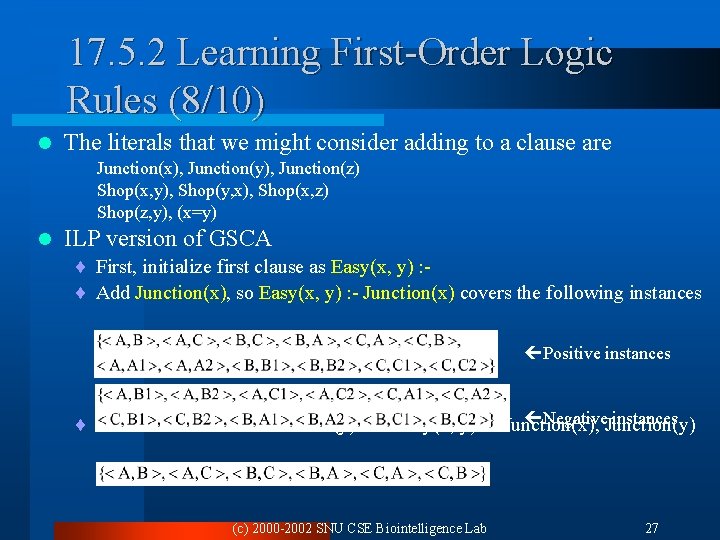
17. 5. 2 Learning First-Order Logic Rules (8/10) l The literals that we might consider adding to a clause are Junction(x), Junction(y), Junction(z) Shop(x, y), Shop(y, x), Shop(x, z) Shop(z, y), (x=y) l ILP version of GSCA ¨ First, initialize first clause as Easy(x, y) : ¨ Add Junction(x), so Easy(x, y) : - Junction(x) covers the following instances çPositive instances çNegative. Junction(y) instances ¨ Include more literal ‘Junction(y)’ Easy(x, y) : - Junction(x), (c) 2000 -2002 SNU CSE Biointelligence Lab 27
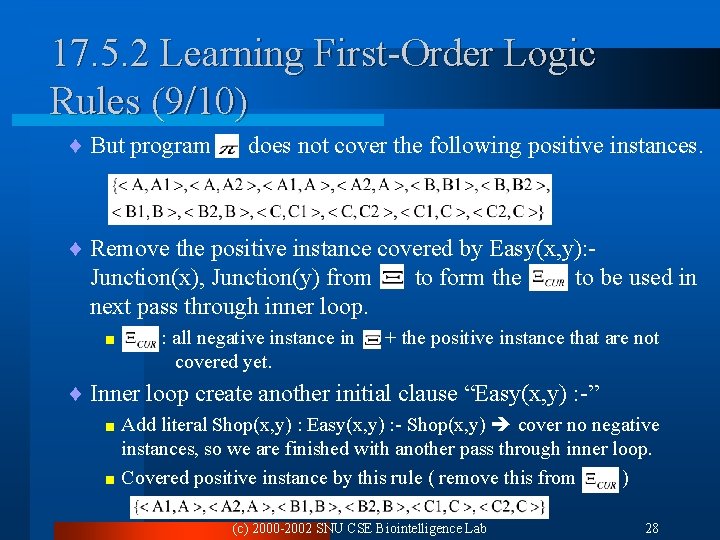
17. 5. 2 Learning First-Order Logic Rules (9/10) ¨ But program does not cover the following positive instances. ¨ Remove the positive instance covered by Easy(x, y): Junction(x), Junction(y) from to form the to be used in next pass through inner loop. < : all negative instance in covered yet. + the positive instance that are not ¨ Inner loop create another initial clause “Easy(x, y) : -” literal Shop(x, y) : Easy(x, y) : - Shop(x, y) cover no negative instances, so we are finished with another pass through inner loop. < Covered positive instance by this rule ( remove this from ) < Add (c) 2000 -2002 SNU CSE Biointelligence Lab 28
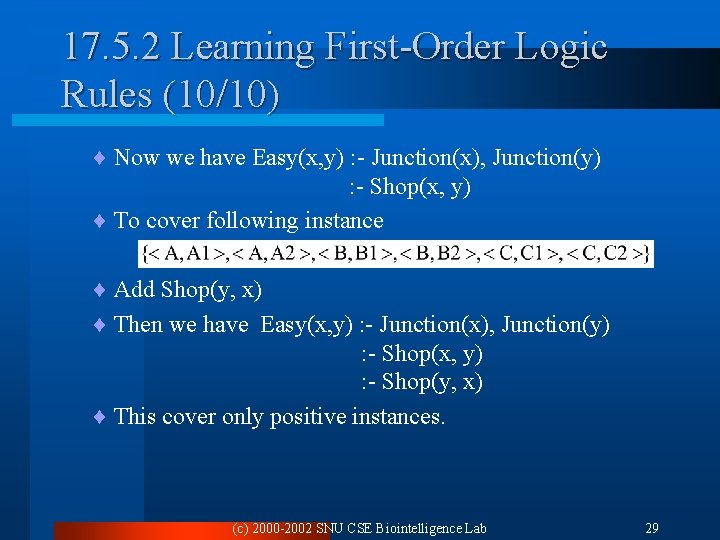
17. 5. 2 Learning First-Order Logic Rules (10/10) ¨ Now we have Easy(x, y) : - Junction(x), Junction(y) : - Shop(x, y) ¨ To cover following instance ¨ Add Shop(y, x) ¨ Then we have Easy(x, y) : - Junction(x), Junction(y) : - Shop(x, y) : - Shop(y, x) ¨ This cover only positive instances. (c) 2000 -2002 SNU CSE Biointelligence Lab 29
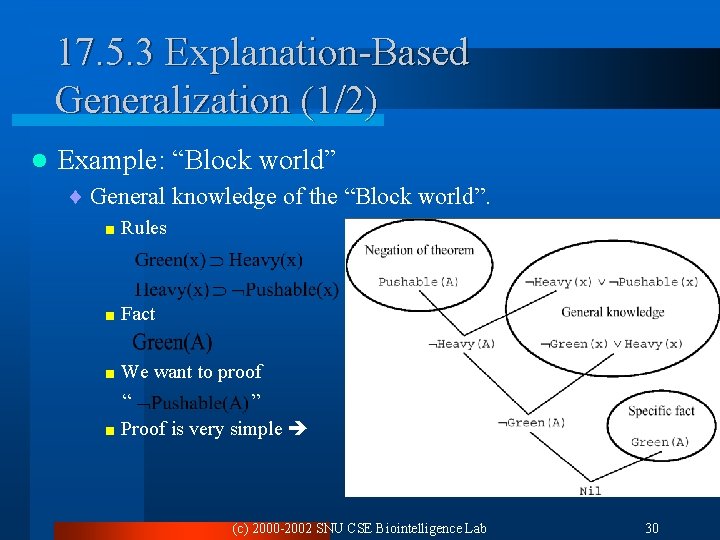
17. 5. 3 Explanation-Based Generalization (1/2) l Example: “Block world” ¨ General knowledge of the “Block world”. < Rules < Fact < We want to proof “ ” < Proof is very simple (c) 2000 -2002 SNU CSE Biointelligence Lab 30
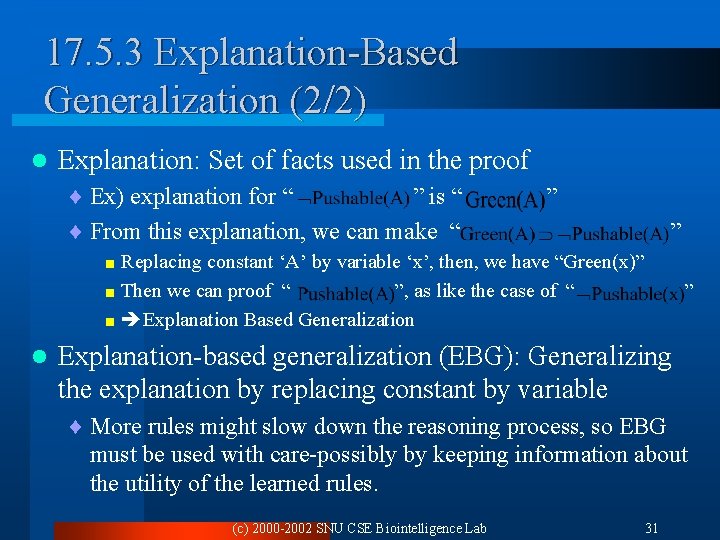
17. 5. 3 Explanation-Based Generalization (2/2) l Explanation: Set of facts used in the proof ¨ Ex) explanation for “ ” is “ ¨ From this explanation, we can make “ ” ” < Replacing constant ‘A’ by variable ‘x’, then, we have “Green(x)” < Then we can proof “ ”, as like the case of “ < Explanation Based Generalization l ” Explanation-based generalization (EBG): Generalizing the explanation by replacing constant by variable ¨ More rules might slow down the reasoning process, so EBG must be used with care-possibly by keeping information about the utility of the learned rules. (c) 2000 -2002 SNU CSE Biointelligence Lab 31
![Additional Readings (1/4) l [Levesque & Brachman 1987] ¨ Balance between logical expression and](http://slidetodoc.com/presentation_image_h2/c47e200304e2742464c504fde8bd86db/image-32.jpg "Additional Readings (1/4) l [Levesque & Brachman 1987] ¨ Balance between logical expression and")
Additional Readings (1/4) l [Levesque & Brachman 1987] ¨ Balance between logical expression and logical inference l [Ullman 1989] ¨ DATALOG l [Selman & Kautz 1991] ¨ Approximate theory: Horn greatest-lower-bound, Horn least-upper-bound l [Kautz, Kearns, & Selman 1993] ¨ Characteristic model (c) 2000 -2002 SNU CSE Biointelligence Lab 32
![Additional Readings (2/4) l [Roussel 1975, Colmerauer 1973] ¨ PROLOG interpreter l [Warren, Pereira,](http://slidetodoc.com/presentation_image_h2/c47e200304e2742464c504fde8bd86db/image-33.jpg "Additional Readings (2/4) l [Roussel 1975, Colmerauer 1973] ¨ PROLOG interpreter l [Warren, Pereira,")
Additional Readings (2/4) l [Roussel 1975, Colmerauer 1973] ¨ PROLOG interpreter l [Warren, Pereira, & Pereira 1977] ¨ Development of efficient interpreter l [Davis 1980] ¨ AO* algorithm searching AND/OR graphs l [Selman & Levesque 1990] ¨ Determination of minimum ATMS label: NP-complete problem (c) 2000 -2002 SNU CSE Biointelligence Lab 33
![Additional Readings (3/4) l [Kautz, Kearns & Selman 1993] ¨ TMS calculation based on](http://slidetodoc.com/presentation_image_h2/c47e200304e2742464c504fde8bd86db/image-34.jpg "Additional Readings (3/4) l [Kautz, Kearns & Selman 1993] ¨ TMS calculation based on")
Additional Readings (3/4) l [Kautz, Kearns & Selman 1993] ¨ TMS calculation based on characteristic model l [Doyle 1979, de Kleer 1986 a, de Kleer 1986 b, de Kleer 1986 c, Forbus & de Kleer 1993, Shoham 1994] ¨ Other results for TMS l [Bobrow, Mittal & Stefik 1986], [Stefik 1995] ¨ Construction of expert system (c) 2000 -2002 SNU CSE Biointelligence Lab 34
![Additional Readings (4/4) l [Mc. Dermott 19982] ¨ Examples of expert systems l [Leonard-Barton](http://slidetodoc.com/presentation_image_h2/c47e200304e2742464c504fde8bd86db/image-35.jpg "Additional Readings (4/4) l [Mc. Dermott 19982] ¨ Examples of expert systems l [Leonard-Barton")
Additional Readings (4/4) l [Mc. Dermott 19982] ¨ Examples of expert systems l [Leonard-Barton 1987] ¨ History and usage of DEC’s expert system l [Kautz & Selman 1992], [Muggleton & Buntine 1988] ¨ Predicate finding l [Muggleton, King & Sternberg 1992] ¨ Protein secondary structure prediction by GOLEM (c) 2000 -2002 SNU CSE Biointelligence Lab 35
- Slides: 35