
17 3 Behavior of Waves The ripples visible
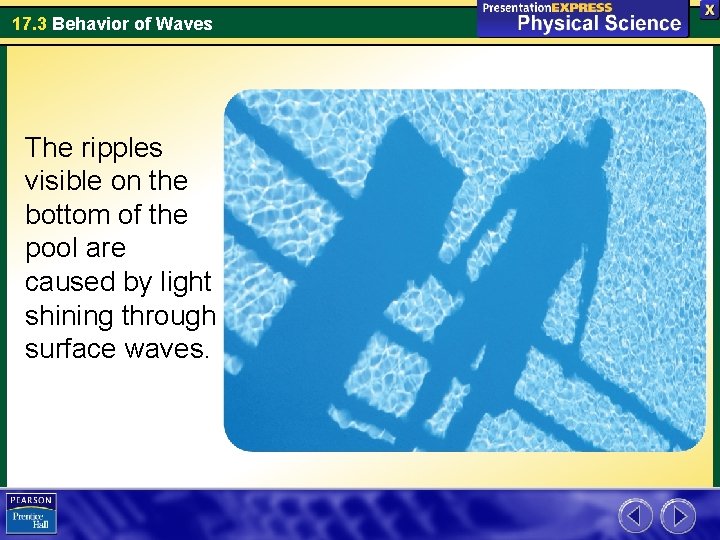
17. 3 Behavior of Waves The ripples visible on the bottom of the pool are caused by light shining through surface waves.
17. 3 Behavior of Waves Reflection How does reflection change a wave? Reflection occurs when a wave bounces off a surface that it cannot pass through. Reflection does not change the speed or frequency of a wave, but the wave can be flipped upside down.
17. 3 Behavior of Waves Refraction What causes the refraction of a wave when it enters a new medium? Refraction is the bending of a wave as it enters a new medium at an angle. When a wave enters a medium at an angle, refraction occurs because one side of the wave moves more slowly than the other side.
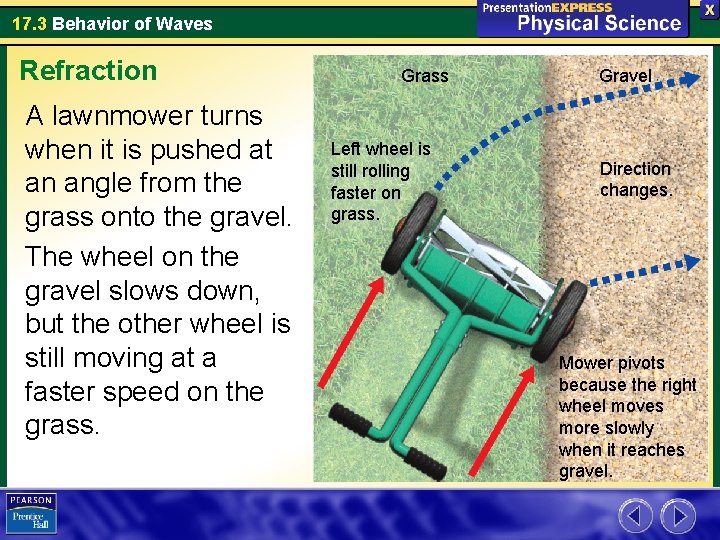
17. 3 Behavior of Waves Refraction A lawnmower turns when it is pushed at an angle from the grass onto the gravel. The wheel on the gravel slows down, but the other wheel is still moving at a faster speed on the grass. Grass Left wheel is still rolling faster on grass. Gravel Direction changes. Mower pivots because the right wheel moves more slowly when it reaches gravel.
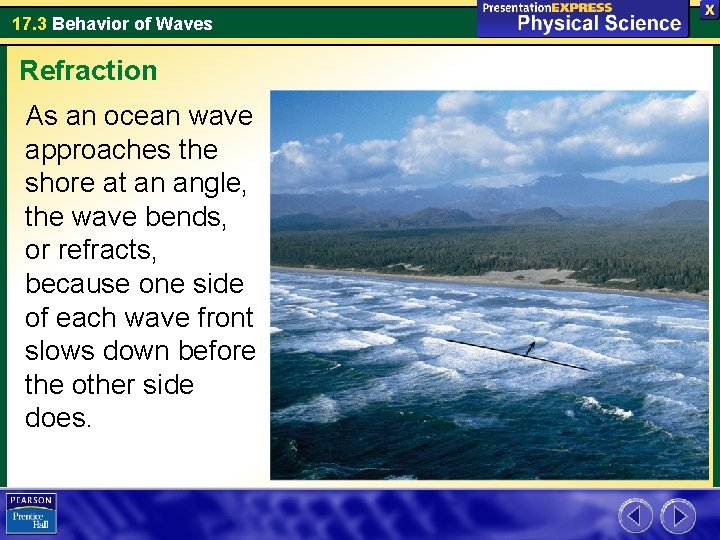
17. 3 Behavior of Waves Refraction As an ocean wave approaches the shore at an angle, the wave bends, or refracts, because one side of each wave front slows down before the other side does.

17. 3 Behavior of Waves Refraction As an ocean wave approaches the shore at an angle, the wave bends, or refracts, because one side of each wave front slows down before the other side does.
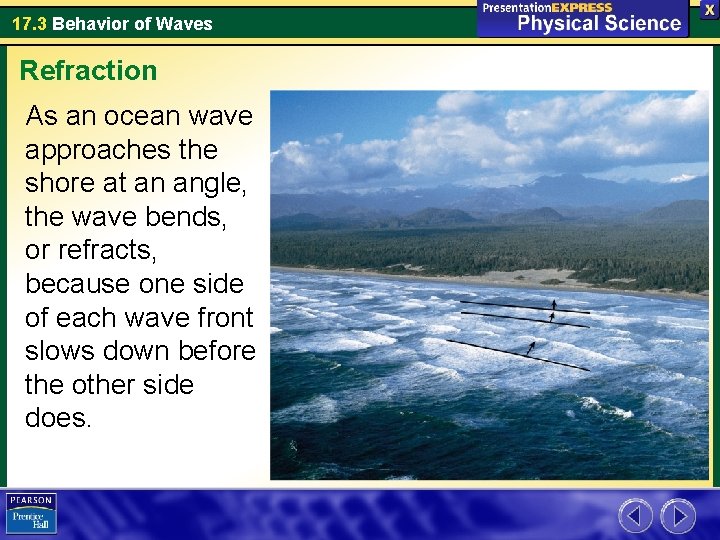
17. 3 Behavior of Waves Refraction As an ocean wave approaches the shore at an angle, the wave bends, or refracts, because one side of each wave front slows down before the other side does.
17. 3 Behavior of Waves Refraction An ocean wave refracts as it flows into a shallow area. • The shallower water can be considered a new medium. • As one side of each wave enters shallower water before the other, that side slows down and the wave bends. • If a wave front is parallel to the shoreline, the wave enters the shallower water all at once, and there is no refraction.

17. 3 Behavior of Waves Diffraction What factors affect the amount of diffraction of a wave? Diffraction is the bending of a wave as it moves around an obstacle or passes through a narrow opening. A wave diffracts more if its wavelength is large compared to the size of an opening or obstacle.
17. 3 Behavior of Waves Diffraction Water waves spread out as they pass through a narrow opening. • The pattern produced is very similar to the circular ripples you see when a pebble is tossed into a pond. • Diffraction also occurs when waves bend around an obstacle. • The larger the wavelength is compared to the size of the opening or obstacle, the more the wave diffracts.
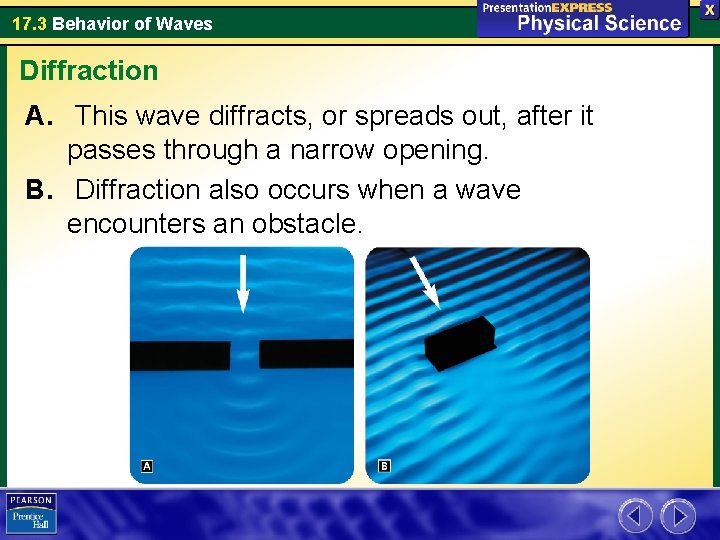
17. 3 Behavior of Waves Diffraction A. This wave diffracts, or spreads out, after it passes through a narrow opening. B. Diffraction also occurs when a wave encounters an obstacle.
17. 3 Behavior of Waves Interference What are two types of interference? Interference occurs when two or more waves overlap and combine together. Two types of interference are constructive interference and destructive interference.
17. 3 Behavior of Waves Interference When waves collide, they can occupy the same region of space and then continue on. • Constructive interference occurs when two or more waves combine to produce a wave with a larger displacement. • Destructive interference occurs when two or more waves combine to produce a wave with a smaller displacement.
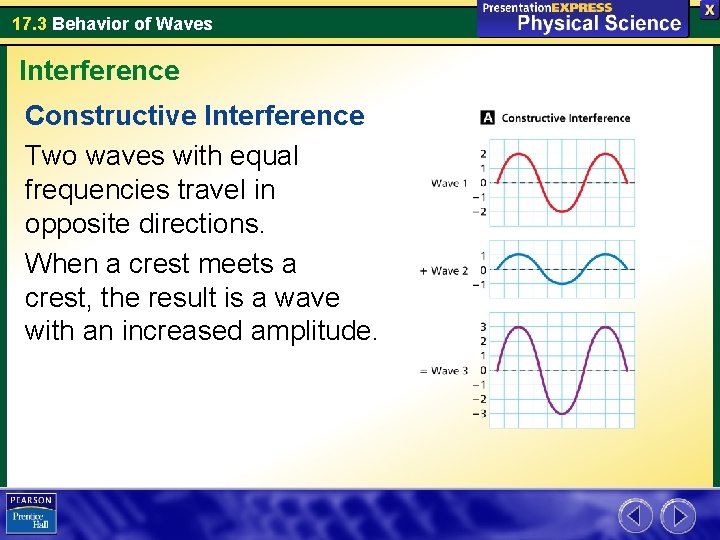
17. 3 Behavior of Waves Interference Constructive Interference Two waves with equal frequencies travel in opposite directions. When a crest meets a crest, the result is a wave with an increased amplitude.
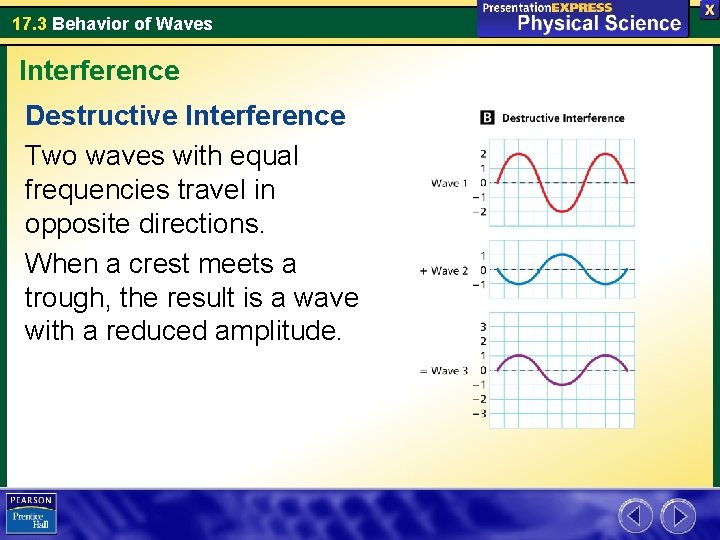
17. 3 Behavior of Waves Interference Destructive Interference Two waves with equal frequencies travel in opposite directions. When a crest meets a trough, the result is a wave with a reduced amplitude.
17. 3 Behavior of Waves Standing Waves What wavelengths will produce a standing wave? A standing wave is a wave that appears to stay in one place—it does not seem to move through the medium. A standing wave forms only if half a wavelength or a multiple of half a wavelength fits exactly into the length of a vibrating cord.
17. 3 Behavior of Waves Standing Waves Interference occurs as the incoming waves pass through the reflected waves. At certain frequencies, interference between a wave and its reflection can produce a standing wave.
17. 3 Behavior of Waves Standing Waves A node is a point on a standing wave that has no displacement from the rest position. At the nodes, there is complete destructive interference between the incoming and reflected waves. An antinode is a point where a crest or trough occurs midway between two nodes.
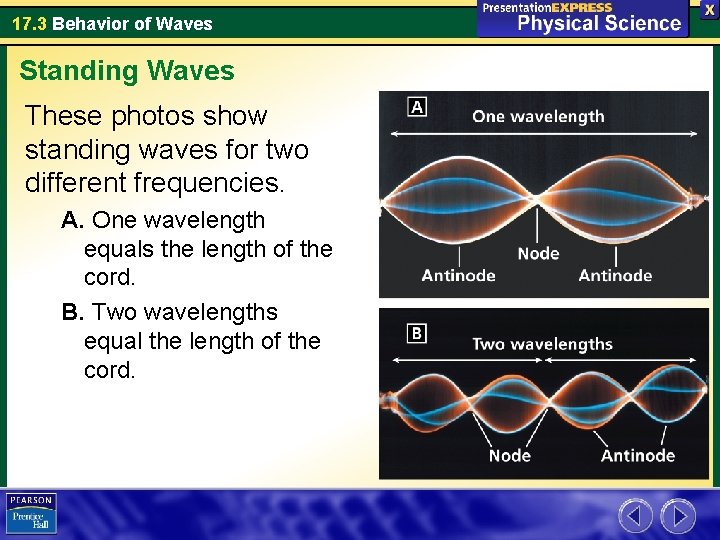
17. 3 Behavior of Waves Standing Waves These photos show standing waves for two different frequencies. A. One wavelength equals the length of the cord. B. Two wavelengths equal the length of the cord.
17. 3 Behavior of Waves Assessment Questions 1. The property of waves bending as they pass through a narrow opening is called a. b. c. d. reflection. refraction. diffraction. destructive interference.
17. 3 Behavior of Waves Assessment Questions 1. The property of waves bending as they pass through a narrow opening is called a. b. c. d. reflection. refraction. diffraction. destructive interference. ANS: C
17. 3 Behavior of Waves Assessment Questions 2. When does refraction of a wave occur? a. b. c. d. The wave cannot enter the new medium. The wave enters a new medium at any angle except 90°. Part of the wave enters a new medium and part is reflected.
17. 3 Behavior of Waves Assessment Questions 2. When does refraction of a wave occur? a. b. c. d. The wave cannot enter the new medium. The wave enters a new medium at any angle except 90°. Part of the wave enters a new medium and part is reflected. ANS: C
17. 3 Behavior of Waves Assessment Questions 3. A 6 -meter rope is tied to a hook in the wall. Which of the following wavelengths can produce a standing wave? a. b. c. d. 1. 5 m 2. 5 m 3. 5 m 4. 5 m
17. 3 Behavior of Waves Assessment Questions 3. A 6 -meter rope is tied to a hook in the wall. Which of the following wavelengths can produce a standing wave? a. b. c. d. 1. 5 m 2. 5 m 3. 5 m 4. 5 m ANS: A
17. 3 Behavior of Waves Assessment Questions 1. The amount of diffraction of a wave increases as the size of the obstacle causing the diffraction decreases. True False
17. 3 Behavior of Waves Assessment Questions 1. The amount of diffraction of a wave increases as the size of the obstacle causing the diffraction decreases. True False ANS: T
- Slides: 27