
17 3 Accessory Structures of the Eye Lacrimal



- Slides: 80
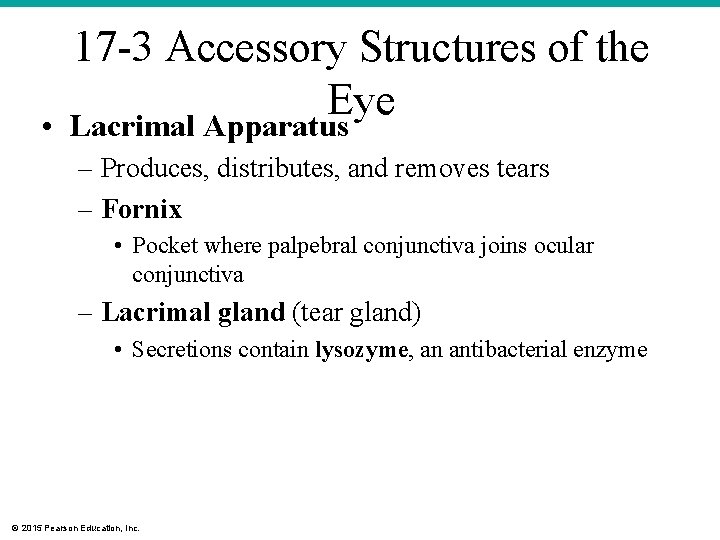
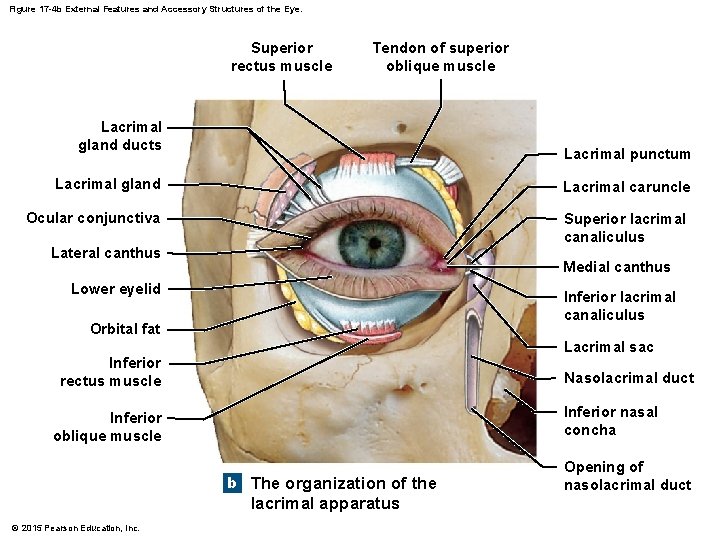
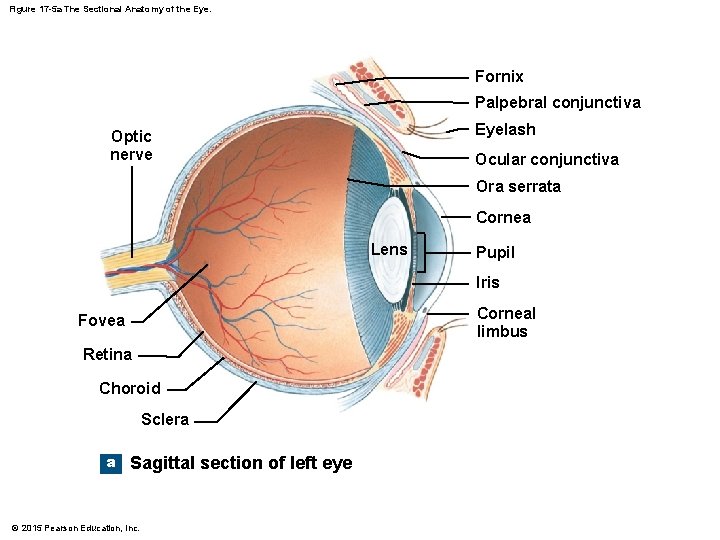
17 -3 Accessory Structures of the Eye • Lacrimal Apparatus – Produces, distributes, and removes tears – Fornix • Pocket where palpebral conjunctiva joins ocular conjunctiva – Lacrimal gland (tear gland) • Secretions contain lysozyme, an antibacterial enzyme © 2015 Pearson Education, Inc.
Figure 17 -4 b External Features and Accessory Structures of the Eye. Superior rectus muscle Tendon of superior oblique muscle Lacrimal gland ducts Lacrimal punctum Lacrimal gland Lacrimal caruncle Ocular conjunctiva Superior lacrimal canaliculus Lateral canthus Medial canthus Lower eyelid Inferior lacrimal canaliculus Orbital fat Lacrimal sac Inferior rectus muscle Nasolacrimal duct Inferior nasal concha Inferior oblique muscle b The organization of the lacrimal apparatus © 2015 Pearson Education, Inc. Opening of nasolacrimal duct
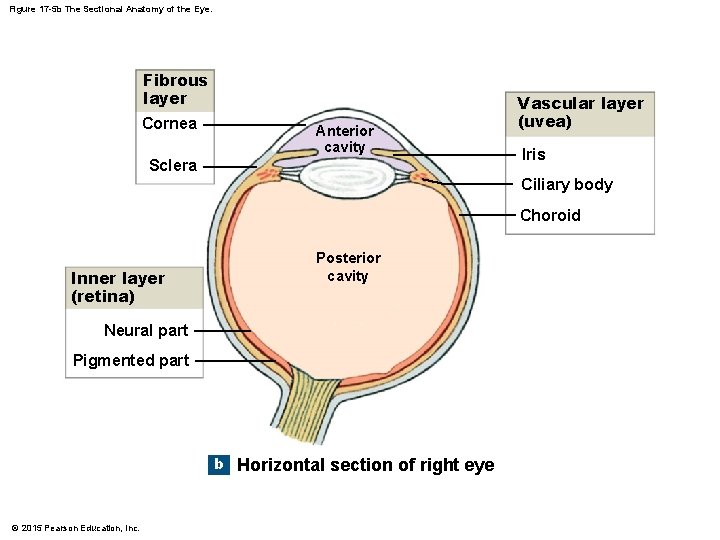
17 -3 The Eye • Three Layers of the Eye 1. Outer fibrous layer 2. Intermediate vascular layer 3. Deep inner layer © 2015 Pearson Education, Inc.
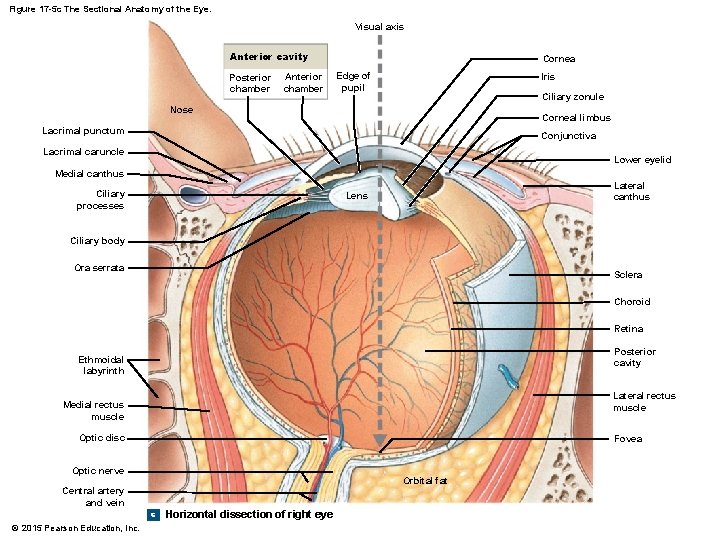
17 -3 The Eye • Eyeball • Is hollow • Is divided into two cavities 1. Large posterior cavity 2. Smaller anterior cavity © 2015 Pearson Education, Inc.
Figure 17 -5 a The Sectional Anatomy of the Eye. Fornix Palpebral conjunctiva Eyelash Optic nerve Ocular conjunctiva Ora serrata Cornea Lens Pupil Iris Corneal limbus Fovea Retina Choroid Sclera a Sagittal section of left eye © 2015 Pearson Education, Inc.
Figure 17 -5 b The Sectional Anatomy of the Eye. Fibrous layer Cornea Anterior cavity Sclera Vascular layer (uvea) Iris Ciliary body Choroid Posterior cavity Inner layer (retina) Neural part Pigmented part b © 2015 Pearson Education, Inc. Horizontal section of right eye
Figure 17 -5 c The Sectional Anatomy of the Eye. Visual axis Anterior cavity Posterior chamber Anterior chamber Cornea Edge of pupil Iris Ciliary zonule Nose Corneal limbus Lacrimal punctum Conjunctiva Lacrimal caruncle Lower eyelid Medial canthus Ciliary processes Lateral canthus Lens Ciliary body Ora serrata Sclera Choroid Retina Posterior cavity Ethmoidal labyrinth Lateral rectus muscle Medial rectus muscle Optic disc Fovea Optic nerve Central artery and vein © 2015 Pearson Education, Inc. Orbital fat c Horizontal dissection of right eye
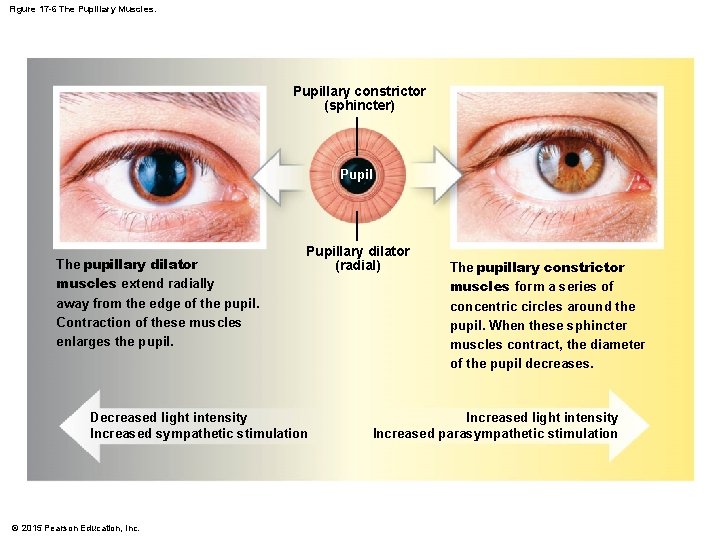
Figure 17 -6 The Pupillary Muscles. Pupillary constrictor (sphincter) Pupil The pupillary dilator muscles extend radially away from the edge of the pupil. Contraction of these muscles enlarges the pupil. Pupillary dilator (radial) Decreased light intensity Increased sympathetic stimulation © 2015 Pearson Education, Inc. The pupillary constrictor muscles form a series of concentric circles around the pupil. When these sphincter muscles contract, the diameter of the pupil decreases. Increased light intensity Increased parasympathetic stimulation
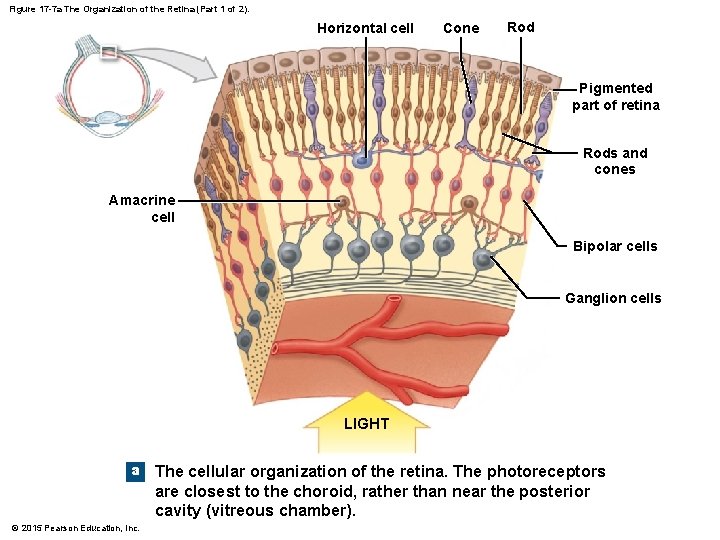
Figure 17 -7 a The Organization of the Retina (Part 1 of 2). Horizontal cell Cone Rod Pigmented part of retina Rods and cones Amacrine cell Bipolar cells Ganglion cells LIGHT a © 2015 Pearson Education, Inc. The cellular organization of the retina. The photoreceptors are closest to the choroid, rather than near the posterior cavity (vitreous chamber).
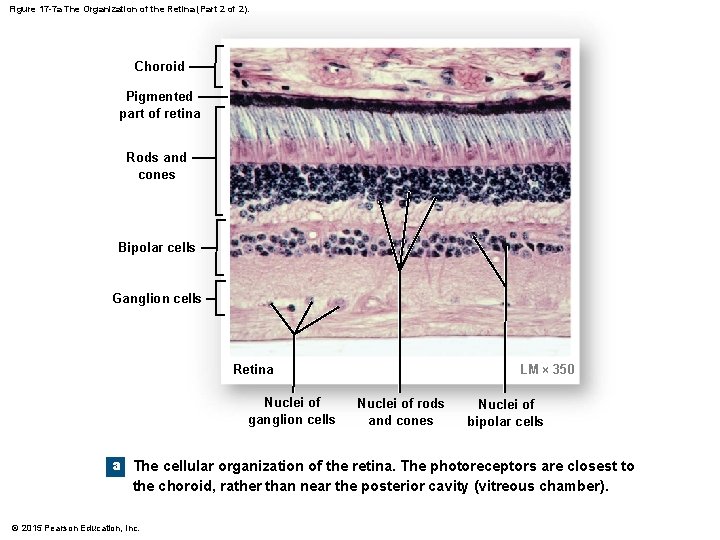
Figure 17 -7 a The Organization of the Retina (Part 2 of 2). Choroid Pigmented part of retina Rods and cones Bipolar cells Ganglion cells Retina Nuclei of ganglion cells LM × 350 Nuclei of rods and cones Nuclei of bipolar cells a The cellular organization of the retina. The photoreceptors are closest to the choroid, rather than near the posterior cavity (vitreous chamber). © 2015 Pearson Education, Inc.
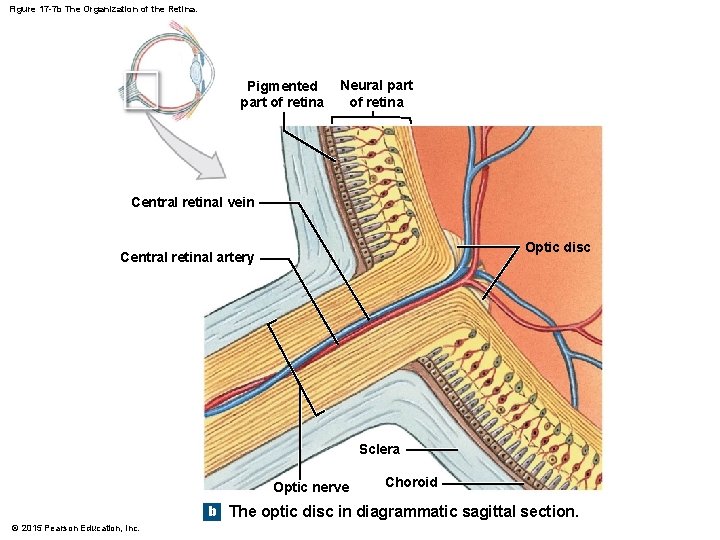
Figure 17 -7 b The Organization of the Retina. Pigmented part of retina Neural part of retina Central retinal vein Optic disc Central retinal artery Sclera Optic nerve Choroid b The optic disc in diagrammatic sagittal section. © 2015 Pearson Education, Inc.
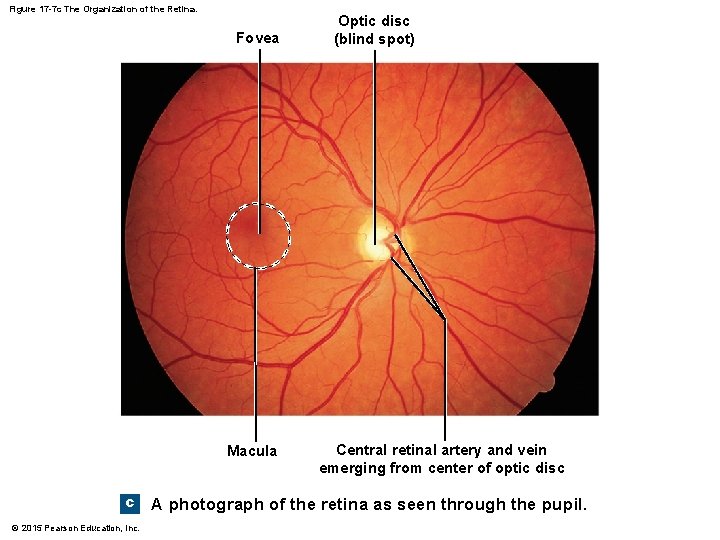
Figure 17 -7 c The Organization of the Retina. Fovea Macula c © 2015 Pearson Education, Inc. Optic disc (blind spot) Central retinal artery and vein emerging from center of optic disc A photograph of the retina as seen through the pupil.
17 -3 The Eye • Inner Neural Part • Bipolar cells • Neurons of rods and cones synapse with ganglion cells • Horizontal cells • Extend across outer portion of retina • Amacrine cells • Comparable to horizontal cell layer • Where bipolar cells synapse with ganglion cells © 2015 Pearson Education, Inc.
17 -3 The Eye • Horizontal and Amacrine Cells • Facilitate or inhibit communication between photoreceptors and ganglion cells • Alter sensitivity of retina • Optic Disc • Circular region just medial to fovea • Origin of optic nerve • Blind spot © 2015 Pearson Education, Inc.
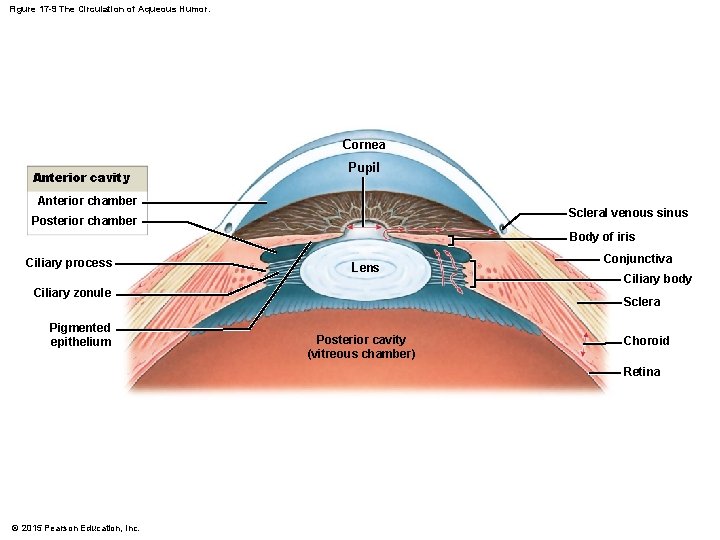
Figure 17 -9 The Circulation of Aqueous Humor. Cornea Anterior cavity Pupil Anterior chamber Scleral venous sinus Posterior chamber Body of iris Ciliary process Lens Ciliary zonule Pigmented epithelium Conjunctiva Ciliary body Sclera Posterior cavity (vitreous chamber) Choroid Retina © 2015 Pearson Education, Inc.
17 -3 The Eye • The Lens • Lens fibers • Cells in interior of lens • No nuclei or organelles • Filled with crystallins, which provide clarity and focusing power to lens • Cataract • Condition in which lens has lost its transparency © 2015 Pearson Education, Inc.
17 -3 The Eye • Light Refraction • Bending of light by cornea and lens • Focal point • Specific point of intersection on retina • Focal distance • Distance between center of lens and focal point © 2015 Pearson Education, Inc.
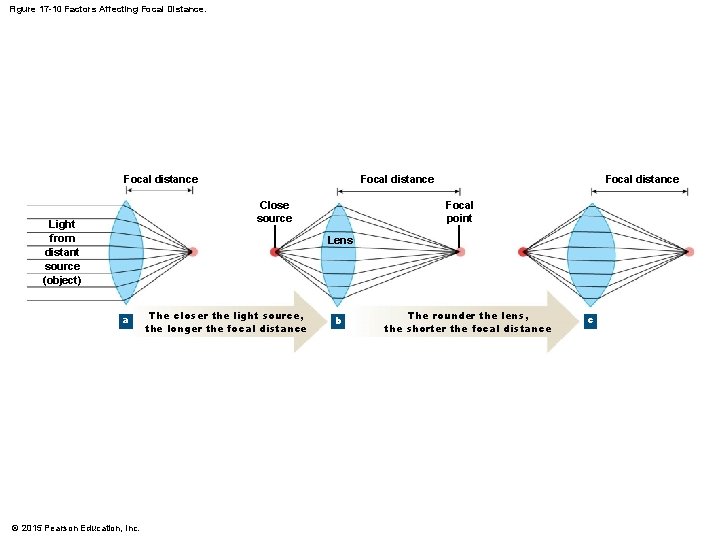
Figure 17 -10 Factors Affecting Focal Distance. Focal distance Close source Light from distant source (object) Focal distance Focal point Lens a © 2015 Pearson Education, Inc. The closer the light source, the longer the focal distance b The rounder the lens, the shorter the focal distance c
17 -3 The Eye • Light Refraction of Lens • Accommodation • Shape of lens changes to focus image on retina • Astigmatism • Condition where light passing through cornea and lens is not refracted properly • Visual image is distorted © 2015 Pearson Education, Inc.
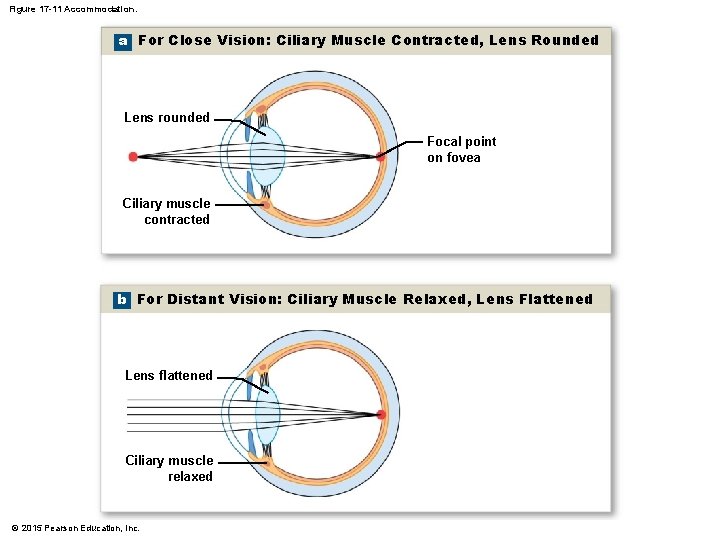
Figure 17 -11 Accommodation. a For Close Vision: Ciliary Muscle Contracted, Lens Rounded Lens rounded Focal point on fovea Ciliary muscle contracted b For Distant Vision: Ciliary Muscle Relaxed, Lens Flattened Lens flattened Ciliary muscle relaxed © 2015 Pearson Education, Inc.
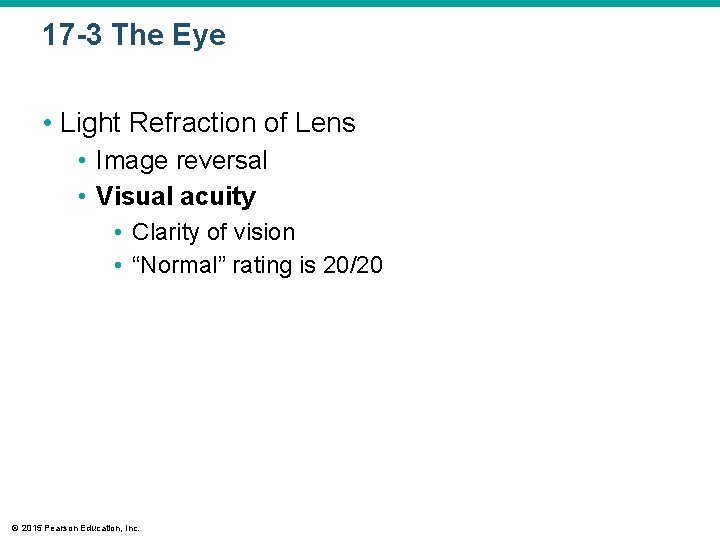
17 -3 The Eye • Light Refraction of Lens • Image reversal • Visual acuity • Clarity of vision • “Normal” rating is 20/20 © 2015 Pearson Education, Inc.
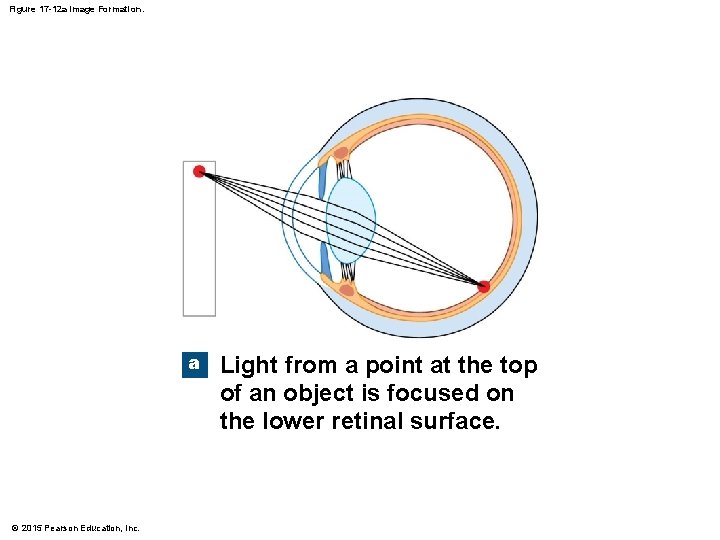
Figure 17 -12 a Image Formation. a © 2015 Pearson Education, Inc. Light from a point at the top of an object is focused on the lower retinal surface.
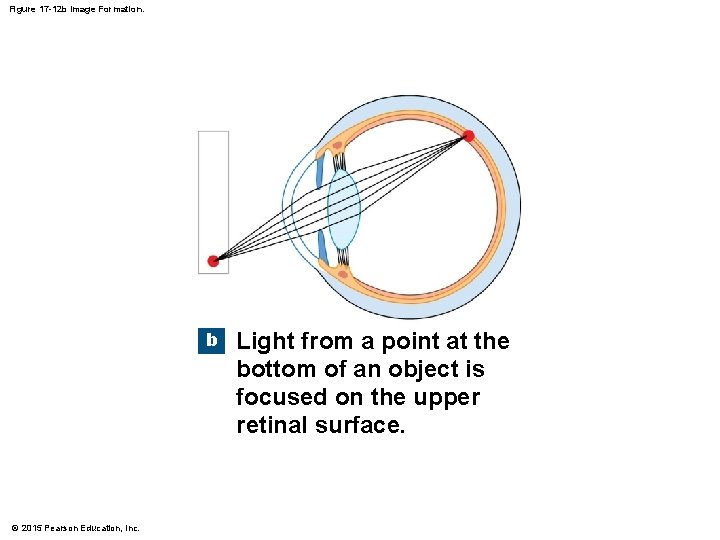
Figure 17 -12 b Image Formation. b © 2015 Pearson Education, Inc. Light from a point at the bottom of an object is focused on the upper retinal surface.
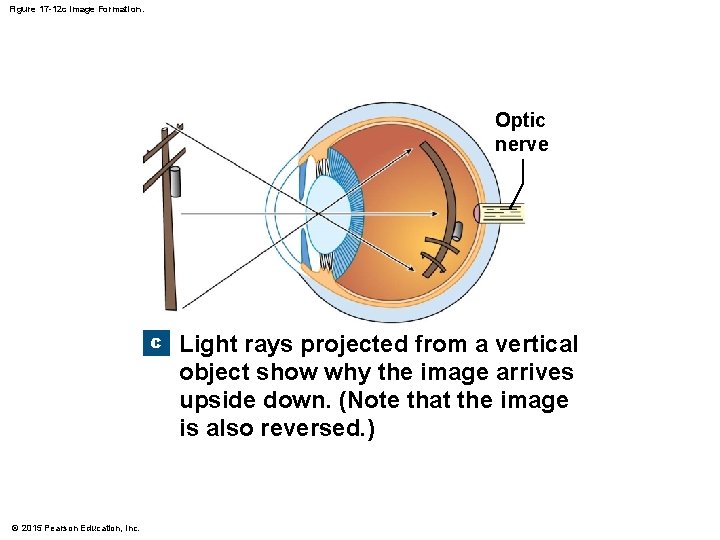
Figure 17 -12 c Image Formation. Optic nerve c © 2015 Pearson Education, Inc. Light rays projected from a vertical object show why the image arrives upside down. (Note that the image is also reversed. )
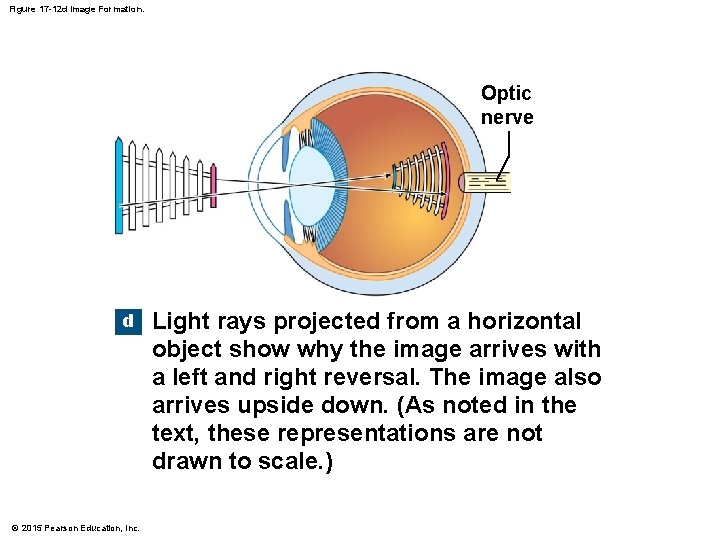
Figure 17 -12 d Image Formation. Optic nerve d © 2015 Pearson Education, Inc. Light rays projected from a horizontal object show why the image arrives with a left and right reversal. The image also arrives upside down. (As noted in the text, these representations are not drawn to scale. )
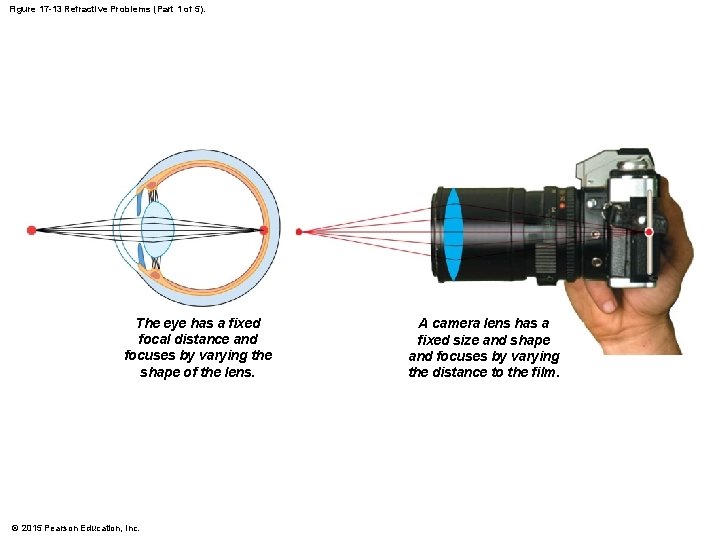
Figure 17 -13 Refractive Problems (Part 1 of 5). The eye has a fixed focal distance and focuses by varying the shape of the lens. © 2015 Pearson Education, Inc. A camera lens has a fixed size and shape and focuses by varying the distance to the film.
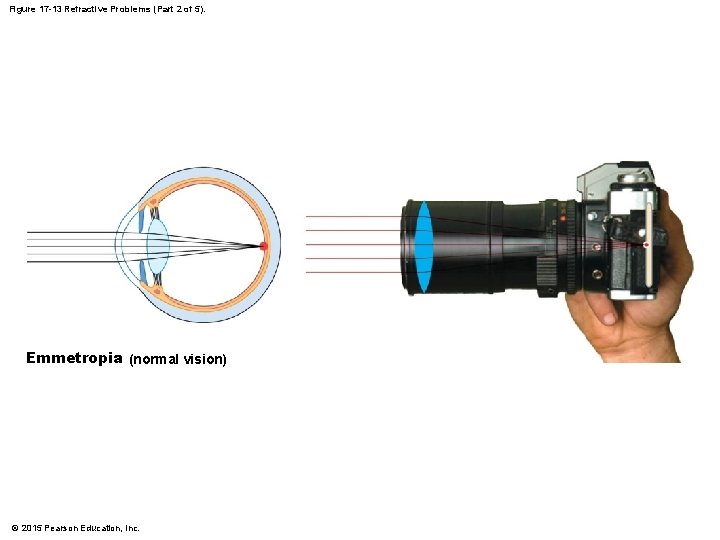
Figure 17 -13 Refractive Problems (Part 2 of 5). Emmetropia (normal vision) © 2015 Pearson Education, Inc.
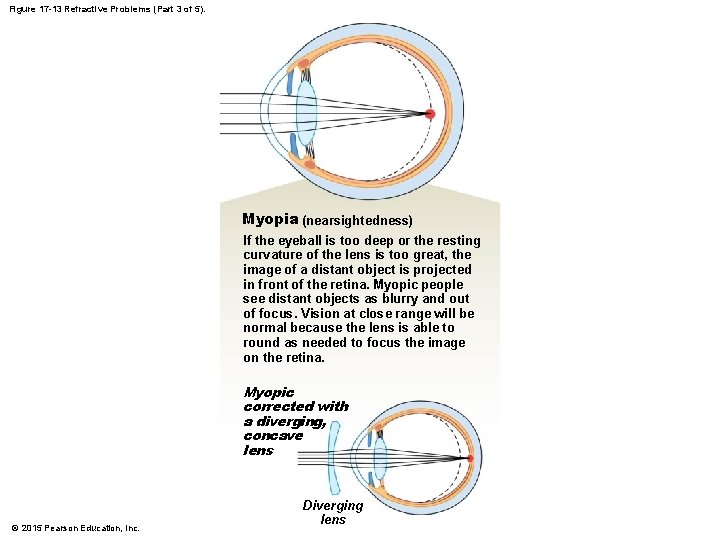
Figure 17 -13 Refractive Problems (Part 3 of 5). Myopia (nearsightedness) If the eyeball is too deep or the resting curvature of the lens is too great, the image of a distant object is projected in front of the retina. Myopic people see distant objects as blurry and out of focus. Vision at close range will be normal because the lens is able to round as needed to focus the image on the retina. Myopic corrected with a diverging, concave lens © 2015 Pearson Education, Inc. Diverging lens
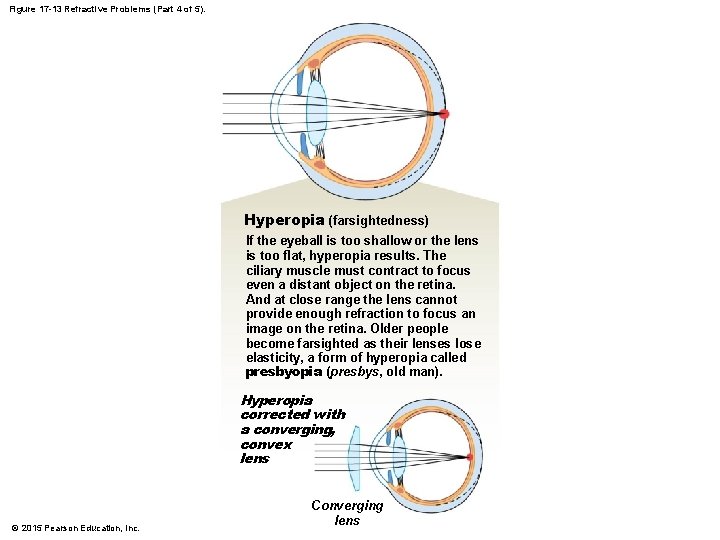
Figure 17 -13 Refractive Problems (Part 4 of 5). Hyperopia (farsightedness) If the eyeball is too shallow or the lens is too flat, hyperopia results. The ciliary muscle must contract to focus even a distant object on the retina. And at close range the lens cannot provide enough refraction to focus an image on the retina. Older people become farsighted as their lenses lose elasticity, a form of hyperopia called presbyopia (presbys, old man). Hyperopia corrected with a converging, convex lens © 2015 Pearson Education, Inc. Converging lens
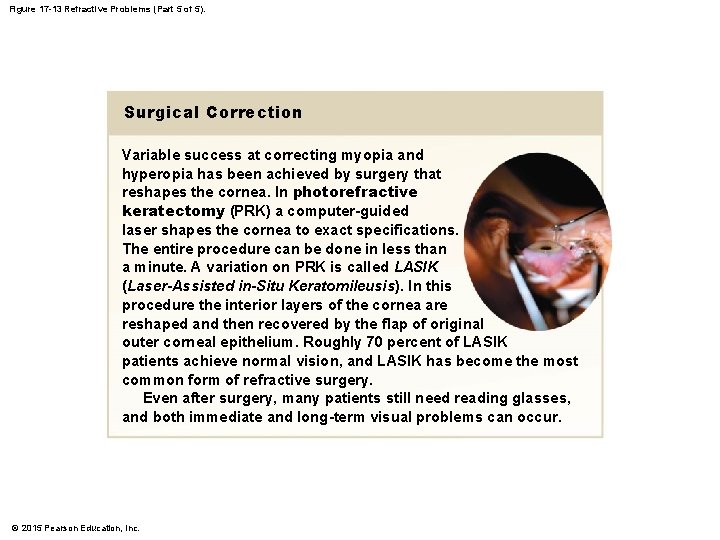
Figure 17 -13 Refractive Problems (Part 5 of 5). Surgical Correction Variable success at correcting myopia and hyperopia has been achieved by surgery that reshapes the cornea. In photorefractive keratectomy (PRK) a computer-guided laser shapes the cornea to exact specifications. The entire procedure can be done in less than a minute. A variation on PRK is called LASIK (Laser-Assisted in-Situ Keratomileusis). In this procedure the interior layers of the cornea are reshaped and then recovered by the flap of original outer corneal epithelium. Roughly 70 percent of LASIK patients achieve normal vision, and LASIK has become the most common form of refractive surgery. Even after surgery, many patients still need reading glasses, and both immediate and long-term visual problems can occur. © 2015 Pearson Education, Inc.
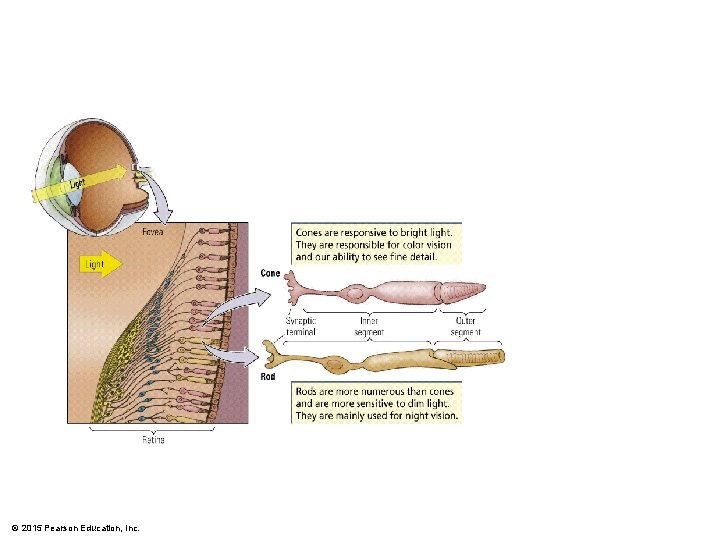
17 -4 Visual Physiology • Rods • Respond to almost any photon, regardless of energy content • Cones • Have characteristic ranges of sensitivity © 2015 Pearson Education, Inc.
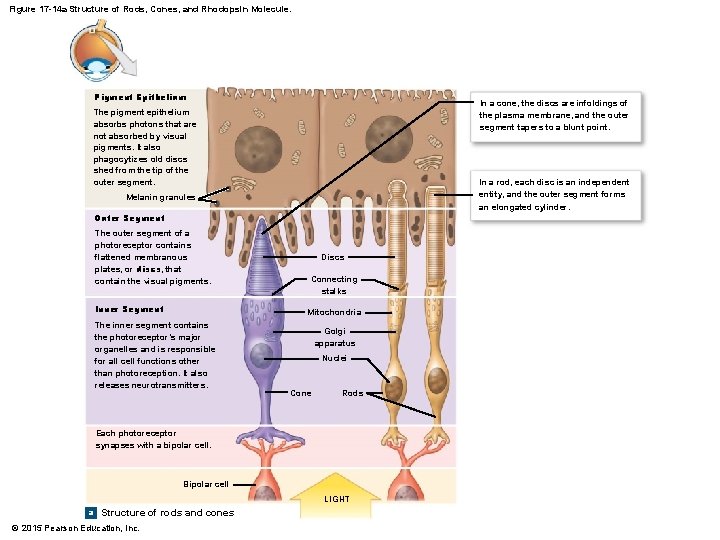
17 -4 Visual Physiology • Anatomy of Rods and Cones • Outer segment with membranous discs • Inner segment • Narrow stalk connects outer segment to inner segment © 2015 Pearson Education, Inc.
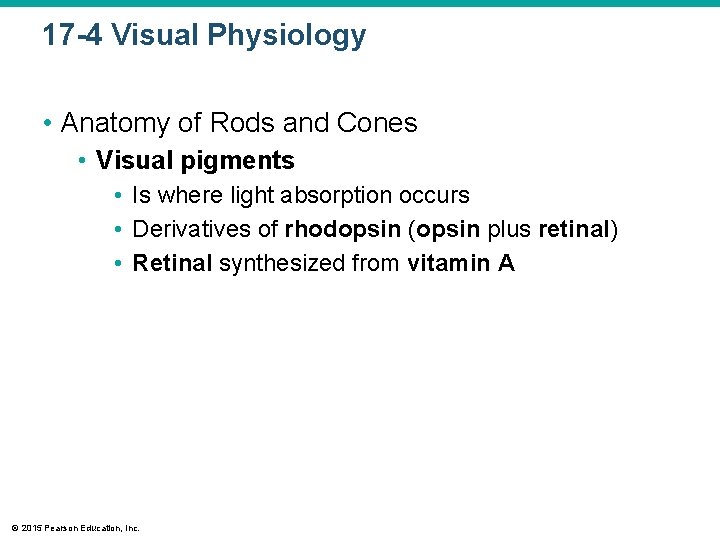
17 -4 Visual Physiology • Anatomy of Rods and Cones • Visual pigments • Is where light absorption occurs • Derivatives of rhodopsin (opsin plus retinal) • Retinal synthesized from vitamin A © 2015 Pearson Education, Inc.
Figure 17 -14 a Structure of Rods, Cones, and Rhodopsin Molecule. Pigment Epithelium In a cone, the discs are infoldings of the plasma membrane, and the outer segment tapers to a blunt point. The pigment epithelium absorbs photons that are not absorbed by visual pigments. It also phagocytizes old discs shed from the tip of the outer segment. In a rod, each disc is an independent entity, and the outer segment forms an elongated cylinder. Melanin granules Outer Segment The outer segment of a photoreceptor contains flattened membranous plates, or discs, that contain the visual pigments. Inner Segment Discs Connecting stalks Mitochondria The inner segment contains the photoreceptor’s major organelles and is responsible for all cell functions other than photoreception. It also releases neurotransmitters. Golgi apparatus Nuclei Cone Rods Each photoreceptor synapses with a bipolar cell. Bipolar cell LIGHT a Structure of rods and cones © 2015 Pearson Education, Inc.
© 2015 Pearson Education, Inc.
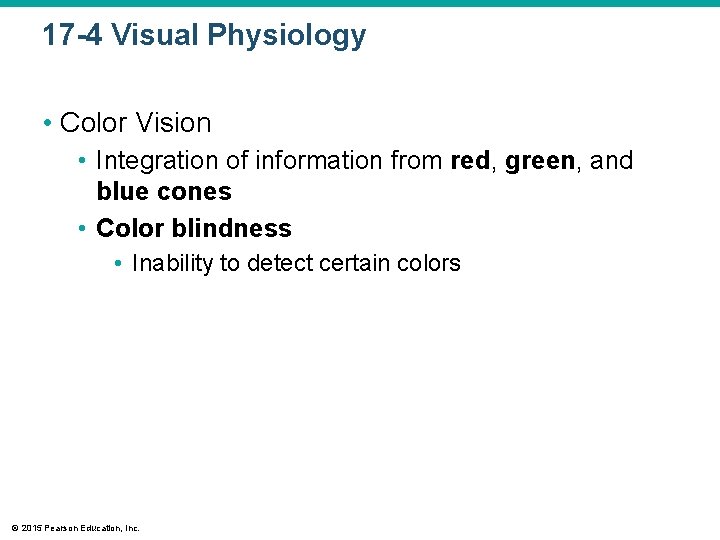
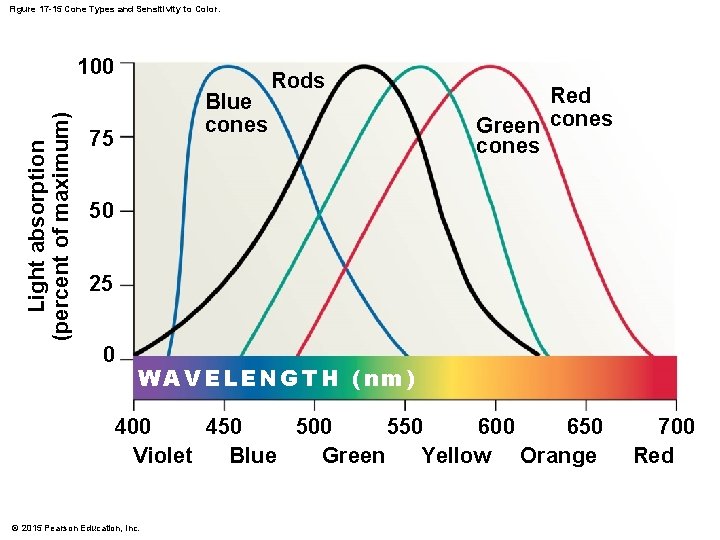
17 -4 Visual Physiology • Color Vision • Integration of information from red, green, and blue cones • Color blindness • Inability to detect certain colors © 2015 Pearson Education, Inc.
Figure 17 -15 Cone Types and Sensitivity to Color. Light absorption (percent of maximum) 100 Blue cones 75 Rods Red Green cones 50 25 0 WAVELENGTH (nm) 400 450 500 550 600 650 Violet Blue Green Yellow Orange © 2015 Pearson Education, Inc. 700 Red
© 2015 Pearson Education, Inc.
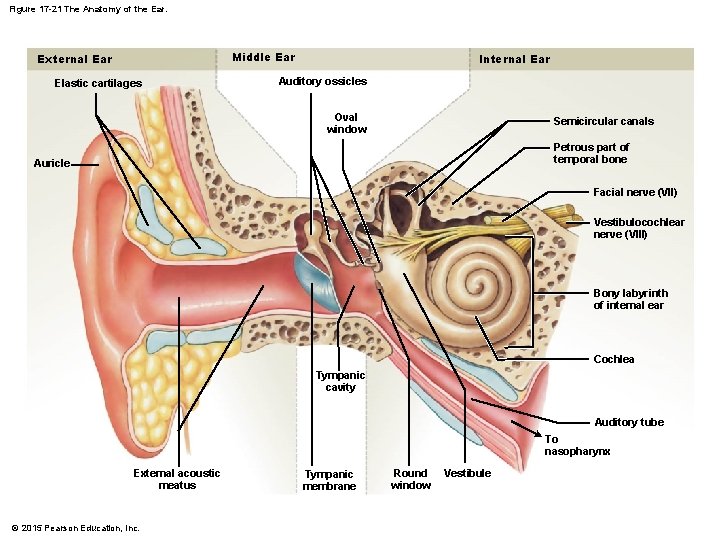
Figure 17 -21 The Anatomy of the Ear. Middle Ear External Ear Elastic cartilages Internal Ear Auditory ossicles Oval window Semicircular canals Petrous part of temporal bone Auricle Facial nerve (VII) Vestibulocochlear nerve (VIII) Bony labyrinth of internal ear Cochlea Tympanic cavity Auditory tube To nasopharynx External acoustic meatus © 2015 Pearson Education, Inc. Tympanic membrane Round window Vestibule
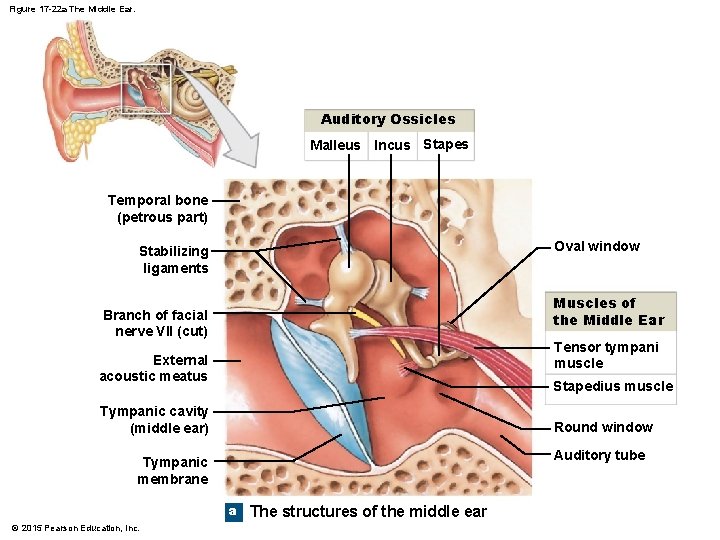
Figure 17 -22 a The Middle Ear. Auditory Ossicles Malleus Incus Stapes Temporal bone (petrous part) Oval window Stabilizing ligaments Muscles of the Middle Ear Branch of facial nerve VII (cut) Tensor tympani muscle External acoustic meatus Stapedius muscle Tympanic cavity (middle ear) Round window Auditory tube Tympanic membrane a © 2015 Pearson Education, Inc. The structures of the middle ear
17 -5 The Ear • Vibration of Tympanic Membrane • Converts arriving sound waves into mechanical movements • Auditory ossicles conduct vibrations to inner ear • Tensor tympani muscle • Stiffens tympanic membrane • Stapedius muscle • Reduces movement of stapes at oval window © 2015 Pearson Education, Inc.
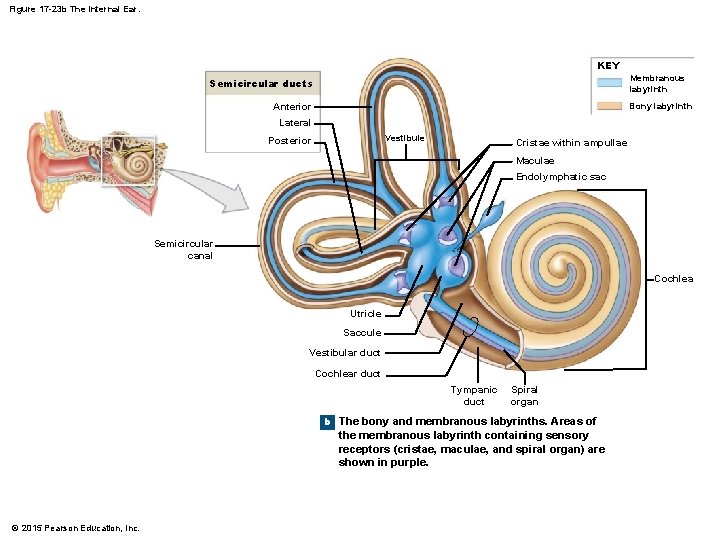
17 -5 The Ear • The Internal Ear • Contains fluid called endolymph • Bony labyrinth surrounds and protects membranous labyrinth • Subdivided into: • Vestibule • Semicircular canals • Cochlea © 2015 Pearson Education, Inc.
Figure 17 -23 b The Internal Ear. KEY Membranous labyrinth Semicircular ducts Bony labyrinth Anterior Lateral Vestibule Posterior Cristae within ampullae Maculae Endolymphatic sac Semicircular canal Cochlea Utricle Saccule Vestibular duct Cochlear duct Tympanic duct Spiral organ b The bony and membranous labyrinths. Areas of the membranous labyrinth containing sensory receptors (cristae, maculae, and spiral organ) are shown in purple. © 2015 Pearson Education, Inc.
17 -5 The Ear • The Internal Ear • Vestibule • Encloses saccule and utricle • Receptors provide sensations of gravity and linear acceleration • Semicircular canals • Contain semicircular ducts • Receptors stimulated by rotation of head © 2015 Pearson Education, Inc.
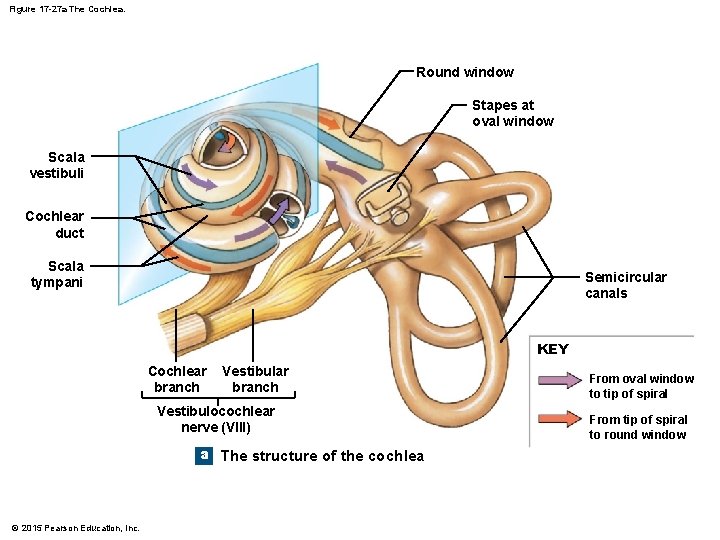
17 -5 The Ear • The Internal Ear • Cochlea • Contains cochlear duct (elongated portion of membranous labyrinth) • Receptors provide sense of hearing © 2015 Pearson Education, Inc.
17 -5 The Ear • The Internal Ear • Round window • Thin, membranous partition • Separates perilymph from air spaces of middle ear • Oval window • Formed of collagen fibers • Connected to base of stapes © 2015 Pearson Education, Inc.
17 -5 The Ear • Stimuli and Location • Sense of gravity and acceleration • From hair cells in vestibule • Sense of rotation • From semicircular canals • Sense of sound • From cochlea © 2015 Pearson Education, Inc.
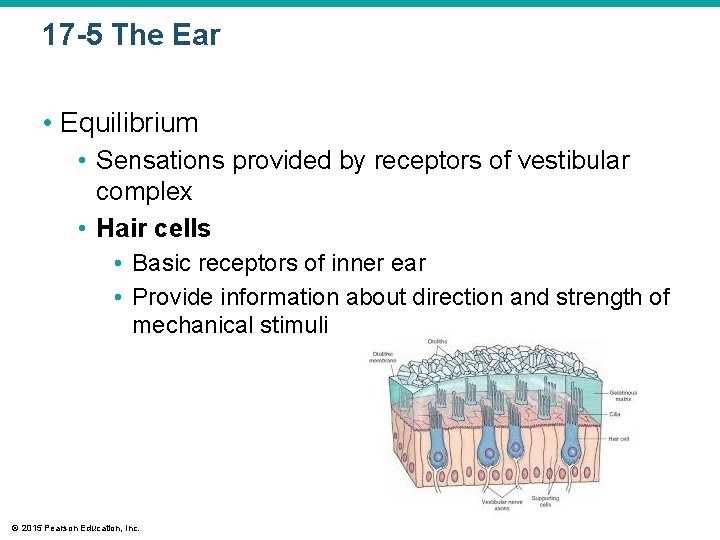
17 -5 The Ear • Equilibrium • Sensations provided by receptors of vestibular complex • Hair cells • Basic receptors of inner ear • Provide information about direction and strength of mechanical stimuli © 2015 Pearson Education, Inc.
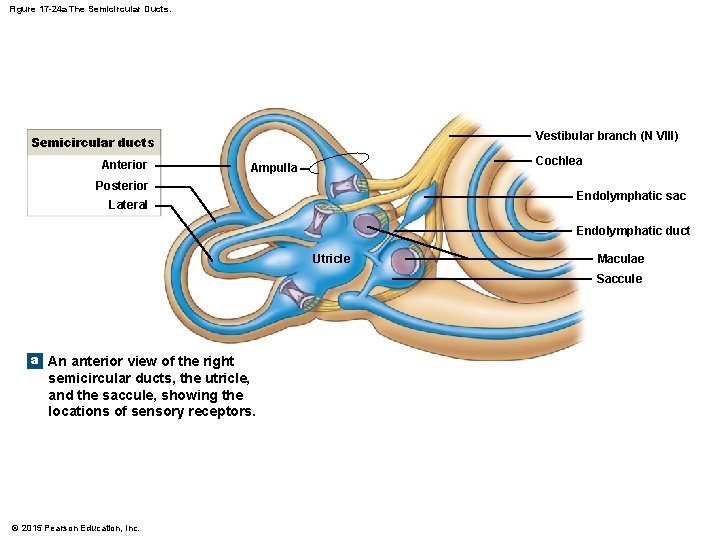
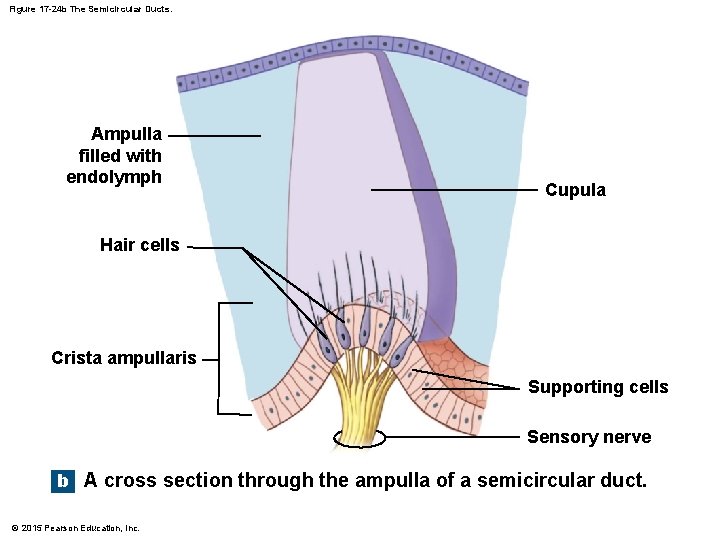
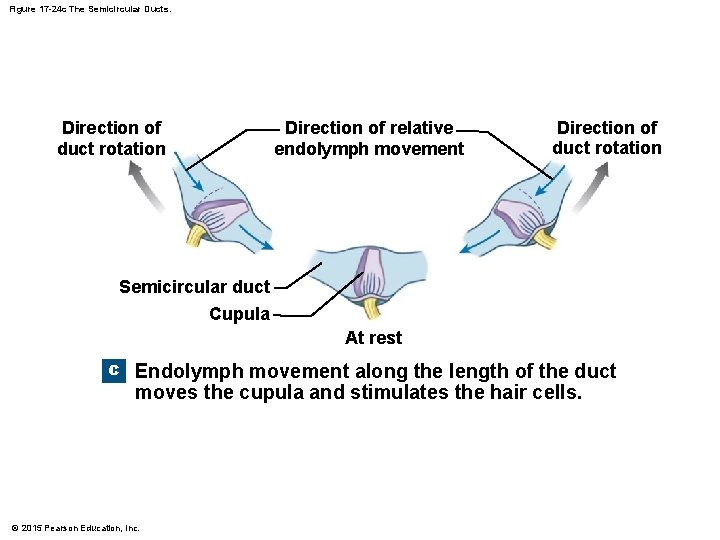
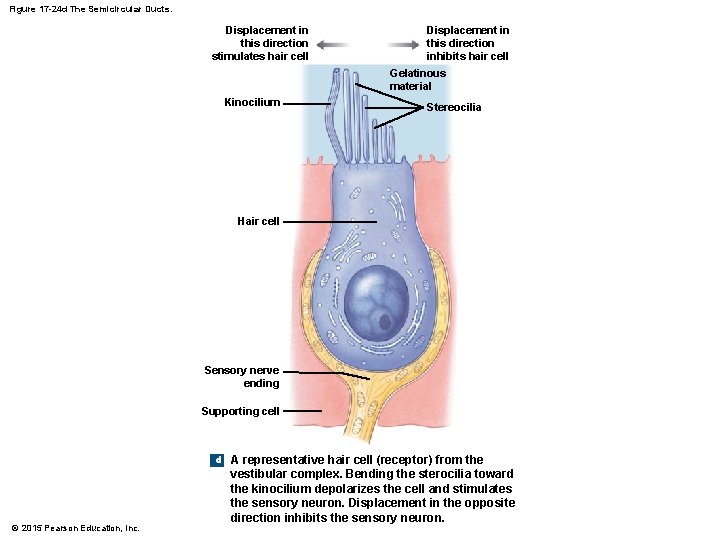
17 -5 The Ear • The Semicircular Ducts • Are continuous with utricle • Each duct contains: • Ampulla with gelatinous cupula • Associated sensory receptors • Stereocilia – resemble long microvilli • Are on surface of hair cell • Kinocilium – single large cilium © 2015 Pearson Education, Inc.
Figure 17 -24 a The Semicircular Ducts. Vestibular branch (N VIII) Semicircular ducts Anterior Cochlea Ampulla Posterior Endolymphatic sac Lateral Endolymphatic duct Utricle Maculae Saccule a An anterior view of the right semicircular ducts, the utricle, and the saccule, showing the locations of sensory receptors. © 2015 Pearson Education, Inc.
Figure 17 -24 b The Semicircular Ducts. Ampulla filled with endolymph Cupula Hair cells Crista ampullaris Supporting cells Sensory nerve b A cross section through the ampulla of a semicircular duct. © 2015 Pearson Education, Inc.
Figure 17 -24 c The Semicircular Ducts. Direction of duct rotation Direction of relative endolymph movement Direction of duct rotation Semicircular duct Cupula At rest c Endolymph movement along the length of the duct moves the cupula and stimulates the hair cells. © 2015 Pearson Education, Inc.
Figure 17 -24 d The Semicircular Ducts. Displacement in this direction stimulates hair cell Displacement in this direction inhibits hair cell Gelatinous material Kinocilium Stereocilia Hair cell Sensory nerve ending Supporting cell d © 2015 Pearson Education, Inc. A representative hair cell (receptor) from the vestibular complex. Bending the sterocilia toward the kinocilium depolarizes the cell and stimulates the sensory neuron. Displacement in the opposite direction inhibits the sensory neuron.
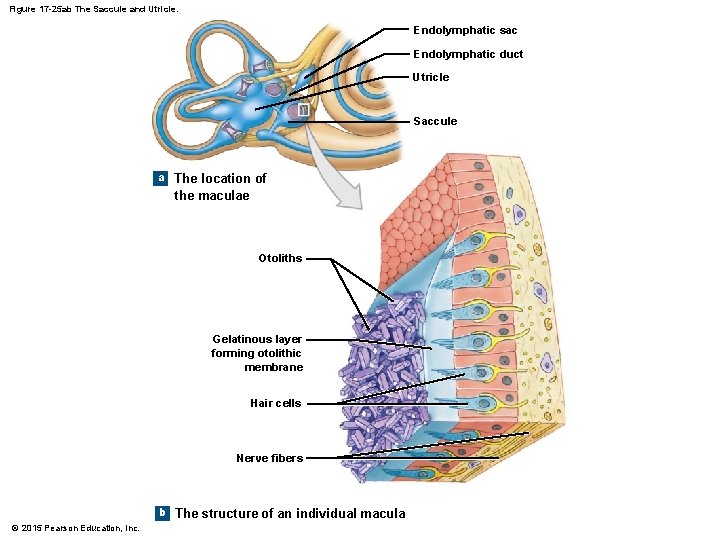
17 -5 The Ear • The Utricle and Saccule • Provide equilibrium sensations • Are connected with the endolymphatic duct, which ends in endolymphatic sac © 2015 Pearson Education, Inc.
17 -5 The Ear • The Utricle and Saccule • Maculae • Oval structures where hair cells cluster • Statoconia • Densely packed calcium carbonate crystals on surface of gelatinous mass • Otolith (ear stone) gelatinous matrix and statoconia © 2015 Pearson Education, Inc.
Figure 17 -25 ab The Saccule and Utricle. Endolymphatic sac Endolymphatic duct Utricle Saccule a The location of the maculae Otoliths Gelatinous layer forming otolithic membrane Hair cells Nerve fibers b The structure of an individual macula © 2015 Pearson Education, Inc.
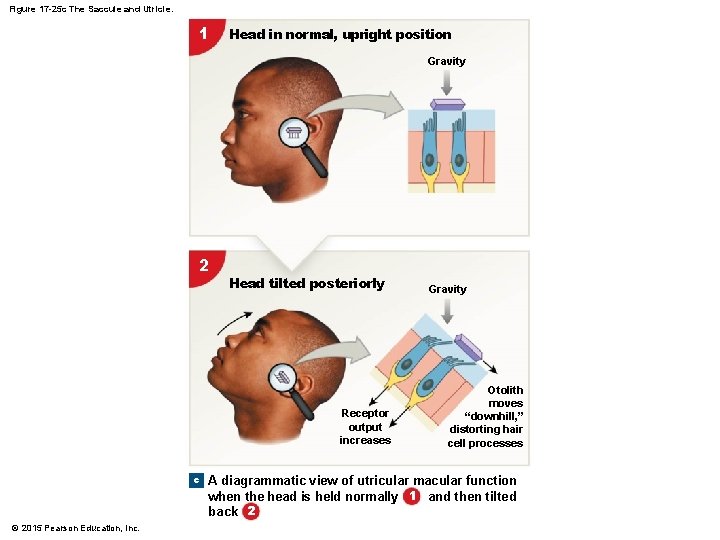
Figure 17 -25 c The Saccule and Utricle. 1 Head in normal, upright position Gravity 2 Head tilted posteriorly Receptor output increases c © 2015 Pearson Education, Inc. Gravity Otolith moves “downhill, ” distorting hair cell processes A diagrammatic view of utricular macular function when the head is held normally 1 and then tilted back 2
17 -5 The Ear • Eye, Head, and Neck Movements • Reflexive motor commands • From vestibular nuclei • Distributed to motor nuclei for cranial nerves • Peripheral Muscle Tone, Head, and Neck Movements • Instructions descend in vestibulospinal tracts of spinal cord © 2015 Pearson Education, Inc.
17 -5 The Ear • Hearing • Cochlear duct receptors • Provide sense of hearing © 2015 Pearson Education, Inc.
Figure 17 -27 a The Cochlea. Round window Stapes at oval window Scala vestibuli Cochlear duct Scala tympani Semicircular canals KEY Cochlear branch Vestibulocochlear nerve (VIII) a The structure of the cochlea © 2015 Pearson Education, Inc. From oval window to tip of spiral From tip of spiral to round window
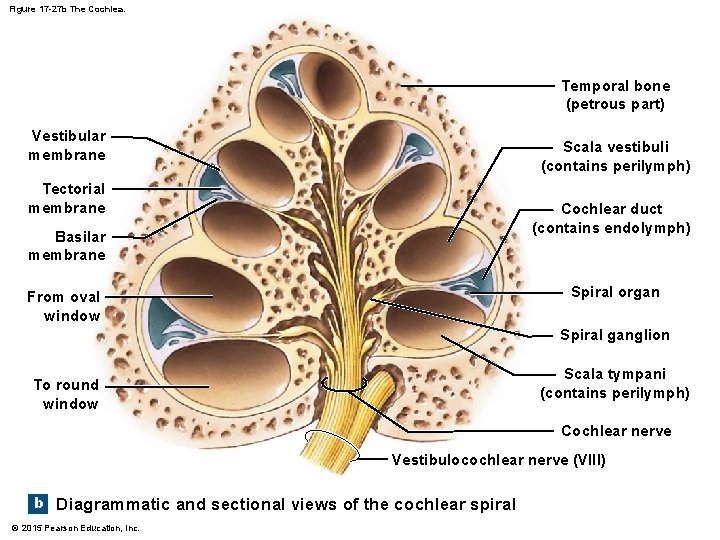
Figure 17 -27 b The Cochlea. Temporal bone (petrous part) Vestibular membrane Scala vestibuli (contains perilymph) Tectorial membrane Cochlear duct (contains endolymph) Basilar membrane Spiral organ From oval window Spiral ganglion Scala tympani (contains perilymph) To round window Cochlear nerve Vestibulocochlear nerve (VIII) b Diagrammatic and sectional views of the cochlear spiral © 2015 Pearson Education, Inc.
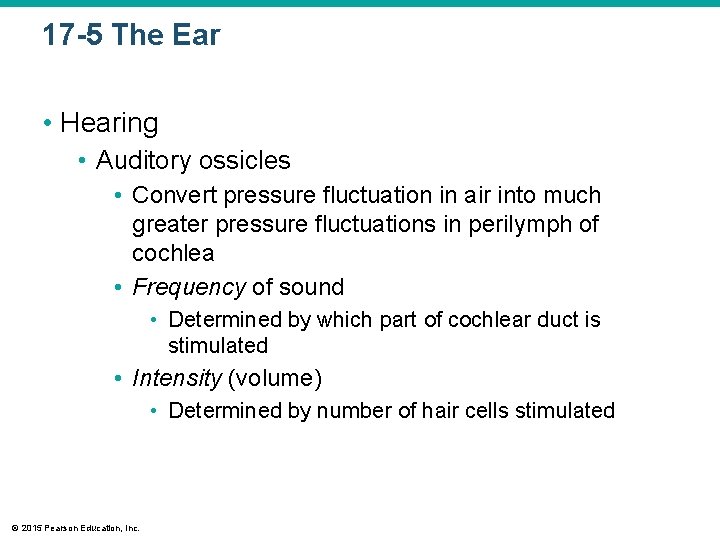
17 -5 The Ear • Hearing • Auditory ossicles • Convert pressure fluctuation in air into much greater pressure fluctuations in perilymph of cochlea • Frequency of sound • Determined by which part of cochlear duct is stimulated • Intensity (volume) • Determined by number of hair cells stimulated © 2015 Pearson Education, Inc.
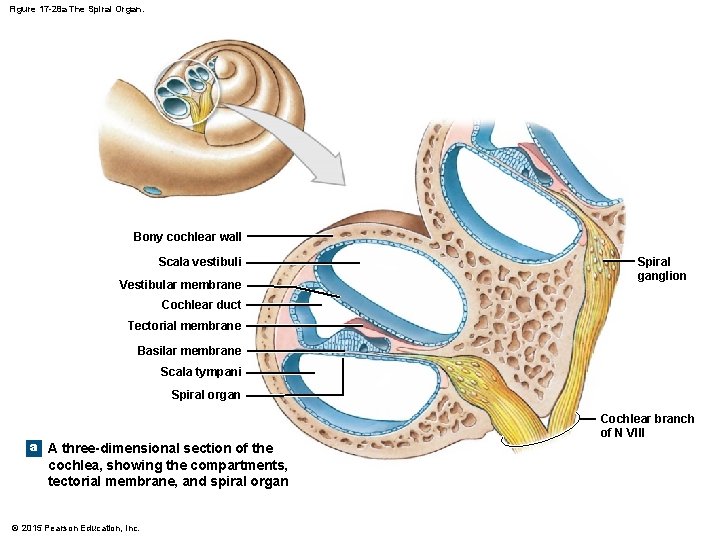
Figure 17 -28 a The Spiral Organ. Bony cochlear wall Scala vestibuli Vestibular membrane Spiral ganglion Cochlear duct Tectorial membrane Basilar membrane Scala tympani Spiral organ a A three-dimensional section of the cochlea, showing the compartments, tectorial membrane, and spiral organ © 2015 Pearson Education, Inc. Cochlear branch of N VIII
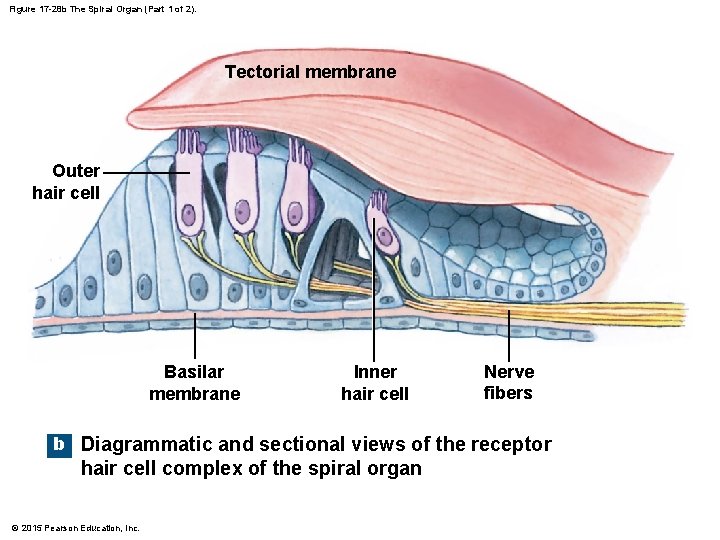
Figure 17 -28 b The Spiral Organ (Part 1 of 2). Tectorial membrane Outer hair cell Basilar membrane Inner hair cell Nerve fibers b Diagrammatic and sectional views of the receptor hair cell complex of the spiral organ © 2015 Pearson Education, Inc.
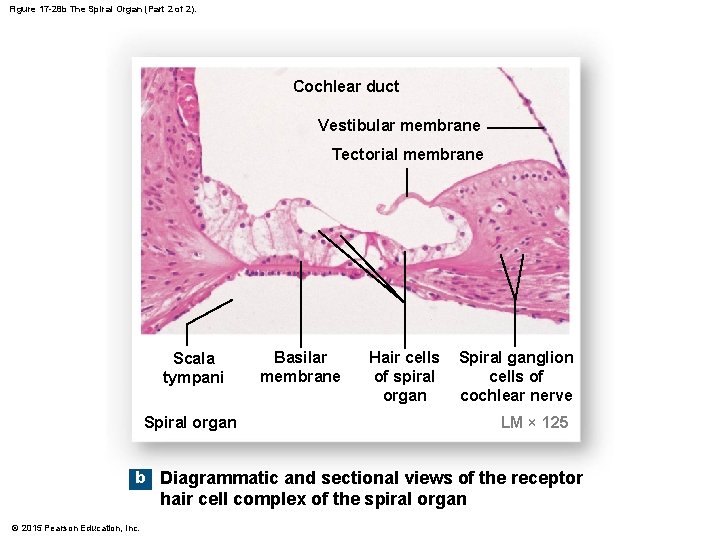
Figure 17 -28 b The Spiral Organ (Part 2 of 2). Cochlear duct Vestibular membrane Tectorial membrane Scala tympani Basilar membrane Hair cells of spiral organ Spiral ganglion cells of cochlear nerve Spiral organ LM × 125 b Diagrammatic and sectional views of the receptor hair cell complex of the spiral organ © 2015 Pearson Education, Inc.
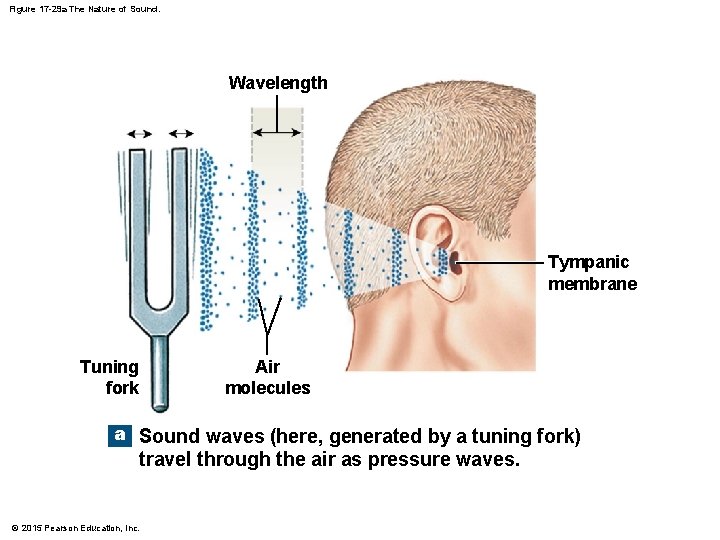
17 -5 The Ear • An Introduction to Sound • Pressure waves • Consist of regions where air molecules are crowded together • Adjacent zone where molecules are farther apart • Sine waves • S-shaped curves © 2015 Pearson Education, Inc.
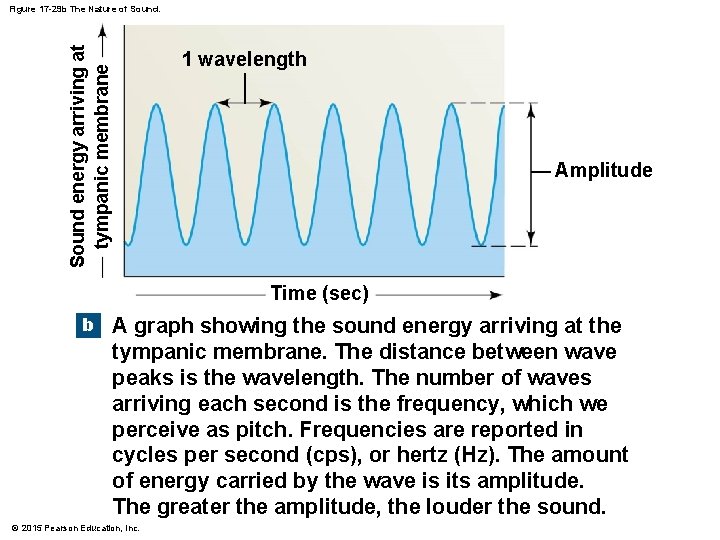
17 -5 The Ear • Pressure Wave • Wavelength • Distance between two adjacent wave troughs • Frequency • Number of waves that pass fixed reference point at given time • Physicists use term cycles instead of waves • Hertz (Hz) number of cycles per second (cps) © 2015 Pearson Education, Inc.
17 -5 The Ear • Pressure Wave • Pitch • Our sensory response to frequency • Amplitude • Intensity of sound wave • Sound energy is reported in decibels © 2015 Pearson Education, Inc.
Figure 17 -29 a The Nature of Sound. Wavelength Tympanic membrane Air molecules Tuning fork a Sound waves (here, generated by a tuning fork) travel through the air as pressure waves. © 2015 Pearson Education, Inc.
Sound energy arriving at tympanic membrane Figure 17 -29 b The Nature of Sound. 1 wavelength Amplitude Time (sec) b A graph showing the sound energy arriving at the tympanic membrane. The distance between wave peaks is the wavelength. The number of waves arriving each second is the frequency, which we perceive as pitch. Frequencies are reported in cycles per second (cps), or hertz (Hz). The amount of energy carried by the wave is its amplitude. The greater the amplitude, the louder the sound. © 2015 Pearson Education, Inc.
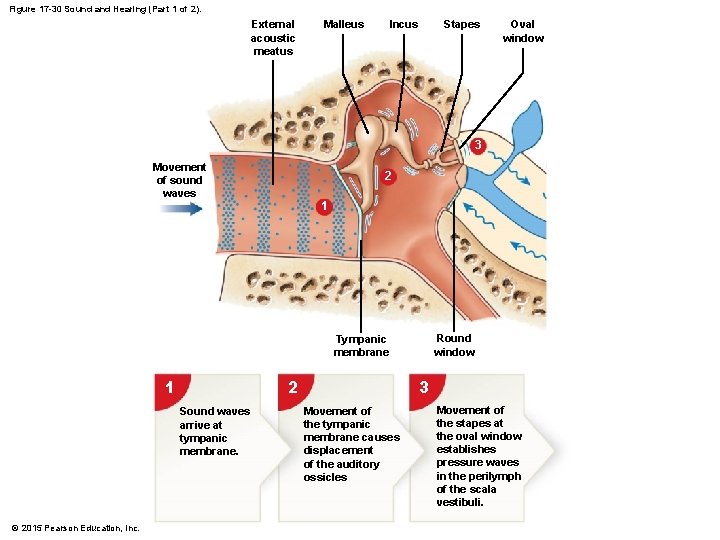
Figure 17 -30 Sound and Hearing (Part 1 of 2). External acoustic meatus Malleus Incus Stapes Oval window 3 Movement of sound waves 2 1 Round window Tympanic membrane 1 Sound waves arrive at tympanic membrane. © 2015 Pearson Education, Inc. 3 2 Movement of the tympanic membrane causes displacement of the auditory ossicles Movement of the stapes at the oval window establishes pressure waves in the perilymph of the scala vestibuli.
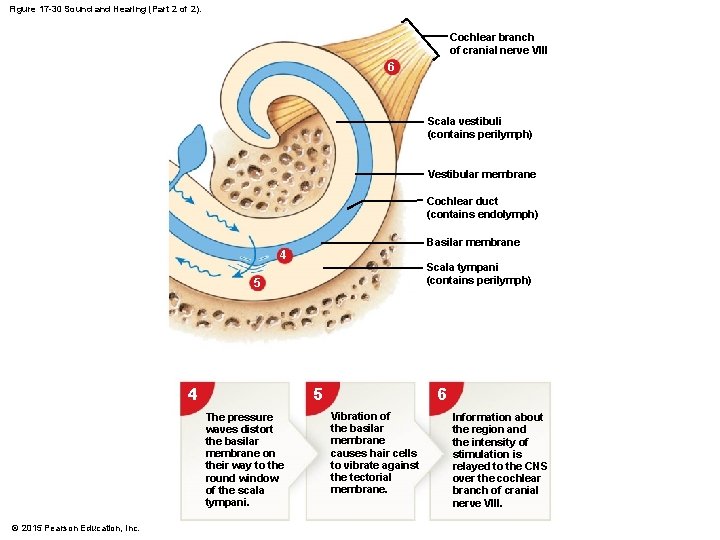
Figure 17 -30 Sound and Hearing (Part 2 of 2). Cochlear branch of cranial nerve VIII 6 Scala vestibuli (contains perilymph) Vestibular membrane Cochlear duct (contains endolymph) Basilar membrane 4 Scala tympani (contains perilymph) 5 4 The pressure waves distort the basilar membrane on their way to the round window of the scala tympani. © 2015 Pearson Education, Inc. 6 5 Vibration of the basilar membrane causes hair cells to vibrate against the tectorial membrane. Information about the region and the intensity of stimulation is relayed to the CNS over the cochlear branch of cranial nerve VIII.
© 2015 Pearson Education, Inc.
17 -5 The Ear • Auditory Pathways • Cochlear branch • Formed by afferent fibers of spiral ganglion neurons • Enters medulla oblongata • Synapses at dorsal and ventral cochlear nuclei • Information crosses to opposite side of brain • Ascends to inferior colliculus of midbrain © 2015 Pearson Education, Inc.
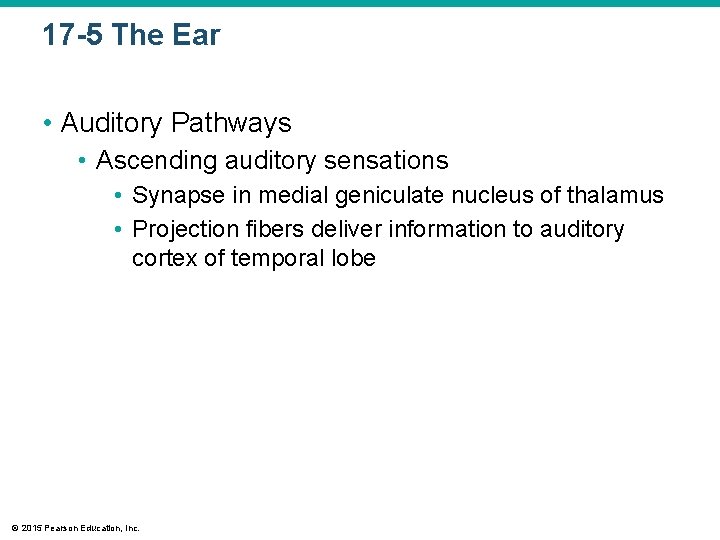
17 -5 The Ear • Auditory Pathways • Ascending auditory sensations • Synapse in medial geniculate nucleus of thalamus • Projection fibers deliver information to auditory cortex of temporal lobe © 2015 Pearson Education, Inc.
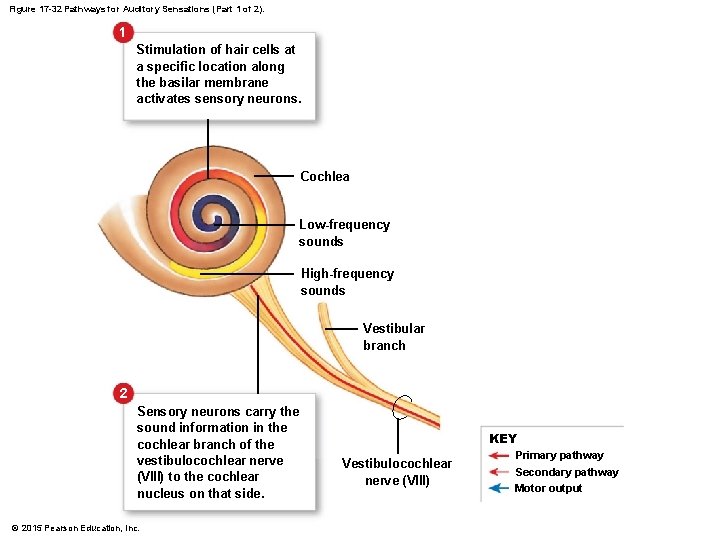
Figure 17 -32 Pathways for Auditory Sensations (Part 1 of 2). 1 Stimulation of hair cells at a specific location along the basilar membrane activates sensory neurons. Cochlea Low-frequency sounds High-frequency sounds Vestibular branch 2 Sensory neurons carry the sound information in the cochlear branch of the vestibulocochlear nerve (VIII) to the cochlear nucleus on that side. © 2015 Pearson Education, Inc. KEY Vestibulocochlear nerve (VIII) Primary pathway Secondary pathway Motor output
Figure 17 -32 Pathways for Auditory Sensations (Part 2 of 2). 6 Projection fibers then deliver the information to specific locations within the auditory cortex of the temporal lobe. To ipsilateral auditory cortex Thalamus Highfrequency sounds Low-frequency sounds 5 Ascending acoustic information goes to the medial geniculate nucleus. 4 The inferior colliculi direct a variety of unconscious motor responses to sounds. To reticular formation and motor nuclei of cranial nerves Superior olivary nucleus 3 Information ascends from each cochlear nucleus to the superior olivary nucleus of the pons and the inferior colliculi of the midbrain. KEY Primary pathway Secondary pathway Motor output © 2015 Pearson Education, Inc. Motor output to spinal cord through the tectospinal tracts
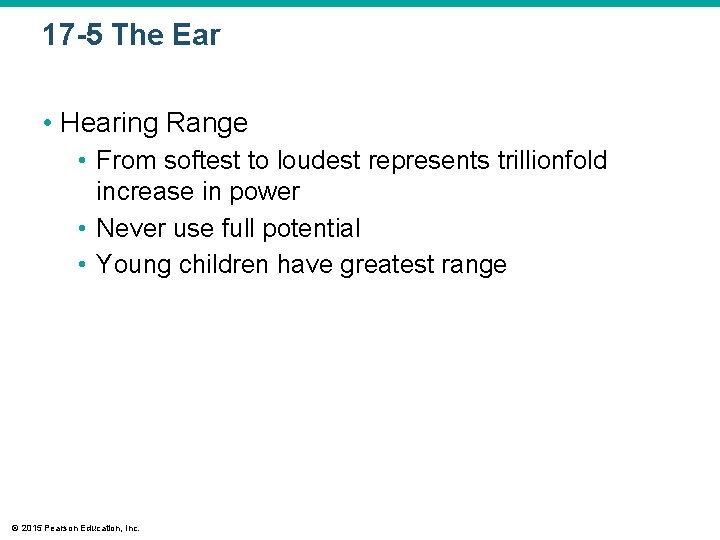
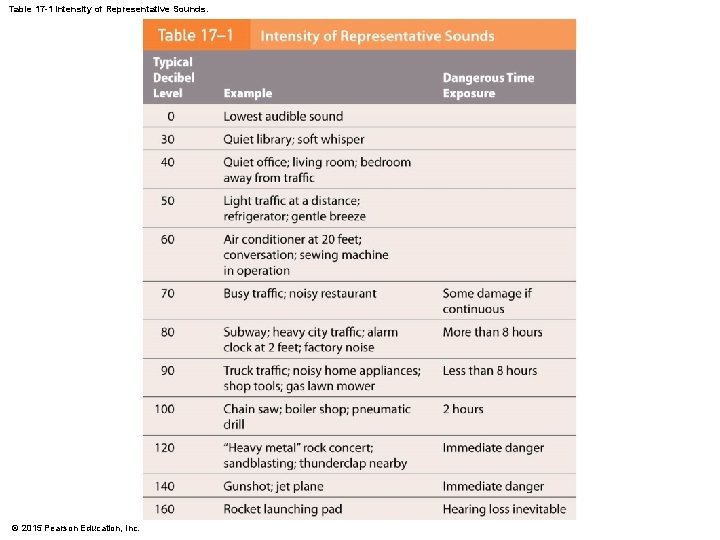
17 -5 The Ear • Hearing Range • From softest to loudest represents trillionfold increase in power • Never use full potential • Young children have greatest range © 2015 Pearson Education, Inc.
Table 17 -1 Intensity of Representative Sounds. © 2015 Pearson Education, Inc.
17 -5 The Ear • Effects of Aging on the Ear • With age, damage accumulates • Tympanic membrane gets less flexible • Articulations between ossicles stiffen • Round window may begin to ossify © 2015 Pearson Education, Inc.