
17 2 Compositions Symmetry of Transformations Warm Up
- Slides: 12
17. 2 Compositions Symmetry of Transformations Warm Up Lesson Presentation Lesson Quiz Holt. Mc. Dougal Geometry Holt
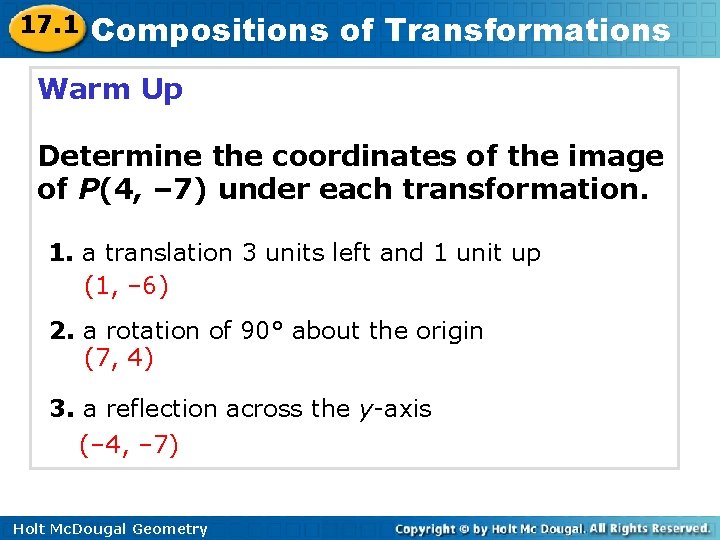
17. 1 Compositions of Transformations Warm Up Determine the coordinates of the image of P(4, – 7) under each transformation. 1. a translation 3 units left and 1 unit up (1, – 6) 2. a rotation of 90° about the origin (7, 4) 3. a reflection across the y-axis (– 4, – 7) Holt Mc. Dougal Geometry
17. 2 Compositions of Transformations Diatoms are microscopic algae that are found in aquatic environments. Scientists use a system that was developed in the 1970 s to classify diatoms based on their symmetry. A figure has symmetry if there is a transformation of the figure such that the image coincides with the preimage. Holt Mc. Dougal Geometry
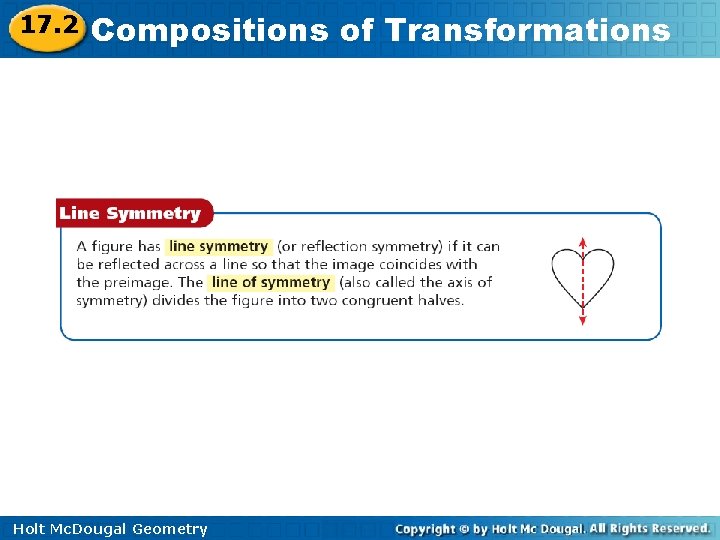
17. 2 Compositions of Transformations Holt Mc. Dougal Geometry
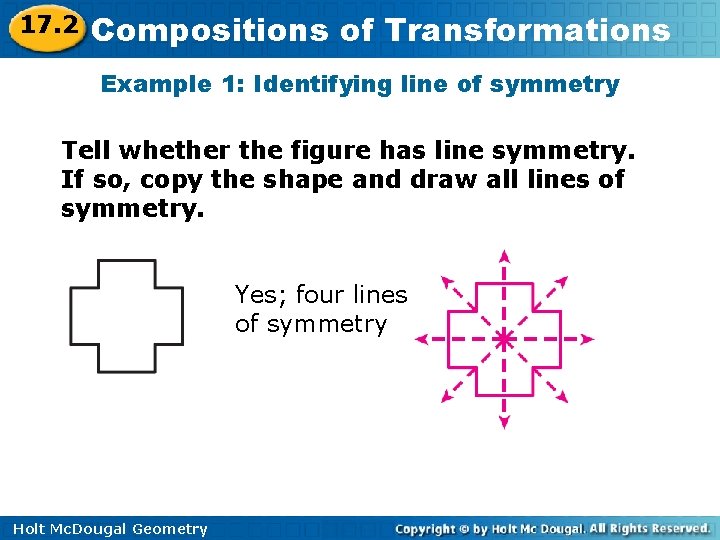
17. 2 Compositions of Transformations Example 1: Identifying line of symmetry Tell whether the figure has line symmetry. If so, copy the shape and draw all lines of symmetry. Yes; four lines of symmetry Holt Mc. Dougal Geometry
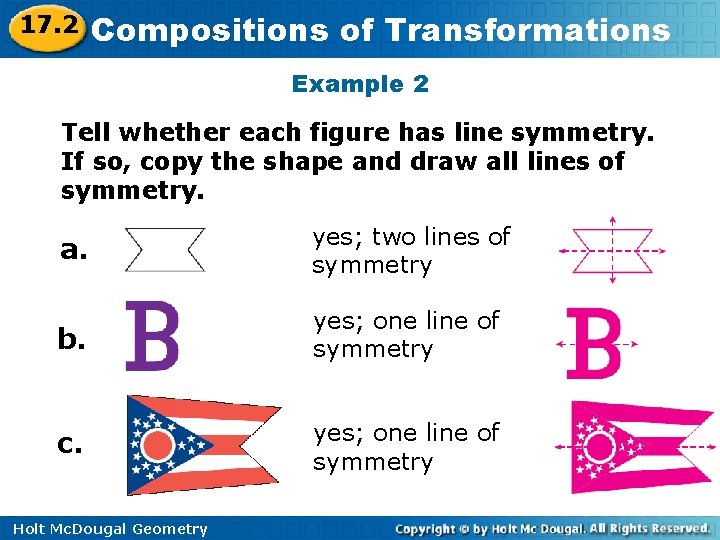
17. 2 Compositions of Transformations Example 2 Tell whether each figure has line symmetry. If so, copy the shape and draw all lines of symmetry. a. yes; two lines of symmetry b. yes; one line of symmetry c. yes; one line of symmetry Holt Mc. Dougal Geometry
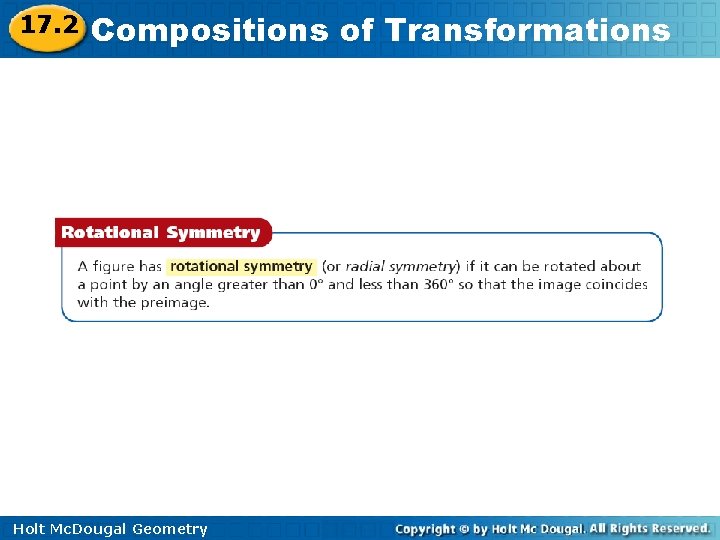
17. 2 Compositions of Transformations Holt Mc. Dougal Geometry
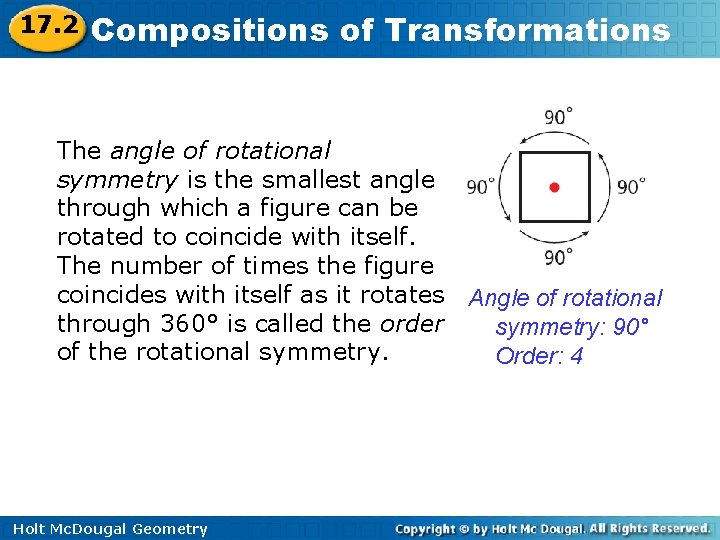
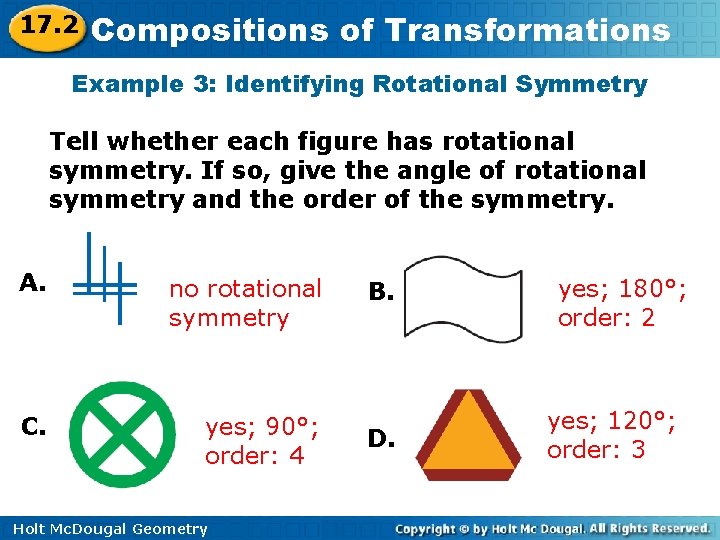
17. 2 Compositions of Transformations The angle of rotational symmetry is the smallest angle through which a figure can be rotated to coincide with itself. The number of times the figure coincides with itself as it rotates Angle of rotational through 360° is called the order symmetry: 90° of the rotational symmetry. Order: 4 Holt Mc. Dougal Geometry
17. 2 Compositions of Transformations Example 3: Identifying Rotational Symmetry Tell whether each figure has rotational symmetry. If so, give the angle of rotational symmetry and the order of the symmetry. A. no rotational symmetry C. yes; 90°; order: 4 Holt Mc. Dougal Geometry B. D. yes; 180°; order: 2 yes; 120°; order: 3
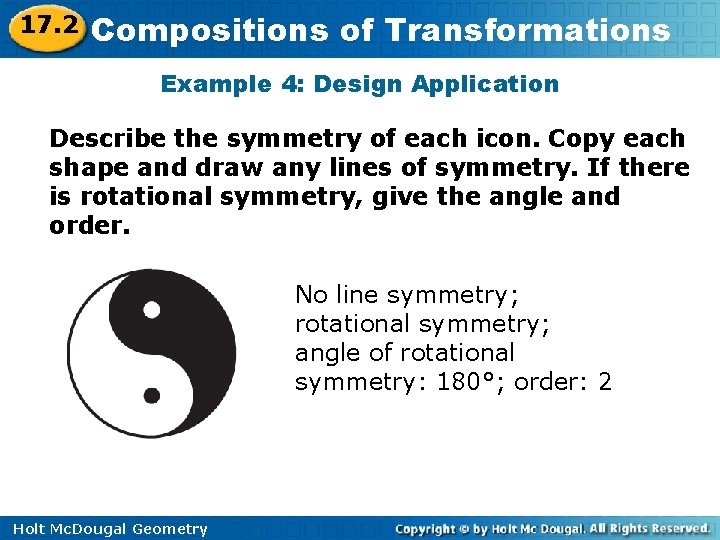
17. 2 Compositions of Transformations Example 4: Design Application Describe the symmetry of each icon. Copy each shape and draw any lines of symmetry. If there is rotational symmetry, give the angle and order. No line symmetry; rotational symmetry; angle of rotational symmetry: 180°; order: 2 Holt Mc. Dougal Geometry
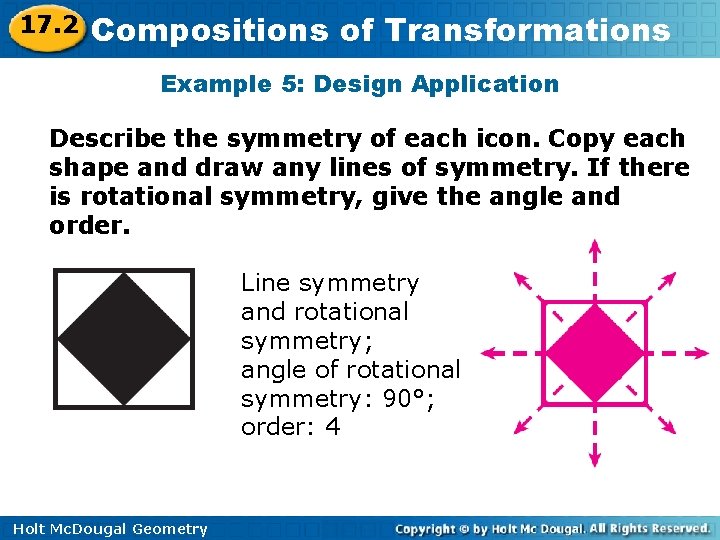
17. 2 Compositions of Transformations Example 5: Design Application Describe the symmetry of each icon. Copy each shape and draw any lines of symmetry. If there is rotational symmetry, give the angle and order. Line symmetry and rotational symmetry; angle of rotational symmetry: 90°; order: 4 Holt Mc. Dougal Geometry
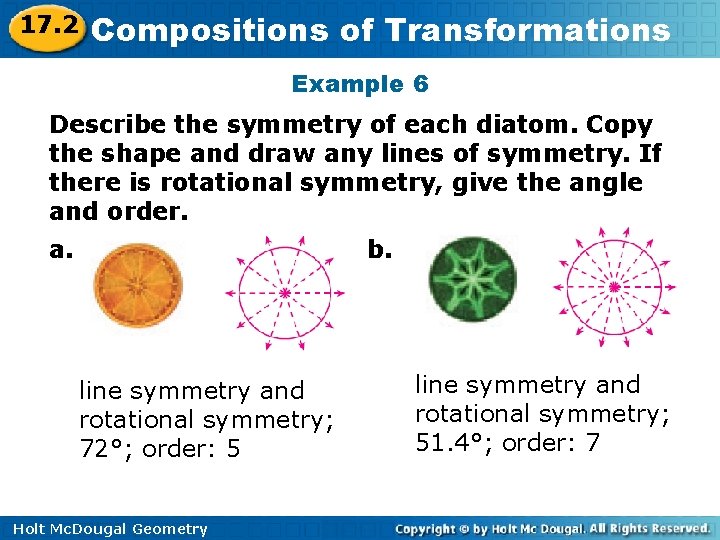
17. 2 Compositions of Transformations Example 6 Describe the symmetry of each diatom. Copy the shape and draw any lines of symmetry. If there is rotational symmetry, give the angle and order. a. b. line symmetry and rotational symmetry; 72°; order: 5 Holt Mc. Dougal Geometry line symmetry and rotational symmetry; 51. 4°; order: 7