
17 1 ECONOMICS ELEVENTH EDITION LIPSEY CHRYSTAL Chapter
![The Budget Surplus Function [£ Million] 17 - 3 GDP [Y] 500 1000 1750](https://slidetodoc.com/presentation_image_h/35c982c96b8faf73e5cbe5193c7a9c44/image-3.jpg "The Budget Surplus Function [£ Million] 17 - 3 GDP [Y] 500 1000 1750")
![Budget Surplus Function Price Saving [£m] 17 - 4 0 0 1000 2000 3000](https://slidetodoc.com/presentation_image_h/35c982c96b8faf73e5cbe5193c7a9c44/image-4.jpg "Budget Surplus Function Price Saving [£m] 17 - 4 0 0 1000 2000 3000")
![Budget Surplus Function Price Saving [£m] 17 - 5 T-G 0 -170 0 1000](https://slidetodoc.com/presentation_image_h/35c982c96b8faf73e5cbe5193c7a9c44/image-5.jpg "Budget Surplus Function Price Saving [£m] 17 - 5 T-G 0 -170 0 1000")
![The Next Export Function [£ Million] 17 - 7 GDP [Y] 0 1000 2160](https://slidetodoc.com/presentation_image_h/35c982c96b8faf73e5cbe5193c7a9c44/image-7.jpg "The Next Export Function [£ Million] 17 - 7 GDP [Y] 0 1000 2160")
![Export and Import Functions Imports and Exports [£m] 17 - 8 IM = 0.](https://slidetodoc.com/presentation_image_h/35c982c96b8faf73e5cbe5193c7a9c44/image-8.jpg "Export and Import Functions Imports and Exports [£m] 17 - 8 IM = 0.")
![17 - 10 The Aggregate Expenditure Function [£ Million] National Income Desired private [GDP]](https://slidetodoc.com/presentation_image_h/35c982c96b8faf73e5cbe5193c7a9c44/image-10.jpg "17 - 10 The Aggregate Expenditure Function [£ Million] National Income Desired private [GDP]")
![An Aggregate Spending Curve and Equilibrium GDP AE = Y Desired Expenditure [£m] 17](https://slidetodoc.com/presentation_image_h/35c982c96b8faf73e5cbe5193c7a9c44/image-11.jpg "An Aggregate Spending Curve and Equilibrium GDP AE = Y Desired Expenditure [£m] 17")
![The Effect of Change in Government Spending 17 - 13 Desired Expenditure [£m] AE](https://slidetodoc.com/presentation_image_h/35c982c96b8faf73e5cbe5193c7a9c44/image-13.jpg "The Effect of Change in Government Spending 17 - 13 Desired Expenditure [£m] AE")
- Slides: 22
17 - 1 ECONOMICS ELEVENTH EDITION LIPSEY & CHRYSTAL Chapter 17 GDP IN AN OPEN ECONOMY WITH GOVERNMENT Slides by Alex Stojanovic
17 - 2 Learning Outcomes • Government consumption contributes to aggregate spending in the same way as any other component of autonomous spending • Taxes affect private consumption via their effect on disposable income • Net exports are negatively related to domestic income • A necessary condition for GDP to be in equilibrium is that desired aggregate domestic spending is equal to national output • The size of the multiplier is negatively related to the income tax rate and the marginal propensity to import
The Budget Surplus Function [£ Million] 17 - 3 GDP [Y] 500 1000 1750 2000 3000 4000 Government expenditure [G] Net Taxes [T = 0. 1 Y] 170 170 170 50 100 175 200 300 400 Government Surplus [T-G] -120 -70 5 30 130 230
Budget Surplus Function Price Saving [£m] 17 - 4 0 0 1000 2000 3000 4000 National Income [GDP][£m] 5000 6000
Budget Surplus Function Price Saving [£m] 17 - 5 T-G 0 -170 0 1000 2000 3000 4000 National Income [GDP][£m] 5000 6000
17 - 6 The budget surplus function • The budget surplus is negative at low levels of GDP and becomes positive at high levels of GDP. • Tax revenue increases with GDP while government spending is assumed not to vary with GDP. • The slope of the budget surplus function is 0. 1 when the income tax rate is assumed to be 10%.
The Next Export Function [£ Million] 17 - 7 GDP [Y] 0 1000 2160 3000 4000 5000 Exports [X] 540 540 540 Imports [IM = 0. 25 Y] 0 250 540 750 1000 1250 Net Exports 540 190 0 -210 -460 -710
Export and Import Functions Imports and Exports [£m] 17 - 8 IM = 0. 25 Y 540 X = 540 0 1000 2000 Net Exports [£m] [i]. Export and Import Functions 3000 Real National Income [GDP] [£m] 540 2160 0 (X - IM) = 540 - 0. 25 Y 1000 [ii]. Net Export Function 2000 3000 Real National Income [GDP] [£m]
17 - 9 The net export function • Net exports, defined as exports minus imports, are negatively related to GDP. • Exports are assumed to be constant at £ 540 million while imports are 0. 25 of National income. • So the net export function is given by: 540 -0. 25 Y
17 - 10 The Aggregate Expenditure Function [£ Million] National Income Desired private [GDP] [Y] consumption expenditure [C = 100 +0. 72 Y] 0 100 500 1000 2000 3000 4000 5000 172 460 820 1540 2260 2980 3700 Desired investment expenditure [I = 250] Desired government expenditure [G = 170] 250 250 170 170 Desired net export expenditure [IM = 540 - 0. 25 Y] 540 515 315 290 40 -210 -460 -710 Desired aggregate expenditure [AE = C + I + G + (X - IM)] 1060 1107 1195 1530 2000 2470 2940 3410
An Aggregate Spending Curve and Equilibrium GDP AE = Y Desired Expenditure [£m] 17 - 11 AE E 0 2000 1060 450 0 1000 2000 3000 4000 5000 Real National Income [GDP] [£m]
17 - 12 Aggregate expenditure • The aggregate expenditure function is the sum of desired consumption, investment, government spending and net exports. • Equilibrium GDP occurs at E 0 where the desired aggregate expenditure line intersects the 450 line. • Only when GDP is £ 2000 will desired spending equal national output.
The Effect of Change in Government Spending 17 - 13 Desired Expenditure [£m] AE = Y 45 o 0 Real National Income [GDP] [£m]
The Effect of Change in Government Spending 17 - 14 AE = Y Desired Expenditure [£m] AE 0 45 o 0 Y 0 Real National Income [GDP] [£m]
The Effect of Change in Government Spending 17 - 15 AE = Y AE 1 Desired Expenditure [£m] AE 0 45 o 0 Y 0 Real National Income [GDP] [£m]
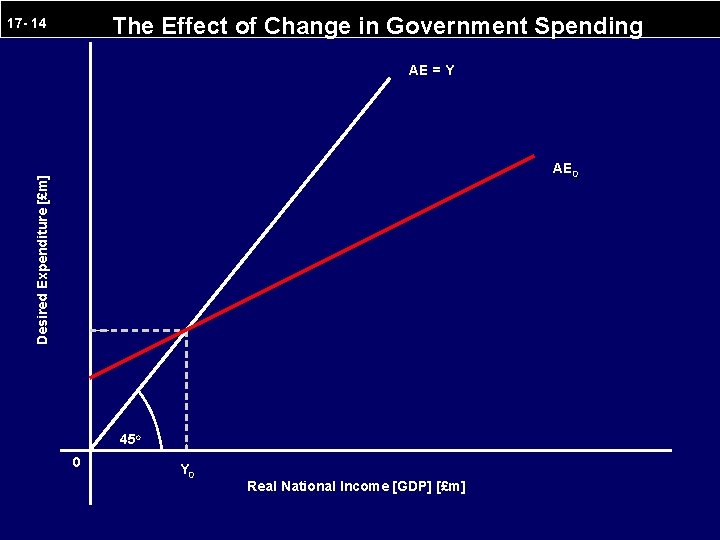
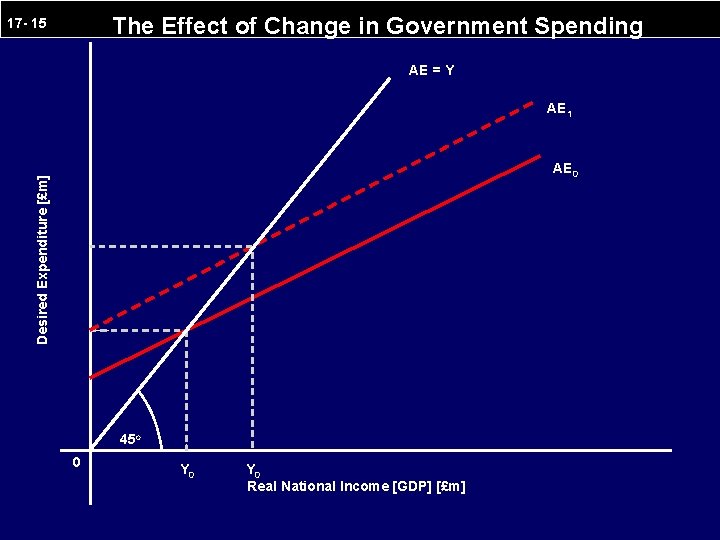
17 - 16 The Effect of Change in Government Spending • A change in government spending changes GDP by shifting the AE line parallel to its initial position. • The initial level of AE is at AE 0 and GDP is Y 0 with desired expenditures at e 0. • An increase in government spending raises AE to AE 1. • GDP rises to Y 1 at which level desired expenditures are e 1. • The increase in GDP from Y 0 to Y 1 is equal to the increase in government spending times the multiplier.
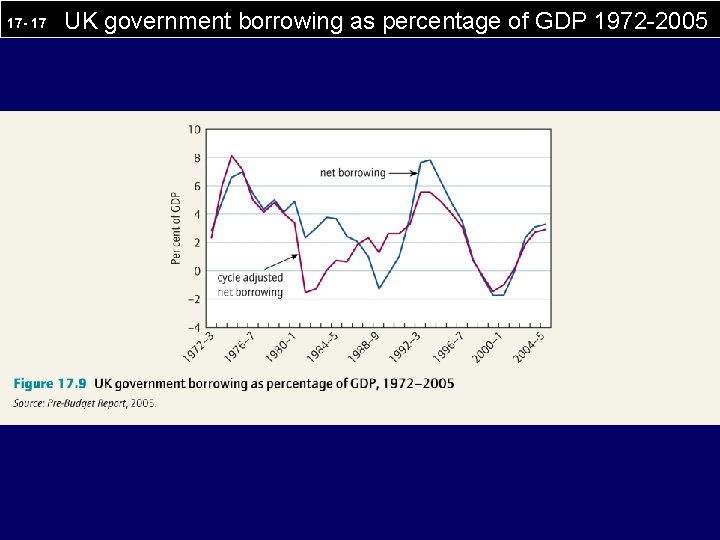
17 - 17 UK government borrowing as percentage of GDP 1972 -2005
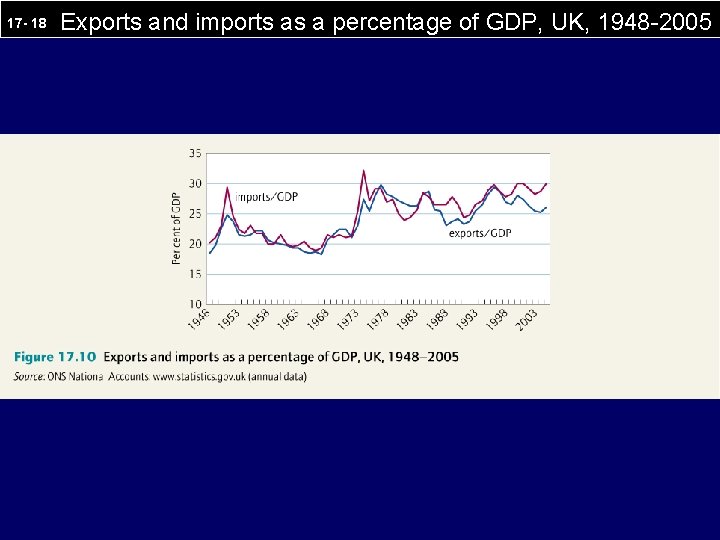
17 - 18 Exports and imports as a percentage of GDP, UK, 1948 -2005
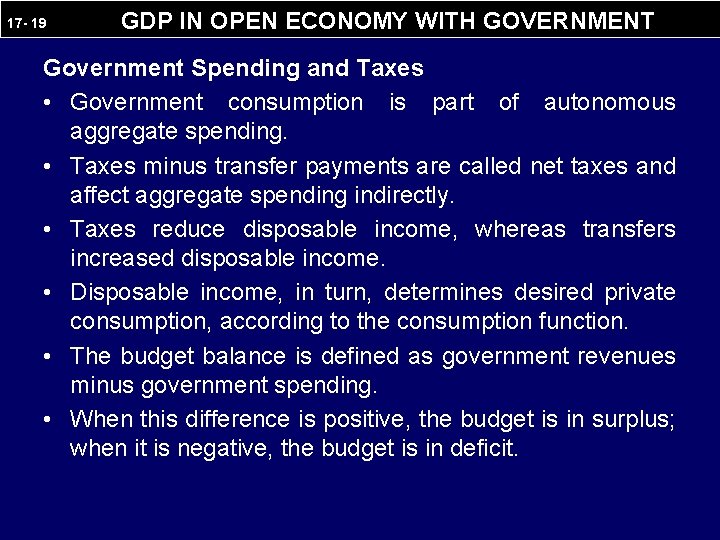
17 - 19 GDP IN OPEN ECONOMY WITH GOVERNMENT Government Spending and Taxes • Government consumption is part of autonomous aggregate spending. • Taxes minus transfer payments are called net taxes and affect aggregate spending indirectly. • Taxes reduce disposable income, whereas transfers increased disposable income. • Disposable income, in turn, determines desired private consumption, according to the consumption function. • The budget balance is defined as government revenues minus government spending. • When this difference is positive, the budget is in surplus; when it is negative, the budget is in deficit.
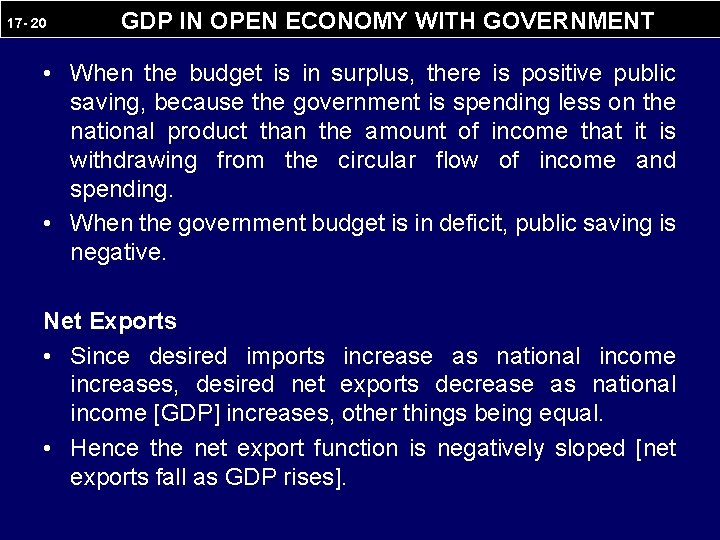
17 - 20 GDP IN OPEN ECONOMY WITH GOVERNMENT • When the budget is in surplus, there is positive public saving, because the government is spending less on the national product than the amount of income that it is withdrawing from the circular flow of income and spending. • When the government budget is in deficit, public saving is negative. Net Exports • Since desired imports increase as national income increases, desired net exports decrease as national income [GDP] increases, other things being equal. • Hence the net export function is negatively sloped [net exports fall as GDP rises].
17 - 21 GDP IN OPEN ECONOMY WITH GOVERNMENT Equilibrium GDP • GDP is in equilibrium when desired aggregate expenditure, C + I + G [X - IM], equals national output. • The sum of investment and net exports is called national asset formation because investment is the increase in the domestic capital stock and net exports result in investment in foreign assets. • At the equilibrium level of GDP, desired national saving, S + T - G, is equal to national asset formation, I + X - IM.
17 - 22 GDP IN OPEN ECONOMY WITH GOVERNMENT Changes in Aggregate Spending • The size of the multiplier is negatively related to the income tax rate. • A shift in exogenous spending changes GDP by the value of the shift times the simple multiplier. • A shift in aggregate spending can be brought about by fiscal policy changes or by a change in official interest rate.