
17 1 Atomic Structure no need to write


- Slides: 8
17. 1 Atomic Structure *no need to write italicized notes
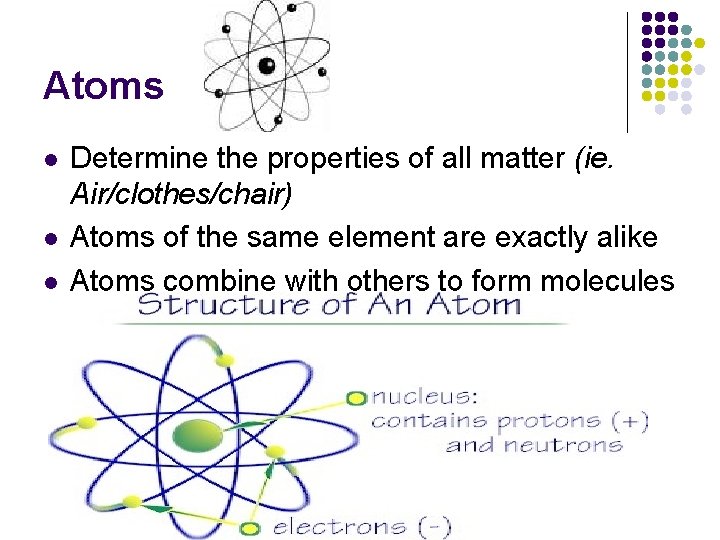
Atoms l l l Determine the properties of all matter (ie. Air/clothes/chair) Atoms of the same element are exactly alike Atoms combine with others to form molecules
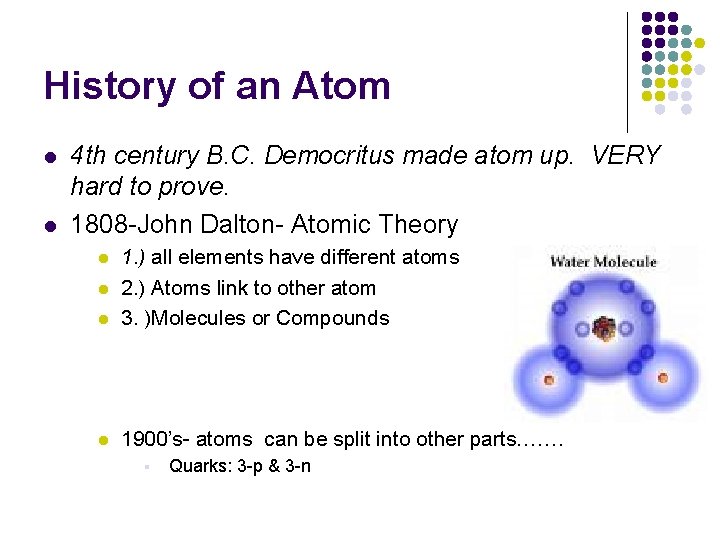
History of an Atom l l 4 th century B. C. Democritus made atom up. VERY hard to prove. 1808 -John Dalton- Atomic Theory l 1. ) all elements have different atoms 2. ) Atoms link to other atom 3. )Molecules or Compounds l 1900’s- atoms can be split into other parts……. l l § Quarks: 3 -p & 3 -n
Composition l l l Protons: +charge Neutrons: = charge Nucleus: Protons + Neutrons (+ charge) Electrons: - charge, moving outside nucleus Atoms overall neutral b/c same # of protons as electrons # Protons determine the element- Atomic #
Atom Models l l l 1913 - Niel Bohr- electrons move in set orbits= energy levels. Can gain/lose energy to change E. Level 1925 -electrons move quickly=electron cloud (orbitals) 4 orbitals= s (sphere), p (dumbbell), d , f (both variety) Valence electron- outermost
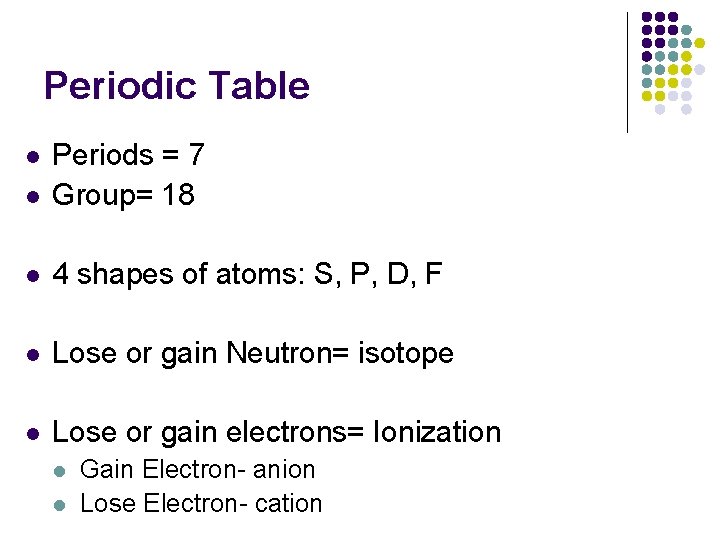
Periodic Table l Periods = 7 Group= 18 l 4 shapes of atoms: S, P, D, F l Lose or gain Neutron= isotope l Lose or gain electrons= Ionization l l l Gain Electron- anion Lose Electron- cation
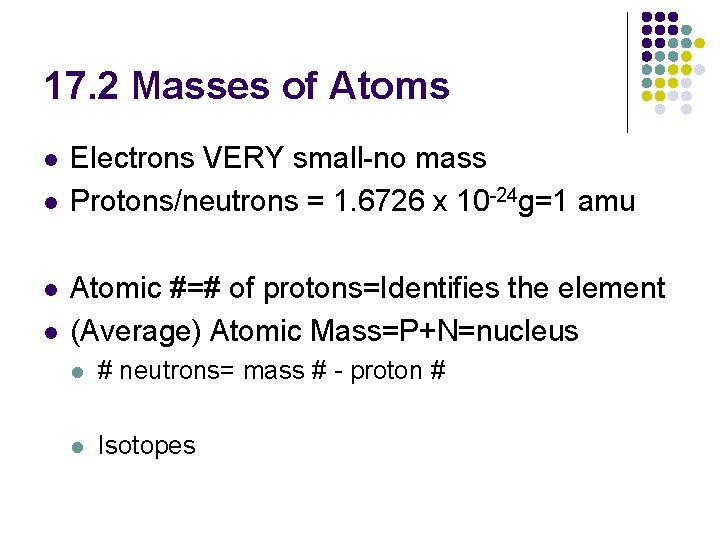
17. 2 Masses of Atoms l l Electrons VERY small-no mass Protons/neutrons = 1. 6726 x 10 -24 g=1 amu Atomic #=# of protons=Identifies the element (Average) Atomic Mass=P+N=nucleus l # neutrons= mass # - proton # l Isotopes