
16 What makes light Light is made when
- Slides: 12
16
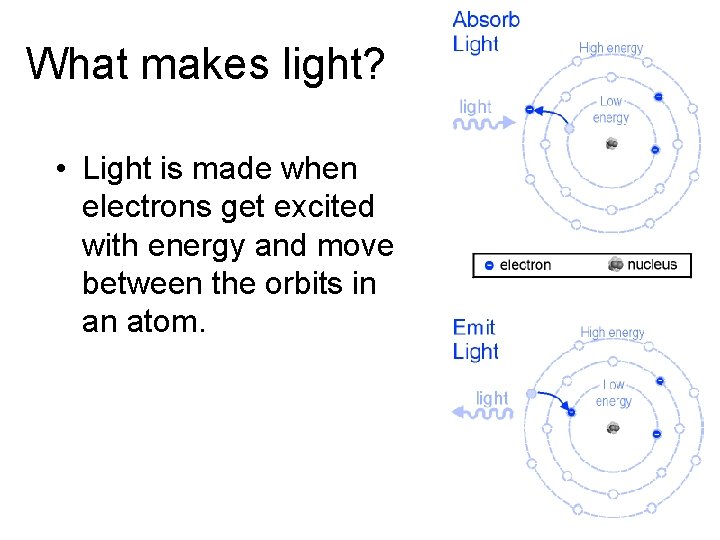
What makes light? • Light is made when electrons get excited with energy and move between the orbits in an atom.
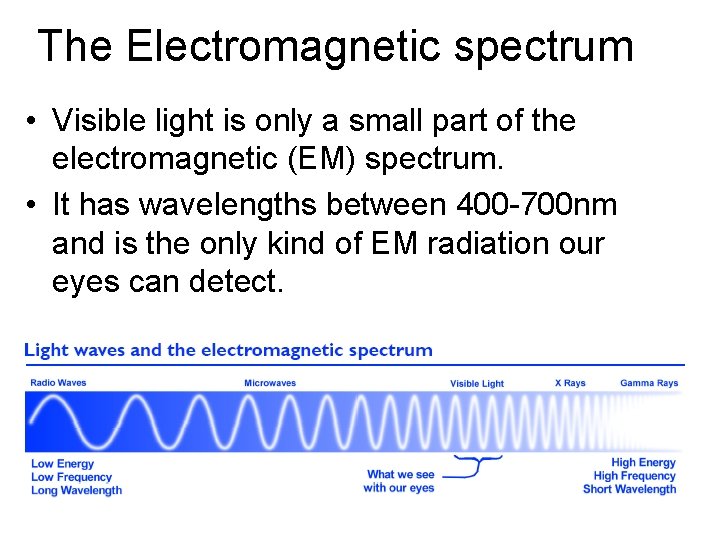
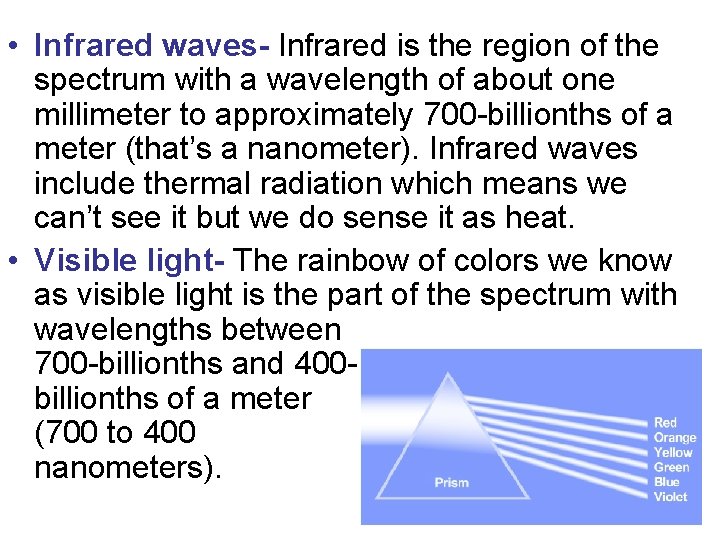
The Electromagnetic spectrum • Visible light is only a small part of the electromagnetic (EM) spectrum. • It has wavelengths between 400 -700 nm and is the only kind of EM radiation our eyes can detect.
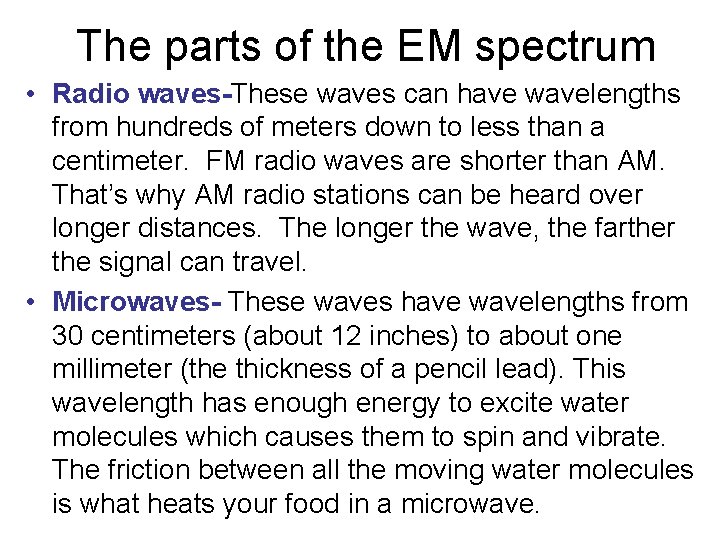
The parts of the EM spectrum • Radio waves-These waves can have wavelengths from hundreds of meters down to less than a centimeter. FM radio waves are shorter than AM. That’s why AM radio stations can be heard over longer distances. The longer the wave, the farther the signal can travel. • Microwaves- These waves have wavelengths from 30 centimeters (about 12 inches) to about one millimeter (the thickness of a pencil lead). This wavelength has enough energy to excite water molecules which causes them to spin and vibrate. The friction between all the moving water molecules is what heats your food in a microwave.
• Infrared waves- Infrared is the region of the spectrum with a wavelength of about one millimeter to approximately 700 -billionths of a meter (that’s a nanometer). Infrared waves include thermal radiation which means we can’t see it but we do sense it as heat. • Visible light- The rainbow of colors we know as visible light is the part of the spectrum with wavelengths between 700 -billionths and 400 billionths of a meter (700 to 400 nanometers).
• Ultraviolet waves- Ultraviolet radiation has a range of wavelengths from 400 -billionths of a meter to about 10 -billionths of a meter. Sunlight contains ultraviolet waves that can burn your skin. • X rays- X rays are high-energy waves which have great penetrating power and are used extensively in medical applications and for inspecting metal welds. Their wavelength range is from about 10 -billionths of a meter to about 10 -trillionths of a meter.
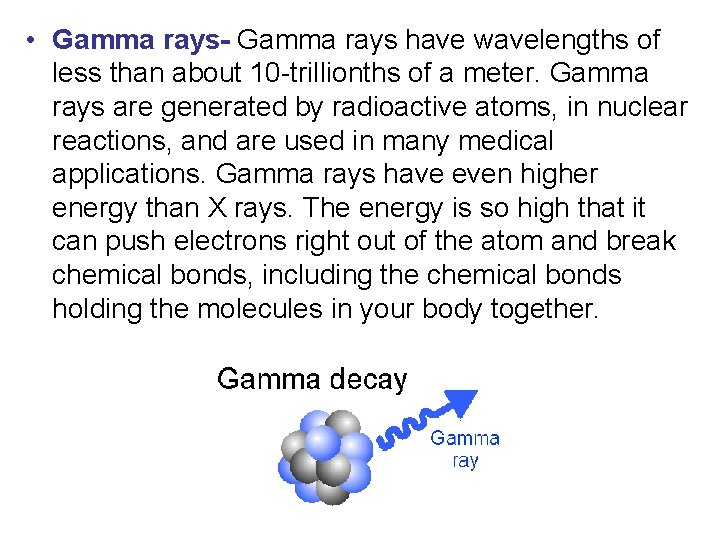
• Gamma rays- Gamma rays have wavelengths of less than about 10 -trillionths of a meter. Gamma rays are generated by radioactive atoms, in nuclear reactions, and are used in many medical applications. Gamma rays have even higher energy than X rays. The energy is so high that it can push electrons right out of the atom and break chemical bonds, including the chemical bonds holding the molecules in your body together.
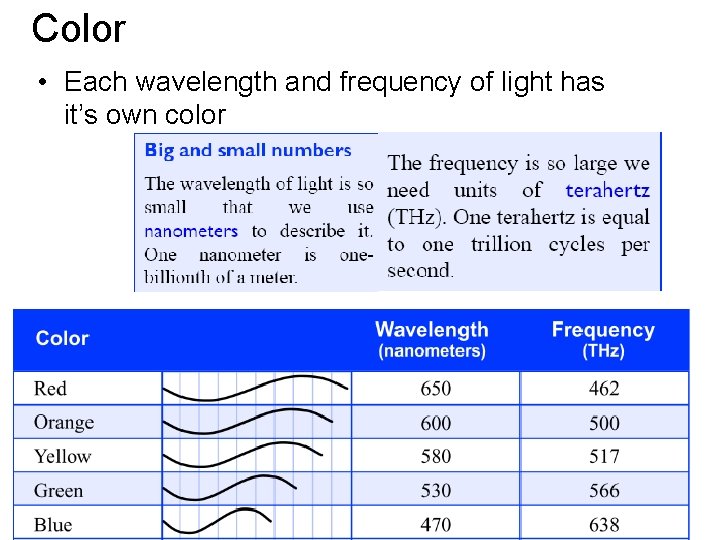
Color • Each wavelength and frequency of light has it’s own color
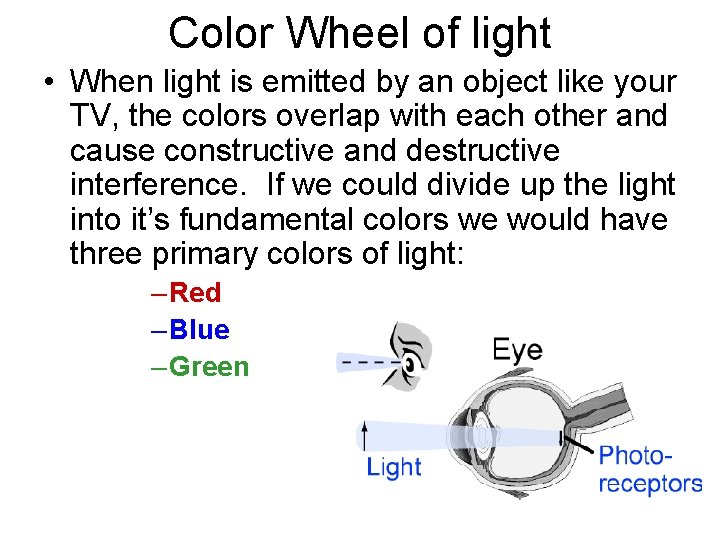
Color Wheel of light • When light is emitted by an object like your TV, the colors overlap with each other and cause constructive and destructive interference. If we could divide up the light into it’s fundamental colors we would have three primary colors of light: – Red – Blue – Green
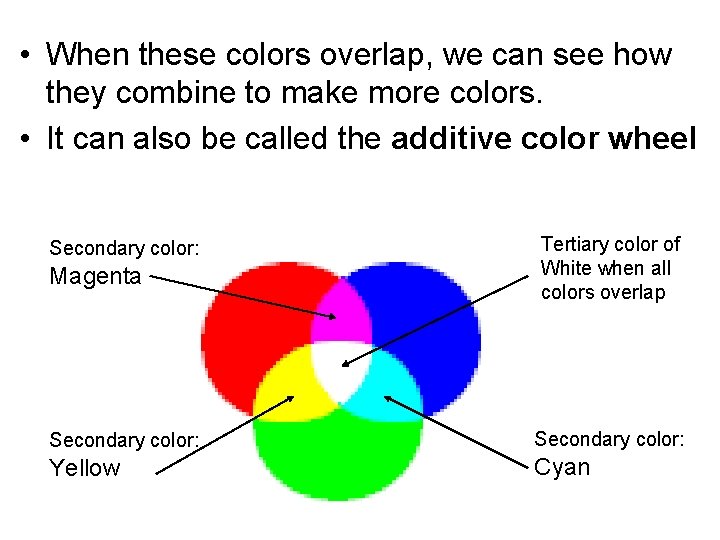
• When these colors overlap, we can see how they combine to make more colors. • It can also be called the additive color wheel Secondary color: Magenta Tertiary color of White when all colors overlap Secondary color: Yellow Cyan
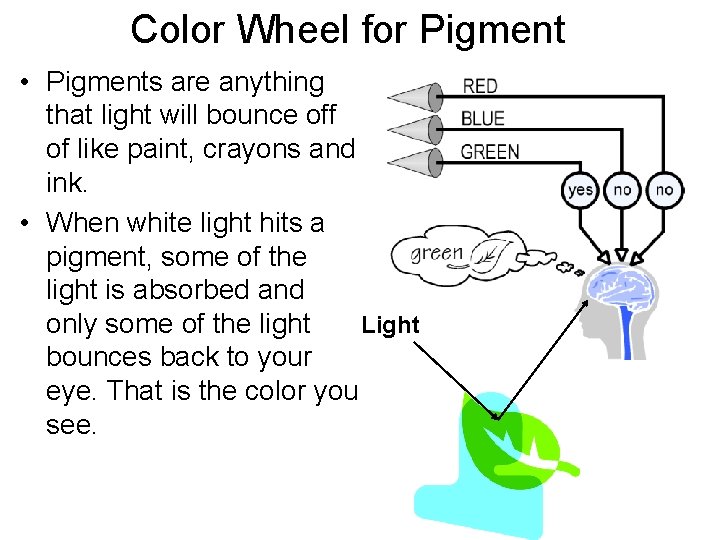
Color Wheel for Pigment • Pigments are anything that light will bounce off of like paint, crayons and ink. • When white light hits a pigment, some of the light is absorbed and only some of the light Light bounces back to your eye. That is the color you see.
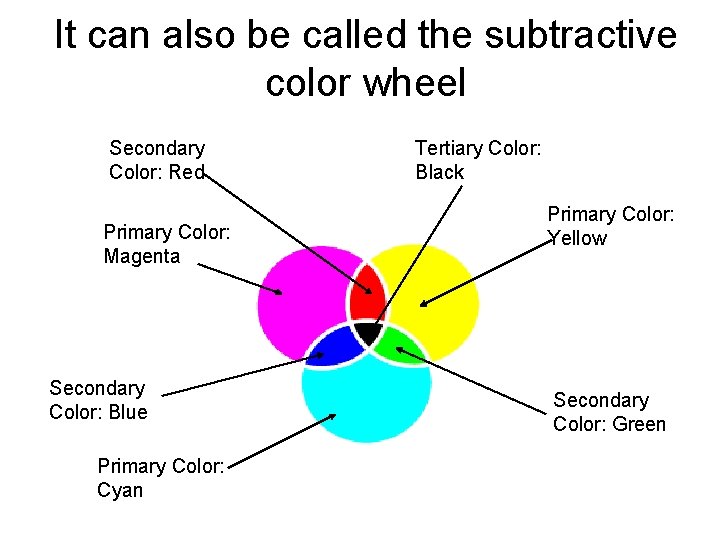
It can also be called the subtractive color wheel Secondary Color: Red Primary Color: Magenta Secondary Color: Blue Primary Color: Cyan Tertiary Color: Black Primary Color: Yellow Secondary Color: Green