
16 The Dirac Equation The KleinGordon Equation How



- Slides: 22
16. The Dirac Equation The Klein-Gordon Equation How we got the free Schrödinger Equation: • Start with a classical equation relating momentum and energy • Multiply by a wave function on the right • Replace E by i / t, and p by P = -i Can we do the same for relativistic? • Start with a classical equation relating momentum and energy • Multiply by a wave function on the right • Replace E by i / t, and p by P = -i • This is the Klein-Gordon equation So, what’s wrong with this? • This equation is second order in time – Bad! It means knowing (x, 0) is insufficient to know (x, t) • You can find solutions for which (x, 0) = 0, but (x, t) is not zero – Bad! It means | (x, t)|2 is definitely not the probability density
16 A. The Free Dirac Equation Taking the Square Root • • • We need a first order equation, something like the square root of this equation Try to find an expression that, when squared, yields c 2 P 2 + m 2 c 4 Dirac’s idea: Try to find some matrices that would make it work He conjectured the equation Here and are four matrices If chosen carefully, maybe we can make Klein-Gordon come out as a consequence • Take another derivative • Can we find a set of four matrices to make this work out?
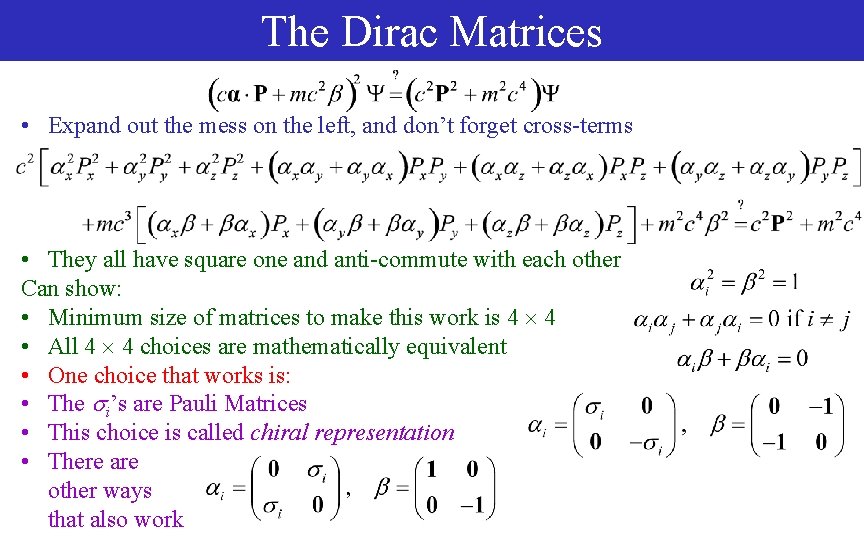
The Dirac Matrices • Expand out the mess on the left, and don’t forget cross-terms • They all have square one and anti-commute with each other Can show: • Minimum size of matrices to make this work is 4 4 • All 4 4 choices are mathematically equivalent • One choice that works is: • The i’s are Pauli Matrices • This choice is called chiral representation • There are other ways that also work
More About the Free Dirac Equation • These are 4 4 matrices; for example • We will avoid writing these out explicitly whenever possible • Note that they are all Hermitian • Hamiltonian is: • Time-independent Dirac equation • The Dirac equation implies the Klein-Gordon Equation
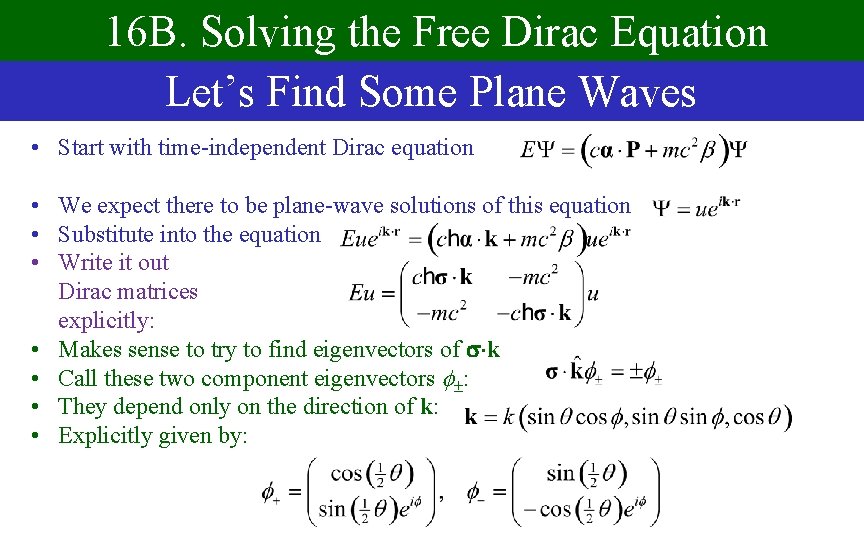
16 B. Solving the Free Dirac Equation Let’s Find Some Plane Waves • Start with time-independent Dirac equation • We expect there to be plane-wave solutions of this equation • Substitute into the equation • Write it out Dirac matrices explicitly: • Makes sense to try to find eigenvectors of k • Call these two component eigenvectors : • They depend only on the direction of k: • Explicitly given by:
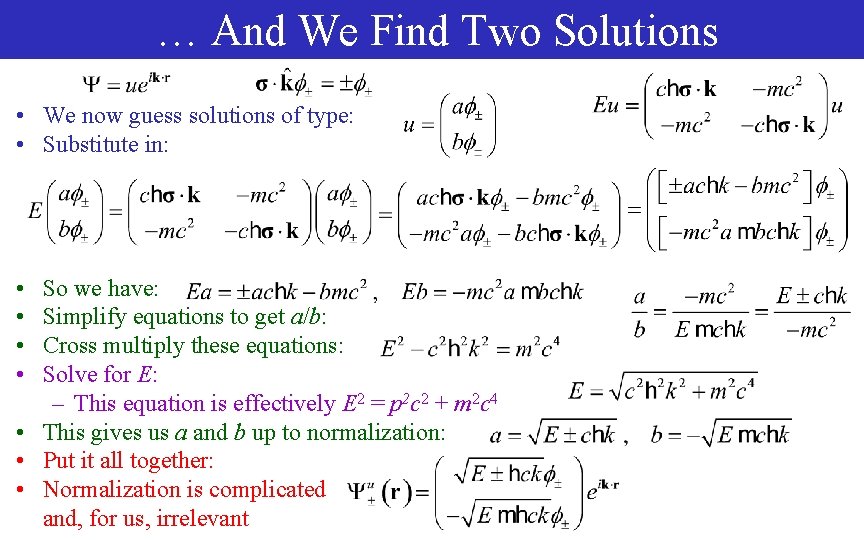
… And We Find Two Solutions • We now guess solutions of type: • Substitute in: • • So we have: Simplify equations to get a/b: Cross multiply these equations: Solve for E: – This equation is effectively E 2 = p 2 c 2 + m 2 c 4 • This gives us a and b up to normalization: • Put it all together: • Normalization is complicated and, for us, irrelevant
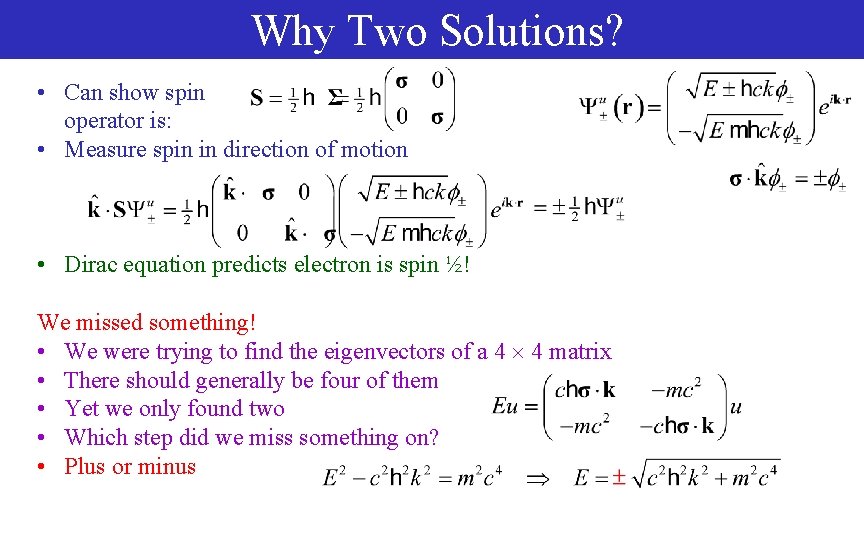
Why Two Solutions? • Can show spin operator is: • Measure spin in direction of motion • Dirac equation predicts electron is spin ½! We missed something! • We were trying to find the eigenvectors of a 4 4 matrix • There should generally be four of them • Yet we only found two • Which step did we miss something on? • Plus or minus
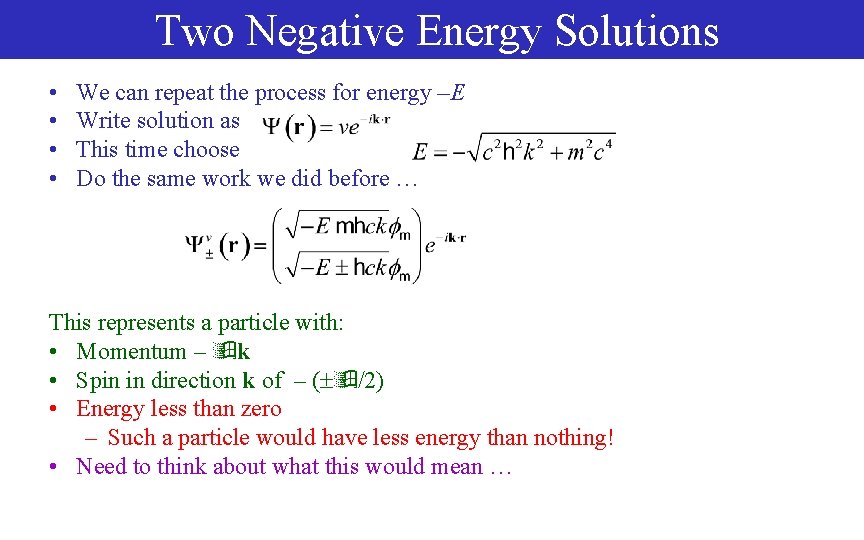
Two Negative Energy Solutions • • We can repeat the process for energy –E Write solution as This time choose Do the same work we did before … This represents a particle with: • Momentum – k • Spin in direction k of – ( /2) • Energy less than zero – Such a particle would have less energy than nothing! • Need to think about what this would mean …
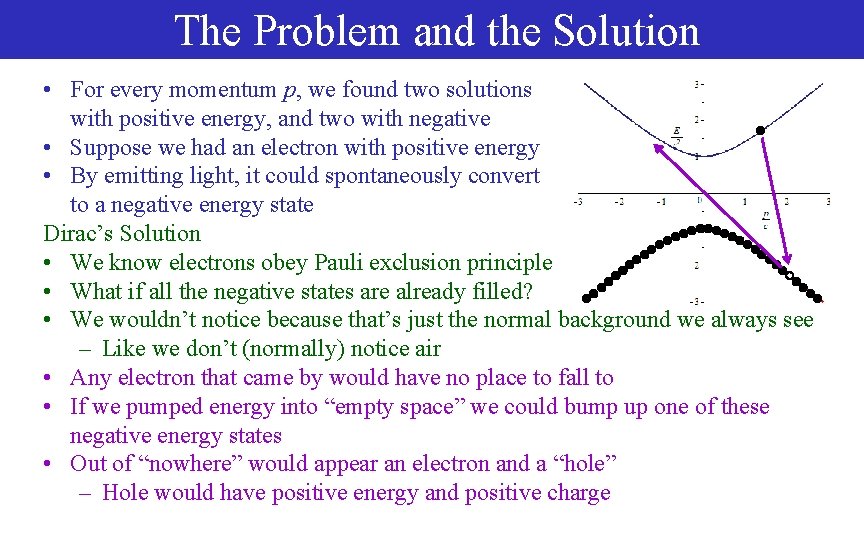
The Problem and the Solution • For every momentum p, we found two solutions with positive energy, and two with negative • Suppose we had an electron with positive energy • By emitting light, it could spontaneously convert to a negative energy state Dirac’s Solution • We know electrons obey Pauli exclusion principle • What if all the negative states are already filled? • We wouldn’t notice because that’s just the normal background we always see – Like we don’t (normally) notice air • Any electron that came by would have no place to fall to • If we pumped energy into “empty space” we could bump up one of these negative energy states • Out of “nowhere” would appear an electron and a “hole” – Hole would have positive energy and positive charge
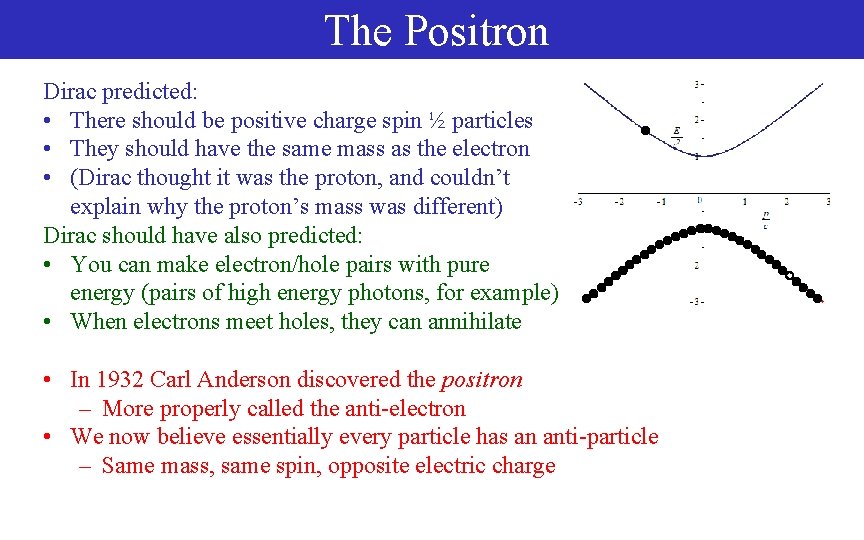
The Positron Dirac predicted: • There should be positive charge spin ½ particles • They should have the same mass as the electron • (Dirac thought it was the proton, and couldn’t explain why the proton’s mass was different) Dirac should have also predicted: • You can make electron/hole pairs with pure energy (pairs of high energy photons, for example) • When electrons meet holes, they can annihilate • In 1932 Carl Anderson discovered the positron – More properly called the anti-electron • We now believe essentially every particle has an anti-particle – Same mass, same spin, opposite electric charge
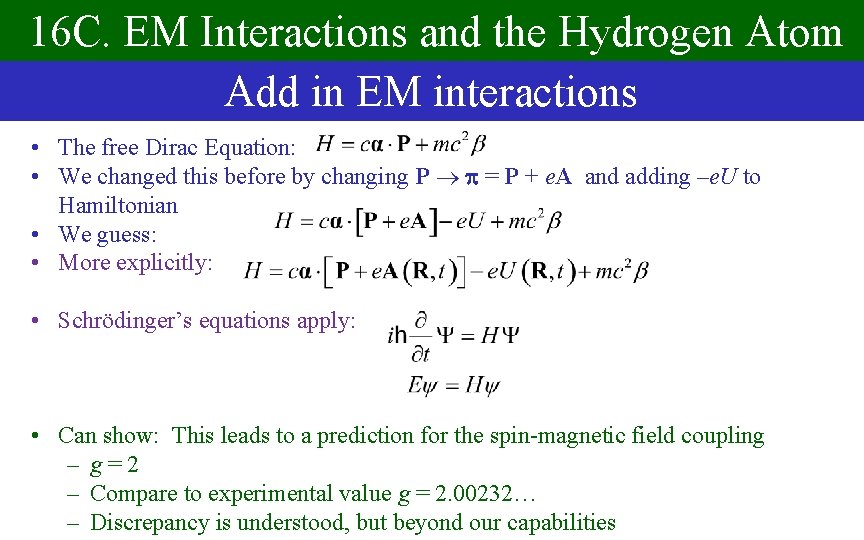
16 C. EM Interactions and the Hydrogen Atom Add in EM interactions • The free Dirac Equation: • We changed this before by changing P = P + e. A and adding –e. U to Hamiltonian • We guess: • More explicitly: • Schrödinger’s equations apply: • Can show: This leads to a prediction for the spin-magnetic field coupling – g=2 – Compare to experimental value g = 2. 00232… – Discrepancy is understood, but beyond our capabilities
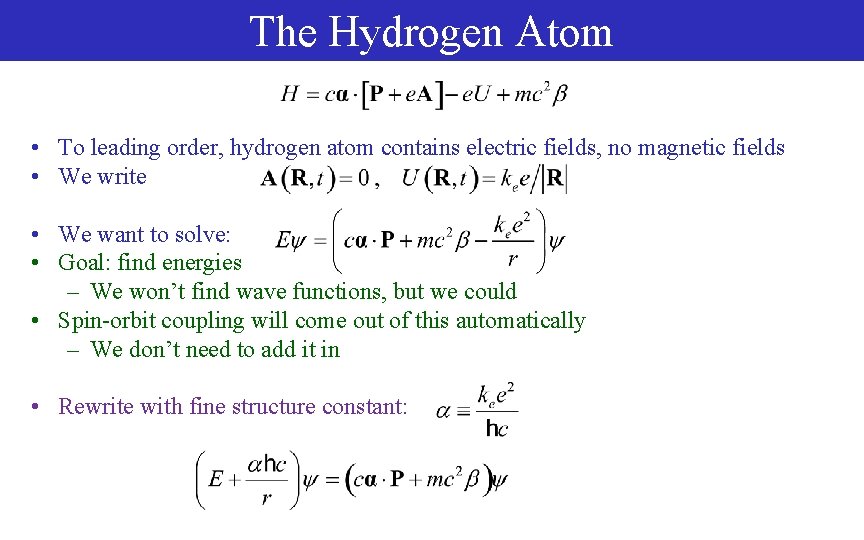
The Hydrogen Atom • To leading order, hydrogen atom contains electric fields, no magnetic fields • We write • We want to solve: • Goal: find energies – We won’t find wave functions, but we could • Spin-orbit coupling will come out of this automatically – We don’t need to add it in • Rewrite with fine structure constant:
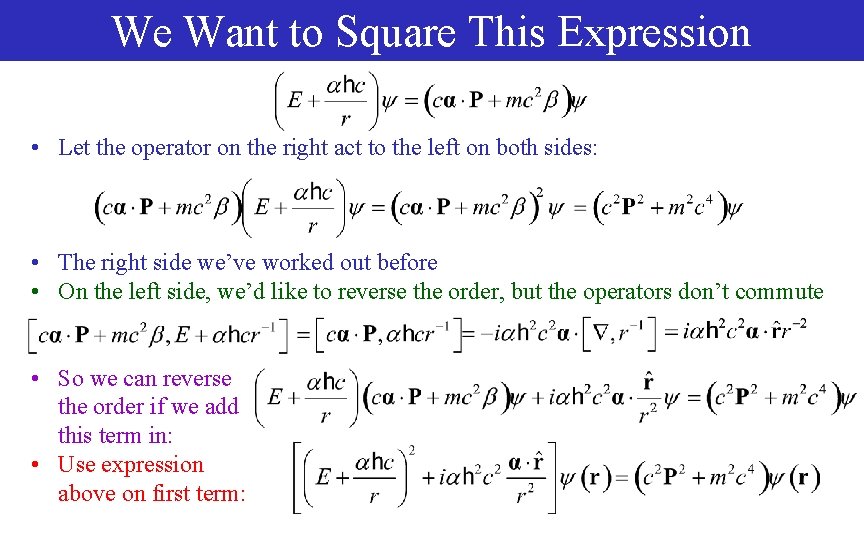
We Want to Square This Expression • Let the operator on the right act to the left on both sides: • The right side we’ve worked out before • On the left side, we’d like to reverse the order, but the operators don’t commute • So we can reverse the order if we add this term in: • Use expression above on first term:
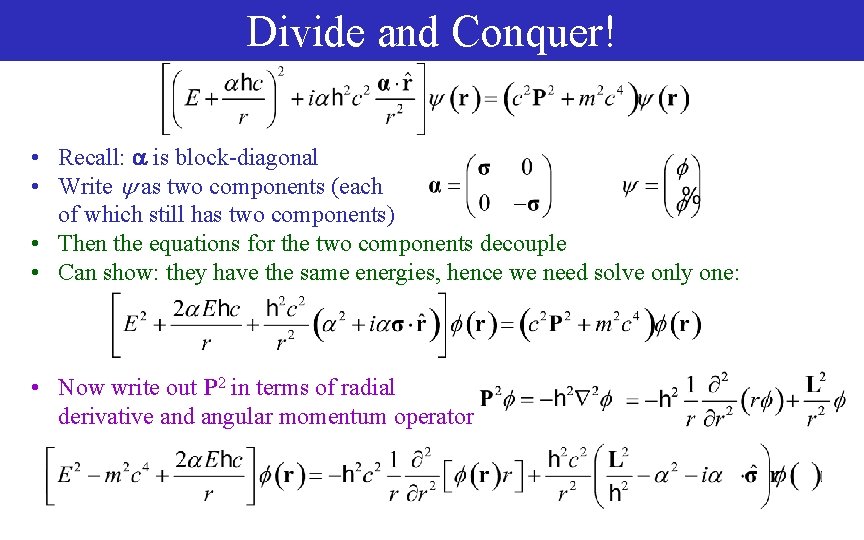
Divide and Conquer! • Recall: is block-diagonal • Write as two components (each of which still has two components) • Then the equations for the two components decouple • Can show: they have the same energies, hence we need solve only one: • Now write out P 2 in terms of radial derivative and angular momentum operator
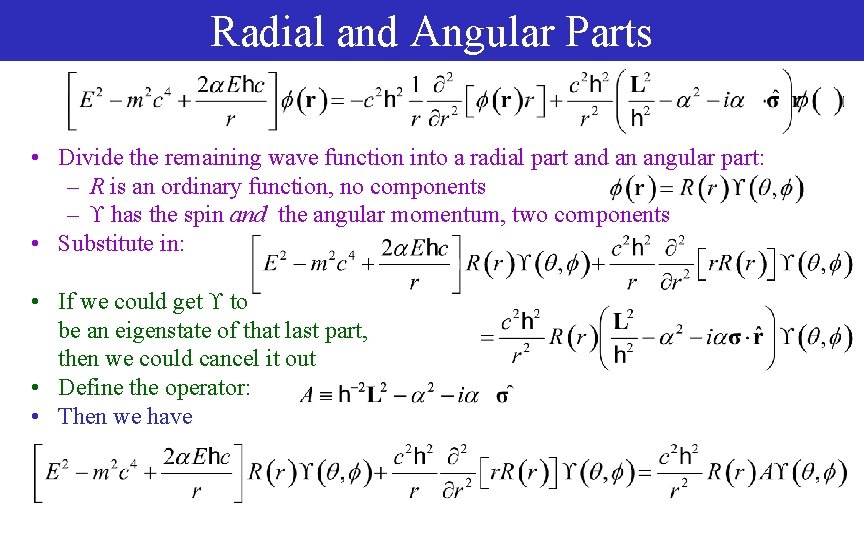
Radial and Angular Parts • Divide the remaining wave function into a radial part and an angular part: – R is an ordinary function, no components – has the spin and the angular momentum, two components • Substitute in: • If we could get to be an eigenstate of that last part, then we could cancel it out • Define the operator: • Then we have
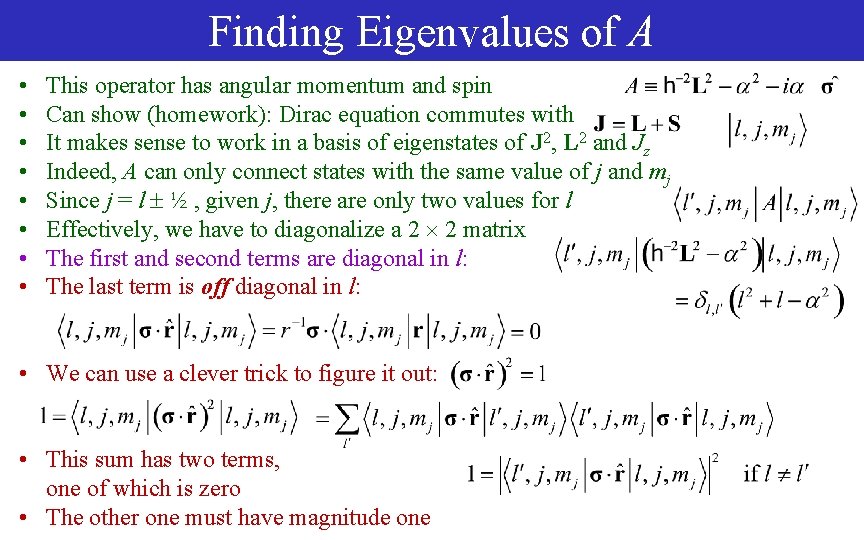
Finding Eigenvalues of A • • This operator has angular momentum and spin Can show (homework): Dirac equation commutes with It makes sense to work in a basis of eigenstates of J 2, L 2 and Jz Indeed, A can only connect states with the same value of j and mj Since j = l ½ , given j, there are only two values for l Effectively, we have to diagonalize a 2 2 matrix The first and second terms are diagonal in l: The last term is off diagonal in l: • We can use a clever trick to figure it out: • This sum has two terms, one of which is zero • The other one must have magnitude one
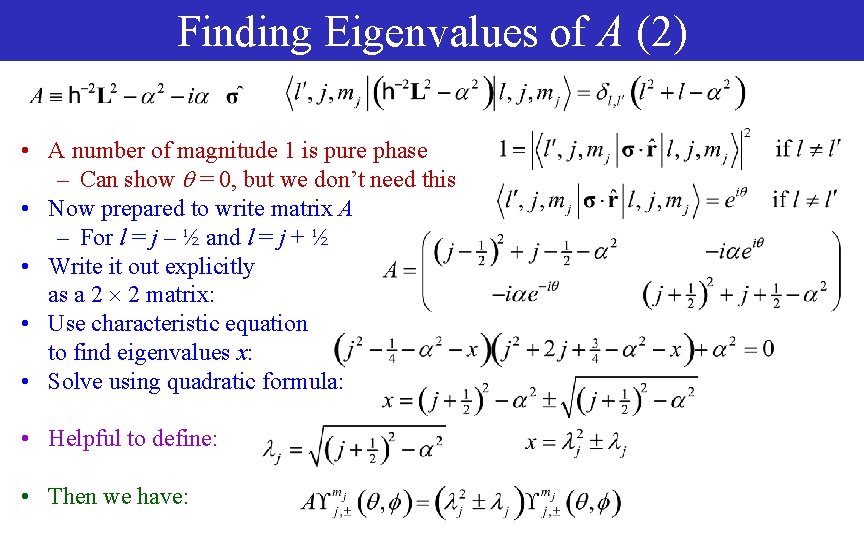
Finding Eigenvalues of A (2) • A number of magnitude 1 is pure phase – Can show = 0, but we don’t need this • Now prepared to write matrix A – For l = j – ½ and l = j + ½ • Write it out explicitly as a 2 2 matrix: • Use characteristic equation to find eigenvalues x: • Solve using quadratic formula: • Helpful to define: • Then we have:
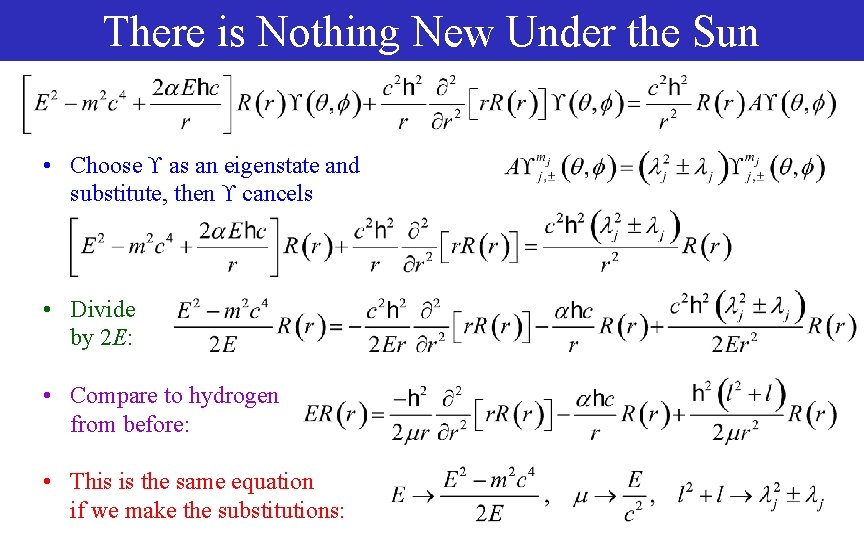
There is Nothing New Under the Sun • Choose as an eigenstate and substitute, then cancels • Divide by 2 E: • Compare to hydrogen from before: • This is the same equation if we make the substitutions:
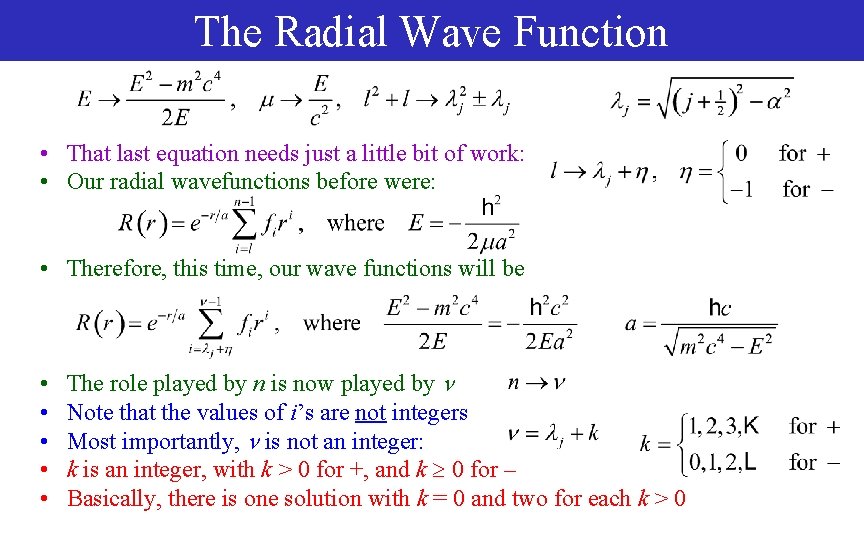
The Radial Wave Function • That last equation needs just a little bit of work: • Our radial wavefunctions before were: • Therefore, this time, our wave functions will be • • • The role played by n is now played by Note that the values of i’s are not integers Most importantly, is not an integer: k is an integer, with k > 0 for +, and k 0 for – Basically, there is one solution with k = 0 and two for each k > 0
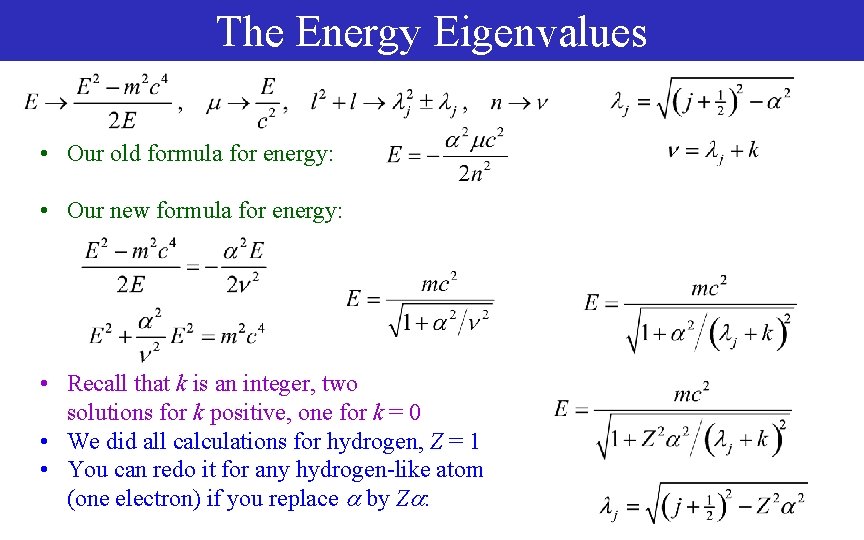
The Energy Eigenvalues • Our old formula for energy: • Our new formula for energy: • Recall that k is an integer, two solutions for k positive, one for k = 0 • We did all calculations for hydrogen, Z = 1 • You can redo it for any hydrogen-like atom (one electron) if you replace by Z :
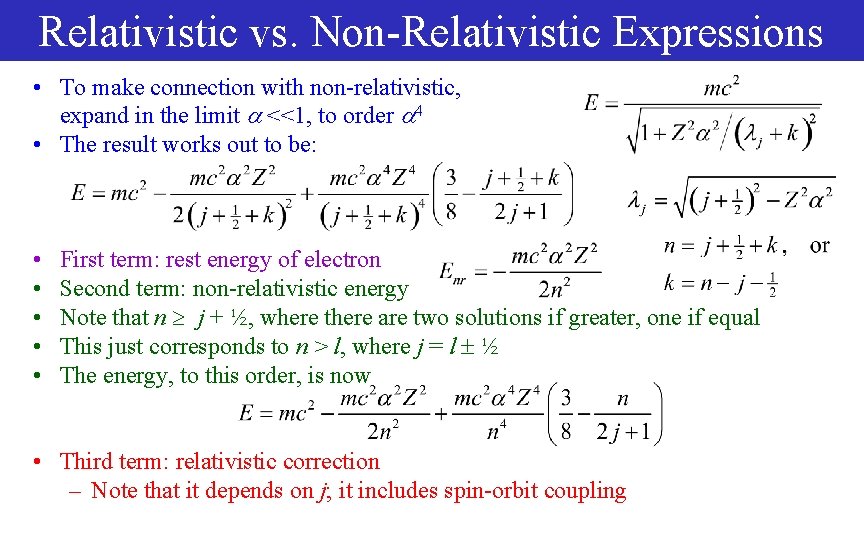
Relativistic vs. Non-Relativistic Expressions • To make connection with non-relativistic, expand in the limit <<1, to order 4 • The result works out to be: • • • First term: rest energy of electron Second term: non-relativistic energy Note that n j + ½, where there are two solutions if greater, one if equal This just corresponds to n > l, where j = l ½ The energy, to this order, is now • Third term: relativistic correction – Note that it depends on j; it includes spin-orbit coupling
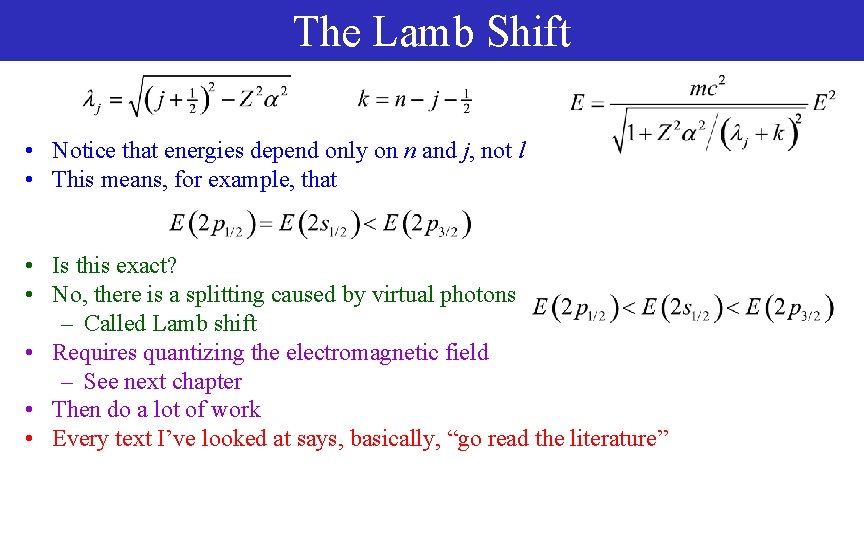
The Lamb Shift • Notice that energies depend only on n and j, not l • This means, for example, that • Is this exact? • No, there is a splitting caused by virtual photons – Called Lamb shift • Requires quantizing the electromagnetic field – See next chapter • Then do a lot of work • Every text I’ve looked at says, basically, “go read the literature”