
16 January 2022 Respiration Glycolysis 1 Write the
- Slides: 32
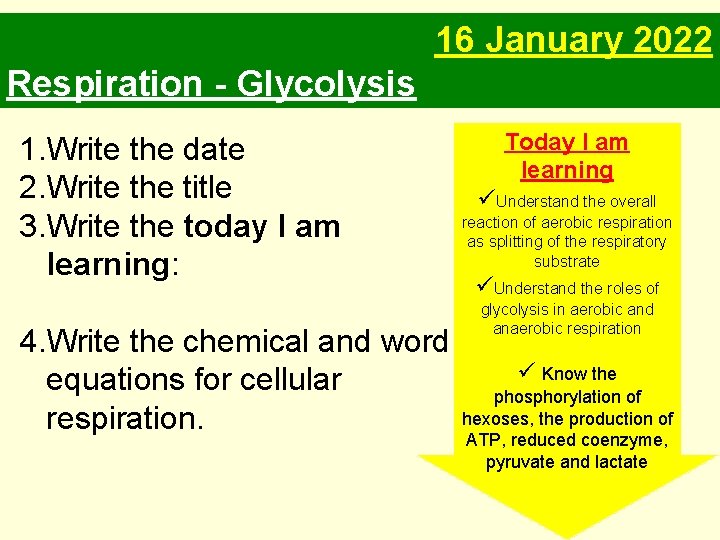
16 January 2022 Respiration - Glycolysis 1. Write the date 2. Write the title 3. Write the today I am learning: 4. Write the chemical and word equations for cellular respiration. Today I am learning Understand the overall reaction of aerobic respiration as splitting of the respiratory substrate Understand the roles of glycolysis in aerobic and anaerobic respiration Know the phosphorylation of hexoses, the production of ATP, reduced coenzyme, pyruvate and lactate
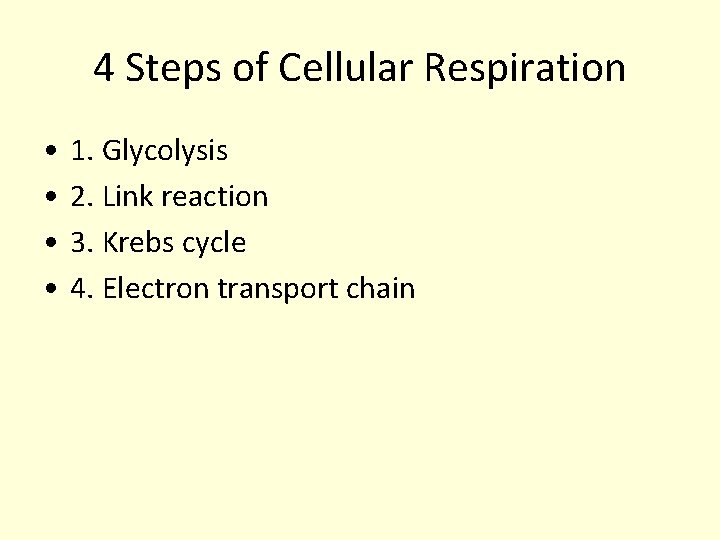
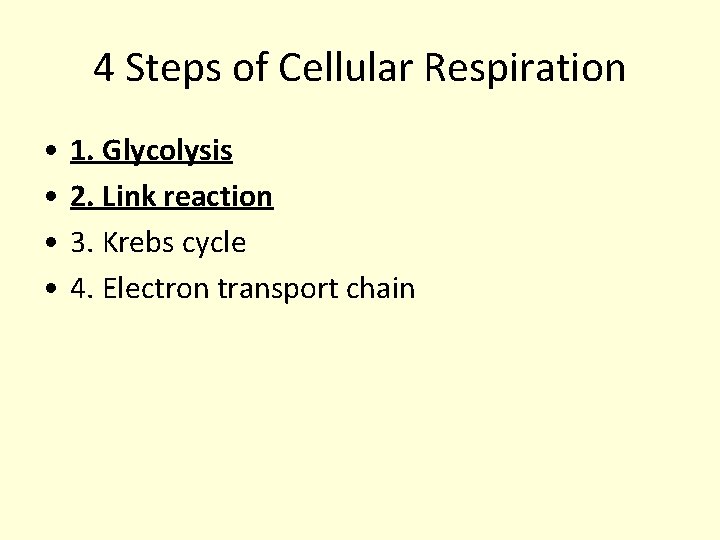
4 Steps of Cellular Respiration • • 1. Glycolysis 2. Link reaction 3. Krebs cycle 4. Electron transport chain
4 Steps of Cellular Respiration • • 1. Glycolysis 2. Link reaction 3. Krebs cycle 4. Electron transport chain
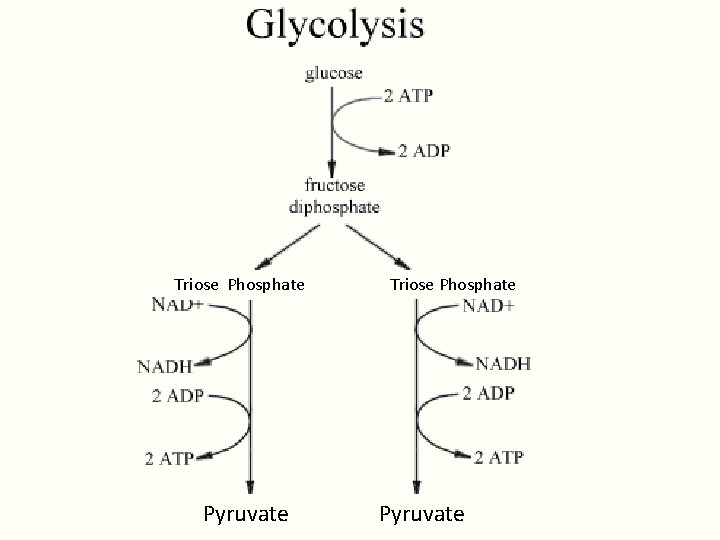
GLYCOLYSIS • Glycolysis is the first step in the biochemical pathway of respiration • Overall a molecule of glucose is broken down into two pyruvate molecules • Glycolysis actually involves a large number of individual reactions which are carefully controlled by enzymes. However, we only need to recall two major parts.
Triose Phosphate Pyruvate
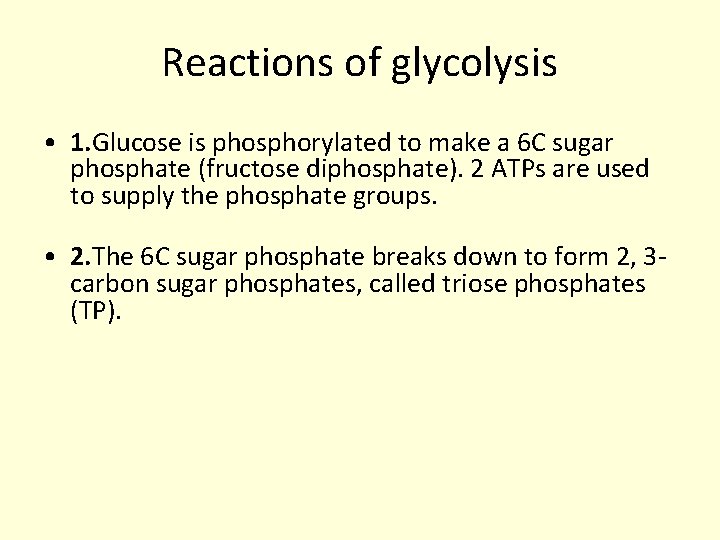
Reactions of glycolysis • 1. Glucose is phosphorylated to make a 6 C sugar phosphate (fructose diphosphate). 2 ATPs are used to supply the phosphate groups. • 2. The 6 C sugar phosphate breaks down to form 2, 3 carbon sugar phosphates, called triose phosphates (TP).
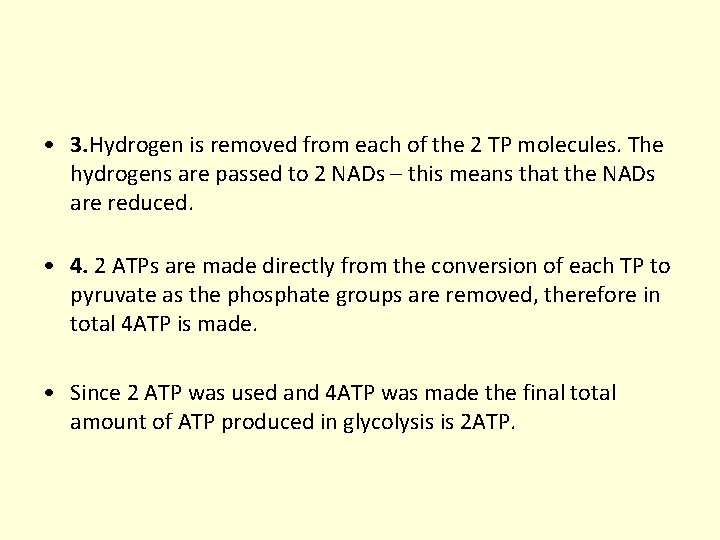
• 3. Hydrogen is removed from each of the 2 TP molecules. The hydrogens are passed to 2 NADs – this means that the NADs are reduced. • 4. 2 ATPs are made directly from the conversion of each TP to pyruvate as the phosphate groups are removed, therefore in total 4 ATP is made. • Since 2 ATP was used and 4 ATP was made the final total amount of ATP produced in glycolysis is 2 ATP.
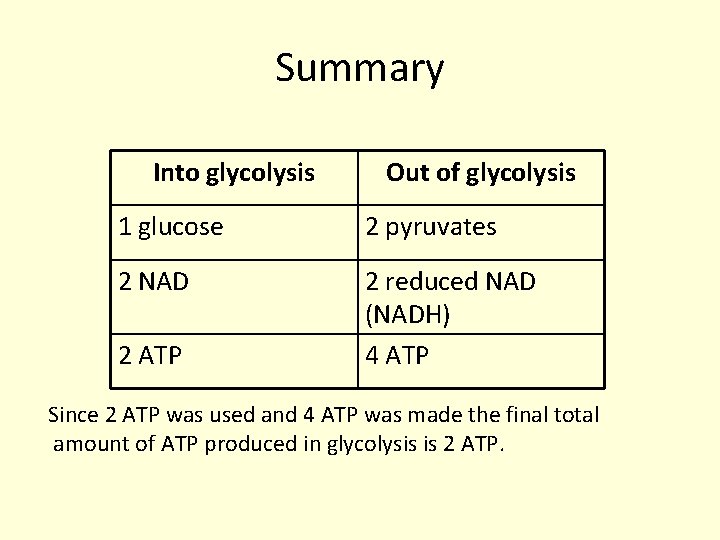
Summary Into glycolysis Out of glycolysis 1 glucose 2 pyruvates 2 NAD 2 reduced NAD (NADH) 4 ATP 2 ATP Since 2 ATP was used and 4 ATP was made the final total amount of ATP produced in glycolysis is 2 ATP.
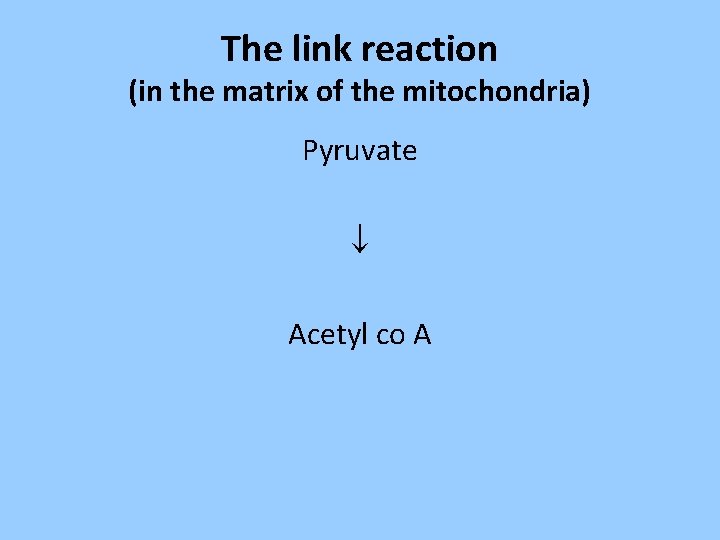
The link reaction (in the matrix of the mitochondria) Pyruvate Acetyl co A
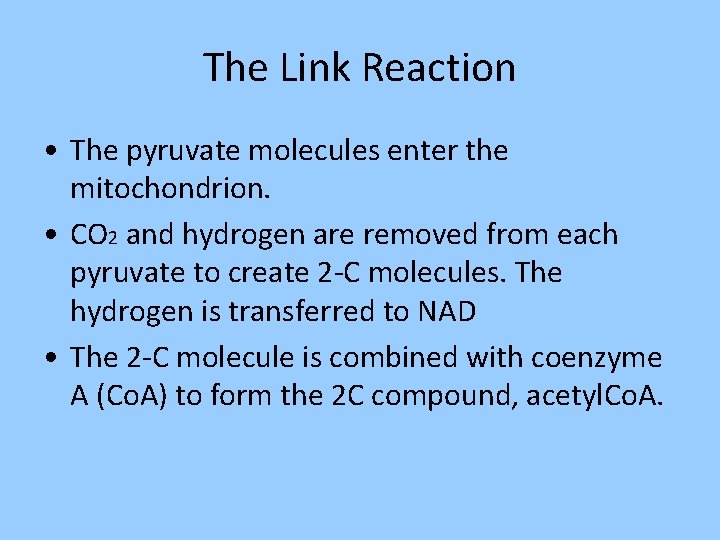
The Link Reaction • The pyruvate molecules enter the mitochondrion. • CO 2 and hydrogen are removed from each pyruvate to create 2 -C molecules. The hydrogen is transferred to NAD • The 2 -C molecule is combined with coenzyme A (Co. A) to form the 2 C compound, acetyl. Co. A.
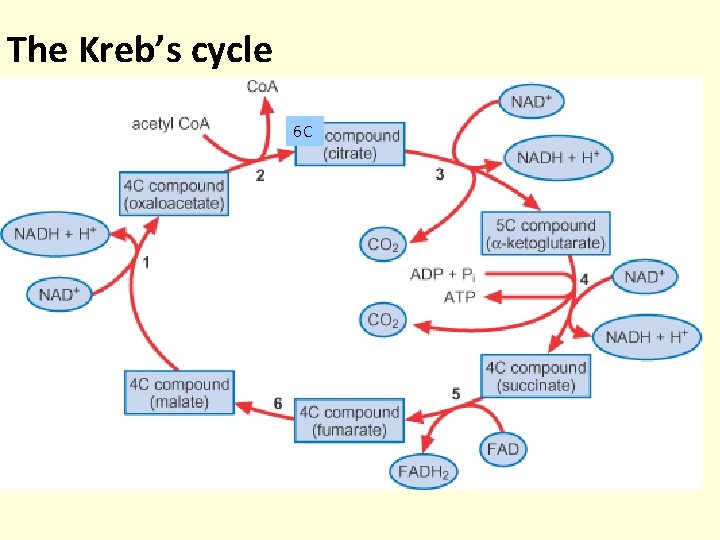
The Kreb’s cycle 6 C
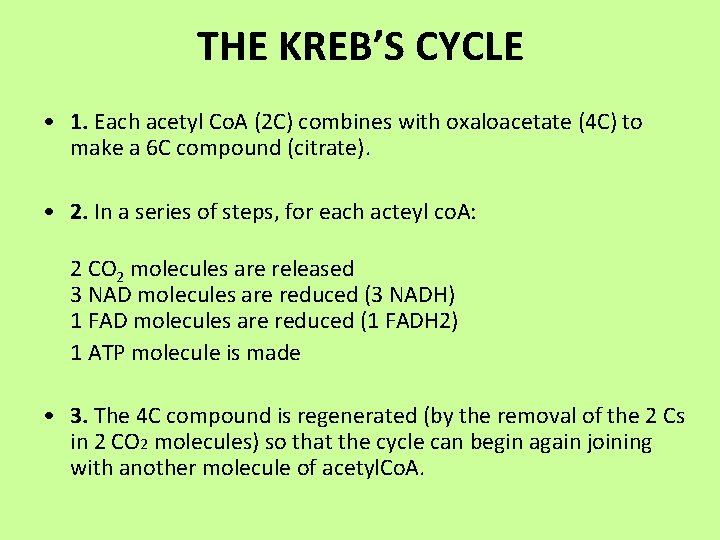
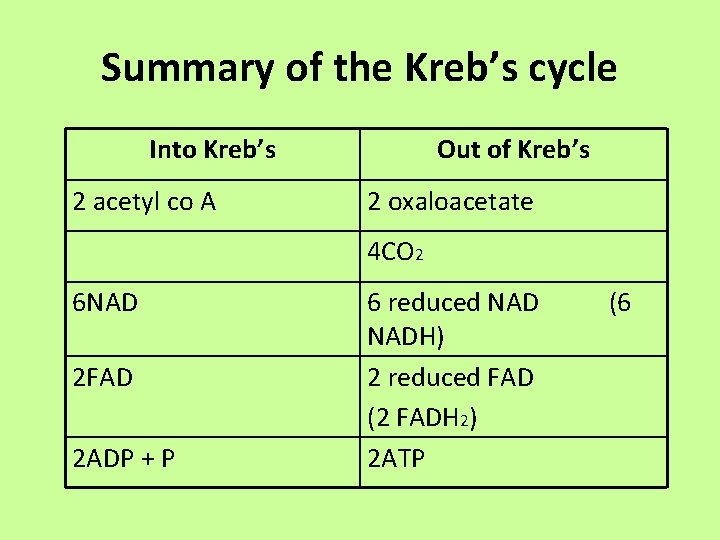
THE KREB’S CYCLE • 1. Each acetyl Co. A (2 C) combines with oxaloacetate (4 C) to make a 6 C compound (citrate). • 2. In a series of steps, for each acteyl co. A: 2 CO 2 molecules are released 3 NAD molecules are reduced (3 NADH) 1 FAD molecules are reduced (1 FADH 2) 1 ATP molecule is made • 3. The 4 C compound is regenerated (by the removal of the 2 Cs in 2 CO 2 molecules) so that the cycle can begin again joining with another molecule of acetyl. Co. A.
What co-enzymes are • Co-enzymes are small molecules that carry chemical groups between enzymes. • NAD and FAD are examples of co-enzymes • The most important product of the Kreb’s cycle is NADH and FADH 2 which are passed to the final stage of respiration, the electron transport chain. • In this final stage the chemical potential energy NADH and FADH 2 contain is used to produce ATP.
Summary of the Kreb’s cycle Into Kreb’s 2 acetyl co A Out of Kreb’s 2 oxaloacetate 4 CO 2 6 NAD 2 FAD 2 ADP + P 6 reduced NADH) 2 reduced FAD (2 FADH 2) 2 ATP (6
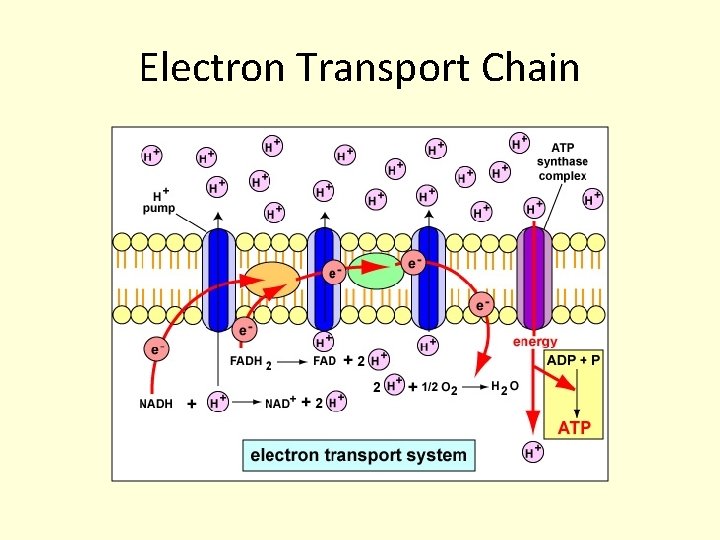
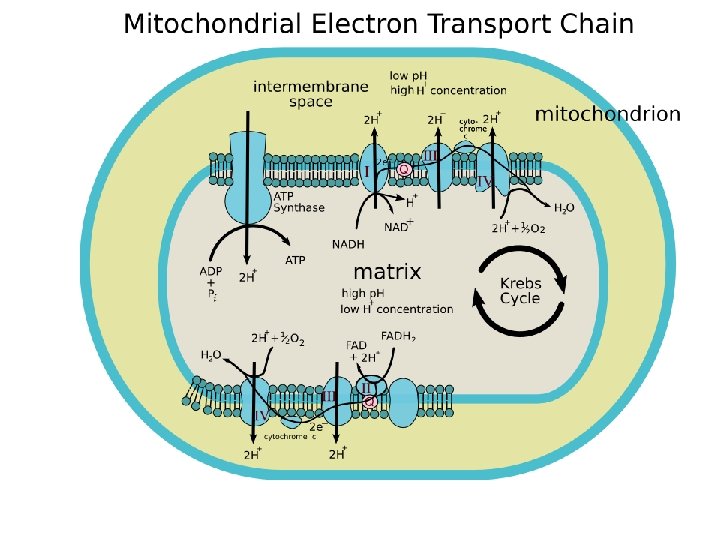
THE ELECTRON TRANSPORT CHAIN • Reduced FAD and NAD produced as a result of oxidation now pass to chains of protein molecules located on the internal membranes of the mitochondria • These chains of molecules are known as the electron transport chains • The H is removed from NAD and FAD and is split into H+ and electrons.
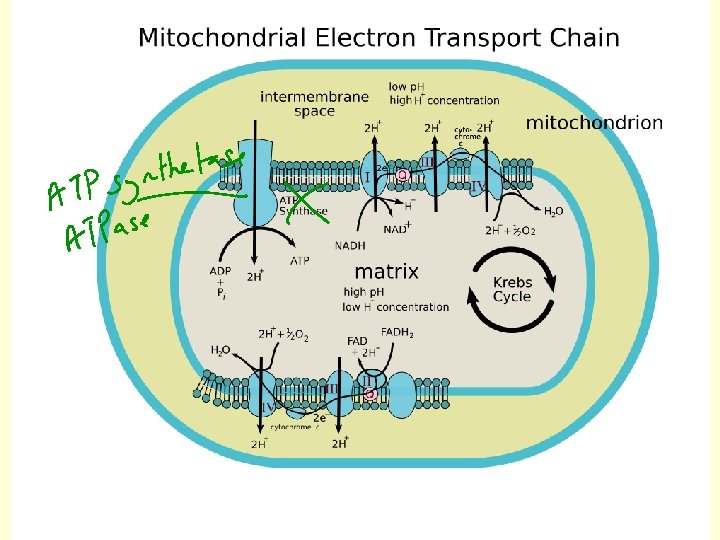
Electron Transport Chain
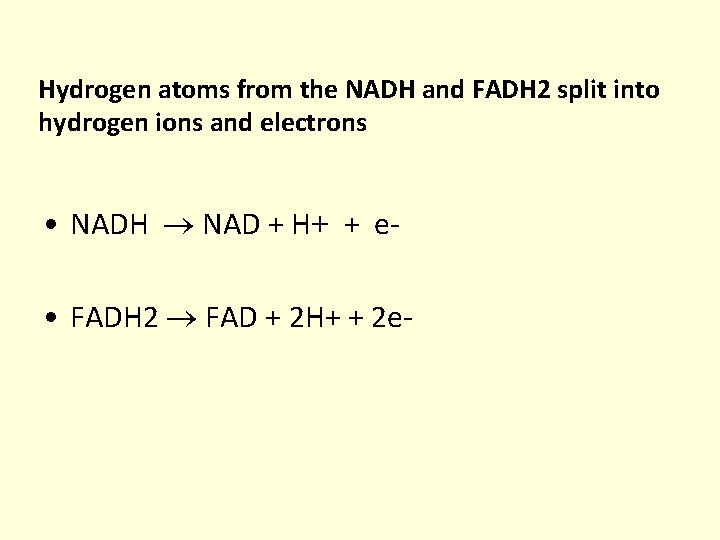
Hydrogen atoms from the NADH and FADH 2 split into hydrogen ions and electrons • NADH NAD + H+ + e • FADH 2 FAD + 2 H+ + 2 e-
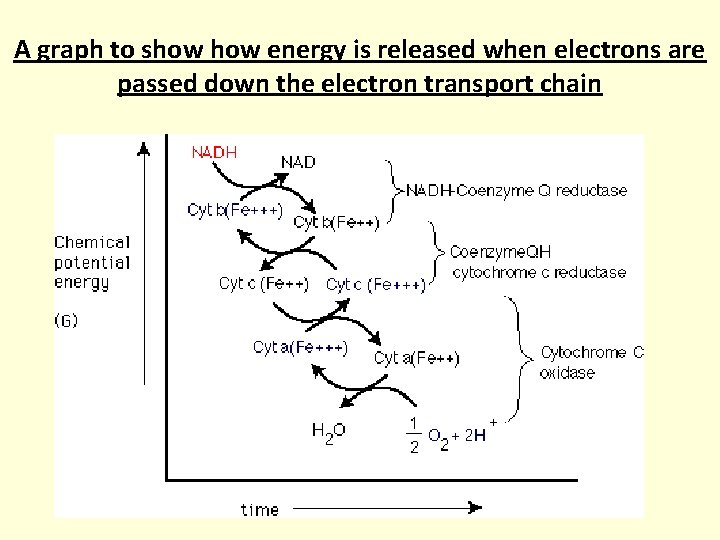
A graph to show energy is released when electrons are passed down the electron transport chain
• The electrons pass from one molecule to the next on the electron transport chain through a series of redox reactions • At each transfer, a small amount of energy is released • This energy is used to pump H+ ions through the inner mitochondrial membrane into the space between the inner and outer membrane.
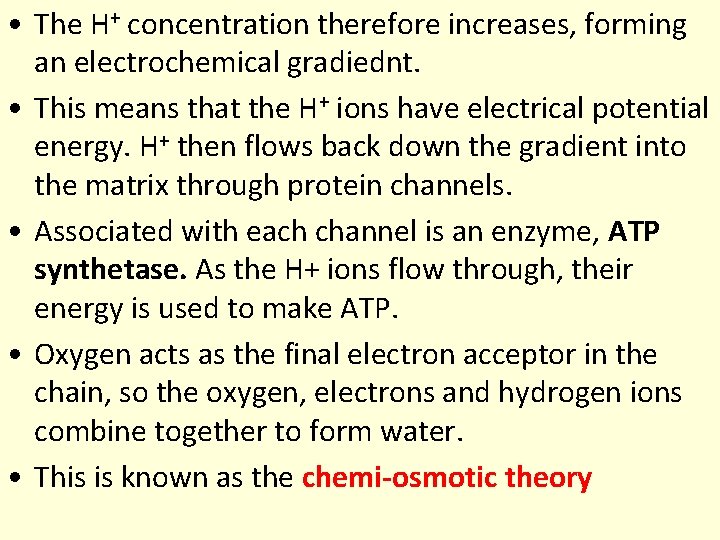
• The H+ concentration therefore increases, forming an electrochemical gradiednt. • This means that the H+ ions have electrical potential energy. H+ then flows back down the gradient into the matrix through protein channels. • Associated with each channel is an enzyme, ATP synthetase. As the H+ ions flow through, their energy is used to make ATP. • Oxygen acts as the final electron acceptor in the chain, so the oxygen, electrons and hydrogen ions combine together to form water. • This is known as the chemi-osmotic theory
Anaerobic Respiration • Under conditions of low oxygen, cells have to produce ATP by anaerobic respiration • The only stage in the anaerobic process which produces ATP is glycolysis. • Only 2 molecules of ATP per glucose molecule are produced
The problem with NAD • Reduced NAD is normally converted back to NAD when its hydrogen is transferred in the electron transport chain. • This will only happen if oxygen is present where H+ and electrons from the ETC combine with the final electron acceptor, oxygen, to form water.
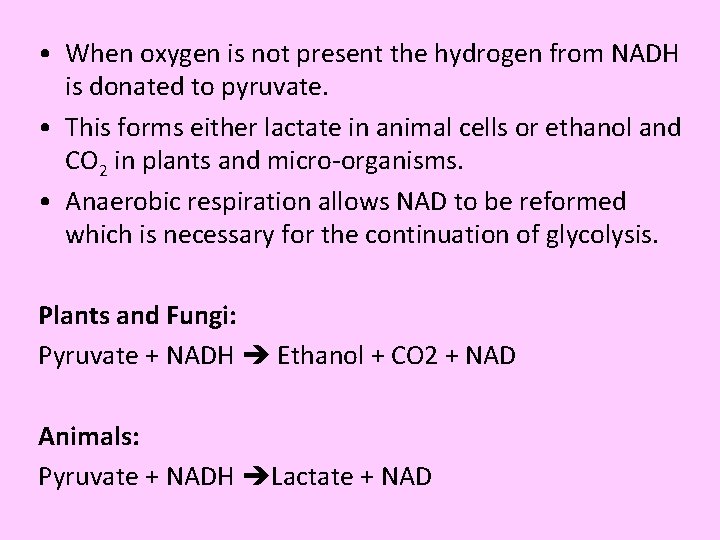
• When oxygen is not present the hydrogen from NADH is donated to pyruvate. • This forms either lactate in animal cells or ethanol and CO 2 in plants and micro-organisms. • Anaerobic respiration allows NAD to be reformed which is necessary for the continuation of glycolysis. Plants and Fungi: Pyruvate + NADH Ethanol + CO 2 + NAD Animals: Pyruvate + NADH Lactate + NAD
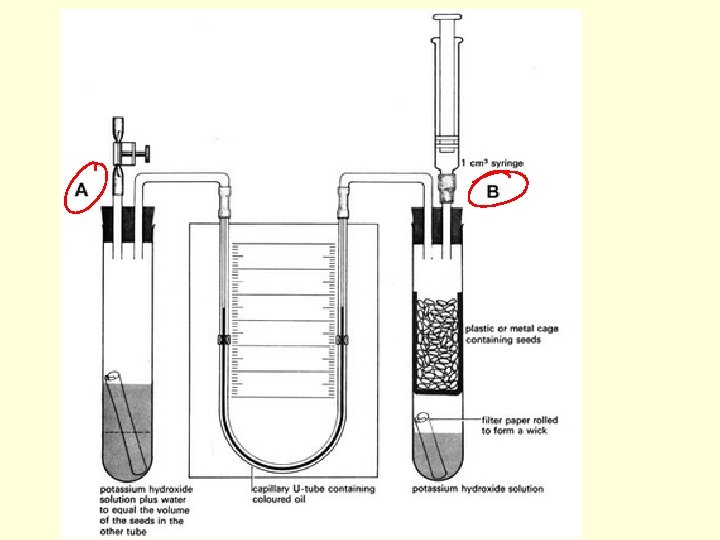
The respirometer to calculate the rate of respiration • Normally the volume of oxygen used equals the volume of carbon dioxide produced so there is no volume change • In this experiment the KOH absorbs all the CO 2 produced by the seeds, therefore the volume of air decreases due to the oxygen used.
• The volume of oxygen used can be calculated using the manometer. The position of the liquid in the manometer is noted at the beginning and the end of the experiment. The distance the liquid travels is calculated. • The volume of air that is used can be calculated by multiplying the distance the liquid travels by πr 2 – this gives you the volume of the cylinder of air used.
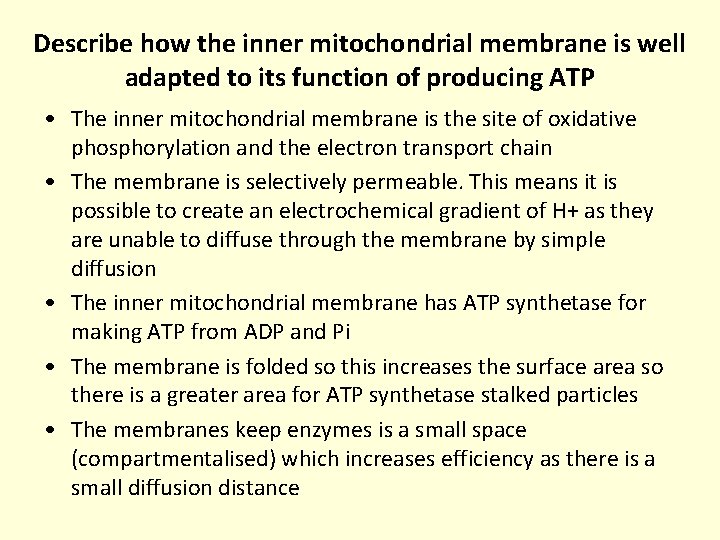
Describe how the inner mitochondrial membrane is well adapted to its function of producing ATP • The inner mitochondrial membrane is the site of oxidative phosphorylation and the electron transport chain • The membrane is selectively permeable. This means it is possible to create an electrochemical gradient of H+ as they are unable to diffuse through the membrane by simple diffusion • The inner mitochondrial membrane has ATP synthetase for making ATP from ADP and Pi • The membrane is folded so this increases the surface area so there is a greater area for ATP synthetase stalked particles • The membranes keep enzymes is a small space (compartmentalised) which increases efficiency as there is a small diffusion distance
Using different respiratory substrates • A respiratory substrate is the substance that is the starting point for respiration. So far we have looked at glucose being the respiratory substrate. • Amino acids and lipids can also be used • We can estimate which substances an organism is using to respire by calculating their R. Q. (Respiratory Quotient).
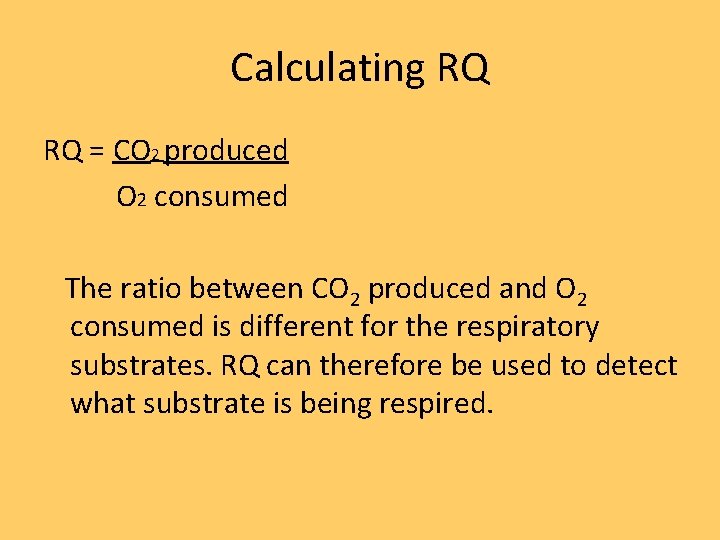
Calculating RQ RQ = CO 2 produced O 2 consumed The ratio between CO 2 produced and O 2 consumed is different for the respiratory substrates. RQ can therefore be used to detect what substrate is being respired.
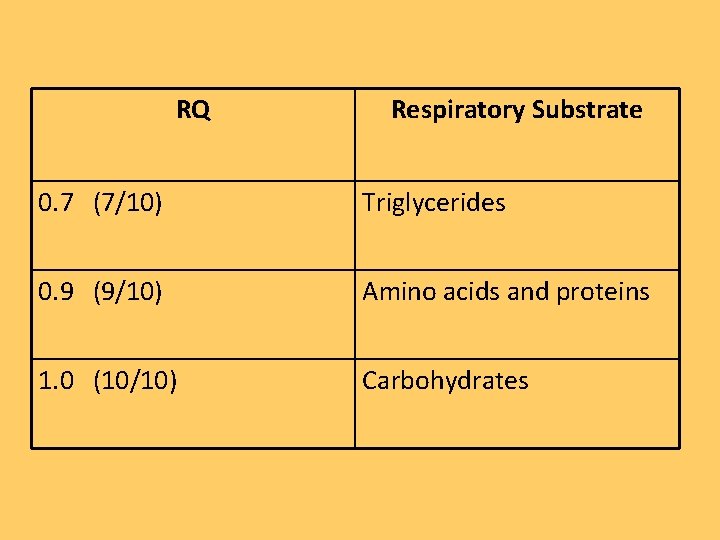
RQ Respiratory Substrate 0. 7 (7/10) Triglycerides 0. 9 (9/10) Amino acids and proteins 1. 0 (10/10) Carbohydrates