
16 Chemistry of Benzene Electrophilic Aromatic Substitution Based
16. Chemistry of Benzene: Electrophilic Aromatic Substitution Based on Mc. Murry’s Organic Chemistry, 6 th edition, Chapter 16 © 2003 Ronald Kluger Department of Chemistry University of Toronto

Substitution Reactions of Benzene and Its Derivatives n Benzene is aromatic: a cyclic conjugated compound with 6 electrons n Reactions of benzene lead to the retention of the aromatic core n Electrophilic aromatic substitution replaces a proton on benzene with another electrophile Mc. Murry Organic Chemistry 6 th edition Chapter 16 (c) 2003 2

16. 1 Bromination of Aromatic Rings n Benzene’s electrons participate as a Lewis base in reactions with Lewis acids n The product is formed by loss of a proton, which is replaced by bromine n Fe. Br 3 is added as a catalyst to polarize the bromine reagent Mc. Murry Organic Chemistry 6 th edition Chapter 16 (c) 2003 3
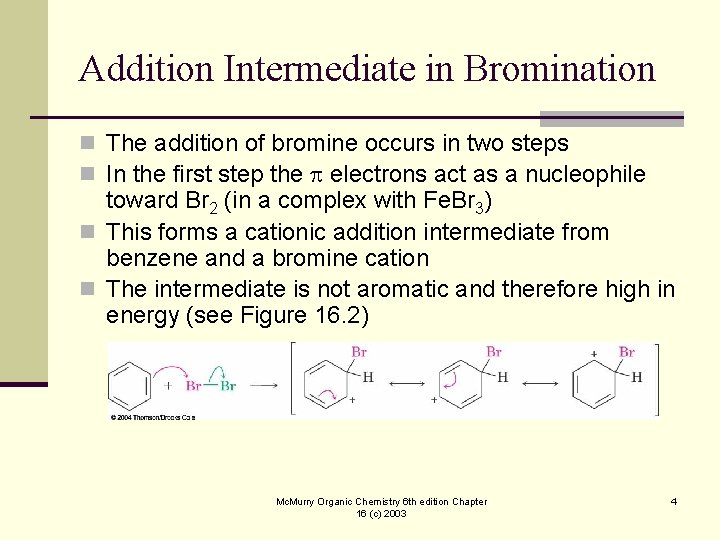
Addition Intermediate in Bromination n The addition of bromine occurs in two steps n In the first step the electrons act as a nucleophile toward Br 2 (in a complex with Fe. Br 3) n This forms a cationic addition intermediate from benzene and a bromine cation n The intermediate is not aromatic and therefore high in energy (see Figure 16. 2) Mc. Murry Organic Chemistry 6 th edition Chapter 16 (c) 2003 4
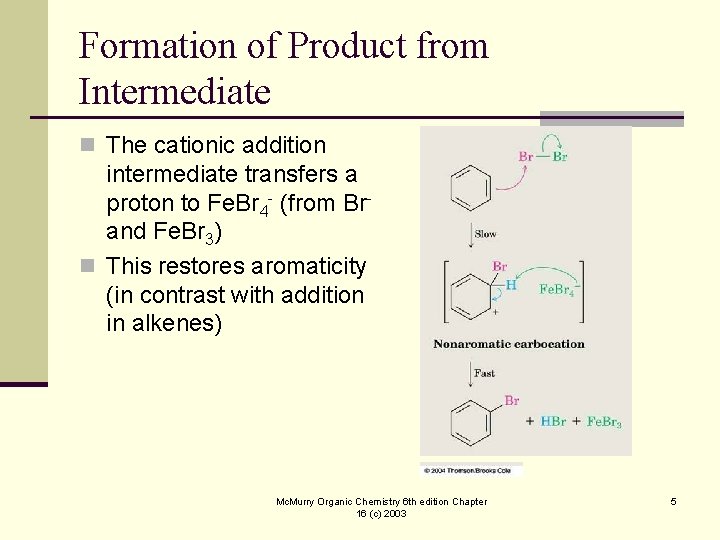
Formation of Product from Intermediate n The cationic addition intermediate transfers a proton to Fe. Br 4 - (from Brand Fe. Br 3) n This restores aromaticity (in contrast with addition in alkenes) Mc. Murry Organic Chemistry 6 th edition Chapter 16 (c) 2003 5
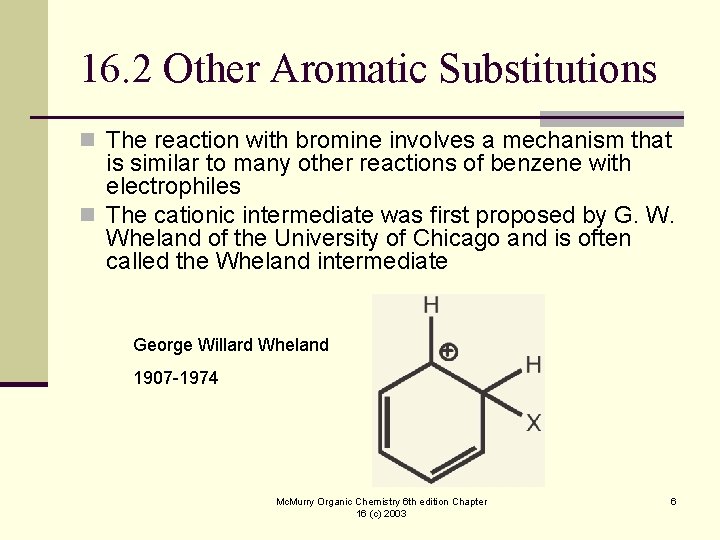
16. 2 Other Aromatic Substitutions n The reaction with bromine involves a mechanism that is similar to many other reactions of benzene with electrophiles n The cationic intermediate was first proposed by G. W. Wheland of the University of Chicago and is often called the Wheland intermediate George Willard Wheland 1907 -1974 Mc. Murry Organic Chemistry 6 th edition Chapter 16 (c) 2003 6
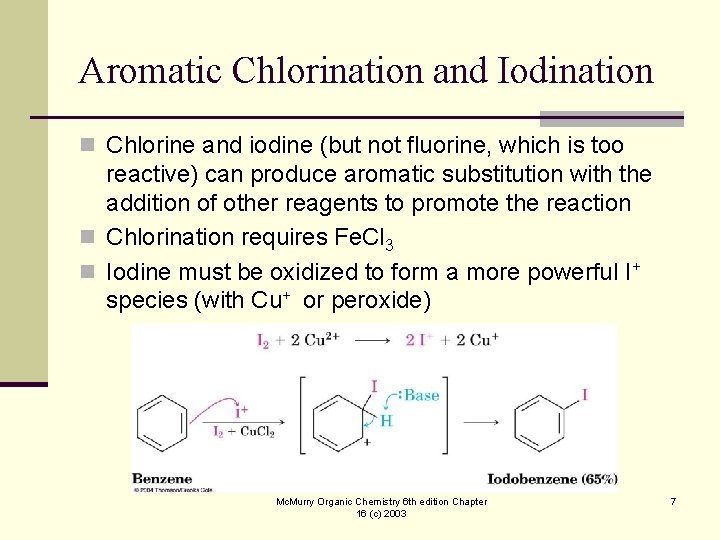
Aromatic Chlorination and Iodination n Chlorine and iodine (but not fluorine, which is too reactive) can produce aromatic substitution with the addition of other reagents to promote the reaction n Chlorination requires Fe. Cl 3 n Iodine must be oxidized to form a more powerful I+ species (with Cu+ or peroxide) Mc. Murry Organic Chemistry 6 th edition Chapter 16 (c) 2003 7
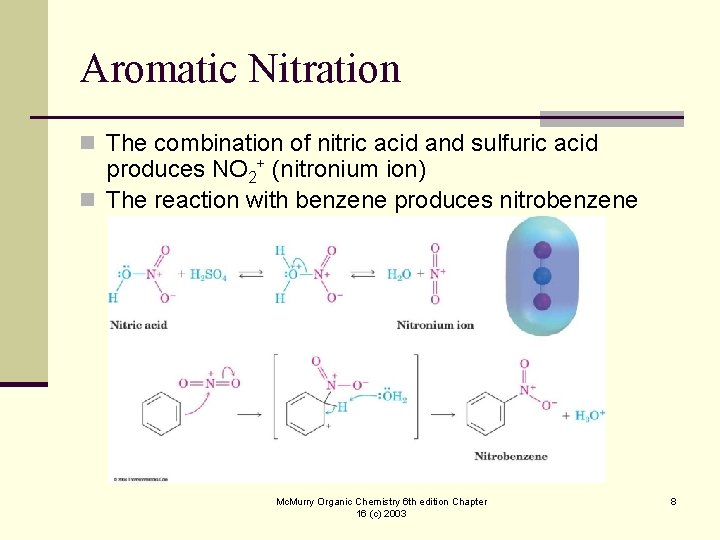
Aromatic Nitration n The combination of nitric acid and sulfuric acid produces NO 2+ (nitronium ion) n The reaction with benzene produces nitrobenzene Mc. Murry Organic Chemistry 6 th edition Chapter 16 (c) 2003 8
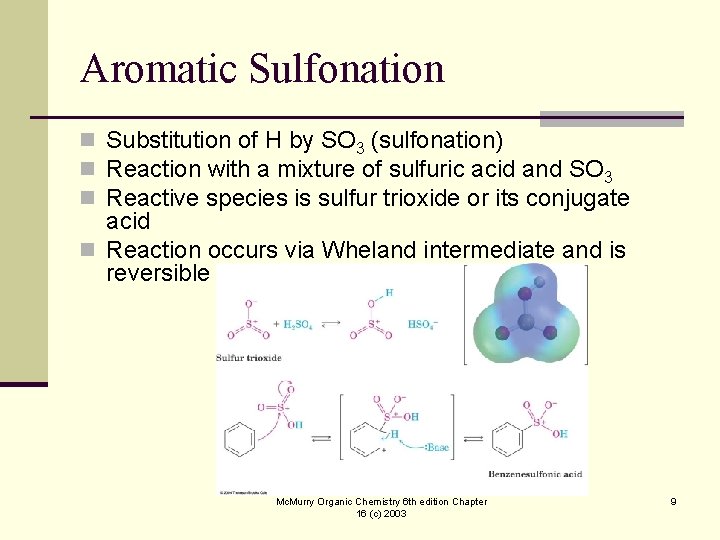
Aromatic Sulfonation n Substitution of H by SO 3 (sulfonation) n Reaction with a mixture of sulfuric acid and SO 3 n Reactive species is sulfur trioxide or its conjugate acid n Reaction occurs via Wheland intermediate and is reversible Mc. Murry Organic Chemistry 6 th edition Chapter 16 (c) 2003 9
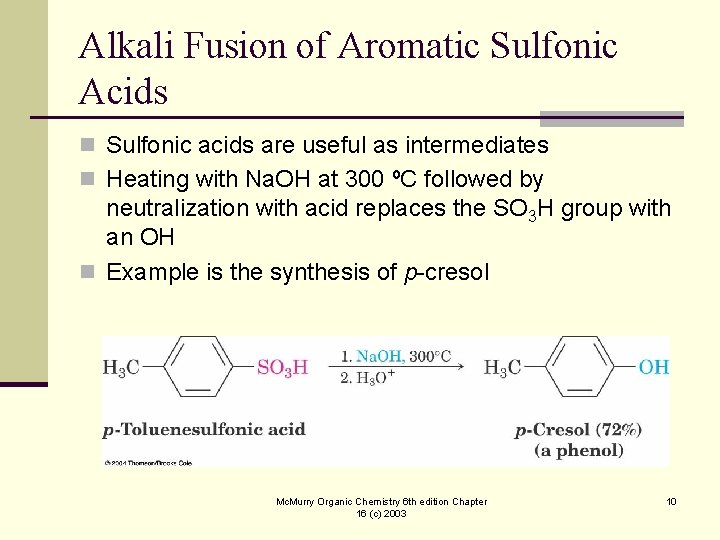
Alkali Fusion of Aromatic Sulfonic Acids n Sulfonic acids are useful as intermediates n Heating with Na. OH at 300 ºC followed by neutralization with acid replaces the SO 3 H group with an OH n Example is the synthesis of p-cresol Mc. Murry Organic Chemistry 6 th edition Chapter 16 (c) 2003 10
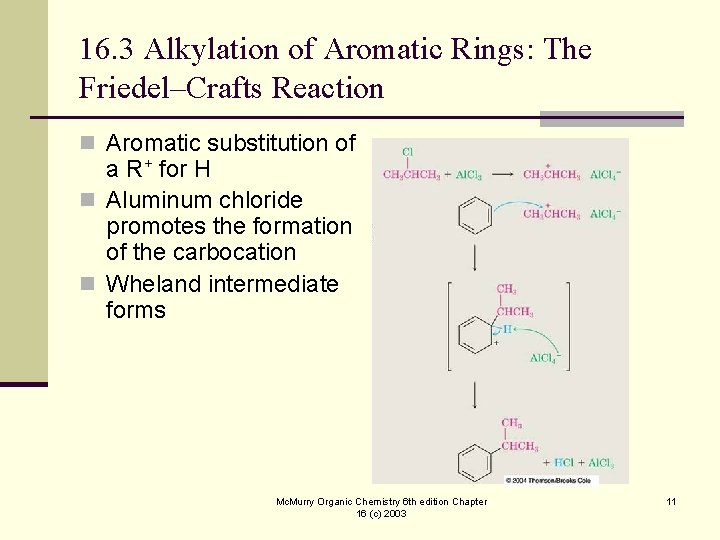
16. 3 Alkylation of Aromatic Rings: The Friedel–Crafts Reaction n Aromatic substitution of a R+ for H n Aluminum chloride promotes the formation of the carbocation n Wheland intermediate forms Mc. Murry Organic Chemistry 6 th edition Chapter 16 (c) 2003 11
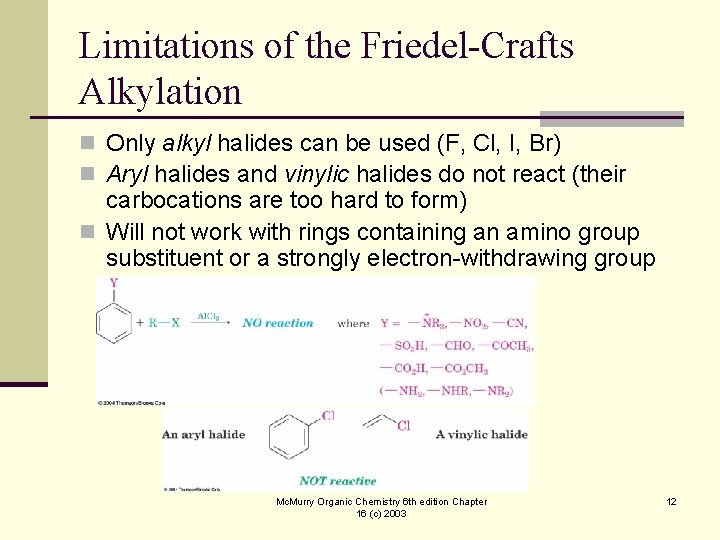
Limitations of the Friedel-Crafts Alkylation n Only alkyl halides can be used (F, Cl, I, Br) n Aryl halides and vinylic halides do not react (their carbocations are too hard to form) n Will not work with rings containing an amino group substituent or a strongly electron-withdrawing group Mc. Murry Organic Chemistry 6 th edition Chapter 16 (c) 2003 12
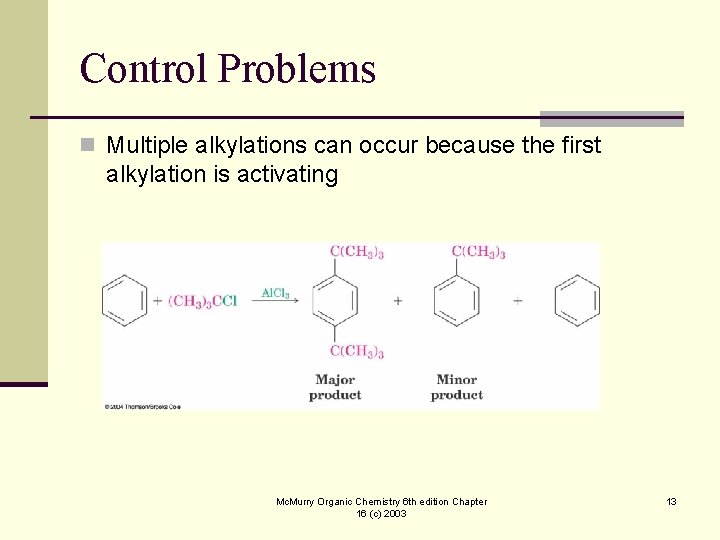
Control Problems n Multiple alkylations can occur because the first alkylation is activating Mc. Murry Organic Chemistry 6 th edition Chapter 16 (c) 2003 13

Carbocation Rearrangements During Alkylation n Similar to those that occur during electrophilic additions to alkenes n Can involve H or alkyl shifts Mc. Murry Organic Chemistry 6 th edition Chapter 16 (c) 2003 14
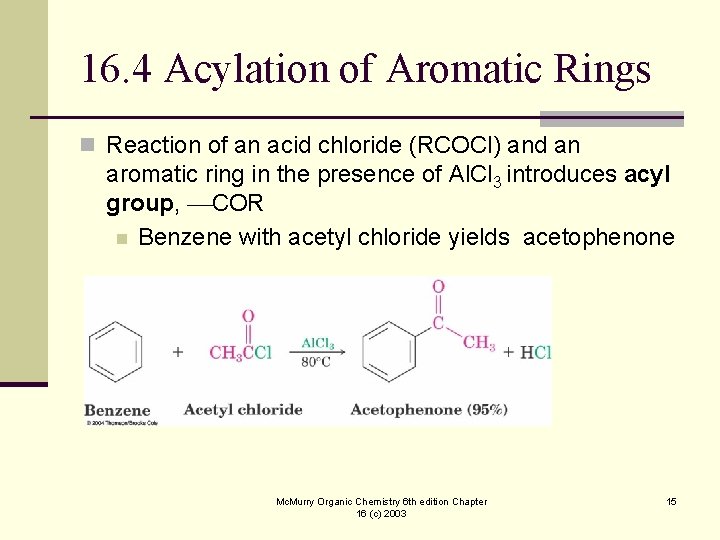
16. 4 Acylation of Aromatic Rings n Reaction of an acid chloride (RCOCl) and an aromatic ring in the presence of Al. Cl 3 introduces acyl group, COR n Benzene with acetyl chloride yields acetophenone Mc. Murry Organic Chemistry 6 th edition Chapter 16 (c) 2003 15
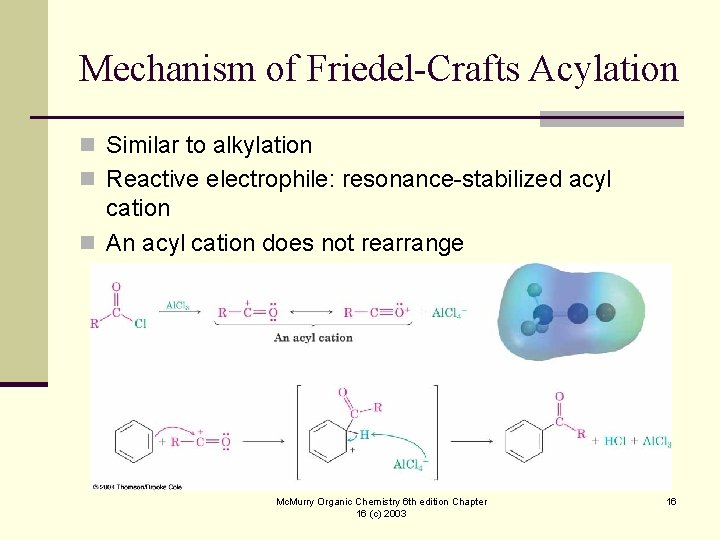
Mechanism of Friedel-Crafts Acylation n Similar to alkylation n Reactive electrophile: resonance-stabilized acyl cation n An acyl cation does not rearrange Mc. Murry Organic Chemistry 6 th edition Chapter 16 (c) 2003 16
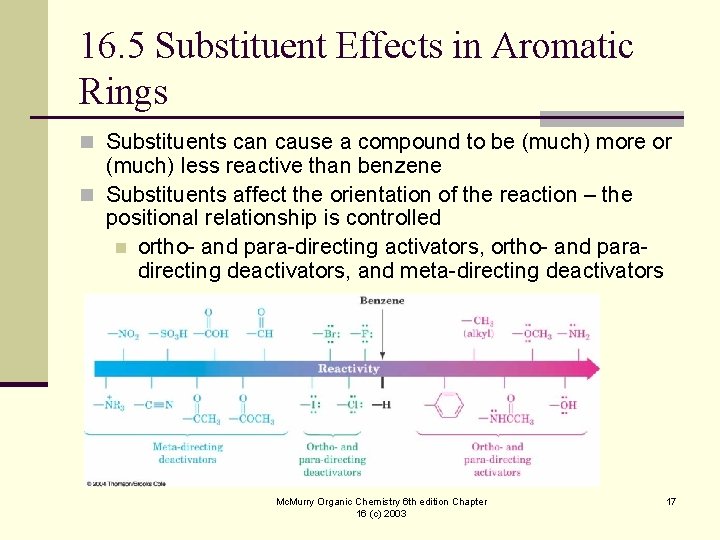
16. 5 Substituent Effects in Aromatic Rings n Substituents can cause a compound to be (much) more or (much) less reactive than benzene n Substituents affect the orientation of the reaction – the positional relationship is controlled n ortho- and para-directing activators, ortho- and paradirecting deactivators, and meta-directing deactivators Mc. Murry Organic Chemistry 6 th edition Chapter 16 (c) 2003 17
Origins of Substituent Effects n An interplay of inductive effects and resonance effects n Inductive effect - withdrawal or donation of electrons through a s bond n Resonance effect - withdrawal or donation of electrons through a bond due to the overlap of a p orbital on the substituent with a p orbital on the aromatic ring Mc. Murry Organic Chemistry 6 th edition Chapter 16 (c) 2003 18
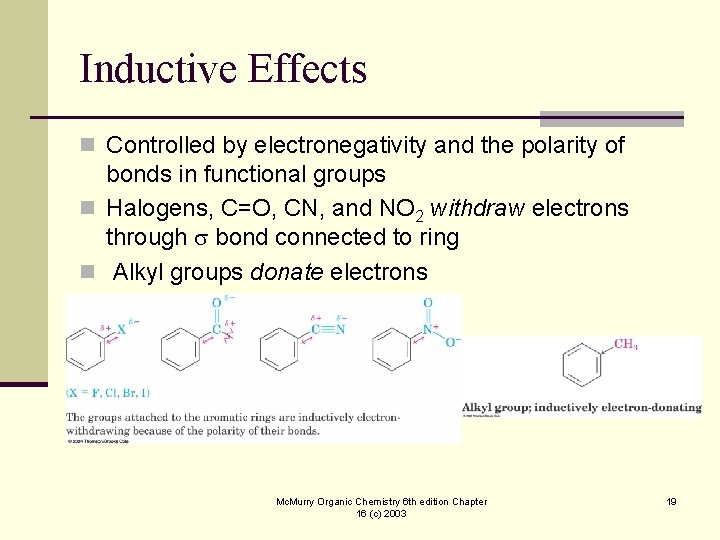
Inductive Effects n Controlled by electronegativity and the polarity of bonds in functional groups n Halogens, C=O, CN, and NO 2 withdraw electrons through s bond connected to ring n Alkyl groups donate electrons Mc. Murry Organic Chemistry 6 th edition Chapter 16 (c) 2003 19
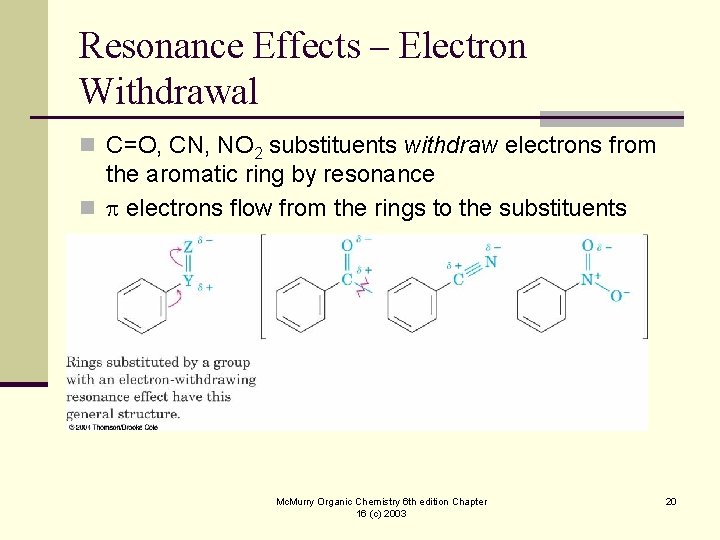
Resonance Effects – Electron Withdrawal n C=O, CN, NO 2 substituents withdraw electrons from the aromatic ring by resonance n electrons flow from the rings to the substituents Mc. Murry Organic Chemistry 6 th edition Chapter 16 (c) 2003 20
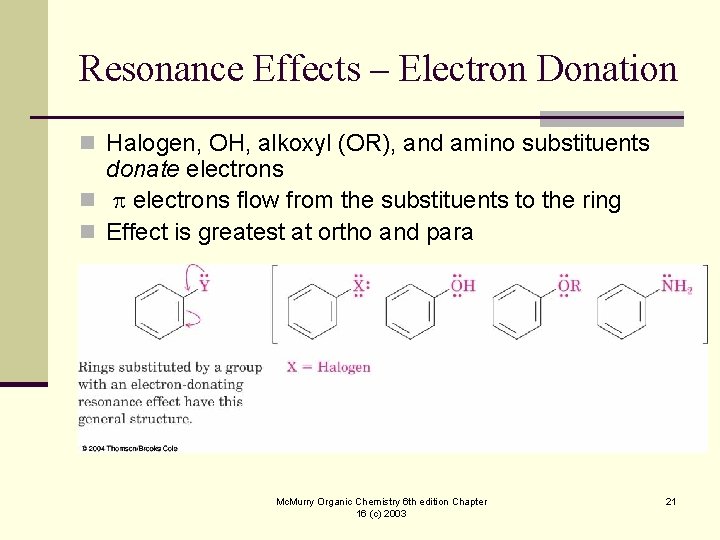
Resonance Effects – Electron Donation n Halogen, OH, alkoxyl (OR), and amino substituents donate electrons n electrons flow from the substituents to the ring n Effect is greatest at ortho and para Mc. Murry Organic Chemistry 6 th edition Chapter 16 (c) 2003 21
Contrasting Effects n Halogen, OH, OR, withdraw electrons inductively so that they deactivate the ring n Resonance interactions are generally weaker, affecting orientation n The strongest effects dominate Mc. Murry Organic Chemistry 6 th edition Chapter 16 (c) 2003 22
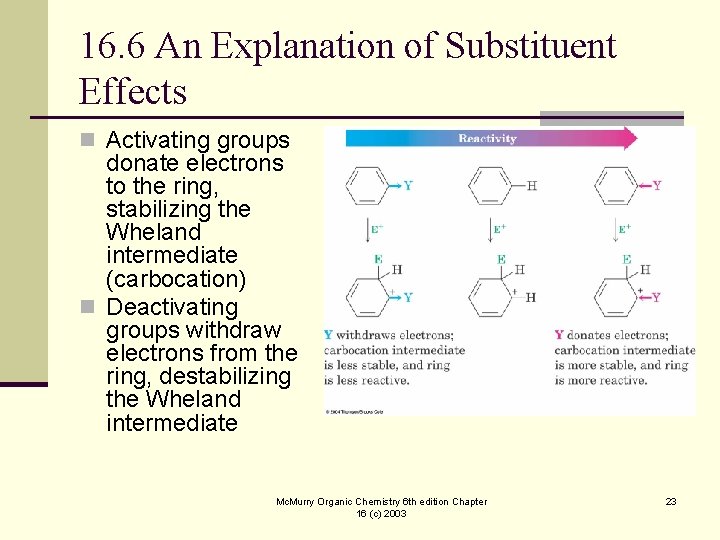
16. 6 An Explanation of Substituent Effects n Activating groups donate electrons to the ring, stabilizing the Wheland intermediate (carbocation) n Deactivating groups withdraw electrons from the ring, destabilizing the Wheland intermediate Mc. Murry Organic Chemistry 6 th edition Chapter 16 (c) 2003 23
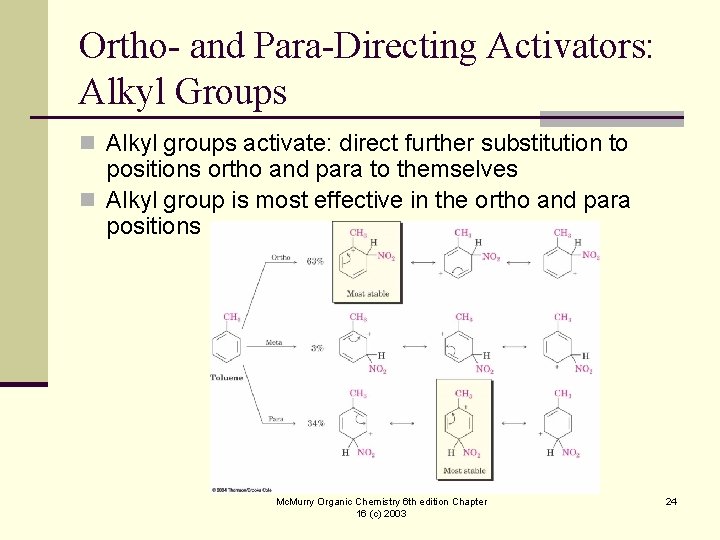
Ortho- and Para-Directing Activators: Alkyl Groups n Alkyl groups activate: direct further substitution to positions ortho and para to themselves n Alkyl group is most effective in the ortho and para positions Mc. Murry Organic Chemistry 6 th edition Chapter 16 (c) 2003 24
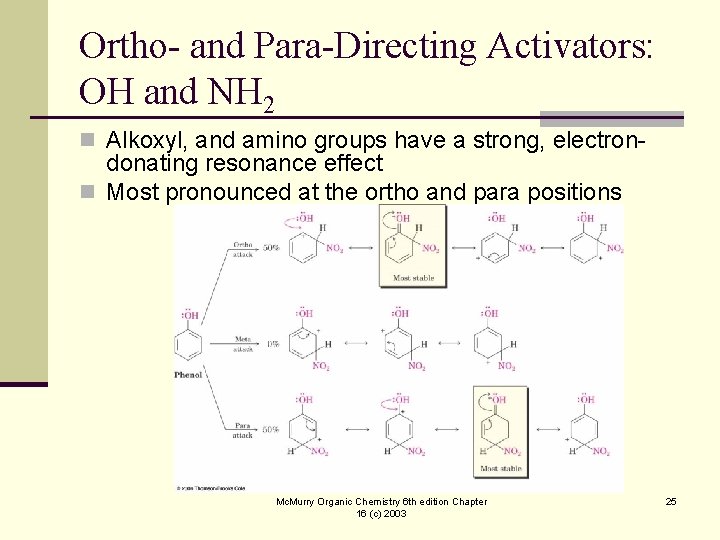
Ortho- and Para-Directing Activators: OH and NH 2 n Alkoxyl, and amino groups have a strong, electron- donating resonance effect n Most pronounced at the ortho and para positions Mc. Murry Organic Chemistry 6 th edition Chapter 16 (c) 2003 25
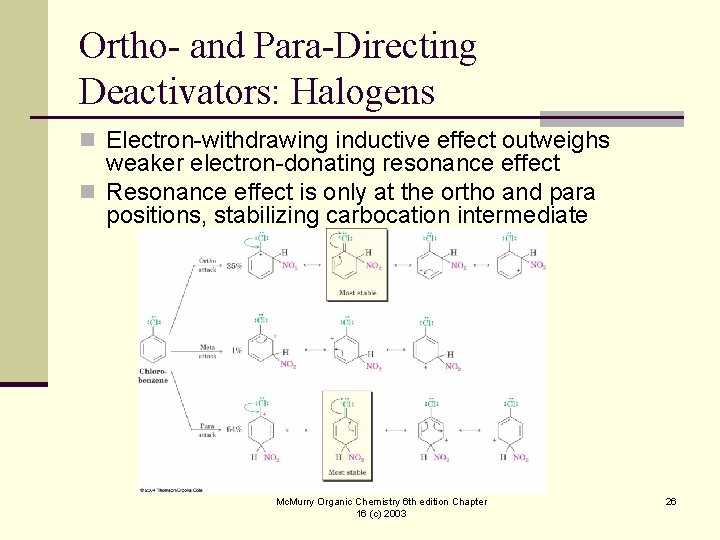
Ortho- and Para-Directing Deactivators: Halogens n Electron-withdrawing inductive effect outweighs weaker electron-donating resonance effect n Resonance effect is only at the ortho and para positions, stabilizing carbocation intermediate Mc. Murry Organic Chemistry 6 th edition Chapter 16 (c) 2003 26
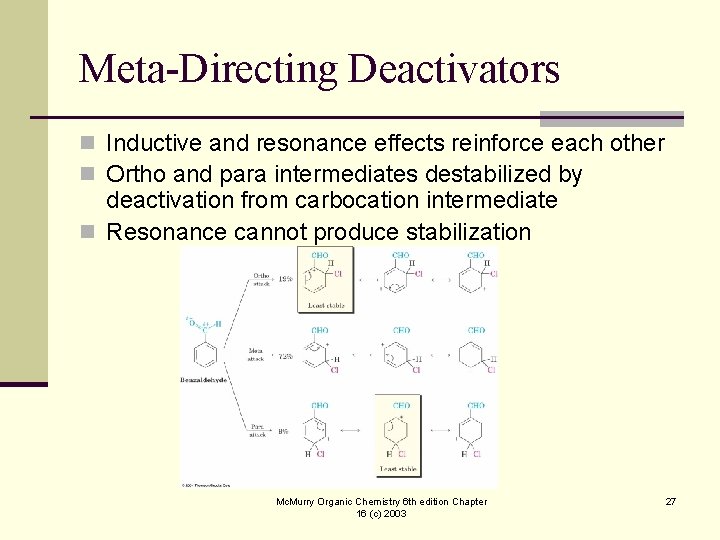
Meta-Directing Deactivators n Inductive and resonance effects reinforce each other n Ortho and para intermediates destabilized by deactivation from carbocation intermediate n Resonance cannot produce stabilization Mc. Murry Organic Chemistry 6 th edition Chapter 16 (c) 2003 27
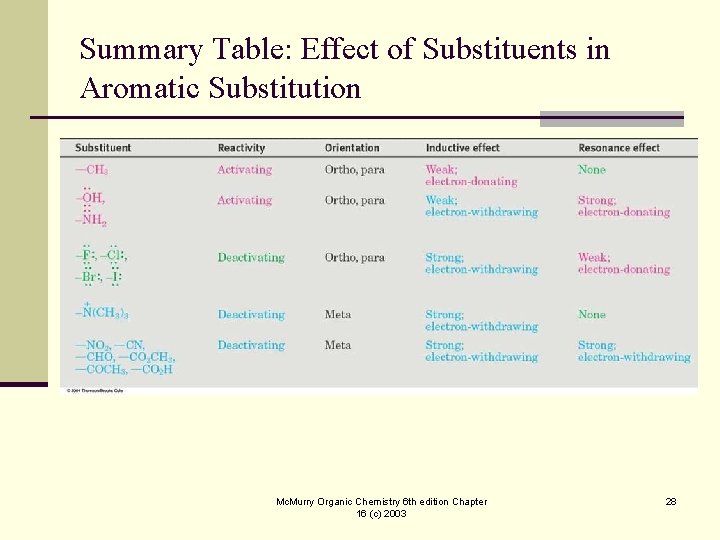
Summary Table: Effect of Substituents in Aromatic Substitution Mc. Murry Organic Chemistry 6 th edition Chapter 16 (c) 2003 28
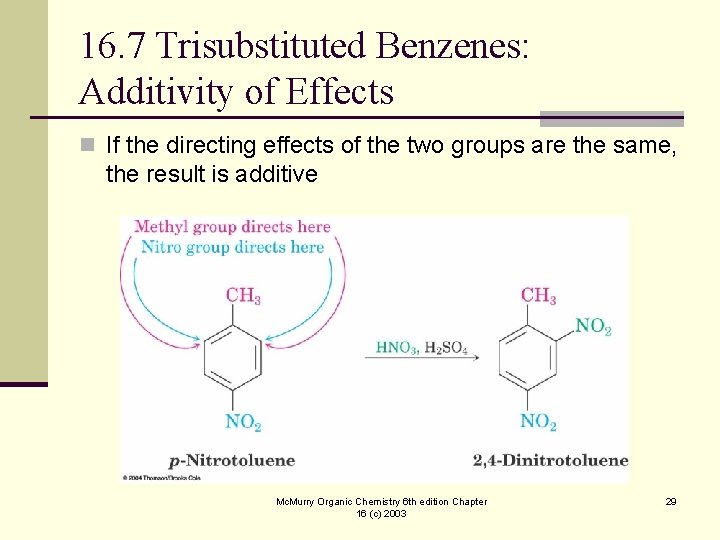
16. 7 Trisubstituted Benzenes: Additivity of Effects n If the directing effects of the two groups are the same, the result is additive Mc. Murry Organic Chemistry 6 th edition Chapter 16 (c) 2003 29
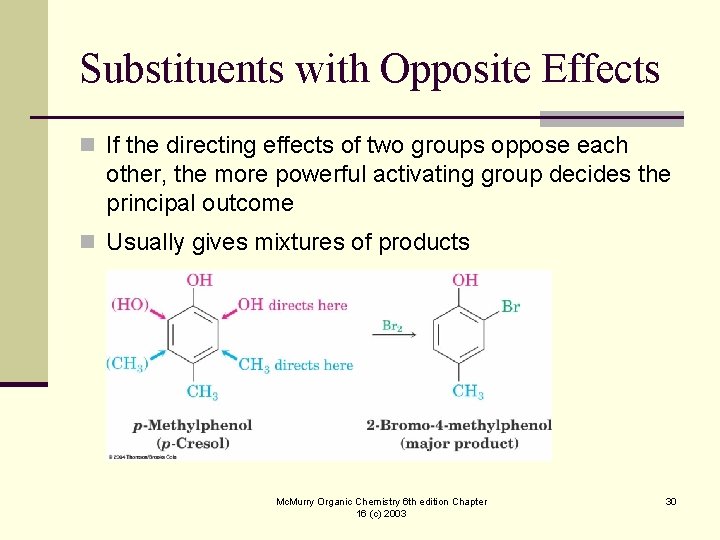
Substituents with Opposite Effects n If the directing effects of two groups oppose each other, the more powerful activating group decides the principal outcome n Usually gives mixtures of products Mc. Murry Organic Chemistry 6 th edition Chapter 16 (c) 2003 30

Meta-Disubstituted Compounds Are Unreactive n The reaction site is too hindered n To make aromatic rings with three adjacent substituents, it is best to start with an orthodisubstituted compound Mc. Murry Organic Chemistry 6 th edition Chapter 16 (c) 2003 31
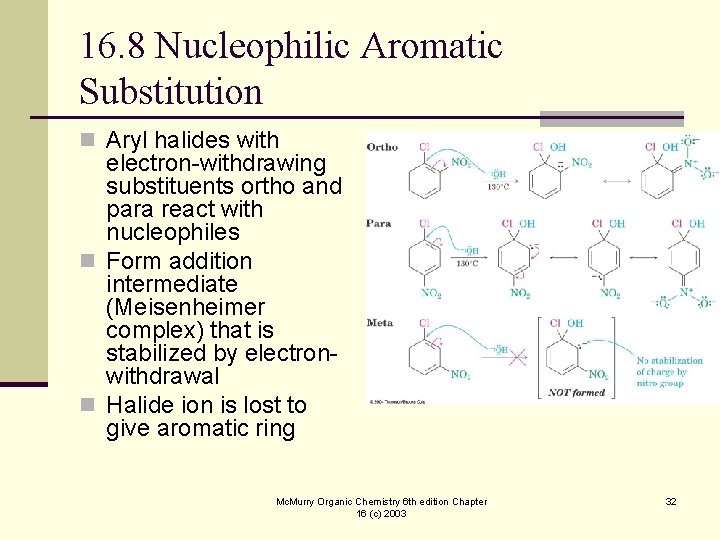
16. 8 Nucleophilic Aromatic Substitution n Aryl halides with electron-withdrawing substituents ortho and para react with nucleophiles n Form addition intermediate (Meisenheimer complex) that is stabilized by electronwithdrawal n Halide ion is lost to give aromatic ring Mc. Murry Organic Chemistry 6 th edition Chapter 16 (c) 2003 32
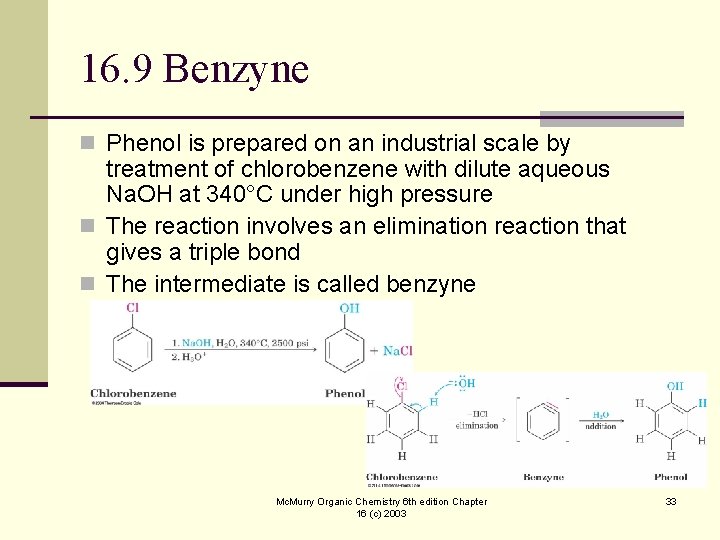
16. 9 Benzyne n Phenol is prepared on an industrial scale by treatment of chlorobenzene with dilute aqueous Na. OH at 340°C under high pressure n The reaction involves an elimination reaction that gives a triple bond n The intermediate is called benzyne Mc. Murry Organic Chemistry 6 th edition Chapter 16 (c) 2003 33
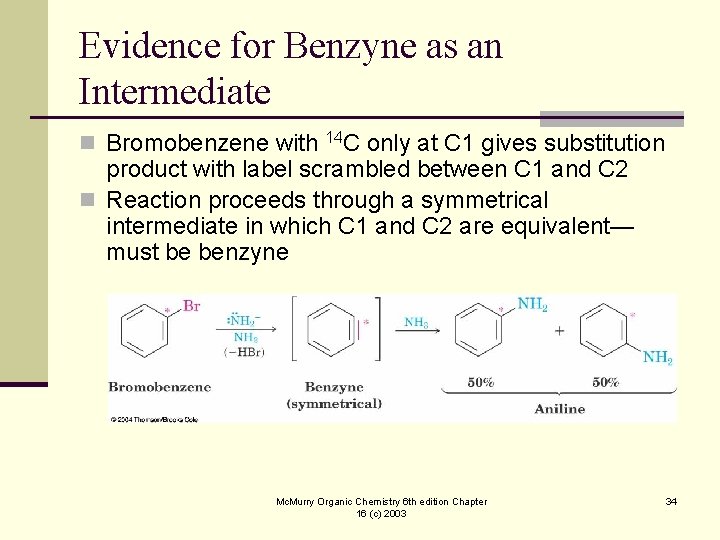
Evidence for Benzyne as an Intermediate n Bromobenzene with 14 C only at C 1 gives substitution product with label scrambled between C 1 and C 2 n Reaction proceeds through a symmetrical intermediate in which C 1 and C 2 are equivalent— must be benzyne Mc. Murry Organic Chemistry 6 th edition Chapter 16 (c) 2003 34
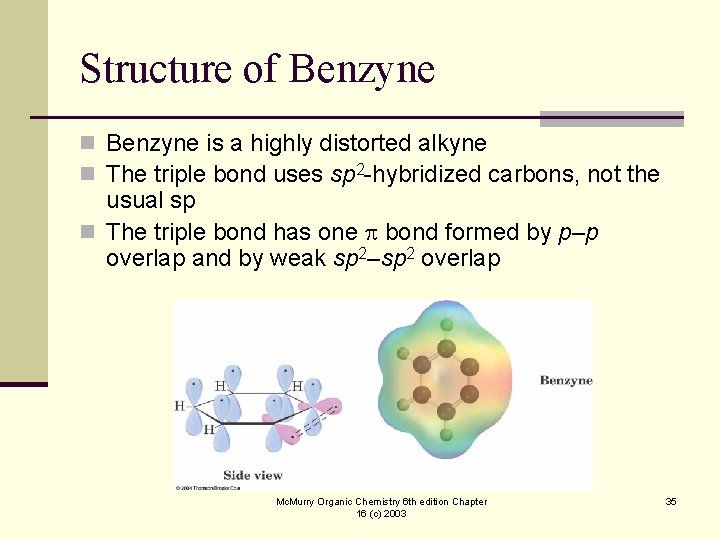
Structure of Benzyne n Benzyne is a highly distorted alkyne n The triple bond uses sp 2 -hybridized carbons, not the usual sp n The triple bond has one bond formed by p–p overlap and by weak sp 2–sp 2 overlap Mc. Murry Organic Chemistry 6 th edition Chapter 16 (c) 2003 35
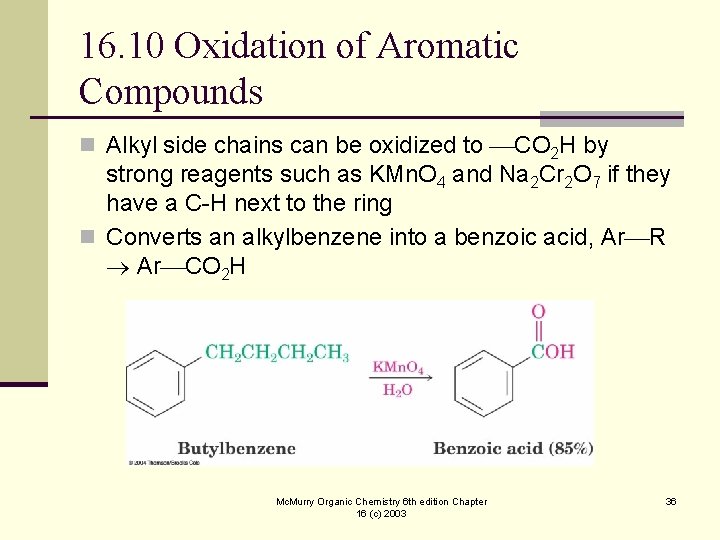
16. 10 Oxidation of Aromatic Compounds n Alkyl side chains can be oxidized to CO 2 H by strong reagents such as KMn. O 4 and Na 2 Cr 2 O 7 if they have a C-H next to the ring n Converts an alkylbenzene into a benzoic acid, Ar R Ar CO 2 H Mc. Murry Organic Chemistry 6 th edition Chapter 16 (c) 2003 36

Bromination of Alkylbenzene Side Chains n Reaction of an alkylbenzene with N-bromo- succinimide (NBS) and benzoyl peroxide (radical initiator) introduces Br into the side chain Mc. Murry Organic Chemistry 6 th edition Chapter 16 (c) 2003 37

Mechanism of NBS (Radical) Reaction n Abstraction of a benzylic hydrogen atom generates an intermediate benzylic radical n Reacts with Br 2 to yield product n Br· radical cycles back into reaction to carry chain n Br 2 produced from reaction of HBr with NBS Mc. Murry Organic Chemistry 6 th edition Chapter 16 (c) 2003 38

16. 11 Reduction of Aromatic Compounds n Aromatic rings are inert to catalytic hydrogenation under conditions that reduce alkene double bonds n Can selectively reduce an alkene double bond in the presence of an aromatic ring n Reduction of an aromatic ring requires more powerful reducing conditions (high pressure or rhodium catalysts) Mc. Murry Organic Chemistry 6 th edition Chapter 16 (c) 2003 39
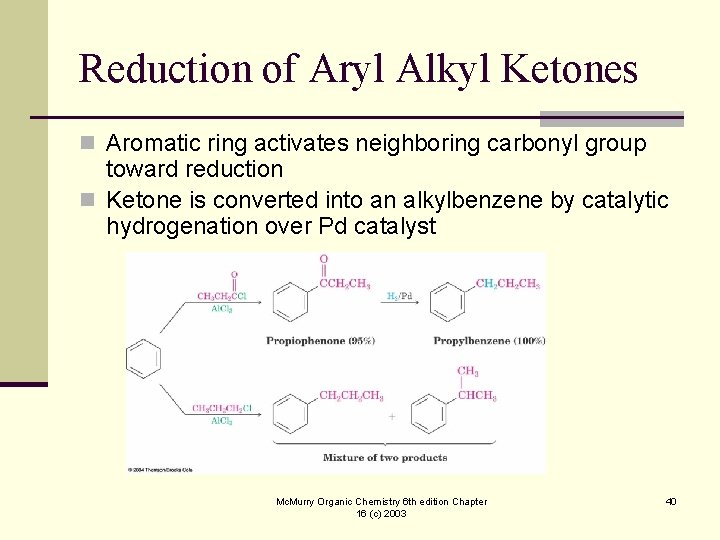
Reduction of Aryl Alkyl Ketones n Aromatic ring activates neighboring carbonyl group toward reduction n Ketone is converted into an alkylbenzene by catalytic hydrogenation over Pd catalyst Mc. Murry Organic Chemistry 6 th edition Chapter 16 (c) 2003 40
16. 12 Synthesis Strategies n These syntheses require planning and consideration of alternative routes n Work through the practice problems in this section following the general guidelines for synthesis (and retrosynthetic analysis in 8. 10) Mc. Murry Organic Chemistry 6 th edition Chapter 16 (c) 2003 41
- Slides: 41