
16 Chapter Robbins Judge Organizational Behavior 14 th
16 Chapter Robbins & Judge Organizational Behavior 14 th Edition Organizational Culture Kelli J. Schutte William Jewell College Copyright © 2011 Pearson Education, Inc. publishing as Prentice Hall 16 -0
Organizational Culture Ø Organizational Culture – A common perception held by the organization’s members; a system of shared meaning – Seven primary characteristics 1. Innovation and risk taking 2. Attention to detail 3. Outcome orientation 4. People orientation 5. Team orientation 6. Aggressiveness 7. Stability E X H I B I T 17 -1 Copyright © 2011 Pearson Education, Inc. publishing as Prentice Hall 16 -1
Do Organizations Have Uniform Cultures? Ø Culture is a descriptive term: it may act as a substitute formalization Ø Dominant Culture – Expresses the core values that are shared by a majority of the organization’s members Ø Subcultures – Minicultures within an organization, typically defined by department designations and geographical separation Ø Core Values – The primary or dominant values that are accepted throughout the organization Ø Strong Culture – A culture in which the core values are intensely held and widely shared Copyright © 2011 Pearson Education, Inc. publishing as Prentice Hall 16 -2
What Do Cultures Do? Ø Culture’s Functions 1. Defines the boundary between one organization and others 2. Conveys a sense of identity for its members 3. Facilitates the generation of commitment to something larger than self-interest 4. Enhances the stability of the social system 5. Serves as a sense-making and control mechanism for fitting employees in the organization Copyright © 2011 Pearson Education, Inc. publishing as Prentice Hall 16 -3
Culture as a Liability Ø Institutionalization – A company can become institutionalized where it is valued for itself and not for the goods and services it provides Ø Barrier to change – Occurs when culture’s values are not aligned with the values necessary for rapid change Ø Barrier to diversity – Strong cultures put considerable pressure on employees to conform, which may lead to institutionalized bias Ø Barrier to acquisitions and mergers – Incompatible cultures can destroy an otherwise successful merger Copyright © 2011 Pearson Education, Inc. publishing as Prentice Hall 16 -4
How Culture Begins Ø Stems from the actions of the founders: – Founders hire and keep only employees who think and feel the same way they do. – Founders indoctrinate and socialize these employees to their way of thinking and feeling. – The founders’ own behavior acts as a role model that encourages employees to identify with them and thereby internalize their beliefs, values, and assumptions. Copyright © 2011 Pearson Education, Inc. publishing as Prentice Hall 16 -5
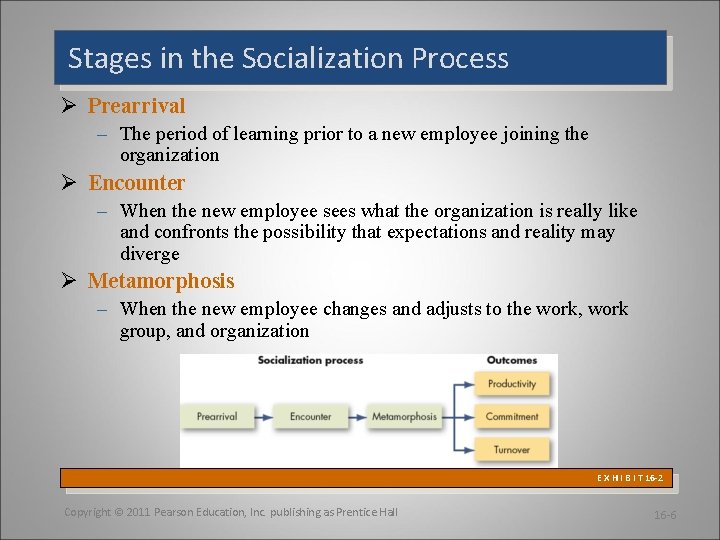
Stages in the Socialization Process Ø Prearrival – The period of learning prior to a new employee joining the organization Ø Encounter – When the new employee sees what the organization is really like and confronts the possibility that expectations and reality may diverge Ø Metamorphosis – When the new employee changes and adjusts to the work, work group, and organization E X H I B I T 16 -2 Copyright © 2011 Pearson Education, Inc. publishing as Prentice Hall 16 -6
Socialization Program Options Ø Choose the appropriate alternatives: – – – Formal versus Informal Individual versus Collective Fixed versus Variable Serial versus Random Investiture versus Divestiture Ø Socialization outcomes: – Higher productivity – Greater commitment – Lower turnover Source: Based on J. Van Maanen, “People Processing: Strategies of Organizational Socialization, ” Organizational Dynamics, Summer 1978, pp. 19– 36; and E. H. Schein, Organizational Culture, ” American Psychologist, February 1990, p. 116. E X H I B I T 16 -3 Copyright © 2011 Pearson Education, Inc. publishing as Prentice Hall 16 -7
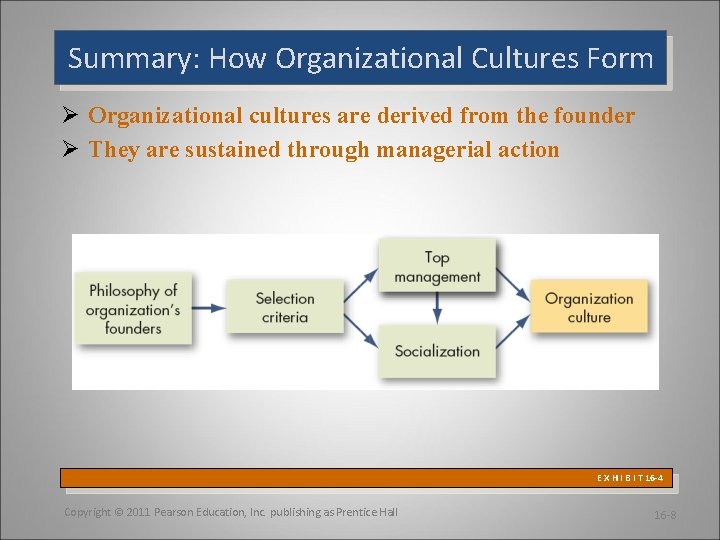
Summary: How Organizational Cultures Form Ø Organizational cultures are derived from the founder Ø They are sustained through managerial action E X H I B I T 16 -4 Copyright © 2011 Pearson Education, Inc. publishing as Prentice Hall 16 -8
How Employees Learn Culture Ø Stories – Anchor the present into the past and provide explanations and legitimacy for current practices Ø Rituals – Repetitive sequences of activities that express and reinforce the key values of the organization Ø Material Symbols – Acceptable attire, office size, opulence of the office furnishings, and executive perks that convey to employees who is important in the organization Ø Language – Jargon and special ways of expressing one’s self to indicate membership in the organization Copyright © 2011 Pearson Education, Inc. publishing as Prentice Hall 16 -9
Creating an Ethical Organizational Culture Ø Characteristics of Organizations that Develop High Ethical Standards – High tolerance for risk – Low to moderate in aggressiveness – Focus on means as well as outcomes Ø Managerial Practices Promoting an Ethical Culture – – – Being a visible role model Communicating ethical expectations Providing ethical training Rewarding ethical acts and punishing unethical ones Providing protective mechanisms Copyright © 2011 Pearson Education, Inc. publishing as Prentice Hall 16 -10
Creating a Positive Organizational Culture Ø Positive Organizational Culture – A culture that: • Builds on employee strengths – Focus is on discovering, sharing, and building on the strengths of individual employees • Rewards more than it punishes – Articulating praise and “catching employees doing something right” • Emphasizes individual vitality and growth – Helping employees learn and grow in their jobs and careers Ø Limits of Positive Culture: – May not work for all organizations or everyone within them Copyright © 2011 Pearson Education, Inc. publishing as Prentice Hall 16 -11
- Slides: 12