
16 451 Lecture 5 Electron Scattering continued 1892003

- Slides: 14
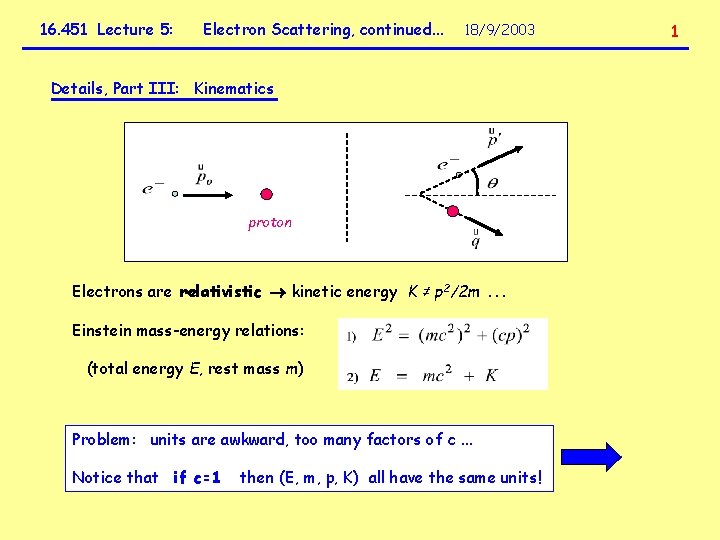
16. 451 Lecture 5: Electron Scattering, continued. . . 18/9/2003 Details, Part III: Kinematics proton Electrons are relativistic kinetic energy K ≠ p 2/2 m. . . Einstein mass-energy relations: (total energy E, rest mass m) Problem: units are awkward, too many factors of c. . . Notice that if c=1 then (E, m, p, K) all have the same units! 1
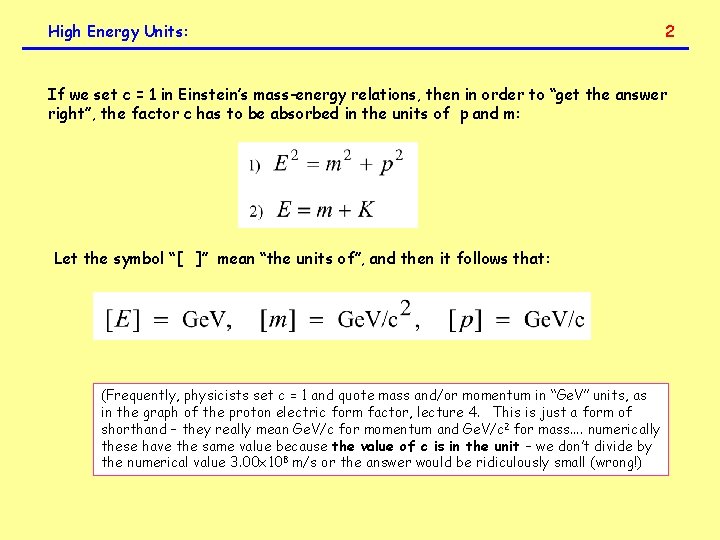
High Energy Units: 2 If we set c = 1 in Einstein’s mass-energy relations, then in order to “get the answer right”, the factor c has to be absorbed in the units of p and m: Let the symbol “[ ]” mean “the units of”, and then it follows that: (Frequently, physicists set c = 1 and quote mass and/or momentum in “Ge. V” units, as in the graph of the proton electric form factor, lecture 4. This is just a form of shorthand – they really mean Ge. V/c for momentum and Ge. V/c 2 for mass. . numerically these have the same value because the value of c is in the unit – we don’t divide by the numerical value 3. 00 x 108 m/s or the answer would be ridiculously small (wrong!)
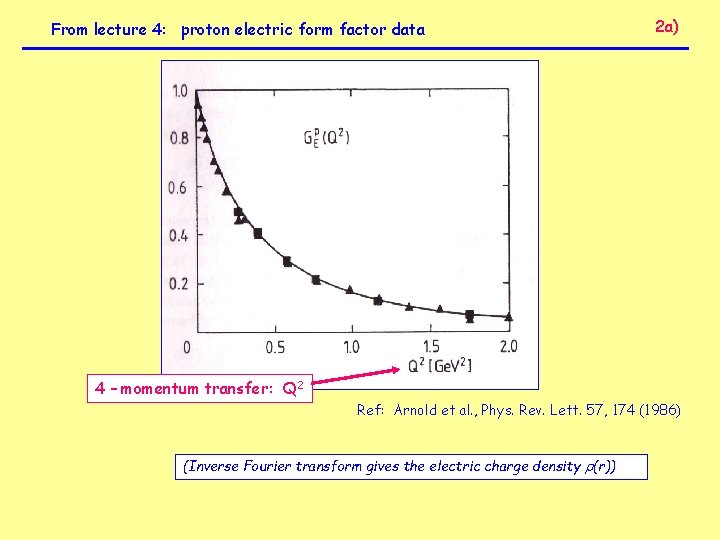
From lecture 4: proton electric form factor data 2 a) 4 – momentum transfer: Q 2 Ref: Arnold et al. , Phys. Rev. Lett. 57, 174 (1986) (Inverse Fourier transform gives the electric charge density (r))
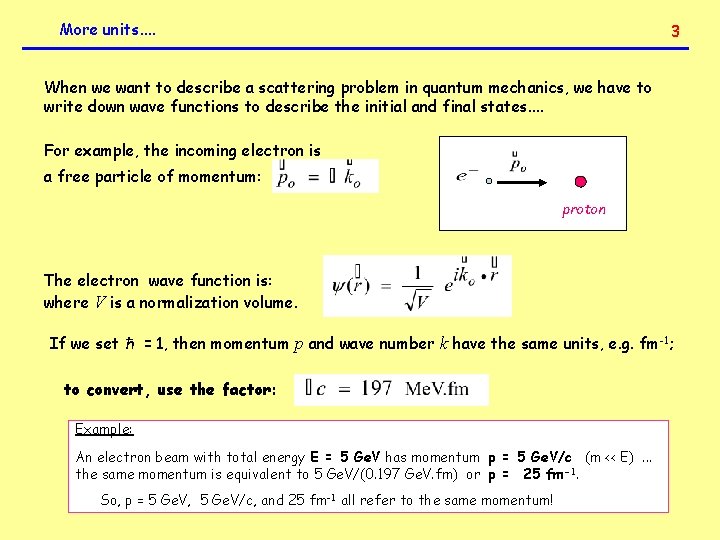
More units. . 3 When we want to describe a scattering problem in quantum mechanics, we have to write down wave functions to describe the initial and final states. . For example, the incoming electron is a free particle of momentum: proton The electron wave function is: where V is a normalization volume. If we set ħ = 1, then momentum p and wave number k have the same units, e. g. fm-1; to convert, use the factor: Example: An electron beam with total energy E = 5 Ge. V has momentum p = 5 Ge. V/c (m << E). . . the same momentum is equivalent to 5 Ge. V/(0. 197 Ge. V. fm) or p = 25 fm-1. So, p = 5 Ge. V, 5 Ge. V/c, and 25 fm-1 all refer to the same momentum!
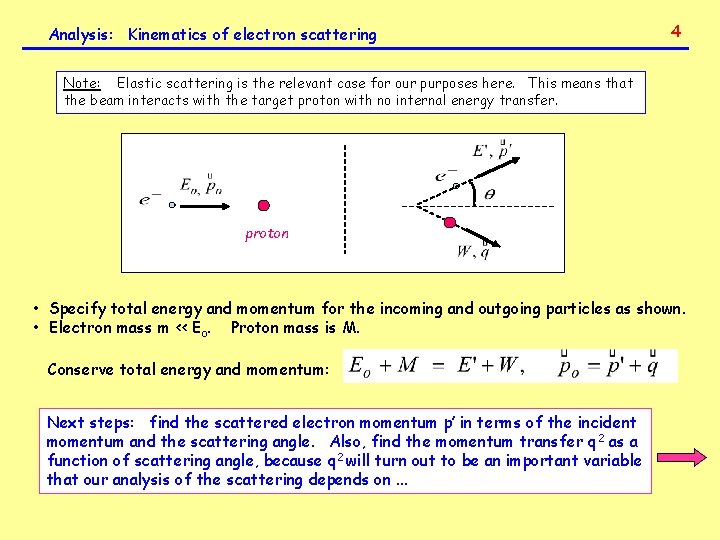
Analysis: Kinematics of electron scattering 4 Note: Elastic scattering is the relevant case for our purposes here. This means that the beam interacts with the target proton with no internal energy transfer. proton • Specify total energy and momentum for the incoming and outgoing particles as shown. • Electron mass m << Eo. Proton mass is M. Conserve total energy and momentum: Next steps: find the scattered electron momentum p’ in terms of the incident momentum and the scattering angle. Also, find the momentum transfer q 2 as a function of scattering angle, because q 2 will turn out to be an important variable that our analysis of the scattering depends on. . .
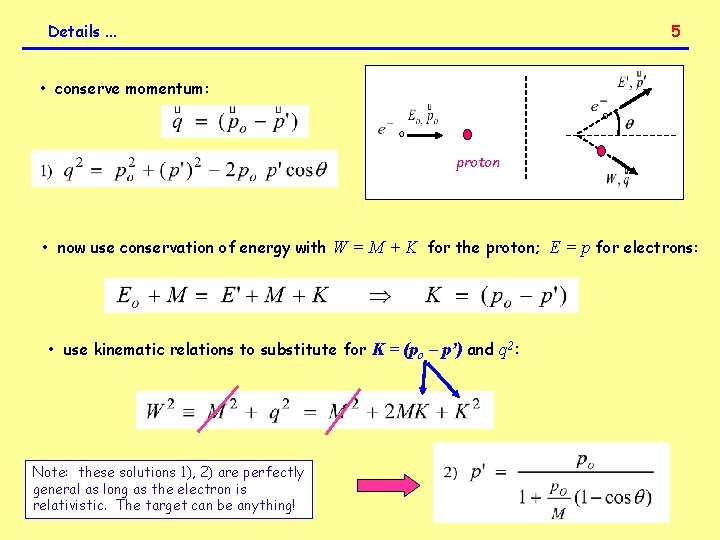
5 Details. . . • conserve momentum: proton • now use conservation of energy with W = M + K for the proton; E = p for electrons: • use kinematic relations to substitute for K = (po – p’) and q 2: Note: these solutions 1), 2) are perfectly general as long as the electron is relativistic. The target can be anything!
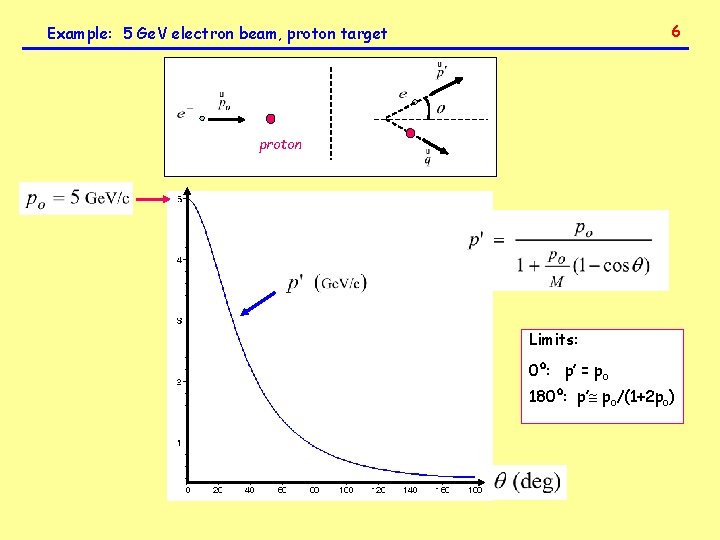
6 Example: 5 Ge. V electron beam, proton target proton Limits: 0º: p’ = po 180º: p’ po/(1+2 po)
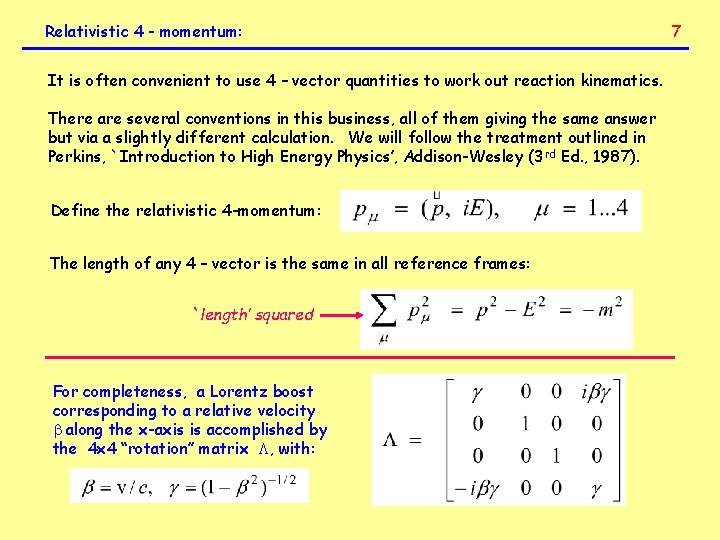
Relativistic 4 - momentum: It is often convenient to use 4 – vector quantities to work out reaction kinematics. There are several conventions in this business, all of them giving the same answer but via a slightly different calculation. We will follow the treatment outlined in Perkins, `Introduction to High Energy Physics’, Addison-Wesley (3 rd Ed. , 1987). Define the relativistic 4 -momentum: The length of any 4 – vector is the same in all reference frames: `length’ squared For completeness, a Lorentz boost corresponding to a relative velocity along the x-axis is accomplished by the 4 x 4 “rotation” matrix , with: 7
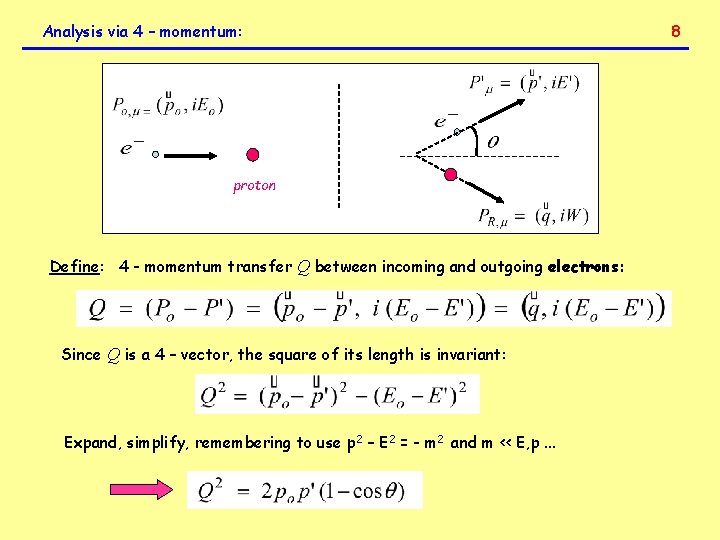
Analysis via 4 – momentum: proton Define: 4 - momentum transfer Q between incoming and outgoing electrons: Since Q is a 4 – vector, the square of its length is invariant: Expand, simplify, remembering to use p 2 – E 2 = - m 2 and m << E, p. . . 8
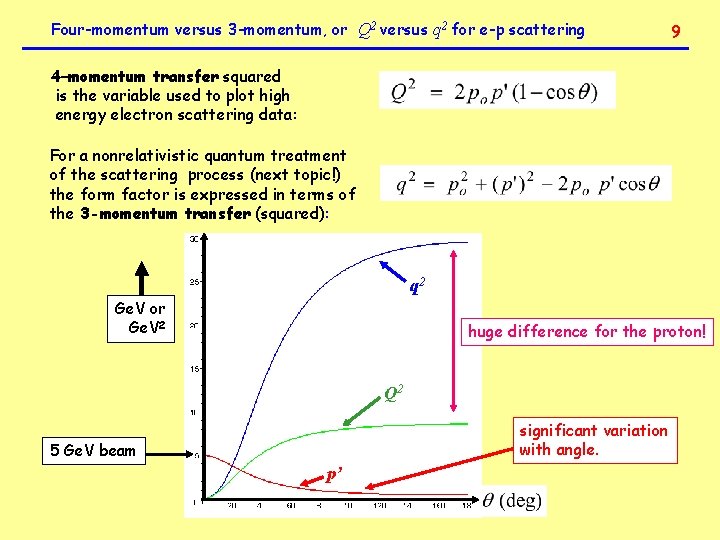
Four-momentum versus 3 -momentum, or Q 2 versus q 2 for e-p scattering 9 4–momentum transfer squared is the variable used to plot high energy electron scattering data: For a nonrelativistic quantum treatment of the scattering process (next topic!) the form factor is expressed in terms of the 3 -momentum transfer (squared): q 2 Ge. V or Ge. V 2 huge difference for the proton! Q 2 significant variation with angle. 5 Ge. V beam p’
10 What happens if the target is a nucleus? (Krane, ch. 3) The difference between numerical values of Q 2 and q 2 decreases as the mass of the target increases we can “get away” with a 3 -momentum description (easier) to derive the cross section for scattering from a nucleus. Note also the simplification that p’ po and becomes essentially independent of as the mass of the target increases. (Why? as M ∞, the electron beam just ‘reflects’ off the target – just like an elastic collision of a ping pong ball with the floor – 16. 105!!) M = 16 M = 100 q 2 Q 2 p’ 5 Ge. V electron beam in both cases, as before, but the target mass increased from a proton to a nucleus (e. g. , 16 O, 100 Ru )
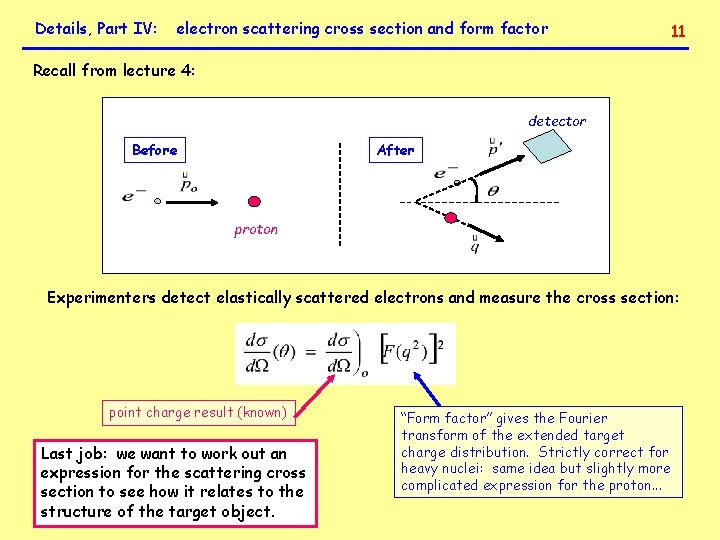
Details, Part IV: electron scattering cross section and form factor 11 Recall from lecture 4: detector Before After proton Experimenters detect elastically scattered electrons and measure the cross section: point charge result (known) Last job: we want to work out an expression for the scattering cross section to see how it relates to the structure of the target object. “Form factor” gives the Fourier transform of the extended target charge distribution. Strictly correct for heavy nuclei: same idea but slightly more complicated expression for the proton. . .
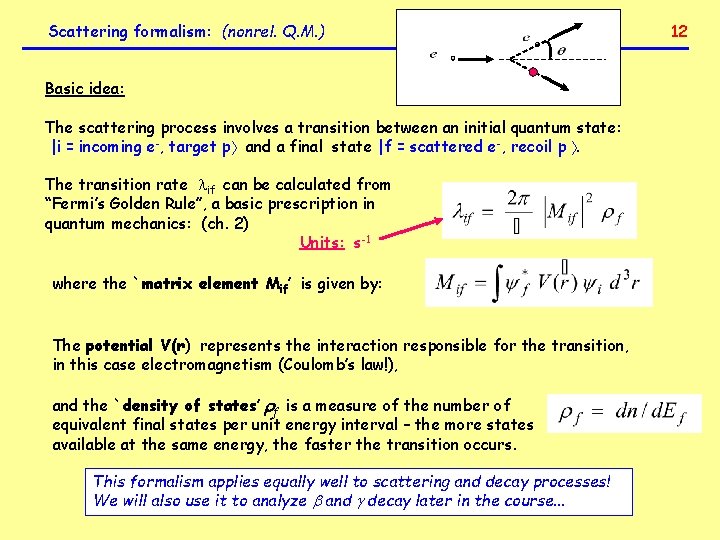
Scattering formalism: (nonrel. Q. M. ) Basic idea: The scattering process involves a transition between an initial quantum state: |i = incoming e-, target p and a final state |f = scattered e-, recoil p . The transition rate if can be calculated from “Fermi’s Golden Rule”, a basic prescription in quantum mechanics: (ch. 2) Units: s-1 where the `matrix element Mif’ is given by: The potential V(r) represents the interaction responsible for the transition, in this case electromagnetism (Coulomb’s law!), and the `density of states’ f is a measure of the number of equivalent final states per unit energy interval – the more states available at the same energy, the faster the transition occurs. This formalism applies equally well to scattering and decay processes! We will also use it to analyze and decay later in the course. . . 12
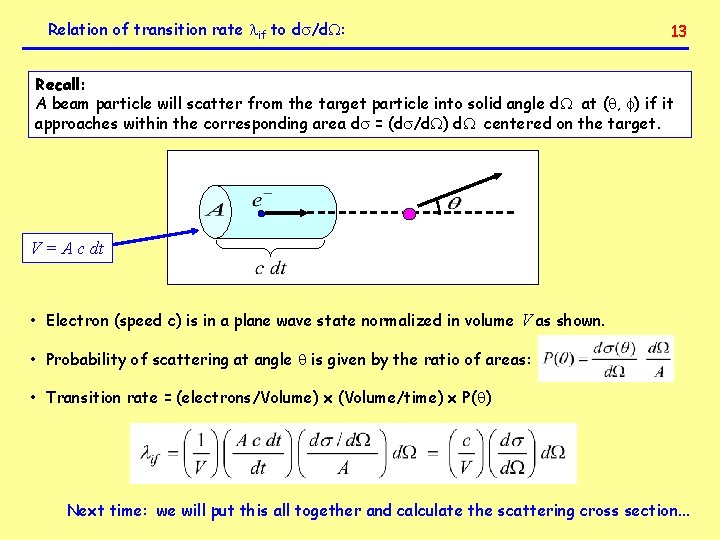
Relation of transition rate if to d /d : 13 Recall: A beam particle will scatter from the target particle into solid angle d at ( , ) if it approaches within the corresponding area d = (d /d ) d centered on the target. V = A c dt • Electron (speed c) is in a plane wave state normalized in volume V as shown. • Probability of scattering at angle is given by the ratio of areas: • Transition rate = (electrons/Volume) x (Volume/time) x P( ) Next time: we will put this all together and calculate the scattering cross section. . .