
16 3 Colligative Properties of Solutions VaporPressure Lowering
- Slides: 13
16. 3 Colligative Properties of Solutions > Vapor-Pressure Lowering A property that depends only upon the number of solute particles, and not upon their identity, is called a colligative property. Slide 1 of 22 © Copyright Pearson Prentice Hall
16. 3 Colligative Properties of Solutions > Vapor-Pressure Lowering Three important colligative properties of solutions are • vapor-pressure lowering • boiling-point elevation • freezing-point depression Slide 2 of 22 © Copyright Pearson Prentice Hall
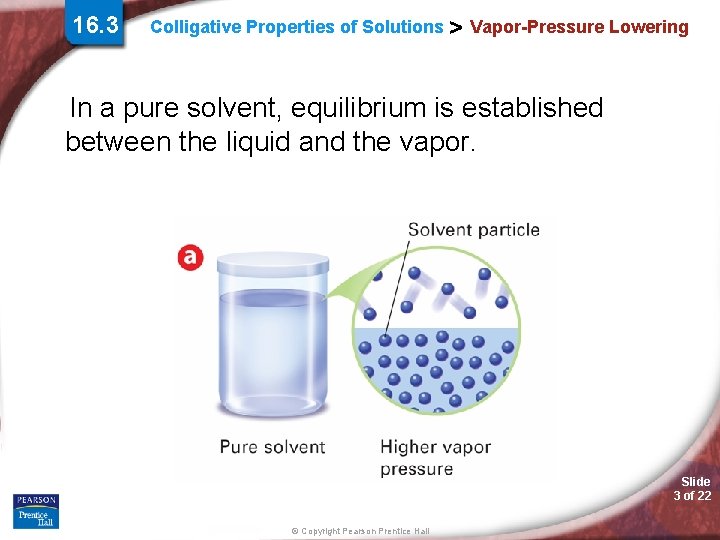
16. 3 Colligative Properties of Solutions > Vapor-Pressure Lowering In a pure solvent, equilibrium is established between the liquid and the vapor. Slide 3 of 22 © Copyright Pearson Prentice Hall
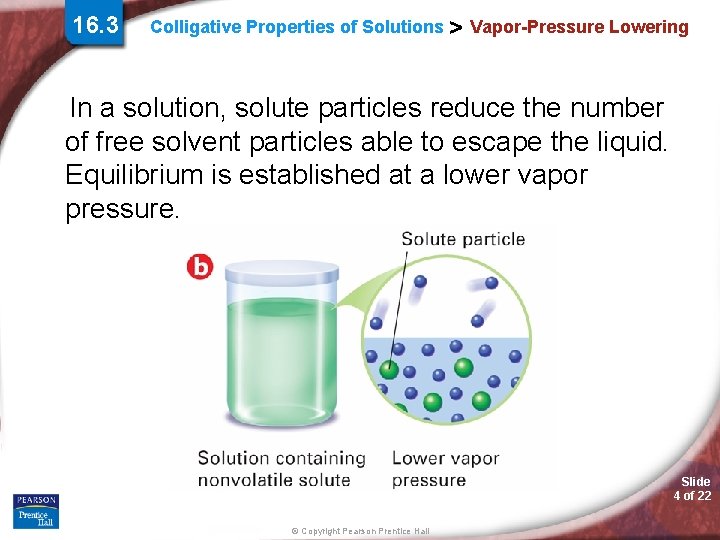
16. 3 Colligative Properties of Solutions > Vapor-Pressure Lowering In a solution, solute particles reduce the number of free solvent particles able to escape the liquid. Equilibrium is established at a lower vapor pressure. Slide 4 of 22 © Copyright Pearson Prentice Hall
16. 3 Colligative Properties of Solutions > Vapor-Pressure Lowering The decrease in a solution’s vapor pressure is proportional to the number of particles the solute makes in solution. Slide 5 of 22 © Copyright Pearson Prentice Hall
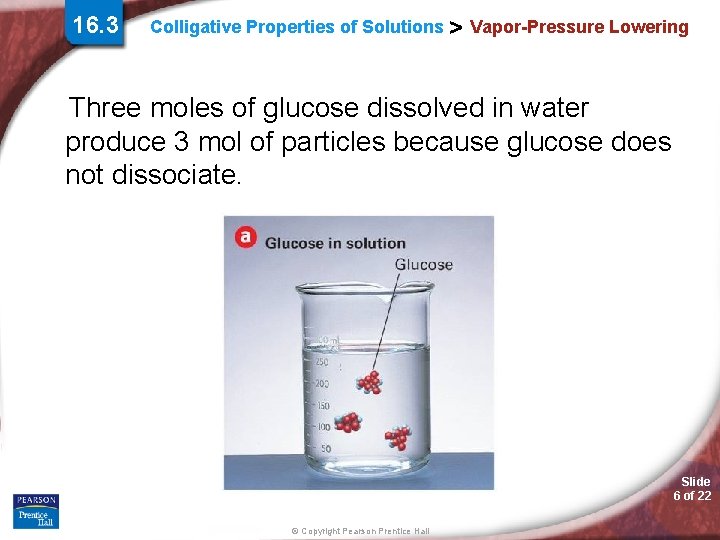
16. 3 Colligative Properties of Solutions > Vapor-Pressure Lowering Three moles of glucose dissolved in water produce 3 mol of particles because glucose does not dissociate. Slide 6 of 22 © Copyright Pearson Prentice Hall
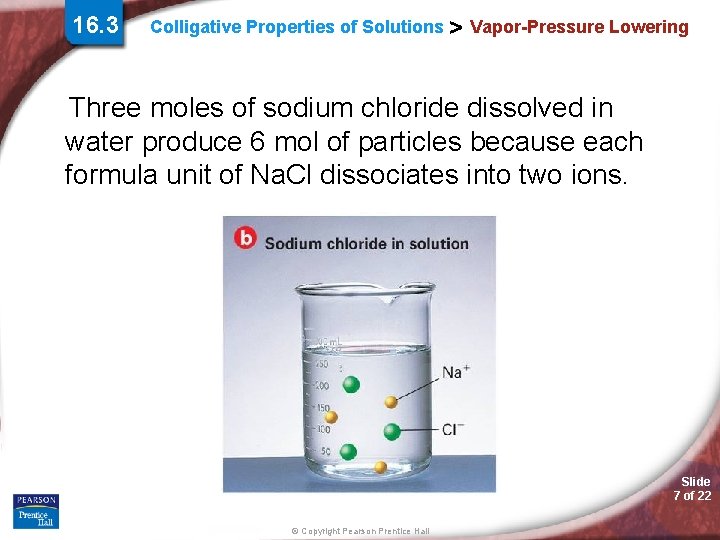
16. 3 Colligative Properties of Solutions > Vapor-Pressure Lowering Three moles of sodium chloride dissolved in water produce 6 mol of particles because each formula unit of Na. Cl dissociates into two ions. Slide 7 of 22 © Copyright Pearson Prentice Hall
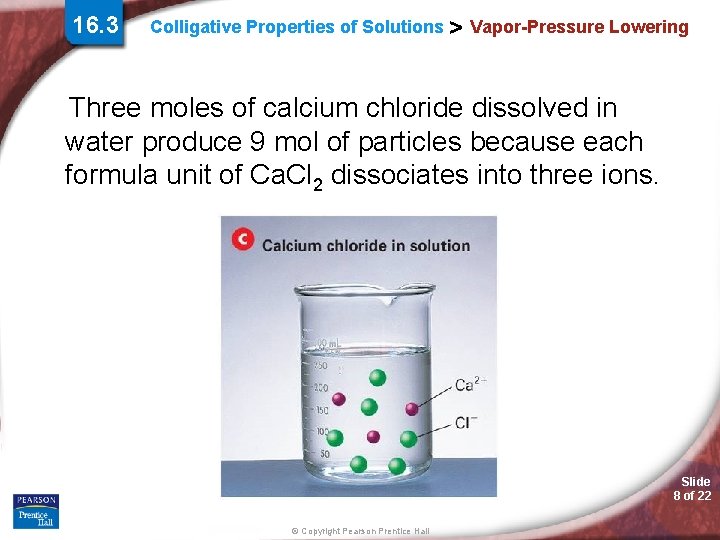
16. 3 Colligative Properties of Solutions > Vapor-Pressure Lowering Three moles of calcium chloride dissolved in water produce 9 mol of particles because each formula unit of Ca. Cl 2 dissociates into three ions. Slide 8 of 22 © Copyright Pearson Prentice Hall
16. 3 Colligative Properties of Solutions > Freezing-Point Depression The difference in temperature between the freezing point of a solution and the freezing point of the pure solvent is the freezing-point depression. Slide 9 of 22 © Copyright Pearson Prentice Hall
16. 3 Colligative Properties of Solutions > Freezing-Point Depression The magnitude of the freezing-point depression is proportional to the number of solute particles dissolved in the solvent and does not depend upon their identity. Slide 10 of 22 © Copyright Pearson Prentice Hall
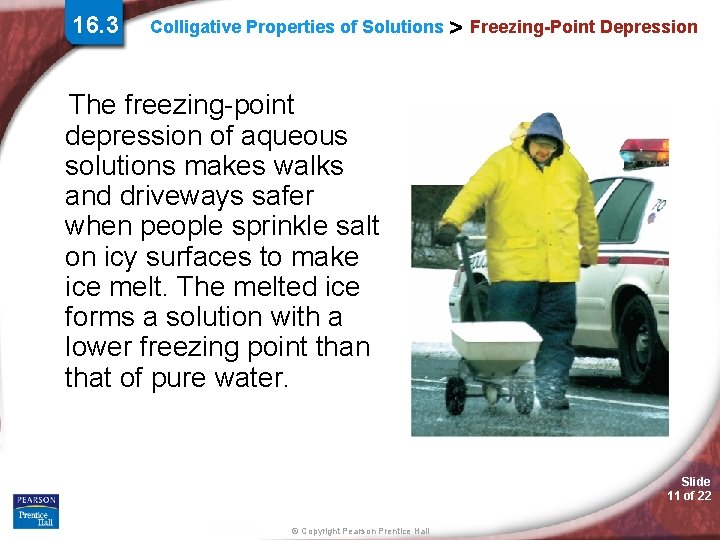
16. 3 Colligative Properties of Solutions > Freezing-Point Depression The freezing-point depression of aqueous solutions makes walks and driveways safer when people sprinkle salt on icy surfaces to make ice melt. The melted ice forms a solution with a lower freezing point than that of pure water. Slide 11 of 22 © Copyright Pearson Prentice Hall
16. 3 Colligative Properties of Solutions > Boiling-Point Elevation The difference in temperature between the boiling point of a solution and the boiling point of the pure solvent is the boiling-point elevation. The same antifreeze added to automobile engines to prevent freeze-ups in winter, protects the engine from boiling over in summer. Slide 12 of 22 © Copyright Pearson Prentice Hall
16. 3 Colligative Properties of Solutions > Boiling-Point Elevation The magnitude of the boiling-point elevation is proportional to the number of solute particles dissolved in the solvent. The boiling point of water increases by 0. 512°C for every mole of particles that the solute forms when dissolved in 1000 g of water. Slide 13 of 22 © Copyright Pearson Prentice Hall