
16 2 Probability of Events Occurring Together Definitions

16. 2 Probability of Events Occurring Together
Definitions • Conditional Probability Conditional probability is the probability of an event given that you know another event has occurred.
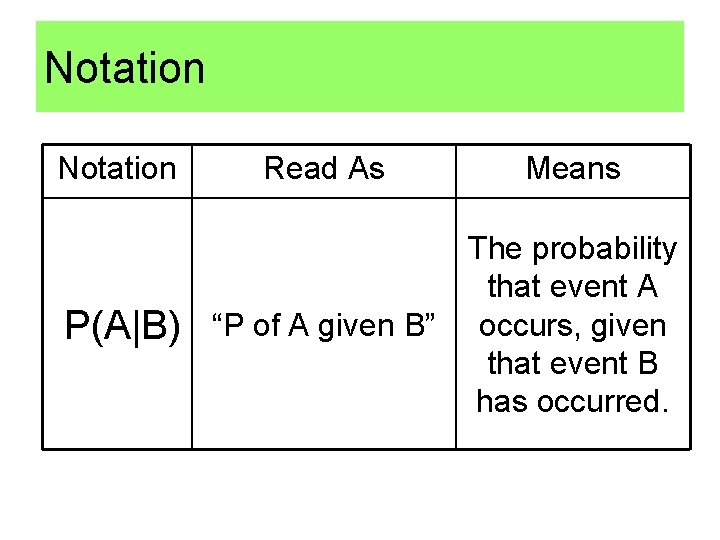
Notation P(A|B) Read As Means “P of A given B” The probability that event A occurs, given that event B has occurred.
Guided Practice Let’s find the following probabilities given I randomly choose a person in the classroom. P(A girl) P(A girl | A person wearing pink) P(A girl | plays softball) P(A girl | plays lacrosse) P(Plays lacrosse | A girl)
Guided Practice There is a jar of 3 blue marbles and 5 yellow marbles without replacement. Find: P(BY) (means blue, then yellow) P(YB) (means yellow, then blue) P(YY) P(BB) P(2 nd is B|1 st is Y) P(2 nd is Y|1 st is B)

Conditional Probability • The probability of event A occurring, given that event B has occurred is: P(A|B) = P(A and B) P(B) “Given” goes in the denominator! Note: P(B) must not equal 0.
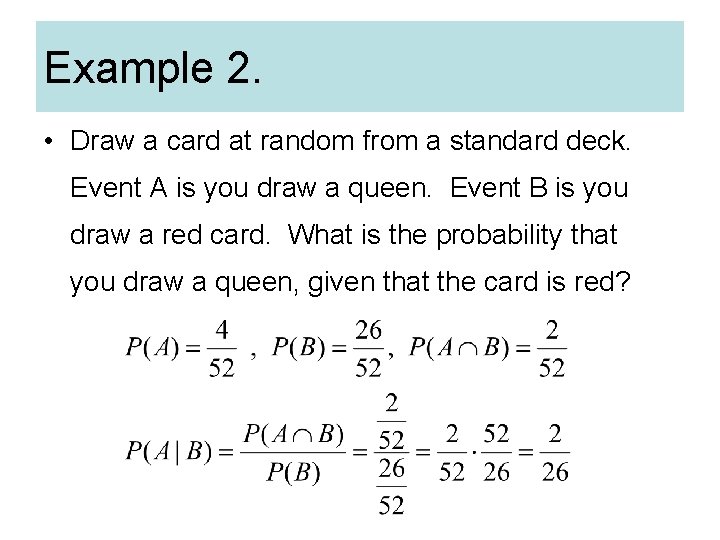
Example 2. • Draw a card at random from a standard deck. Event A is you draw a queen. Event B is you draw a red card. What is the probability that you draw a queen, given that the card is red?
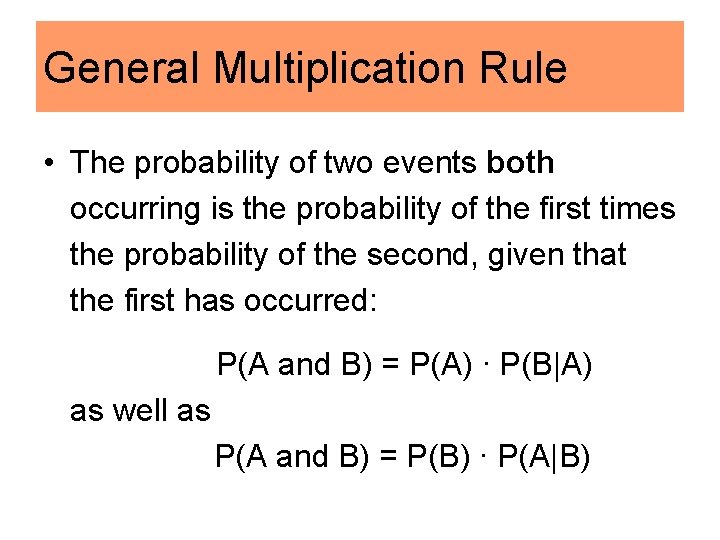
General Multiplication Rule • The probability of two events both occurring is the probability of the first times the probability of the second, given that the first has occurred: P(A and B) = P(A) ∙ P(B|A) as well as P(A and B) = P(B) ∙ P(A|B)
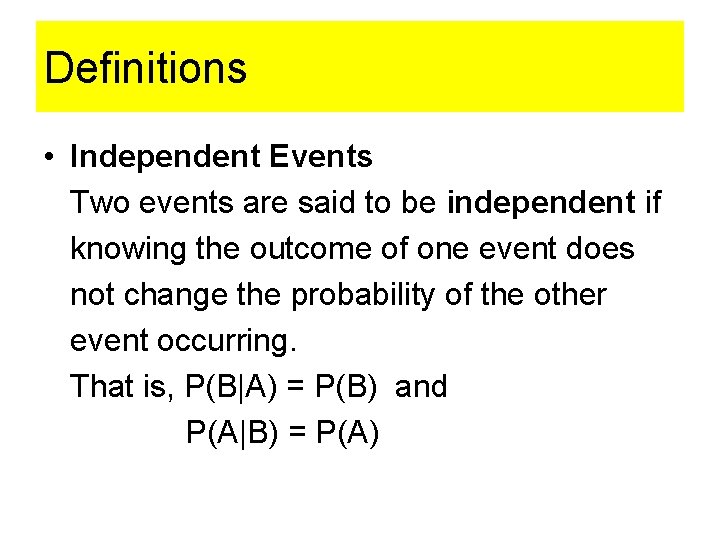
Definitions • Independent Events Two events are said to be independent if knowing the outcome of one event does not change the probability of the other event occurring. That is, P(B|A) = P(B) and P(A|B) = P(A)
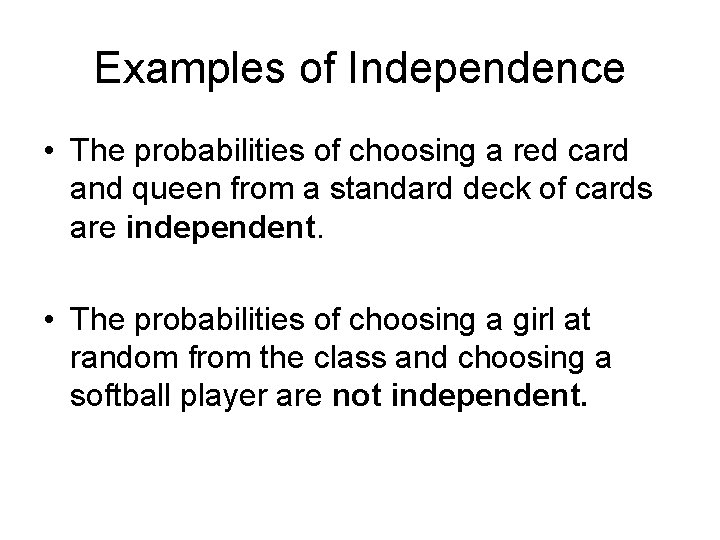
Examples of Independence • The probabilities of choosing a red card and queen from a standard deck of cards are independent. • The probabilities of choosing a girl at random from the class and choosing a softball player are not independent.
Multiplication Rule for Independent Events • The probability of two independent events both occurring is the product of their individual probabilities: P(A and B) = P(A) ∙ P(B) • Note: If this multiplication rule holds, then two events are independent. • Ex. Find the P(Heads and Rolling a 3)
Guided Practice You draw one card from a standard deck. Event A is the card is a heart. Event B is the card is face card. 1. Are these events independent? How can you know? 2. State an Event in this sample space that would NOT be independent from Event A.
- Slides: 12