
152022 Outline Perception Audition Auditory sensory memory Pattern


- Slides: 42
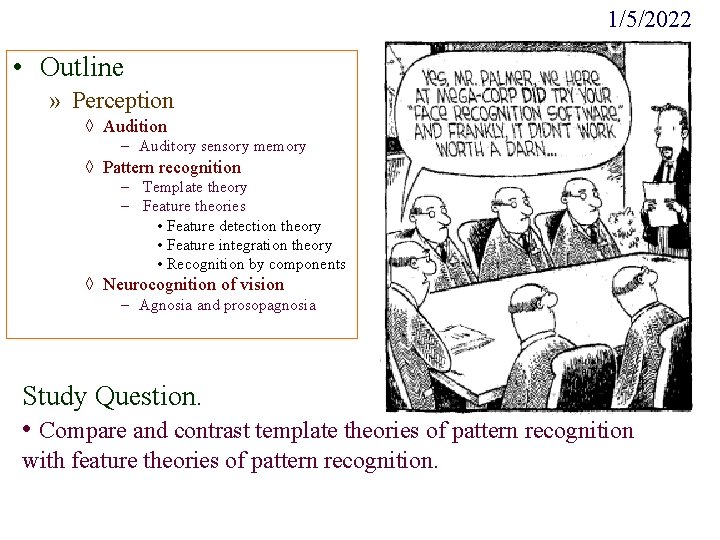
1/5/2022 • Outline » Perception ◊ Audition – Auditory sensory memory ◊ Pattern recognition – Template theory – Feature theories • Feature detection theory • Feature integration theory • Recognition by components ◊ Neurocognition of vision – Agnosia and prosopagnosia Study Question. • Compare and contrast template theories of pattern recognition with feature theories of pattern recognition.
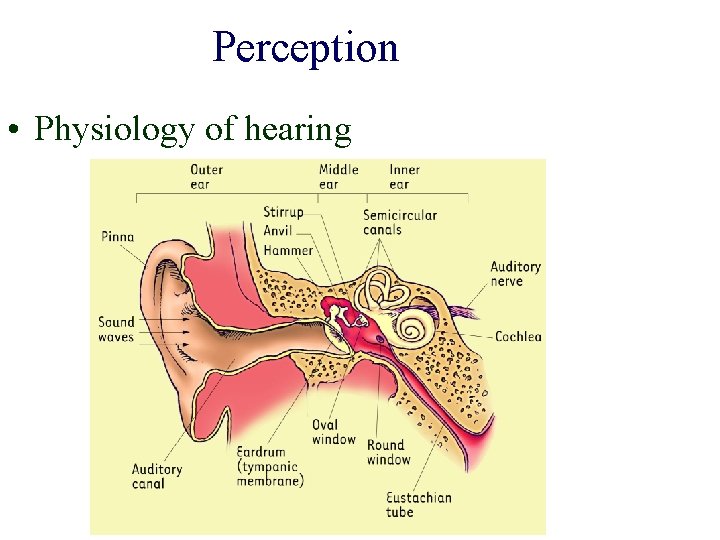
Perception • Physiology of hearing
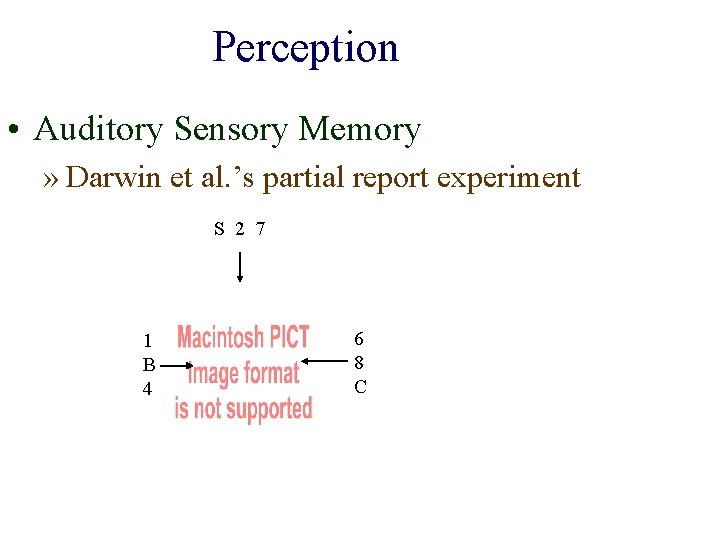
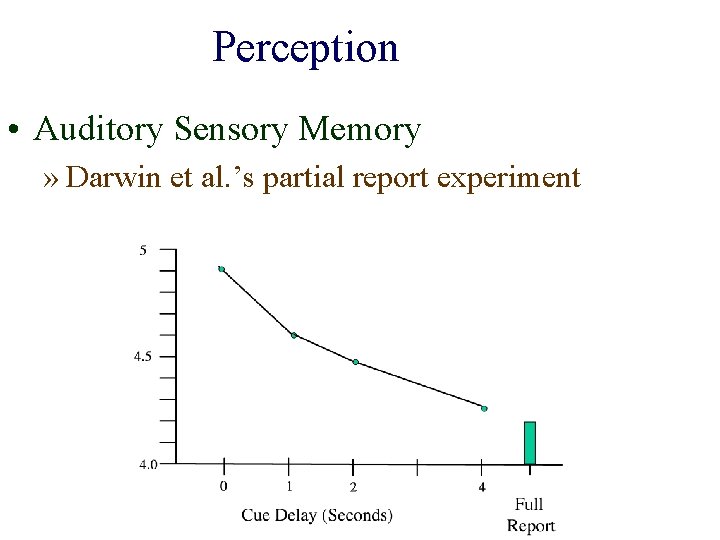
Perception • Auditory Sensory Memory » Darwin et al. ’s partial report experiment S 2 7 1 B 4 6 8 C
Perception • Auditory Sensory Memory » Darwin et al. ’s partial report experiment
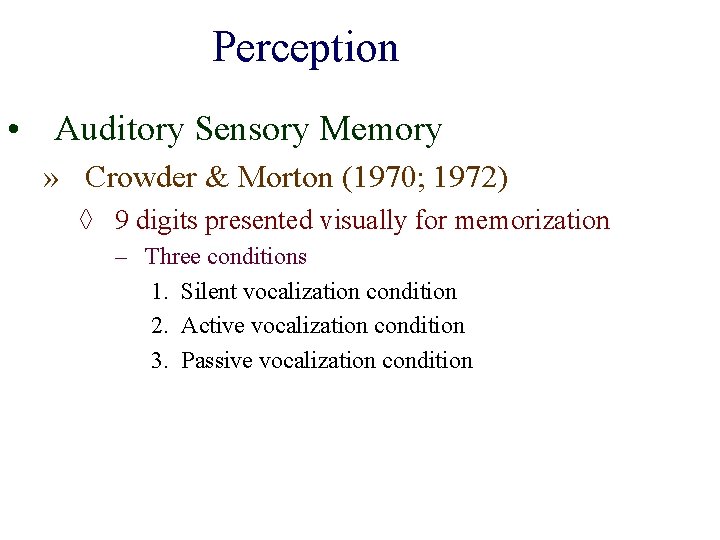
Perception • Auditory Sensory Memory » Crowder & Morton (1970; 1972) ◊ 9 digits presented visually for memorization – Three conditions 1. Silent vocalization condition 2. Active vocalization condition 3. Passive vocalization condition
Perception • Auditory Sensory Memory » Crowder & Morton (1970; 1972)
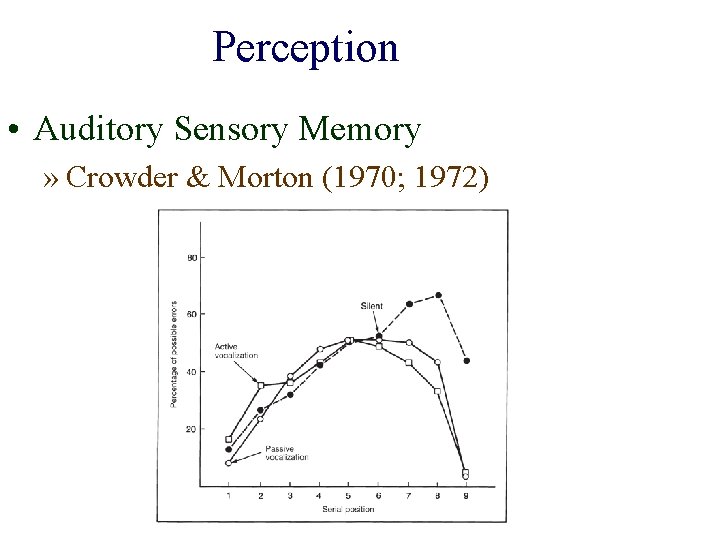
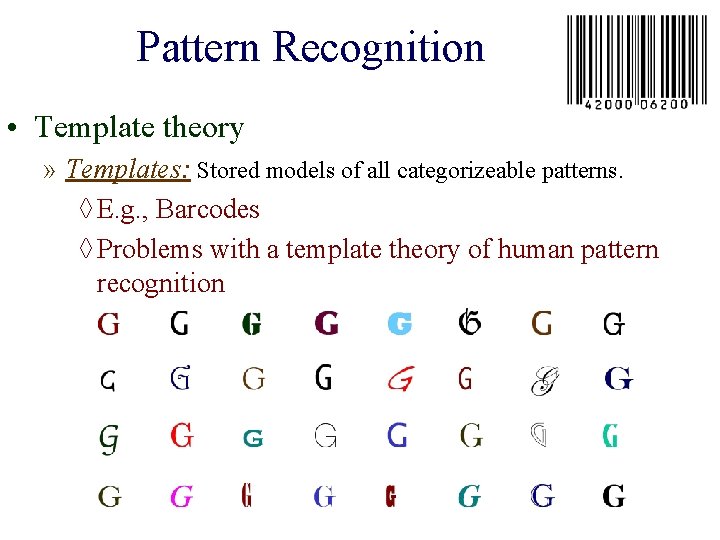
Pattern Recognition • Template theory » Templates: Stored models of all categorizeable patterns. ◊ E. g. , Barcodes ◊ Problems with a template theory of human pattern recognition
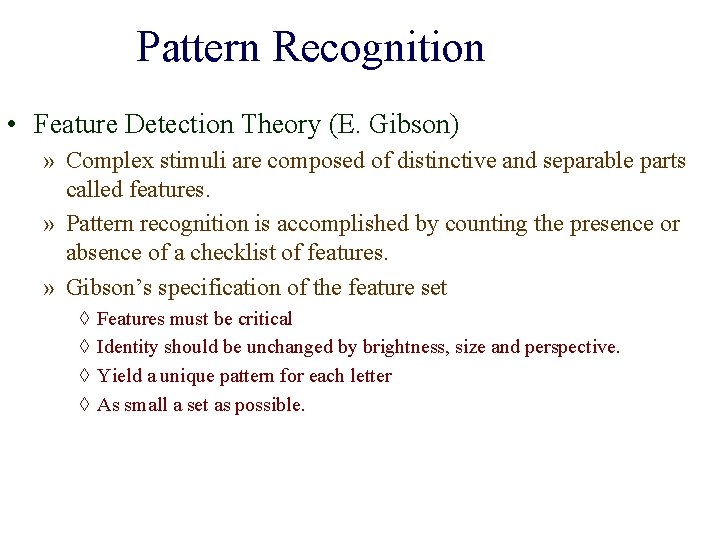
Pattern Recognition • Feature Detection Theory (E. Gibson) » Complex stimuli are composed of distinctive and separable parts called features. » Pattern recognition is accomplished by counting the presence or absence of a checklist of features. » Gibson’s specification of the feature set ◊ ◊ Features must be critical Identity should be unchanged by brightness, size and perspective. Yield a unique pattern for each letter As small a set as possible.
Object Recognition • Features Theories » Complex stimuli are composed of distinctive and separable parts called features
Pattern Recognition • Feature Detection Theory (E. Gibson)
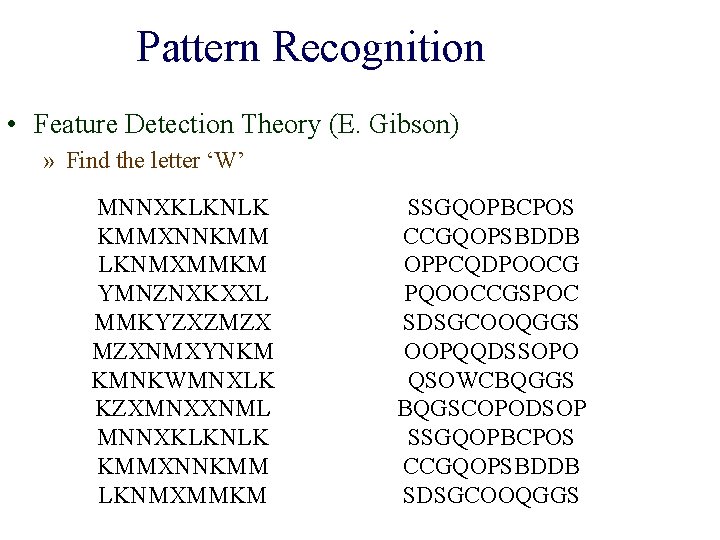
Pattern Recognition • Feature Detection Theory (E. Gibson) » Find the letter ‘W’ MNNXKLKNLK KMMXNNKMM LKNMXMMKM YMNZNXKXXL MMKYZXZMZX MZXNMXYNKM KMNKWMNXLK KZXMNXXNML MNNXKLKNLK KMMXNNKMM LKNMXMMKM SSGQOPBCPOS CCGQOPSBDDB OPPCQDPOOCG PQOOCCGSPOC SDSGCOOQGGS OOPQQDSSOPO QSOWCBQGGS BQGSCOPODSOP SSGQOPBCPOS CCGQOPSBDDB SDSGCOOQGGS
Pattern Recognition • Problems with Feature theory » How features go together are as important as the features themselves. a b d c
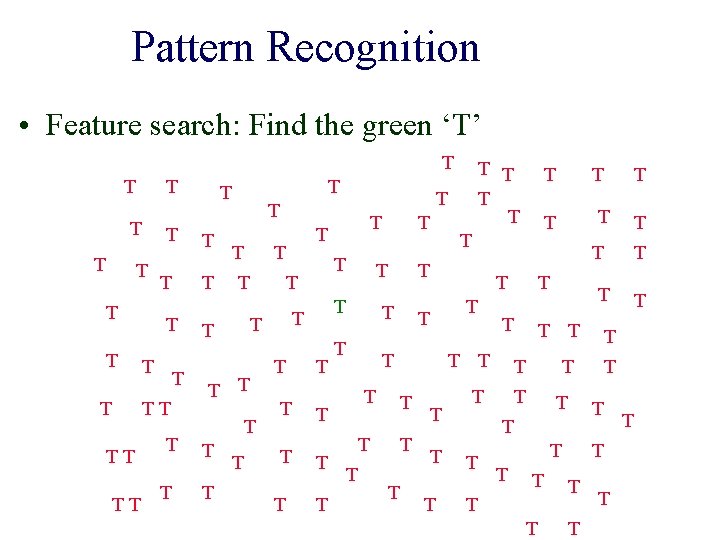
Pattern Recognition • Feature search: Find the green ‘T’ T T T T TT TT T T T T T T T T T T T T T T T T T T T T T T T T
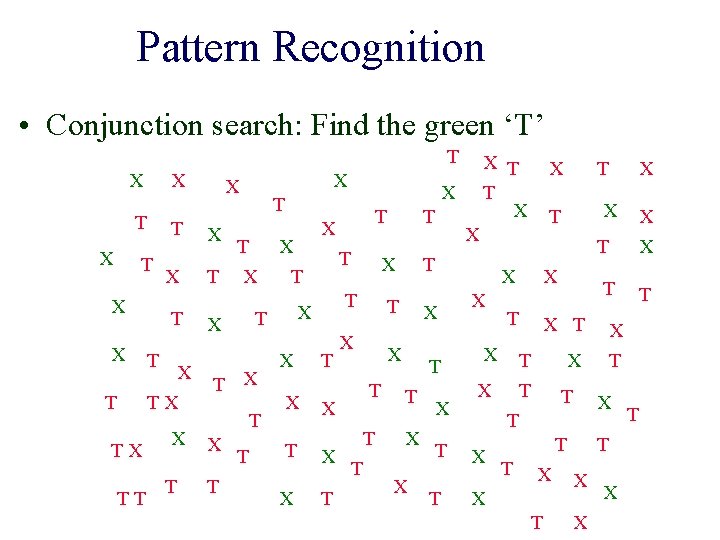
Pattern Recognition • Conjunction search: Find the green ‘T’ T X X T TX TT T X TX X T X X X T T T X X T X T X X T T X X T X T X X T T X X X T X T X X T T X T X T X T T X X X T
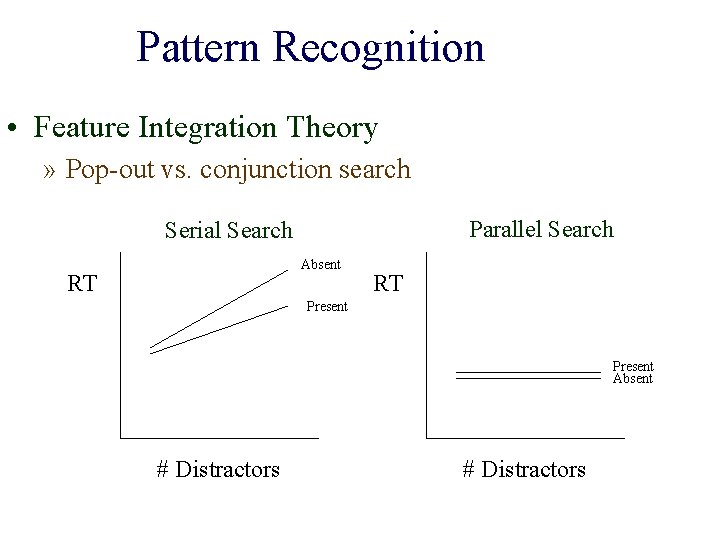
Pattern Recognition • Feature Integration Theory » Pop-out vs. conjunction search Parallel Search Serial Search Absent RT RT Present Absent # Distractors
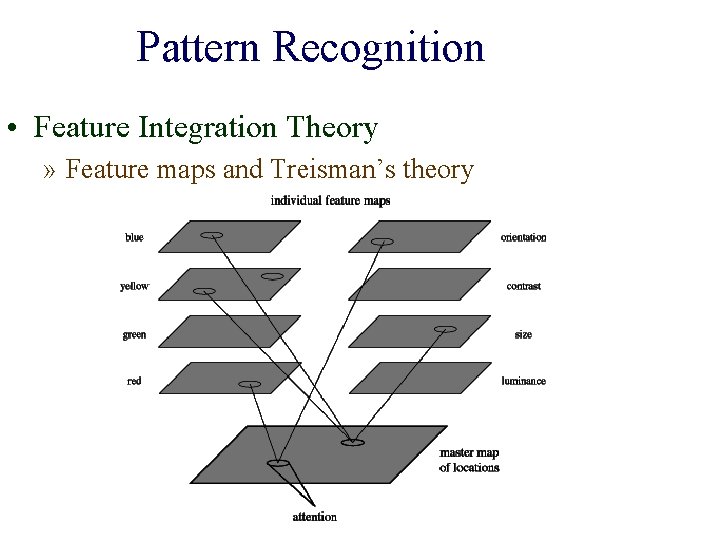
Pattern Recognition • Feature Integration Theory » Feature maps and Treisman’s theory
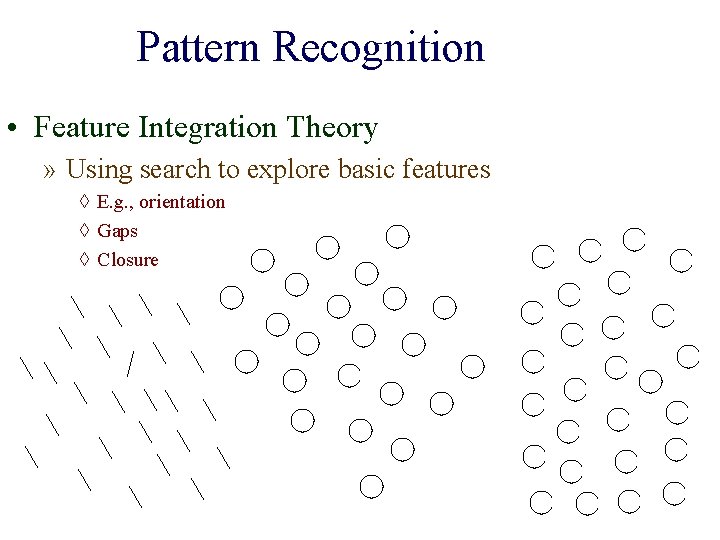
Pattern Recognition • Feature Integration Theory » Using search to explore basic features ◊ E. g. , orientation ◊ Gaps ◊ Closure
Object Recognition • Recognition by Components » Like feature theories, except that they also consider the structure of the features (i. e. , How they go together. » Biederman’s Theory of 3 -d object recognition. ◊ Geons: 3 -D ‘volume’ features
Object Recognition • Recognition by Components » Eliminating information about the relationship between volumes/features should be detrimental to pattern recognition. ◊ E. g. ,
Object Recognition • Recognition by Components » What are these objects? 50 % 70 % Recognition accuracy 100 %
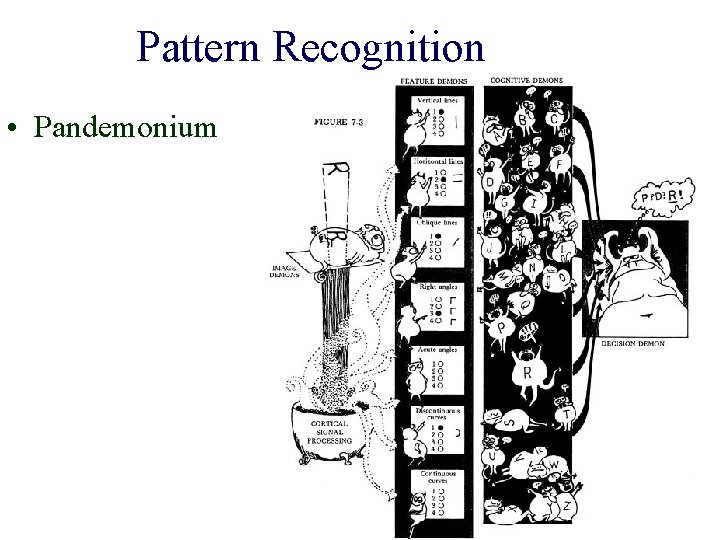
Pattern Recognition • Pandemonium
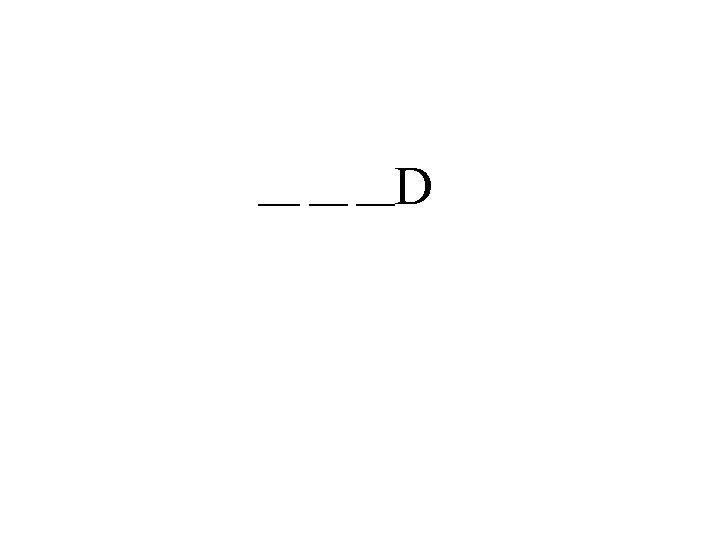
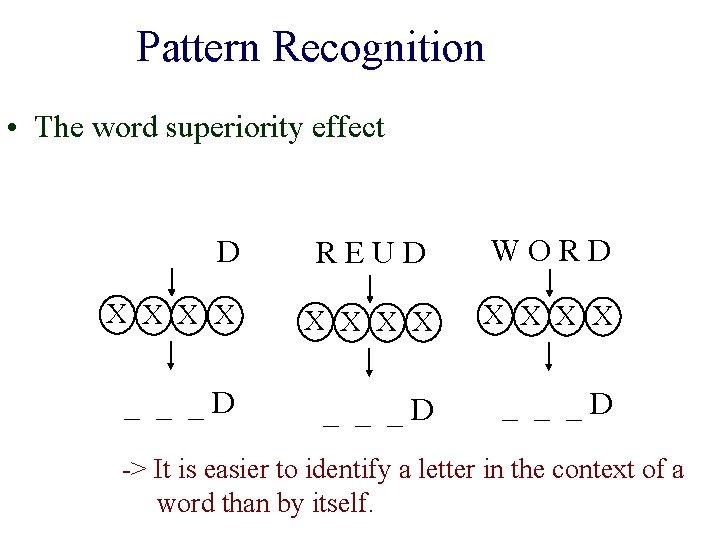
Pattern Recognition • The word superiority effect
RAID
XXXX
D
Pattern Recognition • The word superiority effect D REUD WORD X X X _ _ _D -> It is easier to identify a letter in the context of a word than by itself.
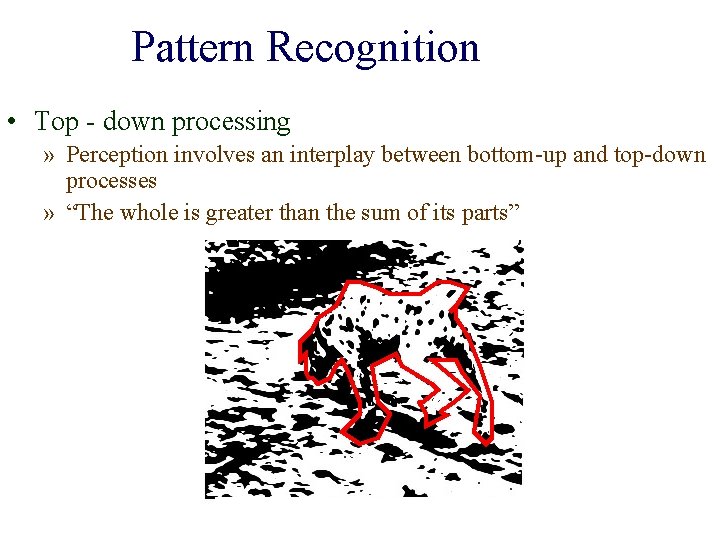
Pattern Recognition • Top - down processing » Perception involves an interplay between bottom-up and top-down processes » “The whole is greater than the sum of its parts”
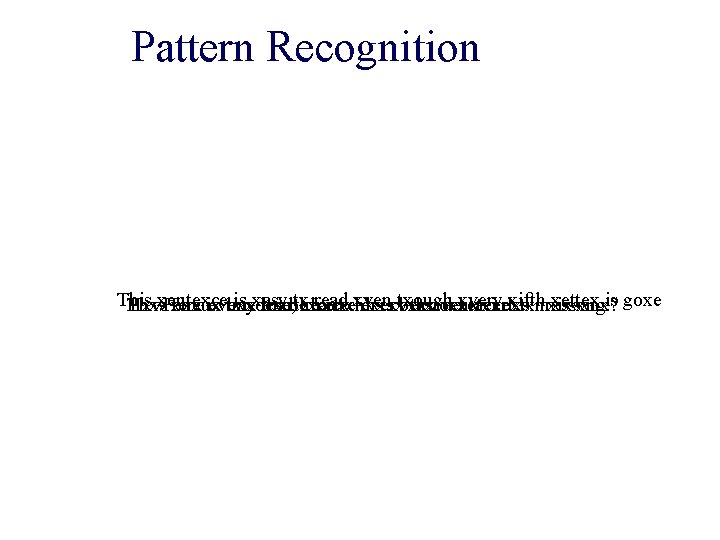
Pattern Recognition This is xasy txxhxcx read txough xvery xifth xettex is goxe Hxwxentexce Thxs Herx xbxux oxe ix evexy txix haxdex foxrth oxe, bexauxe xettxrxven hxs exerx hxsxvxrx bexn thxrd oxhxr rexlacxd. xetxer xextxr xs mxssxng. xixsxnx?
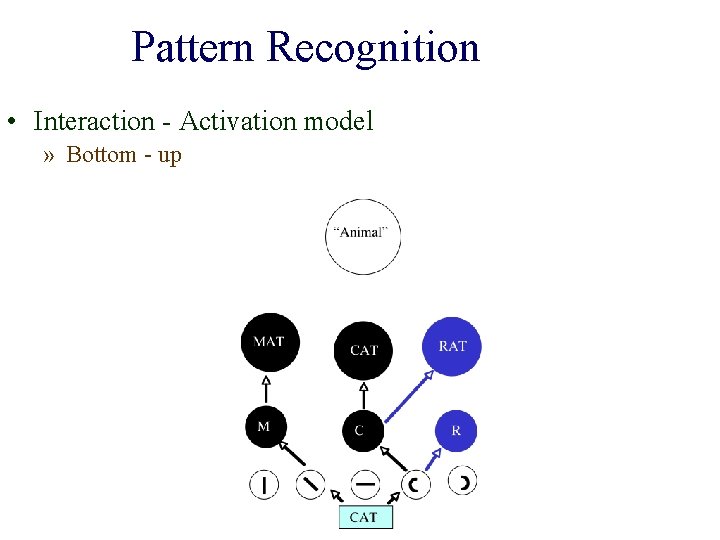
Pattern Recognition • Interaction - Activation model » Bottom - up
Pattern Recognition • Interaction - activation model » Top -down processing
Pattern Recognition • Interaction - activation model » Interaction
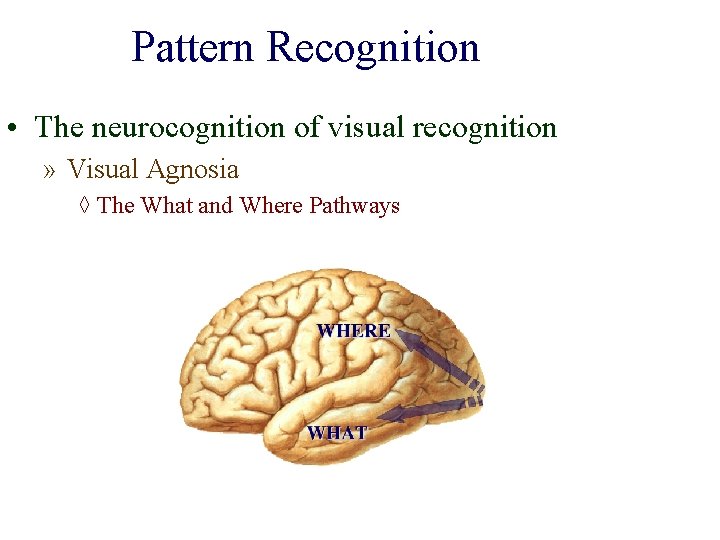
Pattern Recognition • The neurocognition of visual recognition » Visual Agnosia ◊ The What and Where Pathways
Pattern Recognition • The neurocognition of visual recognition » Visual Agnosia ◊ The What and Where Pathways Video clip: Visual agnosia
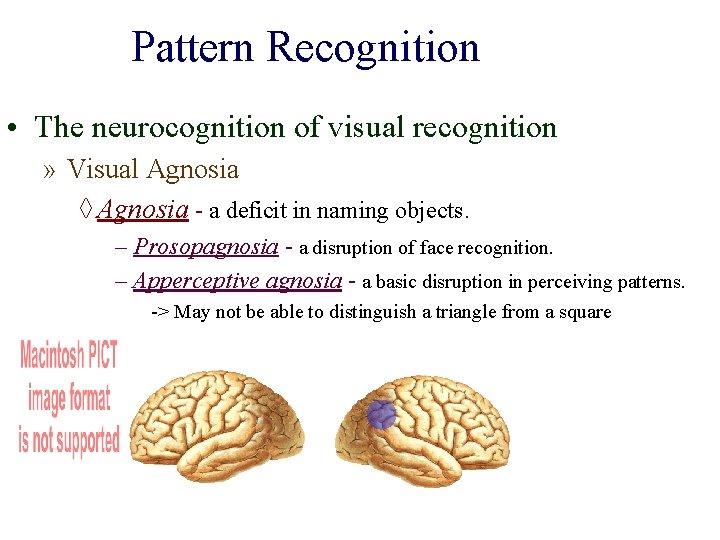
Pattern Recognition • The neurocognition of visual recognition » Visual Agnosia ◊ Agnosia - a deficit in naming objects. – Prosopagnosia - a disruption of face recognition. – Apperceptive agnosia - a basic disruption in perceiving patterns. -> May not be able to distinguish a triangle from a square
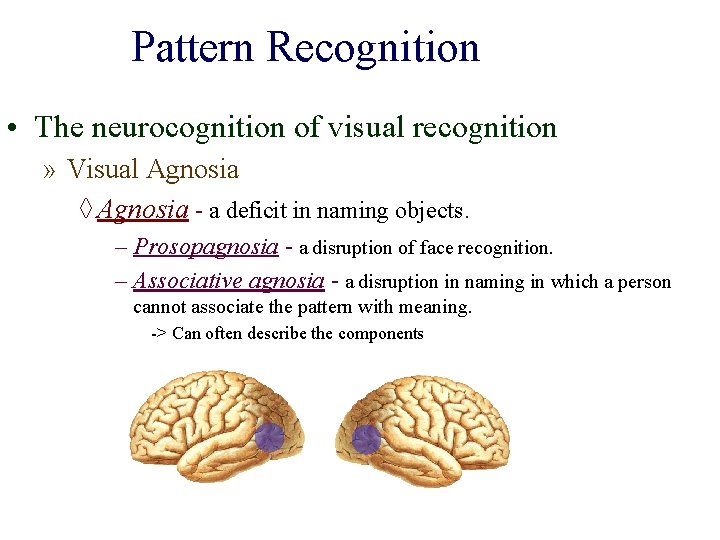
Pattern Recognition • The neurocognition of visual recognition » Visual Agnosia ◊ Agnosia - a deficit in naming objects. – Prosopagnosia - a disruption of face recognition. – Associative agnosia - a disruption in naming in which a person cannot associate the pattern with meaning. -> Can often describe the components
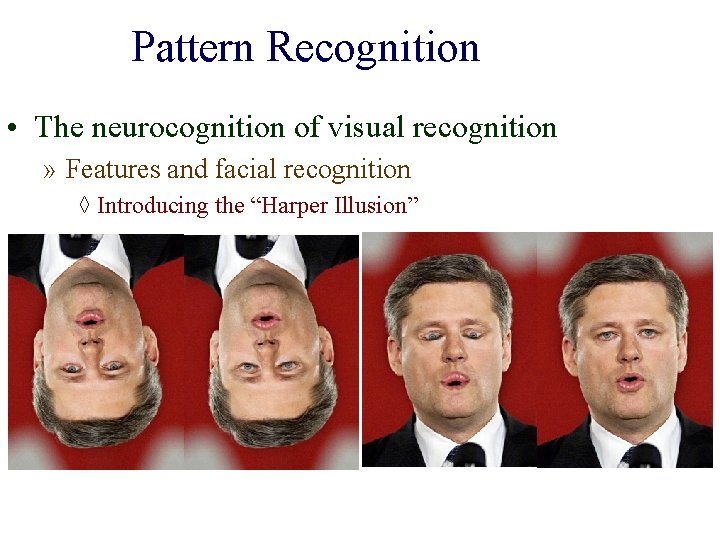
Pattern Recognition • The neurocognition of visual recognition » Features and facial recognition ◊ Introducing the “Harper Illusion”
Quiz 1 • Chaps 1 -3 • Part 1: Multiple choice (30 @ 1 pt. ea) • Part 2: Jeopardy style definitions (15 @ 1 pt. ea. ) 1) They argued that the whole of a perception is more than the sum of its parts. • Part 3: Short answer (2 or 3 @ 10 pts each)
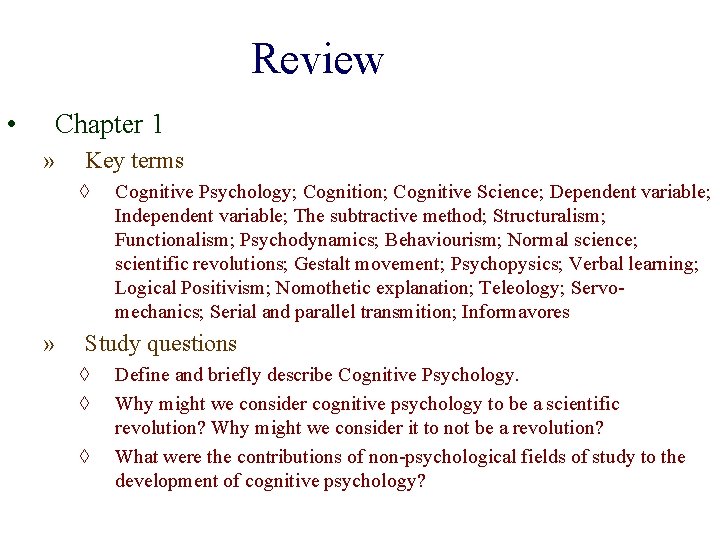
Review • Chapter 1 » Key terms ◊ » Cognitive Psychology; Cognition; Cognitive Science; Dependent variable; Independent variable; The subtractive method; Structuralism; Functionalism; Psychodynamics; Behaviourism; Normal science; scientific revolutions; Gestalt movement; Psychopysics; Verbal learning; Logical Positivism; Nomothetic explanation; Teleology; Servomechanics; Serial and parallel transmition; Informavores Study questions ◊ ◊ ◊ Define and briefly describe Cognitive Psychology. Why might we consider cognitive psychology to be a scientific revolution? Why might we consider it to not be a revolution? What were the contributions of non-psychological fields of study to the development of cognitive psychology?
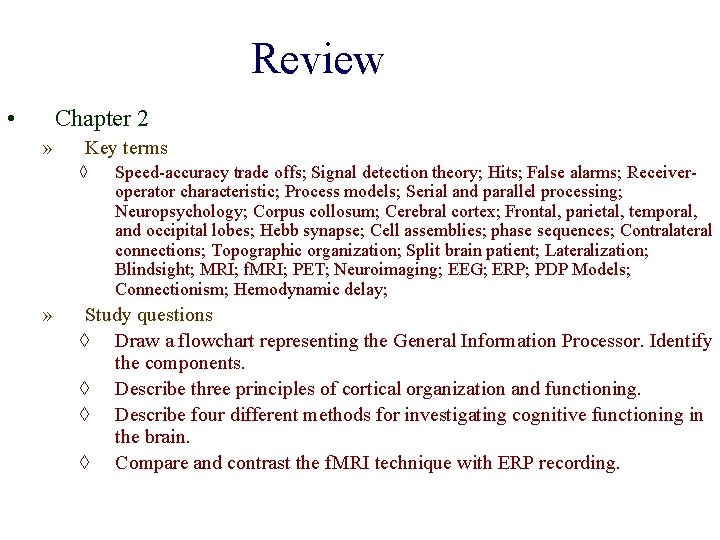
Review • Chapter 2 » Key terms ◊ » Speed-accuracy trade offs; Signal detection theory; Hits; False alarms; Receiveroperator characteristic; Process models; Serial and parallel processing; Neuropsychology; Corpus collosum; Cerebral cortex; Frontal, parietal, temporal, and occipital lobes; Hebb synapse; Cell assemblies; phase sequences; Contralateral connections; Topographic organization; Split brain patient; Lateralization; Blindsight; MRI; f. MRI; PET; Neuroimaging; EEG; ERP; PDP Models; Connectionism; Hemodynamic delay; Study questions ◊ Draw a flowchart representing the General Information Processor. Identify the components. ◊ Describe three principles of cortical organization and functioning. ◊ Describe four different methods for investigating cognitive functioning in the brain. ◊ Compare and contrast the f. MRI technique with ERP recording.
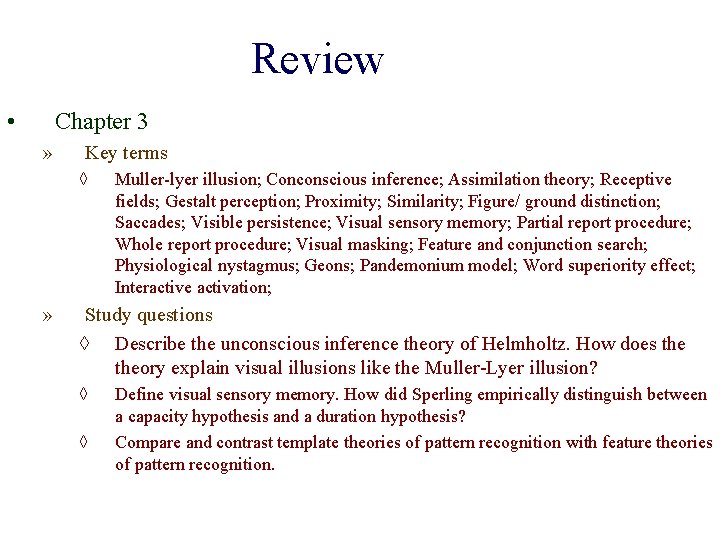
Review • Chapter 3 » Key terms ◊ » Muller-lyer illusion; Conconscious inference; Assimilation theory; Receptive fields; Gestalt perception; Proximity; Similarity; Figure/ ground distinction; Saccades; Visible persistence; Visual sensory memory; Partial report procedure; Whole report procedure; Visual masking; Feature and conjunction search; Physiological nystagmus; Geons; Pandemonium model; Word superiority effect; Interactive activation; Study questions ◊ Describe the unconscious inference theory of Helmholtz. How does theory explain visual illusions like the Muller-Lyer illusion? ◊ ◊ Define visual sensory memory. How did Sperling empirically distinguish between a capacity hypothesis and a duration hypothesis? Compare and contrast template theories of pattern recognition with feature theories of pattern recognition.