
150 Direct Subsidized Loan Limit Webinar 1 Academic
150% Direct Subsidized Loan Limit Webinar #1 Academic Year and Loan Period Reporting June 4, 2013 and June 6, 2013
Overview 2
Law and Regulations § Public Law 112 -141, Moving Ahead for Progress in the 21 th Century Act (MAP 21), enacted July 6, 2012. § Amended the HEA to set a new limit on Direct Subsidized Loan eligibility. § Waive requirement for negotiated rulemaking and master calendar. § ED published Interim Final Rule on May 16, 2013. § Regulations effective immediately upon publication § Revises 34 CFR 685. 200, 685. 202, and 685. 304. § Comment period ends on July 1, 2013. § See May 16 Electronic Announcement on IFAP.
Changes Limits Direct Subsidized Loan eligibility for first-time borrowers as of July 1, 2013. § No effect on unsubsidized or PLUS eligibility. § First-time borrower is a borrower who has no outstanding balance of principal or interest on a Direct Loan or FFEL loan on July 1, 2013, or on the date the borrower obtains a Direct Loan after July 1, 2013. § Borrower who had loan balance and paid off in full prior to receiving loans on/after July 1, 2013, becomes “first-time borrower”. § 4
Consequences § First-time borrower is no longer eligible for Direct Subsidized Loans once the borrower has received Direct Subsidized Loans for a period of 150% of the length of the borrower’s educational program. § Unless the borrower completed the program, continuing enrollment or enrollment in another undergraduate program of equal or lesser length results in the borrower losing interest subsidy benefits on outstanding subsidized loans, effective from the date of the continuing or new enrollment. 5
Components Maximum Eligibility Period – 150% of the published length of the educational program in which borrower is currently enrolled. § Subsidized Usage Period – Period of time for which a borrower received Direct Subsidized Loans. § Remaining Eligibility Period – Difference between the Maximum Eligibility Period and the Subsidized Usage Periods. § 6
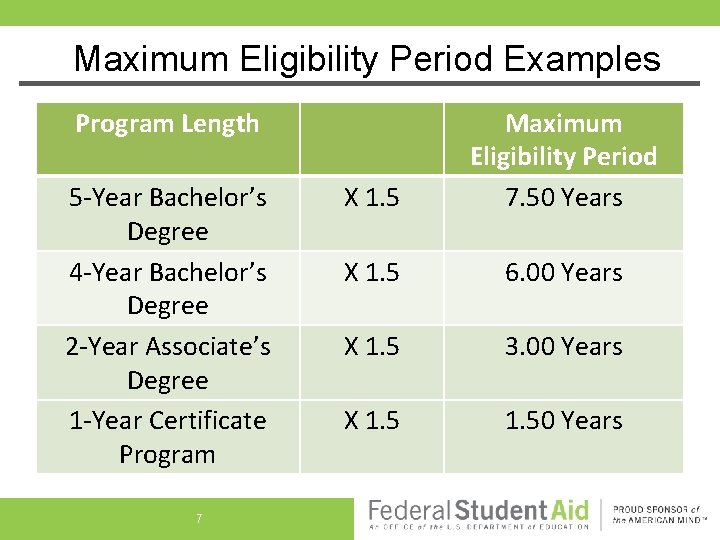
Maximum Eligibility Period Examples Program Length 5 -Year Bachelor’s Degree 4 -Year Bachelor’s Degree 2 -Year Associate’s Degree 1 -Year Certificate Program 7 X 1. 5 Maximum Eligibility Period 7. 50 Years X 1. 5 6. 00 Years X 1. 5 3. 00 Years X 1. 50 Years
Transfers § Examples – § First time borrower received two years of subsidized loans while enrolled in a two-year program then, transfers to a four-year program. § Borrower has a Remaining Eligibility Period of four years. § First time borrower received three years of subsidized loans while enrolled in a four-year program, then transfers to a two-year program. § Borrower has a Remaining Eligibility Period of zero years. 8
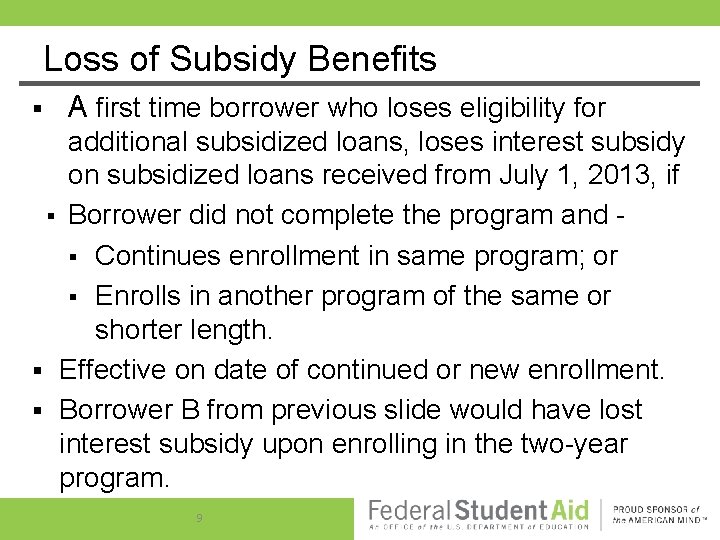
Loss of Subsidy Benefits § A first time borrower who loses eligibility for additional subsidized loans, loses interest subsidy on subsidized loans received from July 1, 2013, if § Borrower did not complete the program and § Continues enrollment in same program; or § Enrolls in another program of the same or shorter length. § Effective on date of continued or new enrollment. § Borrower B from previous slide would have lost interest subsidy upon enrolling in the two-year program. 9
Responsibilities 10
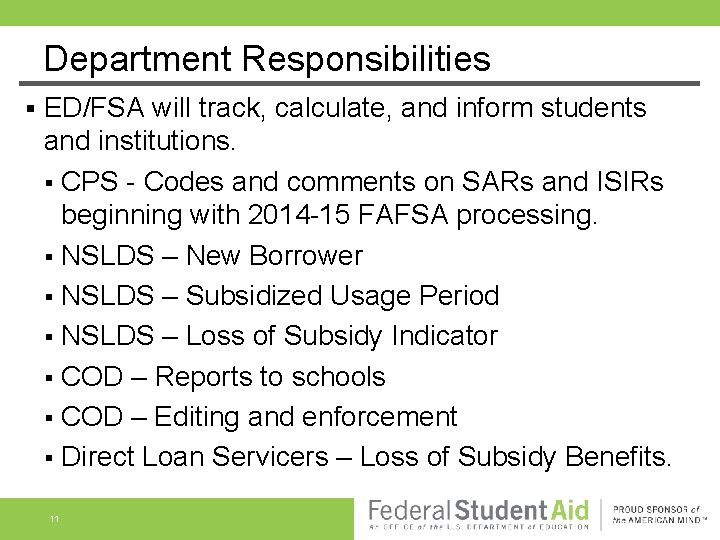
Department Responsibilities § ED/FSA will track, calculate, and inform students and institutions. § CPS - Codes and comments on SARs and ISIRs beginning with 2014 -15 FAFSA processing. § NSLDS – New Borrower § NSLDS – Subsidized Usage Period § NSLDS – Loss of Subsidy Indicator § COD – Reports to schools § COD – Editing and enforcement § Direct Loan Servicers – Loss of Subsidy Benefits. 11
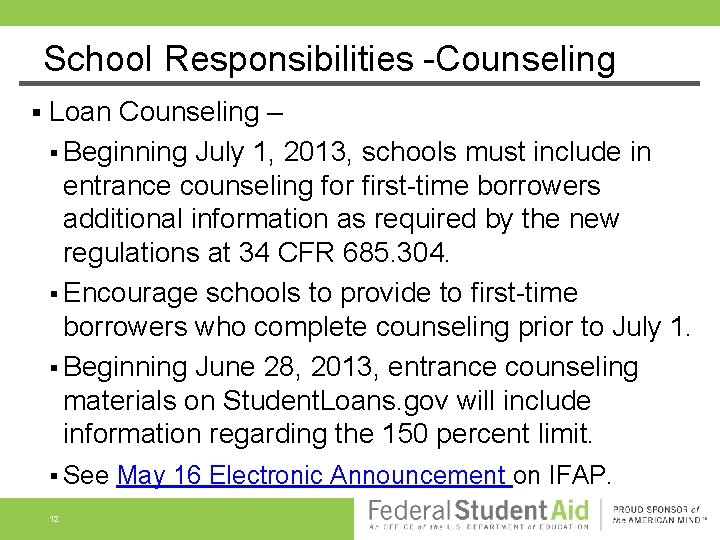
School Responsibilities -Counseling § Loan Counseling – § Beginning July 1, 2013, schools must include in entrance counseling for first-time borrowers additional information as required by the new regulations at 34 CFR 685. 304. § Encourage schools to provide to first-time borrowers who complete counseling prior to July 1. § Beginning June 28, 2013, entrance counseling materials on Student. Loans. gov will include information regarding the 150 percent limit. § See 12 May 16 Electronic Announcement on IFAP.
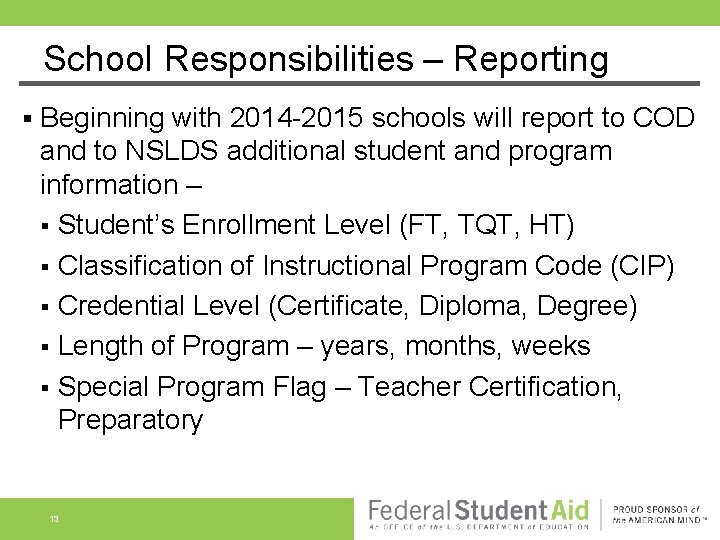
School Responsibilities – Reporting § Beginning with 2014 -2015 schools will report to COD and to NSLDS additional student and program information – § Student’s Enrollment Level (FT, TQT, HT) § Classification of Instructional Program Code (CIP) § Credential Level (Certificate, Diploma, Degree) § Length of Program – years, months, weeks § Special Program Flag – Teacher Certification, Preparatory 13
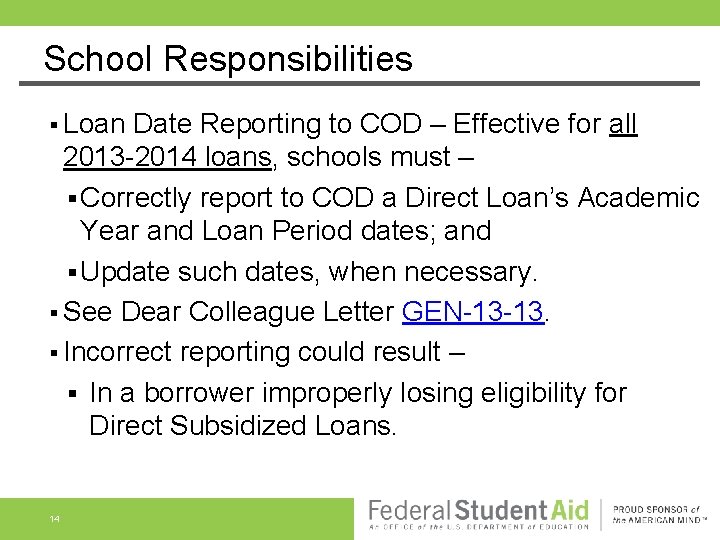
School Responsibilities § Loan Date Reporting to COD – Effective for all 2013 -2014 loans, schools must – § Correctly report to COD a Direct Loan’s Academic Year and Loan Period dates; and § Update such dates, when necessary. § See Dear Colleague Letter GEN-13 -13. § Incorrect reporting could result – § In a borrower improperly losing eligibility for Direct Subsidized Loans. 14
Calculations 15
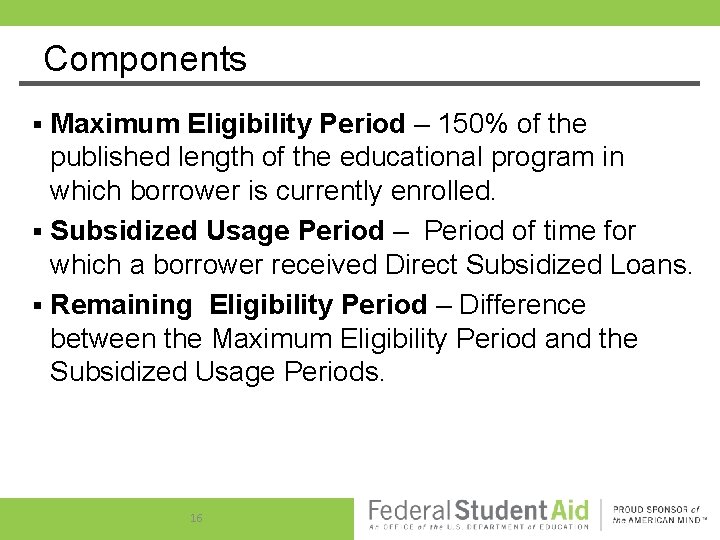
Components Maximum Eligibility Period – 150% of the published length of the educational program in which borrower is currently enrolled. § Subsidized Usage Period – Period of time for which a borrower received Direct Subsidized Loans. § Remaining Eligibility Period – Difference between the Maximum Eligibility Period and the Subsidized Usage Periods. § 16
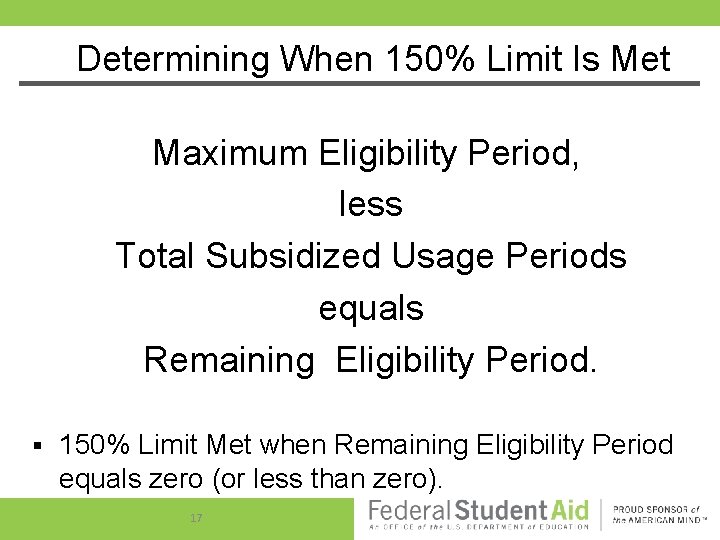
Determining When 150% Limit Is Met Maximum Eligibility Period, less Total Subsidized Usage Periods equals Remaining Eligibility Period. § 150% Limit Met when Remaining Eligibility Period equals zero (or less than zero). 17
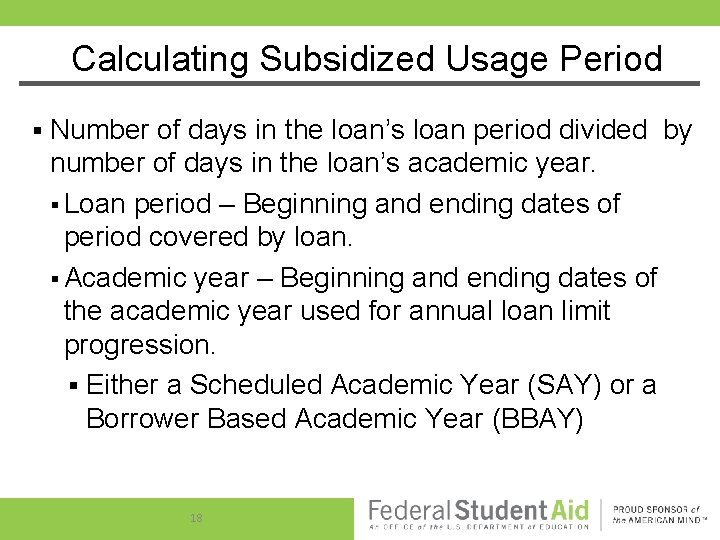
Calculating Subsidized Usage Period § Number of days in the loan’s loan period divided by number of days in the loan’s academic year. § Loan period – Beginning and ending dates of period covered by loan. § Academic year – Beginning and ending dates of the academic year used for annual loan limit progression. § Either a Scheduled Academic Year (SAY) or a Borrower Based Academic Year (BBAY) 18
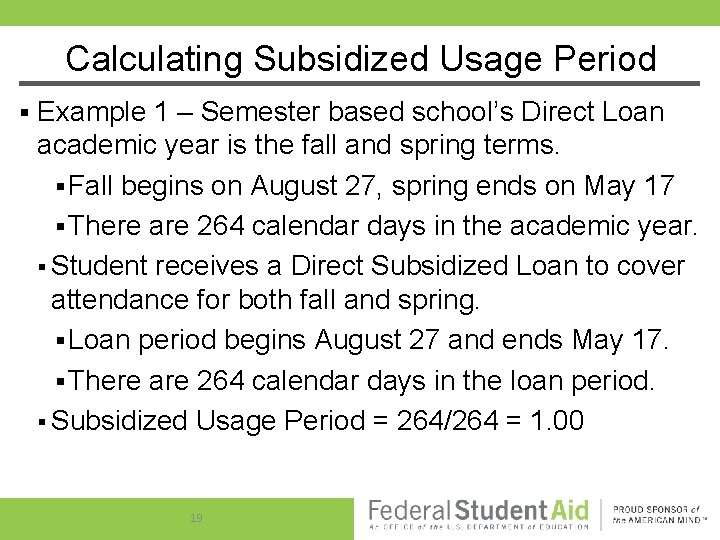
Calculating Subsidized Usage Period § Example 1 – Semester based school’s Direct Loan academic year is the fall and spring terms. § Fall begins on August 27, spring ends on May 17 § There are 264 calendar days in the academic year. § Student receives a Direct Subsidized Loan to cover attendance for both fall and spring. § Loan period begins August 27 and ends May 17. § There are 264 calendar days in the loan period. § Subsidized Usage Period = 264/264 = 1. 00 19
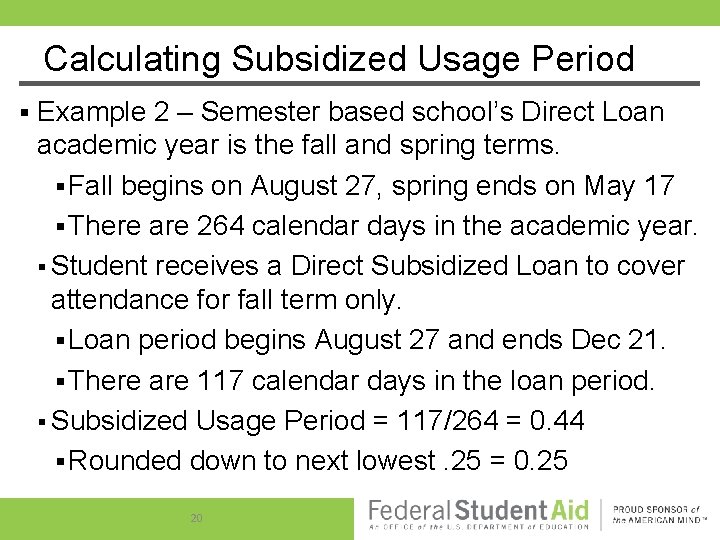
Calculating Subsidized Usage Period § Example 2 – Semester based school’s Direct Loan academic year is the fall and spring terms. § Fall begins on August 27, spring ends on May 17 § There are 264 calendar days in the academic year. § Student receives a Direct Subsidized Loan to cover attendance for fall term only. § Loan period begins August 27 and ends Dec 21. § There are 117 calendar days in the loan period. § Subsidized Usage Period = 117/264 = 0. 44 § Rounded down to next lowest. 25 = 0. 25 20
Reporting of Academic Year and Loan Period 21
Dear Colleague Letter GEN-13 -13 , posted to IFAP on May 10, 2013, provides guidance and examples to schools related to how they must report a Direct Loan’s academic year dates and loan period dates to COD. § Effective for all loans with a first disbursement on or after July 1, 2013, even loans already originated. 22
COD Schema 23
COD Academic Year Schema Tags A Direct Loan’s academic year tags in the COD schema are <Academic. Year. Begin. Date> and <Academic. Year. End. Date>. § Schools must populate these tags with the exact beginning and ending dates of the loan’s academic year (the period to which the annual loan limit applies). § A summer term that is treated as a header or trailer to a Scheduled Academic Year must be included in the academic year dates only if the student will actually be receiving a Direct Loan for the summer. § 24
COD Loan Period Schema Tags § A Direct Loan’s loan period tags in the COD schema are <Financial. Award. Begin. Date> and <Financial. Award. End. Date>. § These tags must be populated with the exact dates of the loan period of the loan, and may need to be updated based on the student's actual enrollment or other eligibility issues. 25
Reporting and Updating Examples (DCL-GEN-13 -13) 26
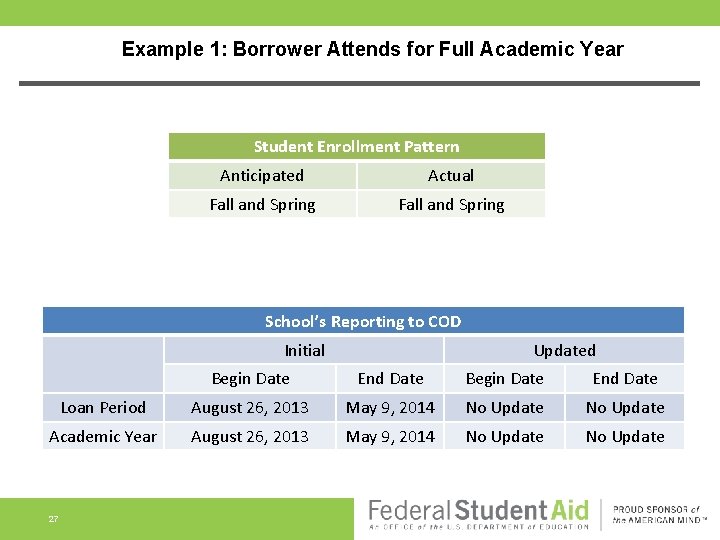
Example 1: Borrower Attends for Full Academic Year Student Enrollment Pattern Anticipated Actual Fall and Spring School’s Reporting to COD Initial Updated Begin Date End Date Loan Period August 26, 2013 May 9, 2014 No Update Academic Year August 26, 2013 May 9, 2014 No Update 27
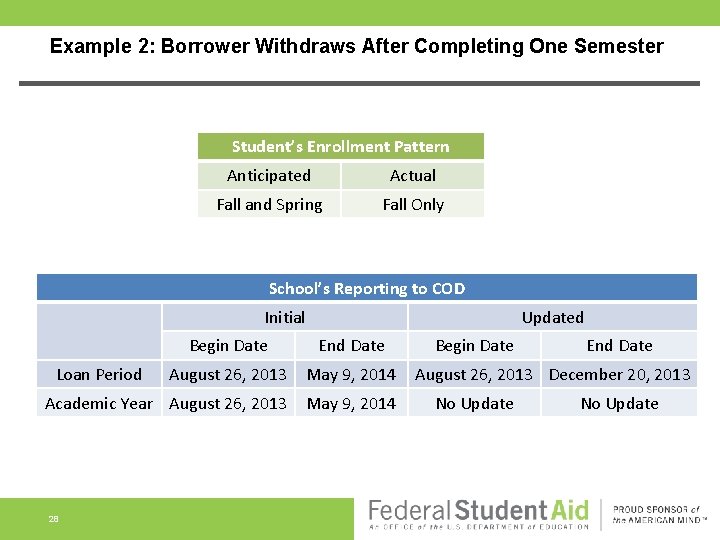
Example 2: Borrower Withdraws After Completing One Semester Student’s Enrollment Pattern Anticipated Actual Fall and Spring Fall Only School’s Reporting to COD Initial Updated Begin Date End Date August 26, 2013 May 9, 2014 Academic Year August 26, 2013 May 9, 2014 Loan Period 28 Begin Date End Date August 26, 2013 December 20, 2013 No Update
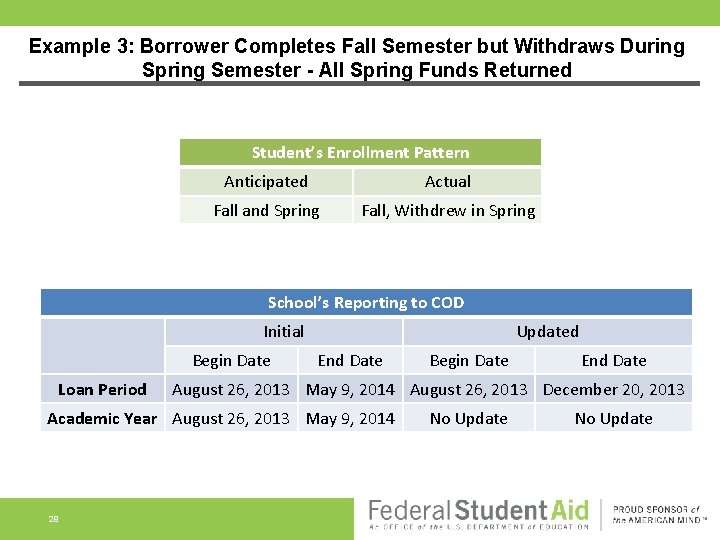
Example 3: Borrower Completes Fall Semester but Withdraws During Spring Semester - All Spring Funds Returned Student’s Enrollment Pattern Anticipated Actual Fall and Spring Fall, Withdrew in Spring School’s Reporting to COD Initial Begin Date Loan Period Updated End Date August 26, 2013 May 9, 2014 August 26, 2013 December 20, 2013 Academic Year August 26, 2013 May 9, 2014 29 Begin Date No Update
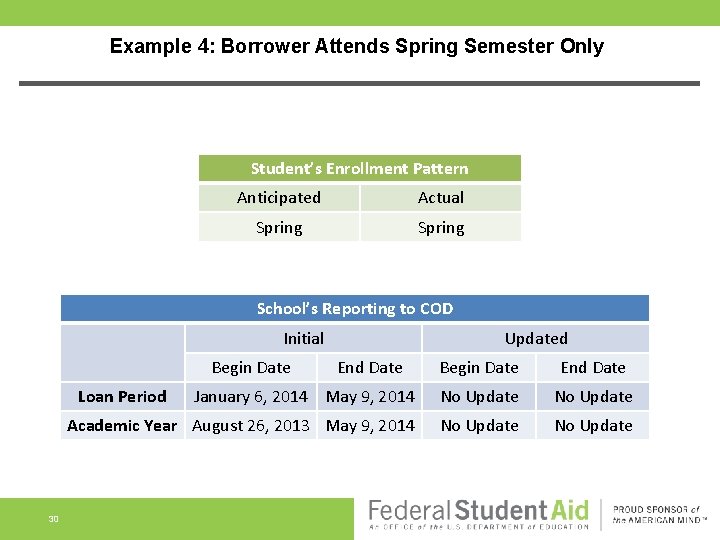
Example 4: Borrower Attends Spring Semester Only Student’s Enrollment Pattern Anticipated Actual Spring School’s Reporting to COD Initial Begin Date End Date January 6, 2014 May 9, 2014 No Update Academic Year August 26, 2013 May 9, 2014 No Update Loan Period 30 Updated End Date
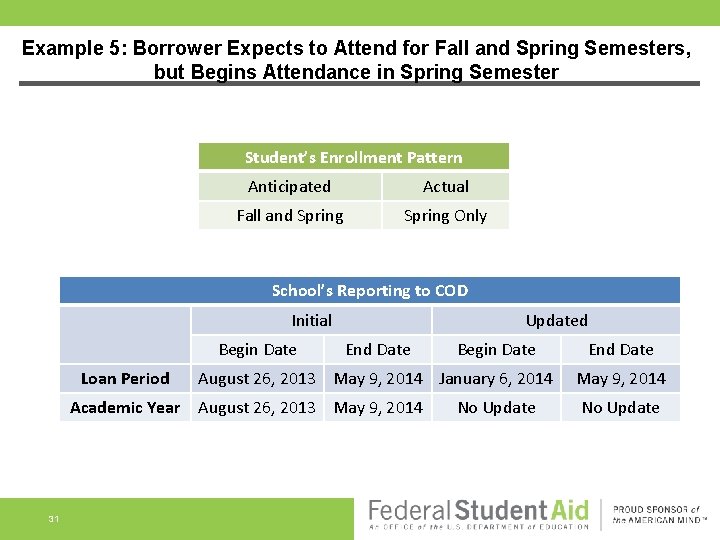
Example 5: Borrower Expects to Attend for Fall and Spring Semesters, but Begins Attendance in Spring Semester Student’s Enrollment Pattern Anticipated Actual Fall and Spring Only School’s Reporting to COD Initial Begin Date Loan Period Academic Year 31 Updated End Date Begin Date August 26, 2013 May 9, 2014 January 6, 2014 August 26, 2013 May 9, 2014 No Update End Date May 9, 2014 No Update
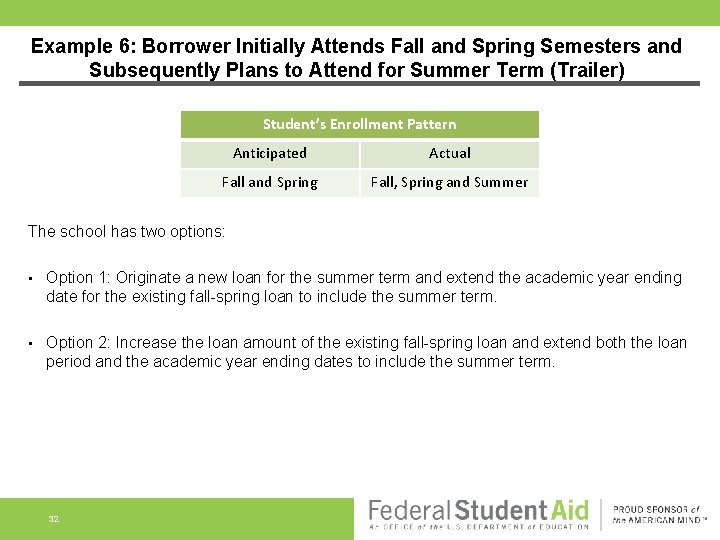
Example 6: Borrower Initially Attends Fall and Spring Semesters and Subsequently Plans to Attend for Summer Term (Trailer) Student’s Enrollment Pattern Anticipated Actual Fall and Spring Fall, Spring and Summer The school has two options: • Option 1: Originate a new loan for the summer term and extend the academic year ending date for the existing fall-spring loan to include the summer term. • Option 2: Increase the loan amount of the existing fall-spring loan and extend both the loan period and the academic year ending dates to include the summer term. 32
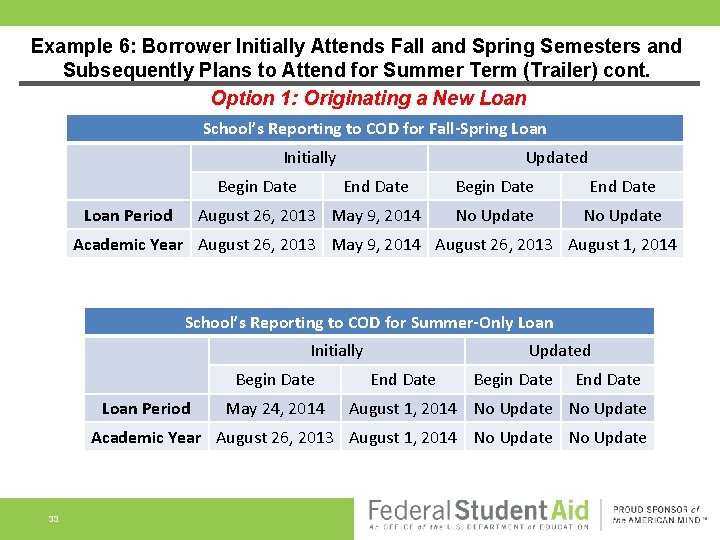
Example 6: Borrower Initially Attends Fall and Spring Semesters and Subsequently Plans to Attend for Summer Term (Trailer) cont. Option 1: Originating a New Loan School’s Reporting to COD for Fall-Spring Loan Initially Begin Date Loan Period Updated End Date August 26, 2013 May 9, 2014 Begin Date End Date No Update Academic Year August 26, 2013 May 9, 2014 August 26, 2013 August 1, 2014 School’s Reporting to COD for Summer-Only Loan Initially Begin Date Loan Period May 24, 2014 Updated End Date Begin Date End Date August 1, 2014 No Update Academic Year August 26, 2013 August 1, 2014 No Update 33
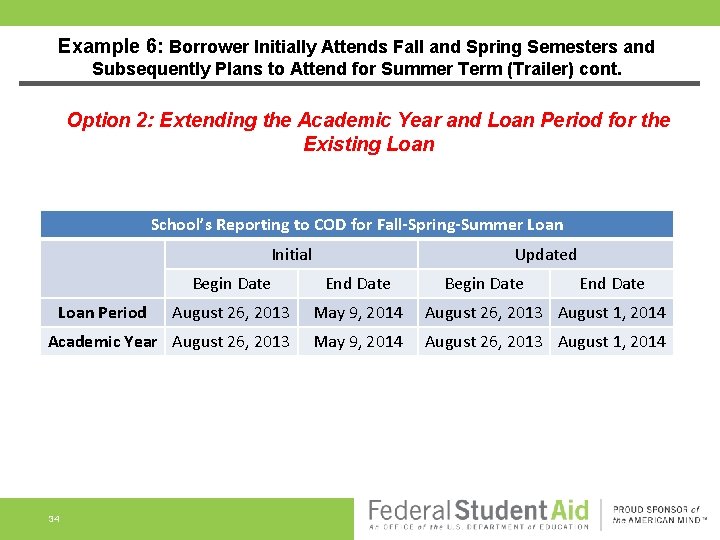
Example 6: Borrower Initially Attends Fall and Spring Semesters and Subsequently Plans to Attend for Summer Term (Trailer) cont. Option 2: Extending the Academic Year and Loan Period for the Existing Loan School’s Reporting to COD for Fall-Spring-Summer Loan Initial Updated Begin Date End Date August 26, 2013 May 9, 2014 August 26, 2013 August 1, 2014 Academic Year August 26, 2013 May 9, 2014 August 26, 2013 August 1, 2014 Loan Period 34 Begin Date End Date
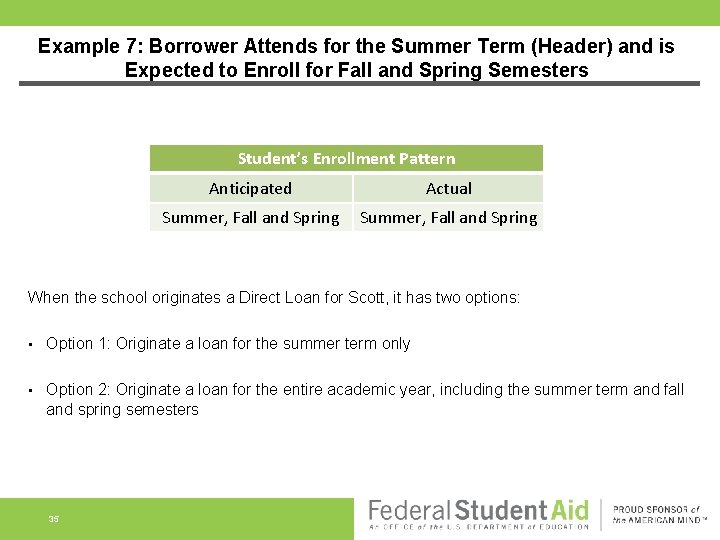
Example 7: Borrower Attends for the Summer Term (Header) and is Expected to Enroll for Fall and Spring Semesters Student’s Enrollment Pattern Anticipated Actual Summer, Fall and Spring When the school originates a Direct Loan for Scott, it has two options: • Option 1: Originate a loan for the summer term only • Option 2: Originate a loan for the entire academic year, including the summer term and fall and spring semesters 35
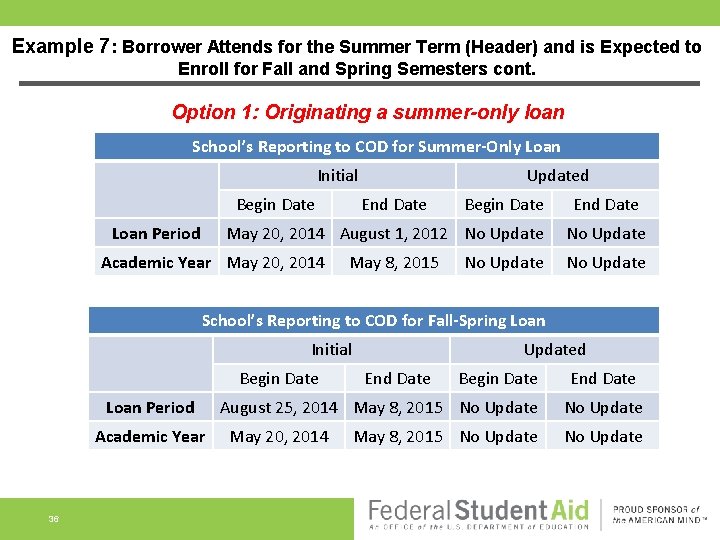
Example 7: Borrower Attends for the Summer Term (Header) and is Expected to Enroll for Fall and Spring Semesters cont. Option 1: Originating a summer-only loan School’s Reporting to COD for Summer-Only Loan Initial Begin Date Loan Period Updated End Date Begin Date May 20, 2014 August 1, 2012 No Update Academic Year May 20, 2014 May 8, 2015 No Update End Date No Update School’s Reporting to COD for Fall-Spring Loan Initial Begin Date Loan Period Academic Year 36 Updated End Date Begin Date August 25, 2014 May 8, 2015 No Update May 20, 2014 May 8, 2015 No Update End Date No Update
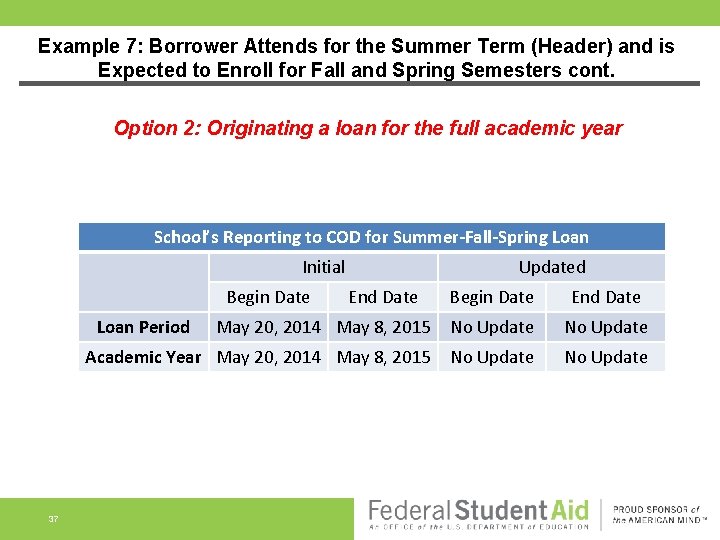
Example 7: Borrower Attends for the Summer Term (Header) and is Expected to Enroll for Fall and Spring Semesters cont. Option 2: Originating a loan for the full academic year School’s Reporting to COD for Summer-Fall-Spring Loan Initial Begin Date End Date May 20, 2014 May 8, 2015 No Update Academic Year May 20, 2014 May 8, 2015 No Update Loan Period 37 Updated End Date
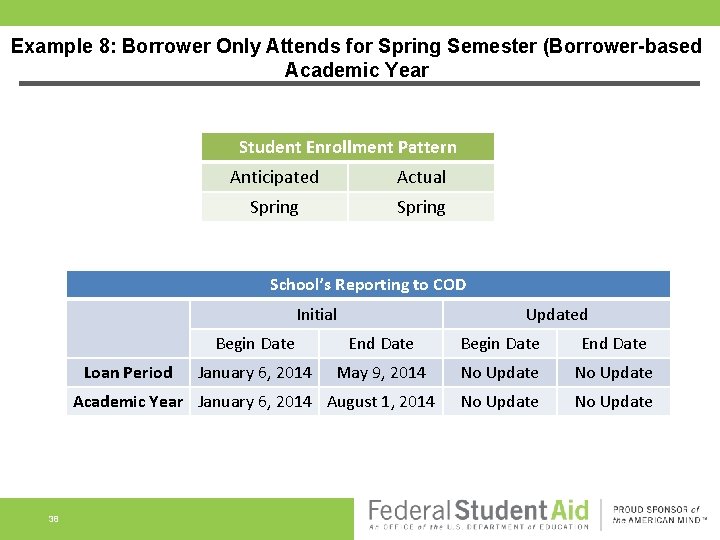
Example 8: Borrower Only Attends for Spring Semester (Borrower-based Academic Year Student Enrollment Pattern Anticipated Actual Spring School’s Reporting to COD Initial Loan Period Updated Begin Date End Date January 6, 2014 May 9, 2014 No Update Academic Year January 6, 2014 August 1, 2014 38
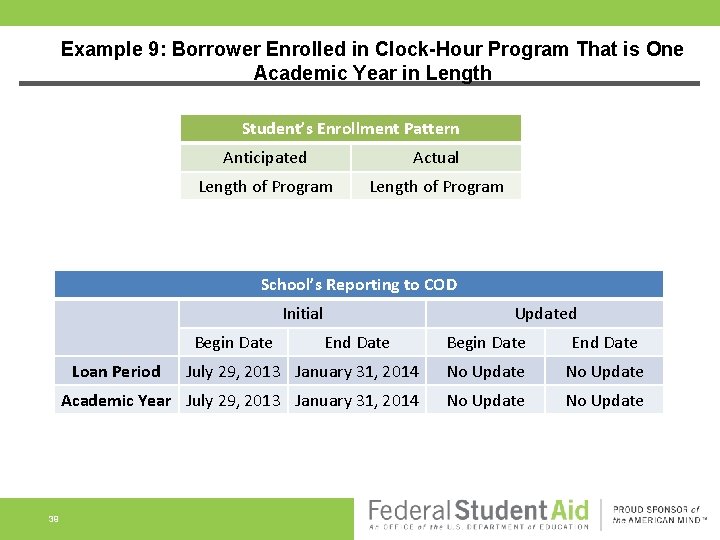
Example 9: Borrower Enrolled in Clock-Hour Program That is One Academic Year in Length Student’s Enrollment Pattern Anticipated Actual Length of Program School’s Reporting to COD Initial Begin Date End Date July 29, 2013 January 31, 2014 No Update Academic Year July 29, 2013 January 31, 2014 No Update Loan Period 39 Updated End Date
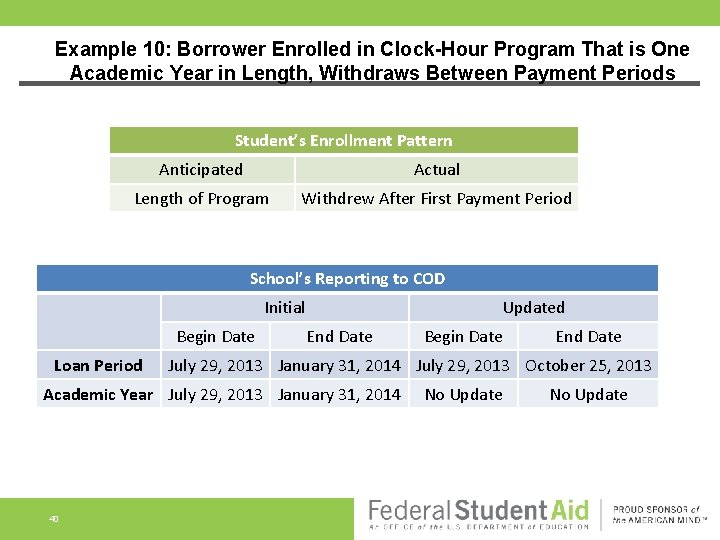
Example 10: Borrower Enrolled in Clock-Hour Program That is One Academic Year in Length, Withdraws Between Payment Periods Student’s Enrollment Pattern Anticipated Actual Length of Program Withdrew After First Payment Period School’s Reporting to COD Initial Begin Date Loan Period Updated End Date July 29, 2013 January 31, 2014 July 29, 2013 October 25, 2013 Academic Year July 29, 2013 January 31, 2014 40 Begin Date No Update
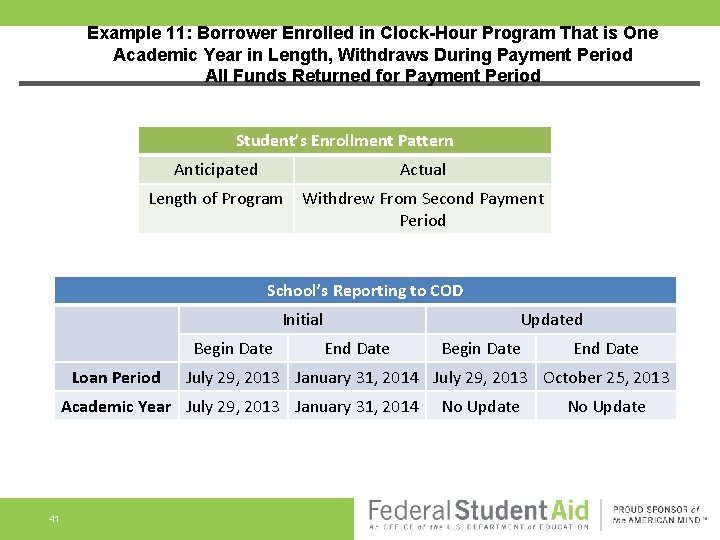
Example 11: Borrower Enrolled in Clock-Hour Program That is One Academic Year in Length, Withdraws During Payment Period All Funds Returned for Payment Period Student’s Enrollment Pattern Anticipated Actual Length of Program Withdrew From Second Payment Period School’s Reporting to COD Initial Begin Date Loan Period Updated End Date July 29, 2013 January 31, 2014 July 29, 2013 October 25, 2013 Academic Year July 29, 2013 January 31, 2014 41 Begin Date No Update
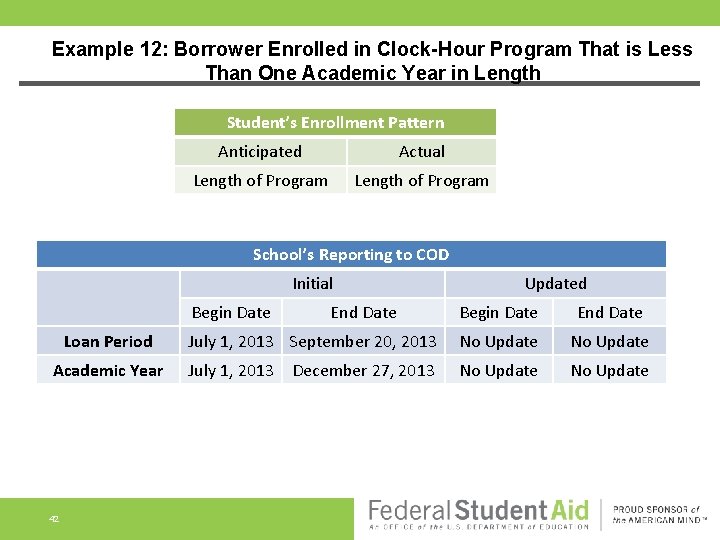
Example 12: Borrower Enrolled in Clock-Hour Program That is Less Than One Academic Year in Length Student’s Enrollment Pattern Anticipated Actual Length of Program School’s Reporting to COD Initial Begin Date Loan Period Academic Year 42 End Date Updated Begin Date End Date July 1, 2013 September 20, 2013 No Update July 1, 2013 No Update December 27, 2013
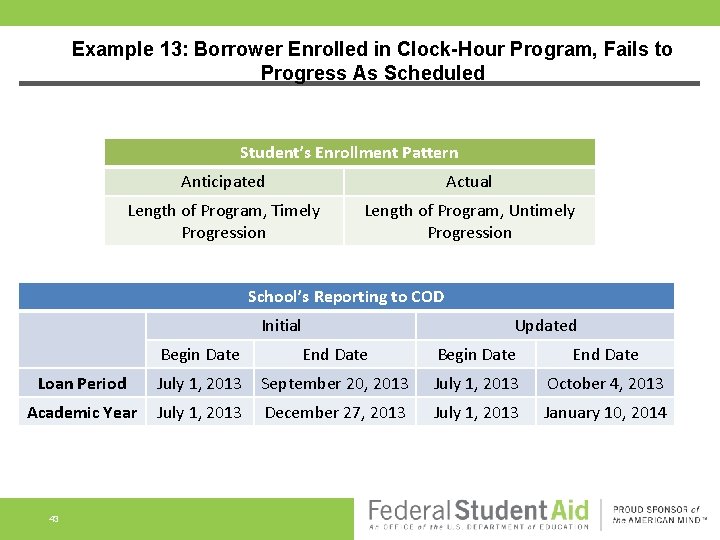
Example 13: Borrower Enrolled in Clock-Hour Program, Fails to Progress As Scheduled Student’s Enrollment Pattern Anticipated Actual Length of Program, Timely Progression Length of Program, Untimely Progression School’s Reporting to COD Initial Updated Begin Date End Date Loan Period July 1, 2013 September 20, 2013 July 1, 2013 October 4, 2013 Academic Year July 1, 2013 December 27, 2013 July 1, 2013 January 10, 2014 43
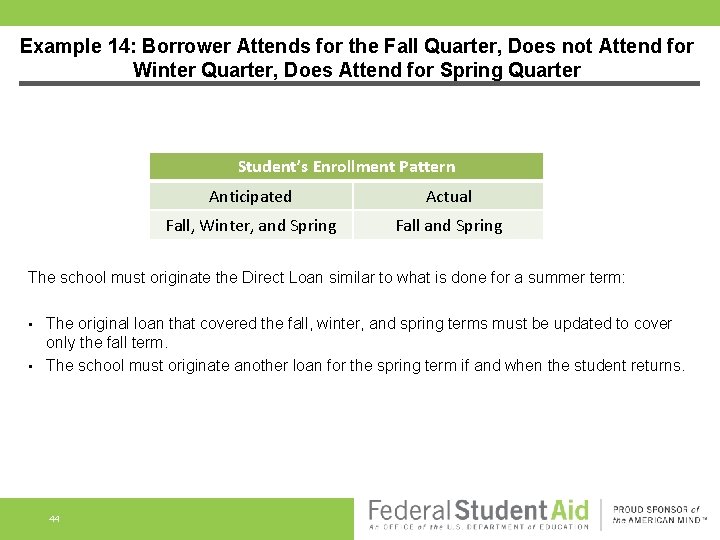
Example 14: Borrower Attends for the Fall Quarter, Does not Attend for Winter Quarter, Does Attend for Spring Quarter Student’s Enrollment Pattern Anticipated Actual Fall, Winter, and Spring Fall and Spring The school must originate the Direct Loan similar to what is done for a summer term: The original loan that covered the fall, winter, and spring terms must be updated to cover only the fall term. • The school must originate another loan for the spring term if and when the student returns. • 44
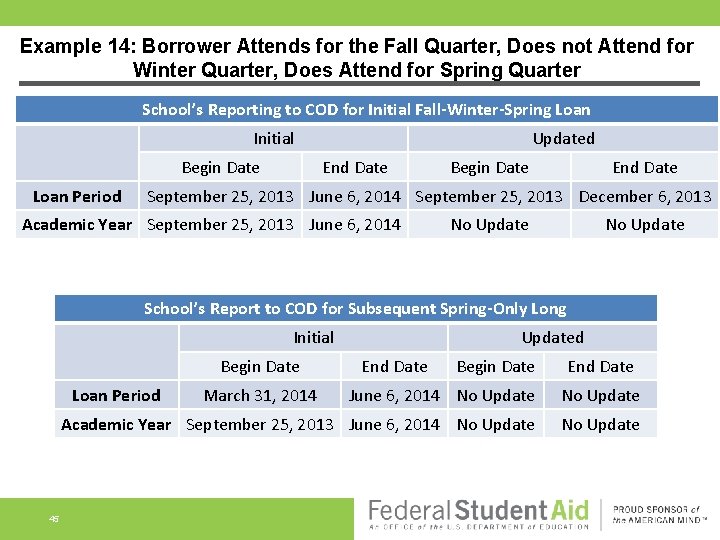
Example 14: Borrower Attends for the Fall Quarter, Does not Attend for Winter Quarter, Does Attend for Spring Quarter School’s Reporting to COD for Initial Fall-Winter-Spring Loan Initial Begin Date Loan Period Updated End Date Begin Date End Date September 25, 2013 June 6, 2014 September 25, 2013 December 6, 2013 Academic Year September 25, 2013 June 6, 2014 No Update School’s Report to COD for Subsequent Spring-Only Long Initial Begin Date Loan Period 45 March 31, 2014 Updated End Date Begin Date End Date June 6, 2014 No Update Academic Year September 25, 2013 June 6, 2014 No Update
QUESTIONS? 46
- Slides: 46