
15 years of LANL data compared to ECSS
- Slides: 17
15 years of LANL data compared to ECSS guidelines for surface charging 23 rd SPINE meeting April 4 th, 2017, ESA HQ, Paris J. C. Mateo-Velez (1), A. Sicard(1), D. Payan(2) (1) (2)
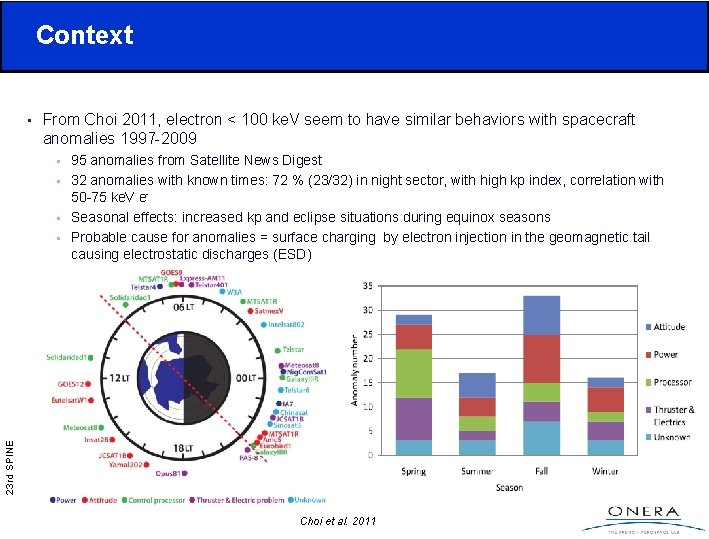
Context • From Choi 2011, electron < 100 ke. V seem to have similar behaviors with spacecraft anomalies 1997 -2009 • • • 23 rd SPINE • 95 anomalies from Satellite News Digest 32 anomalies with known times: 72 % (23/32) in night sector, with high kp index, correlation with 50 -75 ke. V e. Seasonal effects: increased kp and eclipse situations during equinox seasons Probable cause for anomalies = surface charging by electron injection in the geomagnetic tail causing electrostatic discharges (ESD) Choi et al. 2011
Context • At spacecraft design phase, the risk assessment combines two approaches • • • Surface charging risk is generally assessed at spacecraft scale by using computational tools (SPIS, NASCAP, MUSCAT, etc. ) Threshold and effects of ESDs assessed by testing in order to limit/avoid power losses on solar cells for instance Knowing the ‘severe’ and ‘extreme’ environments at GEO/MEO is of prime importance • Worst-case environments from guidelines (ECSS, NASA) defined in the 80’s • More recent data can be used to check that guidelines remain conservative and/or to propose new environment specifications • Objectives 23 rd SPINE • Analyse 15 years of data on LANL spacecraft at GEO • Investigate possible correlation with anomalies from Choi 2011 • Compare with guidelines
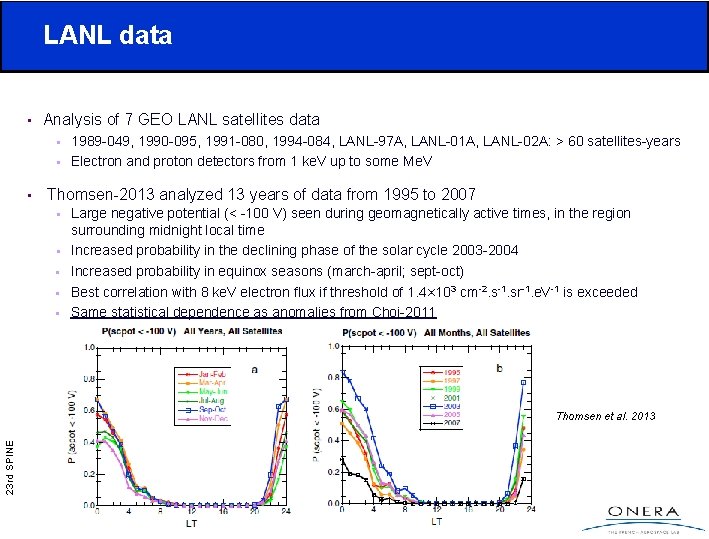
LANL data • Analysis of 7 GEO LANL satellites data • • • 1989 -049, 1990 -095, 1991 -080, 1994 -084, LANL-97 A, LANL-01 A, LANL-02 A: > 60 satellites-years Electron and proton detectors from 1 ke. V up to some Me. V Thomsen-2013 analyzed 13 years of data from 1995 to 2007 • • • Large negative potential (< -100 V) seen during geomagnetically active times, in the region surrounding midnight local time Increased probability in the declining phase of the solar cycle 2003 -2004 Increased probability in equinox seasons (march-april; sept-oct) Best correlation with 8 ke. V electron flux if threshold of 1. 4× 103 cm-2. s-1. sr-1. e. V-1 is exceeded Same statistical dependence as anomalies from Choi-2011 23 rd SPINE Thomsen et al. 2013
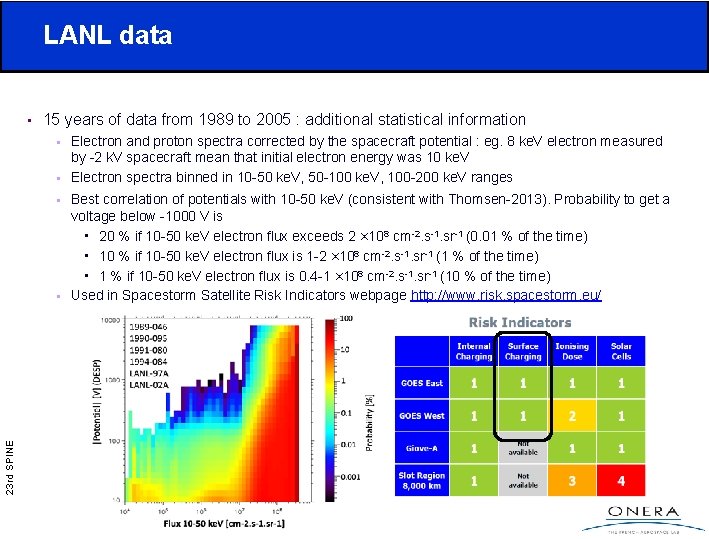
LANL data • 15 years of data from 1989 to 2005 : additional statistical information • • • 23 rd SPINE • Electron and proton spectra corrected by the spacecraft potential : eg. 8 ke. V electron measured by -2 k. V spacecraft mean that initial electron energy was 10 ke. V Electron spectra binned in 10 -50 ke. V, 50 -100 ke. V, 100 -200 ke. V ranges Best correlation of potentials with 10 -50 ke. V (consistent with Thomsen-2013). Probability to get a voltage below -1000 V is • 20 % if 10 -50 ke. V electron flux exceeds 2 × 108 cm-2. s-1. sr-1 (0. 01 % of the time) • 10 % if 10 -50 ke. V electron flux is 1 -2 × 108 cm-2. s-1. sr-1 (1 % of the time) • 1 % if 10 -50 ke. V electron flux is 0. 4 -1 × 108 cm-2. s-1. sr-1 (10 % of the time) Used in Spacestorm Satellite Risk Indicators webpage http: //www. risk. spacestorm. eu/
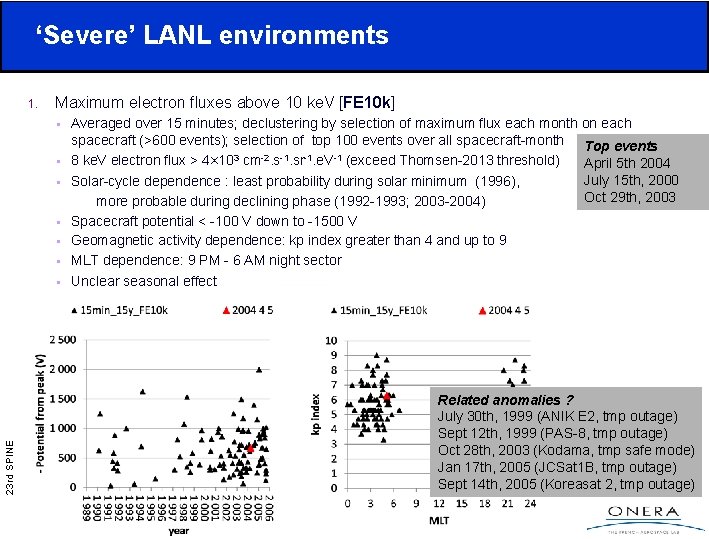
‘Severe’ LANL environments 1. Maximum electron fluxes above 10 ke. V [FE 10 k] • Averaged over 15 minutes; declustering by selection of maximum flux each month on each spacecraft (>600 events); selection of top 100 events over all spacecraft-month Top events 8 ke. V electron flux > 4× 103 cm-2. s-1. sr-1. e. V-1 (exceed Thomsen-2013 threshold) April 5 th 2004 July 15 th, 2000 Solar-cycle dependence : least probability during solar minimum (1996), Oct 29 th, 2003 more probable during declining phase (1992 -1993; 2003 -2004) Spacecraft potential < -100 V down to -1500 V Geomagnetic activity dependence: kp index greater than 4 and up to 9 MLT dependence: 9 PM - 6 AM night sector • Unclear seasonal effect • • 23 rd SPINE • Related anomalies ? July 30 th, 1999 (ANIK E 2, tmp outage) Sept 12 th, 1999 (PAS-8, tmp outage) Oct 28 th, 2003 (Kodama, tmp safe mode) Jan 17 th, 2005 (JCSat 1 B, tmp outage) Sept 14 th, 2005 (Koreasat 2, tmp outage)
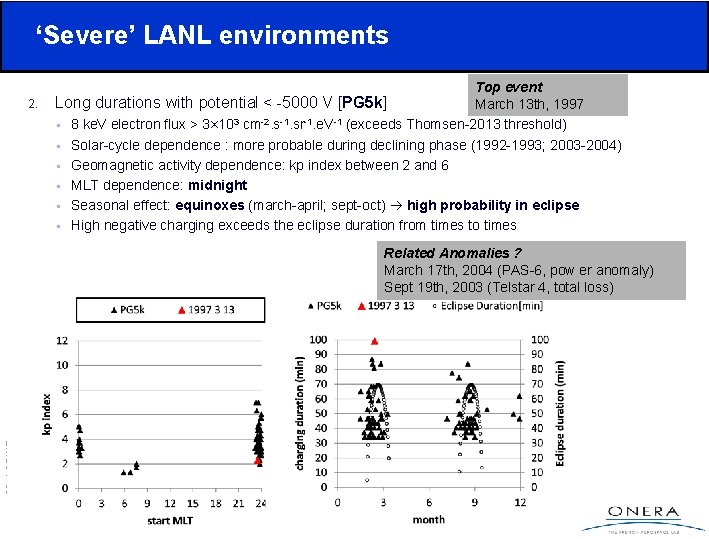
‘Severe’ LANL environments 2. Top event Long durations with potential < -5000 V [PG 5 k] March 13 th, 1997 • 8 ke. V electron flux > 3× 103 cm-2. s-1. sr-1. e. V-1 (exceeds Thomsen-2013 threshold) • Solar-cycle dependence : more probable during declining phase (1992 -1993; 2003 -2004) • Geomagnetic activity dependence: kp index between 2 and 6 • MLT dependence: midnight • Seasonal effect: equinoxes (march-april; sept-oct) high probability in eclipse • High negative charging exceeds the eclipse duration from times to times 23 rd SPINE Related Anomalies ? March 17 th, 2004 (PAS-6, pow er anomaly) Sept 19 th, 2003 (Telstar 4, total loss)
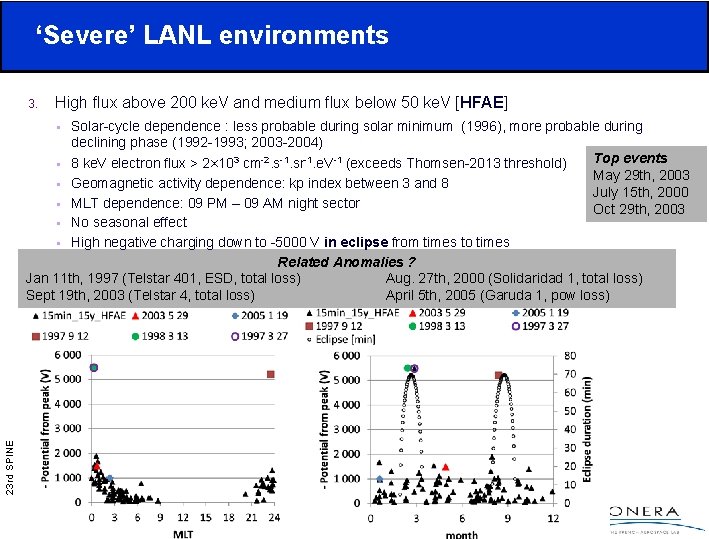
‘Severe’ LANL environments 3. High flux above 200 ke. V and medium flux below 50 ke. V [HFAE] Solar-cycle dependence : less probable during solar minimum (1996), more probable during declining phase (1992 -1993; 2003 -2004) Top events • 8 ke. V electron flux > 2× 103 cm-2. s-1. sr-1. e. V-1 (exceeds Thomsen-2013 threshold) May 29 th, 2003 • Geomagnetic activity dependence: kp index between 3 and 8 July 15 th, 2000 • MLT dependence: 09 PM – 09 AM night sector Oct 29 th, 2003 • No seasonal effect • High negative charging down to -5000 V in eclipse from times to times Related Anomalies ? Jan 11 th, 1997 (Telstar 401, ESD, total loss) Aug. 27 th, 2000 (Solidaridad 1, total loss) Sept 19 th, 2003 (Telstar 4, total loss) April 5 th, 2005 (Garuda 1, pow loss) 23 rd SPINE •
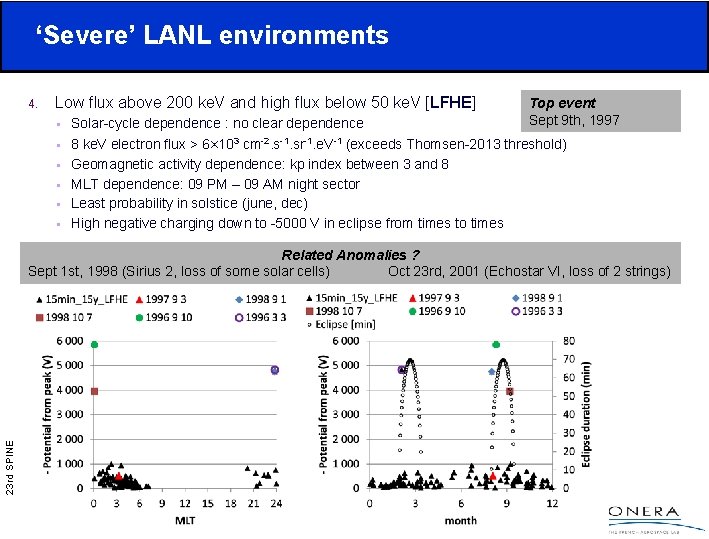
‘Severe’ LANL environments 4. Low flux above 200 ke. V and high flux below 50 ke. V [LFHE] • • • Top event Sept 9 th, 1997 Solar-cycle dependence : no clear dependence 8 ke. V electron flux > 6× 103 cm-2. s-1. sr-1. e. V-1 (exceeds Thomsen-2013 threshold) Geomagnetic activity dependence: kp index between 3 and 8 MLT dependence: 09 PM – 09 AM night sector Least probability in solstice (june, dec) High negative charging down to -5000 V in eclipse from times to times 23 rd SPINE Related Anomalies ? Sept 1 st, 1998 (Sirius 2, loss of some solar cells) Oct 23 rd, 2001 (Echostar VI, loss of 2 strings)
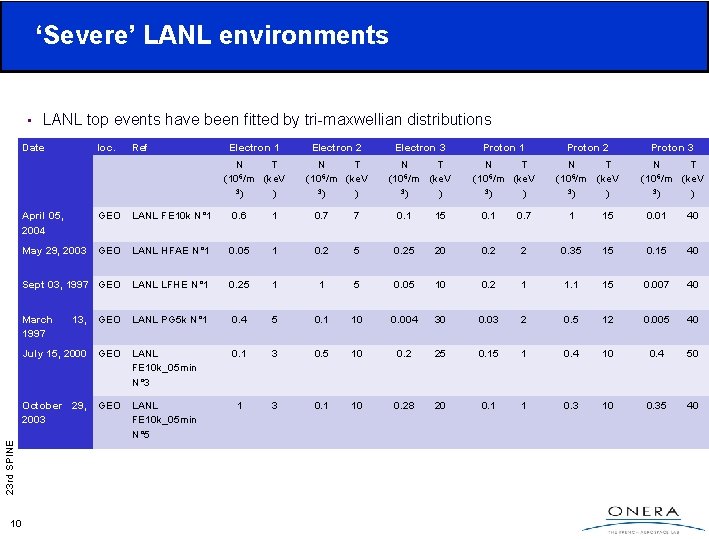
‘Severe’ LANL environments 23 rd SPINE • 10 LANL top events have been fitted by tri-maxwellian distributions Date loc. Ref April 05, 2004 GEO LANL FE 10 k N° 1 0. 6 1 0. 7 7 0. 1 15 0. 1 0. 7 1 15 0. 01 40 May 29, 2003 GEO LANL HFAE N° 1 0. 05 1 0. 2 5 0. 25 20 0. 2 2 0. 35 15 0. 15 40 Sept 03, 1997 GEO LANL LFHE N° 1 0. 25 1 1 5 0. 05 10 0. 2 1 15 0. 007 40 March 1997 LANL PG 5 k N° 1 0. 4 5 0. 1 10 0. 004 30 0. 03 2 0. 5 12 0. 005 40 July 15, 2000 GEO LANL FE 10 k_05 min N° 3 0. 1 3 0. 5 10 0. 2 25 0. 15 1 0. 4 10 0. 4 50 October 29, GEO 2003 LANL FE 10 k_05 min N° 5 1 3 0. 1 10 0. 28 20 0. 1 1 0. 3 10 0. 35 40 13, GEO Electron 1 Electron 2 Electron 3 Proton 1 Proton 2 Proton 3 N T N T 6 6 6 (10 /m (ke. V 3) 3 3 3) ) )
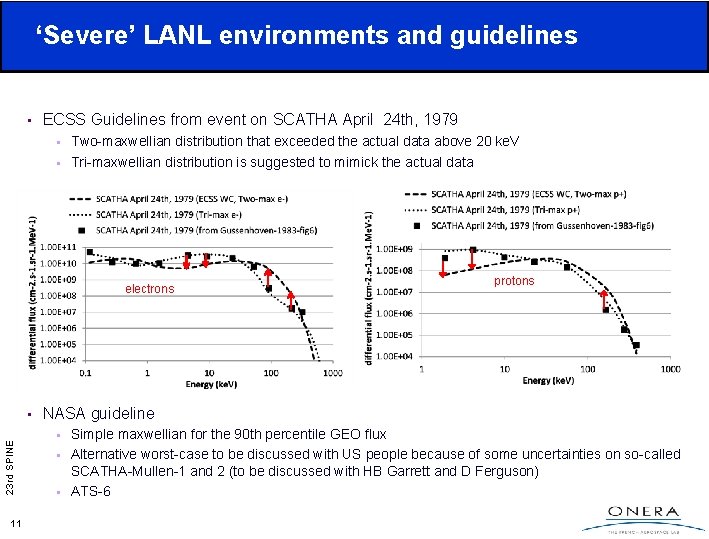
‘Severe’ LANL environments and guidelines • ECSS Guidelines from event on SCATHA April 24 th, 1979 • Two-maxwellian distribution that exceeded the actual data above 20 ke. V • Tri-maxwellian distribution is suggested to mimick the actual data electrons 23 rd SPINE • 11 protons NASA guideline • • • Simple maxwellian for the 90 th percentile GEO flux Alternative worst-case to be discussed with US people because of some uncertainties on so-called SCATHA-Mullen-1 and 2 (to be discussed with HB Garrett and D Ferguson) ATS-6
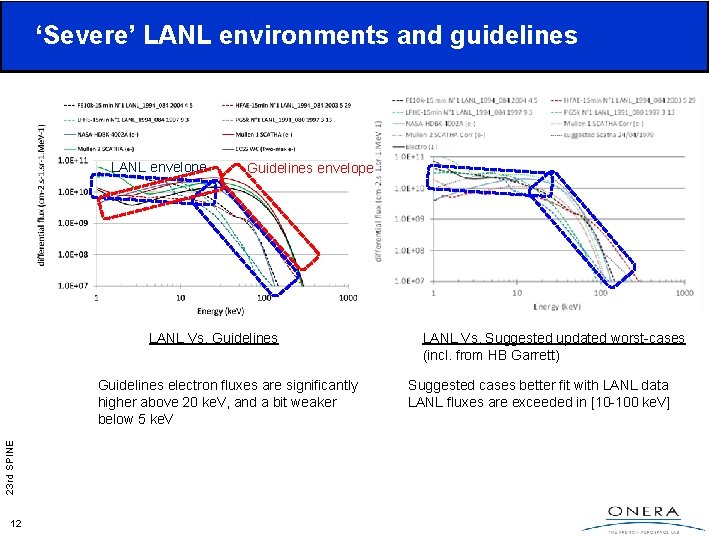
‘Severe’ LANL environments and guidelines LANL envelope Guidelines envelope LANL Vs. Guidelines 23 rd SPINE Guidelines electron fluxes are significantly higher above 20 ke. V, and a bit weaker below 5 ke. V 12 LANL Vs. Suggested updated worst-cases (incl. from HB Garrett) Suggested cases better fit with LANL data LANL fluxes are exceeded in [10 -100 ke. V]
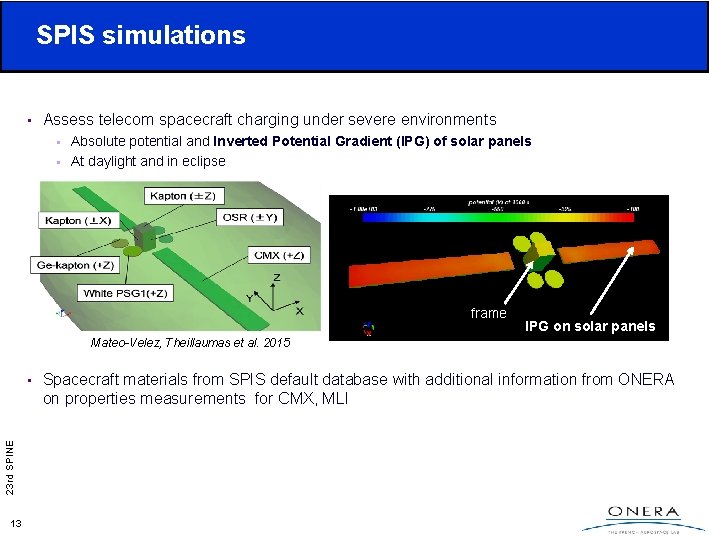
SPIS simulations • Assess telecom spacecraft charging under severe environments • • Absolute potential and Inverted Potential Gradient (IPG) of solar panels At daylight and in eclipse frame IPG on solar panels Mateo-Velez, Theillaumas et al. 2015 23 rd SPINE • 13 Spacecraft materials from SPIS default database with additional information from ONERA on properties measurements for CMX, MLI
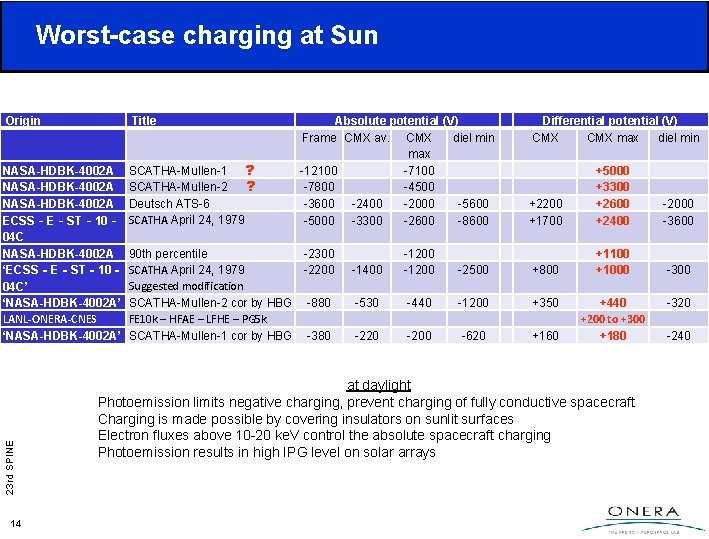
Worst-case charging at Sun Title NASA-HDBK-4002 A ECSS‐E‐ST‐ 10‐ 04 C NASA-HDBK-4002 A ‘ECSS‐E‐ST‐ 10‐ 04 C’ ‘NASA-HDBK-4002 A’ LANL-ONERA-CNES ‘NASA-HDBK-4002 A’ SCATHA-Mullen-1 ? SCATHA-Mullen-2 ? Deutsch ATS-6 SCATHA April 24, 1979 23 rd SPINE Origin 14 Absolute potential (V) Frame CMX av. CMX diel min max -12100 -7800 -4500 -3600 -2400 -2000 -5600 -5000 -3300 -2600 -8600 90 th percentile -2300 SCATHA April 24, 1979 -2200 Suggested modification SCATHA-Mullen-2 cor by HBG -880 FE 10 k – HFAE – LFHE – PG 5 k SCATHA-Mullen-1 cor by HBG -380 Differential potential (V) CMX max diel min +2200 +1700 +5000 +3300 +2600 +2400 -2000 -3600 -1400 -1200 -2500 +800 +1100 +1000 -300 -530 -440 -1200 +350 -320 -200 -620 +160 +440 +200 to +300 +180 at daylight Photoemission limits negative charging, prevent charging of fully conductive spacecraft Charging is made possible by covering insulators on sunlit surfaces Electron fluxes above 10 -20 ke. V control the absolute spacecraft charging Photoemission results in high IPG level on solar arrays -240
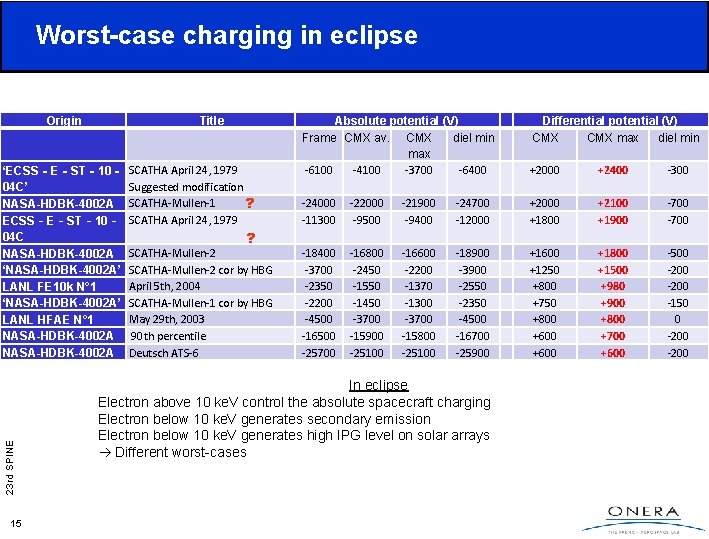
Worst-case charging in eclipse Origin Title 23 rd SPINE ‘ECSS‐E‐ST‐ 10‐ 04 C’ NASA-HDBK-4002 A ECSS‐E‐ST‐ 10‐ 04 C NASA-HDBK-4002 A ‘NASA-HDBK-4002 A’ LANL FE 10 k N° 1 ‘NASA-HDBK-4002 A’ LANL HFAE N° 1 NASA-HDBK-4002 A 15 SCATHA April 24, 1979 Suggested modification SCATHA-Mullen-1 ? SCATHA April 24, 1979 ? SCATHA-Mullen-2 cor by HBG April 5 th, 2004 SCATHA-Mullen-1 cor by HBG May 29 th, 2003 90 th percentile Deutsch ATS-6 Absolute potential (V) Frame CMX av. CMX diel min max -6100 -4100 -3700 -6400 +2000 +2400 -300 -24000 -11300 -22000 -9500 -21900 -9400 -24700 -12000 +2000 +1800 +2100 +1900 -700 -18400 -3700 -2350 -2200 -4500 -16500 -25700 -16800 -2450 -1550 -1450 -3700 -15900 -25100 -16600 -2200 -1370 -1300 -3700 -15800 -25100 -18900 -3900 -2550 -2350 -4500 -16700 -25900 +1600 +1250 +800 +750 +800 +600 +1800 +1500 +980 +900 +800 +700 +600 -500 -200 -150 0 -200 In eclipse Electron above 10 ke. V control the absolute spacecraft charging Electron below 10 ke. V generates secondary emission Electron below 10 ke. V generates high IPG level on solar arrays Different worst-cases Differential potential (V) CMX max diel min
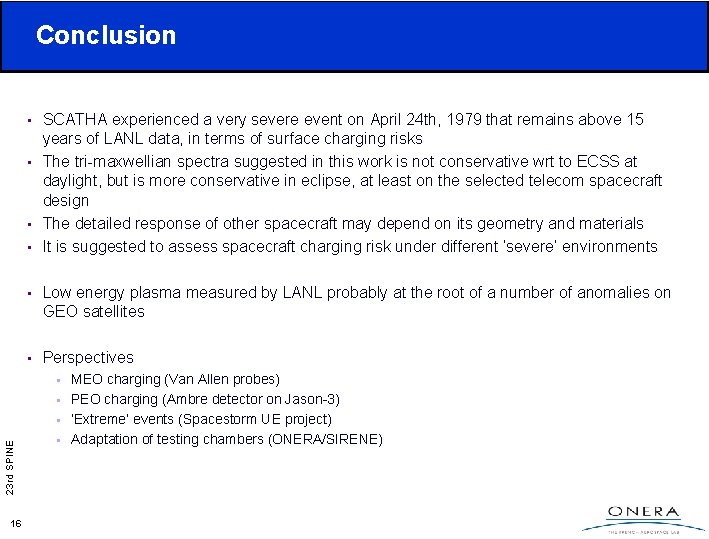
Conclusion • • SCATHA experienced a very severe event on April 24 th, 1979 that remains above 15 years of LANL data, in terms of surface charging risks The tri-maxwellian spectra suggested in this work is not conservative wrt to ECSS at daylight, but is more conservative in eclipse, at least on the selected telecom spacecraft design The detailed response of other spacecraft may depend on its geometry and materials It is suggested to assess spacecraft charging risk under different ‘severe’ environments • Low energy plasma measured by LANL probably at the root of a number of anomalies on GEO satellites • Perspectives • • 23 rd SPINE • 16 • MEO charging (Van Allen probes) PEO charging (Ambre detector on Jason-3) ‘Extreme’ events (Spacestorm UE project) Adaptation of testing chambers (ONERA/SIRENE)
Acknowledgments This work was funded by CNES R&D program Part of the research leading to these results funded in part by the European Union Seventh Framework Programme (FP 7) under grant agreement No 606716 SPACESTORM 23 rd SPINE The authors thank R. Friedel, G. Reeves, M. Thomsen and M. Henderson from LANL for sharing data 17