
15 The Urinary System PART A Power Point


- Slides: 24
15 The Urinary System PART A Power. Point® Lecture Slide Presentation by Jerry L. Cook, Sam Houston University ESSENTIALS OF HUMAN ANATOMY & PHYSIOLOGY EIGHTH EDITION ELAINE N. MARIEB Copyright © 2006 Pearson Education, Inc. , publishing as Benjamin Cummings
Functions of the Urinary System § Elimination of waste products § Nitrogenous wastes § Toxins § Drugs Copyright © 2006 Pearson Education, Inc. , publishing as Benjamin Cummings
Functions of the Urinary System § Regulate aspects of homeostasis § Water balance § Electrolytes § Acid-base balance in the blood § Blood pressure § Red blood cell production § Activation of vitamin D Copyright © 2006 Pearson Education, Inc. , publishing as Benjamin Cummings
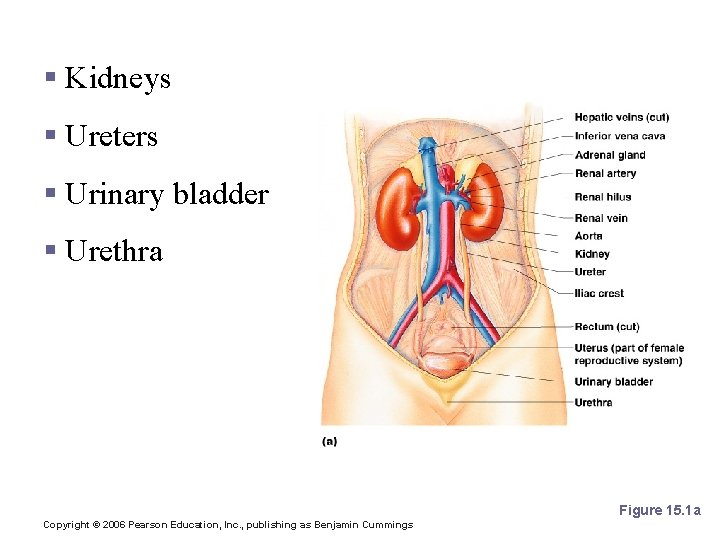
Organs of the Urinary system § Kidneys § Ureters § Urinary bladder § Urethra Figure 15. 1 a Copyright © 2006 Pearson Education, Inc. , publishing as Benjamin Cummings
Location of the Kidneys § Against the dorsal body wall § At the level of T 12 to L 3 § The right kidney is slightly lower than the left § Attached to ureters, renal blood vessels, and nerves at renal hilus § Atop each kidney is an adrenal gland Copyright © 2006 Pearson Education, Inc. , publishing as Benjamin Cummings
Coverings of the Kidneys § Renal capsule § Surrounds each kidney § Adipose capsule § Surrounds the kidney § Provides protection to the kidney § Helps keep the kidney in its correct location Copyright © 2006 Pearson Education, Inc. , publishing as Benjamin Cummings
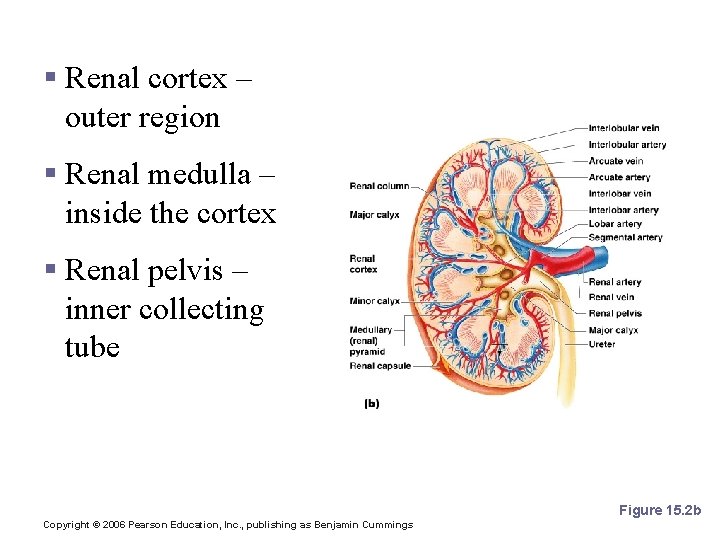
Regions of the Kidney § Renal cortex – outer region § Renal medulla – inside the cortex § Renal pelvis – inner collecting tube Figure 15. 2 b Copyright © 2006 Pearson Education, Inc. , publishing as Benjamin Cummings
Kidney Structures § Medullary pyramids – triangular regions of tissue in the medulla § Renal columns – extensions of cortex-like material inward § Calyces – cup-shaped structures that funnel urine towards the renal pelvis Copyright © 2006 Pearson Education, Inc. , publishing as Benjamin Cummings
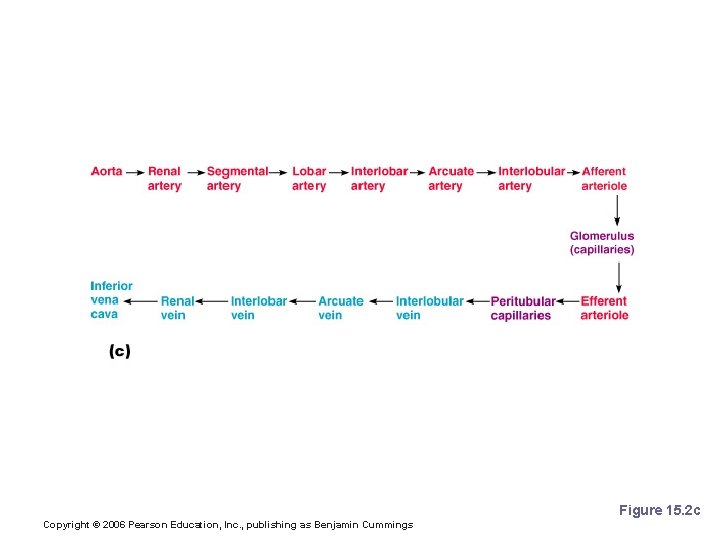
Blood Flow in the Kidneys Figure 15. 2 c Copyright © 2006 Pearson Education, Inc. , publishing as Benjamin Cummings
Nephrons § The structural and functional units of the kidneys § Responsible forming urine § Main structures of the nephrons § Glomerulus § Renal tubule Copyright © 2006 Pearson Education, Inc. , publishing as Benjamin Cummings
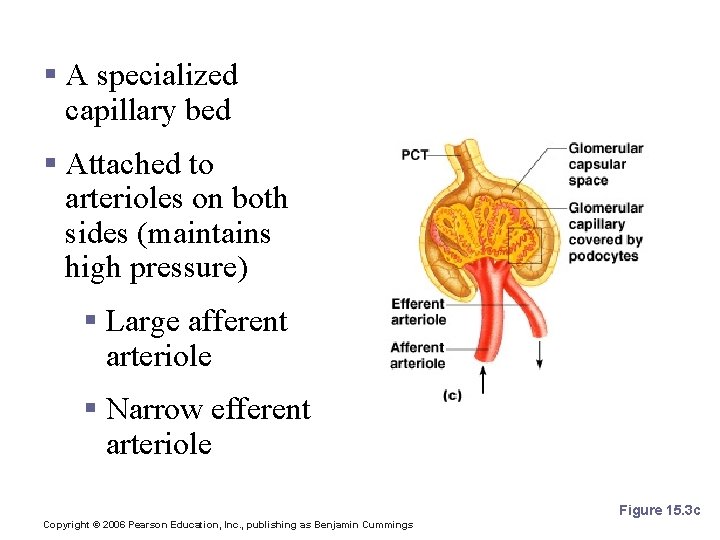
Glomerulus § A specialized capillary bed § Attached to arterioles on both sides (maintains high pressure) § Large afferent arteriole § Narrow efferent arteriole Figure 15. 3 c Copyright © 2006 Pearson Education, Inc. , publishing as Benjamin Cummings
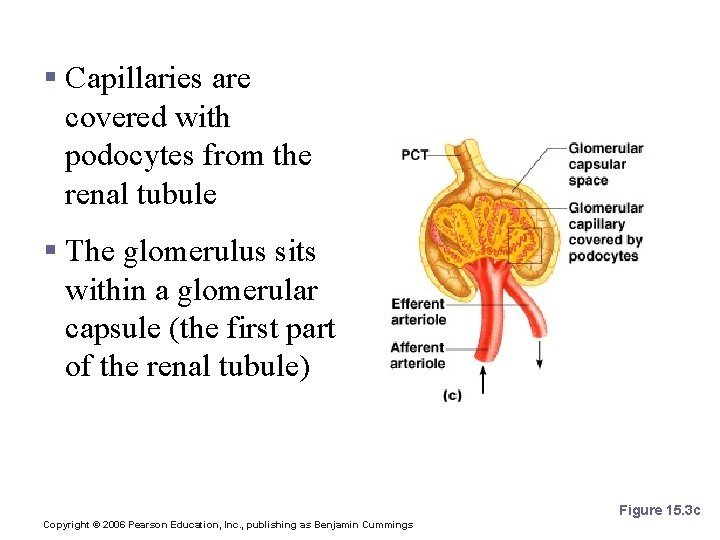
Glomerulus § Capillaries are covered with podocytes from the renal tubule § The glomerulus sits within a glomerular capsule (the first part of the renal tubule) Figure 15. 3 c Copyright © 2006 Pearson Education, Inc. , publishing as Benjamin Cummings
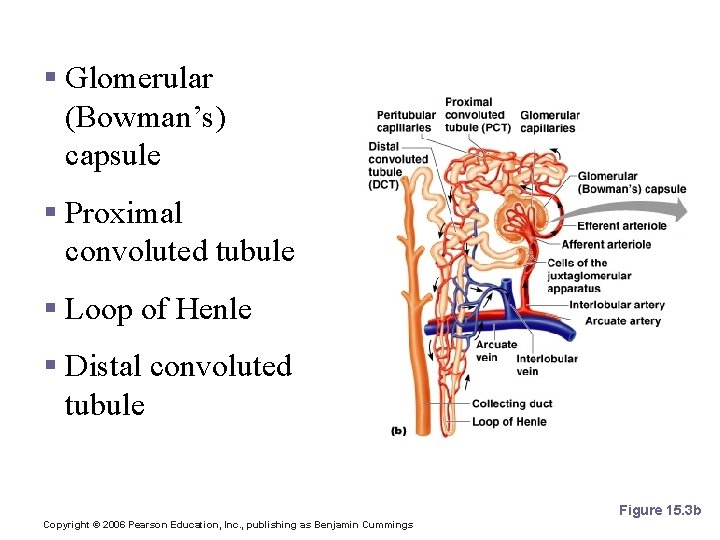
Renal Tubule § Glomerular (Bowman’s) capsule § Proximal convoluted tubule § Loop of Henle § Distal convoluted tubule Figure 15. 3 b Copyright © 2006 Pearson Education, Inc. , publishing as Benjamin Cummings
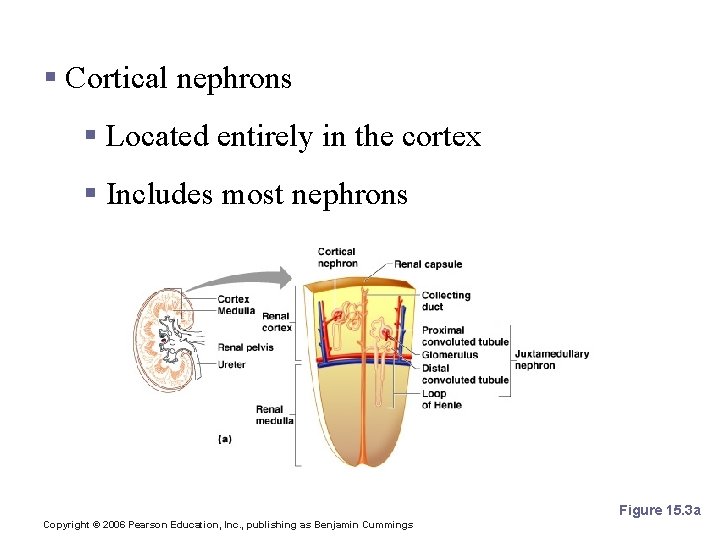
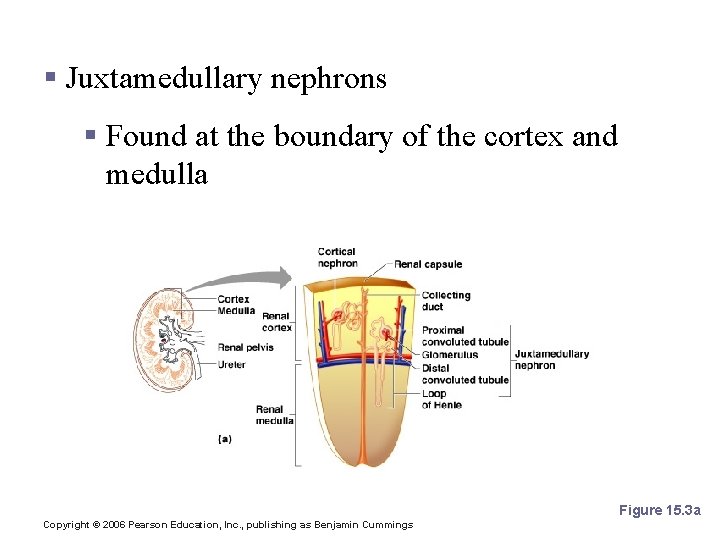
Types of Nephrons § Cortical nephrons § Located entirely in the cortex § Includes most nephrons Figure 15. 3 a Copyright © 2006 Pearson Education, Inc. , publishing as Benjamin Cummings
Types of Nephrons § Juxtamedullary nephrons § Found at the boundary of the cortex and medulla Figure 15. 3 a Copyright © 2006 Pearson Education, Inc. , publishing as Benjamin Cummings
Peritubular Capillaries § Arise from efferent arteriole of the glomerulus § Normal, low pressure capillaries § Attached to a venule § Cling close to the renal tubule § Reabsorb (reclaim) some substances from collecting tubes Copyright © 2006 Pearson Education, Inc. , publishing as Benjamin Cummings
Urine Formation Processes § Filtration § Reabsorption § Secretion Figure 15. 4 Copyright © 2006 Pearson Education, Inc. , publishing as Benjamin Cummings
Filtration § Nonselective passive process § Water and solutes smaller than proteins are forced through capillary walls § Blood cells cannot pass out to the capillaries § Filtrate is collected in the glomerular capsule and leaves via the renal tubule Copyright © 2006 Pearson Education, Inc. , publishing as Benjamin Cummings
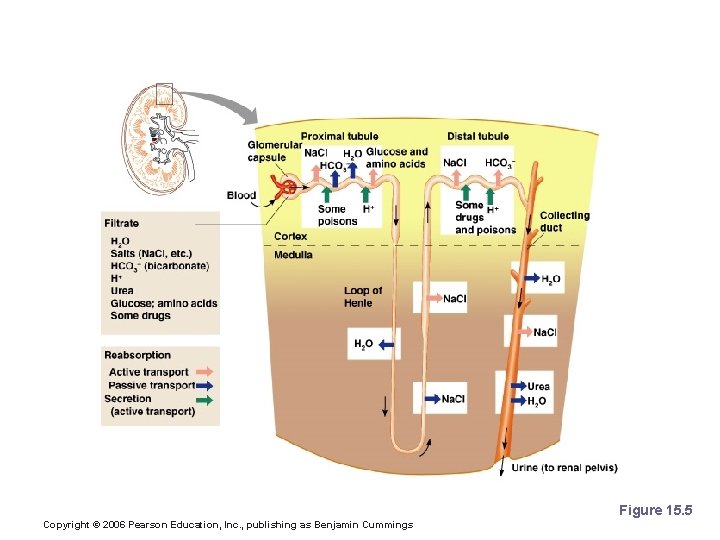
Reabsorption § The peritubular capillaries reabsorb several materials § Some water § Glucose § Amino acids § Ions § Some reabsorption is passive, most is active § Most reabsorption occurs in the proximal convoluted tubule Copyright © 2006 Pearson Education, Inc. , publishing as Benjamin Cummings
Materials Not Reabsorbed § Nitrogenous waste products § Urea § Uric acid § Creatinine § Excess water Copyright © 2006 Pearson Education, Inc. , publishing as Benjamin Cummings
Secretion – Reabsorption in Reverse § Some materials move from the peritubular capillaries into the renal tubules § Hydrogen and potassium ions § Creatinine § Materials left in the renal tubule move toward the ureter Copyright © 2006 Pearson Education, Inc. , publishing as Benjamin Cummings
Formation of Urine Figure 15. 5 Copyright © 2006 Pearson Education, Inc. , publishing as Benjamin Cummings
Characteristics of Urine Used for Medical Diagnosis § Colored somewhat yellow due to the pigment urochrome (from the destruction of hemoglobin) and solutes § Sterile § Slightly aromatic § Normal p. H of around 6 § Specific gravity of 1. 001 to 1. 035 Copyright © 2006 Pearson Education, Inc. , publishing as Benjamin Cummings
Ureters § Slender tubes attaching the kidney to the bladder § Continuous with the renal pelvis § Enter the posterior aspect of the bladder § Runs behind the peritoneum § Peristalsis aids gravity in urine transport Copyright © 2006 Pearson Education, Inc. , publishing as Benjamin Cummings