
15 The Male and Female Reproductive Systems Lesson
- Slides: 48
15 The Male and Female Reproductive Systems Lesson 15. 1: Reproduction and Development of the Human Reproductive Systems Lesson 15. 2: Male Reproductive System Anatomy and Physiology Lesson 15. 3: Female Reproductive System Anatomy and Physiology Lesson 15. 4: Fertilization, Pregnancy, and Birth Lesson 15. 5: Disorders and Diseases of the Reproductive System
Chapter 15: The Male and Female Reproductive Systems Lesson 15. 1 Reproduction and Development of the Human Reproductive Systems
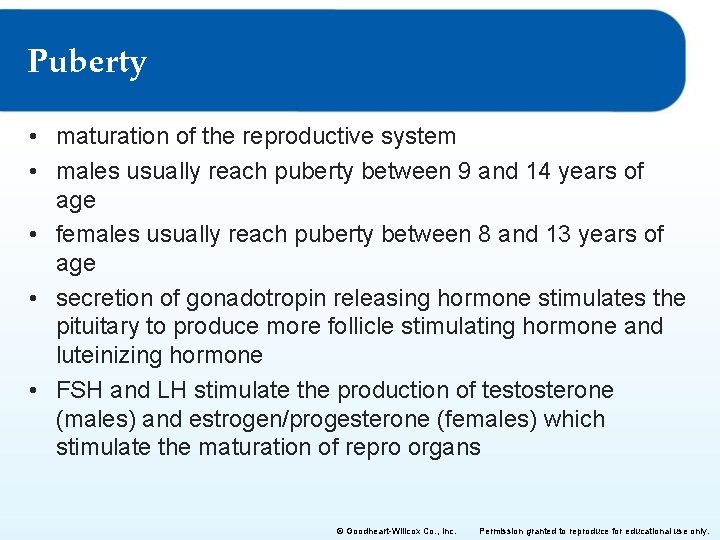
Puberty • maturation of the reproductive system • males usually reach puberty between 9 and 14 years of age • females usually reach puberty between 8 and 13 years of age • secretion of gonadotropin releasing hormone stimulates the pituitary to produce more follicle stimulating hormone and luteinizing hormone • FSH and LH stimulate the production of testosterone (males) and estrogen/progesterone (females) which stimulate the maturation of repro organs © Goodheart-Willcox Co. , Inc. Permission granted to reproduce for educational use only.
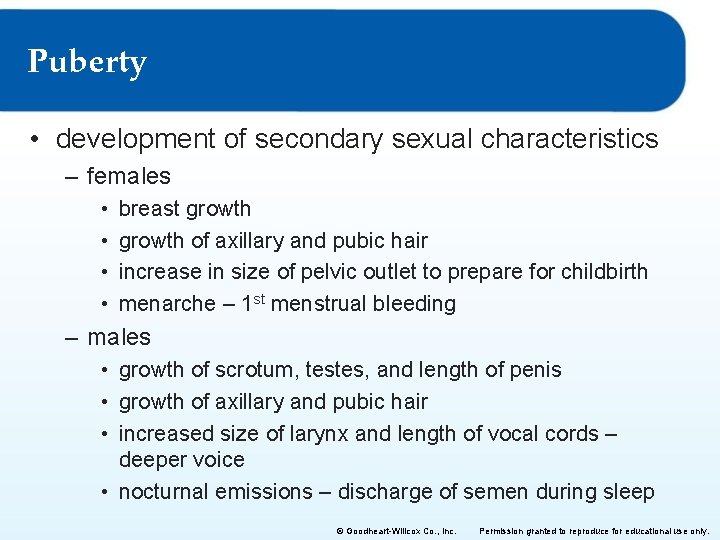
Puberty • development of secondary sexual characteristics – females • • breast growth of axillary and pubic hair increase in size of pelvic outlet to prepare for childbirth menarche – 1 st menstrual bleeding – males • growth of scrotum, testes, and length of penis • growth of axillary and pubic hair • increased size of larynx and length of vocal cords – deeper voice • nocturnal emissions – discharge of semen during sleep © Goodheart-Willcox Co. , Inc. Permission granted to reproduce for educational use only.
Chapter 15: The Male and Female Reproductive Systems Lesson 15. 2 Male Reproductive System Anatomy and Physiology
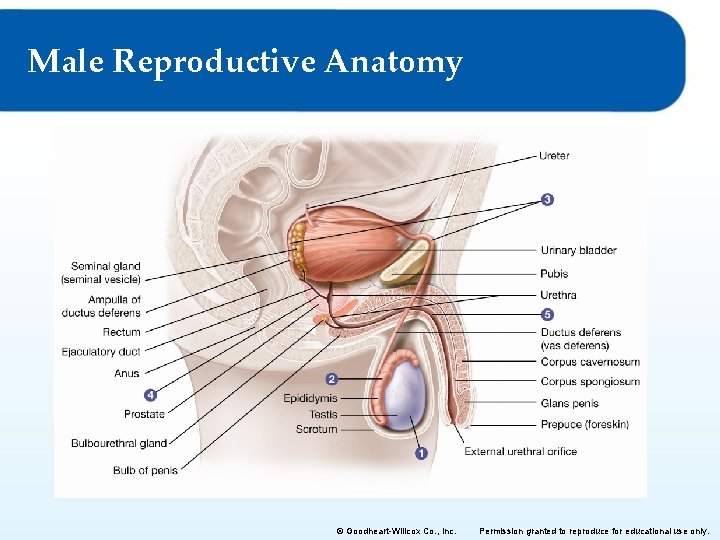
Male Reproductive Anatomy © Goodheart-Willcox Co. , Inc. Permission granted to reproduce for educational use only.
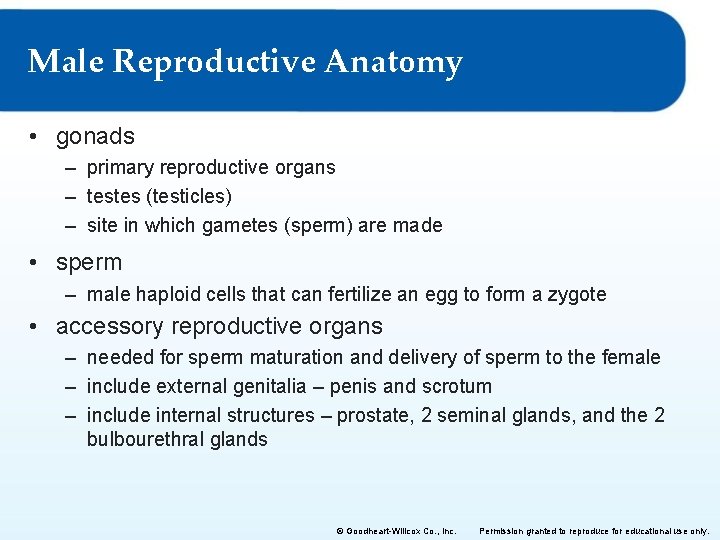
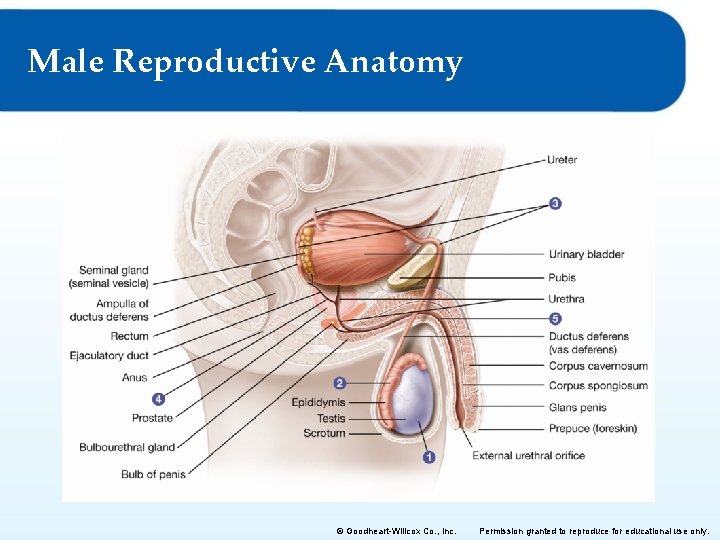
Male Reproductive Anatomy • gonads – primary reproductive organs – testes (testicles) – site in which gametes (sperm) are made • sperm – male haploid cells that can fertilize an egg to form a zygote • accessory reproductive organs – needed for sperm maturation and delivery of sperm to the female – include external genitalia – penis and scrotum – include internal structures – prostate, 2 seminal glands, and the 2 bulbourethral glands © Goodheart-Willcox Co. , Inc. Permission granted to reproduce for educational use only.
Male Reproductive Anatomy • scrotum – pouch of skin that hangs outside the body that contains the 2 testes and associated ducts – externally located to keep the testes at a cooler temp to maximize sperm production – muscles that maximize optimum temp of the scrotum • cremaster and dartos muscles contract when the scrotum is cold bringing the scrotum closer to the body • cremaster and dartos muscles relax when the scrotum is warm allowing the scrotum more freedom © Goodheart-Willcox Co. , Inc. Permission granted to reproduce for educational use only.
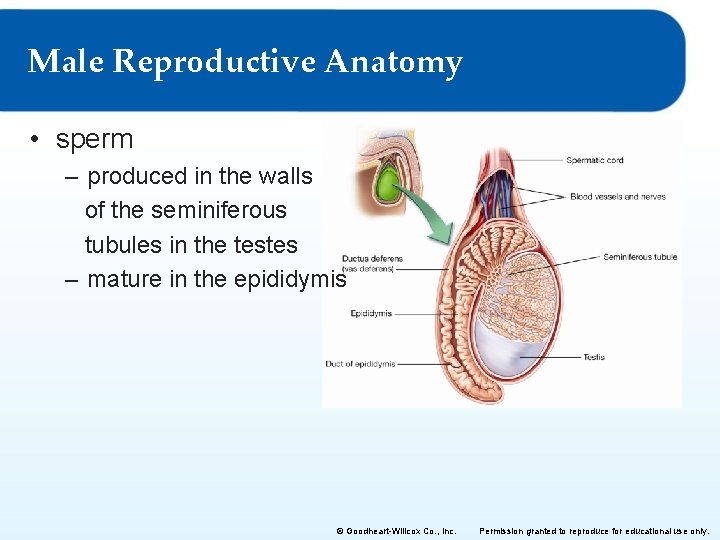
Male Reproductive Anatomy • sperm – produced in the walls of the seminiferous tubules in the testes – mature in the epididymis © Goodheart-Willcox Co. , Inc. Permission granted to reproduce for educational use only.
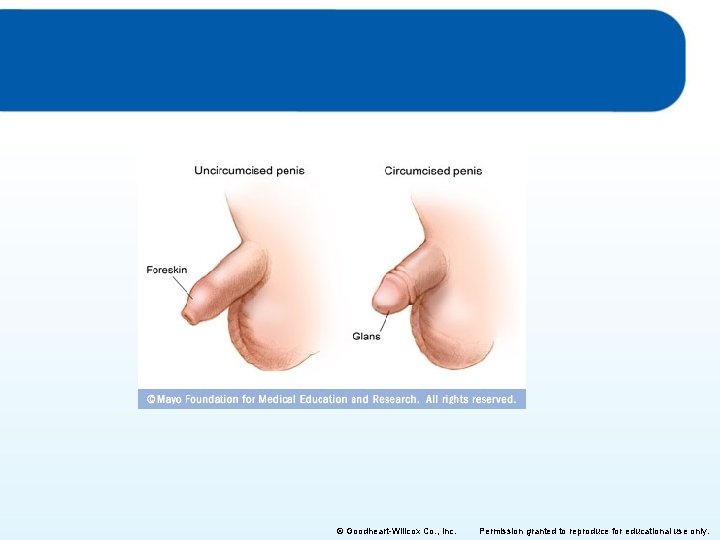
Male Reproductive Anatomy • penis – – delivers sperm to female glans penis – enlarged distal end prepuce – foreskin that covers much of the glans penis shaft • contains erectile tissue • tissues that have spaces to allow blood to pool to produce an erection – 2 corpus cavernosa – 1 corpus spongiosum – circumcision • surgical removal of the prepuce © Goodheart-Willcox Co. , Inc. Permission granted to reproduce for educational use only.
© Goodheart-Willcox Co. , Inc. Permission granted to reproduce for educational use only.
Male Reproductive Anatomy • ducts of the male reproductive system – ductus deferens (vas deferens) • carry sperm from the epididymis in the scrotum to the pelvic cavity • extends from front to back along the upper lateral border of the bladder • ampula – widened portion of ductus deferens forming a chamber at the posterior side of the bladder – ejaculatory ducts • carry sperm from the ampula to the prostate and then to the urethra © Goodheart-Willcox Co. , Inc. Permission granted to reproduce for educational use only.
Male Reproductive Anatomy © Goodheart-Willcox Co. , Inc. Permission granted to reproduce for educational use only.
Accessory Glands and Semen • semen – fluid that contains sperm – only about 10% of the volume of semen is sperm – 2 seminal glands produce up to 70% of the volume of semen – prostate glands produce between one quarter to one third of the volume of semen – 2 bulbourethral glands located below the prostate contribute a small amount of fluid to the semen – during ejaculation, between 2 -5 ml of semen is ejected – normal sperm count is between 20 million and 150 million sperm cells per ml © Goodheart-Willcox Co. , Inc. Permission granted to reproduce for educational use only.
Male Reproductive Physiology • sperm formation – spermatogenesis • formation of spermatids (haploid cells) through mitosis and meiosis – begins at puberty • sexual response – erection • neural impulses travel along parasympathetic nerve fibers to the erectile tissue of the penis • arterioles in the penis relax, filling the erectile tissue with blood – Ejaculation • discharge of sperm from the ejaculatory duct • sperm production and ejaculation © Goodheart-Willcox Co. , Inc. Permission granted to reproduce for educational use only.
Summary • spermatids are produced in the seminiferous tubules • once they develop a flagellum, they become sperm and are released into the lumen of the seminiferous tubules and travel to the epididymis • sperm achieve maturation in the epididymis and travel along the ductus deferens to the pelvic cavity to the upper part of the bladder • sperm enter the ampulla which merges with the duct from the seminal gland to form the ejaculatory duct • the sperm in the ejaculatory duct enters the prostate and then joins the urethra for exit out of the penis © Goodheart-Willcox Co. , Inc. Permission granted to reproduce for educational use only.
Review and Assessment Fill in the blanks with: epididymis, spermatogenesis, testes, or penis. 1. Sperm formation is ________. 2. The ________ delivers sperm to the female. 3. Sperm mature in the ________. 4. Sperm is produced in the ________. © Goodheart-Willcox Co. , Inc. Permission granted to reproduce for educational use only.
• Stop © Goodheart-Willcox Co. , Inc. Permission granted to reproduce for educational use only.
Chapter 15: The Male and Female Reproductive Systems Lesson 15. 3 Female Reproductive System Anatomy and Physiology
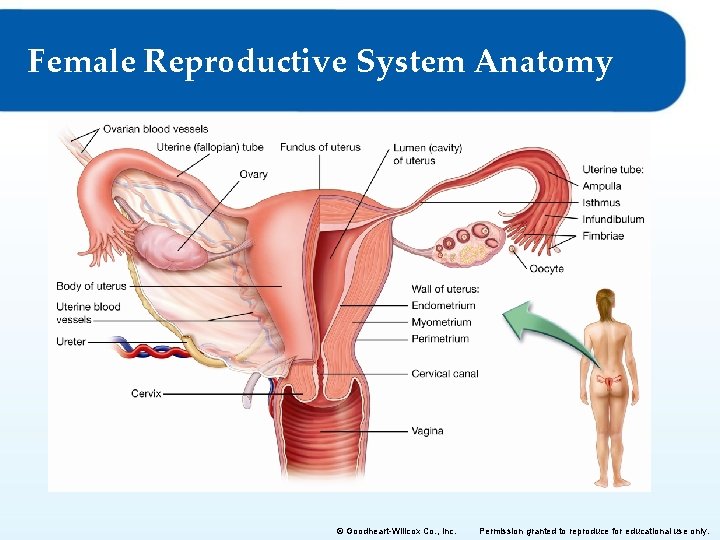
Female Reproductive System Anatomy © Goodheart-Willcox Co. , Inc. Permission granted to reproduce for educational use only.
Female Reproductive System Anatomy • the ovaries – oocyte • egg cell – ovulation • release of egg from the ovary © Goodheart-Willcox Co. , Inc. Permission granted to reproduce for educational use only.
Female Reproductive System Anatomy • ducts of the female reproductive system – uterine tubes • connect ovary to uterus • uterus–womb – endometrium – cervix © Goodheart-Willcox Co. , Inc. Permission granted to reproduce for educational use only.
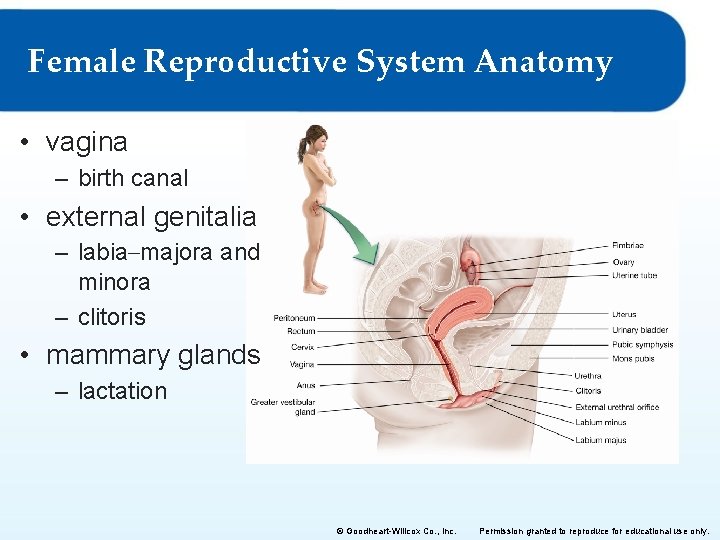
Female Reproductive System Anatomy • vagina – birth canal • external genitalia – labia–majora and minora – clitoris • mammary glands – lactation © Goodheart-Willcox Co. , Inc. Permission granted to reproduce for educational use only.
Oogenesis • • • oocyte production process begins before birth primary oocyte secondary oocyte polar bodies © Goodheart-Willcox Co. , Inc. Permission granted to reproduce for educational use only.
The Female Sexual Cycle • also known as the menstrual cycle • ovarian cycle – maturation and release of oocyte • the uterine cycle – uterus readies for implantation © Goodheart-Willcox Co. , Inc. Permission granted to reproduce for educational use only.
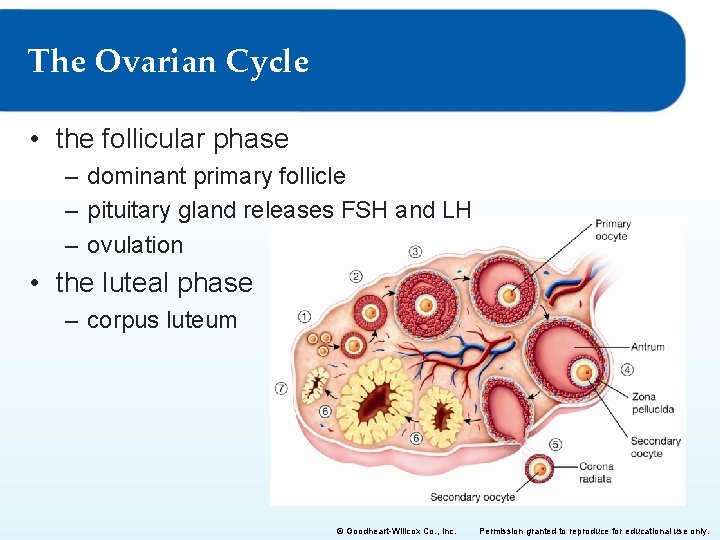
The Ovarian Cycle • the follicular phase – dominant primary follicle – pituitary gland releases FSH and LH – ovulation • the luteal phase – corpus luteum © Goodheart-Willcox Co. , Inc. Permission granted to reproduce for educational use only.
The Uterine Cycle • the menstrual phase – endometrium breaks down and sheds • the proliferative phase – endometrium grows back • the secretory phase – endometrium prepares to nourish embryo © Goodheart-Willcox Co. , Inc. Permission granted to reproduce for educational use only.
Female Sexual Response • stimulation – tactile – psychological • orgasm © Goodheart-Willcox Co. , Inc. Permission granted to reproduce for educational use only.
Review and Assessment True or False? 1. The vagina is the birth canal. 2. Oogenesis makes sperm. 3. The ovary is also called the womb. 4. Oogenesis begins before birth. 5. Ovulation is release of sperm from the ovary. © Goodheart-Willcox Co. , Inc. Permission granted to reproduce for educational use only.
Chapter 15: The Male and Female Reproductive Systems Lesson 15. 4 Fertilization, Pregnancy, and Birth
Fertilization, Pregnancy, and Birth • • fertilization of the oocyte pregnancy childbirth lactation © Goodheart-Willcox Co. , Inc. Permission granted to reproduce for educational use only.
Fertilization of the Oocyte • the journey of the sperm – vagina, uterus, uterine tube – capacitation takes up to 10 hours • sperm penetration – zona pellucida – acrosomal enzymes © Goodheart-Willcox Co. , Inc. Permission granted to reproduce for educational use only.
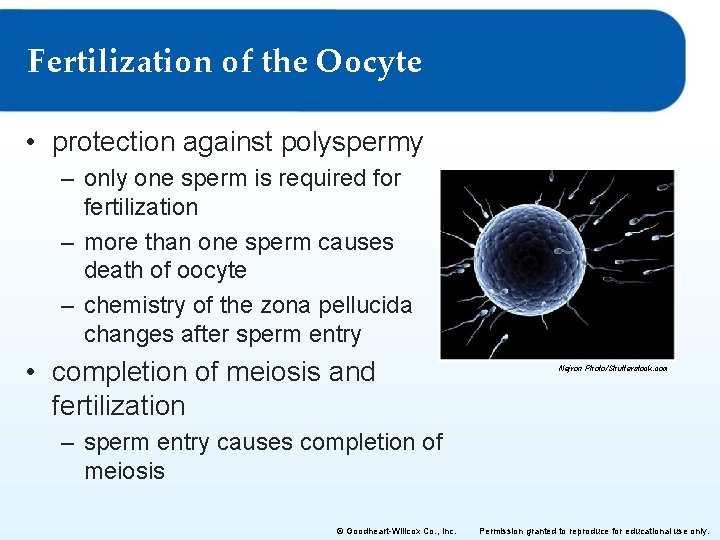
Fertilization of the Oocyte • protection against polyspermy – only one sperm is required for fertilization – more than one sperm causes death of oocyte – chemistry of the zona pellucida changes after sperm entry • completion of meiosis and fertilization Nejron Photo/Shutterstock. com – sperm entry causes completion of meiosis © Goodheart-Willcox Co. , Inc. Permission granted to reproduce for educational use only.
Pregnancy • lasts approximately 265 days • from fertilization to implantation • development of the placenta, embryo, and fetus © Goodheart-Willcox Co. , Inc. Permission granted to reproduce for educational use only.
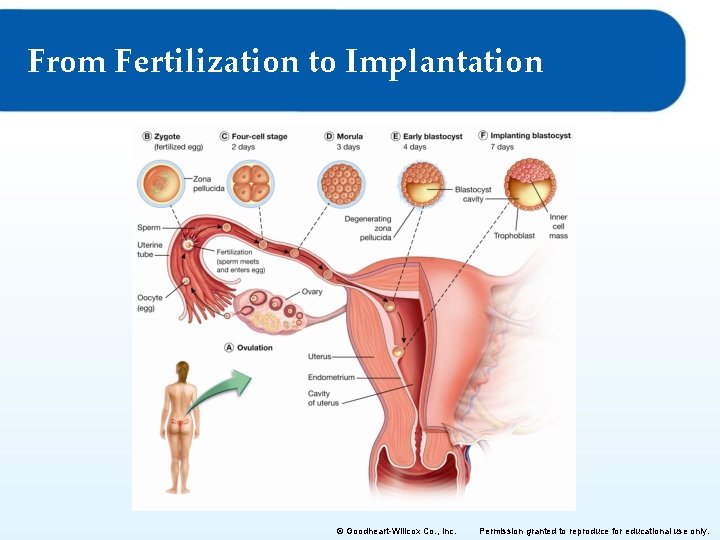
From Fertilization to Implantation • cell stages – zygote – morula – blastocyst • implantation – blastocyst binds to endometrium © Goodheart-Willcox Co. , Inc. Permission granted to reproduce for educational use only.
From Fertilization to Implantation © Goodheart-Willcox Co. , Inc. Permission granted to reproduce for educational use only.
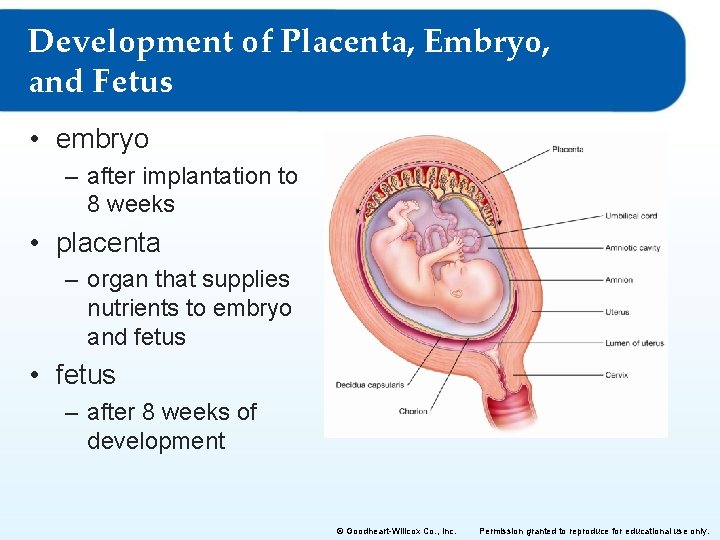
Development of Placenta, Embryo, and Fetus • embryo – after implantation to 8 weeks • placenta – organ that supplies nutrients to embryo and fetus • fetus – after 8 weeks of development © Goodheart-Willcox Co. , Inc. Permission granted to reproduce for educational use only.
Childbirth • parturition – birth • oxytocin • stages of labor – dilation – expulsion – delivery of placenta © Goodheart-Willcox Co. , Inc. Permission granted to reproduce for educational use only.
Lactation • production of breast milk • activation of milk-producing cells – prolactin • delivery of milk through ducts to the nipple – oxytocin © Goodheart-Willcox Co. , Inc. Permission granted to reproduce for educational use only.
Review and Assessment Match these words with 1– 4 below: dilation, prolactin, implantation, birth. 1. activation of milk producing cells 2. parturition 3. a stage of labor 4. blastocyst binds to endometrium © Goodheart-Willcox Co. , Inc. Permission granted to reproduce for educational use only.
Chapter 15: The Male and Female Reproductive Systems Lesson 15. 5 Disorders and Diseases of the Reproductive System
Infertility • male infertility – low sperm count – erectile dysfunction • female infertility – failure to ovulate – inability of egg to reach uterine tube – lack of implantation © Goodheart-Willcox Co. , Inc. Permission granted to reproduce for educational use only.
Infertility • treatment for infertility – lifestyle changes – drugs to induce ovulation – surgery to correct anatomical issues • in vitro fertilization – oocyte and sperm combined outside mother’s body © Goodheart-Willcox Co. , Inc. Permission granted to reproduce for educational use only.
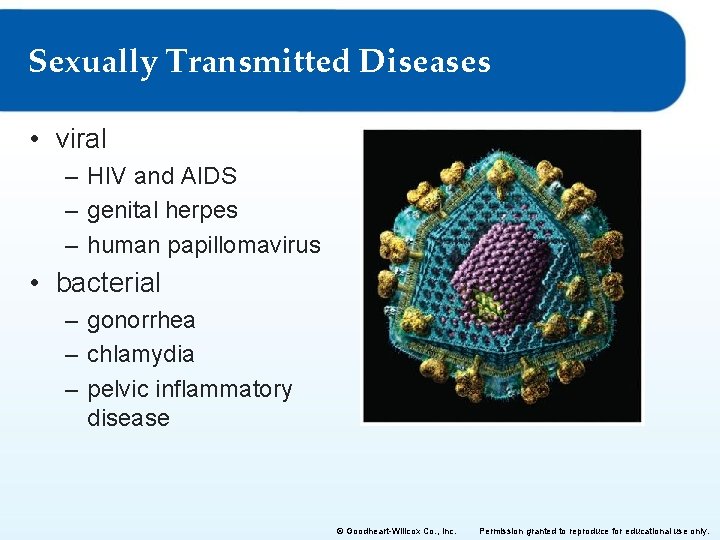
Sexually Transmitted Diseases • viral – HIV and AIDS – genital herpes – human papillomavirus • bacterial – gonorrhea – chlamydia – pelvic inflammatory disease © Goodheart-Willcox Co. , Inc. Permission granted to reproduce for educational use only.
Sexually Transmitted Diseases • detection and prevention – symptoms • genital discharge, sores, rash, burning during urination, and growths – prevention • condom, abstinence © Goodheart-Willcox Co. , Inc. Permission granted to reproduce for educational use only.
Cancers of the Reproductive System • prostate cancer – PSA test • cancers of the female reproductive tract – – uterine cancer ovarian cancer cervical cancer breast cancer © Goodheart-Willcox Co. , Inc. Permission granted to reproduce for educational use only.
Review and Assessment True or False? 1. Abstinence will prevent spread of STDs. 2. A virus causes AIDS. 3. A virus causes gonorrhea. 4. A bacterium causes genital herpes. 5. Genital discharge is a symptom of STDs. © Goodheart-Willcox Co. , Inc. Permission granted to reproduce for educational use only.