
15 Poisson Processes In Lecture 4 we introduced
- Slides: 47
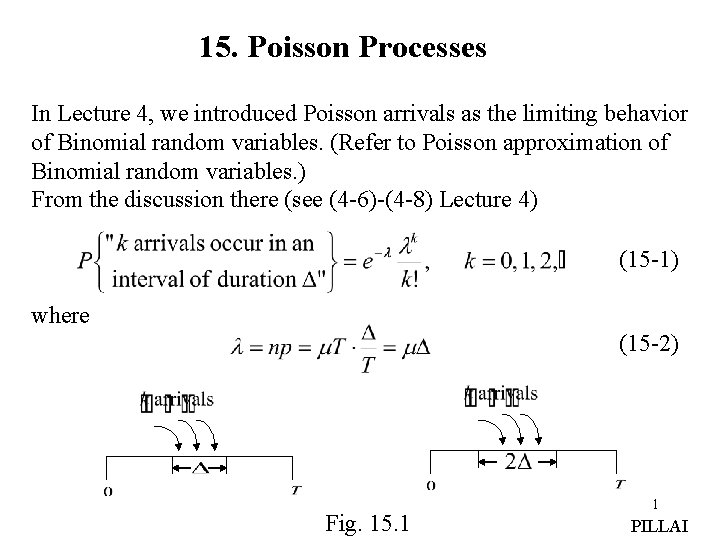
15. Poisson Processes In Lecture 4, we introduced Poisson arrivals as the limiting behavior of Binomial random variables. (Refer to Poisson approximation of Binomial random variables. ) From the discussion there (see (4 -6)-(4 -8) Lecture 4) (15 -1) where (15 -2) Fig. 15. 1 1 PILLAI
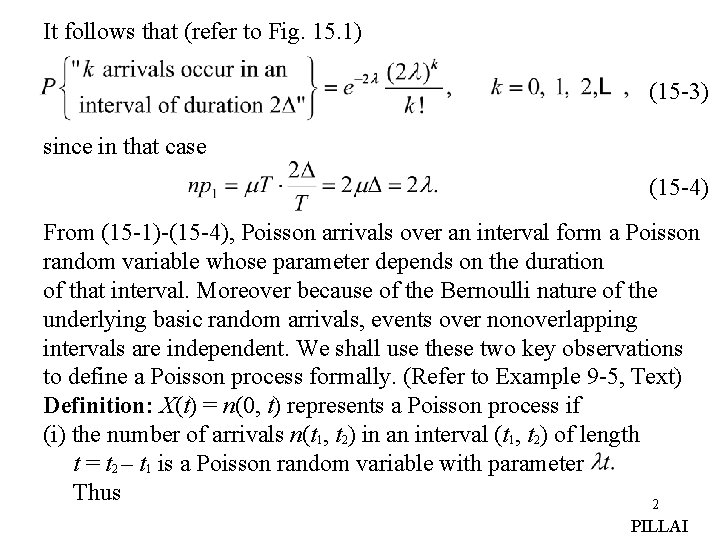
It follows that (refer to Fig. 15. 1) (15 -3) since in that case (15 -4) From (15 -1)-(15 -4), Poisson arrivals over an interval form a Poisson random variable whose parameter depends on the duration of that interval. Moreover because of the Bernoulli nature of the underlying basic random arrivals, events over nonoverlapping intervals are independent. We shall use these two key observations to define a Poisson process formally. (Refer to Example 9 -5, Text) Definition: X(t) = n(0, t) represents a Poisson process if (i) the number of arrivals n(t 1, t 2) in an interval (t 1, t 2) of length t = t 2 – t 1 is a Poisson random variable with parameter Thus 2 PILLAI
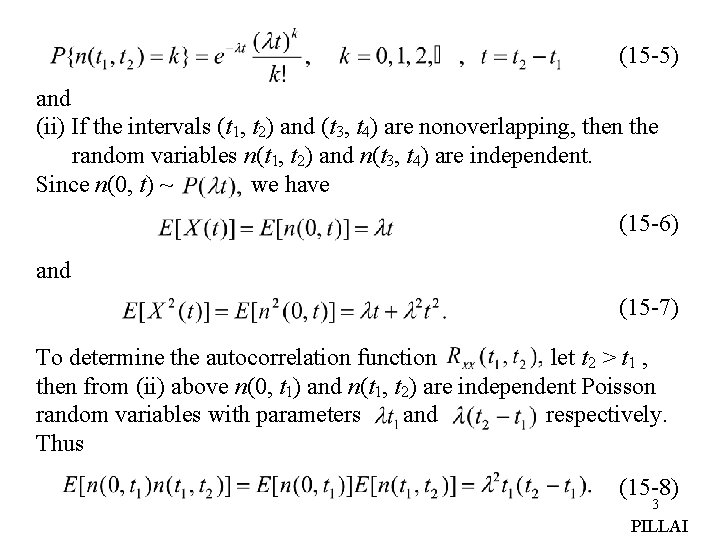
(15 -5) and (ii) If the intervals (t 1, t 2) and (t 3, t 4) are nonoverlapping, then the random variables n(t 1, t 2) and n(t 3, t 4) are independent. Since n(0, t) ~ we have (15 -6) and (15 -7) To determine the autocorrelation function let t 2 > t 1 , then from (ii) above n(0, t 1) and n(t 1, t 2) are independent Poisson random variables with parameters and respectively. Thus (15 -8) 3 PILLAI
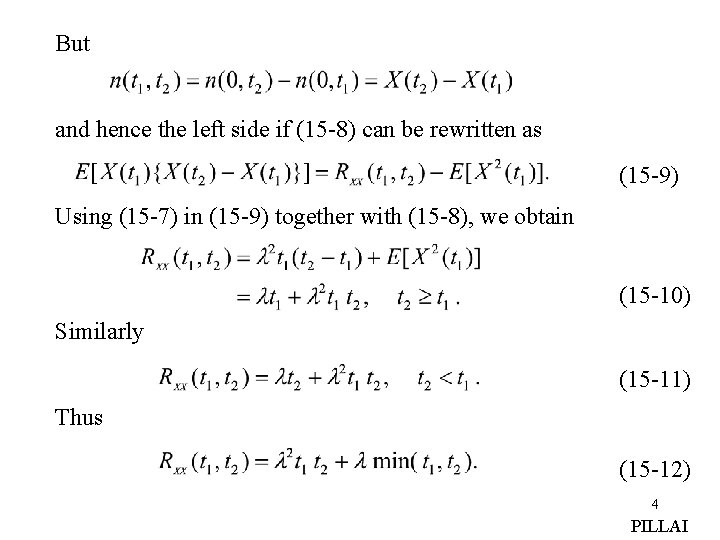
But and hence the left side if (15 -8) can be rewritten as (15 -9) Using (15 -7) in (15 -9) together with (15 -8), we obtain (15 -10) Similarly (15 -11) Thus (15 -12) 4 PILLAI
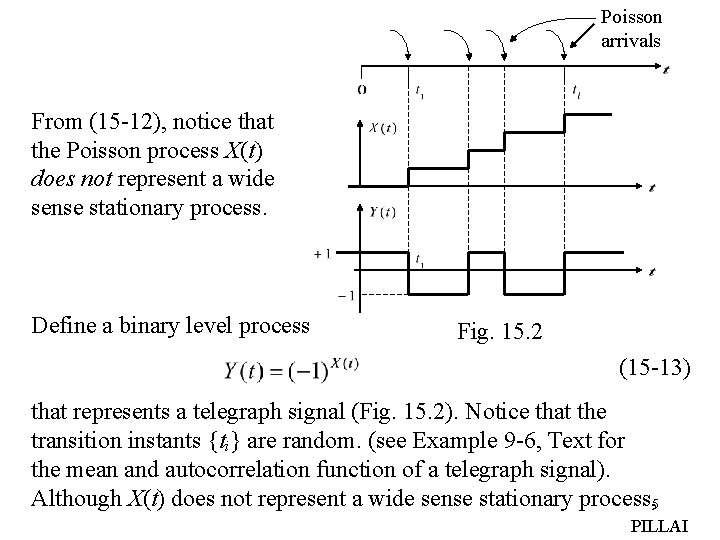
Poisson arrivals From (15 -12), notice that the Poisson process X(t) does not represent a wide sense stationary process. Define a binary level process Fig. 15. 2 (15 -13) that represents a telegraph signal (Fig. 15. 2). Notice that the transition instants {ti} are random. (see Example 9 -6, Text for the mean and autocorrelation function of a telegraph signal). Although X(t) does not represent a wide sense stationary process, 5 PILLAI
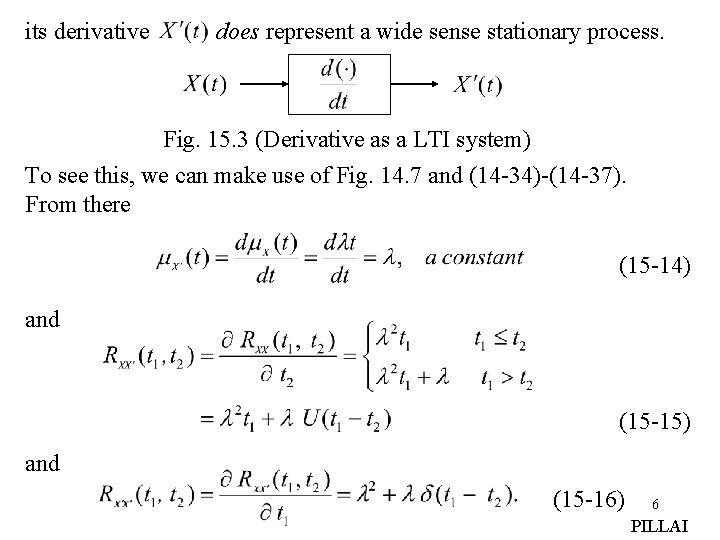
its derivative does represent a wide sense stationary process. Fig. 15. 3 (Derivative as a LTI system) To see this, we can make use of Fig. 14. 7 and (14 -34)-(14 -37). From there (15 -14) and (15 -15) and (15 -16) 6 PILLAI
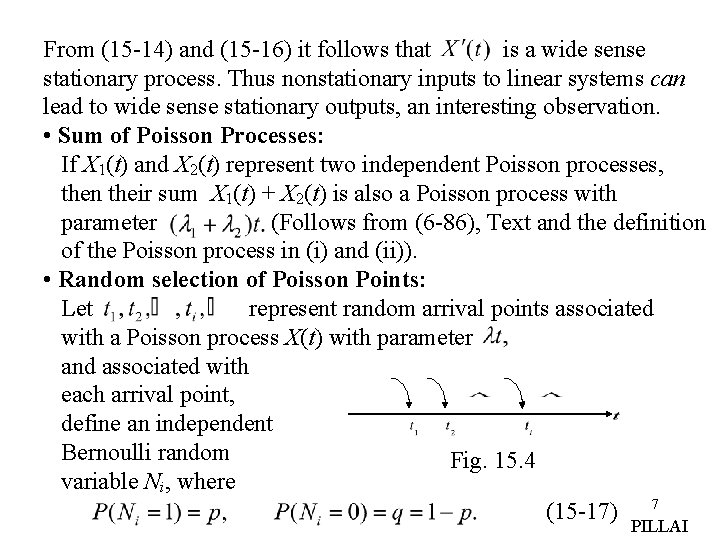
From (15 -14) and (15 -16) it follows that is a wide sense stationary process. Thus nonstationary inputs to linear systems can lead to wide sense stationary outputs, an interesting observation. • Sum of Poisson Processes: If X 1(t) and X 2(t) represent two independent Poisson processes, then their sum X 1(t) + X 2(t) is also a Poisson process with parameter (Follows from (6 -86), Text and the definition of the Poisson process in (i) and (ii)). • Random selection of Poisson Points: Let represent random arrival points associated with a Poisson process X(t) with parameter and associated with each arrival point, define an independent Bernoulli random Fig. 15. 4 variable Ni, where (15 -17) 7 PILLAI
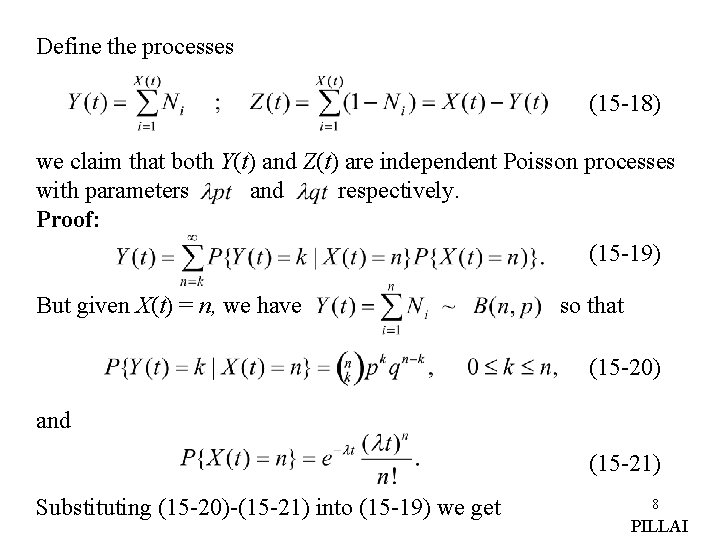
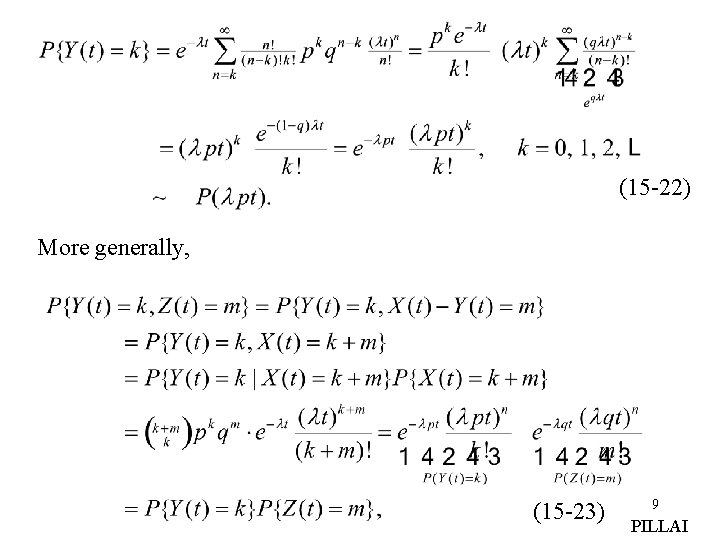
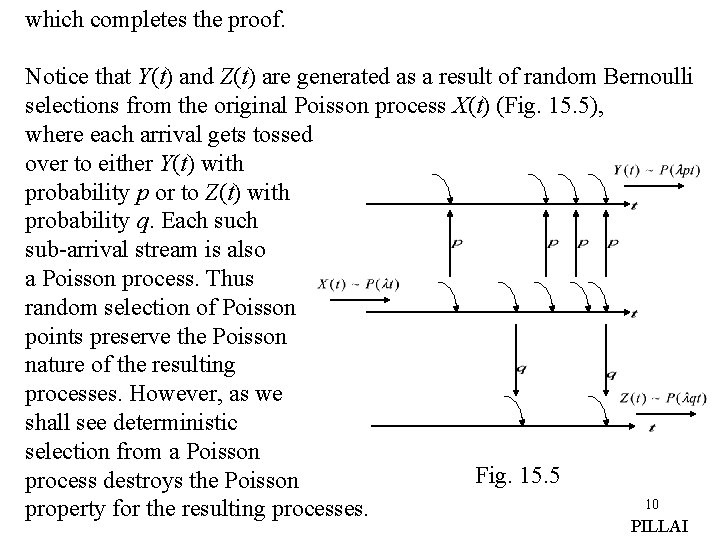
Define the processes (15 -18) we claim that both Y(t) and Z(t) are independent Poisson processes with parameters and respectively. Proof: (15 -19) But given X(t) = n, we have so that (15 -20) and (15 -21) Substituting (15 -20)-(15 -21) into (15 -19) we get 8 PILLAI
(15 -22) More generally, (15 -23) 9 PILLAI
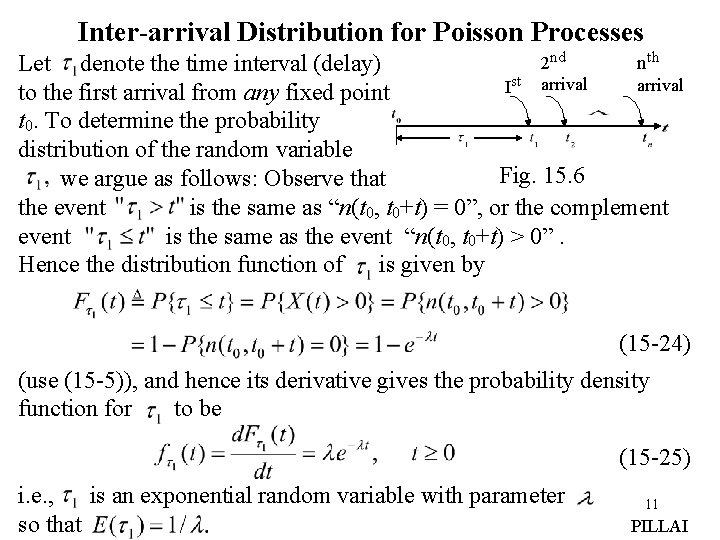
which completes the proof. Notice that Y(t) and Z(t) are generated as a result of random Bernoulli selections from the original Poisson process X(t) (Fig. 15. 5), where each arrival gets tossed over to either Y(t) with probability p or to Z(t) with probability q. Each sub-arrival stream is also a Poisson process. Thus random selection of Poisson points preserve the Poisson nature of the resulting processes. However, as we shall see deterministic selection from a Poisson Fig. 15. 5 process destroys the Poisson 10 property for the resulting processes. PILLAI
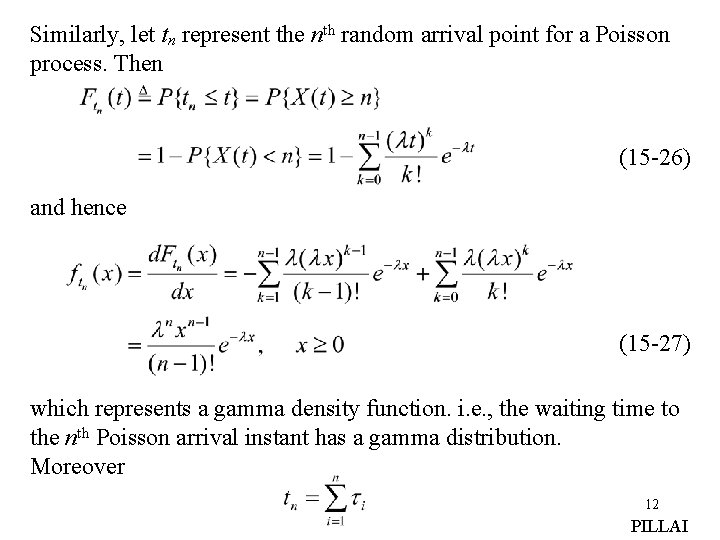
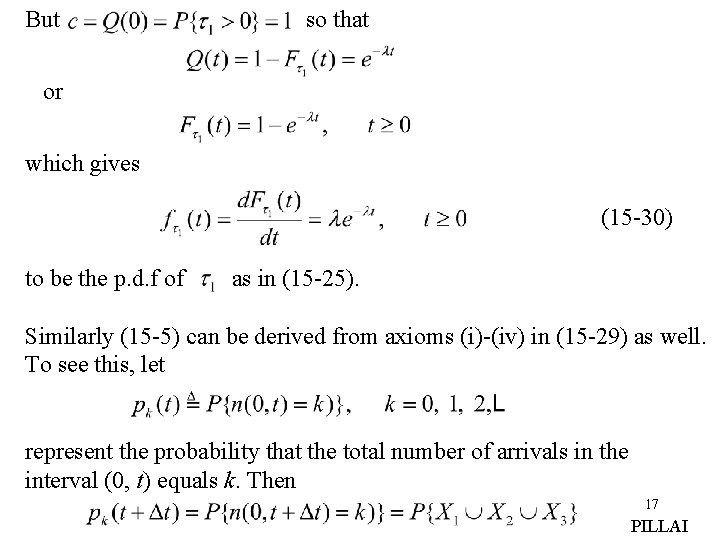
Inter-arrival Distribution for Poisson Processes 2 nd nth Let denote the time interval (delay) arrival Ist arrival to the first arrival from any fixed point t 0. To determine the probability distribution of the random variable Fig. 15. 6 we argue as follows: Observe that the event is the same as “n(t 0, t 0+t) = 0”, or the complement event is the same as the event “n(t 0, t 0+t) > 0”. Hence the distribution function of is given by (15 -24) (use (15 -5)), and hence its derivative gives the probability density function for to be (15 -25) i. e. , is an exponential random variable with parameter so that 11 PILLAI
Similarly, let tn represent the nth random arrival point for a Poisson process. Then (15 -26) and hence (15 -27) which represents a gamma density function. i. e. , the waiting time to the nth Poisson arrival instant has a gamma distribution. Moreover 12 PILLAI
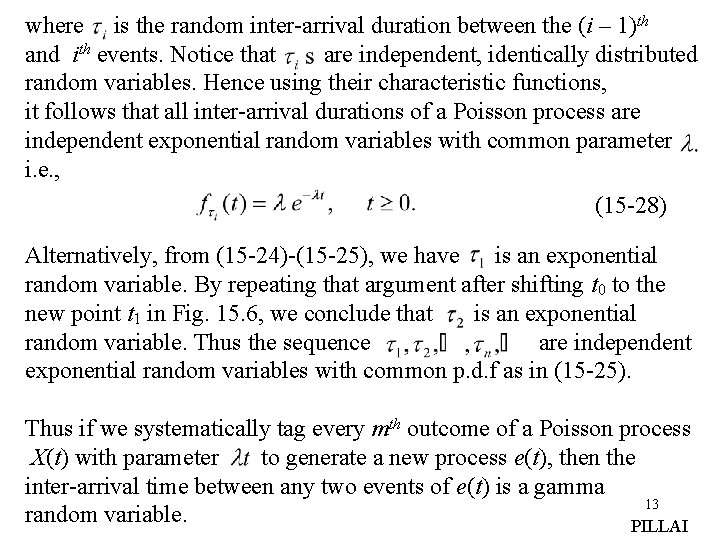
where is the random inter-arrival duration between the (i – 1)th and ith events. Notice that are independent, identically distributed random variables. Hence using their characteristic functions, it follows that all inter-arrival durations of a Poisson process are independent exponential random variables with common parameter i. e. , (15 -28) Alternatively, from (15 -24)-(15 -25), we have is an exponential random variable. By repeating that argument after shifting t 0 to the new point t 1 in Fig. 15. 6, we conclude that is an exponential random variable. Thus the sequence are independent exponential random variables with common p. d. f as in (15 -25). Thus if we systematically tag every mth outcome of a Poisson process X(t) with parameter to generate a new process e(t), then the inter-arrival time between any two events of e(t) is a gamma 13 random variable. PILLAI
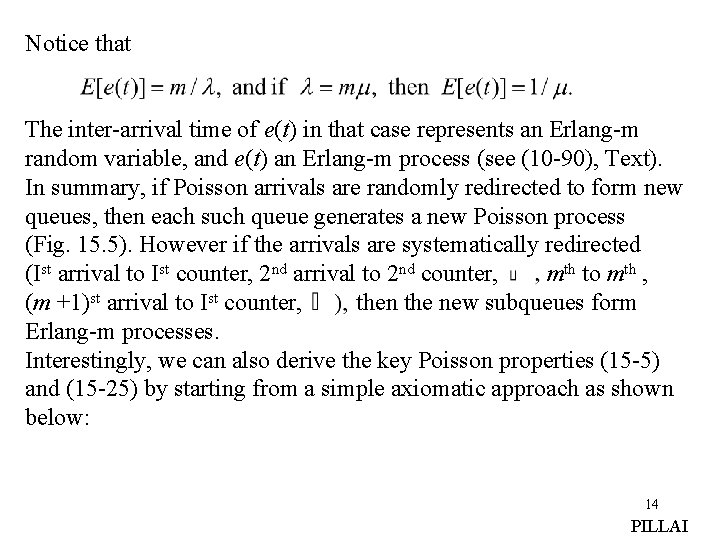
Notice that The inter-arrival time of e(t) in that case represents an Erlang-m random variable, and e(t) an Erlang-m process (see (10 -90), Text). In summary, if Poisson arrivals are randomly redirected to form new queues, then each such queue generates a new Poisson process (Fig. 15. 5). However if the arrivals are systematically redirected (Ist arrival to Ist counter, 2 nd arrival to 2 nd counter, mth to mth , (m +1)st arrival to Ist counter, then the new subqueues form Erlang-m processes. Interestingly, we can also derive the key Poisson properties (15 -5) and (15 -25) by starting from a simple axiomatic approach as shown below: 14 PILLAI
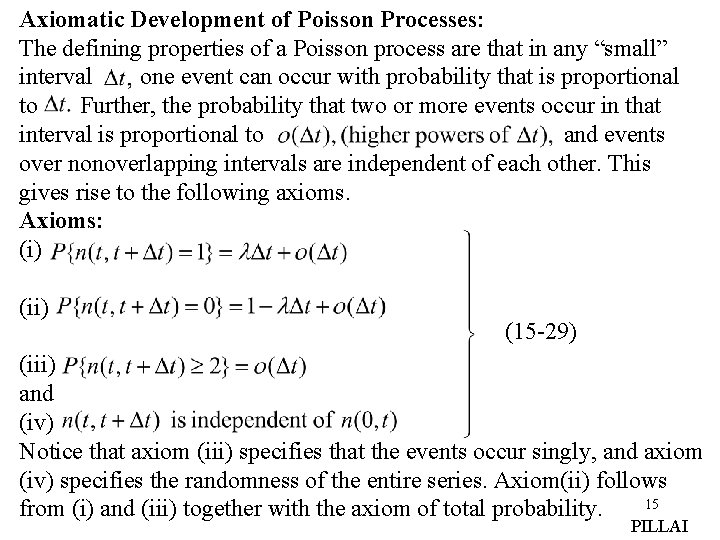
Axiomatic Development of Poisson Processes: The defining properties of a Poisson process are that in any “small” interval one event can occur with probability that is proportional to Further, the probability that two or more events occur in that interval is proportional to and events over nonoverlapping intervals are independent of each other. This gives rise to the following axioms. Axioms: (i) (ii) (15 -29) (iii) and (iv) Notice that axiom (iii) specifies that the events occur singly, and axiom (iv) specifies the randomness of the entire series. Axiom(ii) follows 15 from (i) and (iii) together with the axiom of total probability. PILLAI
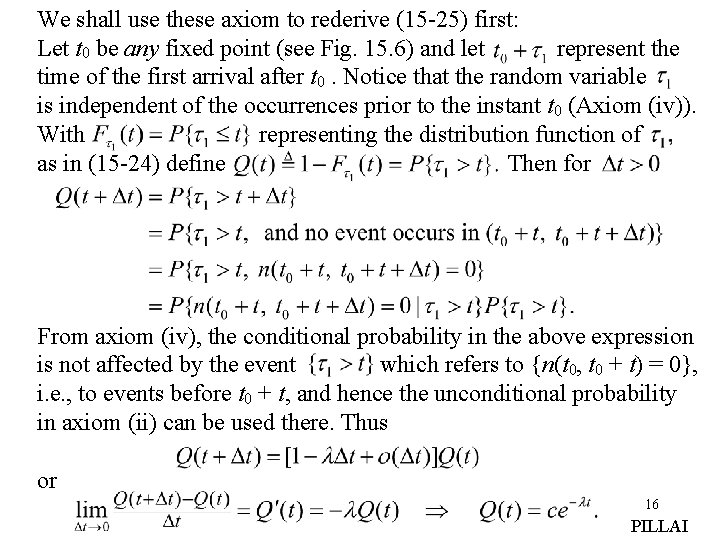
We shall use these axiom to rederive (15 -25) first: Let t 0 be any fixed point (see Fig. 15. 6) and let represent the time of the first arrival after t 0. Notice that the random variable is independent of the occurrences prior to the instant t 0 (Axiom (iv)). With representing the distribution function of as in (15 -24) define Then for From axiom (iv), the conditional probability in the above expression is not affected by the event which refers to {n(t 0, t 0 + t) = 0}, i. e. , to events before t 0 + t, and hence the unconditional probability in axiom (ii) can be used there. Thus or 16 PILLAI
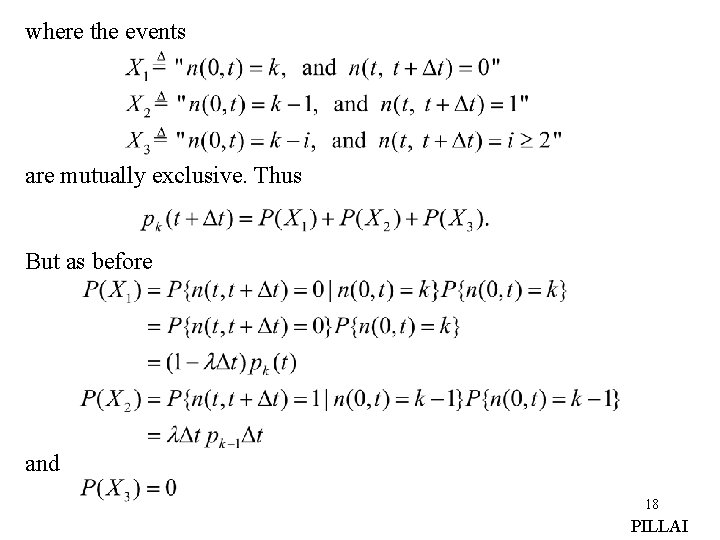
But so that or which gives (15 -30) to be the p. d. f of as in (15 -25). Similarly (15 -5) can be derived from axioms (i)-(iv) in (15 -29) as well. To see this, let represent the probability that the total number of arrivals in the interval (0, t) equals k. Then 17 PILLAI
where the events are mutually exclusive. Thus But as before and 18 PILLAI
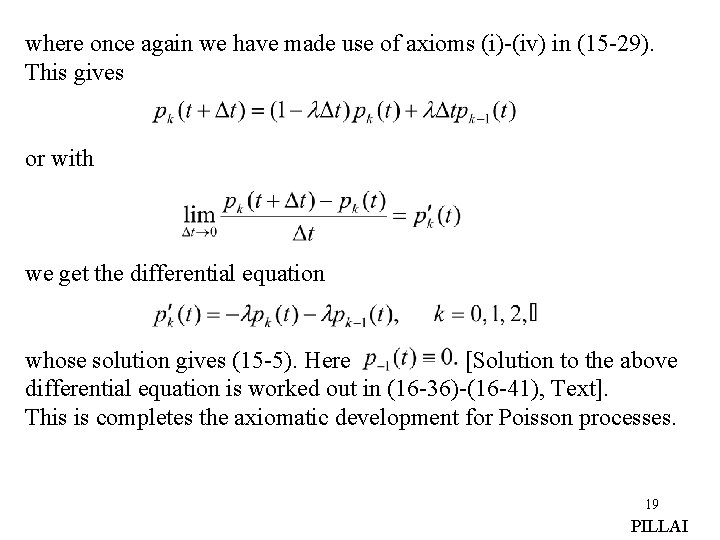
where once again we have made use of axioms (i)-(iv) in (15 -29). This gives or with we get the differential equation whose solution gives (15 -5). Here [Solution to the above differential equation is worked out in (16 -36)-(16 -41), Text]. This is completes the axiomatic development for Poisson processes. 19 PILLAI
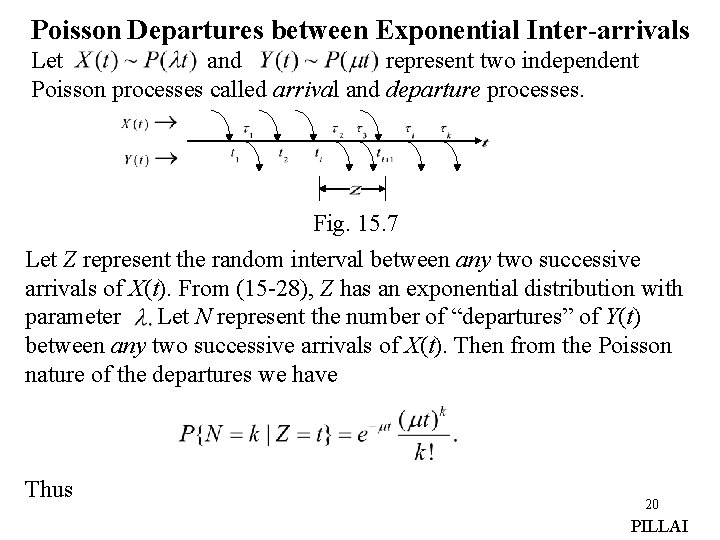
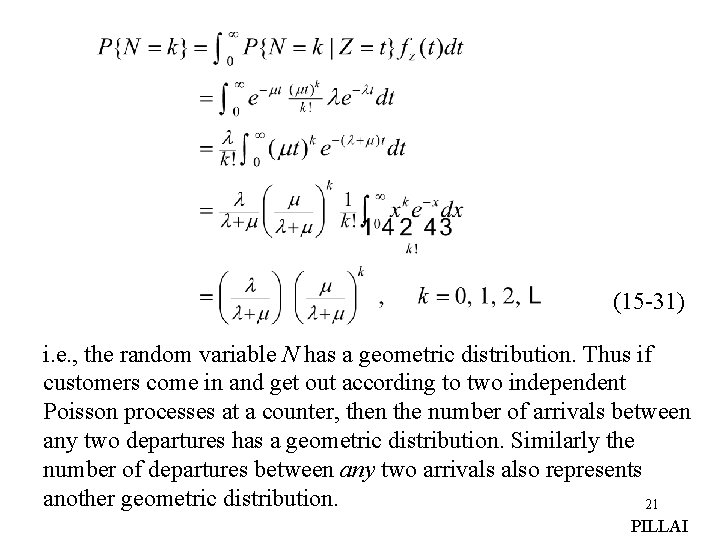
Poisson Departures between Exponential Inter-arrivals Let and represent two independent Poisson processes called arrival and departure processes. Fig. 15. 7 Let Z represent the random interval between any two successive arrivals of X(t). From (15 -28), Z has an exponential distribution with parameter Let N represent the number of “departures” of Y(t) between any two successive arrivals of X(t). Then from the Poisson nature of the departures we have Thus 20 PILLAI
(15 -31) i. e. , the random variable N has a geometric distribution. Thus if customers come in and get out according to two independent Poisson processes at a counter, then the number of arrivals between any two departures has a geometric distribution. Similarly the number of departures between any two arrivals also represents another geometric distribution. 21 PILLAI
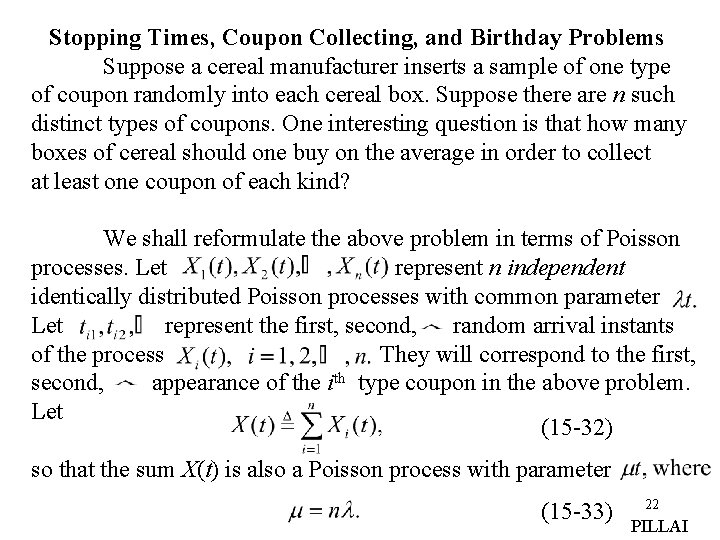
Stopping Times, Coupon Collecting, and Birthday Problems Suppose a cereal manufacturer inserts a sample of one type of coupon randomly into each cereal box. Suppose there are n such distinct types of coupons. One interesting question is that how many boxes of cereal should one buy on the average in order to collect at least one coupon of each kind? We shall reformulate the above problem in terms of Poisson processes. Let represent n independent identically distributed Poisson processes with common parameter Let represent the first, second, random arrival instants of the process They will correspond to the first, second, appearance of the ith type coupon in the above problem. Let (15 -32) so that the sum X(t) is also a Poisson process with parameter (15 -33) 22 PILLAI
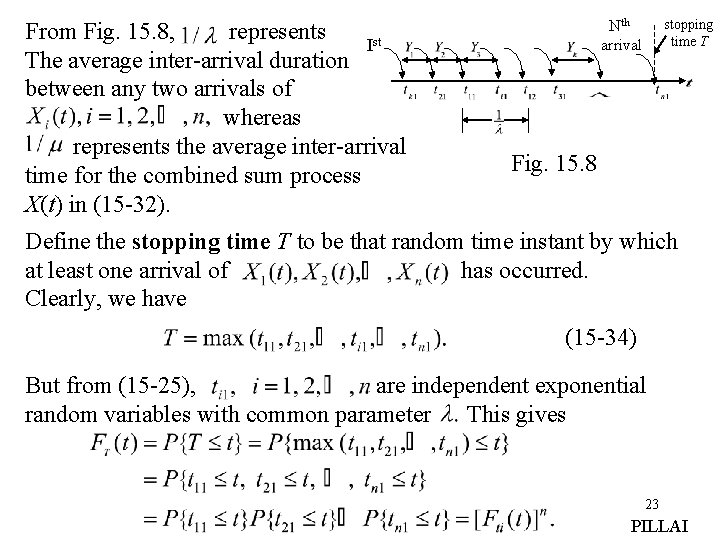
From Fig. 15. 8, represents Ist The average inter-arrival duration between any two arrivals of whereas represents the average inter-arrival time for the combined sum process X(t) in (15 -32). stopping time T Nth arrival Fig. 15. 8 Define the stopping time T to be that random time instant by which at least one arrival of has occurred. Clearly, we have (15 -34) But from (15 -25), are independent exponential random variables with common parameter This gives 23 PILLAI
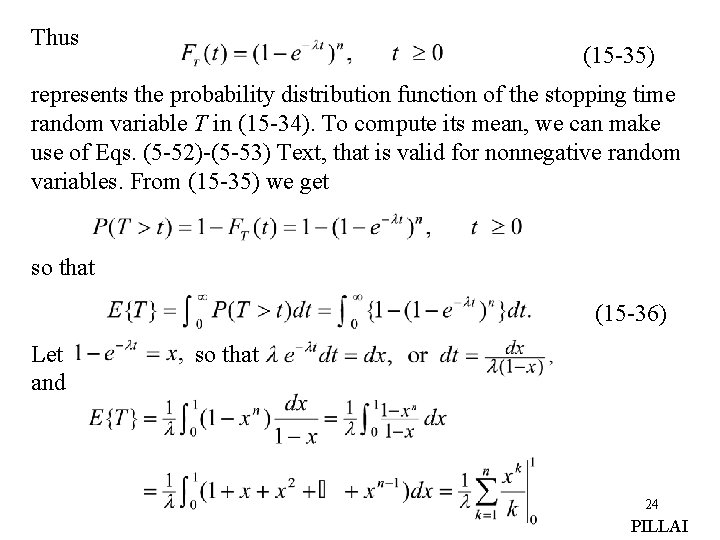
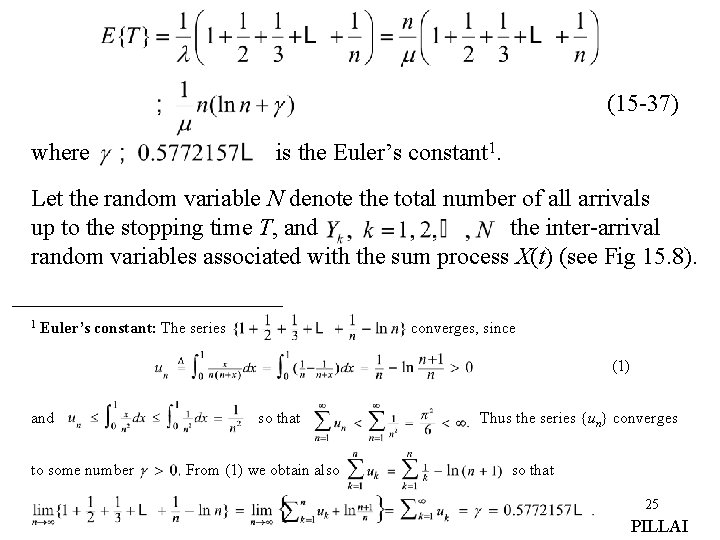
Thus (15 -35) represents the probability distribution function of the stopping time random variable T in (15 -34). To compute its mean, we can make use of Eqs. (5 -52)-(5 -53) Text, that is valid for nonnegative random variables. From (15 -35) we get so that (15 -36) Let and so that 24 PILLAI
(15 -37) where is the Euler’s constant 1. Let the random variable N denote the total number of all arrivals up to the stopping time T, and the inter-arrival random variables associated with the sum process X(t) (see Fig 15. 8). 1 Euler’s constant: The series converges, since (1) and to some number so that From (1) we obtain also Thus the series {un} converges so that 25 PILLAI
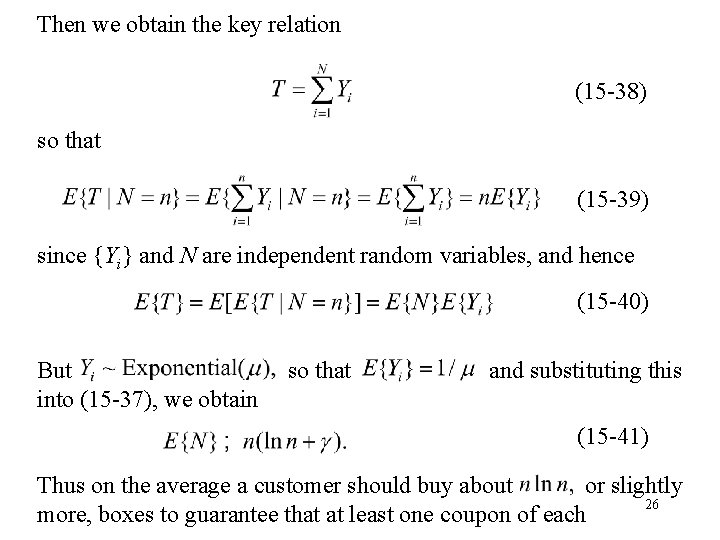
Then we obtain the key relation (15 -38) so that (15 -39) since {Yi} and N are independent random variables, and hence (15 -40) But into (15 -37), we obtain so that and substituting this (15 -41) Thus on the average a customer should buy about or slightly 26 more, boxes to guarantee that at least one coupon of each
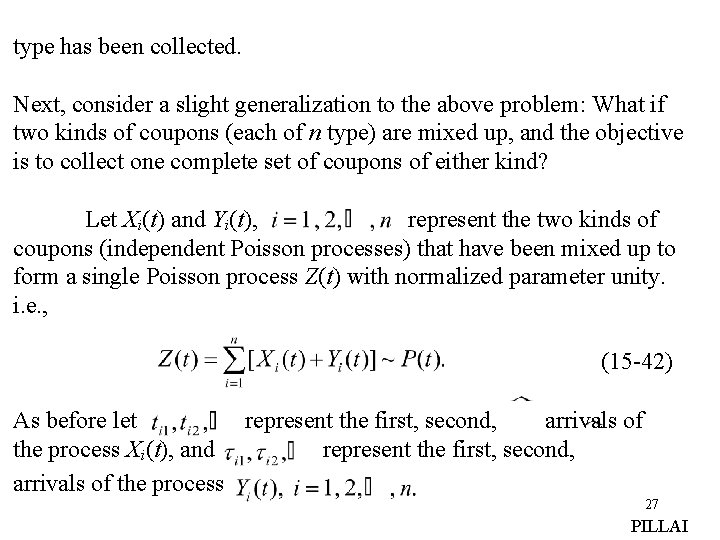
type has been collected. Next, consider a slight generalization to the above problem: What if two kinds of coupons (each of n type) are mixed up, and the objective is to collect one complete set of coupons of either kind? Let Xi(t) and Yi(t), represent the two kinds of coupons (independent Poisson processes) that have been mixed up to form a single Poisson process Z(t) with normalized parameter unity. i. e. , (15 -42) As before let represent the first, second, arrivals of the process Xi(t), and represent the first, second, arrivals of the process 27 PILLAI
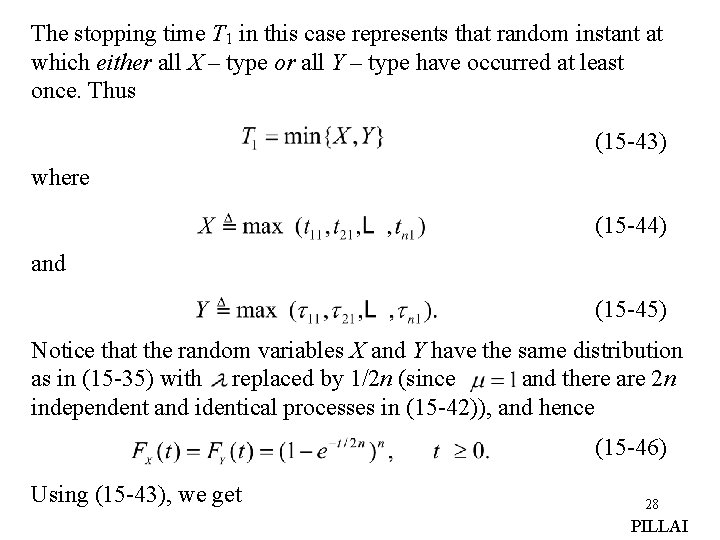
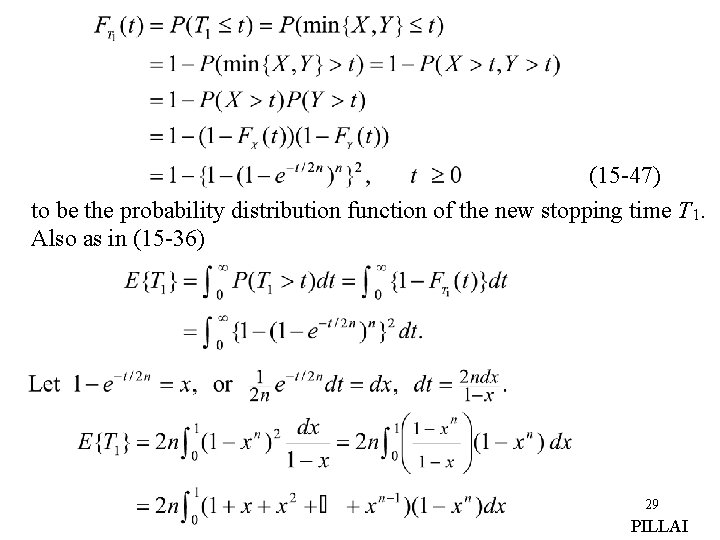
The stopping time T 1 in this case represents that random instant at which either all X – type or all Y – type have occurred at least once. Thus (15 -43) where (15 -44) and (15 -45) Notice that the random variables X and Y have the same distribution as in (15 -35) with replaced by 1/2 n (since and there are 2 n independent and identical processes in (15 -42)), and hence (15 -46) Using (15 -43), we get 28 PILLAI
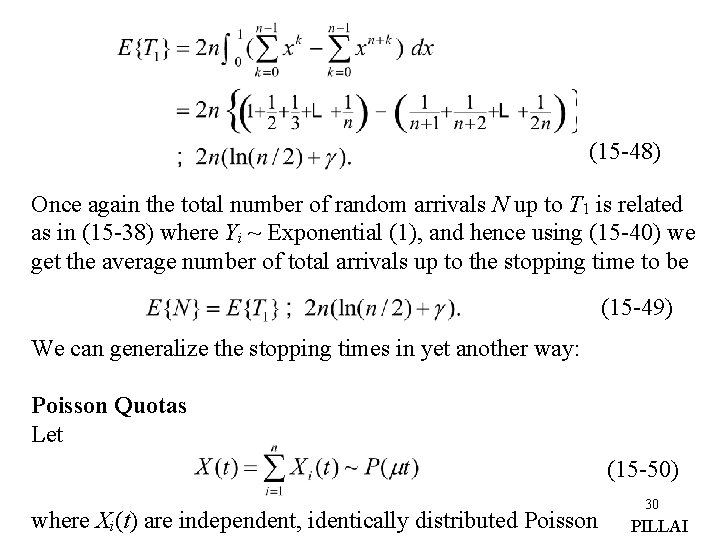
(15 -47) to be the probability distribution function of the new stopping time T 1. Also as in (15 -36) 29 PILLAI
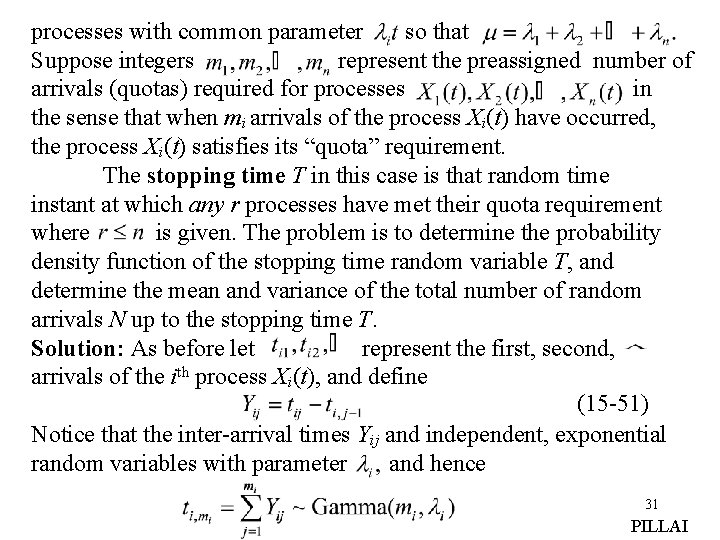
(15 -48) Once again the total number of random arrivals N up to T 1 is related as in (15 -38) where Yi ~ Exponential (1), and hence using (15 -40) we get the average number of total arrivals up to the stopping time to be (15 -49) We can generalize the stopping times in yet another way: Poisson Quotas Let (15 -50) where Xi(t) are independent, identically distributed Poisson 30 PILLAI
processes with common parameter so that Suppose integers represent the preassigned number of arrivals (quotas) required for processes in the sense that when mi arrivals of the process Xi(t) have occurred, the process Xi(t) satisfies its “quota” requirement. The stopping time T in this case is that random time instant at which any r processes have met their quota requirement where is given. The problem is to determine the probability density function of the stopping time random variable T, and determine the mean and variance of the total number of random arrivals N up to the stopping time T. Solution: As before let represent the first, second, arrivals of the ith process Xi(t), and define (15 -51) Notice that the inter-arrival times Yij and independent, exponential random variables with parameter and hence 31 PILLAI
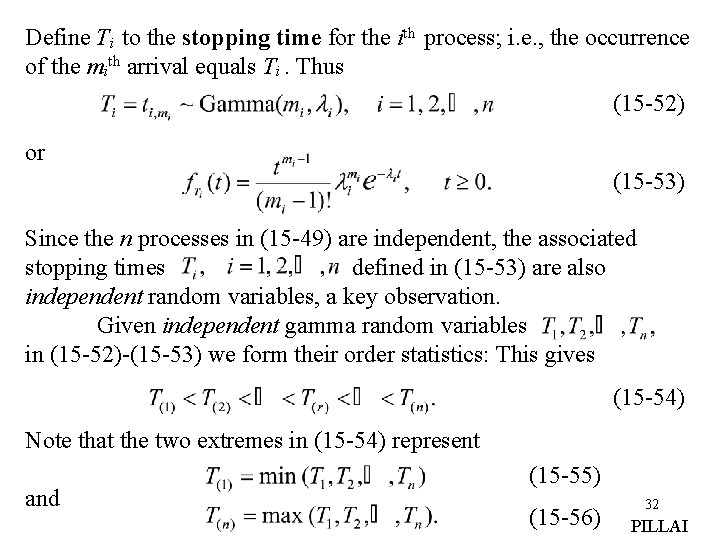
Define Ti to the stopping time for the ith process; i. e. , the occurrence of the mith arrival equals Ti. Thus (15 -52) or (15 -53) Since the n processes in (15 -49) are independent, the associated stopping times defined in (15 -53) are also independent random variables, a key observation. Given independent gamma random variables in (15 -52)-(15 -53) we form their order statistics: This gives (15 -54) Note that the two extremes in (15 -54) represent and (15 -55) (15 -56) 32 PILLAI
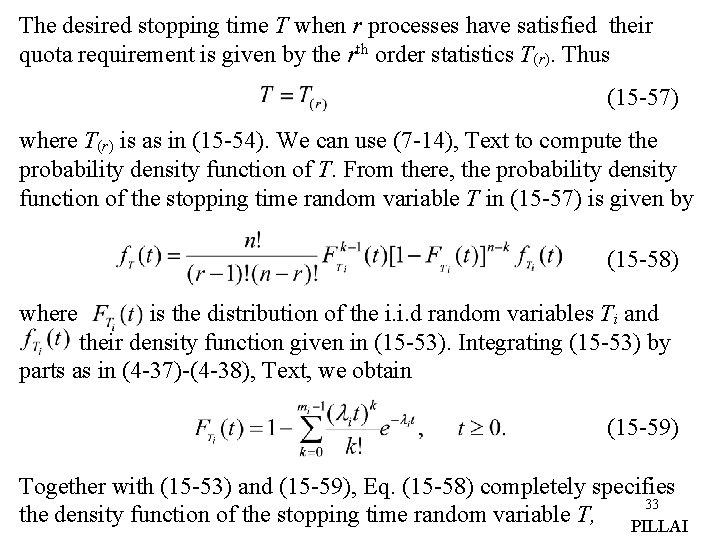
The desired stopping time T when r processes have satisfied their quota requirement is given by the rth order statistics T(r). Thus (15 -57) where T(r) is as in (15 -54). We can use (7 -14), Text to compute the probability density function of T. From there, the probability density function of the stopping time random variable T in (15 -57) is given by (15 -58) where is the distribution of the i. i. d random variables Ti and their density function given in (15 -53). Integrating (15 -53) by parts as in (4 -37)-(4 -38), Text, we obtain (15 -59) Together with (15 -53) and (15 -59), Eq. (15 -58) completely specifies 33 the density function of the stopping time random variable T, PILLAI
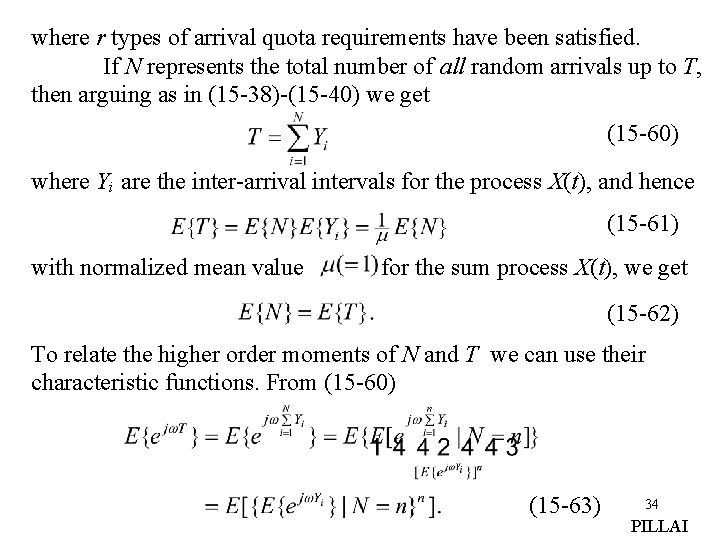
where r types of arrival quota requirements have been satisfied. If N represents the total number of all random arrivals up to T, then arguing as in (15 -38)-(15 -40) we get (15 -60) where Yi are the inter-arrival intervals for the process X(t), and hence (15 -61) with normalized mean value for the sum process X(t), we get (15 -62) To relate the higher order moments of N and T we can use their characteristic functions. From (15 -60) (15 -63) 34 PILLAI
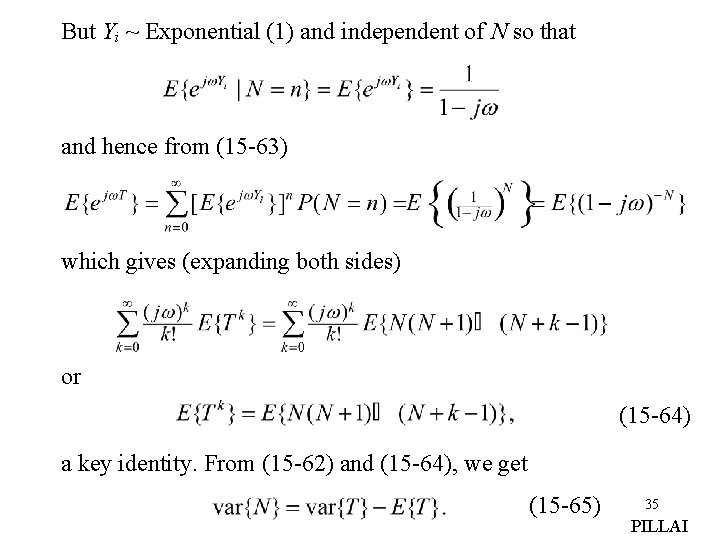
But Yi ~ Exponential (1) and independent of N so that and hence from (15 -63) which gives (expanding both sides) or (15 -64) a key identity. From (15 -62) and (15 -64), we get (15 -65) 35 PILLAI
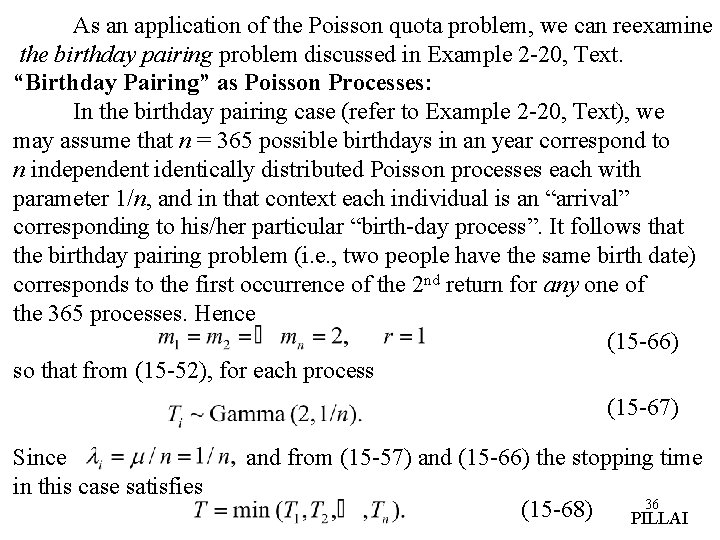
As an application of the Poisson quota problem, we can reexamine the birthday pairing problem discussed in Example 2 -20, Text. “Birthday Pairing” as Poisson Processes: In the birthday pairing case (refer to Example 2 -20, Text), we may assume that n = 365 possible birthdays in an year correspond to n independent identically distributed Poisson processes each with parameter 1/n, and in that context each individual is an “arrival” corresponding to his/her particular “birth-day process”. It follows that the birthday pairing problem (i. e. , two people have the same birth date) corresponds to the first occurrence of the 2 nd return for any one of the 365 processes. Hence (15 -66) so that from (15 -52), for each process (15 -67) Since in this case satisfies and from (15 -57) and (15 -66) the stopping time (15 -68) 36 PILLAI
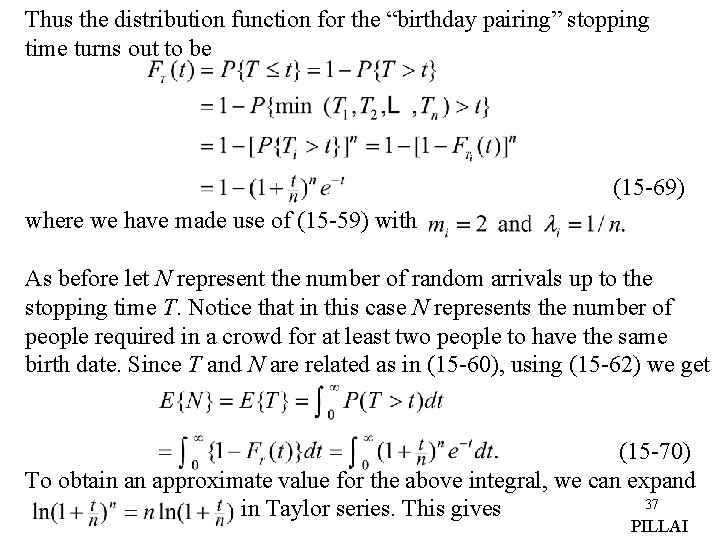
Thus the distribution function for the “birthday pairing” stopping time turns out to be (15 -69) where we have made use of (15 -59) with As before let N represent the number of random arrivals up to the stopping time T. Notice that in this case N represents the number of people required in a crowd for at least two people to have the same birth date. Since T and N are related as in (15 -60), using (15 -62) we get (15 -70) To obtain an approximate value for the above integral, we can expand 37 in Taylor series. This gives PILLAI
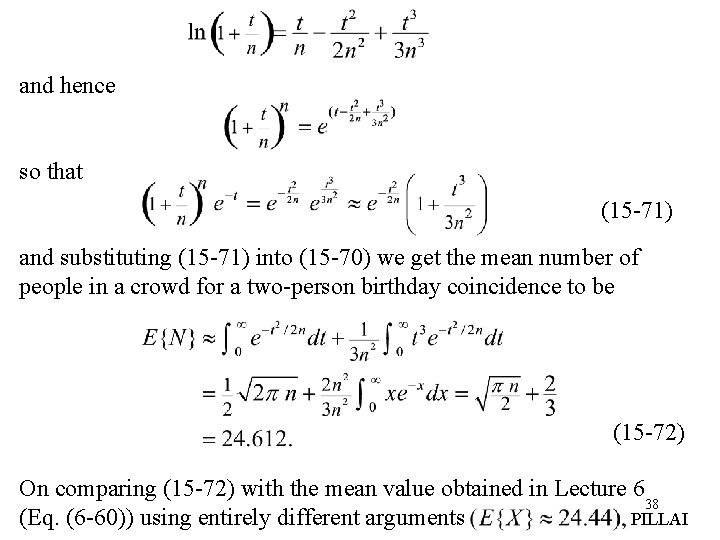
and hence so that (15 -71) and substituting (15 -71) into (15 -70) we get the mean number of people in a crowd for a two-person birthday coincidence to be (15 -72) On comparing (15 -72) with the mean value obtained in Lecture 6 38 (Eq. (6 -60)) using entirely different arguments PILLAI
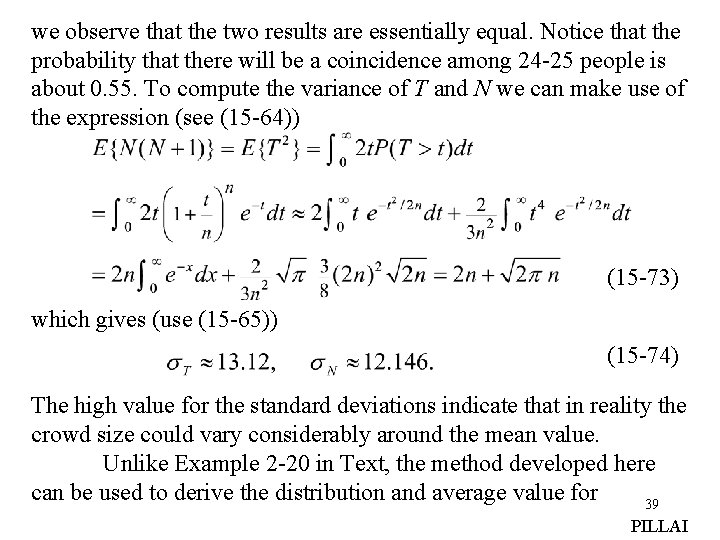
we observe that the two results are essentially equal. Notice that the probability that there will be a coincidence among 24 -25 people is about 0. 55. To compute the variance of T and N we can make use of the expression (see (15 -64)) (15 -73) which gives (use (15 -65)) (15 -74) The high value for the standard deviations indicate that in reality the crowd size could vary considerably around the mean value. Unlike Example 2 -20 in Text, the method developed here can be used to derive the distribution and average value for 39 PILLAI
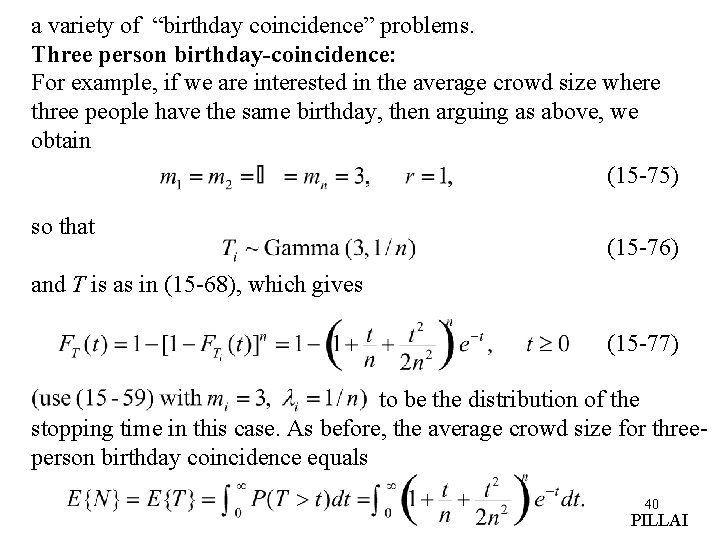
a variety of “birthday coincidence” problems. Three person birthday-coincidence: For example, if we are interested in the average crowd size where three people have the same birthday, then arguing as above, we obtain (15 -75) so that (15 -76) and T is as in (15 -68), which gives (15 -77) to be the distribution of the stopping time in this case. As before, the average crowd size for threeperson birthday coincidence equals 40 PILLAI
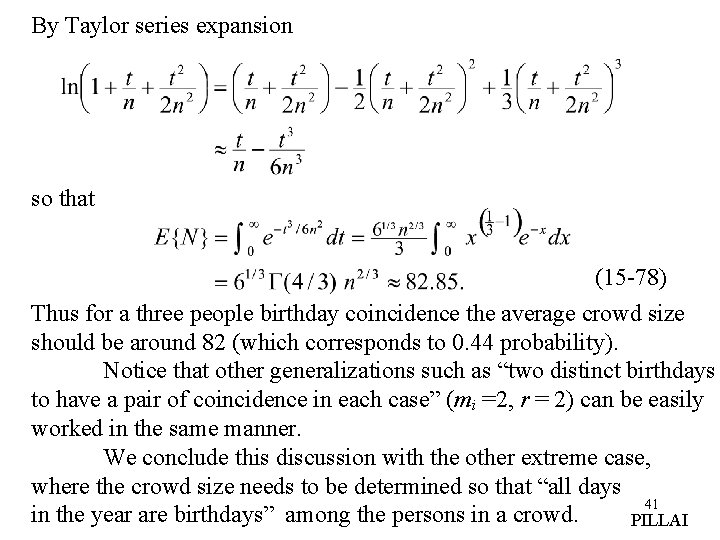
By Taylor series expansion so that (15 -78) Thus for a three people birthday coincidence the average crowd size should be around 82 (which corresponds to 0. 44 probability). Notice that other generalizations such as “two distinct birthdays to have a pair of coincidence in each case” (mi =2, r = 2) can be easily worked in the same manner. We conclude this discussion with the other extreme case, where the crowd size needs to be determined so that “all days 41 in the year are birthdays” among the persons in a crowd. PILLAI
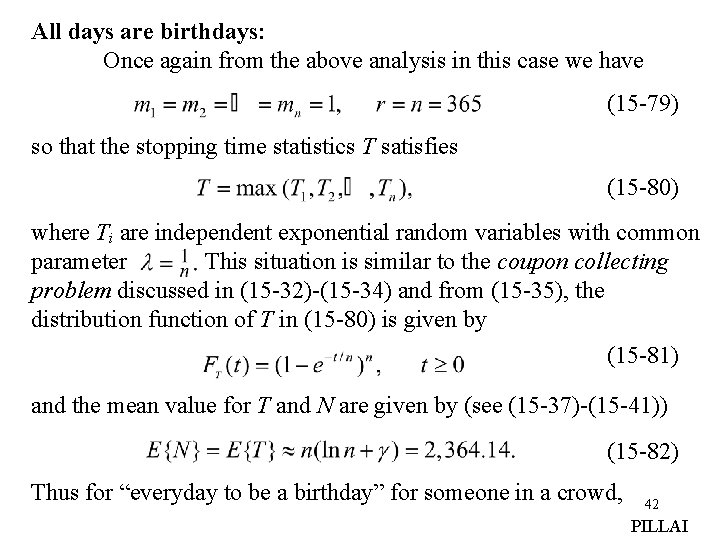
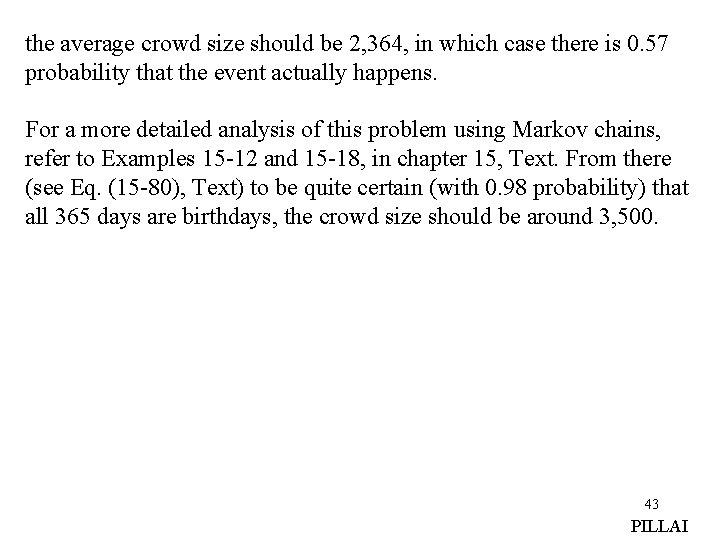
All days are birthdays: Once again from the above analysis in this case we have (15 -79) so that the stopping time statistics T satisfies (15 -80) where Ti are independent exponential random variables with common parameter This situation is similar to the coupon collecting problem discussed in (15 -32)-(15 -34) and from (15 -35), the distribution function of T in (15 -80) is given by (15 -81) and the mean value for T and N are given by (see (15 -37)-(15 -41)) (15 -82) Thus for “everyday to be a birthday” for someone in a crowd, 42 PILLAI
the average crowd size should be 2, 364, in which case there is 0. 57 probability that the event actually happens. For a more detailed analysis of this problem using Markov chains, refer to Examples 15 -12 and 15 -18, in chapter 15, Text. From there (see Eq. (15 -80), Text) to be quite certain (with 0. 98 probability) that all 365 days are birthdays, the crowd size should be around 3, 500. 43 PILLAI
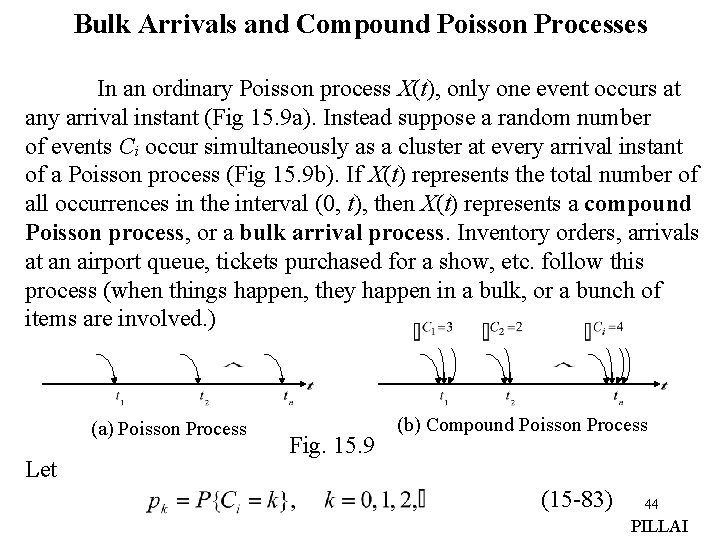
Bulk Arrivals and Compound Poisson Processes In an ordinary Poisson process X(t), only one event occurs at any arrival instant (Fig 15. 9 a). Instead suppose a random number of events Ci occur simultaneously as a cluster at every arrival instant of a Poisson process (Fig 15. 9 b). If X(t) represents the total number of all occurrences in the interval (0, t), then X(t) represents a compound Poisson process, or a bulk arrival process. Inventory orders, arrivals at an airport queue, tickets purchased for a show, etc. follow this process (when things happen, they happen in a bulk, or a bunch of items are involved. ) (a) Poisson Process Let Fig. 15. 9 (b) Compound Poisson Process (15 -83) 44 PILLAI
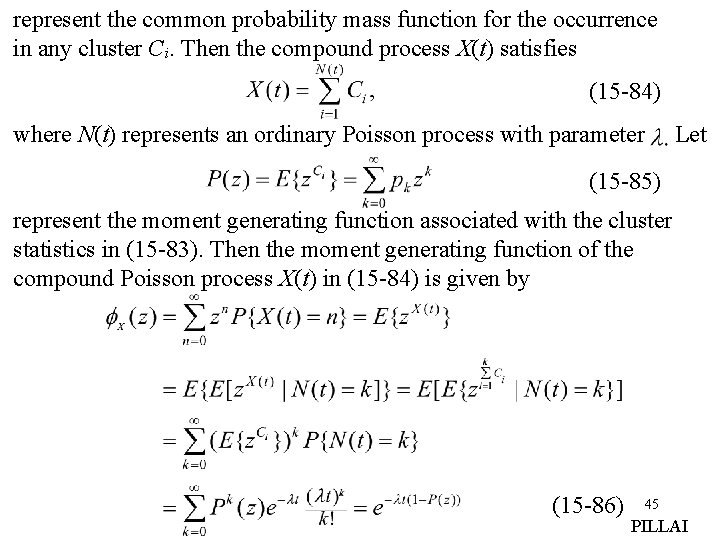
represent the common probability mass function for the occurrence in any cluster Ci. Then the compound process X(t) satisfies (15 -84) where N(t) represents an ordinary Poisson process with parameter Let (15 -85) represent the moment generating function associated with the cluster statistics in (15 -83). Then the moment generating function of the compound Poisson process X(t) in (15 -84) is given by (15 -86) 45 PILLAI
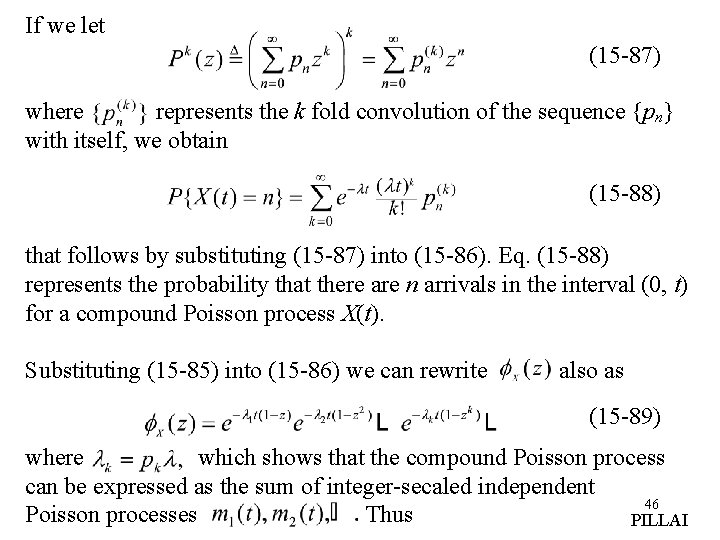
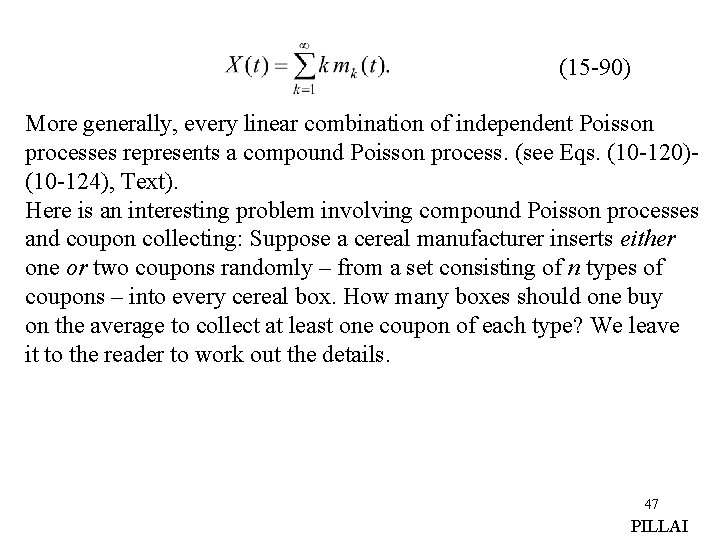
If we let (15 -87) where represents the k fold convolution of the sequence {pn} with itself, we obtain (15 -88) that follows by substituting (15 -87) into (15 -86). Eq. (15 -88) represents the probability that there are n arrivals in the interval (0, t) for a compound Poisson process X(t). Substituting (15 -85) into (15 -86) we can rewrite also as (15 -89) where which shows that the compound Poisson process can be expressed as the sum of integer-secaled independent 46 Poisson processes Thus PILLAI
(15 -90) More generally, every linear combination of independent Poisson processes represents a compound Poisson process. (see Eqs. (10 -120)(10 -124), Text). Here is an interesting problem involving compound Poisson processes and coupon collecting: Suppose a cereal manufacturer inserts either one or two coupons randomly – from a set consisting of n types of coupons – into every cereal box. How many boxes should one buy on the average to collect at least one coupon of each type? We leave it to the reader to work out the details. 47 PILLAI