
15 PARTIAL DERIVATIVES PARTIAL DERIVATIVES 15 5 The


- Slides: 72
15 PARTIAL DERIVATIVES
PARTIAL DERIVATIVES 15. 5 The Chain Rule In this section, we will learn about: The Chain Rule and its application in implicit differentiation.
THE CHAIN RULE Recall that the Chain Rule for functions of a single variable gives the following rule for differentiating a composite function.
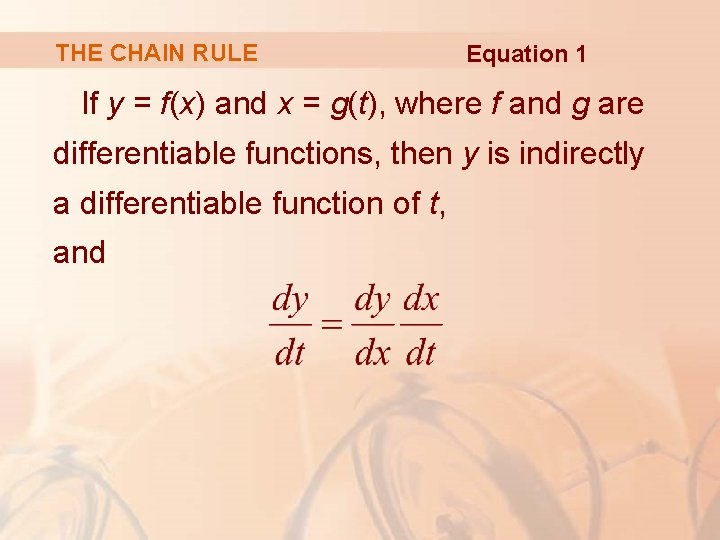
THE CHAIN RULE Equation 1 If y = f(x) and x = g(t), where f and g are differentiable functions, then y is indirectly a differentiable function of t, and
THE CHAIN RULE For functions of more than one variable, the Chain Rule has several versions. § Each gives a rule for differentiating a composite function.
THE CHAIN RULE The first version (Theorem 2) deals with the case where z = f(x, y) and each of the variables x and y is, in turn, a function of a variable t. § This means that z is indirectly a function of t, z = f(g(t), h(t)), and the Chain Rule gives a formula for differentiating z as a function of t.
THE CHAIN RULE We assume that f is differentiable (Definition 7 in Section 14. 4). § Recall that this is the case when fx and fy are continuous (Theorem 8 in Section 14. 4).
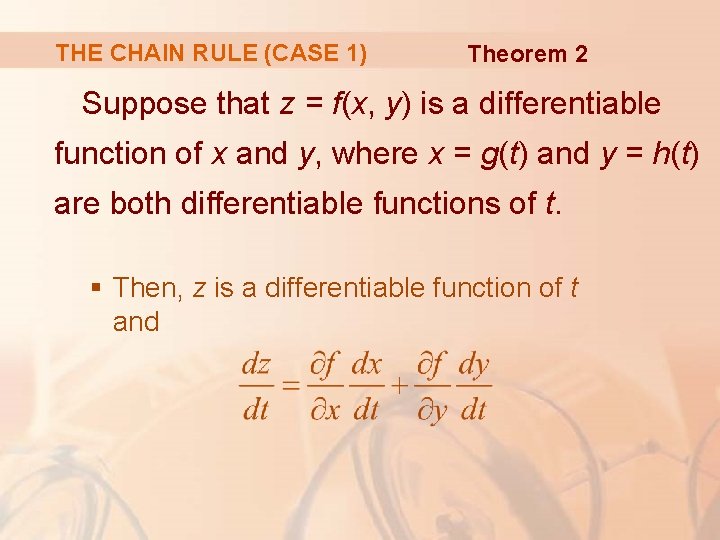
THE CHAIN RULE (CASE 1) Theorem 2 Suppose that z = f(x, y) is a differentiable function of x and y, where x = g(t) and y = h(t) are both differentiable functions of t. § Then, z is a differentiable function of t and
THE CHAIN RULE (CASE 1) Proof A change of ∆t in t produces changes of ∆x in x and ∆y in y. § These, in turn, produce a change of ∆z in z.
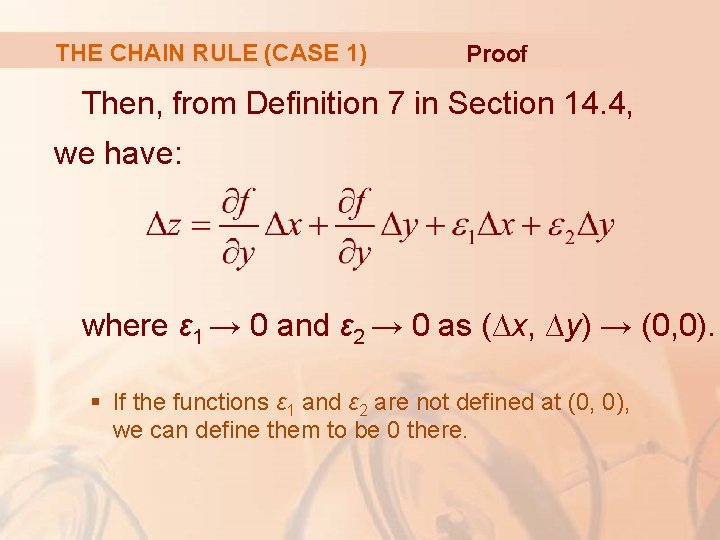
THE CHAIN RULE (CASE 1) Proof Then, from Definition 7 in Section 14. 4, we have: where ε 1 → 0 and ε 2 → 0 as (∆x, ∆y) → (0, 0). § If the functions ε 1 and ε 2 are not defined at (0, 0), we can define them to be 0 there.
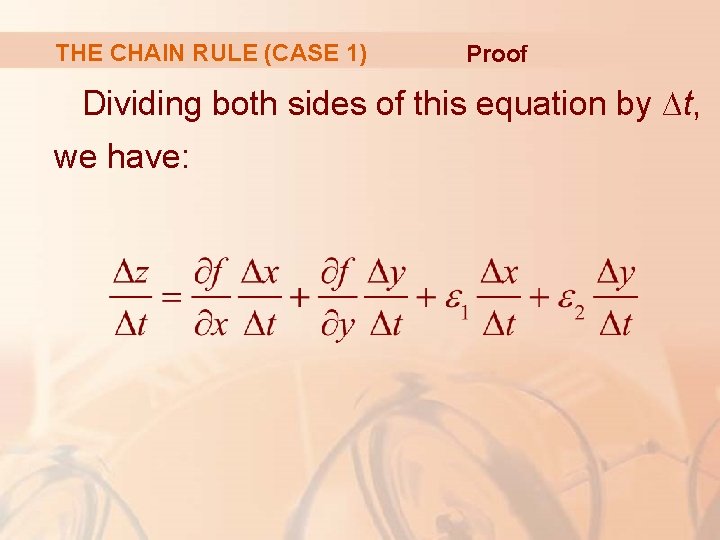
THE CHAIN RULE (CASE 1) Proof Dividing both sides of this equation by ∆t, we have:
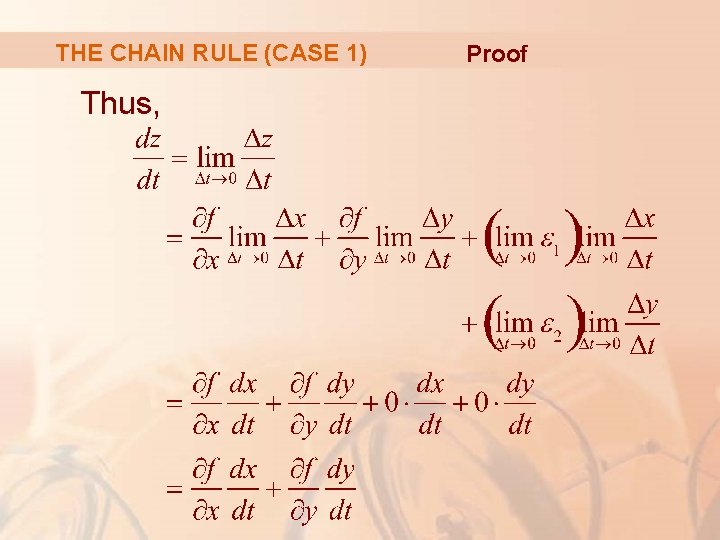
THE CHAIN RULE (CASE 1) Proof If we now let ∆t → 0 , then ∆x = g(t + ∆t) – g(t) → 0 as g is differentiable and thus continuous. Similarly, ∆y → 0. § This, in turn, means that ε 1→ 0 and ε 2→ 0.
THE CHAIN RULE (CASE 1) Thus, Proof
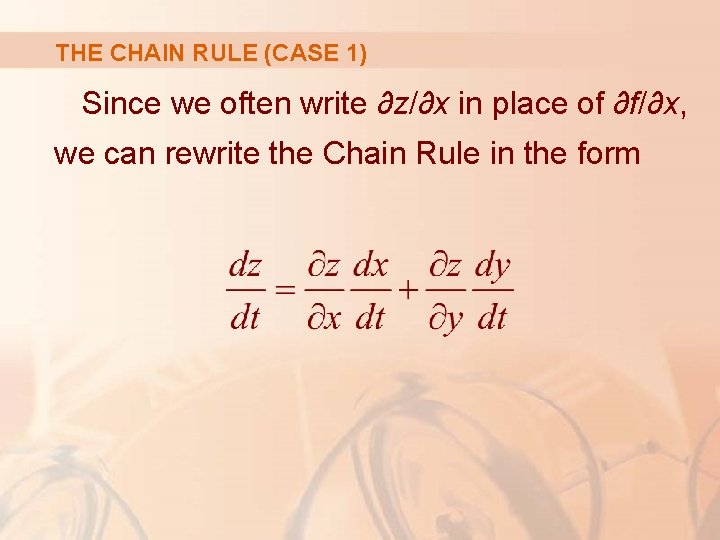
THE CHAIN RULE (CASE 1) Since we often write ∂z/∂x in place of ∂f/∂x, we can rewrite the Chain Rule in the form
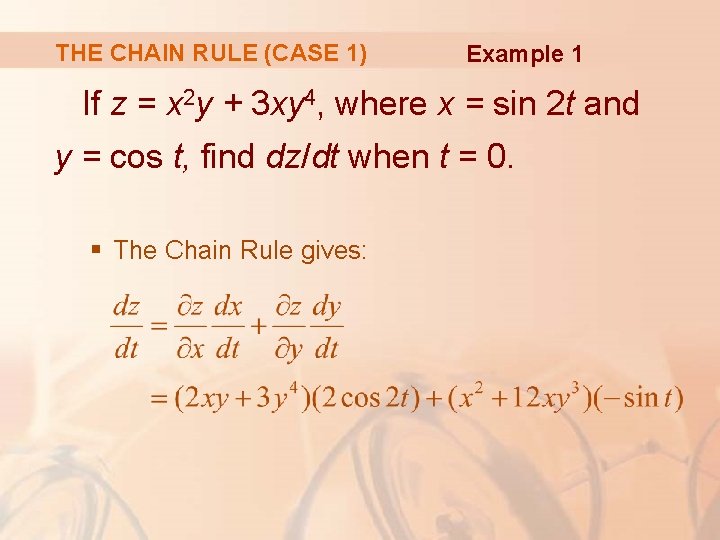
THE CHAIN RULE (CASE 1) Example 1 If z = x 2 y + 3 xy 4, where x = sin 2 t and y = cos t, find dz/dt when t = 0. § The Chain Rule gives:
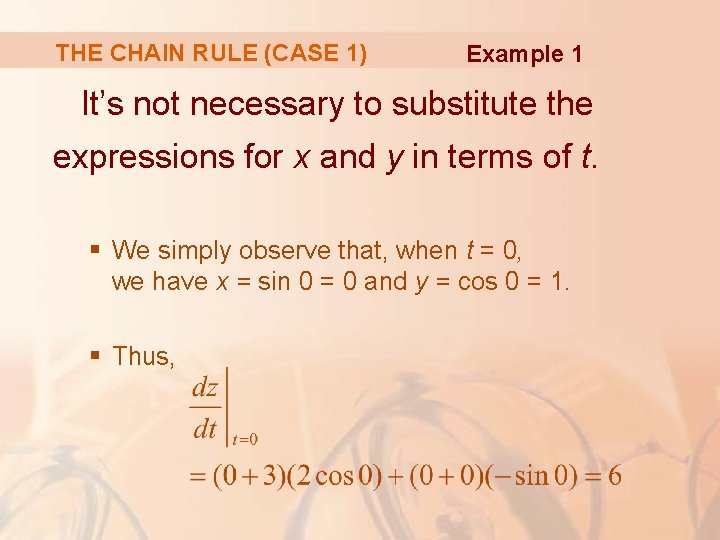
THE CHAIN RULE (CASE 1) Example 1 It’s not necessary to substitute the expressions for x and y in terms of t. § We simply observe that, when t = 0, we have x = sin 0 = 0 and y = cos 0 = 1. § Thus,
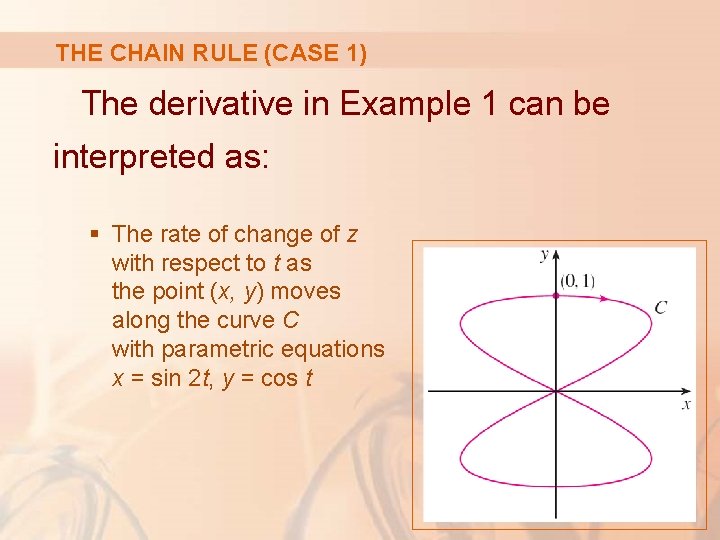
THE CHAIN RULE (CASE 1) The derivative in Example 1 can be interpreted as: § The rate of change of z with respect to t as the point (x, y) moves along the curve C with parametric equations x = sin 2 t, y = cos t
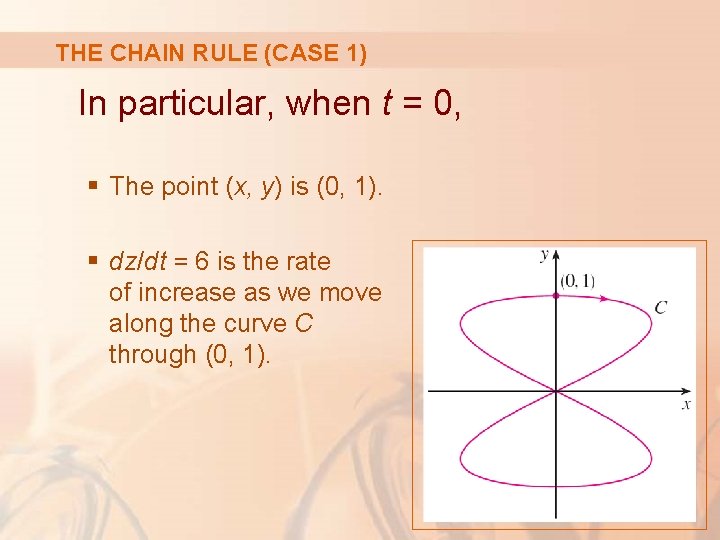
THE CHAIN RULE (CASE 1) In particular, when t = 0, § The point (x, y) is (0, 1). § dz/dt = 6 is the rate of increase as we move along the curve C through (0, 1).
THE CHAIN RULE (CASE 1) If, for instance, z = T(x, y) = x 2 y + 3 xy 4 represents the temperature at the point (x, y), then § The composite function z = T(sin 2 t, cos t) represents the temperature at points on C § The derivative dz/dt represents the rate at which the temperature changes along C.
THE CHAIN RULE (CASE 1) Example 2 The pressure P (in kilopascals), volume V (in liters), and temperature T (in kelvins) of a mole of an ideal gas are related by the equation PV = 8. 31 T
THE CHAIN RULE (CASE 1) Example 2 Find the rate at which the pressure is changing when: § The temperature is 300 K and increasing at a rate of 0. 1 K/s. § The volume is 100 L and increasing at a rate of 0. 2 L/s.
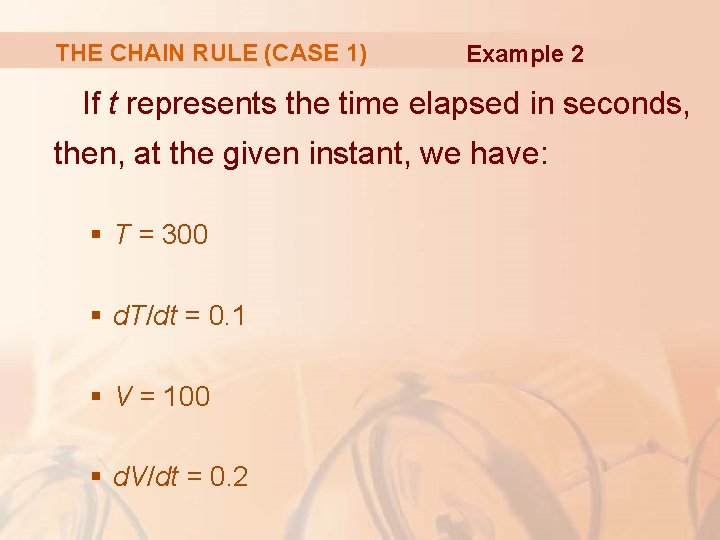
THE CHAIN RULE (CASE 1) Example 2 If t represents the time elapsed in seconds, then, at the given instant, we have: § T = 300 § d. T/dt = 0. 1 § V = 100 § d. V/dt = 0. 2
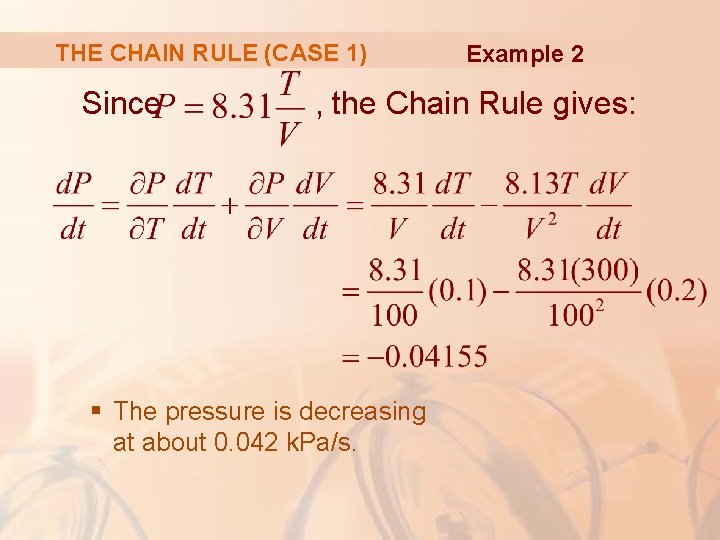
THE CHAIN RULE (CASE 1) Since Example 2 , the Chain Rule gives: § The pressure is decreasing at about 0. 042 k. Pa/s.
THE CHAIN RULE (CASE 1) We now consider the situation where z = f(x, y), but each of x and y is a function of two variables s and t : x = g(s, t), y = h(s, t). § Then, z is indirectly a function of s and t, and we wish to find ∂z/∂s and ∂z/∂t.
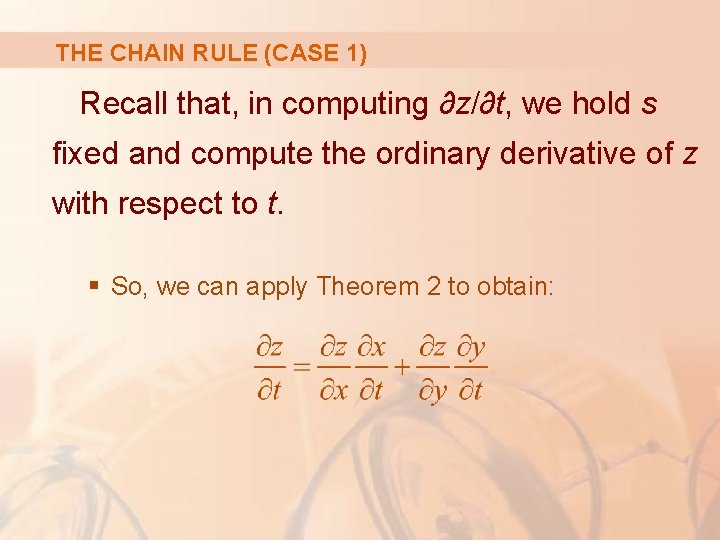
THE CHAIN RULE (CASE 1) Recall that, in computing ∂z/∂t, we hold s fixed and compute the ordinary derivative of z with respect to t. § So, we can apply Theorem 2 to obtain:
THE CHAIN RULE (CASE 1) A similar argument holds for ∂z/∂s. So, we have proved the following version of the Chain Rule.
THE CHAIN RULE (CASE 2) Theorem 3 Suppose z = f(x, y) is a differentiable function of x and y, where x = g(s, t) and y = h(s, t) are differentiable functions of s and t. § Then,
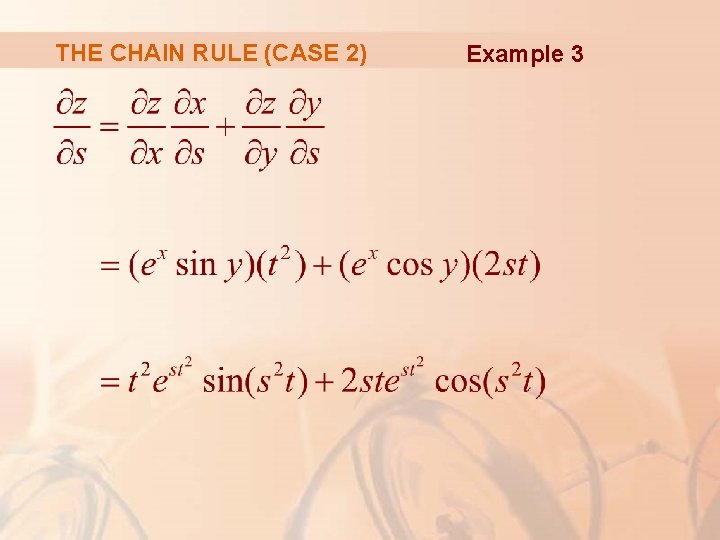
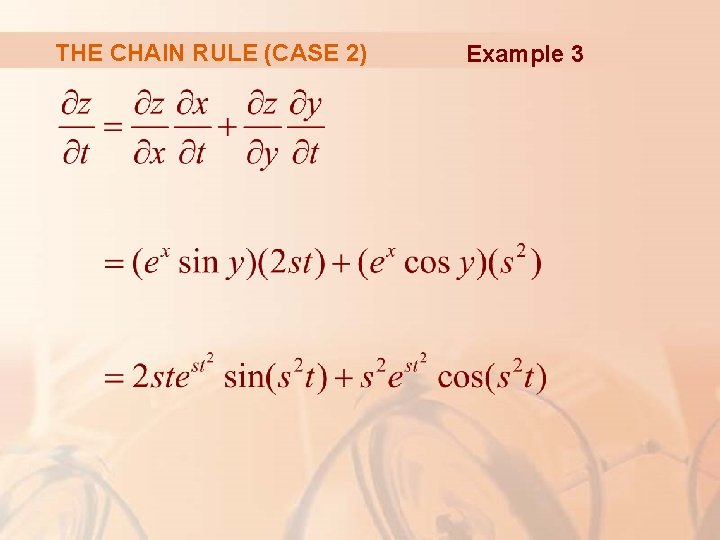
THE CHAIN RULE (CASE 2) Example 3 If z = ex sin y, where x = st 2 and y = s 2 t, find ∂z/∂s and ∂z/∂t. § Applying Case 2 of the Chain Rule, we get the following results.
THE CHAIN RULE (CASE 2) Example 3
THE CHAIN RULE (CASE 2) Example 3
THE CHAIN RULE Case 2 of the Chain Rule contains three types of variables: § s and t are independent variables. § x and y are called intermediate variables. § z is the dependent variable.
THE CHAIN RULE Notice that Theorem 3 has one term for each intermediate variable. § Each term resembles the one-dimensional Chain Rule in Equation 1.
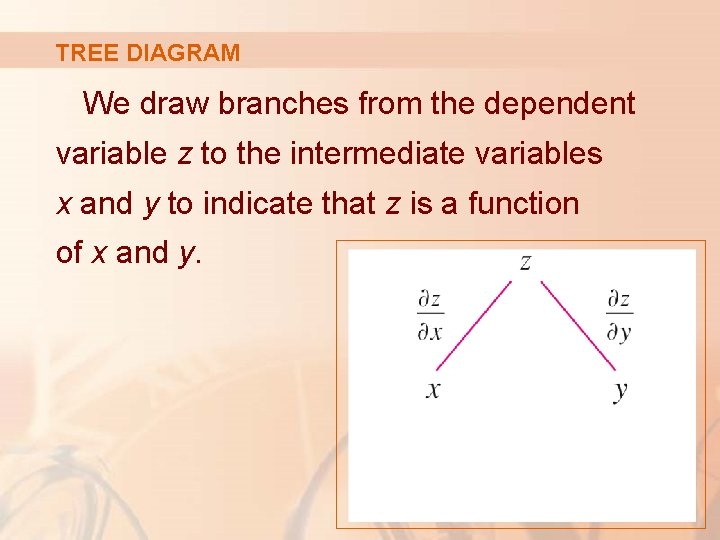
THE CHAIN RULE To remember the Chain Rule, it’s helpful to draw a tree diagram, as follows.
TREE DIAGRAM We draw branches from the dependent variable z to the intermediate variables x and y to indicate that z is a function of x and y.
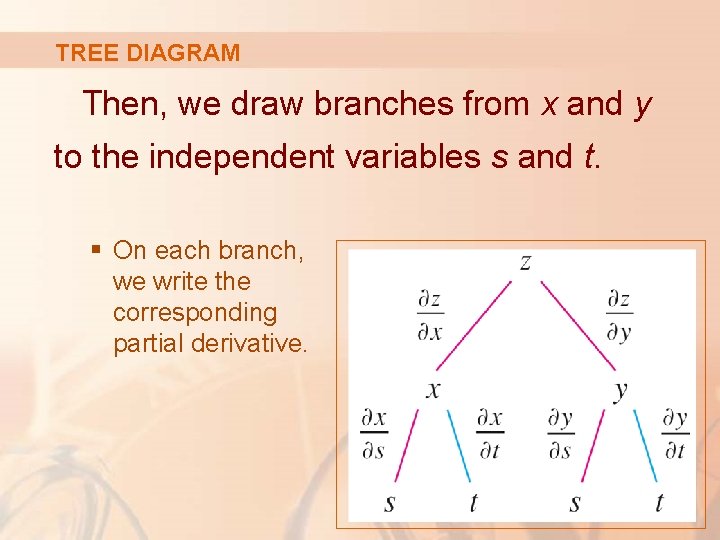
TREE DIAGRAM Then, we draw branches from x and y to the independent variables s and t. § On each branch, we write the corresponding partial derivative.
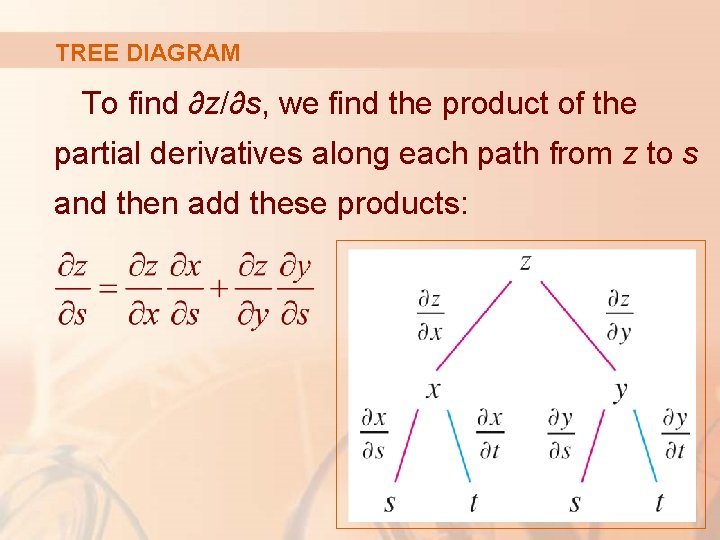
TREE DIAGRAM To find ∂z/∂s, we find the product of the partial derivatives along each path from z to s and then add these products:
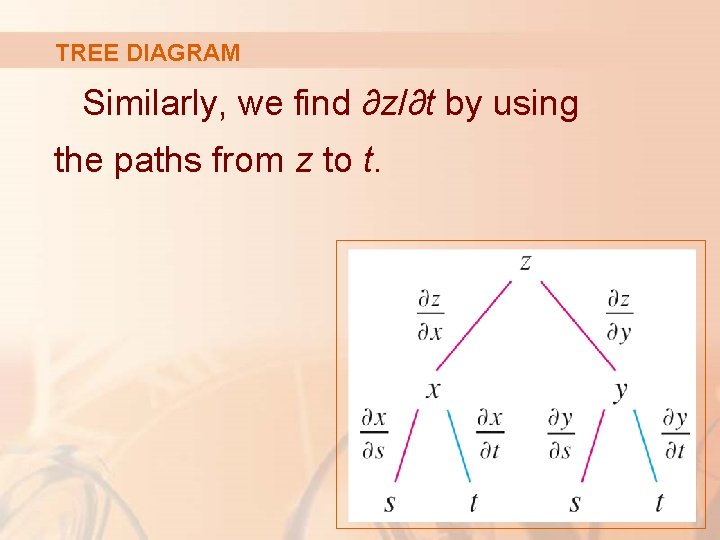
TREE DIAGRAM Similarly, we find ∂z/∂t by using the paths from z to t.
THE CHAIN RULE Now, we consider the general situation in which a dependent variable u is a function of n intermediate variables x 1, . . . , xn. Each of this is, in turn, a function of m independent variables t 1 , . . . , tm.
THE CHAIN RULE Notice that there are n terms—one for each intermediate variable. The proof is similar to that of Case 1.
THE CHAIN RULE (GEN. VERSION) Theorem 4 Suppose u is a differentiable function of the n variables x 1, x 2, …, xn and each xj is a differentiable function of the m variables t 1 , t 2. . . , t m.
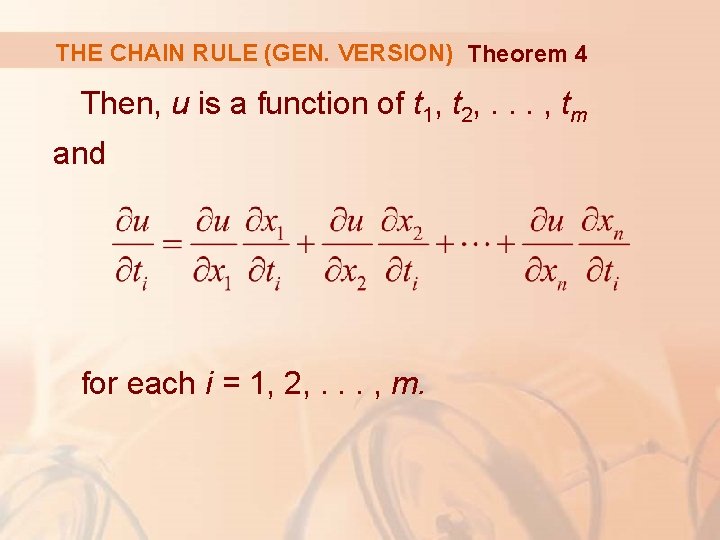
THE CHAIN RULE (GEN. VERSION) Theorem 4 Then, u is a function of t 1, t 2, . . . , tm and for each i = 1, 2, . . . , m.
THE CHAIN RULE (GEN. VERSION) Example 4 Write out the Chain Rule for the case where w = f(x, y, z, t) and x = x(u, v), y = y(u, v), z = z(u, v), t = t(u, v) § We apply Theorem 4 with n = 4 and m = 2.
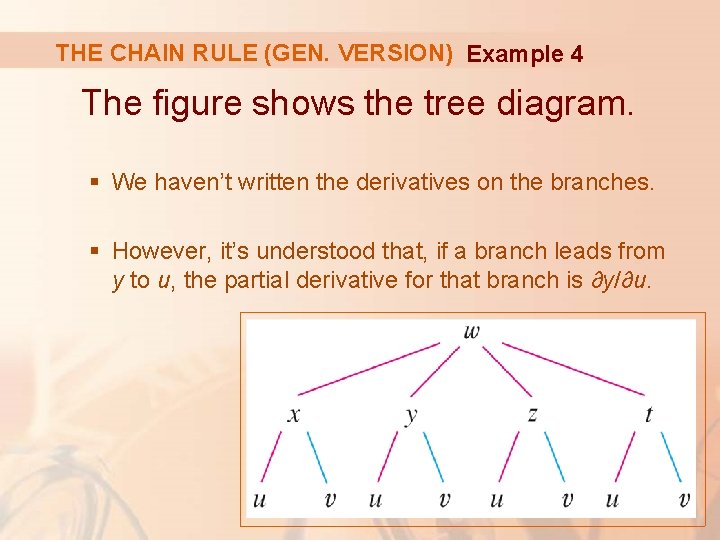
THE CHAIN RULE (GEN. VERSION) Example 4 The figure shows the tree diagram. § We haven’t written the derivatives on the branches. § However, it’s understood that, if a branch leads from y to u, the partial derivative for that branch is ∂y/∂u.
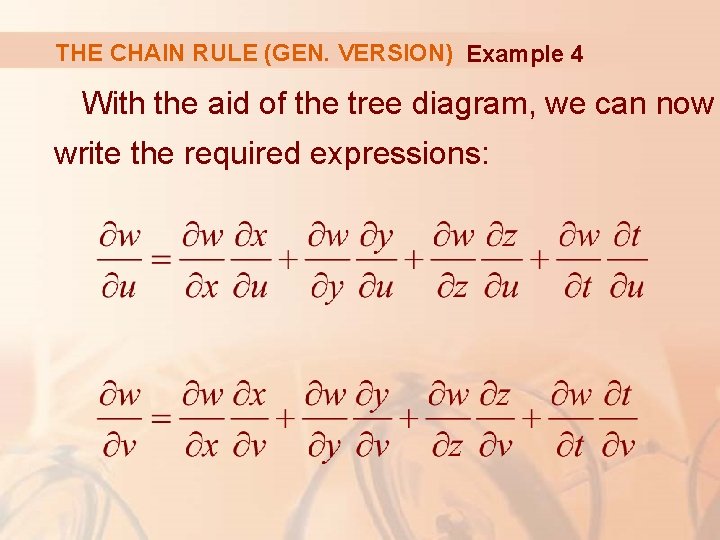
THE CHAIN RULE (GEN. VERSION) Example 4 With the aid of the tree diagram, we can now write the required expressions:
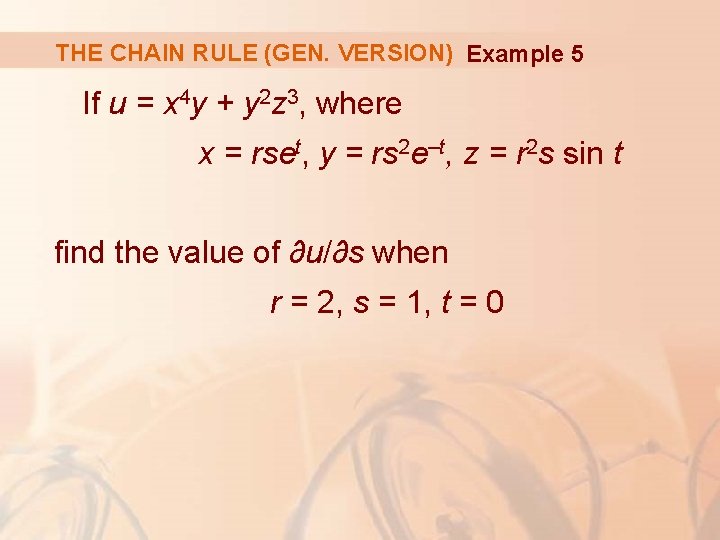
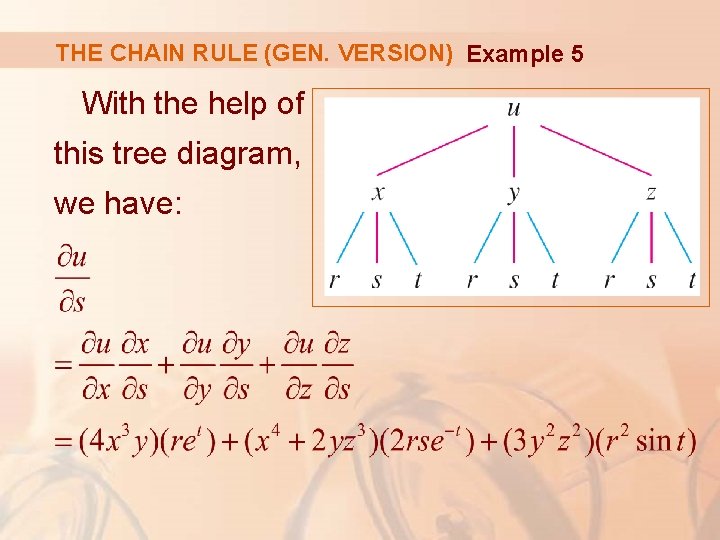
THE CHAIN RULE (GEN. VERSION) Example 5 If u = x 4 y + y 2 z 3, where x = rset, y = rs 2 e–t, z = r 2 s sin t find the value of ∂u/∂s when r = 2, s = 1, t = 0
THE CHAIN RULE (GEN. VERSION) Example 5 With the help of this tree diagram, we have:
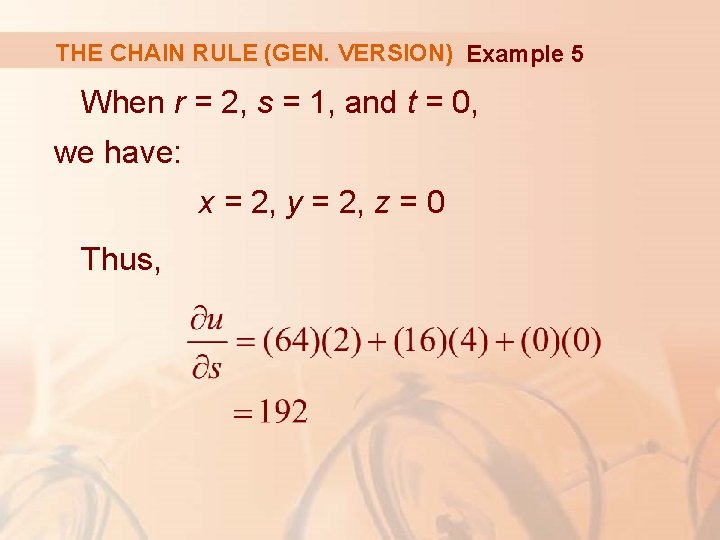
THE CHAIN RULE (GEN. VERSION) Example 5 When r = 2, s = 1, and t = 0, we have: x = 2, y = 2, z = 0 Thus,
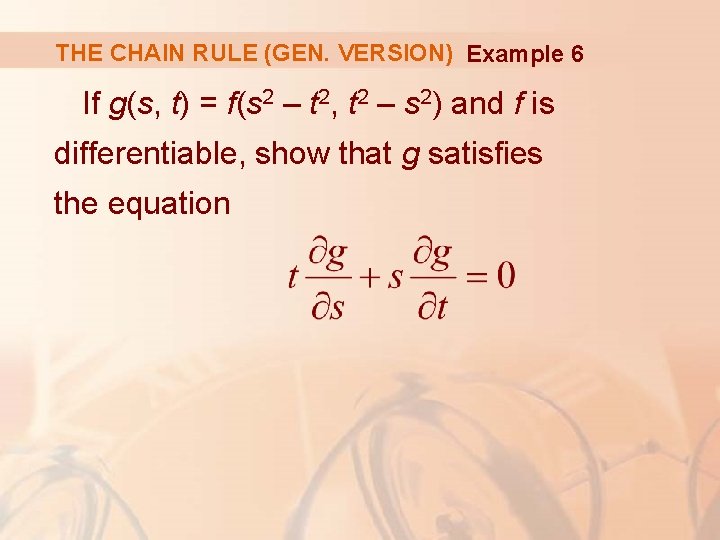
THE CHAIN RULE (GEN. VERSION) Example 6 If g(s, t) = f(s 2 – t 2, t 2 – s 2) and f is differentiable, show that g satisfies the equation
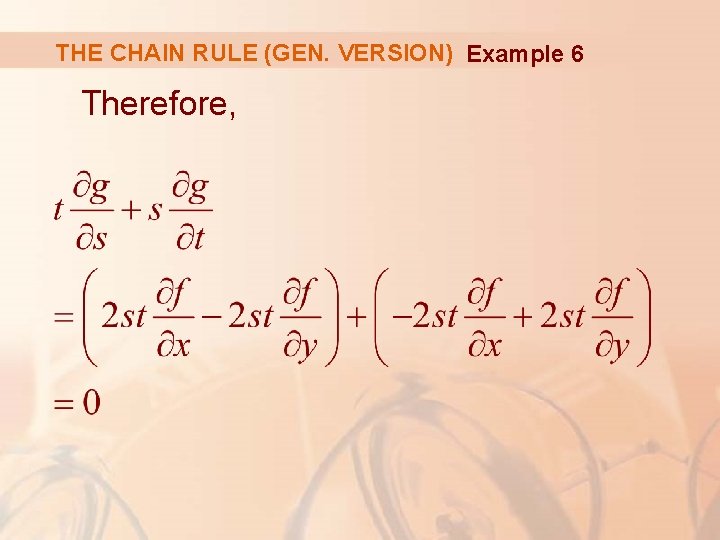
THE CHAIN RULE (GEN. VERSION) Example 6 Let x = s 2 – t 2 and y = t 2 – s 2. § Then, g(s, t) = f(x, y), and the Chain Rule gives:
THE CHAIN RULE (GEN. VERSION) Example 6 Therefore,
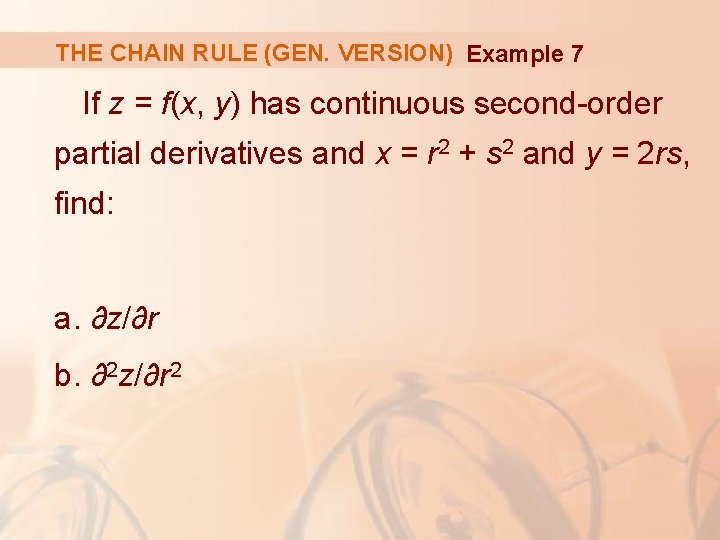
THE CHAIN RULE (GEN. VERSION) Example 7 If z = f(x, y) has continuous second-order partial derivatives and x = r 2 + s 2 and y = 2 rs, find: a. ∂z/∂r b. ∂2 z/∂r 2
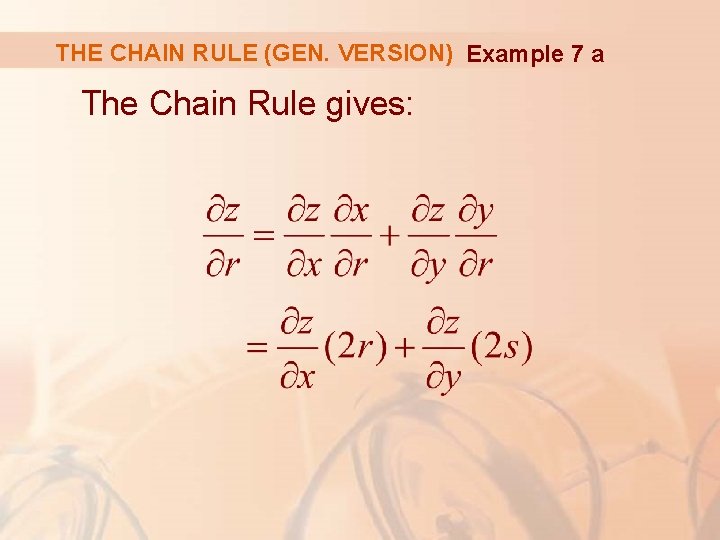
THE CHAIN RULE (GEN. VERSION) Example 7 a The Chain Rule gives:
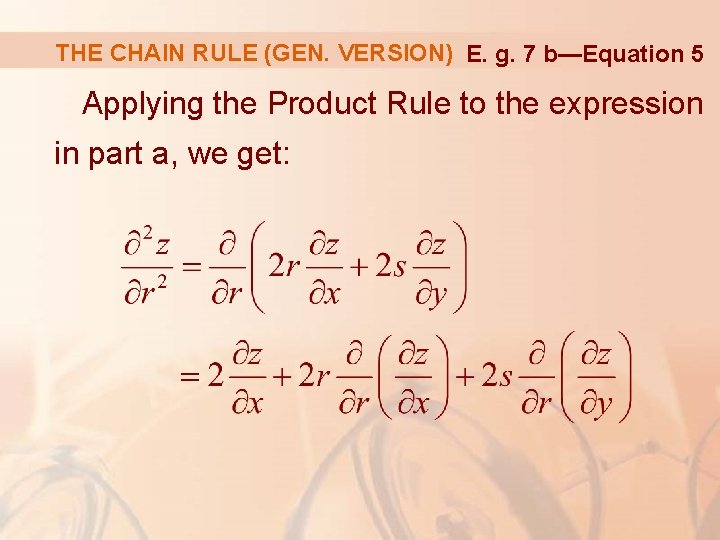
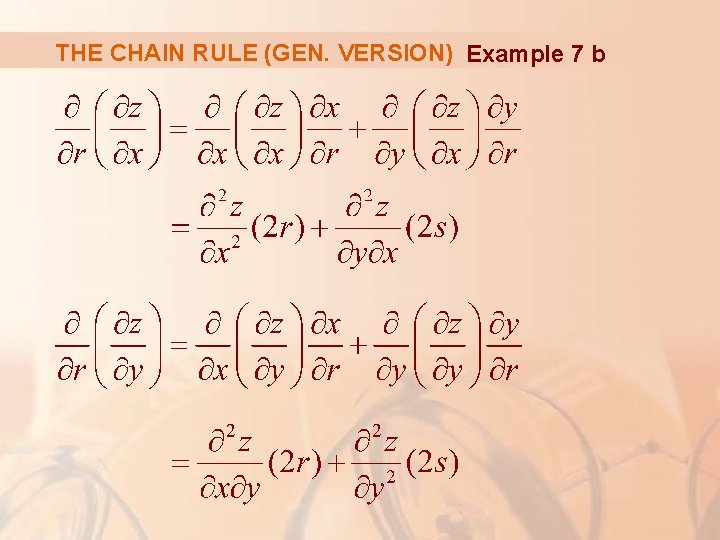
THE CHAIN RULE (GEN. VERSION) E. g. 7 b—Equation 5 Applying the Product Rule to the expression in part a, we get:
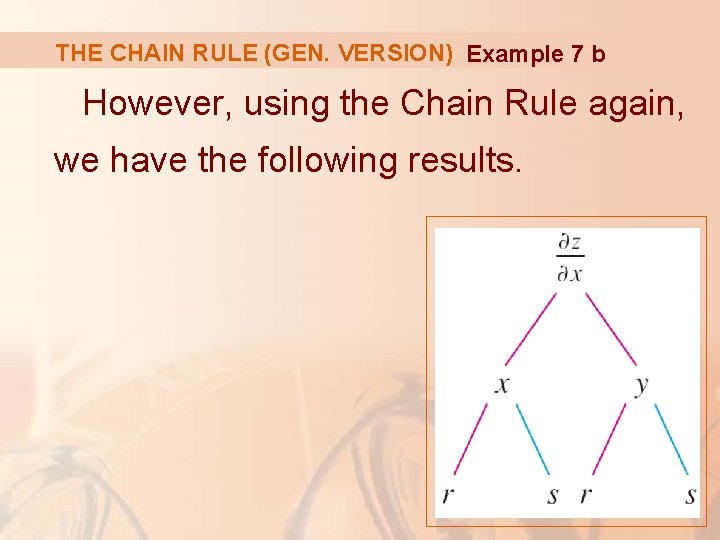
THE CHAIN RULE (GEN. VERSION) Example 7 b However, using the Chain Rule again, we have the following results.
THE CHAIN RULE (GEN. VERSION) Example 7 b
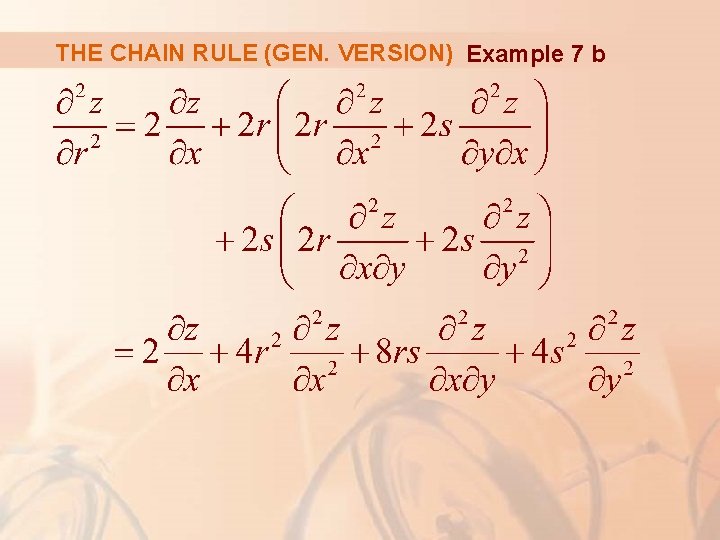
THE CHAIN RULE (GEN. VERSION) Example 7 b Putting these expressions into Equation 5 and using the equality of the mixed secondorder derivatives, we obtain the following result.
THE CHAIN RULE (GEN. VERSION) Example 7 b
IMPLICIT DIFFERENTIATION The Chain Rule can be used to give a more complete description of the process of implicit differentiation that was introduced in Sections 3. 5 and 14. 3
IMPLICIT DIFFERENTIATION We suppose that an equation of the form F(x, y) = 0 defines y implicitly as a differentiable function of x. § That is, y = f(x), where F(x, f(x)) = 0 for all x in the domain of f.
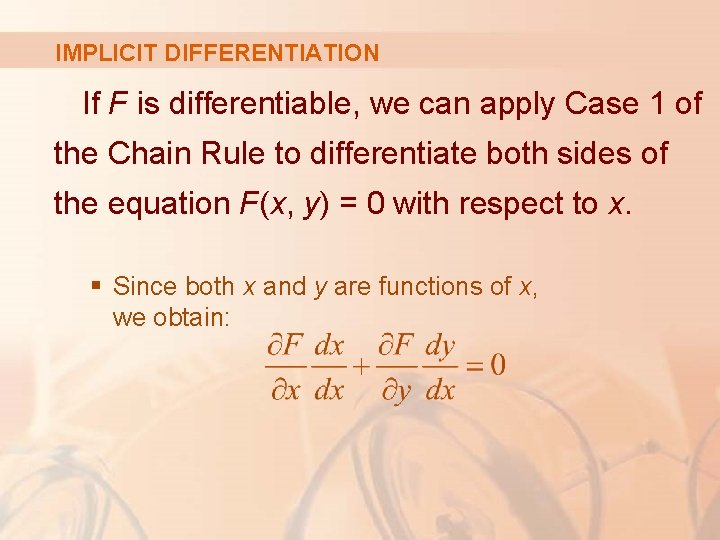
IMPLICIT DIFFERENTIATION If F is differentiable, we can apply Case 1 of the Chain Rule to differentiate both sides of the equation F(x, y) = 0 with respect to x. § Since both x and y are functions of x, we obtain:
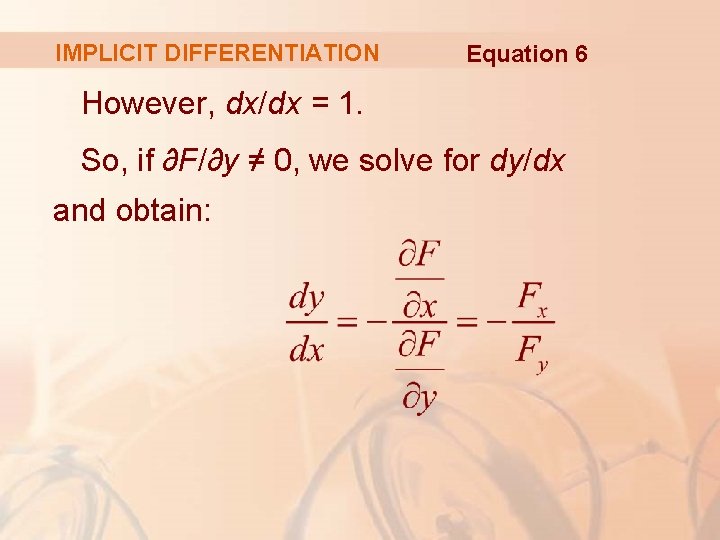
IMPLICIT DIFFERENTIATION Equation 6 However, dx/dx = 1. So, if ∂F/∂y ≠ 0, we solve for dy/dx and obtain:
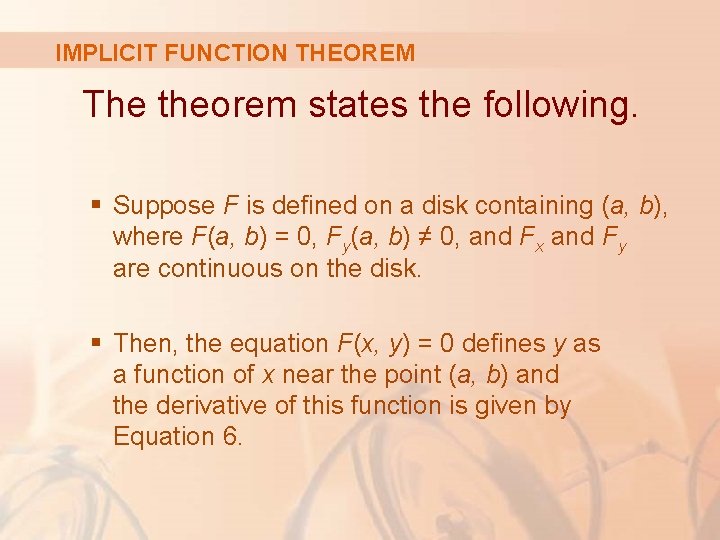
IMPLICIT FUNCTION THEOREM To get the equation, we assumed F(x, y) = 0 defines y implicitly as a function of x. The Implicit Function Theorem, proved in advanced calculus, gives conditions under which this assumption is valid.
IMPLICIT FUNCTION THEOREM The theorem states the following. § Suppose F is defined on a disk containing (a, b), where F(a, b) = 0, Fy(a, b) ≠ 0, and Fx and Fy are continuous on the disk. § Then, the equation F(x, y) = 0 defines y as a function of x near the point (a, b) and the derivative of this function is given by Equation 6.
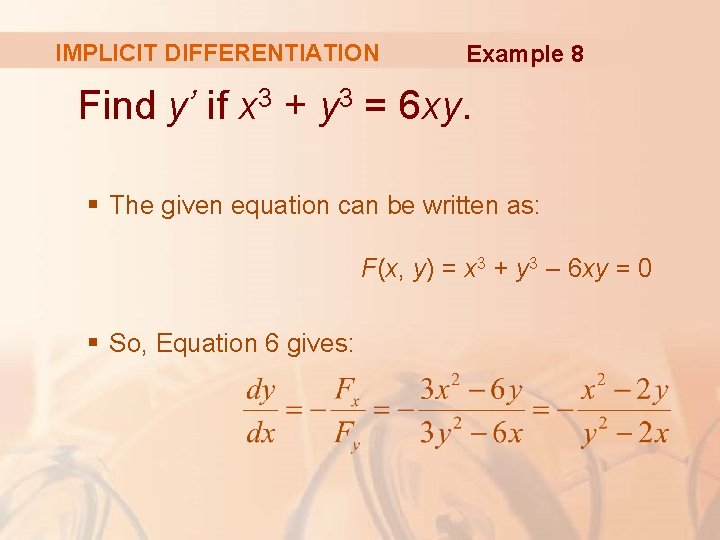
IMPLICIT DIFFERENTIATION Example 8 Find y’ if x 3 + y 3 = 6 xy. § The given equation can be written as: F(x, y) = x 3 + y 3 – 6 xy = 0 § So, Equation 6 gives:
IMPLICIT DIFFERENTIATION Now, we suppose that z is given implicitly as a function z = f(x, y) by an equation of the form F(x, y, z) = 0. § This means that F(x, y, f(x, y)) = 0 for all (x, y) in the domain of f.
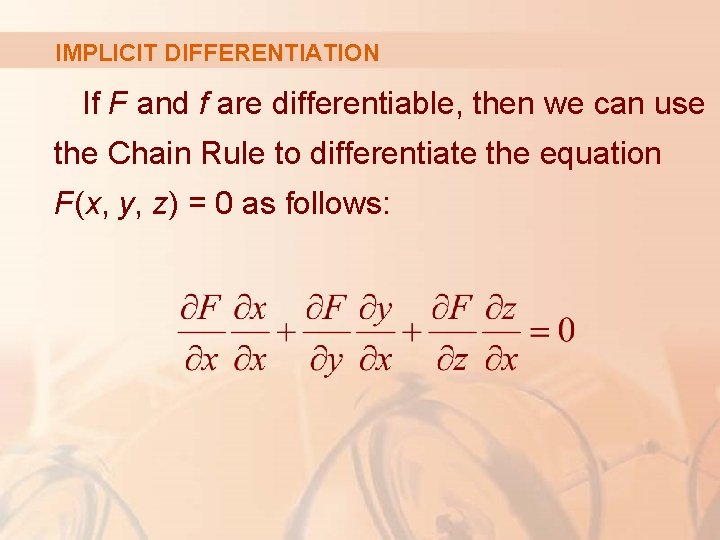
IMPLICIT DIFFERENTIATION If F and f are differentiable, then we can use the Chain Rule to differentiate the equation F(x, y, z) = 0 as follows:
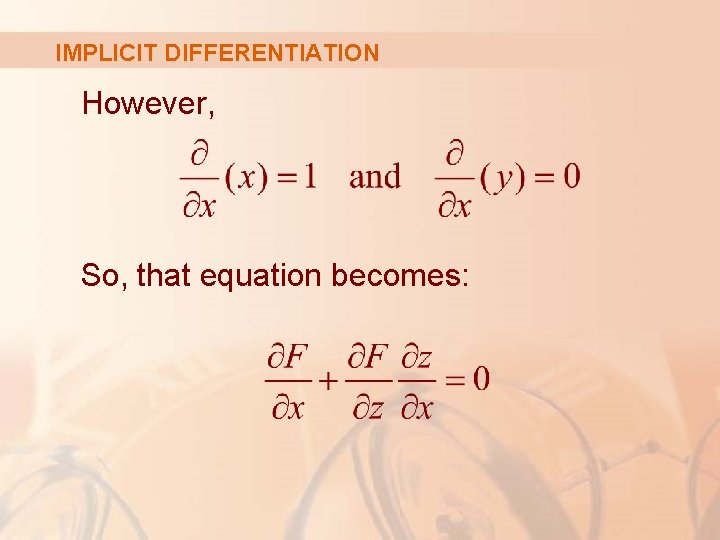
IMPLICIT DIFFERENTIATION However, So, that equation becomes:
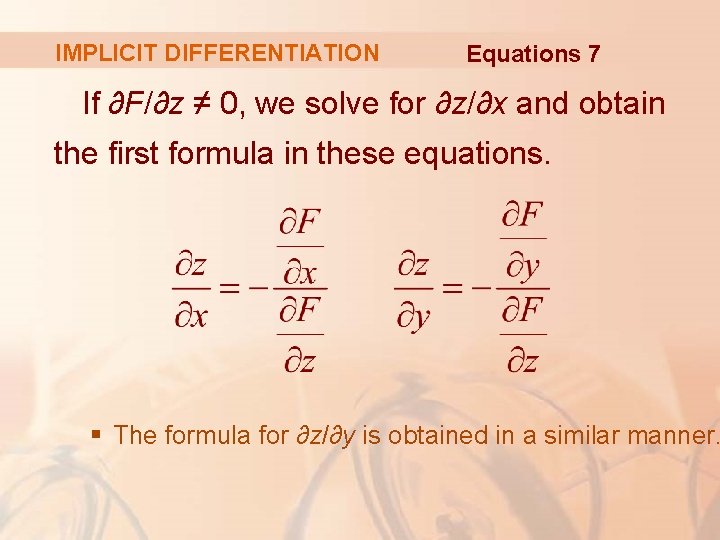
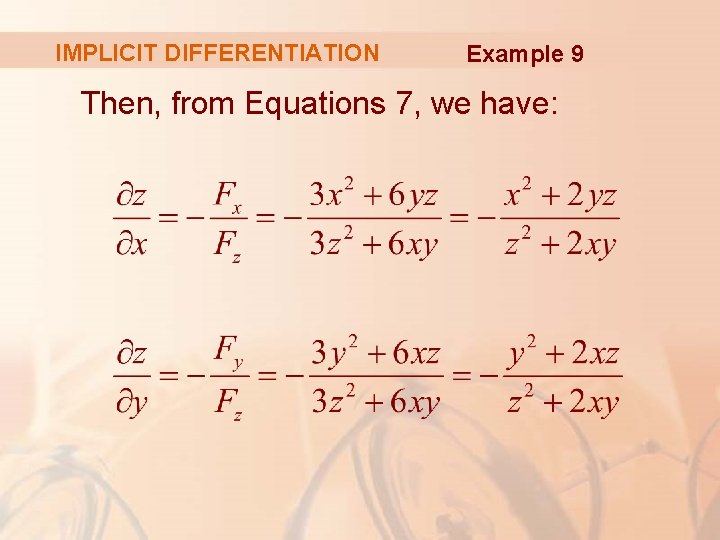
IMPLICIT DIFFERENTIATION Equations 7 If ∂F/∂z ≠ 0, we solve for ∂z/∂x and obtain the first formula in these equations. § The formula for ∂z/∂y is obtained in a similar manner.
IMPLICIT FUNCTION THEOREM Again, a version of the Implicit Function Theorem gives conditions under which our assumption is valid.
IMPLICIT FUNCTION THEOREM This version states the following. § Suppose F is defined within a sphere containing (a, b, c), where F(a, b, c) = 0, Fz(a, b, c) ≠ 0, and Fx, Fy, and Fz are continuous inside the sphere. § Then, the equation F(x, y, z) = 0 defines z as a function of x and y near the point (a, b, c), and this function is differentiable, with partial derivatives given by Equations 7.
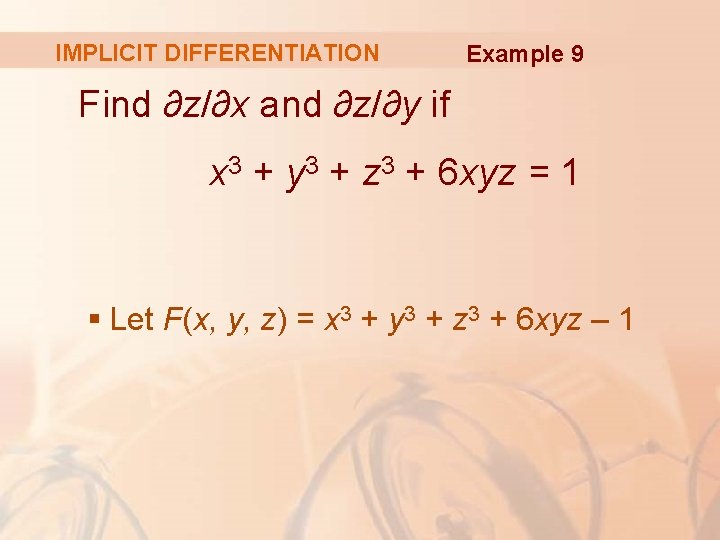
IMPLICIT DIFFERENTIATION Example 9 Find ∂z/∂x and ∂z/∂y if x 3 + y 3 + z 3 + 6 xyz = 1 § Let F(x, y, z) = x 3 + y 3 + z 3 + 6 xyz – 1
IMPLICIT DIFFERENTIATION Example 9 Then, from Equations 7, we have: